Unregulated, Unaccountable Corporate Megacharities Like Oxfam Are Not Fit For Purpose

BRITAIN-HAITI-CHARITY-PROSTITUTION

The Oxfam sex scandal is just more depressing proof that Britain’s giant, government-funded megacharities are almost completely unregulated and accountable only to trial by media

I have refrained thus far from writing about the Oxfam prostitution/rape scandal as the fallout metastasises throughout the charity sector, but I’m sure that regular readers can already guess exactly what I think about a largely government-funded pseudo-charity staffed by overpaid mediocrities who seem to think that their primary job consists of issuing prissy, sanctimonious reports attacking the one economic system which has lifted more people out of grinding, desperate poverty than all the charities of the world put together.

Much of the counterreaction on the Left has focused on the idea that conservatives want to cynically use this scandal as a reason to discredit and cut international aid – guilty as charged, in many cases. But there is also a creeping awareness on the Left that institutionalised compassion through government-funded charities is both inefficient and politically problematic.

As Ian Dunt wrote over on politics.co.uk today:

You could feel the story bursting at the seams of its Oxfam straightjacket and trying to become one which was sector-wide, a broader indictment of charities having generally lost their way. That’s partly because there is a small army of journalists out there intent on taking on the charity sector. The Express and Mail have been obsessed for years. But that does not make it a right-wing initiative alone. Many others on the progressive left are uncomfortable with the way the sector operates.

And there have been plenty of reasons to do so. Many charitable organisations, like Oxfam, grew so big they essentially became akin to corporate giants. They started obsessing over their reputation, which can be a prologue to hushing up that which might damage it. They began paying out eyebrow-raising sums for chief execs. Mostly they could justify these sums by stressing that they wanted the best people for important missions, but that would have made little sense to many of their donors, on low incomes, who had given some of their hard-earned income on a charitable instinct, only to find that the money was funding a salary they would never come close to achieving themselves.

The government guarantee of 0.7% of GDP on aid spending, which functions as a litmus test of the Conservatives’ moral responsibility in an age of austerity, also creates perverse incentives. It reverses the process by which a government department has to justify its spending on a project. The incentive now is to find things to spend the money on. Once that happens, it won’t be long before some dubious projects get funding.

Dunt goes on to warn that if this scandal is not rapidly contained, it could become the charity sector’s equivalent of the MP’s expenses scandal, where permanent and far-reaching reputational damage is done, leading the general public to forswear making charitable donations to international aid organisations.

Dunt’s concerns – including the perverse incentives created by the pig-headed, fixed 0.7% of GDP target for international aid – are absolutely valid, and his willingness to risk angering his own side by pointing out that megacharities like Oxfam often become extensions of the clubby, incestuous Westminster bubble from where they get their funding is commendable. In fact, one wonders how Dunt can be so perceptive and forthright on this issue while simultaneously being so hysterically blinkered on the subject of Brexit, but that’s another issue for another day.

What the Oxfam scandal and other instances of gross negligence in the charitable sector teach us is that however bad corporate governance may sometimes be in the for-profit sector, it is a strict and rigorous regime compared to the unregulated, unaccountable sphere in which the megacharities and NGOs operate.

When companies like BHS or Carillion go into administration, such is the public and political outrage that people associated with the stricken company are often hauled into court to be held accountable for their failings. But when similar outrages take place in the charity sector, the public outrage may be great but the consequences for those who oversee the failings are negligible. Why? Because they were trying to “do good”, and because they come from the same social bubble occupied by many politicians and members of the judiciary. The system protects its own.

One need only think of the fawning, uncritical praise heaped on celebrity charity CEO Camila Batmanghelidjh by politicians right up until the moment she ran her charity into the ground, leaving its service users high and dry, or by the way that she was allowed to melt back into anonymity rather than face any tangible consequences for her mismanagement.

As I wrote at the time of the collapse of Kids Company:

There is an aura around certain people – and around certain professions and political stances too, one might add – which makes close scrutiny and robust criticism almost impossible. And you can hardly do better escaping scrutiny than if you happen to work for one of those favoured organisations which enjoys the favour and blessing – and ministerial veto – of senior government officials, people who are guided by the opinion polls and an all-consuming obsession with how things look over how things really are – or could be.

But when is a charity not a charity?

Here’s a clue: If your organisation receives millions of pounds from the government, and if the state eclipses private and corporate philanthropy as the main benefactor and source of income, then it is not a charity. It is a QUANGO, a Public Service In All But Name, a de facto arm of the government. It comes with all the cons of financial burden on the taxpayer with none of the transparency or oversight that government spending at least pretends to ensure.

There are hundreds of Kids Companies operating up and down the country, charities in name but in reality monopoly providers of social care and other services under exclusive contract to local councils. This broken, unaccountable model should never have come to represent British philanthropy and charitable giving.

Unfortunately, we have a habit of seeing these scandals in isolation. We rightly get worked up about Kids Company, but then the news cycle moves on and the political class have little incentive to pursue people who so frequently come from the same backgrounds and occupy the same social circles. And bad or nonexistent charitable corporate governance is allowed to continue unchecked until the media discovers the next outrage.

Ian Dunt also makes this point:

The public anger towards the political class is not restricted to MPs. It encompasses a much larger, nebulous group, from think tanks, to journalists, to lobbyists, to bankers. Charities are increasingly seen as part of that, not least because they have often adopted many of the same techniques and mannerisms. They live in the same bubble and use the same language. If it isn’t this scandal that blows apart public trust in the sector, it’ll be the next one.

Yes. Britain’s megacharities are seen as part of that larger, nebulous group because they are very much a part of it. The vast over-reliance on state funding alone means that relationship are more opaque and questionable than should be the case, while the fact that such NGOs seem to recruit heavily from the same cultural pool which fills the ranks of politicians, journalists and think-tankers mean that the public naturally (and in this case correctly) jump to certain conclusions.

How much more generous might total British charitable donations be if they were encouraged through a tax-deduction scheme for taxpayers rather than being laundered through HM Revenue & Customs, adding to our total tax burden? And how much more efficient might out international aid efforts be if a large percentage of donations did not support support huge overheads and remuneration for senior staff?

Sadly, we are unlikely to find out. Unless we demand change or the Conservative Party finally decides to grow a backbone, Oxfam will make its insincere mea culpas, a few unfortunate scapegoats will be publicly shamed and stripped of their jobs, and the whole sleazy bandwagon will go rolling on.

 

Oxfam - love is safety badge

Support Semi-Partisan Politics with a one-time or recurring donation:

Agree with this article? Violently disagree? Scroll down to leave a comment.

Follow Semi-Partisan Politics on TwitterFacebook and Medium.

It’s Time For Conservative Party Donors, Members And Activists To Go On Strike

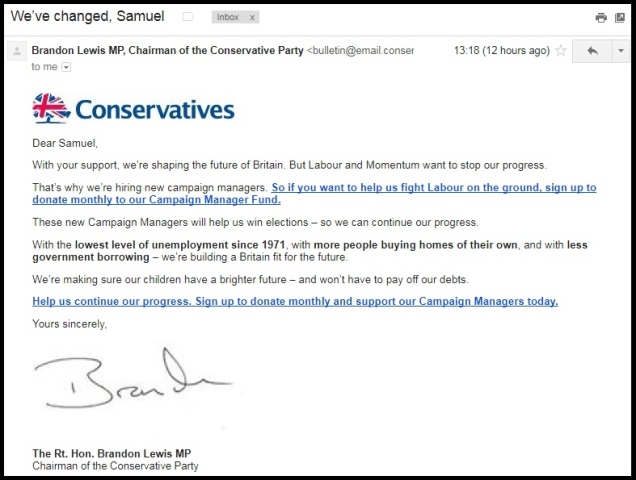
Conservative Party email bulletin - Brandon Lewis Chairman - Weve Changed

The Conservative Party: “Trust us, we’ve changed! It will be different this time, we swear. We love you, please don’t leave us.”

Apparently my incessant complaining for the past five years has finally paid off, because the Conservative Party has changed.

How do I know that the Conservative Party has changed? Because they tell me so. The following email pinged into the inboxes of everybody on the Tories’ distribution list this afternoon. Authored by new party chairman Brandon Lewis MP, the subject heading has all the grovelling obsequiousness of a husband who forgot to buy his wife flowers on Valentine’s Day while the main body offers no evidence of said change and rounds off with a petulant demand for cash.

Lewis writes:

With your support, we’re shaping the future of Britain. But Labour and Momentum want to stop our progress.

That’s why we’re hiring new campaign managers. So if you want to help us fight Labour on the ground, sign up to donate monthly to our Campaign Manager Fund.

These new Campaign Managers will help us win elections – so we can continue our progress.

With the lowest level of unemployment since 1971, with more people buying homes of their own, and with less government borrowing – we’re building a Britain fit for the future.

We’re making sure our children have a brighter future – and won’t have to pay off our debts.

Help us continue our progress. Sign up to donate monthly and support our Campaign Managers today.

The remarkable thing about this email is that every single sentence is either false or egregiously offensive to conservatives, and often both at the same time.

The lies begin at the top, with the risible notion that the current government is “shaping the future of Britain”. No, it most definitely is not. Theresa May’s government has not proactively shaped Britain or dictated the course of Britain’s fortunes or political discourse since the decision to trigger Article 50 of the Lisbon Treaty and set in motion our departure from the European Union. And even that was a colossal mistake, given the fact that the government had given precisely zero thought to what kind of future relationship it wanted with the EU, or what kind of relationship was politically, economically or logistically feasible. In other words, the one time that this government has come anything close to “shaping the future of Britain”, it punched itself (and the rest of us) in the face.

We then learn that the Tories want to hire a bunch of new campaign managers, presumably in the hope of staunching some of the inevitable massive bleeding in the upcoming local elections. But what message will these campaign managers be tasked with propagating? What vision for the future of Britain are they to devise a strategy to articulate? We still don’t know, and haven’t known since the moment Theresa May crossed the threshold of 10 Downing Street as prime minister.

In last year’s self-inflicted calamity of a general election, the whole pitch was “strong and stable”. Any idiot could have told CCHQ and Theresa May’s inner circle that “strong and stable” is a state of being, not a destination, and that people want clarity, purpose and vision in uncertain political and economic times. And this particular idiot did tell the Tories as much, repeatedly:

May’s risible pitch in the 2017 general election was strength and stability, but these are states of being, not a direction of travel. People jetting off in an aeroplane together would generally prefer less turbulence to a more bumpy flight, but more than anything they care about arriving at the correct destination. Jeremy Corbyn made his flight plan crystal clear to the British electorate. Theresa May didn’t even bother to produce one, preferring to pander to the Politics of Me Me Me.

But the political geniuses in CCHQ and Downing Street chose not to listen, and built their entire campaign around the visionary, inspirational leadership of the most wooden, uninspiring and unpersonable senior British politician in recent history. “Who needs ideas when we have Theresa May’s Kennedy-like charisma?”, CCHQ muttered to themselves as they drove the party into oblivion.

One might have hoped for some introspection since that calamity, a rethinking of the uninspiring, technocratic approach which the Tories have long embraced, but of course we saw no such thing. Despite mounting panic among the backbenches and a few gallant attempts at ideological defibrillation from forward-thinking MPs like George Freeman and Nick Boles, the Cabinet and party leadership are too busy undermining one another, messing up Brexit and positioning themselves to succeed Theresa May to actually stop and think about what Britain should look like in 2020, 2025 or 2030, let alone devise a vision for government to get us there. And they have the gall to ask for donations to fund campaign managers to help “win elections” and continue nonexistent progress (the third lie).

The fourth line brings us the Tories’ zippy new slogan, “Building a Britain Fit for the Future”. I initially had some hope that this new slogan might presage some new ideas from the Conservative Party, given its correct suggestion that the Britain of today is not fit for the future. But those hopes were quickly dashed. After having been given three months to take that statement of intent and flesh it out into something more than a slogan, Theresa May utterly failed to do so, instead producing seven bland and entirely forgettable pseudo-aspirations which could just as easily be the credo of the Labour Party or Liberal Democrats.

In reality, of course, the Tories are not building any kind of Britain at all. Thanks to the total lack of leadership from Downing Street and the dearth of policy vision from CCHQ, Britain is not shaping events but rather being shaped by events, in much the same way that large glaciers scour the land, creating valleys and ravines as they flow down a gradient.

Our Foreign Office is vastly underfunded and led by an imbecile who rightly commands zero respect on the world stage. The Ministry of Defence seems to be led by somebody vaguely competent and willing to stand up for the Armed Forces, but the Tories continue to allow our defence capabilities to wither rather than giving them the aggressive investment that they need. And last but not least, the Tories are an incoherent mess when it comes to Brexit, with the prime minister lacking the political authority to impose any kind of decision on her squabbling ministers, meaning that we drift toward whatever Brexit agreement the EU ends up imposing on us rather than having proactively staked out our own position.

And to close off the whole insulting exercise we get the standard Tory boilerplate about giving our children a brighter future by paying off the nation’s debts. In reality, of course, the Tories – much like Donald Trump and Paul Ryan’s debased Republican Party in the United States – wouldn’t know fiscal responsibility if it hit them over the head. Still happy to whine about the economy and deficit they inherited from Labour in 2010, the Conservatives remain curiously silent about how exactly we will pay off the national debt when all deficit reduction targets have been abandoned and the debt continues to grow by the day. They continue to lie and falsely conflate deficit reduction with national debt reduction, and only get away with it because Jeremy Corbyn’s Labour Party is congenitally incapable of seizing the political initiative while half of our overpaid political media stars are themselves also too dim to understand or articulate the difference between the debt and the deficit.

In short, every single line of Brandon Lewis’s fundraising email is an insult to thinking conservatives, or anybody who simply wants the government of the day to have some kind of vague purpose beyond trying to cling on to power as it slips away.

So how might a more honest version of the Conservative Party’s fundraising email read? Perhaps it would go something like this:

We haven’t changed. And much like a drug addict who insists to family and friends that they have quit the habit and turned their lives around, if you give us any more money we will simply fritter it away on the same destructive pursuits which have occupied us for the better part of a decade.

But give us a bit of cash anyway. We’ll pretend to you that we are going to use it to buy healthy food and get a new suit for job interviews, and that just £50 will really help us get back on our feet. But you know as well as us that we’re straight off to the crack house down the road as soon as you indulge us, where we will use your charity to inch ourselves ever-closer to death.

The time has come for Conservative Party members (those handful of brave souls who are left) and donors to take a stand. They should go on strike, and refuse to deliver one more leaflet or part with another penny in donations so long as the cash is flowing to the same failed, mediocre individuals who brought us Theresa May and then outdid themselves by squandering her majority in a spectacularly ill-advised general election.

Ideally this strike should take place immediately – after all, the Tories are going to bomb at the local elections and there’s no point throwing away good money after bad. But in reality, it will probably take the dismal result that we all know this government is capable of delivering for Theresa May’s enablers to wake up and realise that they are funding a clown show.

These are serious times for Britain. We face a period of discontinuity, in which we are confronted by new and unprecedented challenges while the same old policy prescriptions used in the past increasingly fail to either work or command popular support. Issues from globalisation and automation to Brexit and the future of the nation state to the housing and migration crisis require a bold vision for government and a set of coherent, mutually-supporting policies designed to resolve or at least ameliorate these issues without making anything else worse.

Theresa May can’t deliver that, and neither can anybody else in senior positions in her Cabinet. And deep down, everyone knows it. You know it, I know it, Conservative Party members who aren’t trying to suck up to the powers that be know it and Tory donors (who didn’t acquire all their money by being stupid) must also now know it.

In order that the Conservative Party might live again, somebody first needs to pull the plug on the life-support machine keeping Theresa May’s necrocracy technically alive (though certainly brain-dead). And since nobody within the Cabinet will wield the knife, it falls to the people who hold the purse strings and deliver the leaflets to act when nobody else will do so.

Any conservative, anyone with any lingering sentiment for the Conservative Party and what it once represented and accomplished, now needs to join a general strike against CCHQ and withhold their money and their campaigning efforts until they force a change. The party has been overrun by mediocrities for far too long, and the time has come to starve them out.

Conservative Party Logo - Torch Liberty - Tree

Support Semi-Partisan Politics with a one-time or recurring donation:

Agree with this article? Violently disagree? Scroll down to leave a comment.

Follow Semi-Partisan Politics on TwitterFacebook and Medium.

NHS Defenders Value Ideology Over Healthcare Outcomes, But Voters Increasingly Disagree

Reform think tank - NHS private non profit provision

A startling new poll from the Reform think tank suggests that the public’s devotion to government-provided healthcare may be a mile wide but only an inch deep, threatening to burst the leftist bubble of blind, uncritical NHS worship

Today being Valentine’s Day, a predictably saccharine hashtag is trending on Twitter as British people exhort one another to #LoveYourNHS.

And so begins another round of unthinking, unending hymns of praise to the National Health Service, egged on by ideological zealots who wake up in a cold sweat at the mere thought of anyone but the government directly providing all healthcare services in the land, and amplified by thousands of well-meaning but uncritical Britons who have been indoctrinated to believe that because the NHS once delivered their baby / set their broken leg / dug out their inflamed appendix / scooped them off the road after they walked in front of a bus they now owe their eternal thanks not to the medical professionals who helped them, but rather to the bureaucratic system which (dis)organised their care.

These odes of praise generally fall into one of a few well-defined groups. First, there are those predicated on the simple-minded assumption that no other advanced country in the world has figured out how to provide universal healthcare to its citizens:


Then there are those who displace their relief and gratitude at having been successfully treated or sympathetically cared for away from the medical professionals who deserve the praise toward a faceless government bureaucracy and the fifth largest employer on the face of the Earth (right after McDonalds):


Then there are those who just like to take any excuse to bash the Evil Tories and paint themselves as virtuous defenders of institutionalised compassion, struggling against heartless conservatives who want poor people to die in the street when they get sick:

https://twitter.com/JamesSorah/status/963762294890139650


Bringing up the rear are the Part-Time British Exceptionalists, leftists who normally scoff at any expression of patriotism or national pride, but who on hearing or reading the letters “NHS” immediately transform into the worst kind of stereotypical Ukipper, ranting and raving about how our healthcare system is the “envy of the world” and our country the birthplace of all that is good and compassionate, all the while furiously failing to notice the rather glaring fact that no other country in the world has copied our unique and outdated post-war system of socialised healthcare delivery:

https://twitter.com/RoseTintMyWorId/status/963748528588812288


And last but not least are the childishly simple gestures of reverence and affection – poems, songs and the like – which reveal the truly infantilised and subservient attitude held by many of the NHS’s loudest defenders toward the service:

https://twitter.com/RMitchell_NHS/status/961285576816242691


Because these various types of people – NHS High Priest, NHS Congregant, NHS Faith Militant and so on – are so loudly vociferous in the press and on social media, I and many others had rather simplistically assumed that their angry squawking spoke for the country as a whole. But a new poll taken this year shows that in fact the British people have a far more nuanced view of the NHS and the need for serious healthcare reform than the leftist NHS hagiographers would have us believe.

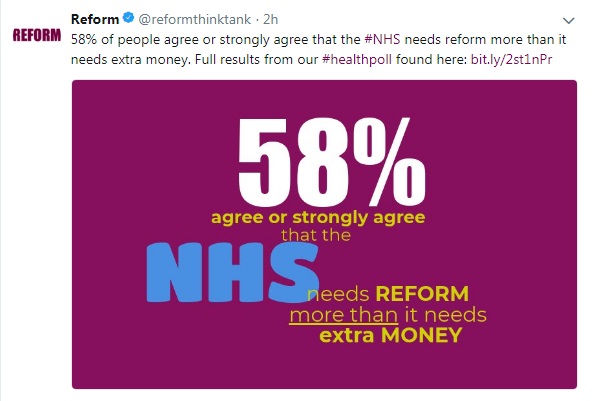
The Reform think tank has published a fascinating poll, taken in January, which revealed some rather striking findings, including:

58 per cent of British voters believe that the NHS needs reform more than it needs extra money, according to a new poll commissioned by the independent think tank Reform.

64 per cent of voters believe that it should not matter whether hospitals or surgeries are run by the government, not-for-profit organisations or the private sector provided that everyone has access to care. This is 2 per cent higher than in 2014, despite the Populus poll of 2,106 people being conducted on the day Carillion went into liquidation.

The think tank finds that 59 per cent of voters would nonetheless be willing to pay higher income tax to fund the NHS. This is up from 33 per cent in 2014. On average, British voters would be willing to pay £5.25 extra a month, which is 0.4 pence in the pound of income tax.

The statistic that most of us are already familiar with is the final one – that a healthy majority (in this poll 59 percent) of Brits would be willing to pay higher income tax in order to support the NHS. We cannot escape stats and narratives like this because the media (and on this subject even the supposedly conservative-leaning newspapers are doggedly left-wing) trumpet the news from dawn to dusk.

But looking at this number alone is highly misleading, because all it tells us is that a majority of people would be willing to pay more money for the NHS, not whether they want to do so or even believe that it is necessary. And that is where the other two statistics come in, rather awkwardly for NHS defenders who loudly insist that everything would be perfect if only we firehose more taxpayer money at the same, unreformed system.

We learn in the first bullet point that a full 58 percent of voters believe that the NHS needs reform more than it needs more money, which suggests that contrary to the prevailing narrative, voters are not automatically opposed to significant reform and in some cases might even welcome it if the reforms were woven into a coherent, comprehensive plan to improve healthcare outcomes for patients. And who can seriously argue that the NHS could not do more to find even top-line efficiency savings when we see non-jobs and full-time union rep roles draining local trust budgets?

https://twitter.com/johnmknox1/status/959819605651984389


But it is the second bullet point which is truly surprising – the fact that a full 64 percent of voters don’t give two hoots whether the hospital or medical facility where they receive treatment is government-owned and operated or run by non-profit or even private service providers.

This flies in the face of everything that we are told about public opinion towards the National Health Service. We may as a country (wrongly) favour the re-nationalisation of the railways, but when it comes to healthcare it appears that we are far more pragmatic, preferring what works to leftist ideology or sentimentality for a system which has operated since 1948.

From the Reform blog:

This is an important message for politicians who have questioned the premise of the outsourcing model following Carillion’s liquidation. The reality is that public services would grind to a halt without private and third-sector involvement. Almost one-third of government spend (£242 billion) is spend on external providers for goods and services from paperclips to the trident nuclear deterrent. The NHS spent £54 billion on external suppliers in 2014-15. This model has delivered value for money through increased competition. While the execution of some contracts can be improved, it seems voters are more concerned with access to services than ideological arguments on either side.

Why this growing openness to non-government provision? It could potentially be a case of “the grass is greener on the other side” – the rail operators are already privatised, and so dissatisfaction is more likely to be expressed in terms of a desire to roll the system back to a previous state, whereas NHS delivery (particularly hospital care) is almost always government-provided, making fresh alternatives seem more appealing. This is very likely a factor.

But such is the strength of public feeling on the issue – with 64 percent supporting radical change – that I don’t think “grass is greener syndrome” can account for the entirety. On the contrary, it seems as though the Left have massively overplayed their hand, thinking that they stood on a rock-solid foundation of obstinate support for preserving the NHS in aspic when in fact they are on a bed of quicksand.

Interestingly, the Left have likely done this to themselves, to a large extent. Having bleated for decades that we have only X or Y number of days to “Save Our NHS” only for the NHS to persist through Tory and Labour governments alike, and with left-wing commentatorsmembers of the NHS Industrial Complex and alarmist agitators like Owen Jones penning articles suggesting that the “NHS as we know it” has in fact already been abolished, perhaps the general public has finally tired of their endless hysteria and started to take it for what it is – cynical emotional manipulation.

And if there really is a new openness to healthcare reform, then all it would now take to finally break free from British healthcare exceptionalism – the blind devotion to a tattered post-war consensus dogma which suffocated all previous impetus for healthcare reform – is a purposeful, visionary government with a clear mandate to lead and a Cabinet brimming with talent and political courage.

Oh well.

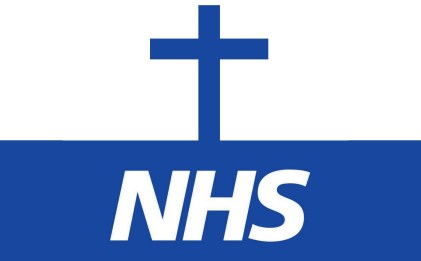
NHS Logo - Cross - National Religion - Worship - Idolatry

Support Semi-Partisan Politics with a one-time or recurring donation:

Agree with this article? Violently disagree? Scroll down to leave a comment.

Follow Semi-Partisan Politics on TwitterFacebook and Medium.

Europeans, The New Persecuted Minority In Britain?

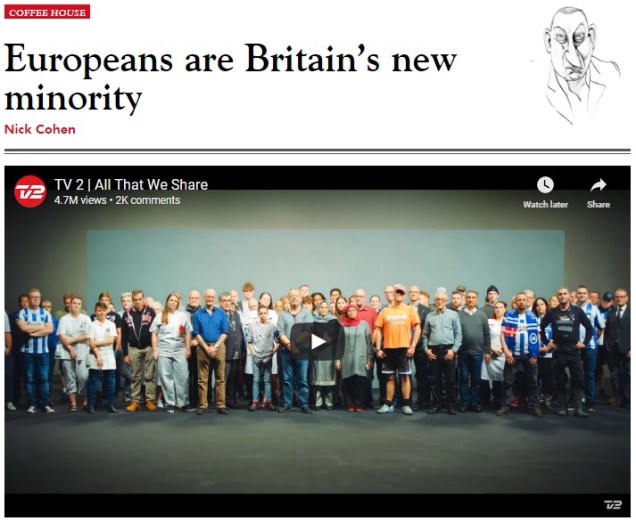
Europeans are Britains new minority - Brexit hysteria - Nick Cohen

Europeans are apparently the latest persecuted minority in benighted, dystopian Brexit Britain

From the annals of overwrought self-pity today comes this piece from Nick Cohen in The Spectator, declaring that thanks to Brexit, Europeans are supposedly the latest designated victim class in Britain.

Money quote:

They have lived, worked and loved here. They never saw their status as a problem until Brexit. Nor did anyone else apart from a few thugs who look for any excuse to racially abuse a target. They knew who they were. And now their certainties have gone.

By this I don’t mean that the British government and the EU are still arguing about their legal status – important though the argument is. Rather that their secure sense of identity has gone.

I am not unsympathetic to the theoretical notion of one’s identity being impinged upon or “ripped away”, as so many Remainers like to claim. And Cohen is quite correct in his piece to point out that the umbrella term “EU immigrant” contains multitudes and diversity, from Romanian fruit-pickers to Romanian or French management consultants and bankers.

I will further concede that some on the Leave side have a tendency to paint all EU immigrants to Britain as city-hopping, rootless “citizens of the world”, members of the highly-educated professional class, when this is by no means always or even usually the case. I have been guilty of this kind of oversimplification in my own writing at times, and it is important to note that an individual or family can simultaneously be EU citizens from another member state and also one of the JAMs (Just About Managing people) invoked by Theresa May.

But what is particularly galling about Cohen’s piece is the total lack of self-awareness yet again shown by Remainers. Yes, an unexpected threatened change to one’s legal residency status can be unnerving and stressful (even though such issues have now been put to bed) but there is no reciprocal regard for the feeling of many Leave voters that their identity had been under increasing assault for the past forty years of Britain’s EU membership. This identity is not to be mistaken for a white ethno-nationalist sense of self, but in the sense of people of all races and ages who hold their British identity significantly more dearly than any European identity, yet have seen government political power and agency increasingly shift from being rooted in a demos to which they feel a part toward a wider European demos with whom they have far less affinity.

In other words, Remainers like Nick Cohen complain because of a sudden reversal of fortunes whereby they no longer call all the shots or get to see their worldview prevail unchallenged, but spent the past recent decades dismissing the concerns of Leave voters who watched their sense of Britishness being undermined against their will and without their positive consent.

Further, it should be pointed out that there is a surefire solution available to many of those who now claim to feel like “aliens in a land they took to be their home”, and that is to apply for citizenship. That’s what people do in practically every other part of the world if they choose to live and work in a country other than their own, and nowhere but within the European Union is it considered an outrageous, retrograde demand. My US citizen wife took the oaths of British citizenship only last month in a very moving ceremony in Camden Town Hall precisely because having lived in this country and grown to love it, she wanted to formalise and make permanent that connection rather than simply renewing her permanent residency ad infinitum or having to apply for it all over again when we return from the United States.

The process of applying for citizenship is bureaucratic, stressful and expensive, not helped by Home Office red tape and administrative incompetence, which should be changed. But barring those rare cases where joint citizenship is not permitted then there is no justifiable impediment from taking this step and formalising one’s connection to the United Kingdom.

As I wrote last month:

Citizenship is more than a basket of rights, privileges and perks. It is also a binding commitment to the society in which we live. Choosing to naturalise means a willingness to undertake obligations as well as demand one’s due. Becoming a citizen is a declaration that one is bound to one’s fellow citizens by something more than temporary convenience or the accidental byproduct of an overseas work assignment or relationship.

This bond is hard to describe or put down in words, which is perhaps why so many self-declared “citizens of the world” – people who consider themselves to have transcended national alignment and who flit from place to place without ever making a binding commitment to anywhere they set foot – don’t understand why it matters.

But if you have built a life in Britain over the course of years or even decades, why would one not want to formalise that connection? Yes it costs money, and yes the Home Office does its damnedest to make the process as bureaucratic, expensive, frustrating and opaque as possible, often actively throwing barriers in the way of people who desperately want citizenship. But if one has the means and the opportunity, why not take the pledge and acquire the passport? Failing to do so is the civic version of cohabiting with a partner but never marrying, one foot always out the door, one eye always casting around for something better.

There is one surefire way to ensure that you are never made to feel like a stranger in the land you call home, and that is to seek and acquire citizenship. The European Union is very much an aberration in that freedom of movement suspended this requirement and removed much of the motivation for taking citizenship in another member state, but this is exactly what people in other parts of the world do every day.

But as I wrote last year when thinking about the degradation of the concept of citizenship in general, we have been indoctrinated to see citizenship as a purely clinical, transactional affair when in reality it is supposed to be so much more:

In Britain, citizenship is increasingly regarded (to the extent that people think of it at all) as a transactional affair, services rendered for taxes paid – or even rendered with no reciprocity at all in the case of the modern welfare state. The argument goes that by the sole virtue of paying taxes or drawing benefits here one deserves a full voice in the country’s affairs, even if one is a non-citizen or is present in the country illegally.

This very transactional approach has frayed the contract or bond between citizen/resident and the state. Of course, people still expect the state to protect them from foreign foes, guard against domestic security threats, provide healthcare, offer a welfare safety net and distribute various domestic and EU services. But even as they make these demands they offer rapidly diminishing loyalty to the state in which they live. People are increasingly insatiable for the benefits while being less and less willing to accept the responsibility.

[..] Today, many people demand the perks without accepting the responsibilities – hence the outrage of and on behalf of EU citizens who have built permanent or semi-permanent lives here yet refuse to see why they should formalise that commitment through the naturalisation process (or at least the acquisition of permanent residency following Brexit). They forget that the European Union is an aberration, that nowhere else in the developed world would countries offer so much while asking for virtually nothing in return.

In a way we should actually be glad to encounter a sustained argument from the Remain side rooted in identity rather than the usual alarmist, short-term economic forecasts and prophecies of doom (or insistence that a reduced rate of forecast economic growth in future years means that we will all be digging through the trash for food tomorrow) – in that sense, I suppose Nick Cohen’s submission to the Oppression Olympics actually counts as a forwards step. But in every other sense, it is just more of the same.

More furious obsession with safeguarding access to perks and benefits, more failure to empathise with or comprehend the other side, more demanding something in exchange for nothing, more Politics of Me Me Me, more trying to win a political argument by referring to one’s supposed oppression rather than with reference to empirical facts and ideas.

Victimhood and oppression are the currency of our age, but Nick Cohen goes way too far with his latest argument, devaluing the idea of discrimination and persecution in just the same way as Social Justice Warrior student activists who take time out from their Ivy League or Oxbridge educations to complain about feeling “unsafe” at some of the most prestigious, well-resourced academic institutions in the world.

Citizenship and residency in another country is a privilege, not a right, and will remain so until the nation state is no longer the primary building block in human civilisation (an inevitability, but by no means an imminent one). The displacement which some EU citizens may feel with regard to their identities, while thoroughly regrettable, is therefore nothing more than normality finally reasserting itself in Britain after a long, unbidden hiatus.

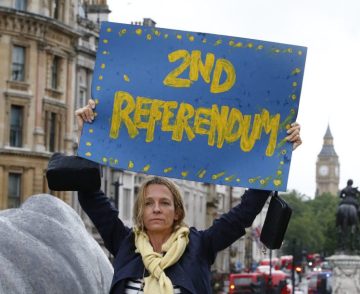
Anti Brexit Pro EU protester holding Second Referendum banner

Support Semi-Partisan Politics with a one-time or recurring donation:

Agree with this article? Violently disagree? Scroll down to leave a comment.

Follow Semi-Partisan Politics on TwitterFacebook and Medium.

Falcon Heavy Takes Flight, Rebooting Human Ambition

At a time when distracted Western governments and decaying institutions are incapable of providing visionary leadership, with society increasingly split along partisan lines, it took the vision of a private citizen to remind us what real ambition looks like

“Ad astra per aspera”, reads one of several memorial plaques to the crew of Apollo 1, three brave NASA astronauts who died in January 1967 when the oxygen in their capsule ignited during a routine launchpad test midway through America’s audacious bid to put a man on the moon. A rough road leads to the stars.

But since 19 December 1972, there has been no road to the stars of any kind, no road anywhere beyond Low Earth Orbit. The final Apollo missions were scrubbed due to their enormous cost, public apathy and perceived lack of return on investment, and while the Space Shuttle and International Space Station served as holding accomplishments of a kind, one cannot escape the conclusion that we have gone backwards, and not only as it relates to space travel, in terms of our willingness to embrace big challenges or dare mighty things.

Various politicians in recent years have proposed vague and (to varying degrees) fanciful plans for a return to manned spaceflight beyond Low Earth Orbit – George W. Bush had his own plan to send people to Mars, never likely to happen while he was busy bungling the War on Terror, while Newt Gingrich promised a moon colony by 2020. But this was always fanciful thinking – the fact that NASA has not had a permanent director in over a year reveals the truth about exactly how much the US government currently prioritises space exploration.

Thus in recent years it has fallen to private companies (as well as the Russians and Chinese) to keep the hope of future manned spaceflight alive. We are able to fill the sky with myriad commercial and military satellites, but the normally insatiable human appetite for exploration seemed in recent years to have dimmed.

Matthew Continetti makes this point in a piece for the National Review:

It was precisely this dream that seemed jeopardized by President Obama’s 2010 decision to cancel our return to the moon. Not only did America cede the final frontier to Russia and China. The policy lowered our sights. It tempered our dreams. Certain possibilities, such as Americans on the red planet, appeared to be closed off.

NASA’s robot explorers, who have traveled to Mars, Jupiter, Saturn, and the asteroid belt, are scrappy and intrepid. They have told us much about the solar system. But they are not very exciting. They make for good copy in Discover and Scientific American, but they do not quicken the pulse or exhilarate the imagination. Only a vision of the human future in space can do that.

This sense of decline finally started to change with the launch of the SpaceX rocket Falcon Heavy on Tuesday 6 February, a machine half the size and power of the Saturn V rockets used in the Apollo missions but far more efficient and able to carry significant payloads into orbit, and beyond. Meanwhile, NASA’s own next-generation Space Launch System is lagging behind and not due to carry its first manned mission until the highly optimistic date of December 2019.

I found the video of the Falcon Heavy launch – much like the footage of the Apollo missions – profoundly moving. I’m a child of the 1980s, and became an adult in the 2000s. And I can name no human accomplishment which has taken place in my lifetime remotely comparable to the moon landings. Nothing even close. Since the Apollo missions we have betrayed that legacy, hugging our own planet and never venturing beyond low-Earth orbit within the lifetimes of most people on this planet. Some even question whether the accomplishment was real, or if it wasn’t all just deception concocted in a TV studio.

The America of 1969 was not without its challenges and issues. The preceding year had been particularly difficult, with the assassinations of Martin Luther King Jr., Robert Kennedy and the Vietnam War protests. Yet despite these trials and difficulties, still the United States accomplished great things, launching (and safely recovering) the first men to ever set foot on another world. We, by contrast, seem overwhelmed by challenges which are no more insurmountable than those we faced in the 1960s.

Humans need vision and purpose. The prevailing political debate in the West implies that we must be concerned with “equality” (of outcome) above all else, that the guiding star of humanity should simply be ensuring that everyone has equal slices of a pie. But equality of outcome is a state of being (and an undesirable one at that), not a destination. As a society, we need to be part of something, to belong to a collective endeavour. Religion has long served that purpose, but is now a diminishing influence for many, while intersectional identity politics threatens atomisation rather than building unity.

President Kennedy once said “We choose to go to the moon in this decade and do the other things, not because they are easy, but because they are hard”. He was addressing a country and a people who wanted more than simply to protect their own perks & privileges – people who asked what they could do for their country, not what the government could do for them.

Our leaders don’t speak like that any more, because there is no longer any political reward to be gained from calling us to a higher, shared purpose. Atomised and highly individualistic, we couldn’t care less about discovery or common endeavour, or anything that doesn’t directly help us to pay a deposit on our London flat or New York apartment.

It’s easy to blame politicians for our societal and cultural drift, but in truth we get the leaders we deserve. And the reason we are lead by identikit drones who waffle on about “Our NHS” and act like making the trains run on time is God’s highest purpose, or ignorant blowhards who spew empty promises to “Make America Great Again”  is because we reward the people who do so. We are overly self-absorbed.

There is no ambition in our politics anymore, only petulant demands from voters and cowardly pandering by politicians. Young people in particular are (rightly) idealistic – but what, aside from the utterly misguided forced equality advocated by the likes of Jeremy Corbyn or Bernie Sanders, is remotely idealistic or ambitious about our politics today? Almost nothing. In Britain, the Conservative government wouldn’t know ambition if it slapped them in the face, while in the United States the “elites” and the “deplorables” are too busy trying to paint one another as Hitler to stop and try to achieve anything remotely tangible.

In 2018, Britain has voted to leave the European Union, and we stand at a unique moment in history. But rather than seizing this opportunity to earnestly debate the meaning of democracy and self-determination at a time when the world is more knitted together than ever before, instead we obsess about personalities and repeat worn-out half-truths and talking points from the referendum campaign.

Rather than starting a serious discussion about the future of the nation state, the challenges it faces and how to preserving meaningful democracy as we move toward whatever comes next, instead we obsess over whether or not the new settlement will put money in our pockets or make us poorer in the short term. The short-term Politics of Me Me Me pervades everything, to the extent that we laugh at and dismiss people who dare to talk about higher ideals.

But this is about so much more than just Brexit; you can agree or disagree with the wisdom of leaving the European Union. This is about the energy, ambition and vitality being sucked out of our politics and gradually replaced over the years with a greedy, grasping self regard. It’s about having no higher purpose (or common purpose) than the fleeting pursuit of pleasure.

That’s why the Falcon Heavy launch, the work of SpaceX and the ambition of Elon Musk struck such a chord this week. The launch of this rocket creates a link to past accomplishments in human spaceflight and reminds us of a time when we set our sights on higher things, when we sought out rather than shunned the difficult challenges, despite the technological deficits we faced. And having witnessed nothing but retrenchment and lowered expectations from government in the intervening years, it fell to a private company and its own commercial ambitions to provide us with that sense of wonder and possibility that we no longer seem able to channel through government or civil society.

https://twitter.com/NickBoles/status/960982603489861632


I look at the historic footage of the Apollo landings, magnificent accomplishments which took place decades before I was born, and ache to live in a time when we as a society cared about something more than our bank balances and social status; when we aspired to goals greater and more noble than mere “tolerance” and “equality” among atomised, self-interested individuals.

Each one of us has in our pocket a computing device more powerful than that which sent Neil Armstrong, Buzz Aldrin and Michael Collins, those brave pioneers, to the moon. What are we doing with the near-limitless intellectual resources at our disposal? With the kind of wealth and purchasing power that only aristocrats and industrialists enjoyed a century ago? And yet with all these advantages at our disposal, for what accomplishments will we be remembered fifty years hence?

We are better than the current depleted state of our national ambition suggests. I don’t know how we rediscover or rekindle the spark, but we urgently need to do so. Western society is drifting, as evidenced by the furious obsession with social justice and identity politics in an age of unrivalled riches and opportunity, by our failure to stand up for small-L liberal Western or Enlightenment values at a time when they are under attack on all fronts, and by the shrinking of our political debate into a question of what the government ought to do for us rather than what we can do for our countries, and for the world.

On January 27 1967, three brave American astronauts died during a routine test of their space capsule. They gave their lives for a higher ideal and paved the way for us to later set foot on the moon. As a society, as a species, we need to once again be worthy of their sacrifice, and the bravery of those who followed in their footsteps. Otherwise what the hell are we all doing?


Falcon Heavy maiden flight

Support Semi-Partisan Politics with a one-time or recurring donation:

Agree with this article? Violently disagree? Scroll down to leave a comment.

Follow Semi-Partisan Politics on TwitterFacebook and Medium.