NHS Heresy, Part 3

NHS Worship - London Olympic Games 3

The latest depressing news about Britain’s slide down the healthcare outcome rankings will only lead to more uncritical NHS-worship instead of the frank, rational and dispassionate conversation we need to have about end-of-life care for the ageing, failing National Health Service

The Times’ Tim Shipman reports some awkward facts in Sunday’s “Red Box” briefing:

As many as 46,000 people die each year because NHS treatments for a range of conditions, including cancer, trail behind the best in the world, a new report has found.

The UK ranks near the bottom of a list of developed nations in terms of survival rates for common cancers such as breast, lung, prostate and bowel cancers.

More than 9,000 people who die each year in the UK from lung cancer would survive if they lived in Japan, which has the best survival rate for the disease among the 32 countries studied. The UK ranks 30th.

BUT THE NHS IS THE ENVY OF THE WORLD!

The NHS was perfect until the Evil Tor-ees got their grubby hands on it six years ago!

We just need a new NHS Tax to fund our beloved healthcare system – I for one would be happy to pay five pence more on the pound to show my support for Our NHS!

Cue a million and one leftist responses to these awkward, sobering facts and statistics. Everything other than a measure of introspection, or questioning whether a centralised, statist bureaucracy designed in 1948 – and which perversely ranks as the fifth largest employer on the face of the Earth, bigger than the Indian railways and only just smaller than McDonald’s – is really the best way to deliver healthcare to Britons in 2016.

That healthcare stat about lung cancer survival rates in Japan looks rather good, doesn’t it? And how exactly is it achieved? Well:

The health care [system] in Japan provides healthcare services, including screening examinations, prenatal care and infectious disease control, with the patient accepting responsibility for 30% of these costs while the government pays the remaining 70%. Payment for personal medical services is offered by a universal health care insurance system that provides relative equality of access, with fees set by a government committee.

All residents of Japan are required by the law to have health insurance coverage. People without insurance from employers can participate in a national health insurance programme, administered by local governments. Patients are free to select physicians or facilities of their choice and cannot be denied coverage. Hospitals, by law, must be run as non-profit and be managed by physicians. For-profit corporations are not allowed to own or operate hospitals. Clinics must be owned and operated by physicians.

So in Japan there is some sense that healthcare is an individual’s responsibility – the requirement to cover 30% of costs ensures that this is the case, acting as an incentive to live healthier lifestyles and take personal responsibility for decisions. But universally mandated insurance and a decree that patients cannot be denied coverage ensures that nobody slips through the net.

In other words, this is hardly a libertarian dystopia. Prices are capped by a government committee, while state law dictates that individuals purchase insurance. Hospitals are non-profit, meaning the big, “evil” American corporations don’t get a look-in.

And yet even to suggest that the UK looks to Japan for inspiration in reforming healthcare would be to mark oneself out as a heretic, as a blasphemer against St. Aneurin Bevan of Tredegar and the Perfect System he bequeathed to us. Ordinary citizens would be shunned by their friends while any politician would quickly find themselves labelled an “extremist” and excommunicated from public life.

How much further down the international rankings must we slip before Britain’s army of NHS worshippers (and the NHS Industrial Complex, whose bidding they unwittingly do) finally stop singing hymns of praise to a failing government bureaucracy and demand that we finally do something bold, something different?

On second thoughts, don’t answer that question.

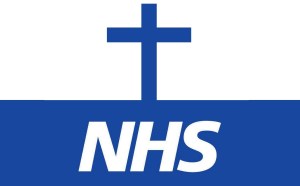
NHS Logo - Cross - National Religion - Worship - Idolatry

Support Semi-Partisan Politics with a one-time or recurring donation:

Agree with this article? Violently disagree? Scroll down to leave a comment.

Follow Semi-Partisan Politics on TwitterFacebook and Medium.

Quote For The Day

After the election, American conservatives cannot simply pretend that Donald Trump never happened. The Republican Party must fully reject Trumpism and then reach out to voters with a brighter, most optimistic conservative message

Jonah Goldberg, addressing an Ashbrook Center event in Cleveland, Ohio back in 2014, when Donald Trump was just a loudmouth birther and not, y’know, a major party presidential candidate:

I love first principles, I’m all about first principles, I think that’s great stuff. But people forget that politics has to be about persuasion, about bringing people to your side who don’t already agree with you. Otherwise it might as well be a Civil War re-enactment club or a Dungeons & Dragons society where we just play our little roles and then we go home.

And this is something that a lot of conservatives have lost. And one of the things we have lost is the ability to tell stories.

Goldberg goes on to criticise the excessive hagiography of Ronald Reagan, pointing out that Reagan’s recent reputation as an unbelievably principled conservative who never once sullied himself with compromise actually much more closely fits Barry Goldwater – who of course went down to glorious defeat.

The point, I suppose, is that Donald Trump fails both tests. He is not a conservative – or at least he has done absolutely nothing to prove that his Damascene conversion to traditional Republican values and talking points is remotely genuine, and not simply a convenient ploy to co-opt supporters.

Worse still, Trump is incapable of telling an authentically conservative story which might actually attract and persuade undecided voters, because every time he opens his mouth to tell a story a new victimhood-soaked conspiracy theory dribbles out instead.

I also post the quote as a reminder to myself. Lord knows that I have a lot of issues with the current British Conservative Party and the direction it has gone under Cameron and May (well, really since mid-Thatcher, when I was born). But when you rant on the internet every day it is easy to preach to the choir sometimes and forget that there are some good Conservative MPs of principle out there who do want to take the country in a different, more small-L liberal direction, and who have no truck with Labour’s vacuous centrists-in-exile or Theresa May’s flirtation with authoritarianism.

But more than anything, the Goldberg quote is a reminder of the huge rebuilding exercise the Republican Party will have to do after Donald Trump. Whatever story they previously used to connect with voters, however battered and dubious it may have been, has now been utterly obliterated. Some say that the GOP can (and will) simply forget that Trump ever happened, and move on serenely. I’m not sure that will be possible – not least because many Republican grassroots members may not let it happen. They may well find an heir to Trump, and throw their support behind Trump Mark II.

Besides, this crisis represents too great an opportunity for American conservatism to re-invent itself. This blog has been intermittently banging on about the need for small government conservatism to come to terms with our modern, globalised world – a world in which supply chains and labour markets are international, and the kind of mass, semi-skilled manufacturing work which once paid well enough to support a comfortable middle class life has either permanently disappeared, or else barely pays a subsistence wage.

This is a particular challenge for conservatives, who believe in empowering the individual and restricting the overbearing hand of government. Left-wingers can simply wave their arms and promise a new government programme to retrain vast swathes of the population, or buy their silence with benefits. Conservatives do not have this luxury.

But the eventual answer will, I am sure, have to come from conservatives. Cranking up the size of the state until it is all things to all people is unsustainable, squelching innovation at best and provoking economic crisis at worst, as proven every single time it has been attempted. Globalisation continues apace and the burning question continues to go unanswered.

Perhaps, once the Republicans are finished debasing themselves by their association with Donald Trump, they might care to have a crack at solving it.


pop-art-donald-trump

Support Semi-Partisan Politics with a one-time or recurring donation:

Agree with this article? Violently disagree? Scroll down to leave a comment.

Follow Semi-Partisan Politics on TwitterFacebook and Medium.

Tales From The Safe Space, Part 43 – DePaul University Censors Pro-Life Conservatives To Placate Black Lives Matter

depaul-university-college-republicans-unborn-lives-matter-blm

Appeasing the gods of social justice and identity politics now overrides a Catholic university’s commitment to Catholicism itself

It is now indisputable: Black Lives Matter are rapidly becoming the one absolutely holy and inviolable interest group on American college campuses, a favoured priesthood of living saints who must be protected from blasphemy and offence at all costs.

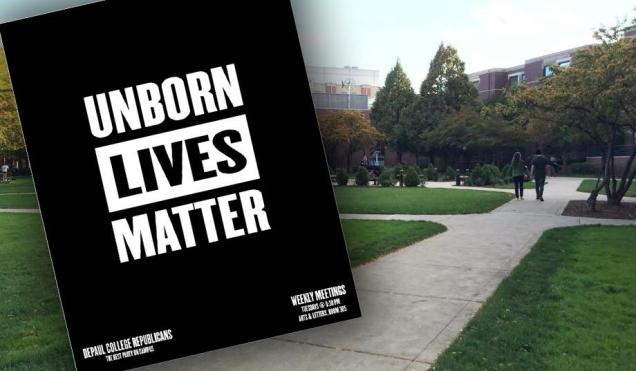
There really is no other way to describe the privilege enjoyed by this organisation following the news that DePaul University in Chicago – a Catholic institution – recently banned a poster produced by the DePaul College Republicans because their catchphrase “Unborn Lives Matter” is supposedly deliberately provocative and hurtful to the delicate Black Lives Matter snowflakes.

I repeat: the president of a Catholic university actively suppressed the free speech of his own students because they dared to publicly support traditional Catholic teaching on the sanctity of life and the rights of unborn children – which might have offended a group of people who are supposedly concerned about racial justice, not abortion rights.

Campus Reform reports:

The DePaul College Republicans chapter has been censored yet again, this time over promotional flyers proclaiming that “Unborn Lives Matter.”

According to University President Rev. Dennis H. Holtschneider, the club was forbidden from using the flyers because they were “bigotry…under the cover of free speech,” meant to “provoke” members of the Black Lives Matter movement.

DePaul College Republicans Vice President John Minster told Campus Reform that his group wanted to use the “Unborn Lives Matter” flyers to draw members to their club meetings, but had to submit the design to the Office of Student Involvement for approval.

OSI Director Amy Mynaugh was out of town during the approval process, however, and the design proposal made it all the way to President Holtschneider.

Holtschneider not only declined to approve the flyers, but sent a letter to the entire university body explaining that the pro-life posters constituted “bigotry” and were not considered free speech.

The letter from President Holtschneider reads in part:

DePaul is a private Catholic institution, and we also are part of the academy.  By our nature, we are committed to developing arguments and exploring important issues that can be steeped in controversy and, oftentimes, emotion.  Yet there will be times when some forms of speech challenge our grounding in Catholic and Vincentian values.  When that happens, you will see us refuse to allow members of our community to be subjected to bigotry that occurs under the cover of free speech.  In fact, you have seen this in past months, as we have declined to host a proposed speaker and asked students to redesign a banner that provokes the Black Lives Matter movement.

Some people will say that DePaul’s stance unfairly silences speech to appease a crowd.  Nothing can be further from the truth.  As we experienced last spring, it’s not difficult to agree that there is a difference between a thoughtful discussion about immigration and a profane remark about Mexicans scrawled in the Quad; or between a panel on racial climate and a noose — a powerful symbol of violence and hatred — outside a residence hall.  In both recent cases, the first, we encourage; the second, we abhor.

Because co-opting a topical phrase to express support for the Church’s pro-life stance is apparently “provocative” – the “provocation” outweighing the moral question at stake in the eyes of DePaul University.

And putting up a poster declaring that “Unborn Lives Matter” – the clearly stated and strongly affirmed position of the Catholic Church, the institution with which DePaul is inseparably affiliated – is not a statement of moral purpose, but is instead deemed the equivalent of a “profane remark about Mexicans scrawled in the Quad”.

The letter continues:

If you read DePaul’s Guiding Principles on Speech and Expression, you will see that our Vincentian values were in the forefront six years ago when these guidelines were developed.  Though a group of your own DePaul colleagues are giving them a fresh look for updates, the current guiding principles still apply.  I encourage you to read the entire document to gain a better understanding of the balance between our values and speech.  In particular, I ask you to reflect on these sentences: “We accept that there is a distinction between being provocative and being hurtful.  Speech whose primary purpose is to wound is inconsistent with our Vincentian and Catholic values.”

More:

Disagreements will happen on important issues—many that are personal to members of our community for whom race, immigration, gender disparities, religious beliefs and economic privilege are more than conversation topics; they are part of an inescapable lived experience.  Students and others will almost certainly continue to explore and seek the exact limits of our tolerance for free expression when that expression is meant to cause distress.  Certainly, everyone is allowed to have their opinions on these topics.  I simply ask when you are expressing your opinion that you respect the difference between a reasoned discussion and words whose primary purpose is to wound.  I also ask that the university community refuse to “rise to the bait” in those moments when speech may become uncomfortable or even exasperating, but falls within the bounds of the academy’s commitment to full and robust debate.

Because hurt feelings are far more important than abortion. And the omniscient president and administrators of DePaul university can look clearly inside the human heart and discern whether a given student intends to provoke, offend or hurt when determining their right to speak.

This is ludicrous. Holtschneider made no attempt to speak with the DePaul College Republicans before censoring their poster and banning it from campus – he high handedly presumed to know what motivated them to speak out in favour of the rights of the unborn, and then publicly find them to be morally deficient and their motives cynical. That is effectively the judgment on their character that Holtschneider passed by revoking their right to express themselves – that they are Evil Racists more interested in “provoking” certain members of the black community than witnessing to their faith and speaking their consciences.

The National Review rages:

As a private, Catholic university, DePaul is not explicitly obliged to respect students’ free-speech rights like a public university would be. But it is disturbing that the university would choose not to do so, and even more disturbing that DePaul’s administration justified their decision by invoking the university’s “Catholic values.” It is hard to believe that the phrase “Unborn Lives Matter” is in violation of a Catholic university’s values when, in fact, this phrase ought to embody them.

This is not the first time that DePaul’s administration has been confused about the proper application of its Catholic guidelines. For instance, one of the university’s 2016 commencement speakers was Martin Castro, chairman of the U.S. Commission on Civil Rights, who in his professional capacity has advocated same-sex marriage and radical gender theory, and opposed religious-freedom legislation that would have enabled Catholic institutions to uphold their values. DePaul was also found to have referred students to jobs and internships at Planned Parenthood, and to have promoted social-media posts celebrating the Supreme Court decision recognizing same-sex marriage nationwide.

While it is the university administration’s prerogative to take these actions — even though they openly conflict with established Church doctrine — it is appalling that the same administration would invoke its Catholic principles to ban pro-life flyers from campus. It is evident that Holtschneider and his staff are intent upon silencing conservative student voices, even if they must wield their Catholic identity as a cudgel to do so.

It is particularly depressing that the SJW snowflakes of DePaul have their grubby hands on the university’s Guiding Principles on Speech and Expression – we can safely assume that the next version of this document will be even more restrictive, and prioritise the feelings and “identities” of coddled students even more strongly over the imperative for debate and the quest for truth. Which will be some achievement, considering the current version already draws a specious “distinction between being provocative and being hurtful.

But one can only be so angry at the students themselves. As this blog has explored repeatedly, these thin-skinned students are very much a product of their environment and their upbringing. They are the result of Everyone Wins A Prize schooling, parental paranoia about a child abductor lurking on every corner and the endless, nauseating praise for the most pedestrian of accomplishments and the corrosive idea, inculcated at every stage of their academic lives, that “sticks and stones may break my bones but words will kill me stone dead”.

Far more to blame are the adults – the liberal college professors now struggling to stay ahead of their students in the race to be ever more strident, intolerant and authoritarian in response to ideas they dislike, and the spineless university administrators who would sooner collaborate with the new regime and stab academic freedom in the back than push back against their millennial masters.

But special criticism has to be levied at the leader of a Catholic educational institution – somebody with Reverend in their title – who prioritises the prickly feelings of Black Lives Matter (and their proprietary sense of ownership over the phrase “[insert interest group] lives matter”) over and above the Church’s teaching on a core social issue.

I happen to be Catholic myself. Personally, I do believe that All Lives Matter. I believe that life begins at conception, and that therefore abortion inherently means the taking of a life. But I also believe that this is also sometimes the lesser of two evils, or an understandable choice in an impossibly difficult situation. As well as the commonly given exceptions – rape, incest, the life of the mother – I believe that abortion should be a legal, safe and much, much rarer. And part of making abortion much rarer must surely involve easier access to (and education about) contraception. One of the best ways to stop new lives being discarded before they begin is to prevent the hideous situation from arising in the first place.

I recognise that all of the above places me in conflict with the church’s teaching, and that is something which I have to wrestle with. I’m reasonably sure that I am right, and that my viewpoint will be vindicated and adopted by the Church in the fullness of time, but that doesn’t lessen the sense of unease at being out of communion with my religion on such an emotive issue.

But here’s the difference: I don’t expect external authority figures to step in, suppressing the free speech of others to prevent my guilty conscience from being pricked. Nor do I expect them to do so because the language they choose to use in affirming traditional Church teaching “appropriates” the name of another cause I happen to care about, or which impacts me. I can think and write what I want – I have no business limiting the freedom of others to do the same.

And students at a Catholic university, of all places, should be free to affirm Catholic teaching through articles, peaceful protest and harmless posters without fear of censorship by craven university authorities – spineless, degenerate cowards who would sooner suppress freedom of speech and publicly reject their own religion’s teaching than risk the slightest offence to their new deity: the Cult of Social Justice and Identity Politics.

Bigotry “under the cover of free speech”? That is to be DePaul University’s sneering, dismissive and hostile attitude toward young conservative Catholics who dare to affirm the teachings of their faith?

People of faith should pray for the censored College Republicans (whether or not you agree with their cause), and for DePaul University. Because religion counts for nothing if it has to disregard doctrine and bend the knee to social fads and new secular shibboleths.

And I don’t know how much longer the academy can plausibly survive the continued ruthless letting of its most vital lifeblood – the right to free speech.


Safe Space Notice - 2

Top Image: National Review

Support Semi-Partisan Politics with a one-time or recurring donation:

Agree with this article? Violently disagree? Scroll down to leave a comment.

Follow Semi-Partisan Politics on TwitterFacebook and Medium.

Brexit Catastrophisation Watch, Part 6 – Stay In The EU Or Kittens Will Die

kitten

Hysterical Remainiacs are now warning that Brexit will endanger the lives of the nation’s pets and farm animals

For the past four months, the British people have been subjected to some ridiculously childish hissy fits and the incessant catastrophisation of Brexit by self-regarding EU apologists in the media. But this latest tantrum by Ian Dunt, editor of politics.co.uk, is on another level.

Ian Dunt already has great form in portraying the slightest move to limit the growth of the state or safeguard national sovereignty as being part of a plot by the Evil Tor-ees to kill the poor and chuck out every last foreigner, but his increasingly bitter and alarmist Brexit coverage is starting to make him look particularly ridiculous. Because Dunt is now claiming that among the many other evils of Brexit, spurning the EU and demanding self-government will also put “people and animals at risk”.

Yes. Going ahead with Brexit means that kittens will die.

Dunt explains:

Look at any part of British society and you’ll see the damage Brexit is doing.

Take veterinary services. Yesterday afternoon, the Royal College of Veterinary Surgeons (RCVS) and the British Veterinary Association (BVA) wrote a letter to the prime minister. These are not radical organisations. They never really put out political statements of this sort. They stay in the background, concerning themselves mostly with relatively dry questions of policy detail. But they’ve been forced to issue a warning that Brexit – and Theresa May’s descent into anti-foreigner rhetoric – are putting people and animals at risk.

“Anti-foreigner”? Really? One can argue endlessly about the economic merits of Theresa May’s seeming determination to reduce net migration, but I challenge Ian Dunt to produce one example where the prime minister has actively sought to whip up anti-foreigner feeling in the population.

Wanting controls on immigration is not an extremist or unpalatable political viewpoint – many countries in the world (like Australia and the United States) don’t automatically accept anybody from their region or continent who wants to live and work. And at some point the British Left are going to have to take their collective finger off the nuclear button and stop screeching “racism” at anybody who dares to suggest that government should have control of who is allowed to come and settle in the country.

Regardless, Dunt continues:

Around half the veterinary surgeons registering to practise in the UK each year are from overseas – mostly the EU. Europeans are particularly prevalent in public health roles like the Government Veterinary Services. In the meat hygiene sector, some estimates put the number of veterinary surgeons who graduate overseas at 95%. And these people – the people who look after our pets, who check our food – are feeling increasingly uncomfortable in this country.

And this supposedly matters because:

The veterinary profession doesn’t just look after pets. It monitors and controls the spread of disease and assures the quality of the food we eat. If it goes into decline, the animals we love and share our homes with are in more danger. But there is also a very significant public health risk to go alongside the emotional one.

[..] while anti-immigrant newspapers and politicians whinged, immigrants were there: Treating your cat. Picking your fruit. Treating your condition. They are crucial to the running of this country and unless we start recognising that, it’ll be this country which suffers the consequences of their absence.

[..] The policy implications of Brexit are even more serious. In the future, the two organisations warn, “changes to the mutual recognition system or immigration restrictions could have a profound impact upon the veterinary workforce”. That means Britain may face a shortage of vets as it loses half its annual intake. It means a potentially catastrophic impact on TB testing and meat hygiene. It means abattoirs may be unable to export their products because the UK veterinary requirements are not recognised by European authorities.

So in other words, wanting to leave a deeply unpopular and dysfunctional continental supranational government is so terrible that it will kill our pets, causing us immense emotional harm, and also ensure that agricultural and food safety standards immediately fall off a cliff, leading to the immediate return of BSE and foot and mouth disease. Our democracy is hostage to the presumed fortunes of our household pets.

See? We warned you! Why didn’t you listen! Now Fluffy the Kitten is going to die, and it’s all your fault, you ignorant, hateful, xenophobic Brexiteer!

Will these histrionics from bitter, intellectually bankrupt Remainers never end?

The one valid point in this screaming tantrum of an article is that changes to (or severance of) the mutual recognition agreements governing veterinary standards or food safety – much of the latter of which actually falls under the purview of Codex Alimentarius – could cause real disruptions to trade. Too much of the political debate over Brexit has focused on buccaneering assumptions by government ministers and journalists that the avoidance of tariffs is the sole issue, when this is not at all true. The potential erection of non-tariff trade barriers by failing to extend mutual recognition of standards would have immensely more impact on British industry in terms of cost and complexity of doing business, and it is this which politicians need to wrap their heads around.

Dunt (inadvertently) raises an important issue here, and a timely warning. But his incessant, hysterical scaremongering (and pretence that there are no solutions or workarounds to the practical issue he flags) overshadows his argument. This is the polar opposite of constructive criticism – it is the kind of sulky fault-picking more worthy of a toddler than a grown man with a political website.

And yet I am coming to suspect that this is how it will always be. Never expecting victory in the EU referendum, I naturally didn’t devote much time to thinking about what it would actually feel like to be on the winning side, to finally overturn the 40-year pro-EU consensus. Now I’m starting to get an idea. And it is not pleasant.

Brexiteers had better get used to endless “won’t somebody please think of the kittens?!” caterwauling from aggrieved pro-Europeans, because it will probably last the rest of our lives. Even if Brexit ushers in the kind of democratic renewal that some of us hoped for – and even if we achieve secession from the EU on the most favourable terms possible – they will still criticise us and act as though we have ushered in an unprecedented calamity. And in the absence of counterfactuals, who can disprove Ian Dunt when in five years he whines that we would be enjoying hover cars and 200 year lifespans if only we had done the sensible thing, listened to him and voted to remain in the EU?

Brexiteers should settle in for the long haul. Yesterday it was Marmite, today it’s kittens and tomorrow it will be something else. And why? All because Ian Dunt and other pro-European can’t just bring themselves to say “I hate patriotism, I’m ashamed of my country, I feel more European than British and more than anything I hate the 52 percent of my fellow citizens for  defying my will and causing me not to get my own way for once in my life”?

Maybe therapy would help some of the Remainiacs-in-denial towards a necessary moment of catharsis. One can only hope so. Their endless hysterics and catastrophisation of Brexit makes them look far more stupid than it makes Brexit seem reckless.

European Union - United Kingdom - Britain - Flags

Top Image: Nanto, Pixabay

Support Semi-Partisan Politics with a one-time or recurring donation:

Agree with this article? Violently disagree? Scroll down to leave a comment.

Follow Semi-Partisan Politics on TwitterFacebook and Medium.

Brexit Catastrophisation Watch, Part 5 – Britain Stronger In Europe Tacitly Admit They Were Lying The Whole Time

open-britain-hard-brexit-soft-brexit-catastrophisation

While advocating a “soft Brexit” as their fallback position, Remainers contradict themselves and expose the tawdry lies they told during the EU referendum

Even Open Britain, the shrivelled husk of Will Straw’s failed Remain campaign group Britain Stronger in Europe, has now effectively admitted that leaving the European Union need not be intrinsically economically harmful – thus undermining the central pillar of their case for staying in the EU.

The harsh light which Remainers are now knowingly shining on their prior scaremongering and lies is quite hilarious. By drawing a distinction between “hard” and “soft” Brexit and campaigning fervently for continued membership of the EEA, campaigners are effectively admitting that their many economic apocalypse warnings applied only to leaving the single market, and not the EU’s political union.

From an Open Britain campaign email sent to supporters yesterday:

Open Britain is campaigning for Britain to stay in the Single Market, which brings increased investment, trade, jobs and growth.

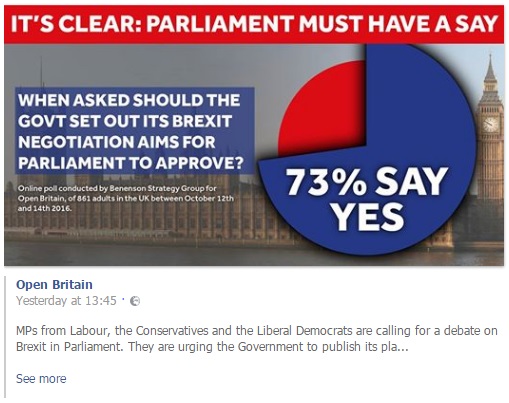
It seems the public agree. A new poll we commissioned has found that 59% of voters want the UK to stay in the Single Market, so there is no mandate for a destructive Brexit.

Now, MPs from Labour, the Conservatives and the Liberal Democrats are calling for a debate in Parliament. They are urging the Government to publish its plan for the forthcoming EU negotiations and to allow Parliament to approve it. A huge majority – 73% of people – support this.

Our future partnership with the EU should be not decided in secret but determined by democratic debate.

There is “no mandate for a destructive Brexit,” we are told. Well, that’s funny. Because not long ago, every Remainer in town – most certainly including Britain Stronger in Europe – was screeching about the automatic ruin which would befall Britain if we voted to leave the EU, regardless of how the Brexit process played out or whatever our eventual new trading and political relationship with the EU happened to be. For months we were told by sanctimonious Remainers that “destructive Brexit” was the only kind of Brexit available – yet now they acknowledge a benign version of Brexit and encourage us to adopt it.

Fast-forward four months and suddenly the story changes. Now, apparently, we need to fight tooth and nail to preserve our membership of and unimpeded access to the single market, because this is the lynchpin on which Britain’s economy rests. In other words, their entire economic scaremongering case was a giant lie.

Oh sure, they’ll come back and claim that most Brexiteers supposedly want a “hard Brexit” and that the major Leave campaigns envisioned Britain leaving the single market, which is why they felt justified in equating the European Union with the single market in their own campaign rhetoric. But this is the mealy-mouthed defence of someone who has been caught in a blatant lie. Remainers were desperate to bury the awkward fact that the EU and single market are not one and the same thing, and the fact that they did all they could to fudge the distinction (heck, they suggested that leaving the EU meant severing ourselves from the continent of Europe) shows that they were more obsessed with economic scaremongering than truth. It is Remainers, not Brexiteers, who dwell in a land of post-factual politics.

As this blog recently commented:

Funny. It’s almost as though [Remainers] are suggesting that leaving the EU needn’t necessarily mean “plung[ing] the UK into a period of recession and international decline”, and that Britain’s economic and diplomatic health is actually contingent on the kind of choices that Britain makes once we are free of the supranational political union.

Claiming that a mismanaged, uncontrolled or “hard” Brexit might cause serious economic harm is a perfectly respectable position. More than that, it is basic common sense. But that isn’t the argument that Remainers were making during the EU referendum campaign. No, they were claiming that any form of Brexit would be disastrous, that Britain leaving the European Union would be economically calamitous in and of itself, regardless of how Brexit unfolded or the model of our future trading relationship with the EU.

As it happens, this blog agrees with Open Britain’s revised position. Certainly as an interim measure Britain should remain in the EEA while working toward a longer-term solution which hopefully replaces the single market with a new framework which is more democratic and not part of a protectionist, beady-eyed, euro-federalist master plan. Given that the most skilled trade negotiators in the world (in which Britain is singularly lacking, despite generous help from our Commonwealth friends) take a decade or more to thrash out comprehensive bilateral agreements it is the height of idiocy to assume that a Brexit-inspired sense of urgency and the concerns of “German car makers” will get the job done in the initial two short years set out in Article 50 of the Lisbon Treaty.

But why couldn’t the Remainers just be honest from the beginning, level with the British people and tell them that it is Britain’s uninterrupted EEA access, not our membership of the supranational political union, on which our economic stability depends?

The answer, of course, is that for top Remainers the EU referendum was never about economics. It was about their craven desire to live in an amorphous internationalist blob where the nation state is fatally undermined and the strongest level of government and identity reforms at the European level. That’s what they wanted but couldn’t say in public. And so instead they falsely equated the EU with the single market in an attempt to scare low information voters and assorted unthinking lefties that voting for Brexit inherently meant economic doom.

Now that the decision to leave the EU has been made, these disingenuous people are having to regroup and come up with a new argument – that it is our future relationship with the single market, not the EU, which will have the greatest potential impact on our economy and future prosperity. And just as even a stopped clock tells the correct time twice a day, this time they happen to be correct.

Unfortunately, changing arguments mid-stream also reveals that nearly everything that the Remain campaign said prior to the EU referendum was a deliberate, filthy lie.


European Union - United Kingdom - Britain - Flags

Support Semi-Partisan Politics with a one-time or recurring donation:

Agree with this article? Violently disagree? Scroll down to leave a comment.

Follow Semi-Partisan Politics on TwitterFacebook and Medium.