Donald Trump Meets Social Justice Therapy Culture, And No One Comes Away Looking Good

donald-trump-anxiety-therapy

Now apparently Donald Trump has made it impossible for millennials to experience love. Hysterical accusations and overreactions like this from his opponents will do more than anything to sweep Trump to victory in November

Donald Trump would almost certainly make a terrible president – and yet one is half tempted to give him a shot when confronted with the hysterical reactions of America’s permanent victims, who have naturally found a way to make a debate about the future of the republic and the possibility of a Trump presidency all about them, their own anxieties and their pwecious feewings.

Michelle Goldberg has a particularly nauseating article in Slate, in which a succession of weepy Manhattan therapists drone on about the sleepless nights and anxiety attacks being suffered by their patients, and even by their fellow therapists, at the mere thought of Donald Trump sitting in the Oval Office.

Some choice quotes:

“People are scared,” says Fiachra “Figs” O’Sullivan, a psychotherapist in San Francisco who specializes in relationships. “People are distressed, and it’s affecting their level of presence in their relationships with their significant others.” Dorie Chamberlain, a 54-year-old stay-at-home mom in Los Angeles who says she talks about Trump every time she goes to therapy, says watching the election “is like living in a house where everybody screams.”

There is, of course, no way to quantify the scope of mental anguish caused by Trump’s campaign; these stories are entirely anecdotal. There are, however, a lot of anecdotes, as I discovered when I started speaking to both therapists and panicking voters. I’ve covered four elections as a journalist, but this is the first one to regularly poison my dreams; at least once a week I wake up in the middle of the night in clammy, agitated horror.

Oh good grief. Mental anguish? At this point one should already have a good idea of the thrust of the piece – journalist and subjects alike are self-regarding, quivering mounds of useless emotion.

More:

Some of the therapists told me they are talking their patients through their Trump terror while trying not to succumb to it themselves. “The therapists that I know are pretty overwhelmed by managing their personal feelings, which we have to do and we’re doing, but it’s a lot,” says psychologist Heather Silvestri. She belongs to a meditation group for therapists and says the election comes up in every session.

I have also recently been through a high-stakes election – the EU referendum on 23 June, which was far more of an existential question for Britain than even this high-stakes election is for America. By some miracle, my side won and Britain voted to leave the European Union. But if we had lost (as I fully expected to happen) I would not have claimed to have suffered severe emotional harm and retreated to my safe space. I would have dusted myself off, licked my wounds and prepared to fight another day.

A Donald Trump presidency would be bad for any number of reasons, but to carry on as though it were automatically the end of the world – as though the American system of government had no checks and balances to limit the impact of a buffoon leading the executive branch (it wouldn’t be the first time) – is an overreaction in the extreme. Be upset about the rise of Donald Trump for political reasons; don’t make it about “personal feelings”.

More:

About two weeks ago, Liz, a 45-year-old photographer in suburban Minneapolis who asked to be identified only by her first name, started noticing alarming symptoms: headaches, jitteriness, tightness in her chest, sometimes even difficulty breathing. She went to her physician, who said it sounded like she was suffering from anxiety. “I thought, huh, I don’t even have a stressful job. I don’t know what that can be,” she says. Then she went home and turned on the news, “and all the sudden the symptoms came back with a fury.” She realized that thinking about Trump was affecting her health.

Liz hasn’t agreed with past Republican candidates, she says, but she didn’t think they would “ruin my country, or cause civil war, or cause World War III.” But her fear also stems from her incredulous realization that so many of her fellow citizens inhabit a reality that barely intersects with her own. “I can no longer see where they’re coming from,” she says of Trump supporters. “I feel like I’m in The Twilight Zone.” Even if Clinton wins, she’s terrified of Trump’s followers responding with violence. “We’re getting closer and closer and closer to something that seems so insane,” she says, “The thought of him winning, or even the thought of her winning and parts of the country imploding in chaos as a result—it all just seems like a nightmare.”

The anxiety is encroaching on her relationships, Liz says. Sometimes she’ll delay putting her 9-year-old daughter to bed because she’s so caught up in the news.

I don’t contest for a moment the fact that Donald Trump is an extremely egotistical person – an “oleaginous clump of non sequiturs [who] sweat[s] his insecurities on national television”, in the immortal words of Jonah Goldberg. But this “Liz” character must really have personally wronged or provoked Trump very badly indeed if she is literally having sleepless nights and neglecting her daughter out of fear of what might happen to her if he gets the nuclear codes. This seems like a vast overreaction.

But in another sense, Liz’s case really cuts to the heart of the issue – particularly her “incredulous realisation” that so many Americans see the world so differently. This suggests a failure to empathise with other Americans prior to this point, particularly the economically struggling lower middle class who make up the backbone of Trump’s support.

We saw the same thing in Britain with the EU referendum. I am loathe to draw any parallels at all between Brexit and the rise of Donald Trump, primarily because Brexit is pure and noble and about democracy, while Trump is mostly about authoritarianism and demagoguery. But suffice it to say that the Remain side lost partly because it was comprised of and led by urban-dwelling metro-leftists who had no conception of what life is like in hard-scrabble towns or the suburbs, and who had only contempt for the people who live in such places, including people who have tended to be on the losing side of globalisation.

There was an utter failure of empathy in Britain, with the pro-EU ruling class furiously unwilling to look at things from the perspective of anybody not like them. It was this failure of empathy which blindsided the British establishment to the extent of anti-EU sentiment, and it could likewise be this failure of the American creative and upper middle class to show any solidarity with those struggling beneath them that effectively pushes people into the arms of Donald Trump.

More:

Fear of a Trump presidency is a normal human reaction, of course, not a clinical condition. A vertiginous sense of unreality is a symptom of an anxiety attack, but it is also a symptom of being a thinking person in America in the fall of 2016. People with anxiety disorders tend to imagine that catastrophe is imminent, but in this case they may not be wrong. “You can’t pathologize this anxiety,” says Andrea Gitter, a New York psychotherapist and member of the faculty at the Women’s Therapy Centre Institute. “People who are marginalized to begin with know that they are targets because of the hatred that’s been unearthed.” Gitter says the election comes up daily in her practice.

Ah yes, the marginalised people, all of whom Trump intends to ship to concentration camps within the first hundred days of his presidency. We all remember that pledge from his campaign website.

This is a familiar trick from the EU referendum campaign, too. In Britain, desperate Remainers attempted to smear eurosceptics and Leave voters by suggesting that they were solely responsible for the toxic political climate in the country. This culminated in the shameful harnessing of the murder of MP Jo Cox by cynical Remain supporters who thought they could make political capital by effectively blaming innocent Leave campaigners for the death of a young woman.

Now, Donald Trump has admittedly gone further than the British anti-EU campaign in terms of his rhetoric, appalling statements about Muslims and seeming comfort in the presence of his fringe supporters. But he has not incited “hatred”, and the people that Michelle Goldberg patronisingly refers to as being “marginalised” are grown adults with voices of their own, and are certainly free to rebut anything and everything that the Trump campaign says.

But then the article gets really surreal:

Sometimes the election’s psychic fallout takes less obvious forms. [Psychologist Heather] Silvestri, for example, has noticed a curious phenomenon among some of the millennial women in her practice: The rise of Trump has made them wonder how much they can reasonably expect from romantic relationships. Trump embodies some of the worst aspects of their ex-boyfriends, men who were “self-aggrandizing, self-important, not amenable to collaboration, cooperation, etc.,” Silvestri says. “When you break up with someone you need space, and they’re feeling like they can’t get space because their ex is sort of incarnate all over the news.”

It’s not just that Trump reminds them of their exes. It’s that Trump’s success seems to validate the men’s behavior. “They had gotten themselves to a place of, This is not what I deserve, I deserve better, I can do better,” Silvestri says. But watching dutiful, responsible Clinton struggle to best Trump, “people are really backtracking and saying, ‘I made this move to be more empowered and be who I am based on my values, but now I see my ex writ large on the national stage, and everyone’s following him,’ ” Silvestri says. They start thinking that, for a woman, maybe being beautiful really is more important than being smart, assertive, and authentic. “What happens in microcosm on a Friday night,” she says, is now playing out on the national stage. “The men have the power, and [the women] are trying to be a better version of themselves, but it doesn’t play well.”

We are through the looking glass now, folks. Apparently the mere fact of Donald Trump’s existence is so triggering to American millennial women that his candidacy (I feel stupid even writing this) conjures up painful memories of their ex-boyfriends – all of whom were (naturally) swaggering, chauvinistic misogynists utterly lacking in the virtuous qualities of “collaboration” and “cooperation”. And this is so traumatic that it is preventing these poor triggered millennial women from successfully forming future romantic relationships. Yes – Donald Trump has ruined love itself.

What can one say in the face of such preening, baseless hyperbole? This is the Cult of Social Justice and Identity Politics writ large, throwing absolutely everything it can at Donald Trump in the hope of discrediting him, and not realising that it renders Trump’s accusers every bit as ridiculous as the man himself.

Are there some people with legitimate anxiety disorders whose conditions have been exacerbated through worry about the presidential election and the possibility of a Trump victory? I have no doubt. But by definition, these are people with a specific illness, and not representative of the general population. If Michelle Goldberg had wanted to write an article about the impact of the Donald Trump candidacy on people with diagnosed anxiety conditions then she could have done so. But she didn’t – Goldberg painted with a far broader brush, including the perspective of therapists as well as therapy patients, ordinary people not in therapy and even millennial women in general.

The result is an incoherent mess of an article which proves nothing at all and makes no clear argument of any kind, other than the fact that the Bad Man Donald Trump has evidently replaced the monster under the bed in the childlike imaginations of America’s infantilised millennials and assorted other permanent victims.

The trouble with pursuing a line of attack against a presidential candidate based not on facts or policy (where there is plenty of material to damn Trump) but rather on how that candidate makes certain other people feel is that Trump and his supporters can legitimately respond by saying “so what?”

Above all, it is a lazy line of attack. It reeks of a lazy refusal to take on Donald Trump on the issues, instead seeking to void and invalidate his candidacy because he generates overwhelmingly negative emotions in certain sensitive souls.

And while there are many reasons why Trump would make a terrible president, the fact that his name keeps coming up on the therapist’s couch is not one of them.
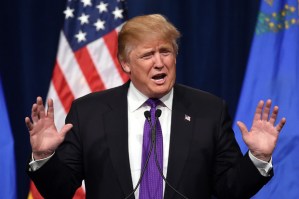
 

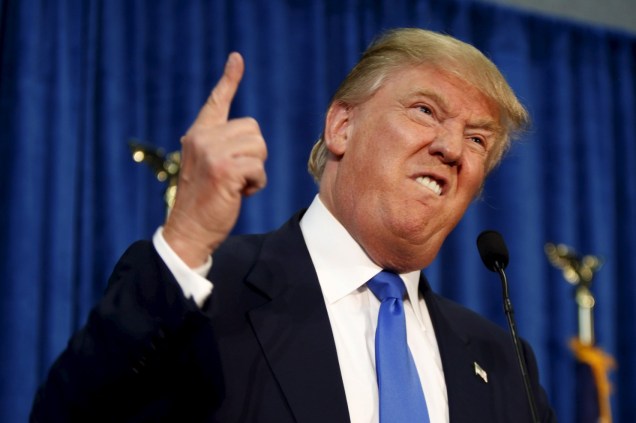
Donald Trump Hosts Nevada Caucus Night Watch Party In Las Vegas

Top Image: Washington Post, Dominick Reuter/Reuters

Support Semi-Partisan Politics with a one-time or recurring donation:

Agree with this article? Violently disagree? Scroll down to leave a comment.

Follow Semi-Partisan Politics on TwitterFacebook and Medium.

Donald Trump Wants Your Help With His Debate Prep

bill-clinton-al-gore-election-1996-campaign-website

Trump needs YOUR help to prepare for his debate with Hillary Clinton

No, not really. But his campaign have sent out a survey to supporters, asking them a series of leading questions about what subjects Donald Trump should raise in the first presidential debate on Monday, as well as precisely which insults and zingers he should hurl at Hillary Clinton.

Naturally, the landing page once you complete the survey is a donation form in favour of the Trump Make America Great Again committee (the real reason for the mailshot).

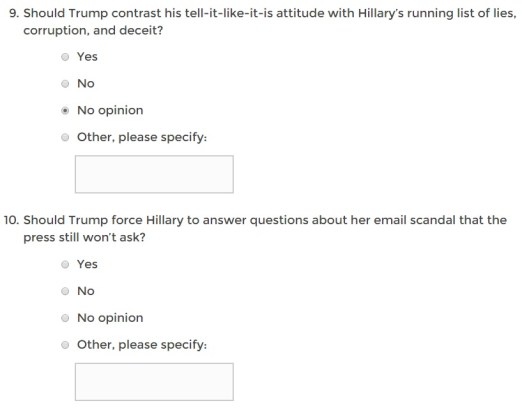
But even though the survey is utterly pointless and will have zero bearing on what Donald Trump decides to do on stage at Hofstra University, some of the questions are quite amusing:

donald-trump-debate-survey-questions

What self-respecting Trump supporter is ever going to select “No” to Question 9?

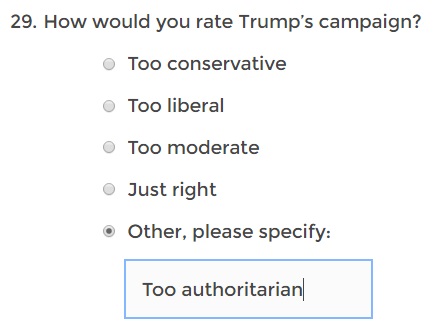
Meanwhile, other questions just cry out for an honest answer:

donald-trump-debate-survey-questions-2

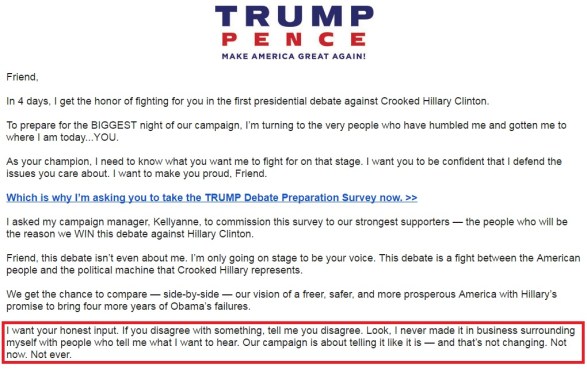
But the most amusing part has to be the introductory email:

donald-trump-debate-survey-questions-3

The message concludes:

I want your honest input. If you disagree with something, tell me you disagree. Look, I never made it in business surrounding myself with people who tell me what I want to hear. Our campaign is about telling it like it is — and that’s not changing. Not now. Not ever.

Because that’s the Donald Trump we all know and love – the humble and collaborative team player who actively solicits constructive criticism and goes to great pains to respond to just criticism.

Of course there is nothing new about surveys like this – the Hillary Clinton campaign sends out its fair share, too. But it is interesting to see how formulaic and transactional the online campaign still is – fill in this fake survey which nobody will ever read so that we can get our hands on your credit card details too.

And with the emergence of one stop shop political organising software like Nationbuilder, and those incessant, overly personal emails which overuse your name in every sentence (or substitute it with “Friend” if your name can’t be found in their database) in a desperate bid for familiarity, the online campaigns have perhaps never been as divorced from the individual candidacies and personalities of the candidates. There is certainly none of the “authenticity” of the Howard Dean online campaign, or even the Obama ’08 campaign.

As this Politico piece notes, contrasting the pioneering Howard Dean campaign with today’s professionalised and sanitised web outreach:

The question of authenticity is one that many Dean alums mull. Dean for America was a genuine, organic grass-roots movement that used Internet tools to empower volunteers and supporters to take ownership of the effort, but today’s campaigns use the Web to collect data and control the message.

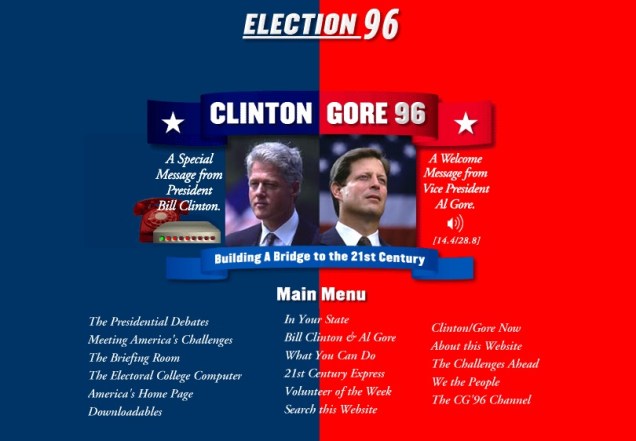
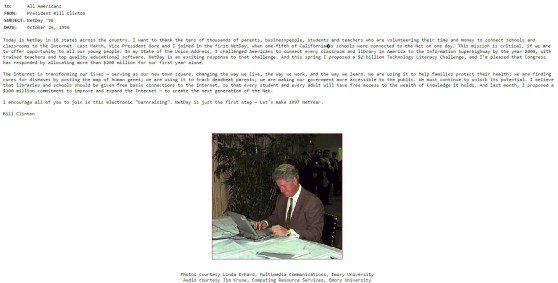
It rather makes one pine for the pioneering 1996 Bill Clinton / Al Gore campaign website, in all its dial-up, Windows 3.1 glory – if for no other reason than it offers definitive proof that contrary to his own claims, Bill Clinton does use email.

At least once, anyway.


bill-clinton-al-gore-election-1996-campaign-website-bill-using-email-on-laptop


Support Semi-Partisan Politics with a one-time or recurring donation:

Agree with this article? Violently disagree? Scroll down to leave a comment.

Follow Semi-Partisan Politics on TwitterFacebook and Medium.

Shameless Conservatives Try To Blame The Rise Of Donald Trump On Barack Obama And The Democrats

Anti-Trump conservatives need to stop trying to blame Democrats for the rise of Donald Trump, and take a good look in the mirror instead

While it is admirable that many prominent American conservatives are refusing on principle to support Donald Trump, far fewer seem introspective or self-critical enough to consider their own role in fuelling the mania which brought a reality TV star to the cusp of the presidency.

Latest to hop aboard the “look what the Democrats made us do” bandwagon is a writer I like and respect very much, the National Review’s Jonah Goldberg. There is much to admire in Goldberg’s continued and principled criticism of Donald Trump, but he goes too far when he tries to shift blame for the rise of Trump away from where it belongs – the hysterical and alarmist nature of Republican opposition to President Obama – and create an alternative universe where the dastardly Obama “trolled” the helpless GOP and effectively forced the Republican base to become frothing-at-the-mouth crazy people uniquely receptive to Trump’s message.

Goldberg writes:

Consider President Obama. One of the central insights of both the Obama campaign and administration (the difference is subtle but real) is that Obama benefits when his critics overreact. In 2008, then-political adviser David Axelrod coined the phrase “no drama Obama” to describe not only his client’s personality but his messaging. By seeming unflappable in the face of criticism, Obama comes across as presidential. The more heated the criticism, the more presidential he seems.

The thing is, Obama often intentionally provokes the conservative base. As the Washington Post’s Paul Waldman put it in January 2015, Obama “seems to come up with a new idea every couple of weeks to drive [the GOP] up a wall.” That makes him a master at trolling.

[..] Obama played a similar game with his birth certificate and the whole birther craze. He could have released his birth certificate as early as 2008, when the Mephistophelean Clinton henchman Sid Blumenthal was whispering in reporters’ ears. But Obama didn’t for years — in part because he knew the conspiracy theory would galvanize his base. It not only confirmed everything liberals wanted to hear about the Right, it also provided Obama with an endless supply of one-liners. And for a long time that worked well for Obama; he got to mock birthers and play the dignified victim.

You can probably already see the problem. When you throw out so many buckets of chum, you have no idea what kinds of creatures you’ll attract.

Obama chummed the waters for so long, he pulled in a great white shark. A man often in error but never in doubt, with a thumbless grasp of facts and a total willingness to repeat conspiracy theories, rumors, and innuendo as the truth, Trump was almost the personification of the collective id of the angrier strata of the Republican base.

It takes quite some gall to accuse Barack Obama (of all people) of fuelling the birther movement, while keeping a straight face. No other presidents in history have been forced by relentless fringe political pressure to release their birth certificate in order to prove eligibility for office, and to suggest that Obama’s understandable reluctance to rise to the conspiracy theorist bait was motivated primarily by a desire to smear the Republican Party is like blaming a homeowner you just burgled for not warning you in advance that burglary is illegal and will get you in trouble with the law.

Is Barack Obama now responsible for the welfare and fortunes of the Republican Party? Does he have some hitherto-unknown obligation to save his political foes from their own worst excesses? The idea is laughable. Republicans loved having fringe birthers on their side when it helped them storm to victory in the 2010 midterm elections – it is disingenuous in the extreme for American conservatives to pretend that birtherism was something foisted upon them by Obama himself now that it has finally become a liability.

Besides, the real roots of Donald Trump’s rise – besides the pervasive weariness with political elites in general, a phenomenon witnessed on both sides of the Atlantic – lie in the behaviour of leading conservative politicians and media personalities, and the way in which they chose to portray Obama’s centre-leftism as a unique and unprecedented socialist assault on America.

As this blog recently noted:

It was the tri-cornered hat brigade whose admirable devotion to fiscal responsibility only materialised once Barack Obama took office, and then failed to force any meaningful change in Washington despite many of their number being elected to Congress in the 2010 midterms which, who have a case to answer. They were the Great White Hope whose inevitable failure formed the third strike against the political class.

It was not the Democratic Party which fanned the flames of birtherism (and then considered a nominee for president who was born in Canada) and refused to stand up to angry constituents demanding to see a birth certificate. That was all on the Republicans. Donald Trump led that effort, and nearly the entire GOP sat back with a tub of popcorn, thinking that the circus would benefit them politically. And so it did, until their attack dog finally broke the leash and turned on its handlers.

Has Barack Obama been a decidedly left-wing and in some (though by no means all) ways unimpressive president? Yes, he has. But is he a closet Communist, a secret Muslim planning to enforce hardline Islamism on America or a hopelessly incompetent buffoon? Absolutely not. He is a centre-left politician with undeniable skills, twice elected on a centre-left platform and governing according to a centre-left approach. But in their greed to quickly win back power without doing the hard work of making their own pitch to the voters more appealing, too many Republicans were willing to tolerate and sometimes actively participate in the anti-Obama hysteria for short term political gain.

[..] Yes, the Democrats peddle in identity politics and often come down on the wrong side when it comes to favouring political correctness over freedom of speech, religion and behaviour. But it was the Republicans who opted to whip up (and profit from) blind fury about the state of the country instead of articulating a serious, coherent alternative. And in the end they were beaten at their own game. Why vote for the politician who smirks or winks when someone else is making ignorant, bigoted remarks when now you can vote for the real deal?

And again, even earlier, here:

As Barack Obama’s second term reaches its end, the size and scope of the federal government is still stubbornly large, but America has by no means transitioned into a Soviet-style planned economy. Even the hated (in right-wing circles) ObamaCare has only tinkered around the margins, funnelling a few million uninsured into some form of health coverage, inconveniently disrupting the existing coverage of a number of other people but otherwise doing nothing to change the private insurance, private provision model of American healthcare. The Second Amendment has not been substantially undermined, let alone repealed. Defence spending may be misaligned but still eclipses the rest of the world, and the US military has not been decimated. In terms of domestic policy, in other words, the world has not ended.

Has America become a libertarian paradise under President Obama? Of course not. But that’s because a Democrat won the White House and focused (as much as he could, given a spineless Democratic congressional caucus and entrenched Republican opposition) on the kind of centre-left priorities you would expect from a Democrat. And crucially, neither has America become a socialist dystopia in that time.

That’s not to say that the Republicans did not often have a point, or that they were perpetually in the wrong – in many cases, their opposition to Obama’s agenda was justified. But at all times this opposition was carried out in a shrill, alarmist and hyperbolic manner – much as British left-wingers are currently mirroring the American Tea Party with their “pass the smelling salts” horror at the thoroughly unexciting, centrist government of David Cameron.

And when you go trawling for low information votes by feeding on prejudice and stoking up concerns about the personal motivations, the loyalty and even the American-ness of the president in a childishly obstructionist scorched earth strategy, you can’t really feign surprise when the sentiments you unleash give rise to a populist demagogue like Donald Trump.

Remember, this is a political party which urged Americans in all seriousness to vote for Sarah Palin as vice president back in 2008. Sarah Palin. The Republicans have been dabbling in crazy and courting the proudly ignorant vote for decades. Donald Trump is nothing but the GOP’s longstanding approach taken to its logical extreme.

And if decent conservatives want to ensure that they never again find themselves in a position of seeing their movement taken over by an ignorant, populist demagogue then they might want to stop blaming Democrats for their own self-inflicted misfortune and instead re-examine their behaviour both in government and opposition.

Was it wise, for example, to pretend to be super tough on immigration, yet ultimately do nothing to stem the flow of illegal immigrants or otherwise reform the system, simply because Republican donors had no interest in changing the status quo, with its plentiful cheap labour for corporations and affordable illegal domestic service for households?

Was it wise to continually shriek not just that Democrats wanted to impose stricter gun control but that they were actively seeking to abolish the Second Amendment? (The big push to completely outlaw guns trumpeted in GOP propaganda has been just weeks away for the past eight years now – is Obama waiting until his very last day in office to take America’s guns?)

Was it smart to prance around as the party of national security while consistently involving America in foreign conflagrations which increased anti-American sentiment, or to pose as the party of civil liberties while loudly cheerleading for the surveillance state?

Was it really such a genius move to talk endlessly about the benefits of tax cuts for ordinary Americans while focusing them overwhelmingly on the wealthy, or to cynically pretend that America’s lost manufacturing jobs could be easily brought back home in the age of globalisation and international supply chains?

At nearly every election going back to the Bill Clinton administration and probably earlier, the Republican Party has been writing rhetorical cheques that its politicians cannot or will not cash when they are either in office or a position of influential opposition, at a national or statewide level.

They promised to be on the side of ordinary wage and salary earners, yet together with the Democrats they did nothing to address the economic stagnation of the middle class.

They ran around screaming that ObamaCare (originally a conservative think tank idea, in large part) was socialism incarnate, an evil government takeover of healthcare rather than merely a messy and flawed patch to America’s abysmal healthcare system.

They took tons of cash in campaign contributions and small donations in order to fight the Culture Wars, enriching many pundits and activists in the process, and then rode to glorious defeat on nearly all fronts.

In other words, the Republican Party was acutely vulnerable to a Trumpian takeover because they have consistently been a party of failure. They sucked at doing the things they promised their base that they would do, and they did a whole load of other things in office or opposition which their base never wanted. And still they coasted by for years, knowing that they were their supporters’ least-worst option, until a brash new arrival appeared on the scene, a stranger to Washington politics, who promised – however glibly – that instead of mere talk he would deliver decisive action.

I think this is one of those times when I see things a little more clearly and with better perspective than American conservatives like Jonah Goldberg who have been in the trenches, fighting Barack Obama from Day 1 of his presidency. Aside from eighteen instructive months in Chicago, I spent the past eight years living in Britain, where the legacy and tradition of socialism is much stronger and more pervasive than it is in the United States.

In Britain we make the NHS, our nationalised healthcare system, into a ghastly national religion and worship it from dawn to dusk even as it kills people. We accept a much bigger welfare state than Americans would tolerate. Many of us actively demand a large, activist state to protect us from the consequences of our own decisions. Even our nominally conservative party supports many of these things.

And while I may not have the painful first-hand experience of socialism as someone from, say, Venezuela, I am surrounded by enough monuments to it for Republican wailings that Evil ObamaCare is going to destroy the “greatest healthcare system on the face of the earth” and institute socialist “death panels” to dispatch infirm Americans as the opportunistic, partisan rabble-rousing that it is. Those conservatives screeching about Obama’s plot to force “socialism” on America need to take a vacation in Venezuela, and then come back and moderate their language.

As proclaimed conservatives, the Republicans are supposedly the party of personal responsibility. Well, Donald Trump is 100% the responsibility of conservative politicians and pundits, and their scorched earth approach to opposing President Obama’s agenda. It was never the job of Barack Obama to protect the Republicans from their own worst excesses, though the GOP has done a remarkable job of “socialising” the consequences and spreading the cost of their greed and idiocy across the entire country in the risk of a potential Trump presidency.

Jonah Goldberg and other conservative thinkers peddling the “look what the Democrats made us do” defence are better than this. Donald Trump is the product of decades of establishment and conservative failure to address the needs, concerns and aspirations of millions of traditional Republican voters. And rather than blaming a Democratic president for failing to keep their own supporters in check, influential conservatives should hold themselves accountable for their part in this failure.

Hopefully the price of their failure will not be a Donald Trump presidency. But if Hillary Clinton does prevail in November, Republicans should be aware that opposing her in the same shrill and apocalyptic manner as they opposed Obama may see the donations come rolling in to conservative candidates and Super PACs, but it will leave them acutely vulnerable to takeover by someone far worse than even Donald Trump in 2020.

In other words, this would be a very good time for American conservatives to learn the right lessons from their own recent history.


Donald Trump Hat - Make America Great Again

Support Semi-Partisan Politics with a one-time or recurring donation:

Agree with this article? Violently disagree? Scroll down to leave a comment.

Follow Semi-Partisan Politics on TwitterFacebook and Medium.

Politicians Aren’t Entitled To Their Own Facts, But Neither Is The Media

An independent political press corps with the knowledge and authority to call the shots and confidently call out lies when politicians tell them – rather than giving equal credence to two diametrically opposed crazy positions – is a great idea. If only our media was sufficiently trustworthy and capable of performing such a nuanced, sensitive role

Something funny seems to have happened to the New York Times.

For the past week or so, the newspaper which once twisted itself into a risible-looking pretzel trying to justify calling the practice of waterboarding “torture” when inflicted by America’s enemies but “enhanced interrogation” when conducted by American forces has discovered a new passion for clarity and bold truth-telling.

Peter Beinart explains, over at The Atlantic:

Last Saturday, The New York Times published an extraordinary story. What made the story extraordinary wasn’t the event the Times covered. What made it extraordinary was the way the Times covered it.

On its front page, top right—the most precious space in American print journalism—the Times wrote about Friday’s press conference in which Donald Trump declared that a) he now believed Barack Obama was a US citizen, b) he deserved credit for having established that fact despite rumors to the contrary and c) Hillary Clinton was to blame for the rumors. Traditionally, when a political candidate assembles facts so as to aggrandize himself and belittle his opponent, “objective” journalists like those at the Times respond with a “he said, she said” story.

Such stories, according to the NYU journalism professor Jay Rosen, follow this formula: “There’s a public dispute. The dispute makes news. No real attempt is made to assess clashing truth claims in the story … The symmetry of two sides making opposite claims puts the reporter in the middle between polarized extremes.”

[..] But the Times, once a champion practitioner of the “he said, she said” campaign story, discarded it with astonishing bluntness. The Times responded to Trump’s press conference by running a “News Analysis,” a genre that gives reporters more freedom to explain a story’s significance. But “News Analysis” pieces generally supplement traditional news stories. On Saturday, by contrast, the Times ran its “News Analysis” atop Page One while relegating its news story on Trump’s press conference to page A10. Moreover, “News Analysis” stories generally offer context. They don’t offer thundering condemnation.

Yet thundering condemnation is exactly what the Times story provided. Its headline read, “Trump Gives Up a Lie But Refuses to Repent.” Not “falsehood,” which leaves open the possibility that Trump was merely mistaken, but “lie,” which suggests, accurately, that Trump had every reason to know that what he was saying about Obama’s citizenship was false.

In other words, the New York Times has sporadically started to report objective facts and truth, rather than doing what has long been traditional among the political press corps – walking a neutral tightrope between two partisan positions of staggeringly obvious falsehood or stupidity.

Despite his protestations and evasions, Donald Trump has been one of the key players in the birther movement from the beginning – picking up from the memorably loopy Orly Taitz – and has certainly been the conspiracy movement’s most public face. I remember blogging about it over four years ago, back in 2012.

Given the context of a presidential election and the extra scrutiny on media bias, it is surprising and rather heartening to see the Times displaying the courage to report fact rather than controversy; the same headline a month ago might easily have read “Trump Withdraws Birther Allegation”, with no reference to the established facts and outcome of the story.

Jon Stewart (formerly of The Daily Show) must be smiling. Since 2004 and even earlier, Stewart railed against political coverage which ginned up conflict in pursuit of ratings and incessantly reported issues through the prism of Left vs Right, Democrat vs Republican without ever seeking to either restrict coverage to facts or move beyond partisan talking points to get to the truth. The video at the top of this article shows Stewart’s memorable appearance on CNN’s Crossfire show, in which he castigated the hosts for “hurting America” by injecting partisanship and sucking nuance out of the political discourse.

Obviously the New York Times does not inhabit quite the same infotainment space as Crossfire, but the basic operating principle has been very much the same of late – present two or more strongly opposing partisan viewpoints, let the talking heads (or journalistic sources) slug it out in defence of their respective positions, and then move on without ever really applying any kind of judgment as to the respective merits of the contrasting positions.

Nowhere is this approach better summed up than the slogan of the Fox News Channel – “we report, you decide”. It is a relativist worldview which suggests there is no truth in even quite straightforward binary debates, and that we are free to pick our own facts and construct our own reality in accordance with our personal biases and interests.

Now, there is yet more evidence that the New York Times is moving away from this risk-averse and rather cowardly stance – yesterday the newspaper described as “false” Donald Trump’s claims that Hillary Clinton has sinister plan to destroy the Second Amendment:

In justifying his remarks, Mr. Trump falsely claimed that Mrs. Clinton wants to “destroy your Second Amendment,” apparently a reference to her gun control policies.

My emphasis in bold.

At face value this is a good development – the “he said she said” approach to political coverage is what has enabled so much of the spineless print journalism and sensationalist, conflict-stoking television news reporting in Britain and America. Seeing a “respectable” institution finally buck that trend and push back against the toxic idea that reality is malleable and truth exists only in the eye of the super-partisan beholder is, in theory, a very good thing.

Peter Beinart certainly seems to think so:

A certain etiquette has long governed the relationship between presidential candidates and the elite media. Candidates stretch the truth, but try not to be too blatant about it. Candidates appeal to bigotry, but subtly. In turn, journalists respond with a delicacy of their own. They quote partisans rather than saying things in their own words. They use euphemisms like “polarizing” and “incendiary,” instead of “racist” and “demagogic.”

Previous politicians have exploited this system. But Trump has done something unprecedented. He has so brazenly lied, so nakedly appealed to bigotry, and so frontally challenged the rule of law that he has made the elite media’s decorum absurd. He’s turned highbrow journalists into referees in a World Wrestling Entertainment match.

Last Saturday, the Times answered Trump’s challenge. He’s changed the rules, so it did, too.

But this analysis only holds if one has reasonable grounds to trust the journalistic institution or media outlet doing the reporting; will they reserve their merciless news analysis features for instances when there really is a right and wrong binary perspective, or will editorial judgment and personal bias cloud the picture?

Remember, the New York Times was happy to characterise the EU referendum and the Brexit campaign as being motivated not out of concerns for democracy and sovereignty but primarily by xenophobia and anti-immigrant prejudice. And while there were highly visible elements of the latter, under the “News Analysis” model what would prevent the Times deciding that the entire Leave campaign was based on racism and then reporting this skewed perspective to their readers as simple, self-evident “truth”?

While the “he said, she said” ra-ra approach may be divisive and unseemly, it at least offers a right of reply to those whose views are misinterpreted or deliberately slandered by shameless opponents. And while conventional wisdom might hold that it is more often conservative voices who live in a sealed bubble of their own facts, in reality we would all be vulnerable to a style of news reporting in which reporters and editors are given sweeping new authority to pass what often amount to value judgments on behalf of readers. At some point in the future, any one of us could find our unpopular, minority opinion almost entirely  frozen out of the public discourse.

So this blog will cautiously cheer along with Peter Beinart at the New York Times’ sudden willingness to call out lies – provided that this is to be genuinely bipartisan new scrutiny rather than merely a one-sided club with which to bash the Trump campaign.

But we should be aware that we are at the top of a slippery slope here. Smacking down candidates and their statements is a positively good thing when we are dealing with easily proven questions of who said what, and when. But the temptation to apply this swashbucklingly assertive style of journalism to more subjective debates (like economic policy, immigration or foreign affairs) may prove to be irresistible for journalists with human biases and editorial boards with agendas.

In case they hadn’t noticed, the mainstream media doesn’t presently enjoy a particularly enviable trustworthiness rating among the general public. Abuse “news analysis” by using it as a blatantly partisan cudgel and they will drive that rock-bottom rating still lower.


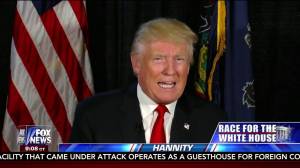
donald-trump-fox-news

Support Semi-Partisan Politics with a one-time or recurring donation:

Agree with this article? Violently disagree? Scroll down to leave a comment.

Follow Semi-Partisan Politics on TwitterFacebook and Medium.

No, Donald Trump Did Not Call For Hillary Clinton’s Assassination (This Time…)

Donald Trump already provides ample evidence that he is temperamentally unsuitable to be US president without the biased, pro-Hillary American media putting words in his mouth

There is a particularly pernicious story making the rounds at the moment that Donald Trump supposedly called for the assassination of Hillary Clinton (again).

From the New York Times:

Donald J. Trump once again raised the specter of violence against Hillary Clinton, suggesting Friday that the Secret Service agents who guard her voluntarily disarm to “see what happens to her” without their protection.

“I think that her bodyguards should drop all weapons,” Mr. Trump said at a rally in Miami, to loud applause. “I think they should disarm. Immediately.”

He went on: “Let’s see what happens to her. Take their guns away, O.K. It’ll be very dangerous.”

In justifying his remarks, Mr. Trump falsely claimed that Mrs. Clinton wants to “destroy your Second Amendment,” apparently a reference to her gun control policies.

[..] On Friday night, breaking from his prepared remarks and turning his gaze from the teleprompters, Mr. Trump looked straight into the crowd as he made the insinuation about Mrs. Clinton’s safety. He gestured emphatically with his hands as he spoke, at one time pointing to a member in the crowd to find agreement.

And the US Guardian:

In a sometimes bizarre 45-minute speech on Friday night, which opened with the unfurling of a new “Les Deplorables” battlefield flag backdrop, the Republican nominee went off-script to call for his opponent’s bodyguards to “disarm immediately” – adding, “Let’s see what happens to her.”

“Take their guns away!” Trump demanded to loud cheers during a section of the speech in which he said his rival wanted to “destroy your second amendment” and he accused Clinton of “arrogance and entitlement”.

In a statement, Clinton campaign manager Robby Mook denounced Trump’s comments: “Donald Trump, the Republican nominee for President, has a pattern of inciting people to violence. Whether this is done to provoke protesters at a rally or casually or even as a joke, it is an unacceptable quality in anyone seeking the job of Commander in Chief.”

“But we’ve seen again and again that no amount of failed resets can change who Donald Trump is.”

The call to leave the Democratic nominee protected by unarmed secret service agents, first made by Trump in May, raised eyebrows as a reversion to the undisciplined candidate of the primaries rather than the more scripted one of recent weeks. Trump also suggested in August that if Clinton was elected president, “the second amendment people” might be able to stop her from appointing judges. That statement was widely interpreted as a veiled assassination threat as well at the time.

The tone and inference of both of these articles are shockingly misleading.

The point that Donald Trump was making was that it is rather hypocritical of Hillary Clinton to advocate for stronger gun control laws which potentially limit the ability of the citizenry to defend itself when she herself is surrounded by the best trained and equipped armed guards in the world, and does not have to worry for her own safety. Trump was suggesting that were Clinton’s Secret Service protection revoked, forcing her to provide for her own personal security, she might not be so keen to limit the types of weapons available to private citizens.

Now, one can disagree with the premise of Trump’s point and poke all kinds of holes in the logic (though this blog considers the basic thrust of the argument to be quite sound), but by no stretch of the imagination does this amount to a snide assassination threat. It does not even amount to a charge of inciting his supporters to imagine the horrific scenario of an assassination. It is merely a reductio ad absurdum argument intended to make the point that well-protected senior members of the US government should perhaps refrain from dictating to ordinary Americans the manner in which they can defend themselves.

John Hinderaker of the Powerline blog makes the same point:

Trump obviously was making the point that he and countless others have made many times before: liberals like Hillary Clinton, who are protected 24/7 by armed guards, are deeply hypocritical when they try to disarm millions of Americans who don’t have taxpayer-funded protection and rely on their own firearms for self-defense. The point is a powerful one, which is why liberal reporters don’t want to acknowledge it. Instead, they absurdly pretend that Trump was hinting that Hillary should be assassinated.

This kind of thing fools no one. Millions of Americans are quietly fuming over the press’s overreach, going over the top, day after day, to defeat Donald Trump. The blowback is building, and will continue building until election day.

At one point, when I was opposing Trump during the GOP primaries, I said to the press: Stop attacking Trump! Liberal reporters often began with a valid point, but their hysterical hatred for Trump caused them to go too far, making arguments that were patently unfair and unsustainable. Therefore, the more they attacked Trump the more his support grew. The same thing is happening now: most Americans have a pretty good sense of fair play, and they know that Trump is being treated badly by the establishment–a group for whom most Americans have no great affection.

But the media, always on the lookout for the next Trumpian outrage, refused to see reality in these terms. Rather than reporting Trump’s rather simplistic but sound argument – one which was worthy of discussion and a response – many media outlets instead chose to claim, with no evidence, that Trump had done something far worse.

This blog has no problem calling out Donald Trump’s extreme and unacceptable language when he actually says something bad – the infamous “second amendment remedies” comment in August being of another order altogether. But on this occasion, Trump was not making an extremist or reckless point, though the media chose to report the two stories with the same level of outrage.

And it is this behaviour, right here, which erodes public trust in the mainstream media. It is tawdry, opportunistic media overreaches like this, so clearly betraying a seething partisan agenda, which drive decent but concerned citizens into the arms of the extremist fringe and the conspiracy theorists.

Sometimes, to watch the American media openly campaign for Hillary Clinton, one wonders if everybody else inhabits a slightly different universe. We all witnessed disturbing footage of Clinton’s lifeless body being dragged into the back of her waiting secret service van on the occasion of the 9/11 memorial in New York City, yet the chirpy presenter on MSNBC that afternoon casually announced that she merely “stumbled” a little – the definition of “stumbled” having been temporarily extended to include loss of motor control and even consciousness. What we see with our own eyes and what the media choose to report are increasingly two very different things.

And while Donald Trump has a treasure trove of past incendiary statements positively bulging with potential scandal, that is apparently not enough for the media – they must also twist Trump’s words and breathlessly and falsely report to the public that the Republican presidential nominee just called for the assassination of his rival.

You don’t need to admire or support Donald Trump to be outraged at the lazy, biased journalism on display here. This blog is certainly no Trump fan. But if someone does happen to support Trump then these unnecessary extra efforts by the media to demonise the candidate and his supporters will only harden their support and erode what little trust is left in the media.

Those perpetually outraged American liberals in the media, on the hunt for their next anti-Trump scandal, should bear in mind that hysterical and obviously-inflated charges will not have the effect of somehow “bringing Trump supporters to their senses”. On the contrary, it will simply drive Trump loyalists and even wavering voters to alternative, less scrupulous sources which echo rather than castigate their beliefs.

Lying to the American public and pretending that Donald Trump’s remarks were a de facto call for Hillary Clinton’s assassination will not cause a single person to flip from supporting Trump to supporting Clinton. But it will ensure that a number of readers wave goodbye to the New York Times and the Guardian, instead placing their trust in pro-Trump outlets like InfoWars or Mike Cernovich.

Now, is the catharsis of manufactured outrage and liberal media grandstanding really worth the potential risk of shoring up Trump’s base?


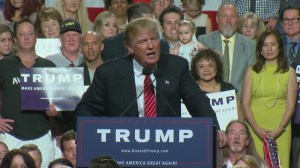
Donald Trump Rally

Support Semi-Partisan Politics with a one-time or recurring donation:

Agree with this article? Violently disagree? Scroll down to leave a comment.

Follow Semi-Partisan Politics on TwitterFacebook and Medium.