Dancing With Yourself

Tea Party Protest - Barack Obama

It is hard to disagree with this assessment of recent GOP obstructionism from Jamelle Bouie at The American Prospect:

The crux of the matter:

If I sound frustrated—and I am—it’s because we’re in the middle of an absolutely ludicrous scenario. Under a Republican president, the United States endured eight years of disastrous economic stewardship—arguably the worst of the post-war era—that nearly led to a second Great Depression. In response, voters elected a Democratic president and gave him huge majorities in both chambers of Congress. Rather than work with the new president, Republicans ran to the right and promised to defeat this president by any means necessary. They abused institutional rules to block nominees, and imposed a de-facto super-majority requirement on all legislation. Republicans rejected stimulus, the automobile rescue, a climate bill built from their ideas, a health care bill built from their ideas, and a reform bill designed to keep the Great Recession from happening again.

This was an amazingly successful strategy. It destroyed Democratic standing with the public, energized the right-wing fringe, and led to a historic victory in the House of Representatives. Once in command of the House, Republicans pushed hugely draconian budgets, risked a government shutdown, and nearly caused a second economic collapse by threatening to default on the nation’s debt. This reckless behavior depressed the economy, prolonged the recovery, and destroyed trust in the nation’s political institutions. The Speaker of the House has even promised to do this again, if Democrats don’t bow to his demands for greater spending cuts.

The Republican party of today has drifted so far – not just to the right, but into the realm of crazy, where the eight years of disastrous Bush economic stewardship apparently never happened, and the economic malaise is entirely Obama’s fault – that it’s hard for me to see how I could ever bring myself to vote for them. I have joined firmly with those who are hoping for a complete electoral landslide in the upcoming presidential elections, to perhaps convince the GOP to tack back toward a reasonable, pragmatic conservatism.

Of course, this would have been easier if one of the crazies had managed to wrest the nomination away from Mitt Romney. As it is, we will probably have to wait until Romney’s likely defeat in 2012, and then a further tack to the right and an even bigger defeat in 2016 before we might finally have a viable choice between two parties again.

The Hypocrisy of Mitt Romney – Birther Edition

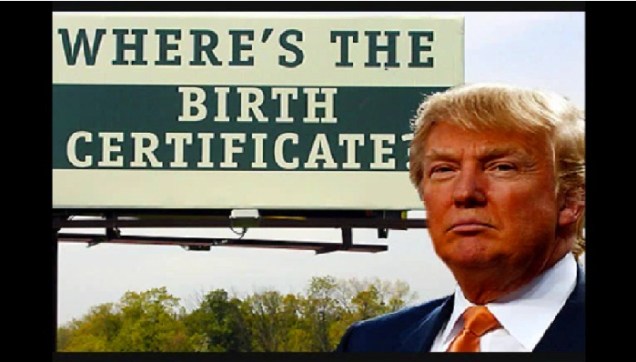
donald-trump-barack-obama-birth-certificate-birtherism

A lot of people have been wondering about the extent to which Mitt Romney would tack back to the centre of the political spectrum in the highly, highly, highly unlikely event that he manages to defeat Barack Obama in November’s contest. And to be fair, Mitt Romney has certainly added fuel to the fire of such speculation by some of his statements, most recently his surprise revelation that everything he has said before about immediately balancing the budget was just a big joke, because he is actually a Keynesian at heart, and knows that to reduce federal spending by $1 trillion in year 1 would not be the most positive thing to do to a fragile economy.

But those people thinking (either worrying or hoping) that a Romney presidency would move to occupy the political centre ground need speculate no more. Because Mitt Romney has now proved beyond question that he is fully and totally beholden to the extreme right wing of the Republican Party, and would no sooner do anything to anger that bastion of support than he would chop off his own hand. How do we know this? Because Mitt Romney refused to distance himself from his most high profile campaign surrogate and supporter, Donald Trump, when he said this:


And then doubled down with this:


Romney, meanwhile, had only this to say when asked about his wayward campaign surrogate:

Mitt Romney said Monday he wasn’t concerned about Donald Trump’s commitment to the “birther” conspiracy, one day before the GOP presidential candidate hosts a fund-raiser alongside the celebrity business magnate.

Asked on his charter plane whether Trump’s questioning of President Barack Obama’s birthplace gave him pause, Romney simply said he was grateful for all his supporters.

“You know, I don’t agree with all the people who support me and my guess is they don’t all agree with everything I believe in,” Romney said. “But I need to get 50.1% or more and I’m appreciative to have the help of a lot of good people.”

Even when his most high-profile supporter and key surrogate goes totally off the rails and revives his old birther conspiracies prompted by nothing at all, Mitt Romney is too afraid of angering his base to unequivocally disassociate himself from the remarks. Surely no one now harbours any remaining belief that Romney would tack back to the centre if he got elected. Tea Partiers, fear not – you may not like the guy and distrust the sincerity of his convictions, but it doesn’t matter – he’s scared of incurring your wrath, so you have him safely in the bag.

If, in some dystopian world, I had to choose between a President Romney and a President Trump, I think I am minded to go for President Trump. He may be batsh*t insane with an ego the size of one of his towers, but at least I would always know what he really thinks about something.

The Hill Channels The Onion

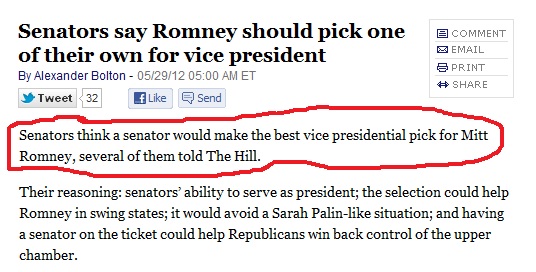
I saw this headline on thehill.com and just had to laugh:

Senators think a senator would make the best vice presidential pick for Mitt Romney, several of them told The Hill.

http://thehill.com/homenews/senate/229757-senators-say-romney-should-pick-one-of-their-own-for-vp

Fancy that. Good to see that they have a sense of humour over there on The Hill.

The Hypocrisy of Mitt Romney – Government Spending Edition

mitt-romney-2012-presidential-election

I missed this when it happened last week, but it appears that during an extended interview with Mark Halperin, Mitt Romney managed to fastidiously lay multiple bundles of high explosive around the foundations of his own economic policy arguments, retreat to a not-very-safe distance, press the plunger and bring the whole thing crashing down around him, revealing his public stance to be the glib, opportunistic sham that it is, with hardly anyone – least of all the interviewer – noticing a thing.

I only found out after being cross-linked through Charles Pierce’s blog at Esquire, where he documents the exchange as follows:

Halperin: Why not in the first year, if you’re elected — why not in 2013, go all the way and propose the kind of budget with spending restraints, that you’d like to see after four years in office?  Why not do it more quickly?

Romney: Well because, if you take a trillion dollars for instance, out of the first year of the federal budget, that would shrink GDP over 5%.  That is by definition throwing us into recession or depression. So I’m not going to do that, of course.


I then picked up the thread when Jonathan Chait jumped on Romney in his piece in the New York Magazine:

Of course! Romney says this as if it’s completely obvious that reducing the deficit in the short term would throw the economy back into recession, even though he and his party have been arguing the opposite case with hysterical fervor. Republicans have committed themselves to Austrian economic notions and other hoary doctrines justifying the position that reducing deficits is a helpful way out of a liquidity trap.

I’ve thought that this represents primarily a case of self-delusion in the cause of political self-interest, as opposed to conscious cynicism: Republicans understood that bigger deficits would spur faster growth and reduce their chances of regaining power, so they found themselves more persuaded by theories suggesting bigger deficits wouldn’t really help. But if they had really converted to this belief, wouldn’t there be even a tiny bit of wailing about Romney’s open endorsement of Keynesianism? It’s not as if conservatives have been shy about holding his feet to the fire when he expresses some tiny deviation from their position. Yet I have noticed zero conservative complaints about Romney’s big fat wet kiss to John Maynard Keynes, which suggests their level of actual devotion to this position borders on nil.

It really does take a special kind of nerve – or else just the realisation that he can be a completely convictionless politician and change his public statements to suit the political mood without ever, ever suffering significant fallout – to execute this kind of 180-degree U-turn in a televised interview, and expect to get away with it.

Aside from revealing an important truth about what a Romney administration would actually do were he to win the election, it also demonstrates a total contempt for his supporters, some of whom he must know actually believe that he will take the immediate and drastic action to balance the federal budget that he still promises in his attacks on President Obama.

What a man.

The Last Word On Bain

Mitt Romney - Bain Capital

Between them, I think that Andrew Sullivan (writing at The Daily Beast) and Joe Klein (at Time) sum up perfectly the way that Romney’s tenure at Bain Capital can be reasonably and fairly framed in the forthcoming election debate.

First Sullivan:

The point is that a president cannot just maximize profts for shareholders. Being a CEO is not the same as being a president. Moreover, even if you think that Romney’s highly profitable adventures in private equity helped the economy more than hurt it, the rigged system in which he paid lower taxes, exploited other loopholes and made money regardless of the outcome in any specific case is not a pretty picture of real market capitalism.

And then Klein:

It seems to me that Obama’s immediate point is wrong: Romney wasn’t primarily about job destruction and corporate plundering. His larger point–that Romney was not so much about job-creation as he was about profit-creation–is correct, though. But the largest point of all is this: private equity capitalism was all about short-term profits–maximizing shareholder value–rather than long-term growth. It ushered in an era of massive executive compensation and bonuses. It prospered because of tax rules that made debt more profitable than equity, and a “carried interest” tax dodge that enabled Mitt Romney to pay a lower percentage in taxes than your average construction worker. It can be a useful tool in restructuring companies and steering them toward profitability, but it is not the sort of model you’d want to apply to the entire American economy.

A President has to be about long-term growth, not short-term profits–and to the extent that Barack Obama is using the Bain ads to make this larger argument, he is not “stumbling” or attacking “free enterprise,” but he is steering the conversation toward the most important topic this year: what sort of economy do we want to have and how do we get there?

There’s nothing in these arguments that sounds stridently anti-capitalist or envious of wealth creation. The point is simply one of short term vs. long term focus, and whether successful stewardship of a large nation requires additional skills over and above those required to succeed in business.

If – if – Obama can stick to this narrower line of attack, as he did at the recent NATO summit press conference, he will be much less vulnerable to the inevitable, tired charges of socialism and class warfare that are already being warmed up by some on the Right.