People’s Vote Celebrities Burnish Their Woke Credentials By Giving False Hope To Remainers

Bono U2 EU flag Brexit virtue signaling

As celebrities and failed politicians prepare to gather for another central London protest against Brexit, their unchanging tactics make clear that this is more about burnishing their reputations as right-on culture warriors than sincerely trying to persuade the British people to change course

John Harris has long been about the only writer at the Guardian worth reading, and today he has some wise words of advice for the organizers and stars of the upcoming march in support of “People’s Vote” on overturning Brexit and remaining in the European Union.

For those who have been living under a rock and therefore missed the incessant publicity of these astroturf, significantly foreign-funded umbrella groups agitating for another vote (termed by activists and unquestioningly sympathetic journalists the “People’s Vote” because presumably the June 2016 vote which they lost turned out not to be a people’s vote) are holding another one of their big marches in central London. They will be meeting in fashionable Park Lane, that bastion of salt-of-the-earth Britishness with which so many potentially wavering regional Leave voters identify, and sauntering down to Parliament Square where they will hear various assembled celebrities and last season’s political grandees tell them the same comforting bromides that they have been repeating for over two years.

John Harris thinks that maybe – just maybe – this “second time lucky” approach will not bring the windfalls which the organizers are hoping for, which presumably include generating mounting and irresistible public pressure for Brexit to be delayed while a new referendum is organized.

Says Harris:

The music, apparently swelling towards a climax that never arrives, sounds like a Coldplay outtake, and most of the faces suggest an entertaining Saturday night in front of the TV. On and on they go: the singer Jamelia, the actor Dominic West, Philip Pullman, Stephen Mangan, Josh Widdicombe, Tracey Ullman, Natascha McElhone, the musician Nitin Sawhney, Gary Lineker, Matt Lucas and good old Dan Snow. Non-famous people seem to be few and far between, with the exception of an unnamed man in front of a football crowd and someone whose caption merely says “a farmer from Scotland”.

Who are these people? The same crowd of luvvies who believe that their celebrity endows them with some special wisdom and insight into geopolitics which the rest of us desperately need to hear. The same people who actively drove wavering voters into the arms of the 2016 Leave campaign.

Harris continues:

Ostensibly, the video is aimed simply at encouraging people to go on the demo, a job it may well be doing reasonably well. But it clearly has a larger reach, and shines light on an increasingly inescapable problem: the failure of the range of forces now pushing against Brexit (from Open Britain, to Scientists for EU and the student campaign FFS (AKA For our Future’s Sake), and Britain for Europe) to do much more than working up their own side, and get anywhere near shifting the balance of opinion in the country.

Slow hand clap. It took two years, but we finally got there. To be fair, Harris probably knew this all along – but then if more instinctively pro-EU journalists, commentators and campaigners had half of Harris’ self-awareness we likely would not have voted to leave the EU in the first place. More:

To be fair to anti-Brexit campaigners, the contortions of the Labour party and the big trade unions are not helping them. But they should also look at their own failings. First, as evidenced by the video, they cannot seem to break out of the stereotype of remain voters as metropolitan and largely middle class, nor push beyond the impression of the anti-Brexit cause as something led by representatives of some awful ancien regime, commanded by Tony Blair, Nick Clegg and Bob Geldof (with supporting roles for, say, the former minister Andrew Adonis and the philosopher AC Graying, both of whom perhaps ought to tweet less).

Overall, there is still precious little awareness that if you put the people formerly known as the great and the good at the forefront of anti-Brexit campaigning, you run the risk of simply reminding millions of people why they voted to exit the EU in the first place. The problem is arguably symbolised by one fact above all others: that by the end of this month, the two biggest anti-Brexit events to date will have been huge marches in London.

This is why I shake my head every time that Tony Blair decides that the nation needs to hear from him on Brexit one more time – that if only he gives one more stirring speech, contorting his increasingly cadaverous face into those positions of faux-anguish and sincerity which once fooled so many of us – that we will immediately stop, see the error of our ways and hand the car keys back to the same determined kidnappers who drugged and abducted us in the first place, just as we stand on the cusp of escape.

But clearly this is not a lesson which penetrates the minds of the Smartest Guys In The Room, the people who think that their credentials, jobs and lifestyles give them some kind of exclusive divine right to chart Britain’s course. And so, like a one-hit wonder that won’t go away, they keep playing the same tune to an increasingly bored wider audience.

But it need not be like this, says Harris, who proposes ditching the celebrities and failed ex-politicians in favor of being seen “pitching up in the places that voted leave, and finally listening”. Harris signs off with this parting advice:

And perhaps bear in mind the words of the venerable Gina Miller, uttered at the people’s vote march earlier this year. “It’s time we took things back to the streets and the lanes, the towns and the villages, the meadows and the squares of this country,” she said. So why haven’t they done it?

Why haven’t they done it yet? Maybe because people like Gina Miller and the assembled celebrities agitating to subvert Brexit would never sully themselves by holding their big march in Sunderland (61-39) or Boston (75-25). Hell, they won’t even go so far as Birmingham (50.4-49.6). They wouldn’t be caught dead in any of those places. They’re happy to cut schmaltzy little videos exhorting other people to take the “People’s Vote” campaign to those areas, but Patrick Stewart and Bob Geldof aren’t going to check in to the Premier Inn Coventry and dine at Wetherspoon’s after a long day knocking on doors or accosting shoppers outside WH Smith.

And so we have this ludicrous campaign of unhinged celebrity carnival barkers, bleating their hypocritical demand about another referendum yet refusing to take their message beyond its existing metropolitan strongholds. Remember, these people really do consider themselves so smart. So much more educated, so much better informed, so much more aware of every possible relevant factor concerning Brexit, and yet they have made zero attempt to change the disastrous strategy which saw them lose the last round back on June 23, 2016.

Why? I am becoming increasingly convinced that the reason is that for many of them, this is not about leaving the European Union at all. That like so many other social justice causes, this is little more than a convenient vehicle for second-tier celebrities to clamber onto in order to prove their woke, right-on credentials. In short, the People’s Vote campaign is at least 50% a culture war issue. If even half of these celebrities were really motivated purely by the earnest desire to see Britain saved from economic self-harm, they would have been found during the 2017 snap general election protesting Jeremy Corbyn’s Labour Party and cutting urgent YouTube campaign videos warning people not to vote for the party of renationalization and endlessly high taxes. But they didn’t, because allying with the Conservative party makes for bad PR, while hating on the Tories makes you cool and edgy.

Establishment and celebrity Remainers talk the language of economic damage, but at heart they are fighting a culture war. And to these people, Brexit is to be opposed because as Bono never tires of lecturing us, the European Union stands for everything enlightened and noble on this continent, and the nation state (and particularly Britain) stands for everything retrograde, oppressive and embarrassing. I have been watching this establishment-celebrity hissy fit roll on for over two years now, and I am convinced that the great thrust of their motivation is entirely rooted in the culture war.

Were it otherwise, establishment and celebrity Remainers would have used some of their vaunted intellect to learn from their mistakes and change tack. They would have realized that screeching worst case scenarios of economic doom at a population who were not evaluating the decision to leave the EU purely on economic terms had failed once, and would likely fail again. They would have conceded that having the same tedious, back-slapping conversation in which they and other like-minded souls praise one another for being so compassionate, intelligent and not stupid enough to be manipulated by the Russians was not buttering any parsnips among Leave voters. They would have ventured out into places like my hometown of Harlow, Essex and chatted with voters there – that way they could engage and attempt to convert some Leave voters firsthand while remaining within spitting distance of the M25 when they reached their tolerance limit for mingling with parochial Gammons.

But the celebrities and their political puppet-masters didn’t do any of that stuff. Instead, they threw every insult in the book at the other side. They painted the question in stark, good versus evil terms. They put forward air-headed celebrity spokespeople to make pro-EU statements about as emotionally convincing as a Kate Winslet Oscars acceptance speech. They came up with a new, racist word for white male Leave voters: Gammons. They broke out their actuarial tables and publicly looked forward to the death of elderly Brexit voters. And they organized march after insufferable march deep in the heart of Fortress London, the only part of the United Kingdom which most of them know or like.

The campaign for a “People’s Vote” is an exercise in catharsis for ordinary Remainers and an opportunity for virtue-signaling and personal brand-burnishing for the campaign’s celebrity conscripts. It is the least organic political movement in modern British history, and by far the most cynical. Again, most of these people bleating that the British people must be given a say over the terms of our future relationship with the EU never wanted the public to have a say in the first place, and certainly never wanted any public consultation or consensus-building as government after government took us deeper into supranational political union. And now they’re weeping in the streets of London, claiming that another referendum is required in the name of justice and democracy? Give me a break.

This is a culture war and these people are culture warriors – and rather pathetic, transparent ones at that. They certainly are not genuine tribunes of the people. Go ahead, try to change my mind.
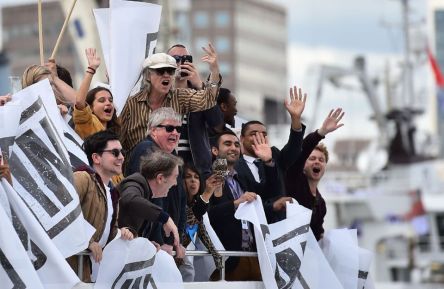
Bob Geldof - EU Referendum - Brexit- Fisherman boat protest

Agree with this article? Violently disagree? Leave a comment.

Follow Semi-Partisan Politics on TwitterFacebook and Medium.

Preserving The Legitimacy Of The Supreme Court Must Outweigh Partisan Anger

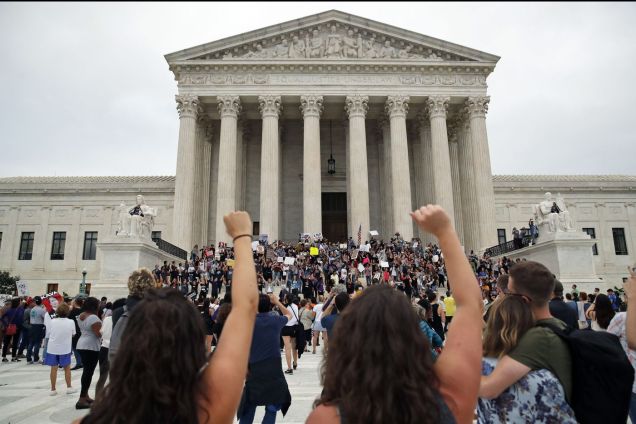
Protesters on steps of Supreme Court - Brett Kavanaugh confirmation - SCOTUS

Conservatives lived with what they saw as a left-leaning, activist Supreme Court for decades without undertaking serious efforts to undermine the institution. But while the American Left rightly decries the various attacks on governmental institutions in the Age of Trump, their anger at the confirmation of Brett Kavanaugh is leading them to do precisely that which they say endangers the Republic

I spend a lot of time criticizing the American news media, and rightly so since there is a lot to criticize in this so-called renaissance of print journalism in the Age of Trump. I often single out the New York Times for particular criticism – their claim to run a scrupulously impartial and ideologically neutral newsroom is risible when their opinion pages are stacked 10-1 with not just left-wing progressives, but the kind who have drunk deep from the well of social justice and are now utterly high on the most poisonous distillation of identity politics dogma.

But I also feel compelled to give credit where credit is due. While the New York Times and other prestige media outlets may devote large portions of their time and resources to misrepresenting conservatives and stealthily promoting leftist agendas, today their Opinion email bulletin featured a progressive Op-Ed writer who actually sought to lay out the conservative perspective in good faith for the benefit and enlightenment of Times readers, rather than misrepresenting the conservative perspective to generate cheap outrage.

Addressing the ongoing rancor generated by the nomination and confirmation of Justice Brett Kavanaugh to the Supreme Court, Op-Ed columnist David Leonhardt clearly set out his own liberal position, but then laid out the opposing view in a way which did not openly invite ridicule or snap moral judgment.

Leonhardt begins:

In this polarized era, most of us don’t spend a lot of time genuinely trying to see a political issue the way that the other side does. And it’s often worth doing so. Let me give you an example.

He then goes on to state his own personal view (entirely in line with progressive thinking) that the Court is supposedly dominated by an “extremely conservative and partisan majority” sufficient to justify Democrats looking at potentially extreme ways to curb the institution‘s power.

But then Leonhardt says this:

But here, roughly, is how some conservatives think about the Supreme Court:

In the mid-20th century, a liberal court regularly overruled the popular will or blocked the democratic process. It happened most famously on abortion, but also on school prayer and other subjects. And even though Republicans won the White House in five out of six presidential elections starting in 1968, the court remained left of center, partly because a few supposedly conservative justices didn’t turn out to be conservative.

Yes, the current court is more conservative than the country, these conservatives might say. But we know how you liberals feel right now. Don’t go undermining an entire institution of government just because you have some complaints about it.

The Left does not like to be told of its glaring faults and hypocrisies, particularly by one of their own, so we will no doubt soon see what happens to the career trajectory of David Leonhardt. But laid out here, with no attempt at distortion, is the basic thought process behind most conservatives’ attitude toward the Supreme Court.

To be clear, I personally would not have nominated Brett Kavanaugh to the court over concerns about his views of executive power, and I would not have confirmed him after his performance in the confirmation hearings (yes, it’s natural to be angry at what you see as false accusations, but going on a conspiratorial rant about the Clintons is the antithesis of the impartiality which should be shown by a Justice of the Supreme Court, particularly one whose background was in the Republican presidential administration of George W. Bush). There are other judges with similar judicial philosophies who would have been better for conservatives from both a constitutional perspective and the short-term political perspective of the nomination process (cough, Amy Coney Barrett).

But while I would much rather have seen a different justice confirmed to the ninth seat on the Supreme Court, at this point I am more concerned about the hypocrisy of those on the Left who rend their garments about the damage which President Trump is doing to vital American institutions, while also actively seeking to undermine public faith in the court and even enthusiastically contemplating the idea of stacking the court to restore it’s leftward tilt, should they acquire sufficiently strong control of Congress after the midterms.

The dangers posed by President Trump’s erratic, ego-driven leadership are very real, and the precipitous decline in public faith in key institutions of government is a corrosive acid eating away at the American democracy. But those entirely valid fears are recast as cynical partisan pandering when their chief expounders are also doing their darnedest to destroy trust in institutions after having suffered a setback on the Supreme Court. And as a result of this cynical behavior, people are less likely to take the warnings seriously.

Worse still, the Democrats’ pain threshold is apparently so low that they could not tolerate a potential originalist/textualist (or more cynically, rightward) shift on the court for even a week before they started openly agitating to undermine the institution. Say what you want about the Republicans, and there is much to say – particularly concerning their disgraceful refusal to even consider Merrick Garland, President Obama’s eminently qualified Supreme Court nominee – but conservatives watched as the Burger, Rehnquist and Roberts courts handed down many decisions which they regarded as unconstitutional. Decisions which decisively reshaped the fabric of American life. And while nobody would say that Republicans took defeat gracefully or played the part of happy warriors, at least they did not try to stack the court or mount targeted efforts to delegitimize the institution altogether.

One can disagree with the originalist and textualist judicial philosophy which may now come to more prominence in the Supreme Court’s deliberations, but it is a valid and serious worldview worthy of respect, certainly no less so than the “living constitution” alternative. The answer to political setback is not to take one’s toys and go home in a temper – it is to seek to persuade voters that the progressive alternative is better such that Democratic senators and presidents are elected who can nominate like-minded individuals to the Court. The answer is not to falsely claim that theirs is the only pure and neutral interpretation of the constitution while the conservative perspective is uniquely partisan and dangerous.

Congress already has a rock-bottom approval rating, with hardly anyone respecting the legislative branch of government. The divisiveness of the Donald Trump era has seen one group hold out the present head of the executive branch to be worshipful and almost divinely given while the other group thinks he is Literally Hitler. That leaves only one branch of government held in significant public esteem – the judiciary, led by the Supreme Court.

Is undermining remaining public trust in the third branch of government and sawing the third and final leg off America’s governmental tripod the responsible thing to do right now? Is it even the most politically lucrative thing to do in the short and medium term, given how the Kavanaugh saga has energized the Republican base and put a handful of oncecompetitive seats further out of the reach of Democrats?

My opinions on how best to move forward are currently in flux, but I am attracted by propositions that the Supreme Court should no longer be populated with the same nine lifetime appointees, but rather by federal appeals court judges selected at random for shorter terms, on a staggered basis (see this Vox piece, which is sadly also a prime example of how the Left see theirs as the only legitimate point of view and recent progressive leanings of the Supreme Court not something even worth mentioning). Of course, this change is about as likely as President Trump admitting that he is a Russian stooge, resigning Nixon-style and flying away in a helicopter as a bemused nation watches him go. But it seems like a good potential approach, and one which would do much to depoliticize the highest court (even if the nomination of federal appeals court judges then became somewhat more contentious as a result).

But realistically, we go forward with the institutions we have in the form we have them, staffed by the people whom due process has put in charge. And there is a simple choice to be made by the American Left: do they press ahead and burn away remaining public faith in the Supreme Court, or do they commit – as conservatives did, when they saw that they would keep losing and losing at the hands of the judiciary unless they took a long-term approach to regaining influence – to advance their goals utilizing the legitimate, existing (if flawed) processes and institutions available to them?

Last week I attended oral arguments at the Supreme Court for the first time, hearing the somewhat dry but still fascinating case of New Prime Inc. v. Oliveira being argued before the then-eight sitting Justices of the Court. Sitting in the public seating, soaking in the weight of history within those walls and watching some of the best-credentialed lawyers at the top of their game argue before eight eminent and generally well-intentioned jurists was an unforgettable experience, especially given that I am now studying law in the shadow of that court, right here in Washington, DC.

This case was about employment rights and whether long-distance transportation workers were required to resolve workplace disputes through compulsory arbitration rather than through the courts – an edict which currently varies depending on whether the individual is a waged employee or an independent contractor (an increasingly irrelevant distinction in today’s economy). This kind of case is the Supreme Court’s bread and butter – deciding disputes whose facts would make most people’s eyes glaze over within thirty seconds, but which nonetheless need to be resolved in order to give direction to lower courts and advance the broader course of justice in the United States.

This was not one of the few hot-button social issues which attract hordes of placard-waving protesters to the courtroom steps. The case certainly matters, but primarily to the litigants involved and those who share their interests – transport corporations, unions and the like. Does the Left really want to wage such war on the legitimacy of the United States Supreme Court that even these workaday cases become seen by half the country as fraudulently or illegitimately decided? So that lobbyists, pressure groups and corporate interests feel more emboldened to undermine every negative decision and even mount targeted campaigns against specific Justices as a result of their opinions?

I share some of the American Left’s concerns about America’s direction, particularly the slide toward authoritarianism and protectionism (though I hold the Left equally if not more responsible for these phenomena than the Trumpists, who are largely a symptom, not a cause of America’s malaise). But for the life of me I fail to see how waging an all-out assault on the remaining credibility of the most respected branch of the United States government redounds to the Left’s long-term advantage, results in a more functional country or a more harmonious society. All I see is more bitterness, more mutual distrust and more negative energy fueling the ever-growing vortex of our ongoing culture war.

The Left have every right to be angry with some of the circumstances of Brett Kavanaugh’s nomination to the Supreme Court, and with cynical Republican political behavior prior to that. But they do not have the right to enjoy decades of often-amenable Supreme Court decisions, and then seek to tear down an institution vital to all Americans the moment they believe it may no longer adequately serve their progressive purposes.

In that regard at least, the price of the Left’s present paroxysms of rage may be more than this beleaguered country can bear.


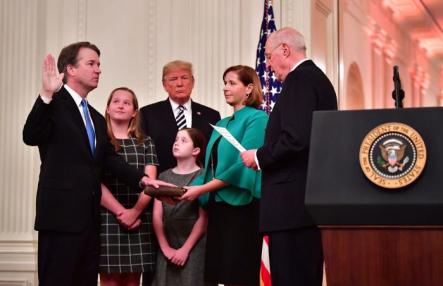
Brett Kavanaugh swearing in ceremony Supreme Court - SCOTUS

Agree with this article? Violently disagree? Leave a comment.

Follow Semi-Partisan Politics on TwitterFacebook and Medium.

Lee v. Ashers Baking Company, A Victory Against Compelled Speech

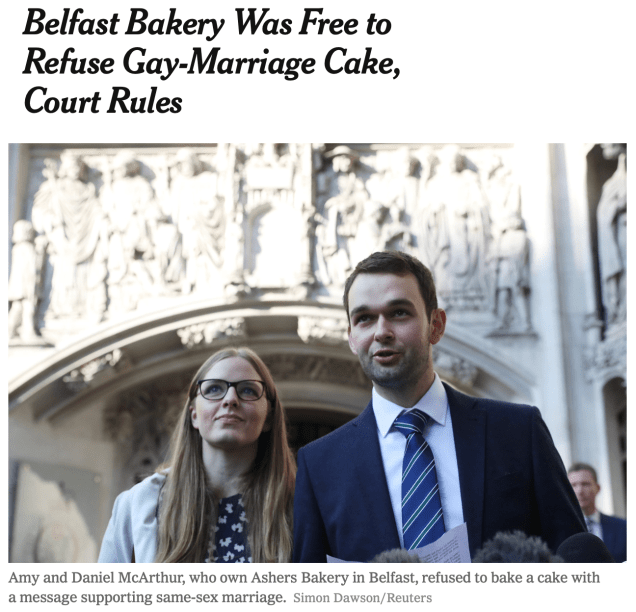
Asher Bakery Belfast gay marriage cake compelled speech

Today saw a victory against compelled speech and authoritarian government, but fewer and fewer voices on the Left are in the mood to celebrate

Today the Supreme Court of the United Kingdom handed down a decision in Lee v Ashers Baking Company Ltd, the UK’s equivalent of the Masterpiece Cakeshop case in the United States (which the UK court actually cited in its ruling).

Both cases came about when plaintiffs claimed discrimination based on sexual orientation after trying to place an order for wedding cakes bearing messages supportive of gay marriage at bakeries owned and operated by traditional conservative Christians, who then refused the orders on the grounds that to produce the cakes bearing the specific messages would violate their deeply held religious beliefs.

From the BBC:

The UK’s highest court ruled that Ashers bakery’s refusal to make a cake with a slogan supporting same-sex marriage was not discriminatory.

The five justices on the Supreme Court were unanimous in their judgement.

[…] The customer, gay rights activist Gareth Lee, sued the company for discrimination on the grounds of sexual orientation and political beliefs.

But the bakery has always insisted its objection was to the message on the cake, not the customer.

I have long taken the view put forward many years ago by Andrew Sullivan, that gay marriage should be accepted on the grounds that broadening an institution which promotes stability, permanence, mutual responsibility and (consequently) social capital can only be a good thing, especially at a time when social atomization and selfish, destructive cultural hedonism are doing so much to weaken vital bonds at the community and national level.

I would never advocate (nor tolerate) religious institutions being forced to conduct gay marriage ceremonies against their will, but rolling out the basic template of marriage and making it more widely accessible – especially to one of the only demographics which currently shows any enthusiasm for the institution! – seems perfectly sensible to me.

But even more abhorrent than the idea that the government might compel religious organizations to conduct ceremonies which violated their codes and moral systems is the  prospect of government compelling the speech of ordinary people, making anybody who wishes to participate in the public square affirm certain social dogmas on pain of civil or criminal liability. We have already seen Canada start to go down this road with Canadian Bill C-16, a statutory amendment which adds gender identity and gender expression to classes of individuals protected under Canadian human rights law, and moves perilously close to criminalizing the “misgendering” of people. Thus it is not inconceivable that someone could be held criminally liable in Canada were they to refuse to conform their speech to proclaim that trans women are women and trans men are men.

Compelled speech is the very last thing a healthy liberal democracy should be striving to enact. Thus it is great to see at least one human rights and civil liberties group – one which has not yet fully prostrated itself before the Cult of Social Justice and Identity Politics – celebrate the Ashers Baking Company decision.

From the Peter Tatchell Foundation:

“This verdict is a victory for freedom of expression. As well as meaning that Ashers cannot be legally forced to aid the promotion of same-sex marriage, it also means that gay bakers cannot be compelled by law to decorate cakes with anti-gay marriage slogans,” said human rights campaigner Peter Tatchell, Director of the Peter Tatchell Foundation.

“Businesses can now lawfully refuse a customer’s request to emblazon a political message if they have a conscientious objection to it. This includes the right to refuse messages that are sexist, xenophobic or anti-gay, which is a good thing.

“Although I profoundly disagree with Ashers opposition to marriage equality, in a free society neither they nor anyone else should be forced to facilitate a political idea that they oppose.

“The ruling does not permit anyone to discriminate against LGBT people. Such discrimination rightly remains unlawful.

“Ashers did not discriminate against the customer, Gareth Lee, because he was gay. They objected to the message he wanted on the cake: Support gay marriage.’

It is sad that statements like this now have to be cheered and encouraged rather than taken for granted by civil liberties defenders and free speech advocates, but such are the authoritarian times in which we live – trapped in a pincer movement between what Maajid Nawaz calls the “Control Left” on one side, and reactionary, protectionist nationalists on the other.

Proving that he is one of the few prominent voices on the British Left who remains capable of thinking through the consequences of implementing illiberal leftist identity politics dogma heedless of the ramifications, Tatchell continues:

If the original judgement against Ashers had been upheld it would have meant that a Muslim printer could be obliged to publish cartoons of Mohammed and a Jewish printer could be forced to publish a book that propagates Holocaust denial. It could have also encouraged far right extremists to demand that bakers and other service providers facilitate the promotion of anti-immigrant and anti-Muslim opinions.

Of course it wouldn’t be; we know that the administrators of this illiberal code – including establishment figures as powerful as the former head of the Crown Prosecution Service – would implement any such statutes or case law highly selectively, punishing only the disfavored “white, Christian male” group while refraining from holding other groups to the same draconian standard. But Tatchell is quite right that the argument for compelled speech, taken not even so far as to its logical conclusion but merely a few steps down the road, would swiftly end up censoring and controlling us all.

The real concern is that old-school campaigners like Peter Tatchell are a dying breed. In fact, they are being hunted to extinction by a new generation of social justice warrior activists whose petty accomplishments are nothing compared to someone like Tatchell (who, like him or not, has labored for years and put his body in harms way more than once in advance of his ideals) but who deludedly think they morally outrank him because they are willing to go further in their rhetorical, legal and constitutional attacks on dissenters.

This is a time when conservatives – indeed, anyone not of an ultra-progressive persuasion – need to pick their battles very carefully. Social conservatives may disagree vehemently with the social views of someone like Peter Tatchell, but in this authoritarian age it is not he who seeks to impose his views on others. Indeed, given the opportunity, some social conservatives would be more likely to impose their own views on progressive dissenters than Tatchell would do to them – which should give serious pause for reflection.

At this time the threat to fundamental rights and civil liberties, when the identity politics Left is hell-bent on compelling the speech of private citizens, forcing them to say words or endorse ideas in which they do not believe, old political divisions must be put aside in order to withstand the creeping incursions of authoritarianism into society. There will be time enough to relitigate social issues once we have jointly confronted and dispensed with the band of zealots who would actually put us in prison for thinking the wrong things.

In these fractious times, the sane(r) Left urgently needs shoring up. Because if things continue on their current trajectory, Peter Tatchell’s ideological opponents on the right will miss him when he is gone.


Ashers Bakery Belfast

Agree with this article? Violently disagree? Leave a comment.

Follow Semi-Partisan Politics on TwitterFacebook and Medium.