Bernie Sanders Is Right To Seek To Ban Private Prisons

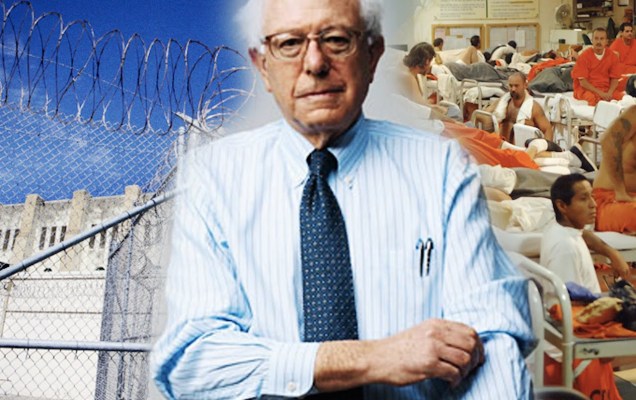
Bernie Sanders - Abolish Private Prisons

Free market and small government arguments are immaterial: privately run jails and prisons are morally repugnant and should be banned

As yet more evidence that the world is rapidly going insane, I find myself in agreement with Bernie Sanders on a matter of domestic policy.

The Washington Post reports:

Sen. Bernie Sanders (I-Vt.) will unveil a plan Thursday to ban privately run jails and prisons, which he says have a “perverse incentive” to increase the number of incarcerated people in the country.

Under the proposal by the Democratic presidential hopeful, the federal government would have three years to end its practice of using private companies to keep people behind bars. The ban would also apply to state and local governments, which have increasingly turned to private contractors in a bid to save money.

“It runs counter to the best interests of our country,” Sanders said in an interview Wednesday. “You should not be making a profit off of putting people in prison.”

Sanders’s “Justice Is Not For Sale Act,” which he plans to introduce as legislation in Congress, also includes several provisions intended to dramatically reduce the number of immigrants who are held in detention facilities while awaiting court hearings on their legal status.

Good. This blog is all for privatisation of state-owned industries and competitive free markets, but there is a limit to how far small government absolutism should go.

The most sacred and fundamental powers of any democratic government are the power to wage war and the power to imprison (or in America’s case, even execute) a citizen found guilty of committing a crime. Both matters are far too serious to be left to the private sector, especially for so tawdry a reason as cost reduction.

Just as Western democracies now rely on volunteer armies for defence and (generally – again, with some regrettable exceptions) eschew using paid mercenaries to do their dirty work, so the state, at whatever level of government is best applicable, should be directly responsible for the welfare and rehabilitation of offenders. Contracting the job out to private firms, ostensibly in order to save taxpayer money, is wrong and often counterproductive, producing the kind of perverse incentives correctly identified by Bernie Sanders. Besides which, the idea of private companies incarcerating citizens under government contract is morally repugnant, whether it is done in Britain, America or elsewhere.

There are plenty of things ripe for privatisation in America, including Amtrak (a giant taxpayer subsidy for wealthy elites living in the Acela corridor) and the United States Postal Service. In this day and age, there is less and less argument for the government having an active hand in transporting people, goods or items of correspondence. So by all means, let’s privatise what government has no business doing in the first place.

But when it comes to the most essential functions of government, some things ought never to have been handed over to the private sector in the first place. And the awesome power and responsibility which comes with incarcerating one’s fellow citizens is a case in point.


Corrections Corporation of America

Top Image: The Young Turks

Agree with this article? Violently disagree? Scroll down to leave a comment.

Follow Semi-Partisan Politics on TwitterFacebook and Medium.

Feminists Against Brexit, The Patriarchy’s Latest Cunning Tool Of Oppression

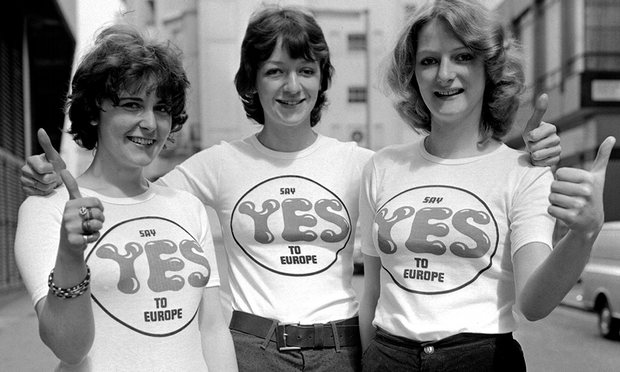
Brexit feminism - EU Referendum

Democracy? Don’t be daft. Brexit is nothing more than an oppressive tool of the patriarchy. Or something.

If you had to guess what somebody whose web bio reads “Muireann O’ Dwyer is a PhD candidate in European Law and Governance in University College Dublin” has to say about Brexit in an article for Left Foot Forward, what angle do you think that piece would take?

Yup. Muireann O’Dwyer has found a way to make Brexit and the reclamation of our democracy and national self-determination all about intersectional feminism:

There is no shortage of analysis on the post-Brexit fallout but, following a trend established in the referendum campaign, issues of gender are remarkably absent. Indeed, women’s voices are rare in the debate regardless of their position.

[..] While all male panels and the dominance of male columnists and talking heads continues after the result, there has been some change to the political landscape.

Apparently Andrea Leadsom, Gisela Stuart and Kate Hoey (the first two of which took part in the main televised EU referendum debate watched by millions of people) don’t count, because they are women who dared to express the “wrong” views. And journalists / TV pundits Isabel Hardman and Isabel Oakeshott likewise do not exist.

Conservative women or women who supported the Leave campaign in the EU referendum are not “real” women, and the only women’s voices which should be elevated and amplified are those of pro-EU, left-wing women – at least, that’s the clear inference from O’Dwyer’s remarks.

O’Dwyer continues:

Economic policy is deeply gendered – the different general positions of men and women in the economy means that any policy intervention will impact them different.

In the UK, successive budgets have been analysed by the Fawcett Society, which has highlighted that women are bearing the burden of austerity cuts and reforms. In the aftermath of the referendum, it is likely that this disparity will continue.

However, the economic impacts of the vote are themselves gendered. For example, the pay gap for women over decades has lead to a pensions gap – women tend to have lower pensions, and to be more likely to have no private pension at all.

This existing disadvantage means that women are more likely to suffer the consequences of the devaluation in pension funds caused by the market instability and the sterling fluctuations.

This makes no sense. If there is a pensions gap, with more women having lower pensions or no pension savings at all, then the economic impact of any post-Brexit market turbulence would be felt more keenly by men, who O’Dwyer admits have more money invested in the stock market subject to risk.

But even if this were not so, looking at something as long-term as pension scheme performance through the lens of short-term market reaction to Brexit is stupid beyond measure. Unless one is cashing in a pension early or unfortunate enough to be retiring right this minute, any of last week’s stock market losses (most of which have already rebounded) are of little relevance. Who is to say that the improved economic output resulting from a well-negotiated Brexit and an agile, proactive trade policy will not lead to better stock market performance than would have been the case if Britain had voted to remain in the EU? Who can disprove the counterfactual? Certainly not Muireann O’Dwyer, who isn’t even aware of its existence.

O’Dwyer then turns her gaze on fiscal policy:

Additionally, the proposed tax reforms, particularly to the corporate tax rate, mean a transfer of wealth away from those who rely on various public services and supports to the already wealthy.

Again – insidious, cretinous nonsense. To the extent that people rely on public services, they do not have “wealth” – they are the beneficiaries of a compulsory wealth transfer from high earners to low earners, facilitated by the government. Assuming the government cut taxes and benefits, this is not a transfer of wealth from poor to rich, as the Owen Jones Left continually screech. It is just a smaller transfer of wealth from rich to poor. But of course it does not suit the left-wing purpose to acknowledge this fact, so O’Dwyer readily perpetuates the lie that tax cuts combined with spending cuts constitute a transfer of “wealth” which is somehow rightfully owned by those who did not earn it.

And then on to immigration:

Concerns over migration played a major role in the discourses of the referendum, and these have now mutated into heightened racism and abuse.

Migration is itself deeply gendered, as can be seen from the different migration patterns of men and women, but also in how migrants are constructed in media discourses.

The despicable rise in racial attacks in the days since the vote merges with street harassment of women. Even before the vote, Muslim women were the group most likely to be subject to racist street abuse.

While the rise in racism has been roundly criticised, it is essential to understand how this racism connects with sexism, both in online abuse and in the street.

Racism and sexism combine in migration policy debates as well. The famed points system proposed by Leave campaigners is based on the Australian system that has led to inhumane treatment of migrants of refugees and is itself the policy embodiment of a racist and xenophobic attitude.

Further, a points system operationalizes sexist discrimination – for example by setting earnings requirements for entrants. Since women on average earn less than men, their success in such a system will be systematically lower.

Further, unpaid work does not count in such a metric based system, and so the work of women in care and the community is discounted, further disadvantaging applications by women.

The proposed points system then provides a clear example of the intersections of xenophobic policy and gendered economic inequality.

Sure, it took some twisting to get there – assuming that a points-based immigration system is desired by all Brexiteers, and that Britain would adopt the same “discriminatory” rules for that system rather than create our own criteria, and that accepting people on economic merit is evil but favouring predominantly white Europeans while discriminating against predominantly non-white people from the rest of the world is A-OK – but O’Dwyer found a way.

And she did all of this based on the insidious, unspoken proposition that women are so feeble that they would all flop around helplessly were their alms from the welfare state jeopardised by a Brexit-inspired economic downturn. This is what passes for feminism in the 21st century – treating women like an inherently vulnerable, permanent victim class for whom the reclamation of Britain’s democracy can only be seen as a fearful calamity.

Fortunately, the women of Britain – naive, helpless and dependent creatures that they are – have virtuous and compassionate intellectuals like Muireann O’Dwyer, PhD candidate in European Law and Governance at University College Dublin, fighting their corner.


Brexit - EU - European Union Flag - Missing Star - Britain - UK

Top Image: Guardian

Agree with this article? Violently disagree? Scroll down to leave a comment.

Follow Semi-Partisan Politics on TwitterFacebook and Medium.

Brexit: It’s Time To Tone Down The Article 50 Hysteria

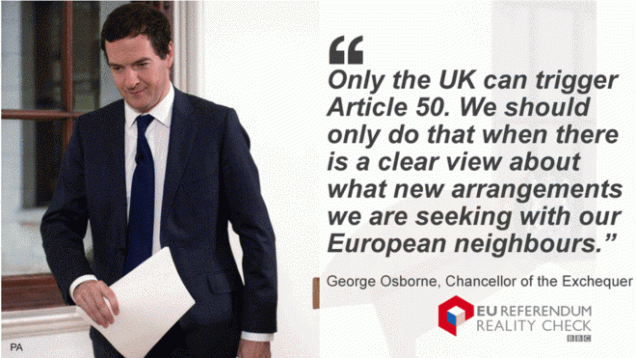
George Osborne - EU Referendum - Brexit - Article 50

There’s nothing super-democratic or virtuous about triggering Article 50 and starting the clock on our EU secession negotiation before we are ready

I like Spiked magazine a lot. Despite technically being a left-wing outfit, you wouldn’t know it from reading much of their output – they are certainly nothing like the morally bankrupt and ideologically rootless centrist politicos who infest much of the Labour, LibDem and Green parties. And on key issues like democracy and freedom of speech, their instincts are generally sound, while many of their writers argue with eloquent and forceful conviction.

That being said, Spiked’s new campaign to force the British government to immediately invoke Article 50 of the Lisbon Treaty to start the clock on our two (minimum) years of secession talks with the EU is rash and unusually ill-considered.

Editor Brendan O’Neill (whom again, I respect enormously) thunders:

Right now, today, the government must invoke Article 50 of the Lisbon Treaty. The people voted for it. More Brits voted to leave the EU than for anything else in history. So for officialdom, experts and agitators to demand that we hold off from triggering Article 50 – the clause that sets in motion a nation’s rupture with Brussels – is a straight-up denial of the democratic will. It’s an attempt to stymie, weaken, make meaningless the political demand of 17.5million people. Invoking Article 50 ought to be the great democratic cry of our times. Anyone who takes the franchise seriously, who cherishes the hard-won right of a people to shape their nation’s politics, must insist that Article 50 is invoked now.

The political and media elites are devoting an incredible amount of energy to ensuring Article 50 is not triggered. They have formed a protective ring around it, shielding it from being enacted on what they view as the reckless, ill-informed say-so of the public. From the legal realm, the political world, the media elite and the agitating leftist set, various actors have come together to say: ‘Don’t touch Article 50.’ And it’s no mystery why: they know Article 50 will make the people’s will a reality, and while they can just about handle the people expressing their will, they’re determined it should not form the basis of politics.

O’Neill then goes on to rightly criticise some of the delaying tactics we have seen orchestrated by the law firm Mishcon de Reya, attempting (on behalf of wealthy anonymous clients) to make invocation of Article 50 contingent on the will of Parliament rather than the outcome of the referendum.

We can all agree that any such delaying tactics borne out of a desire to overturn the result of the EU referendum are utterly abhorrent and toxic to democracy. But it does not follow, as Spiked seem to think, that maximal democracy is achieved by doing the exact opposite, by invoking Article 50 yesterday in a fit of pique.

The EU referendum question asked voters whether Britain should leave or remain in the European Union, and the electorate gave a clear instruction that Britain should leave. But it is the government’s duty to do so in a responsible manner, extricating the UK from a rejected political union while maintaining economic stability and limiting extraneous harm.

If the most “democratic” response to the EU referendum result is to leave the EU as quickly as possible, then Britain should immediately repeal the European Communities Act 1972 and walk away from all of our diplomatic and treaty obligations, consequences be damned. But what consequences they would be. Britain would rightly become a pariah nation, our word distrusted for many decades to come. And of course there is nothing amazingly democratic about such an act of self-harm.

Spiked love to take an maximalist stance on issues. When it comes to things like free speech, this is admirable. But applying the same uncompromising stance to the delicate issue of negotiating a departure from the EU on good terms is not wise.

Pete North agrees:

Ok kids, let me put this Article 50 nonsense to bed. Article 50 is a notification to the EU that we intend to leave. It triggers a two year period in which to negotiate our new relationship. Before that can happen we need to know from each member state what their position is likely to be on our position. This is called a scoping exercise so that we can create a timeline for events and an agenda whereby anything that was not agreed beforehand is not opened up for discussion unless the rest agree.

Before we do this we first have to know what our own objectives are and whether we wish to keep full membership of the single market and what we are prepared to compromise on and what we are not prepared to compromise on. That will require hearings of select committees, expert panels, public consultations and referrals to professional bodies, unions and trade guilds. I expect academia will want their say as well.

If we have even half a clue inside a year it will be a miracle. Scoping and testing the water with out position will take anywhere up to six months or more, also keeping in mind there are French and German elections which may see a change of position. So we would be quite reckless to even consider any rushed moves.

Some of this can happen concurrently but Article 50 invocation would be most ill advised until the process is complete. Keep in mind not a single strata of policy making is not affected somehow by EU laws. And at best after those two years of official talks all we will come out with is a roadmap for gradual divergence. To say this is complex doesn’t even begin to cover it.

Some have asked if I gave concerns that Article 50 may never be triggered. There is always a danger of that. It has yet to dawn on most politicians just how big this is and they may seek a pause when it does dawn on them. The only politicians who has thus far given us a hint of a clue that they know how big this is is David Cameron. That is ideally why we need someone from his camp leading the proceedings. They will have been given the same briefings. Gove will still be clinging on to childish fantasies about knocking up a free trade deal over beer and sandwiches followed by a slash and burn of red tape.

It is natural to want to see immediate, dramatic action following the referendum decision (not that we have been short of drama this past week), but even in the most reckless scenario, forty years of incessant and stealthy political integration cannot be unpicked in one quick move, as Pete North emphasises. And nor should it be attempted.

If there is some kind of coup to take place against Brexit, orchestrated by shadowy businessmen and lawyers over their cups of tea, I would be the first to march on Westminster with a flaming torch in hand. But in his admirable determination to defend democracy, Brendan O’Neill is making the mistake of conflating the absolute necessity of proceeding with initial scoping discussions to get an informal outline of a deal in place before invoking Article 50 with the more insidious attempts by vested interests and scorned left-wingers to unduly delay the Brexit process or thwart it entirely.

It’s understandable – like most of the Westminster media, O’Neill likely hasn’t heard of Flexcit. But if he were to familiarise himself with the only comprehensive, robust Brexit plan in existence, he might appreciate the narrow but crucial difference separating those who want an unhurried approach to Article 50 in order to plot out the smoothest and most economically non-disruptive secession and those who want to kick Brexit into the long grass altogether.

Spiked’s commitment to democracy and free speech is admirable, and a frequent source of inspiration to this blog. But in this case, by seeing the world in such black and white terms, divided between democracy-loving good guys who want to invoke Article 50 yesterday and the evil conspirators who want to delay it forever, Spiked is not serving the best interests of the country.

And sadly, this is one Spiked campaign which this blog can not support.


Brexit - EU - European Union Flag - Missing Star - Britain - UK

Agree with this article? Violently disagree? Scroll down to leave a comment.

Follow Semi-Partisan Politics on TwitterFacebook and Medium.

Happy Independence Day

From one soon-to-be independent country to our dear ally, today celebrating 240 years of glorious freedom

A very happy Fourth of July to all of my American readers.

Given recent events, I would also invite those Americans (I’m thinking here of President Obama and the political and economic elites who have the New York Times as their mouthpiece) celebrating their wonderful country’s independence today while looking on Brexit as some kind of terrible catastrophe to ask themselves why they would deny their closest and most reliable ally the same sovereignty and freedom which they rightly demand for themselves.

As America celebrates today, so we in Britain celebrate soon being able to join in the proclamation that “this nation under God shall have a new birth of freedom; and that government of the people, by the people, for the people shall not perish from the earth.”

Happy Independence Day.

Let freedom ring!


US UK British Flags

Top Image: Telegraph

Support Semi-Partisan Politics with a one-time or recurring donation:

Agree with this article? Violently disagree? Scroll down to leave a comment.

Follow Semi-Partisan Politics on TwitterFacebook and Medium.