The Daily Toast: Iain Martin’s Brexit Ultimatum To Tory Ministers

Conservative Eurosceptics - Brexit - David Cameron

Politicians with the integrity to openly declare their stance on the biggest political issue of our generation should be the rule, not the exception

Like most people in Britain, Iain Martin has had enough of equivocating politicians – specifically Conservative cabinet ministers – refusing to take a public position on Britain’s EU membership, and maintaining the fiction that David Cameron’s cosmetic “renegotiation” can have any possible impact on their decision.

Martin goes so far as to call Conservative ministers “a bunch of careerist scaredy cats”, writing in CapX:

Britain’s looming vote on the EU is not – or should not be – politics as normal. It is a historic moment, in which the UK will decide to take one of two quite different paths. Party management and careers matter, of course, but sometimes there are choices that should be about something more than the mere game of politics. The EU referendum is one such event.

This is absolutely correct. Whatever one’s views on the European Union and Brexit, surely all of us can agree that this debate is infinitely more important than the minor tweaks to education, healthcare and fiscal policy which separate the various political parties.

Having established the importance of the coming referendum, Iain Martin issues the following challenge:

Ministers, it is make your mind up time. Although David Cameron’s renegotiation with the EU for new membership terms could have been the real deal, it is clear that it will deliver very little. It is In or Out, probably as soon as this summer. For that reason, ministers need to do something that is highly unfashionable and considered downright deranged in the British Establishment: decide what you believe – enthusiastically for In, reluctantly for In, or Out because you think it is best for your country – and get ready to fight for it at public meetings across the land. Don’t be scared. You are grown men and women. You might even be surprised how much voters like politicians saying what they believe rather than what is convenient for their careers.

This argument is – I know – a stretch, considering how careerist politics has become. But for anyone playing a leading role in the affairs of a nation to base such a vital decision purely on career progression or fear of friends is not only wrong, it’s pathetic. And in ten years time, none of it, all the hedging and game-playing, will matter a jot. By then David Cameron will be having a snooze after lunch in rural Oxfordshire. Osborne will be running the World Bank or a hedge fund. The decision on the EU, on the other hand, now that will have mattered a lot.

The current failure of Conservative ministers and other senior politicians to break cover and nail their colours to the mast only contributes to the (depressingly accurate) perception of contemporary politicians as principle-free careerists squabbling over the right to sit in technocratic management of our public services, rather than principled statesmen grappling with weighty political issues.

In our current political climate, where the Conservative Party runs away from small government principles in pursuit of the centre ground and Jeremy Corbyn’s Labour Party is criticised for actually being left-wing, it is clear that the vast majority of politicians prefer the former to the latter.

Power is pursued for its own sake, even if it means the centrist coalition of supporters cobbled together to deliver victory make it impossible to do anything remotely radical, transformational or different once in office. Thus, despite the overwrought rhetoric from both sides, neither Labour nor the Conservatives  propose a single policy which would move Britain away from its current centrist landscape.

Politicians who came of age in this age of the Tyranny of Centrism find it inordinately difficult to express a strong, sincerely held political opinion because all of their training and professional experience teaches them that pragmatic caution and a reflexive fear of fixed beliefs are the surest route to success.

Whether it’s the NHS, tax reform, constitutional reform or Britain’s relationship with Europe, MPs are strongly predisposed to fiddling around the edges themselves, while accusing others of partisan recklessness. Thus change is only ever incremental, and nearly always in the direction of More Government – the path of least resistance for any elected official.

Unfortunately, too many within the public and the media are willing to excuse this state of affairs, urging us to put ourselves in the politicians’ shoes rather than demanding sincerity and principle from our elected officials. It is therefore particularly pleasing to see Iain Martin losing patience with the status quo and demanding that those who seek to run the country actually declare the direction in which they would lead us.

The Tyranny of Centrism can only continue so long as we tolerate and enable it by rewarding glib superficiality and punishing strong displays of principle from our politicians. And on an issue as important as Britain’s future relationship with the EU, this is no time for fence-sitters, careerists or cowards.

EU Renegotiation - Brexit - European Union

Agree with this article? Violently disagree? Scroll down to leave a comment.

Follow Semi-Partisan Politics on TwitterFacebook and Medium.

Pro-EU Campaigners Can’t Decide Whether Brussels Is Friend Or Frenemy

Britain - UK - European Union - Referendum - Brexit - Punishment Beating

The Good Cop/Bad Cop routine of the EU’s British cheerleaders betrays the fundamental weakness of the europhile argument

I have always struggled to wrap my head around that strain of pro-Europeanism which declares “the EU is a benevolent and harmless group of countries working together for mutual gain” on the one hand, and “the EU will ruthlessly punish us and seek to make an example out of us if we ever try to leave” on the other.

Call me stupid, but the two visions of Brussels don’t seem to be compatible. Either the European Union is a harmless coming together of independent European nations seeking to work together to meet challenges that no single country can face alone (ha!), or the EU is a process whose ultimate destination is a single sovereign entity possessing most of the executive, legislative and judicial powers which it gradually usurped from the member states.

If it is the former, nobody would much care whether Britain stayed or departed. Why would they, when the EU is just a harmless club of countries coming together voluntarily to deal with mutual challenges?

But if it is the latter – if the EU is in fact a deadly serious political project with clear federal aspirations, which dare not make themselves known for fear of alarming the electorate – then its portrayal as a snarling, vindictive beast when scorned suddenly starts to make a lot of sense. Any member state attempting to leave such an organisation would represent a stunning repudiation of over forty years of incremental, relentless political integration, and therefore it is a very helpful piece of deterrence if people believe that any country trying to leave would be dealt with ruthlessly and punitively.

Of course, the cynical pro-EU “Remain” campaign tries to have it both ways. When it suits them in their campaigning, the EU is a happy-go-lucky club of like-minded countries who frolic and trade with one another. But when that hopelessly naive, childlike view of Brussels is questioned by eurosceptics and Brexiteers, out comes the other portrait of a snarling, vicious EU which will ruthlessly destroy Britain if we continue to drag our feet or think about leaving.

Good cop, bad cop. Europhiles will normally try the “good cop” routine first when engaging with undecided voters. But this tends to come unstuck as soon as eurosceptics and Brexiteers counter with their own positive vision of Britain restored as a sovereign democracy playing a full and engaged role in global trade and world affairs.

Since the pro-EU crowd are unable to share their own repugnant vision of a politically integrated Europe for fear of scaring people away, they are instead forced to go negative, hence the rapid and disconcerting pivot from “See how nice the European Union is, and all the wonderful things it does for us” to “If we try to leave the EU, they’ll rough us up”. Truly, their position is less a serious argument about governance and diplomacy, and more the tortured thought process of a battered spouse trying to rationalise staying in an abusive relationship.

Latest to play the part of the battered spouse is Labour MP Stephen Kinnock, who spuriously claimed in Parliament:

Article 50 of the Lisbon treaty states that, on announcing its intention to withdraw from the European Union, the withdrawing state will automatically be excluded from all meetings of the European Council and, if agreement is not reached within two years, the withdrawing state will be automatically excluded from the negotiated terms. Does the right hon. and learned Gentleman agree that a withdrawing state is therefore liable to suffer what would amount to a punishment beating to dissuade others from withdrawing, and that therefore there is no such thing as a soft Brexit?

Of course, this is alarmist, hyperbolic nonsense emanating from the mouth of somebody who is either catastrophically stupid and truly believes his own fiction, or who hails from that school of thought which believes that pro-EU evangelists are allowed to tell blatant lies in service of the Greater Good.

The truth is that remaining EU member states could not be overtly vengeful toward a departing Britain even if they wanted to. The European Union is required by law to negotiate constructively and in good faith with any member exercising its Article 50 right to secede, besides which there are powerful business interests on both sides who have a lot riding on continued trade and good relations between Britain and the EU, and who would assert overwhelming pressure on politicians to overcome whatever petty personal gripes they may have in order to reach a pragmatic deal with the EU’s biggest trading partner.

As Ben Kelly points out over at Conservatives for Liberty:

The notion that the EU would refuse to cooperate, or even seek to “punish” the UK in the event of secession – thereby clearly violating EU law as well as failing to comply with international law – is beyond the realm of realistic politics. As Sir David Edward, the first British Judge of the European Court, has said – EU law requires all parties to negotiate in good faith and in a spirit of cooperation.

Article 50 requires the EU to conclude an agreement with the seceding state, “taking account of the framework for its future relationship with the Union“. Notably, Articles 3, 4 8 and 21 of the Treaty on European Union require the EU to “contribute to … free and fair trade” and to “work for a high degree of cooperation in all fields of international relations, in order to … encourage the integration of all countries into the world economy, including through the progressive abolition of restrictions on international trade” and to adhere to the “principle of sincere cooperation […] in full mutual respect” and “assist each other in carrying out tasks which flow from the Treaties.”

Add to that the sheer illogicality of effectively launching a trade war against the only vaguely dynamic economy and trading partner in the entire region, and the idea of the EU “punishing” Britain starts to look like the absurd scaremongering hyberbole which it so clearly is.

But being demonstrably wrong does nothing to deter the European Union’s cheerleaders within the British political establishment. Only back in October, this blog had to take Conservative MP Mark Field to task for tremulously suggesting that a vote for Brexit would somehow give France just cause to cease all co-operation with reciprocal border controls by way of retaliation:

On the border question, Mark Field seems to accept that it would be right and proper for France to retaliate against Brexit by ceasing all border co-operation and actively helping to funnel more illegal immigrants to Britain. If this is really what he thinks France would do – if he really believes that the French hold this attitude to the British – he should be railing against the French for their supposed immaturity and recklessness in the face of a European migration crisis, not holding it up as a warning to Britons not to provoke the French into doing something so patently unreasonable.

At every turn, Mark Field seems to not only imagine the worst, most apocalyptic response possible from our EU partners, but also then assumes that they would be somehow justified in being so intransigent and punitive in their dealings with Britain, and that it would somehow be our fault for having provoked them.

Where does this dismal, pessimistic attitude come from? Why does Mark Field think so little of his own country, our status and our potential that he sincerely believes that other (mostly smaller) countries would bully us if we vote to leave the European Union, and that not only would Britain be totally unable to withstand this bullying, but that they would be right to bully us in the first place?

Displaying Olympian feats of cognitive dissonance, the EU’s cheerleaders within the Remain campaign are somehow able to hold a number of poisonous and utterly contradictory ideas within their heads at all times, including the following rigid beliefs:

  1. The EU is our benevolent protector, always looking out for us
  2. The EU is a jealous lover, demanding our absolute fidelity
  3. The EU will attack us mercilessly if we ever decide to leave it
  4. Britain will deserve any attack by the EU if we choose to leave
  5. Britain is incapable of standing up to any act of bullying by the EU

Like a battered spouse, many pro-EU campaigners and commentators have convinced themselves that Brussels is always in the right, and Britain – with our pesky, awkward hangups about sovereignty and democracy – is perpetually in the wrong.

Like a battered spouse, many of the EU’s British cheerleaders have internalised the corrosive, national self-doubt and occasional sabre-rattling from the continent to such an extent that they sincerely believe that any punishment or retaliation coming our way would somehow be deserved.

And like a battered spouse, the Remain campaign are under the spell of an autocratic (and in this case imaginary) bully whose power to coerce is completely illusory – once we make the brave decision to leave.

But here’s the really good news: Britain does not have to remain in this abusive relationship any longer. There will be no retaliation for leaving, because there can be no retaliation – even if intemperate heads within Brussels wanted to make an example out of Britain, they would be constrained both by law and commercial imperative.

Better still, a rational and thorough plan of escape already exists, laying out a detailed strategy to separate Britain from the EU’s political tentacles in a phased, low-risk approach. That plan is called Flexcit (or The Market Solution), and any serious Brexit campaigner – or engaged citizen – should give it their serious attention.

By contrast, the pro-EU side – as well as being unable to decide whether Brussels is a trusted partner or an abusive spouse – have no plan for how Britain should react when the EU takes the next inevitable step toward fiscal and political union, leaving Britain with the choice of limited influence within the core (at the price of adopting the Euro) or complete irrelevance on the periphery. The status quo is not an option in this referendum.

And given the choice between the timid, euro-parochialism of the Remain campaign and the Leave campaign’s positive vision of a prosperous and democratic United Kingdom outside the EU, there is simply no contest.

EU Democracy - Brexit

Agree with this article? Violently disagree? Scroll down to leave a comment.

Follow Semi-Partisan Politics on TwitterFacebook and Medium.

Cameron’s Fear That EU Partners Will Reveal Truth About His “New Deal”

British People - EU Renegotiation - Referendum - Brexit

David Cameron is negotiating with the British people on behalf of the European Union, not the other way around

David Cameron’s entire “renegotiation” (in fact in has been no such thing, for there were never any demands made) has all been completely backwards, with the prime minister far more interested in huddling with fellow European ministers to work out what kind of a deal might be successfully snuck past the British people than conducting any kind of listening exercise with the British public to determine what key concerns and demands need to be taken to Brussels.

And we see yet more evidence of this in the Times’ Red Box briefing today, which reports on the understandable concern from the government that the meaningless superficiality of David Cameron’s “reform” will be inadvertently exposed by a fellow European leader or minister who makes the mistake of telling the truth:

British ministers are urging their European counterparts to talk up David Cameron’s renegotiation deal to persuade British voters that it is significant.

There are fears in the UK government that some foreign leaders, who have been irritated by Cameron’s demands, will be publicly dismissive of any deal agreed at next month’s European Council summit.

Senior British figures point to polling that shows that opinion on the EU is evenly split, but if voters think the prime minister has secured “major change” they will vote overwhelmingly to stay.

[..] The nightmare scenario is if a minister from Germany, France or Poland goes on the record to say Cameron’s changes are meaningless window dressing.

The piece goes on to quote polling which suggests that successfully presenting the output from the renegotiation as “major change” dramatically increases the probability of a “Remain” vote:

Asked to “imagine David Cameron has secured a small change in Britain’s relationship with the European Union, securing guarantees over some key issues that he said protected British interests, but without any major change in which policy areas the European Union has powers in”, 38 per cent wanted to leave and 37 would want to stay.

If Cameron “could not secure any change” and the referendum was held with the EU “as it is now”, 46 per cent would leave and only 32 per cent remain.

But if Cameron gets “major change” including “substantial changes to the rules Britain has to follow and British opt-outs from European Union rules in several different policy areas” the result is dramatically shifted

Some 50 per cent of people would then vote to remain, with only 23 per cent determined to leave.

None of this is in any way surprising, and as such it is not really “news” at all. Anybody with their head properly screwed on knows that the government is not conducting a serious renegotiation with the EU in good faith with their mandate from the British people, and that everything we are now witnessing is part of a co-ordinated public perceptions and expectations management effort from a prime minister and a government who made their minds up long ago.

But while this is hardly breaking news, it is still worth taking the time to pause, step back from the daily commotion of the Brexit debate, and marvel at the bigger picture.

The first duties of any elected government – of any prime minister – are to advance the national interest of the United Kingdom, and to fulfil the mandate on which they were elected in the first place. Feeling the pressure from UKIP midway through the last parliament, David Cameron chose to offer a referendum on Britain’s continued membership of the EU – against his better judgement, his personal pro-Europeanism and his (wrong but sincerely held) belief that Brexit would be against our national interest.

But since having been returned to power in May, the prime minister has not acted in good faith based on that mandate. In fact, he has been deliberately deceptive and manipulative, seeking to create and propagate the illusion that he is pounding tables in Brussels and fighting for our priorities in Europe, when he never even bothered to check what those priorities are, let alone insist on any specific concessions.

David Cameron and his loyalist cheerleaders prance around as though they have bravely confronted the EU with a specific list of demands designed to win back sovereignty and secure it forever, when all they did was write a wheedling, begging letter to Donald Tusk hesitantly suggesting a few topics of discussion – half of which were slapped down the same day.

This is how you end up with the risible scenario of George Osborne appearing on Newsnight yesterday to give an update on “renegotiations” which are not taking place, and declaring himself a eurosceptic despite the fact that he is currently engaged in nothing more than a joint marketing effort with our EU partners to hoodwink British voters into thinking that we have won some meaningful concessions:

If David Cameron, George Osborne and the more vacuous half of the Conservative Party can all describe themselves as “eurosceptic” and do so with a straight face, then we are all eurosceptics now. Everyone, from Martin Schulz, Jean-Claude Juncker, Kenneth Clarke and the entire sorry cast of Britain Stronger in Europe would qualify as a eurosceptic by this metric, because everybody concedes that the EU needs reform of one kind or another (even if that reform involves “more Europe”).

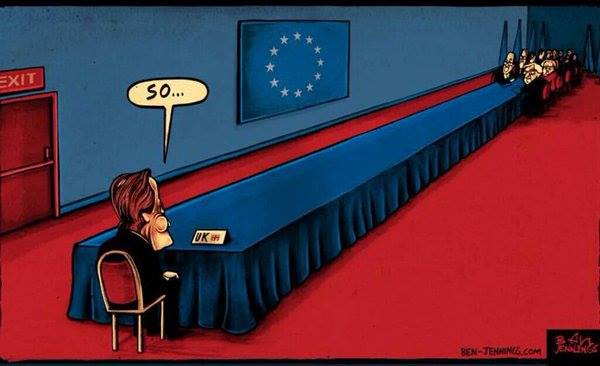
In fact, it is not an exaggeration to say that when it comes to this non-renegotiation, the British public are effectively sitting at one end of the long conference table while the British government schemes and confers with the rest of the European Union at the other end.

I know it is hopelessly idealistic of me, but I expect more from my elected government. And it is getting tremendously tiring waking up every day wondering what new schemes,devices and cunning plans the prime minister of this country intends on using to hoodwink and misdirect the people he supposedly serves into believing that he is in any way working on their behalf.

A greater man than David Cameron – if his devotion to the EU and fear of Brexit were similarly genuine – might have stood up and declared that because he believes EU membership to be strongly in our national interest, he couldn’t in good conscience put it to a popular vote or negotiate in an unbiased way on behalf of the United Kingdom. Yes, such a stance would have further fuelled the rise of UKIP, but at least I could respect the intellectual honesty and consistency.

But David Cameron did not do this. Rather than behaving with honour or principle, Cameron swanned around, pretending to share the public’s concerns about the European Union, and then – as soon as his re-election was secure and the UKIP threat neutralised – zipped across to Brussels to begin plotting with fellow EU heads of government and state as to how Britain’s pesky electorate could best be mollified, placated and distracted while the Brussels juggernaut rolls on unopposed.

And they wonder why there is a strong public perception of a self-serving European political elite who doggedly pursue their own interests in direct opposition to the will and interests of their national electorates!

There is only so much that one can take of duplicitous politicians who pretend to be eurosceptic and favour Brexit when stumping for votes or positive headlines, but whose every action contradicts this stance once in power. And I may have finally reached my limit.

If the EU’s form of parochial pseudo-internationalism really does represent the best future of human governance – and it really, really, really doesn’t – then politicians should come out and say so. They should own their love and admiration of the EU and their lack of faith in Britain, instead of hiding from these things and pretending to be eurosceptics.

I respect any politician of any stripe who has the courage of their convictions – who is able to articulate a sincerely held viewpoint without first running it by a focus group, and whose commitment to their causes runs deeper than exploiting them for electoral gain. That’s why I maintain a degree of respect for Jeremy Corbyn, despite sharing none of his socialist beliefs.

Jeremy Corbyn’s sincere-but-loopy socialism I can respect. The unabashed European federalists in Brussels I can respect, too. Though hardly any of them are democratically elected officials, at least they have the courage to hail their creation for what it is – an embryonic state in gestation.

But David Cameron and George Osborne – europhiles in stolen eurosceptic clothing, actively engaged in perpetrating a moral fraud on the British public – people like that I cannot respect, do not respect and will never respect.

Brexit - Flexcit - European Union

Top image: cartoon by Ben Jennings

Agree with this article? Violently disagree? Scroll down to leave a comment.

Follow Semi-Partisan Politics on TwitterFacebook and Medium.

Why I Write

Political Blogging

At the risk of sounding like a PBS telethon…

Why isn’t there more good journalism out there? Gawker paints a depressing picture for those of us who toil away in the often thankless business of writing.

Hamilton Nolan writes:

Many writers believe that our brilliant writing will naturally create its own audience. The moving power of our words, the clarity and meaning of our reporting, the brilliance of our wit, the counterintuitive nature of our insights, the elegance with which we sum up the world’s problems; these things, we imagine, will leave the universe no choice but to conjure up an audience for us each day.

Time and experience have long since disabused me of any such idea. Fortunately, writing about politics and public policy – if immensely frustrating at times – is also its own form of reward.

Nolan concludes:

Maybe there is a talented young writer out there with a dream of starting the very best, smartest magazine or website that has ever existed, and building it into their very own historic legacy. I am here to tell you that it will not work. The business of media has very little, if anything, to do with quality journalism. If you aspire to be a Writer of Legitimately Good Things, the best you can hope for is to get the prestige spot that is paid for by the garbage. To hope for a prestige spot that is not paid for by garbage, or by a lone rich wacko, or by a new advertising technology, but instead by the mass audience that will flock to your brilliance is to ask for too much. If you are able to get a job writing good stuff, you are one of the lucky ones in the big Exercycle of Mindless Entertainment that is “the media.”

Now, political writing certainly shouldn’t be an easy career option. After all, it takes a certain arrogance to expect to be remunerated for sitting at a keyboard ranting about the state of the world and pontificating on the “obvious” solutions to society’s ills, particularly when there are people out there doing real work like serving in the armed forces, providing healthcare, creating world-class art, working out how to get to Mars or producing amazing, unthought-of new consumer products.

There are certainly times when my own efforts at political writing seem depressingly far from the high ideal set out by George Orwell, and much closer to the ranting of the pub bore or the slick keyword focus of the SEO marketer – though having done this (with varying levels of commitment) for four years now, I hope that I am somewhat better than when I started out.

Earlier this week I was at a talk given by Dan Hodges about his general election book “One Minute To Ten”, and got chatting to a senior journalist from the Sunday Times. I put to him that while political blogging may have been ripe with promise ten years ago, the format seems to have dried up today, and readers left with the choice between established legacy media outlets or the latest viral clickbait funnelled through social media.

He didn’t disagree, and hammered home the fact that many readers currently have almost zero loyalty to any specific news outlet, and instead get their news according to what happens to be trending on social media or appear in their (often bias-reinforcing) news feeds. This trend is reflected in the traffic stats for Semi-Partisan Politics. A sizeable minority of traffic now comes through Facebook in particular, and there is always the temptation to devote time and effort to promoting pieces on Facebook to get more eyeballs on the latest piece, even if it brings in few potential long-term readers with whom one can develop a relationship.

The one positive trend at present is the growing and thriving community of Brexit bloggers and campaigners coalescing around eureferendum.com and the work of Dr. Richard North to promote Flexcit – by far the best (and only) properly thought-through plan for how Britain might best leave the European Union and re-emerge as a globally engaged, prosperous sovereign democracy.

If only the same collegial, rigorous and dedicated spirit could be found elsewhere in the political blogosphere as exists among many of my fellow Brexiteers (see links in the sidebar on the right), journalism in this country – particularly citizen journalism and the concept of the campaigning blog – might not be in quite such a parlous state.

Regardless: whatever the people at Gawker say, Semi-Partisan Politics will continue to grow and flourish as we enter 2016, and will campaign – loudly and unapologetically – for the following goals and ideals:


Brexit: freedom from the European Union

Democracy and national sovereignty

Constitutional reform and a federal UK

Separation of church and state

Healthcare reform, not NHS worship

Smaller, smarter government

Free speech, without restriction

Fighting timid centrism on the Right

Fighting empty virtue-signalling on the Left


If you agree with these objectives and enjoy this blog’s coverage of UK politics and current affairs, please do consider using the PayPal tip jar to make a small regular contribution or a one-time donation:


Any reader donations will 1) be a personal ego boost to myself, 2) help me to do more original reporting, like the successful live blog of last year’s UKIP annual conference, and 3) help me promote this site and the work of other like-minded writers – particularly in the crucial effort to win a “Leave” vote in the coming Brexit referendum – so that we can actually make a difference.

Small donations from individual contributors are not only greatly appreciated by me, but also help to preserve independent journalism and commentary in general – so that nobody has to rely exclusively on the BBC, the Guardian or the Telegraph to understand what’s going on in our country and around the world.

But it’s not all about the money. What matters even more than that (for me) is spreading the word and sharing the message – and these days, like it or not, that means social media. So if you read something you like here, don’t just sit on it. Share it on Twitter or Reddit. Email it to a friend. Be that person on Facebook who posts provocative political articles on their timeline.

2016 is already off to a good start – pageviews and comments are at their highest ever, and an appearance on a certain major national political TV show (to be announced soon) is in the works. Onwards and upwards!

Many thanks to all my readers for your continued generous support.

Follow Semi-Partisan Politics on TwitterFacebook and Medium.

A Plan For Every Stage Of Your Life

David Cameron - Parenting Classes - Plan for every stage of your life - Coke Zero Conservatism

David Cameron’s rootless Conservative government is casting around, finding ever more ways to shoehorn the state into our lives

Buried in all the talk of Brexit and Bowie this week has been the Prime Minister’s announcement that he intends to force every British parent to take state-run classes in parenting – if not on pain of criminal penalty then at least at the sharp end of some pointed fiscal incentives.

The Telegraph reports:

All parents should enrol in state-backed parenting classes to learn how to raise their children properly, David Cameron will say as he announces a new plan to stop families breaking up.

[..] He will use a major speech on Monday to set out proposals for a new voucher system to incentivise parents to attend the classes in an attempt to make parenting advice socially “normal” and even “aspirational”.

The Prime Minister’s plan comes as he announces a £70 million investment in relationship counselling to prevent hundreds of thousands of families splitting up over the next five years.

Mr Cameron’s speech marks the latest step in delivering on the Conservatives’ key election promise to help families at every stage of life.

So here we are. The man who lets his daughter be carried around in a Waitrose bag in the Downing Street gardens – when he isn’t accidentally leaving her behind at the pub – thinks that the rest of the country make such bad parents that what they really need is a big, heaped spoonful of big government medicine to set them straight.

One does not have to deny that family breakdown and – how to put it – “unaspirational” parenting have real, negative consequences in our society to balk at the notion of government run classes enforcing the childrearing fads of the day on first time parents.

And Cameron is not even targeting potentially troubled familes – that would be far too judgemental. No, these classes will be “made available” to all, because children “don’t come with a manual” and apparently what has worked for parents for thousands of years is suddenly insufficient to the task of raising a child in twenty-first century Britain.

Dr. Ellie Lee retorts in Spiked magazine:

As parents well know, it is one thing to seek out genuine expertise and help when a child has specific problems (for example, parents of a sick or disabled child will do everything they can to get help from doctors and find all the advice possible to make their child’s life better). But it is quite another to imagine that parents want to be taught the supposedly general skill of parenting. Rather, being a parent means taking on the responsibility for trying, experimenting, failing and learning from experience over and over again. And parents find that the best people to support them in their childraising are those in their family and local community.

… [This] episode shows how a belief in parental determinism, justified through neuro-nonsense, generates a policy programme based on the idea that raising children is just too important and difficult to be left to mere parents, their families and their communities. Those who hold an a priori belief in the need for parenting education simply cannot accept that parents may neither need nor want expert advice. The only conclusion they draw is that more must be done to find ways to train parents, and to increase parents’ ‘demand’ for their own training. Furthermore, they openly support the idea that taking babies away from their mothers is a way to ‘alter destinies’ and ‘improve life chances’.

Policymakers and a parasitical layer of third-sector organisations, whose claim to expertise and professional status lies in knowing how to improve others’ ‘relationships’, are telling us nothing about parents and the family. And it’s not just parents who lose through the relentless politicisation of parenting, and, by association, the private sphere; it’s all of us.

How long, one wonders, until David Cameron seizes upon that totalitarian idea from north of the border, and seeks to introduce a Scottish-style Named Person scheme in England and Wales, whereby a specified adult named by the government is placed in a position of co-responsibility, together with the parents, for the welfare of every newborn child?

Don’t think he wouldn’t do it. If we have learned nothing else about David Cameron since he came to power in 2010, we know that there is no conservative, small government principle which he is not happy to cast into the woodchipper if it helps him to dominate the political centre ground and atone for the supposed reputational sins of Thatcherism.

Never mind that the Named Person scheme was cooked up by Nicola Sturgeon’s swivel-eyed SNP government in Scotland, and is the complete antithesis to how a restrained state should behave. That won’t stop David Cameron if he spies an opportunity to undermine the nationalists, steal a march on the Labour Party and gain short-term tactical political advantage.

But that doesn’t make it good policy, good politics or the right thing for any party calling itself “conservative” to be doing. Who within the Conservative Party – James Cleverley, Chris Philp, Lucy Allan, David Nuttall? – will stand against this creeping tide of paternalism, one which is otherwise likely to be implemented unopposed given that both sides of the warring Labour Party would probably also approve?

Mandatory parenting classes as part of your masterplan for every stage of our lives?

Dear God, man, stop talking. You sound more socialist than Jeremy Corbyn.

No to Named Person Scheme

Agree with this article? Violently disagree? Scroll down to leave a comment.

Follow Semi-Partisan Politics on TwitterFacebook and Medium.