Maria Miller And The Government’s Contempt For The People

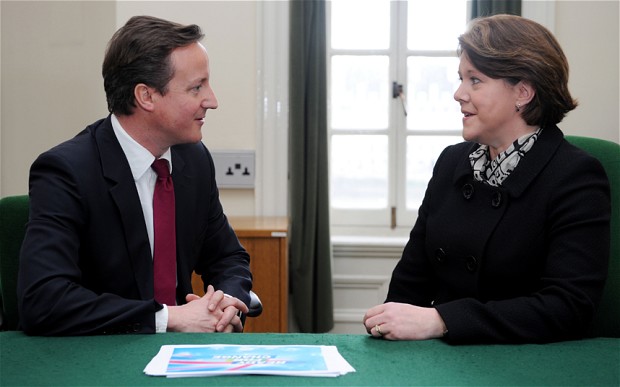
maria miller david cameron

According to the prime minister of the United Kingdom, it is both professionally and ethically acceptable for a Member of Parliament to use taxpayer money to house their parents and contribute toward the purchase of a property which is later sold having appreciated in value, the profits accruing to the lucky politician.

Furthermore, when questioned by the parliamentary expenses authority and by the media it is appropriate for an MP – in this case Maria Miller, the Culture Secretary – to obstuct, bully and harass those investigating the questionable expenses claims at every turn. There is nothing more to see here, the issue is closed and we should all stop fussing and just move on.

We know this because David Cameron tells us so.

The Telegraph summarises the tawdry scandal briefly enough to inform without entirely sapping the will to live:

[Culture Secretary Maria Miller] had to repay £5,800 in mortgage interest payments and also apologise for failing to cooperate with the parliamentary inquiry into her expenses. The Parliamentary Commissioner for Standards, Kathryn Hudson, had recommended that she pay back £44,000, an amount reduced by the MP-dominated Commons Committee on Standards.

But having housed her parents at the taxpayers’ expense, and made a capital gain in the process, Mrs Miller could be presented by the Tories’ opponents ahead of May’s European elections as the personification of alleged Westminster sleaze which so infuriates voters.

If any one image will come to symbolise this latest expenses scandal in British politics, it will be this – the picture of a haughty, self-entitled, unrepentant Maria Miller making her perfunctory, insincere and lightning-fast pseudo-apology to Parliament after having successfully reduced the amount which she was ordered to repay from the original £45,000 to an astonishingly low £4,500:

maria miller 1

Here, Maria Miller is flanked by a number of faces not commonly seen sitting on the back benches by virtue of their position – Health Secretary Jeremy Hunt and Chief Whip Sir George Young. This is no accident. They were ordered to sit with Miller to show the leadership’s determination to stand by the scandal-plagued politician no matter the public outcry.

The picture (from The Times) is essentially a freeze-frame image of Parliament once again conspiring to do right for themselves and act in the interests of the Old Boys (or, in this case, Girls) Club and against the interests of every single voter in the United Kingdom.

Iain Martin correctly surmises that the biggest beneficiary of this tawdry, self-inflicted crisis will be Nigel Farage and the UK Independence Party:

In such circumstances, the survival of the Culture Secretary is a dream for Ukip, as those Tory MPs observed. Having exploited the expenses system and made a sum most voters can only dream about, Miller then had her punishment watered down by a committee of MPs stuffed with the representatives of the mainstream parties. Farage can present Miller as a totem of all that he claims is wrong with the ruling elite.

Martin goes on to suggest that any benefit felt by UKIP would be the result of “scary populist politics”, which rather make one wonder whose side he is on – that of corrupt politicians or that of the people. But tactically speaking, he is quite right – the Maria Miller scandal can only redound to UKIP’s advantage because all of the other major British political parties are represented at Westminster and are consequently tainted by association.

Polly Toynbee, writing in The Guardian and no ideological soulmate of this blog, agrees that Cameron’s refusal to sack Miller – a case of misapplied loyalty at the worst possible time – will come back to haunt MPs from each and every political party and re-open the wounds from a parliamentary expenses scandal that had scarely been given time to heal since the original revelations:

The harm done to politics by the expenses scandal is felt by every MP in the blowback on the doorstep. Even the cleanest get the blame. Miller’s behaviour confirms the worst people think of politicians. How a £1.2m London property housing her husband, children and parents could be called a “second home” defeats most reasonable people. All those “second” bedrooms strike a wicked contrast with the bedroom tax. If her MP colleagues cutting a £45,000 payback to £5,800 was astounding, her 32-second stroppy teenager non-apology took the biscuit. Cameron should have sacked her that day, not for his government’s sake but to salvage a crumb of respect for the politician’s trade.

This really sums up the problem, a rather glaring one left conspicuously untackled since the expenses scandal blew up under the premiership of Gordon Brown – namely, the fact that the spirit of the rules governing expenses continue to be repeatedly violated and mocked, even if they are followed to the literal letter.

In the public mind, expenses exist to cover the necessary costs of performing a job, costs that can or should not be reasonably borne out of the employee’s own pocket. People tend to be reasonable and do not object to the idea of MPs being compensated for expenses incurred while conducting parliamentary or constituency business, just as they would never begrudge a business person legitimately claiming travel and accommodation costs when sent to visit a faraway client.

This blog advocates the introduction of a monitored charge card as the sole method of allowing MPs to pay for purchases to be expensed. Such a system – successfully deployed by many companies with vastly more employees than Westminster’s 650 serving MPs – would provide instant transparency and ease of auditing. In the twenty-first century, there is really no excuse for anything less.

Whenever talk of cracking down on expenses reaches a certain point, the counter-claim is often made that for our politics to work we must continue to attract the “brightest and best” talent to Westminster, and that frozen parliamentary salaries and stricter expenses policies will act as a grave disincentive. This is a self-serving and overblown threat, reliant on the assumption that the best statesmen and policymakers are motivated by cold hard cash. And while the 2015 general election will be the first to take place now that the new rules on expenses have bedded down, there seems little cause to worry that the next intake of MPs will be vastly different in composition to the bland automaton freshmen from 2010.

It is a popular conceit among MPs to believe that they are precious and irreplaceable altruists, but in reality there are many capable people willing and able to serve their country in parliament without also expecting the taxpayer to pick up the tab for their mortgage or second home as some kind of sick golden handshake deal-sweetener. Maria Miller belongs to a political generation that stubbornly refuses to acknowledge this new reality.

The longer that Miller’s petulant non-apology and the image of stony-faced Tory ministers supporting and flanking her on the backbenches remains forefront in the general consciousness, the more damage is done to what remains of public trust and engagement in the British political process.

It may be too late to claim any moral high ground for doing the right thing, but David Cameron needs to end the damage and guide the spirit of Maria Miller’s dying, unmourned political career towards the light.

Spot The Bully – Journalism or Government?

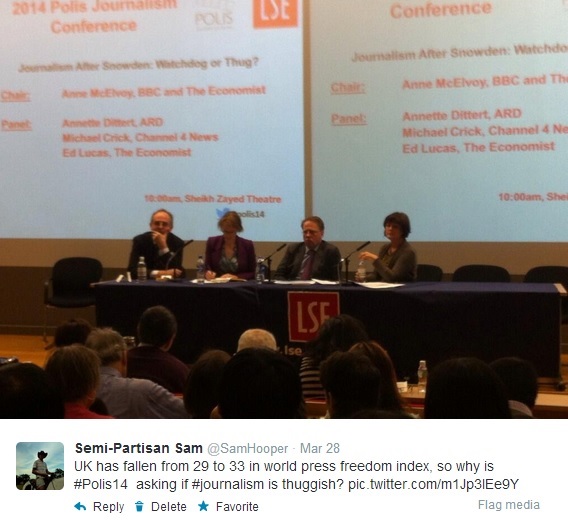
SPS Polis 2014 journalism conference

The POLIS 2014 Journalism Conference, held on the campus of the London School of Economics, played host to a number of luminaries from the British media establishment and debated some important issues. But among the various items on the agenda – including riveting discussions on the methods and ethics of investigative journalism, an interview with Guardian editor Alan Rusbridger and a forum on the use of social media in the newsroom – was a slightly incongruous, strangely titled session.

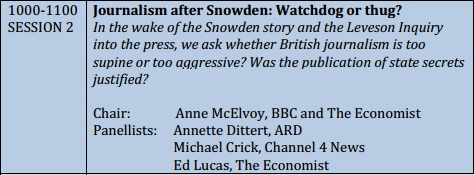
In the second session of the day, the panel – comprised of chair Anne McElvoy (BBC and The Economist), Annette Dittert (German broadcaster ARD), Michael Crick (Channel 4 News) and Ed Lucas (The Economist) debated the following topic:

Journalism after Snowden: Watchdog or thug?

In the wake of the Snowden story and the Leveson Inquiry into the press, we ask whether British journalism is to supine or too aggressive? Was the publication of state secrets justified?

SPS_Polis2014_01

Semi-Partisan Sam, attending the POLIS Journalism Conference for the first time, took the opportunity to ask the following question of the panel:

QUESTION – Given the facts: that Reporters Without Borders downgraded the UK from 29th to 33rd in the World Press Freedoms rankings for 2014;  that the British government now assumes the right to stop and detain partners and relatives of journalists at Heathrow airport under grossly misapplied anti-terror laws; that the Prime Minister last year saw fit to dispatch his Cabinet Secretary to the offices of a major national newspaper in order to threaten it with closure unless they desisted with the publication of materials embarrassing to the government; and that the government forced that same newspaper to destroy their privately owned computers and hard drives under the watchful presence of intelligence and GCHQ officers – why are we sitting here having an introspective debate about whether or not journalists are behaving like thugs when the real thug is clearly the bullying, heavy-handed British government?

The question was extremely well received among the attendees in the hall, prompting a significant round of applause from delegates. Sadly, this did not translate into a a full or robust answer from the panel, who at times had been happier to wander off-topic and waste time debating side issues such as America’s merits as a country and the proper role of the intelligence services.

The panel’s complete answer – such as it was – to the question can be seen in the video below (Semi-Partisan Sam is “the gentleman” referred to by Anne McElvoy):

The Economist’s Ed Lucas, an enthusiastic apologist for anything and everything that the government decides to do in the name of ‘security’, was obviously unsympathetic to the idea that the British government has displayed thuggish behaviour. But since even Lucas was unable to justify what the government has been caught doing without public knowledge or consent, he instead diverted attention by building up and then destroying a straw-man argument of his own creation – namely that those who speak out against government persecution of journalists who expose overreach by the security services are somehow naive pacifists who want to abolish the military and the intelligence services entirely.

Lucas said: “If you want to have a country which has no intelligence and security services, where there are no state secrets or no penalty for stealing state secrets, then fine – I guess that may be the world that the Green Party would like. I suspect it’s a minority point of view.”

This is a patently false and absurd proposition. No serious critic of the British or American governments as pertaining to their secretly allowing their security services to infringe on citizen privacy is suggestion that GCHQ, MI6, the CIA or NSA be disbanded, and Lucas insults our intelligence to cast this aspersion. The issue is not whether we have security and intelligence services, but the lengths to which we as a society are prepared to let them act in our interest.

The other fatuous argument sometimes made by apologists – and indeed by Ed Lucas himself during this same session – goes along the lines of: “Why are people so surprised that we have spies, and that they are involved in acts of spying?” Again, this is a deliberate and misleading attempt to change the terms of the debate. Citizens fully understand the need for foreign and domestic intelligence, but they also have the right to expect that the technology and bureaucracy of surveillance will not be turned inwards upon themselves. While no one expects (or demands) a list of current surveillance targets to be posted and regularly updated on the  internet, the public should have input as to the criteria for targeting through the democratic process.

It is a rather sad statement on the current status of British journalism that the only panellist to seriously engage with the question and agree that it is government – not the press – who have been acting the bully, was Annette Dittert from German broadcaster ARD.

Even the panel chair, Anne McElvoy, felt the need to reframe the question and make the unsubstantiated claim that Glenn Greenwald’s partner, David Miranda, had been carrying “shedloads of secrets with him” when he was detained at Heathrow airport, and that rather than being an outrage, this was just one of the “more difficult areas” where the public “might begin to have some doubts” and feel that the government has a case to answer.

In her response, Dittert correctly identified the apathy of the British people as being partly responsible for the lack of public outcry at the Edward Snowden revelations, saying that Britain has an “almost romantic relationship with the security services” – our experiences of the fictional James Bond being somewhat different to the German experience of the Stasi.

Responding to the question, Dittert said: “I thought it was really concerning – the Prime Minister threatening in the House of Commons a newspaper and journalists … in case they go on publishing is something that shouldn’t happen in a democracy.”

Dittert then went on to describe the way that The Guardian newspaper was treated as being “entirely wrong”.

It is profoundly worrying that even at a prestigious journalism conference such as POLIS 2014, so few of the attendees (and only one of the panellists – a German television correspondent) felt able to push back against the notion that it is the journalistic profession that has become the bully and the thug rather than the British government, whose track record on secrecy, paranoia and intimidation speaks for itself.

And while the POLIS 2014 conference was excellent, the fact that the whole day passed with virtually no observance or mention of the harrassment and intimidation of the British press by the goverment will only reinforce the belief that the establishment media with their well-connected sources and comfortable positions within the Westminster bubble are, at times, quite incapable of holding to account the government that they simultaneously both depend on and fear.

England In The United Kingdom

SPS_BBC_politics_section

Above is a screenshot taken from the Politics section of the BBC News website.

There are clear and clickable links leading to separate sections for Northern Irish politics, Welsh politics and Scottish politics. However, the largest nation within the United Kingdom is given the more cryptically condescending heading “Around England”, which cannot be clicked and which does not lead to its own dedicated section.

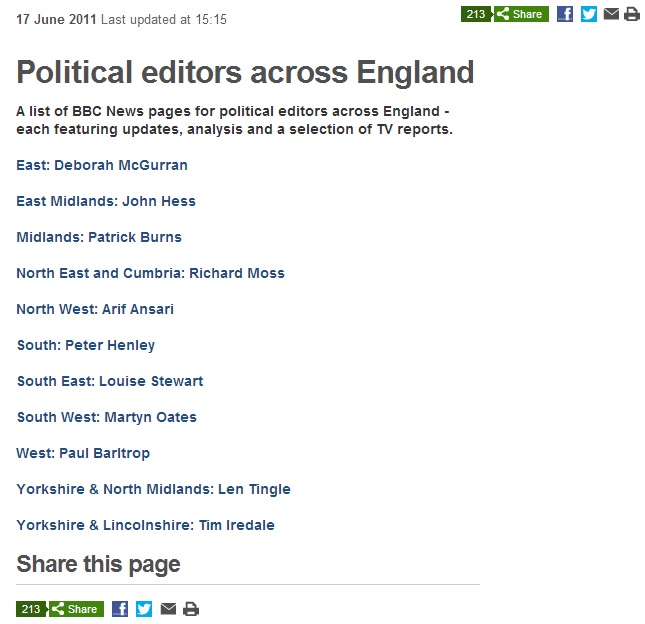
Furthermore, clicking on the obscure “Political analysis around England” link leads to the the following badly laid-out page listing the BBC’s English political editors by region (presumably outdated since it was last updated nearly three years ago):

SPS_BBC_politics_section_2

Who made the decision to slice and dice our United Kingdom in this way when it comes to political coverage? Who decided on behalf of the British population that the Welsh, Scots and Northern Irish should see their politics primarily at a national level, while the English must be given news at a regional basis?

More importantly, is this discrepancy in political coverage a result of  organisational efficiency (so that political editors cover “patches” roughly equal in population, for example) or is it for another, perhaps more sinister reason?

The answer, of course, is that the BBC’s way of splitting its political coverage is merely a reflection of the way that the political elite want us to see ourselves – with all of the home nations save England deserving of a degree of individual recognition and autonomy.

But this way of organising news coverage – and structuring our political system – does everyone a disservice. People living in Wales, Scotland or Northern Ireland are denied the chance to view or shape events in their respective nations from anything other than a macro level, while English residents are not given the chance to look at issues which affect England in particular.

At a time when the Scottish people have a referendum to determine their future participation in the United Kingdom, and issues of devolution of power are coming increasingly to the fore, why does the BBC persist with a political reporting structure that is fundamentally out of touch with the sentiment of the country?

On Wednesday 23rd April, England will celebrate – or at least observe – St. George’s Day. This blog would not be surprised if there was a significant popular backlash or uprising of English nationalist sentiment around this time, given the fact that so much of our leaders’ energies are currently taken up talking about how best to cater to the needs of Scotland while the West Lothian question remains – as ever – conspicuously unaddressed.

Of course, if a debate does bubble to the surface around this time, it could well be diffused into obscurity by the BBC’s eleven English regional political editors.

Nigel Farage vs The Politically Correct Line On Russia

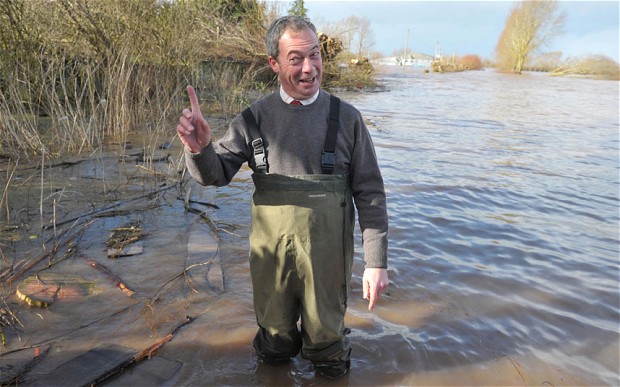
Attempts to sink Nigel Farage tend to fail


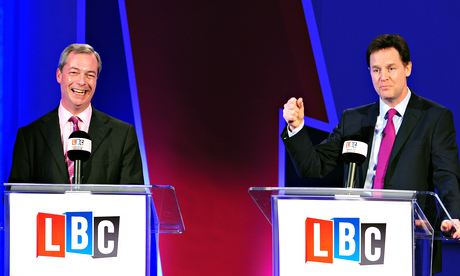
In the aftermath of last week’s debate on Britain’s place in the European Union, UKIP leader Nigel Farage had gall to say that he admired the tactics of the despotic Russian president Vladimir Putin. Not that he admired Putin as a person, agreed with his annexation of Crimea or supported his policies in any way, mind you – just that he thought Vladimir Putin had played a good hand and used methods both conventional and shady to advance the national interest of his country.

To hear Deputy Prime Minister Nick Clegg’s subsequent shrieks of outrage, quickly repeated and parroted thoughtlessly by numerous political commentators and talking heads, you would think that Nigel Farage had whipped a large Soviet flag out from behind his podium and paraded up and down with it during the debate, singing  the State Anthem of the USSR at the top of his lungs (incidentally, it’s a cracking piece of music).

The second live televised Leader’s Debate on the EU will take place tonight, and given the establishment media’s heroic efforts last week to spin the results of the first as a victory for the hapless Nick Clegg – until overwhelming reality and the results of a YouGov poll made their position indefensible and forced a sudden reassessment of Farage’s performance – this blog aims to clear the fog of war which still threatens to obscure what Nigel Farage actually said (eminently reasonable) and what he has subsequently been accused of saying (treachery).

Here is what Nigel Farage actually said, when asked by Alastair Campbell which world leader he most admired:

“As an operator, but not as a human being, I would say Putin. The way he played the whole Syria thing. Brilliant. Not that I approve of him politically. How many journalists in jail now?”

 The recognition of Putin’s moral failings and outrage at Russia’s insidious suppression of free speech was not enough to save Farage from what followed. The point was clearly that Russia has been running rings around a hopelessly divided (and in some cases, morally equivalent) international community, not that Russia pursued a just or worthy course of action.

Nick Clegg chose to see it somewhat differently:

“It shows quite how extreme people can be like Nigel Farage when their loathing of the European Union becomes so all-consuming that they even end up siding with Vladimir Putin in order to make their point.

The only reason we are able to seek to exert any influence – and it is difficult enough as it is – on Vladimir Putin is because we can act with the clout of being part of the economic superpower that is the European Union, upon which Russia depends a lot.”

A heady mix of deliberate misrepresentation and the sadly typical denigration and talking down of Britain’s capacity to act in it’s own interests on the world stage such as this would be remarkable coming from anyone other than the Liberal Democrat leader and our Deputy Prime Minister.

Clegg and Farage


Former Conservative Foreign Secretary Malcolm Rifkind also loses the plot over Farage’s comments, railing against the UKIP leader in his uniquely blustering, pompous style:

How very revealing. When asked which world politician he most admires, Nigel Farage chooses, of all people, Vladimir Putin. While others might have sought a successor to Winston Churchill or Nelson Mandela, Farage fawns over an autocrat who has made Russia the least free country in Europe – a man who locks up his political opponents and has just invaded his neighbour, annexing part of its territory.

Rifkind also chooses to go with the trusty trick of blatant misrepresentation. Nigel Farage was clear to add the caveat “as an operator, but not as a human being” before making his comments about Russia’s effective foreign policy. Those key words by Farage, which place his remarks in context and which came literally right before the ones that Rifkind quoted to support his diatribe, seemed to sail past his ears unnoticed.

Rifkind then goes on to miss the point entirely:

[Farage’s] irresponsibility has not just been restricted to Putin’s behaviour in Ukraine. He described Putin’s policy on Syria as “brilliant”. Does he not realise that Russia has vetoed every resolution in the UN Security Council that was aimed at pressing Assad to end his murderous violence – which has led to the deaths of over 140,000 Syrian men, women and children? Does he not know that without Russian arms supplies, the Assad regime would have been forced to negotiate an end to the civil war two years ago?

Again, we see the deliberate, false equating of Farage’s admiration of the brilliant execution of an terrible policy with actual support for that policy. But the two are clearly not one and the same, no matter how much the prevailing climate of political correctness may insist that because something is judged by the collective to be bad, all aspects of it must be denounced as equally terrible and any positive aspects be purged from discussion and memory.

Russia’s annexation of Crimea is outrageous and terrible – on that much, nearly everyone aside from Russia agrees. But to stop at saying that is not enough for the politically correct pundits of today. In this world, because Russia has done this terrible thing and made itself persona non grata in the international community, we all must now say that everything about Russia is bad, and never acknowledge any good until we are told by our superiors that it is safe to do so.

To be fair, Russia makes this task quite simple. Through their domestic and foreign policies on any number of issues, that country has placed itself on the wrong side of human rights, freedom of speech and even the arc of history. The lamentable implosion of Russia’s nascent democracy is well known, as are the stories about increasing suppression of free speech, the government takeover of the media and Russia’s appalling record on civil rights for gay people. But why must all of these misdeeds be meticulously restated before a British politician can say the truth – that despite Russia being completely wrong on all of these issues, they played their foreign policy hand really well in support of their own national interests?

Telegraph columnist Tim Stanley hits the nail on the head in support of Nigel Farage’s right to say the blindingly obvious:

Farage’s sin was to say that he admires Putin as a political leader, although not as a human being. Why this is controversial, I have literally no idea. Farage made it abundantly clear that he regards the Russian leader as a despot (“How many journalists in jail now?”); he simply thinks that he outwitted Obama on Syria. I think that; you think that; even Obama probably thinks that … Ah, but you can’t say such things out loud because the consensus in Westminster right now is that Putin is Hitler, Ukraine is the Sudetenland and anything less that outright Russophobia is treachery. And probably a little bit homophobic.

Precisely. Believing that Putin outwitted other world leaders in terms of the response to the awful situation in Syria does not imply support for Putin’s position, just as believing he is currently one step ahead with regard to Ukraine does not mean that Nigel Farage wants Russia’s gamble to succeed.

Tim Stanley continues, giving a brilliant summation of the current problem with British political discourse:

And that’s Farage’s real sin: he dares to be different. Contemporary British politics works by an unusual degree of consensus. All three party leaders want to stay in the EU, all wish to preserve the principle of the welfare state, all back gay marriage, all accept the need to go green, none will challenge the concept of open borders on immigration. Some or all of these positions may well be right – that’s not the issue. The issue is that this homogeneity of opinion is fundamentally undemocratic. In democracies, voters are supposed to be offered real choices rather than one establishment philosophy spun three different ways. To make matters worse, the party leaders now not only sound alike but also lookalike.

This much is true, and scarily so. The sad fact is that the British political elite have imposed a consensus on society that the people themselves have not yet reached. For good or ill (okay, for ill) there is a large rump of opinion within the British population that would bring back the death penalty in a heartbeat, scrap the new legalisation of gay marriage, become Fortress Britain for immigrants seeking the right to work, and undertake any number of other regressive policies. But in Britain the elite went ahead and determined the “correct” answer to all of these issues on behalf of the people but without seeking their input, and so the debate is continually suppressed – except for when it bubbles to the surface manifested as support for the insurgent or extremist parties.

Contrast the situation in Britain with that in the United States. The political debate there is no more enlightened or informed, but there is still the sense that they debate important issues, often from diametrically opposing viewpoints. The US senate hears strident views from such diverse characters as self-proclaimed socialist Bernie Sanders, the senior senator from Vermont, as well as the fire-and-brimstone filibusterings of Tea Party darling Ted Cruz. And people with views anywhere within this spectrum are made to feel welcome in the political debate. As a result, though the American process is a lot slower, louder and more contentious, when political unanimity is finally reached (and it takes a long time – civil rights has more or less just crossed the line, with gay rights looking at another 30 years of toil) it is much more strongly reflected in the people, and is consequently much more likely to stick.

The difference could not be clearer – a lively national debate where everyone feels they can speak and be heard, or the stultifying restrictions of an artificial consensus imposed by the political elite.

Now faced with a politician who refuses to follow the approved talking points on Russia, these weasely politicians who came scurrying out of the woodwork to denounce Nigel Farage over his comments are deliberately misleading the public and attempting to change the narrative. Hell, let’s call a spade a spade – they are lying, deliberately lying to the British people in the political establishment’s latest doomed attempt to make Nigel Farage, the UK Independence Party and the millions of people who share his viewpoint seem extremist, weird and dangerous.

All of these armchair pundits know what Nigel Farage meant when he said he admired the direct effectiveness of Vladimir Putin’s assertive foreign policy as compared to the dithering and retrenchment which have all too often characterised the governments of David Cameron and Barack Obama. But why let a non-story go to waste when words can be twisted and mischaracterised to falsely make their speaker sound like the CEO of the Vladimir Putin Fan Club?

Of course, all of this kerfuffle could have been avoided if Nigel Farage had chosen his words more carefully. Had Farage prefaced his words with a lengthy (but surely unnecessary) denunciation of Russia’s behaviour and Putin’s morals, he might have escaped censure by the self-appointed moral arbiters of British political debate. That’s exactly what they want to happen, and it is why they are now so furious with the idiosyncratic UKIP leader, resolved once more to try to drive him out of British politics.

In the heavily thought-policed world of Nigel Farage’s critics, no opportunity to say The Correct Thing should ever remain unseized. If you want to make a point about the effectiveness of Russia’s foreign policy then that’s okay, but by God you had better utter the cross-party approved talking points before you do so. Only once all of your political pronouncements become entangled in endless disclaimers and footnotes grounding them in established political correctness will these meddling people be satisfied.

Tim Stanley puts it well:

Westminster is going to continue hitting its head against the brick wall of public antipathy towards politics-as-usual. The more that Farage acts up, the more different he seems, the more the establishment will hate him, the more the voters will like him.

And there, right there, is the popularity of Nigel Farage. Political correctness and towing the establishment party line? He will have none of it, thank you very much. Whether you like his political stances or not, he is the only leader of a major political party in Britain who remains willing and able to speak honestly and passionately as though he isn’t reading from a focus group-approved script.

How richly will the voters reward him in May’s elections for daring to talk like a normal human being?


The next Leader’s debate on the European Union takes place tonight (Wednesday 2nd April) at 1900 BST, and will be shown on BBC Two.