Ron Paul, The New Russian Apologist

RonPaul


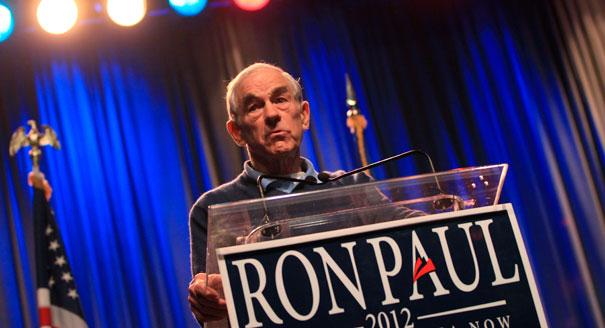
Former US congressman Ron Paul (R-TX) is nothing if not consistent – an admirable and all too rare quality in a politician. But just sometimes, the unflinching adherence to a particular principle or policy can be a bad thing – witness the Tea Party’s stance on taxation, the National Security Cheerleader Caucus’ enthusiasm for government surveillance, or the legislate-by-Bible-verse preference of the religious right.

Ron Paul has now sadly joined this group of ideologues, not because many of the points that he makes have suddenly stopped being timely, persuasive and correct, but because he now makes them in such a way that they no longer inform or educate, but merely generate material to be used by enemies of the United States and the West as ready-made propaganda pieces.

Indeed, some of Paul’s recent pronouncements on the Ukraine crisis and the Russian usurpation of Crimea are so one-sided and so determined to examine only the faults of the West while negating or ignoring the faults of Russia, that one wonders what his motivation could possibly be. Paul seems to be adopting a one-man Fox News Strategy, whereby he single-handedly attempts to redress what he sees as an inherent bias or gross imbalance by coming down incredibly hard on one side of an argument – whilst proclaiming all the while to be fair and balanced.

The latest fodder for Kremlin-apologists came on Sunday, when Paul penned an op-ed for his own Ron Paul Institute website, the subtitle of which could easily have been ‘I told you so.’ In this piece, he lashes out at the monetary and other forms of assistance given to Ukraine over the past ten years by US-funded non-governmental organisations (NGOs):

But what do the US taxpayers get, who were forced to pay for this interventionism? Nothing good. Ukraine is a bankrupt country that will need tens of billions of dollars to survive the year. Already the US-selected prime minister has made a trip to Washington to ask for more money.

And what will the Ukrainians get? Their democracy has been undermined by the US-backed coup in Kiev. In democracies, power is transferred peacefully through elections, not seized by rebels in the streets. At least it used to be.

As with most effective attempts to mislead, there is just enough truth contained in this statement to suggest respectability and provide a stepping stone to reality, but not too much that it might get in the way of the misinformation being delivered.

It is certainly the case that the National Endowment of Democracy, a private and non-profit organisation, is active in Ukraine. But the NED is not secretive about this fact. Indeed, they detail all of their activities and funded initiatives across all of the countries where they work on their own website. Details of their funded work in Ukraine can be read here.

It is certainly possible that organisations such as the Human Rights Training Center or the Ukrainian Catholic University are nothing but shadowy US puppet organisations, greedily taking in American taxpayer money and using it to subvert the will of the Ukrainian people, just as it is possible that Barack Obama became president of the United States for the sole purpose of gathering material to aid in his upcoming romantic comedy about living and working in the White House. Possible, in other words, but eyebrow-raisingly unlikely.

But the narrative sounds very good to anyone predisposed to view any American or Western activity with suspicion, and so by floating unsubstantiated assertions that western-funded NGOs are doing anything other than trying to promote and build the strong institutions required for democracy to flourish, Paul is playing into a harmful narrative which misconstrues the intentions of his own country and those of the West.

In a separate intervention last week, Paul rhetorically asked:

Why does the US care which flag will be hoisted on a small piece of land thousands of miles away?”

The thought does not seem to occur to Paul that perhaps the United States does not care about the flag – that perhaps it is not the small piece of land that is at stake, but rather the way that it changed hands so rapidly under threat of force that is the problem. And, regrettably, he seems all too willing to recall previous bad actions and mistakes made by the United States to excuse current crimes committed by Russia:

“Where were these people when an election held in an Iraq occupied by US troops was called a ‘triumph of democracy’?

Iraq was certainly very recent, but to make a blasé statement such as this without giving a thought to the many differences between the invasion of Iraq (non-permanent and not for acquisition of land) – however terrible and wrong it may have been – and the Russian invasion and annexation of Crimea, is propagandist point-scoring at its worst.

No strangers to propagandist point-scoring themselves, the Kremlin-funded Russia Today network predictably seized on Ron Paul’s latest op-ed, and folded it into their continuing efforts to spin the Russian invasion and annexation of Ukraine’s sovereign territory as something entirely consistent with international law, recent precedent and human decency.

RT.com wasted no time putting their own helpful gloss on Ron Paul’s words:

According to Paul, high-funded intervention doesn’t equate to spreading democracy. Instead, he wrote, the US has invested in a country where power has been passed along not by the way of a democratic election, but rather the ousting of the country’s presidents by his opponents.

Of course, the regime of Viktor Yanukovych ousted by the supposedly undemocratic popular uprising in Kiev was itself busily trying to subvert the Ukrainian democracy by cracking down on freedom of speech, silencing dissent and dramatically increasing the powers of the president, which rather muddies the waters and exposing the Ron Paul / Russia Today line as the one-sided propaganda that it is.

Ron Paul accuses President Obama of doing many of the things in America that Viktor Yanukovych did in Ukraine, albeit on a slightly smaller scale – certainly, Obama’s war on whistleblowers and the surveillance state that he has tolerated and expanded can be said to chip away at the foundation of democracy. And yet this outrage at the illiberal policies being enacted in America is nowhere to be found when he looks at the former Yanukovych government, who, for all Paul seems to know or care, were benign arbiters of justice and democracy, unjustly pushed from office by a baying mob of anti-democracy fanatics.

If the recent Edward Snowden / NSA / surveillance debate have taught us nothing else, we have at least been reminded that democracy and its institutions are fragile and never more than one generation away from serious damage, subversion or destruction. When countries such as Britain and America – who have traditionally held aloft the flame of liberty and democracy – now suffer under governments that think nothing of secret surveillance of their own citizens, detain people or subject them to indefinite curtailments on their freedom without trial or allow those who permitted torture to take place to avoid justice, how much more fragile and in need of support must be those nations with a much shorter history of democratic government?

And in this context, is NGO money spent to strengthen democratic institutions in countries around the world not one of the best investments that the West could make?

The suggestion is not that Ron Paul has no right to speak out against past US failings – he has a longstanding and admirable track record of doing so. But the problem comes when his zeal to remind people of past US and Western failings leads him not to condemn those same actions by other countries, but rather almost to praise them as a perverse means of restoring parity within the global order.

In his recent speech to the Russian parliament, Vladimir Putin ranted, raved and gave the world a stark insight into his paranoia, his sense of inadequacy and the huge chip on his shoulder concerning how his country is perceived by the rest of the world. Railing against the West, he said:

Our Western partners, led by the United States of America, prefer not to be guided by international law in their practical policies, but by the rule of the gun. They have come to believe in their exclusivity and exceptionalism, that they can decide the destinies of the world, that only they can ever be right. They act as they please: here and there, they use force against sovereign states, building coalitions based on the principle, “If you are not with us, you are against us.” To make this aggression look legitimate, they force the necessary resolutions from international organisations, and if for some reason this does not work, they simply ignore the UN Security Council and the UN overall.

They did it before, so now we can do it, too.

Ron Paul is in many ways a visionary, and is certainly a real American patriot. Which is why it is concerning that he and the dictator from Russia find themselves singing from the same hymn sheet.

Texas Spares No Expense To Kill

texas_death_penalty


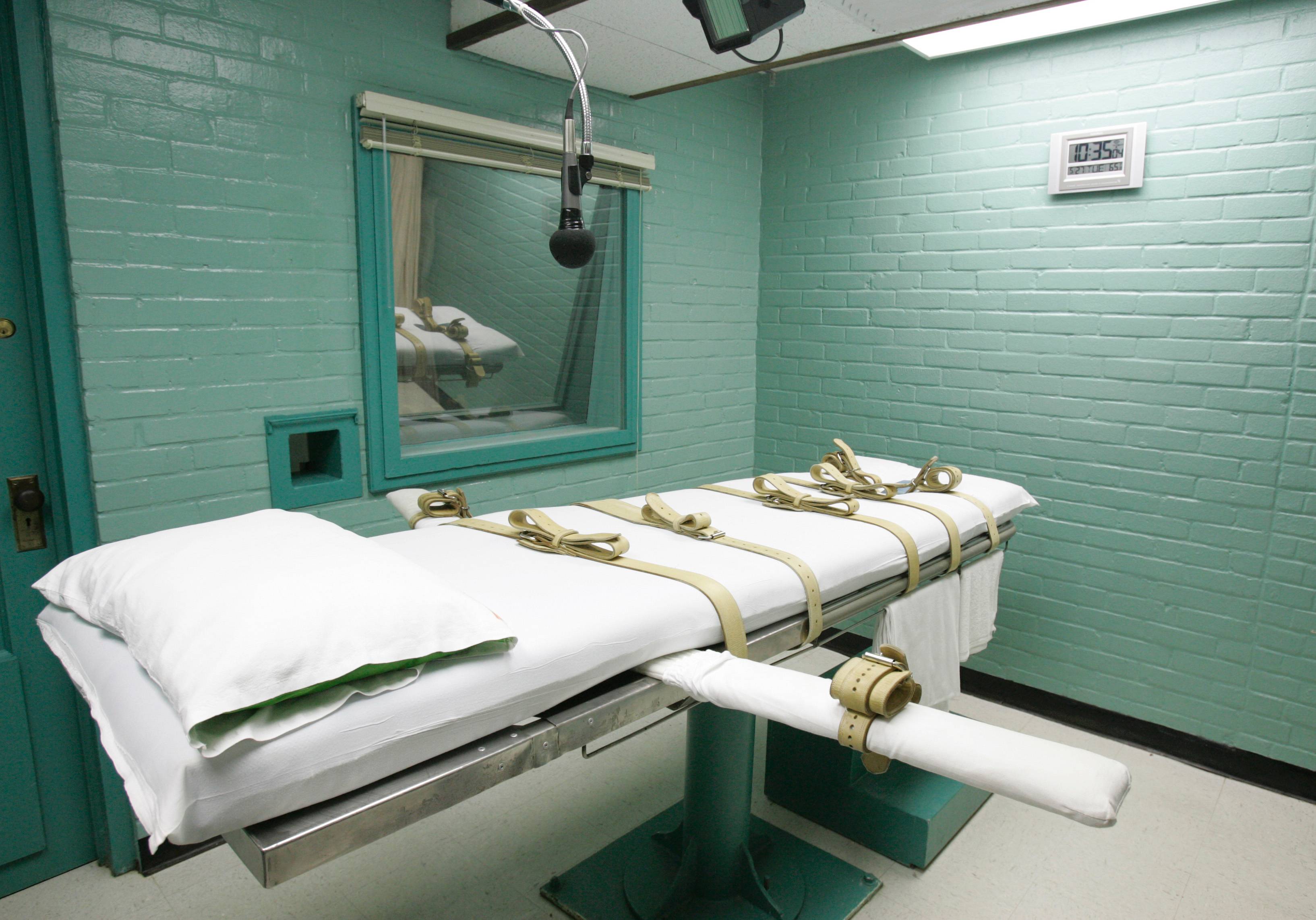
In Texas today,  there is apparently no expense too great when it comes to efficiently killing people, and no expense too small to be called unaffordable and cancelled if it preserves or improves quality of existence for the living.

This has nothing to do with the Democratic gubernatorial candidate Wendy Davis, or the ongoing and contentious argument over abortion; those battles are raging on their own elsewhere.

Rather, this is about the eagerness of the state of Texas to go to any expense and any length to continue dispatching prisoners on death row with clockwork efficiency and regularity, under a veil of secrecy and unknown cost, while any other state expenditures are castigated as a sign of ‘big government’ and pared back – even as those who have (rightly or wrongly) come to depend on that government support suffer grievously as a consequence.

The Guardian reports on the extraordinary lengths to which the Texas state government – which takes every opportunity to position itself as staunchly pro-life and legislate based on the ‘sanctity of human life’ – is willing to go in order to continue performing lethal injections once its current supply of lethal injection drugs runs out at the end of March:

Texas has obtained a new batch of the drugs it uses to execute death row inmates, allowing the state to continue carrying out death sentences once its existing supply expires at the end of the month.

But correction officials will not say where they bought the drugs, arguing that information must be kept secret to protect the safety of its new supplier. In interviews with the Associated Press, officials with the Texas Department of Criminal Justice also refused to say whether providing anonymity to its new supplier of the sedative pentobarbital was a condition of its purchase.

It should be noted that Texas is not the only state to go above and beyond in its zeal to continue killing inmates – Ohio also recently switched to a new cocktail of lethal injection drugs after it found itself unable to obtain new supplies of the original formula.

The fact that no international pharmaceutical company is willing any longer to supply drugs to be used for barbaric executions was a mere obstacle to be overcome for Ohio, who found a new drug and a new supplier, and subsequently botched their first execution using the new method. One eyewitness, a priest, reported:

I was aghast. Over those 11 minutes or more he was fighting for breath, and I could see both of his fists were clenched the entire time. His gasps could be heard through the glass wall that separated us. Towards the end, the gasping faded into small puffs of his mouth. It was much like a fish lying along the shore puffing for that one gasp of air that would allow it to breathe. Time dragged on and I was helpless to do anything, sitting helplessly by as he struggled for breath. I desperately wanted out of that room.

For the next four minutes or so a medical tech listened for a heart beat on both sides of his chest. That seemed to drag on too, like some final cruel ritual, preventing us from leaving. Then, at 10.53am, the warden called the time of death, they closed the curtains, and that was it.

I came out of that room feeling that I had witnessed something ghastly. I was relieved to be out in the fresh air. There is no question in my mind that Dennis McGuire suffered greatly over many minutes. I’d been told that a “normal” execution lasted five minutes – this experimental two-drug concoction had taken 26 minutes. I consider that inhumane.

But let us return to Texas, so often the protagonist in these stories. The reason given by Texas state officials for not releasing details of where their shiny new supply of lethal injection drugs came from – in response to an entirely justified request by the AP – sets a new standard for cognitive dissonance and Orwellian doublethink:

The decision to keep details about the drugs and their source secret puts the agency at odds with past rulings of the state attorney general’s office, which has said the state’s open records law requires the agency to disclose specifics about the drugs it uses to carry out lethal injections.

“We are not disclosing the identity of the pharmacy because of previous, specific threats of serious physical harm made against businesses and their employees that have provided drugs used in the lethal injection process,” said Texas Department of Criminal Justice spokesman Jason Clark.

It is already well known that Texas’ supposed devotion to the sanctity of life does not apply to those on death row, just as the state that held a prayer event to ask God to intercede and end a long-running drought is also quite happy to ignore Jesus’ teachings about mercy and forgiveness.

But now it also appears that the state of Texas is acting in this opaque and clearly antidemocratic manner because of fears for the safety of those people who are involved in producing the deadly drugs.

Imagine, for a moment, that the Texas Department of Criminal Justice had instead released their statement with the following revision (amendments in brackets):

“We are not disclosing the identity of the [people and organisations involved] because of previous, specific threats of serious physical harm made against businesses and their employees that have provided [services] used in the [abortion] process.”

Pigs would fly and snow fall in hell before the state of Texas would ever consider withholding the names and details of people involved in providing abortion services out of a desire to protect their safety, even though there are many real, tangible examples of such people being subjected to harassment, intimidation, physical harm and assassination. By contrast, anti-death penalty campaigners have shown no signs of wanting to intimidate or harm those with whom they disagree.

The key difference (and reason for the massive divergence in treatment of the two groups) is that as far as those in power in Texas are concerned, anyone ever involved in facilitating an abortion is inherently evil and deserves whatever comes their way, but anyone who facilitates an execution is doing their God-fearing, patriotic duty.

And this dichotomy exists because the governing majority in Texas, from Rick “Oops” Perry on downwards, do not see the execution of an incarcerated inmate by the all-powerful government as a violation of the commandment Thou Shalt Not Kill.

texas_executions
One of the indispensable functions of government?


At this point, two disclaimers:

1. The purpose of this article is not to elicit sympathy for murderers, or even to debate the merits of the death penalty – though this blog will go on record as being resolutely against the death penalty, viewing it as a barbaric practice from a bygone age best relegated to the past.

2. Nor is the purpose of this article to debate the issue of abortion – though this blog will go on record as believing that life begins at conception, but that there are various times and circumstances (rape, incest, catastrophic developmental anomalies, risk to the life of the mother) when two equally terrible choices must be weighed and the resultant answer may come down on the side of terminating the pregnancy at the earliest opportunity; and that in these terrible, heart-wrenching circumstances, no one is better placed to make the awful decision than the mother, least of all government.

The purpose of this blog is to ask a very simple question of the Texas government: where the hell are your priorities?

Why, when Texas struggles with shameful rates of illiteracy, teen pregnancy, teen births, adults in correctional facilities, adults under probation, citizens without health insurance and food insecure children, is the state government rummaging for spare change and wasting precious time and resources in order to continue funding executions, of all things?

Why, when life is so difficult and wretched for so many Texans, is their state government more interested in preserving its ability to smite the guilty (or not guilty) than help the needy?

When conservative Texans are not threatening to secede from the United States in protest of the Tyrannical Kenyan Socialist Marxist Fascist Community-Organising Gun-Confiscating Traitor unlawfully occupying the White House, they often like to pledge their love and respect for the Constitution. Section 13 of Article 1 (Bill of Rights) of their own Texas State Constitution has this to say on the matter of punishing the guilty:

Sec.13. EXCESSIVE BAIL OR FINES; CRUEL AND UNUSUAL PUNISHMENT; REMEDY BY DUE COURSE OF LAW. Excessive bail shall not be required, nor excessive fines imposed, nor cruel or unusual punishment inflicted. All courts shall be open, and every person for an injury done him, in his lands, goods, person or reputation, shall have remedy by due course of law.

“Nor cruel or unusual punishment inflicted.”

In Texas, it appears that selective reading is not limited to the Bible.

What Do The Tories Stand For?

Interchangeable
Interchangeable


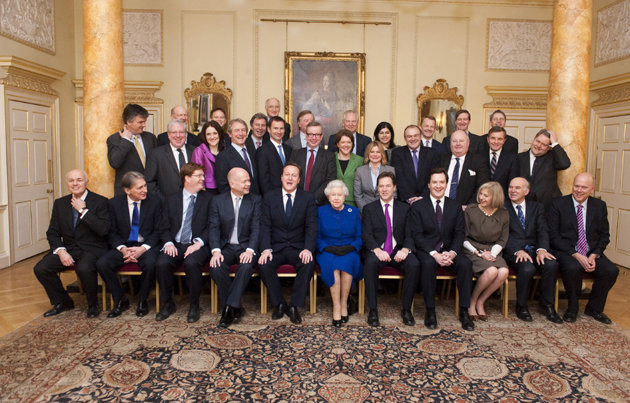
Iain Martin poses an excellent question to restive Conservative ministers and backbenchers currently jostling for position in a 2015 conservative leadership election that may very well never transpire – what would they do for the country if they actually got the job?

A very pertinent question. Watching the unseemly attempts of cabinet member after cabinet member manoeuvre for advantage and brief against perceived rivals provokes unpleasant flashbacks to the time when Gordon Brown finally had his way and muscled Tony Blair out of Number 10 Downing Street, only to become prime minister and realise that he had just fulfilled the extent of his ambition.

With more than a year to go until what will undoubtedly be a closely-fought election campaign, now is really not an appropriate time for self-interested ministers to be promoting their personal prospects at the expense of stable governance. And if they absolutely must indulge in such counterproductive, selfish shenanigans, they could at least give the public some semblance of a reason to believe that they offer a better alternative to David Cameron.

As Iain Martin points out, none of the would-be plotters have yet risen to this challenge:

Some people are positioning ahead of a potential vacancy and talking seriously in private about who the next Tory leader will be. So far it has all been very heavy on personalities and score-settling.

What we hear less of is ideas. What do those who want to succeed Cameron, if he loses, want to do with or for the country? This is, I know, a hopelessly naive question, although I never tire of asking it during a leadership race.

We already have a coalition government that stands for next to nothing. Blaming Labour for the country’s economic predicament and the state of the public finances may be correct, but it doesn’t amount to a platform for governing. And with little more than a year left in the lifetime of this parliament, we can expect precious little more in terms of radical or effective new policies. This mean that the electorate has to make up their minds based on what we can see today. So what is there?

Michael Gove’s education reforms spring to mind as something both tangible and in line with conservative principles, but aside from that, what else can the Tories point to? The period from 2010, when the United Kingdom finally escaped the Gordon Brown terror, has been characterised by retrenchment and burden-sharing and sacrifice-making and painful compromise at every turn. There has been almost nothing positive. Whether it is fiscal policy, defence policy, welfare reform (though credit to Iain Duncan Smith for at least trying), privacy or constitutional reform, it has been an exercise in damage limitation on all fronts.

If the conservatives were (heaven forfend) to elect Boris Johnson as their new leader, or Theresa May, or George Osborne or anyone else, what would they do differently? Why go through the trauma of ditching Cameron and choosing someone else who may be identical, or worse?

Iain Martin proposes a good set of questions, well worth asking, that could help distinguish one candidate from another and maybe tease out some real talent or independent thinking amidst a sea of caution and homogeneity. Making the valid point that voters will not warm to a new leader who only attained his or her position by virtue of being ‘next in line’, he issues the following challenge:

Eventually, the rest of us in the audience – taxpayers, the people who live here, Tories and non-Tories alike – might like to hear what applicants to be Conservative leader and trainee prime minister have in mind, other than stopping each other.

Here are his ten questions:

1) How can the country be more productive?

2) How can we maximise the advantages of globalisation without having to concrete over the whole of southern England to accommodate the millions more who want to be here?

3) Are our banks still too big and how do we get more competition to aid consumers and business?

4) Why is the tax system such a mess of conflicting incentives?

5) Is EU membership really compatible with being a self-governing nation state?

6) Is it even possible to be truly self-governing any longer in the age of the EU, big tech and giant corporates that operate across continents?

7) The Blair/Gove education reforms are up and running – how might they be built on?

8) What is the UK’s foreign policy?

9) What are the threats and how will we defend ourselves?

10) Can the UK be remade to give all its constituent parts, especially England, greater autonomy while still holding together the Union?

While it is absolutely right to challenge those seeking to be David Cameron’s successor to answer these questions, in reality it would be good for all politicians and party leaders to have a stab at addressing them, because these ten questions really form the basis of how we currently see ourselves as a country, and where we want to go from here.

Take the first question on productivity. This could lead to an interesting debate along any number of lines, including trade union reform, European Union membership status, working conditions for interns and apprentices, and more. Already we would see a divide between the mainstream Conservative party MPs who remain deeply eurosceptical, and the more Europhile fringe. Similarly, a contrast would be drawn between the mainstream anti-union position and those such as Robert Halfon MP who have been trying to reintroduce a trade union heritage to the party.

The tax system question is also one that urgently requires answering, not just to help search for the ideal future Tory leader but because the current tax code is such a mess. Some are quite keen to continue incentivising certain ‘good’ behaviours such as marriage through the tax code while others (one dares to hope) might argue for a radical stripping down and simplification of the system. While none of the potential candidates are likely to come out in support of a genuinely interesting idea such as a flat tax, we might see ideas about eliminating the myriad of tax credits in order to lower rates for everyone gain some traction.

Martin’s list is not perfect, and some of the questions are more philosophical than immediately useful. The brace of questions on the EU, for example, are the type of topic that one could imagine being debated at length over canapes at Davos or Bilderberg, but which are of no help in distinguishing future Tory leadership candidates. EU membership is clearly increasingly incompatible with being a self-governing nation state, and will remain that way for as long as the Treaty of Rome’s ‘ever closer union’ call continues to be advanced with no democratic mandate from the European people. And no Tory leader is ever likely to publicly surrender British policymaking to the forces of the EU, multinational business or big tech, no matter what compromises may take place in secret.

The questions on foreign policy and preparing to meet future threats are of extreme importance. While Russia’s annexation of Crimea and continued slide back toward authoritarian despotism is not about to herald a new age of big set-piece land wars in Europe, it will at least hopefully remind UK policymakers that the next unknown threat to the UK will by definition come from out of the blue. Having been chastened by that reminder, Tory leadership candidates might have some refreshing opinions on the size, strength and scope of our armed forces, perhaps with a view toward undoing some of the recent damage done.

The final question on remaking the UK to allow greater (and ideally equal) autonomy for all constituent nations of the United Kingdom, and the need to clearly set out those powers that belong at Westminster, those that belong with the home nations and those that should be devolved to local level is perhaps the most important of all. This blog has long advocated for answering this question by holding a UK constitutional convention to decide these matters once and for all. While this is an extremely unlikely prospect, it would be interesting to know the potential candidates’ thoughts on these matters.

But of course we will hear no opinions on any of these matters, because there are no Tory leadership candidates. And there are no Tory leadership candidates because there is no Tory leadership election on the cards.

The bottom line is this – there are a lot of important questions about the current state of our country and how best to move forward. Iain Martin has done a good service by listing some of these, and any politician who can disengage from the daily grind of politicking and governance for long enough to answer them would be making a valuable contribution to the debate.

But those Conservative ministers and prominent backbenchers inclined to look past the 2015 general election to burnish their leadership prospects while refusing to engage in real debate on the issues are just being opportunistic and cowardly, and do not deserve the air time or our attention.

Those who want to replace David Cameron as leader of the Conservative Party ought to try believing in and standing for something themselves – something other than their own selfish career advancement – before the jostling for position and knife-sharpening gets out of hand.

The death throes of free speech in Russia


As the world’s attention remains fixed on Ukraine, less attention is paid to the final nails being hammered into the coffin containing the corpse of Russia’s free and independent press. And while the annexation of Crimea and the west’s shamefully half-hearted response (slapping sanctions on a mere handful of Russian officials and exempting Vladimir Putin and his closest confidantes) certainly deserve their column inches, journalistic independence and free speech finally died in Russia, without a shot being fired. It is only right that we acknowledge this backward step, too.

A couple of excellent columns published over the past weekend aimed to do exactly that – Julia Ioffe writing at the New Republic and David Remick at The New Yorker. Both articles come highly recommended and paint a compelling, sad story.

In his piece, Remnick mourns the backwards steps under Putin which have now erased each and every gain made for freedom of expression under the Gorbachev glasnost era, with particular reference to the Russian government’s recent interference with popular news site Lenta.ru:

In recent years, when Russian liberals have tried to sound optimistic, they have invariably said, Well, at least they haven’t cracked down on the Internet the way the Chinese have. Lenta.ru is one Web site, not the entire Russian-language Web, to be sure, but today’s firing is still an important and ominous step. Lenta.ru was getting more than thirteen million unique visitors a month, and was far more direct and critically minded than anything on state television or in most print publications. Some staff writers and editors have said that they will leave rather than work with [new editor] Goreslavsky. They have no doubt that responsibility for today’s firing lay with Putin and his circle.

Seventy-nine staffers at Lenta.ru issued a statement of angry protest, reading, “Over the past couple of years, the space of free journalism in Russia has dramatically decreased. Some publications are directly controlled by the Kremlin, others through curators, and others by editors who fear losing their jobs. Some media outlets have been closed and others will be closed in the coming months. The problem is not that we have nowhere to run. The problem is that you have nothing more to read.”

Remnick notes that in today’s world and with modern technology, the domestic Russian media can be bought, manipulated and coerced very easily by Putin, with no need for recourse to any of the Soviet-era’s more heavy-handed techniques:

In each individual case, the degree of censorship and pressure is hardly Stalinist in degree. Putin’s media strategy is more sophisticated than that. (The book-publishing industry has remained quite free and unchanged in recent years.) The sophistication of it is that Putin exerts just enough control (blacklisting certain known dissident voices from state television, for example), and punishes just enough of his opponents, to set markers—boundaries of the permissible. Sometimes those boundaries are crossed, but a general tone has been set.

This is precisely the problem, and perhaps the reason why the assault on the Russian free press is getting much less attention than it deserves. In the modern age, the sheer number of cable television channels, newspapers and online news sites can easily give the impression of a vibrant, raucous and effective media, easily reflecting the views of the entire population and holding the leadership to account. However, because of concentration of ownership and endemic corruption, the appearance diversity or independence is merely an illusion – everyone toes the party line.

Julia Ioffe’s New Republic piece sees even more danger, with Russia’s authoritarian attempts to control speech and thought now reaching the internet:

Yesterday, the Kremlin went full-China on the Internet, the holy of holies of the Russian opposition. Using some flimsy legal pretexts, it banned access to various oppositional news sites, to the website of Moscow’s biggest radio station, and to the blog of Alexey Navalny, who is currently under house arrest. Last week, the owner of Dozhd announced that, due to the clampdown, the channel is going to close in a couple months.

Within the span of a couple months, the Kremlin, by hook and by crook, has cleared all the media underbrush. There’s suddenly not much left of the independent media, even of what little of it there was left after Putin’s first two terms at the wheel.

Some of the personal anecdotes recounted by Julia Ioffe are even more disturbing:

Then came the day a Moscow acquaintance announced on Facebook that her daughter, a first-grader, came home from school in a panic because the teacher had told the class that America was about to invade Russia. But then television host and attack dog Dmitry Kiselev went after the “radicals” in Kiev in a special broadcast dedicated to Ukraine, saying that the transfer of Crimea to the Ukrainian Soviet Republic in 1954 was “a historical crime” and blaming the dissolution of Yugoslavia on the West. “What is Yugoslavia now? A pimple on the body of Europe.”

The Russian Writer’s Union then felt the need to write an open letter to the Kremlin throwing their wholehearted support behind Russia’s annexation of Crimea:

… the Russian Writers’ Union, which is as Soviet as it sounds, declared that, “in these worrying times, when the fate not only of Russia and Ukraine, but of all European civilization, is being decided, we want to express our support of your firm and responsible position.” They also blamed “the destructive forces of the West.”

Whatever one might think of the press in the United Kingdom or United States, one cannot imagine them banding together like this to explicitly praise the leader. It is certainly true that President George W. Bush received ridiculous levels of hagiography and unquestioningly supportive coverage from the western press in the run-up to the second Iraq war, the profession as a whole did not feel the need to pledge their fealty with one voice. And though they were largely banished from the main networks, there was strong and vocal opposition. Not so in Russia today.

If there is any glimmer of hope to be had in this sorry situation, it is the fact that a sizeable number of Russians – despite their almost total erasing from the domestic news – have grown heartily sick of their country’s backward slide, and are making their views known as best they can.

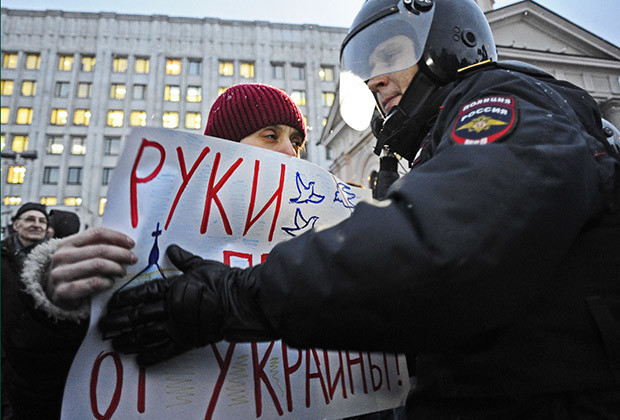
The BBC reports that up to 50,000 people attended a pro-Democracy “Hands Off Ukraine” rally in central Moscow. And apparently caught off guard, Putin’s regime did not thwart the march, and mustered only 15,000 of their own supporters in a counter-demonstration:

Earlier in Moscow, tens of thousands rallied against Russia’s actions in Ukraine, the biggest such protest in two years. As many as 50,000 attended the rally, with protesters shouting: “Hands off Ukraine.”

One man told the BBC he felt Russia was turning back to the days of Soviet dictator Joseph Stalin.

Nearby, some 15,000 supporters of President Vladimir Putin came out to support the Crimean referendum. Many of them wore identical red outfits and carried Russian and Soviet flags.

But displays such as this are likely to become far fewer as the number of truly – or even partially – independent news outlets willing to provide a non-Kremlin perspective on the world dwindles to nothing.

Regrettably, the paranoid propagandists at the Kremlin are now also being encouraged to a degree by some in the west. The usually-admirable Ron Paul, for example, clearly shows the limitations of applying libertarian philosophy to its ultimate limits, and of citing moral equivalency between Russian meddling in Ukraine and unauthorised Western invasions to argue that the West has no legitimate basis to condemn Russia’s actions. Because the United States and Britain did wrong in the past, goes this argument, Russia must be allowed to do wrong now:

Paul said Crimeans should be allowed to break away from Kiev.

“I think everyone should have right to express themselves,” he said. “It is messy, that is for sure, because two big governments are very much involved in trying to tell the Ukranians what to do.”

However he said Russia had a more justifiable basis for being involved in Crimea than the US, and no government should prevent locals on the peninsula from determining their future.

This deference toward Russia maintaining a geopolitical sphere of influence whereby it is allowed to meddle and assert special interests in the politics of its neighbours would be slightly more defensible coming from Ron Paul if he did not castigate the United States for doing the same thing when it comes to influencing America’s Latin American neighbours:

PAUL: Well, I think free trade is the answer. Free trade is an answer to a lot of conflicts around the world, so I’m always promoting free trade. And you might add Cuba, too. I think we would be a lot better off trading with Cuba.

But as far as us having an obligation, a military or a financial obligation to go down and dictate to them what government they should have, I don’t like that idea. I would try to set a standard here where countries would want to emulate us. Unfortunately, sometimes we slip up on our standards and we go around the world and we try to force ourselves on others.

If free trade and an absence of foreign meddling is truly the stance favoured by Ron Paul he should be vigorously denouncing the aggressive actions taken by Russia, not seeking to justify them by finding tenuous comparisons in recent US and western foreign policy. Ukraine had a clear choice – closer engagement with the European Union or re-embracing Russia. Until Vladimir Putin began interfering in Ukraine’s internal politics and encouraging President Yanukovych to abandon the EU deal in exchange for sweeteners from Russia, Ukraine leant towards Europe. The EU may have its imperfections, but it represents a much more liberal option than anything Putin’s Russia represents, and if anyone has subverted the will of the Ukrainian people and deserves Ron Paul’s disapproval today it is Vladimir Putin.

And while Ron Paul has led from the front in the important public debate about the nature and extent of the US surveillance state, and any curtailments on free speech in America, there is no acknowledgement from him of the grave and far more routine impositions on free speech that take place in Russia. That’s not to say that every criticism of America needs to be counterbalanced with a corresponding flaw in the rest of the world, but it is certainly the case that jumping into the debate on Ukraine without acknowledging this elephant in the room significantly detracts from his argument.

When it comes to counterarguments and balance in media coverage, Russia makes America and Britain’s own tribulations look like nothing by comparison. And while it is unfortunate that some people – particular those from the left/libertarian part of the spectrum – have felt the need to use the Ukrainian crisis as an “I told you so” moment or to burnish their own non-interventionist credentials, this is nothing more than posturing for a domestic audience. It does nothing to help the people of Ukraine or Russia.

While it is Ukraine that is currently being deprived of its territory in Crimea, the usurping Russians are also being robbed. Their loss, taking place with far less comment, is that of their independent press and free speech. And without a free domestic press to even go through the motions of scrutinising Vladimir Putin’s leadership, today’s Russia – in full paranoid, expansionist, Soviet-nostalgic mode – is not going to stop at Ukraine.

Music For The Day

The second movement of Ravel’s Piano Concerto in G, performed by Leonard Bernstein and accompanied by the Orchestre National de France:


I have never been a tremendous aficionado of Bernstein’s piano performances – a great (if variable) composer and conductor, he simply spread himself too thin to have made himself one of the greats. But this is a superb performance, very well conducted from the keyboard.

It is also interesting to see Bernstein (partly through necessity) adopt the pre-Liszt piano/orchestra configuration.