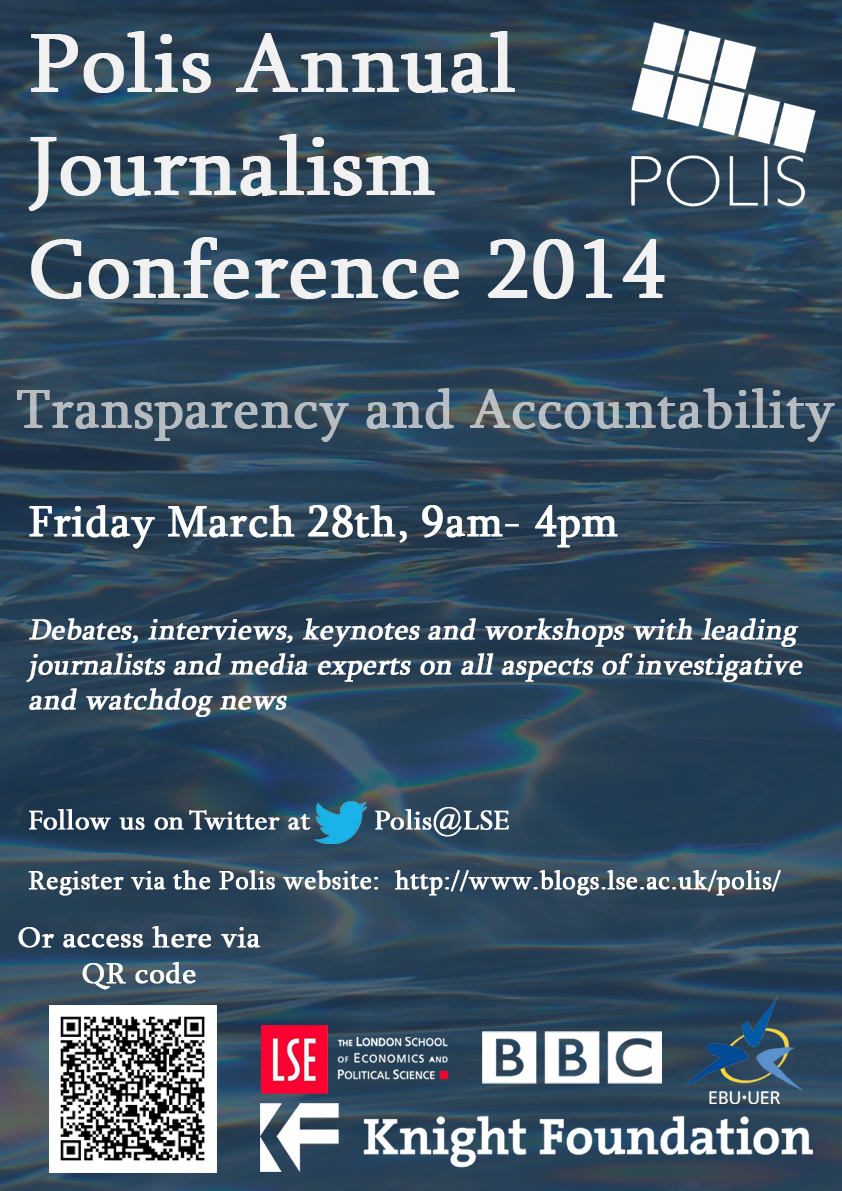
Semi-Partisan Sam will be attending the annual Polis Journalism Conference later today at the London School of Economics for what promises to be a very stimulating day of discussion and debate, featuring – for good or for ill – a Who’s Who of the British media establishment.
Several sessions in particular are especially relevant to the aims and objectives of this blog:
Journalism after Snowden: Watchdog or thug? In the wake of the Snowden story and the Leveson Inquiry into the press, we ask whether British journalism is too supine or too aggressive? Was the publication of state secrets justified?
Taking on the world: The Guardian In the last 12 months The Guardian has published one the biggest scoops in its history. The Snowden revelations brought intelligence officials into its offices to smash up hard-drives. At the same time it is re-inventing itself as the radical liberal journalism platform for the world. Steve Hewlett puts its editor under the spotlight.
The future of transparency journalism A new generation of journalists is emerging, finding fresh ways to hold power to account. What skills do they need? How will their work change? We bring together former top news professionals and journalism educators to debate the way forward.
Holding Europe to account As Europe prepares to go to the polls in a month’s time it is facing a political crisis. How can journalists get citizens to engage with European issues and how should they report on the growth of scepticism?
Stay tuned to @SamHooper on Twitter for live-tweets from the event, and to this blog for discussion and analysis of the conference after the fact.
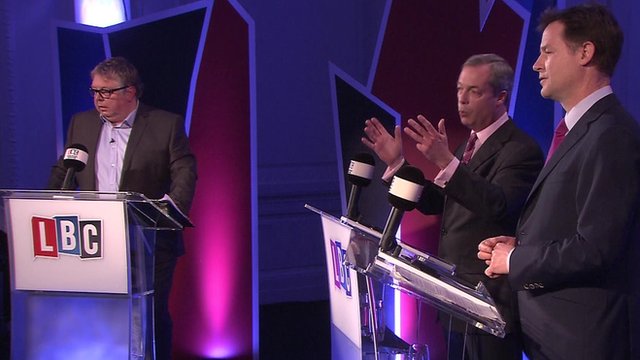
Finally, the British voters got what they had always wanted – a real debate between politicians on the merits and disadvantages of Britain’s continued EU membership. The political elite and main party leaders may have snubbed the debate and thumbed their noses at the concerns and sentiments of the people, but the discussion went ahead nonetheless, thus proving that important and thorny issues will be debated and tackled in Britain, even when it does not dovetail conveniently with the news strategies of the main political parties.
This blog offered a running, real-time commentary on the debate as it took place, on Twitter.
Nick Clegg, having been nominated to begin the debate, started with the risible and misleading suggestion so beloved of Europhiles that Britain’s trade with Europe and membership of the European Union are essentially one and the same thing – that to leave the political organisation that is the EU would be to build a wall and sever all trade ties with our continental European trading partners. Of course, in reality this is simply not the case, and Nigel Farage took the earliest opportunity to swat down this false argument.
Farage continued his strong start by cunningly reversing the question and asking if Britain were currently outside the EU, and given what we all now know about the costs and flaws and drawbacks of EU membership, whether the British electorate would likely vote to join. This simple shifting of the lens on the debate is clever, and moves focus away from distracting side-issues about the mechanics of secession, looking instead specifically at the merits.
The debate then moved on to whether a referendum on British membership of the EU is desirable at all. Here, Farage did a superb job of calling out the main political party leaders for repeatedly promising referenda in the run-up to elections and then back-peddling or stalling when the time came to deliver on the promises.
Here, Nick Clegg was firmly on the defensive, continually resorting to the official line that he might deign to grant the British people a say on future EU membership, but only in the event of some future treaty change. The justification for this particular stance, at one time used by all of the major political party leaders, has never been convincingly made. People in Britain are unhappy with the EU as it is now, not with how it might be after some as-yet unknown treaty modification. So why can the debate and the referendum not take place on Britain’s current status quo relationship with the EU? As this blog observed at the time, if you catch someone stealing from you, you don’t wait until the next theft before alerting the police, you would do so immediately. And so if Britain’s EU membership has been acting against our national interests, why should the British people have to wait until the next harm is caused to the country before seeking redress?
Of course, the topic of immigration was raised, thus exposing the major chink in UKIP’s armour – the perception that the party and its supporters are hostile to immigrants per se. The fact that the question was asked by an audience member of the ‘swivel-eyed lunatic’ type appearance and then heartily embraced by Farage did not help matters. A party that aims to abhor regulation and restrictions on business and the market really needs to ask itself if continued opposition to immigration is a sound policy in 21st century Britain.
Aside from this inevitable rocky point, Farage remained combative and humorous throughout, while Clegg – despite deploying his usual tricks of staring into the camera and repeating the names of audience members as many times as possible – seemed defensive and on the back foot. There was even time for an awkward Marco Rubio-style on-camera gulp of water from the Deputy Prime Minister.
Farage landed yet another blow on Clegg when he reminded viewers of the apocalyptic doomsday scenarios laid out by pro-Europeans in the 1990s, claiming that Britain’s economy would be dealt a mortal blow if we failed to sign up for the single European currency. “Thank God we didn’t listen,” thundered Farage, to loud applause.
This left Nick Clegg scrabbling around for any remaining mud to sling at Nigel Farage and the Eurosceptic movement. In the end, he resorted to a beloved bogeyman of British social discourse, paedophilia. Nick Clegg, in his desperation to score a final point against Nigel Farage, actually appeared to suggest that British secession from the EU would eradicate Britain’s ability to extradite and prosecute paedophiles – a ludicrous argument, and basically a reassertion of the false argument that Britain would leave the EU without drawing up replacement political, trading and justice treaties with the remaining member states.
And on that damp squib of a counter-argument, save only the closing statements, the debate was over. A solid victory for Nigel Farage, one might have thought, until one witnessed the commentary on television and the internet.
Several commentators rightly pointed out that the media showed several worrying signs of institutional bias. In the buildup to the televised debate, ably anchored by Kay Burley on Sky News, at one point a panel member – a visiting university student from America – was asked if she was ‘worried’ or ‘alarmed’ by the fact that Britain was debating the topic as she landed in the country. Never mind the fact that the poor girl clearly knew next to nothing about what the EU is or how it works, the question was so leading as to be risible. Rather than painting the in/out decision in more clinical terms and asking for a comment, it was suggested to the American student that the very idea of Britain leaving the European Union is alarming and scary. Naturally, the student – on live television – agreed with the questioner that it was indeed a scary prospect. So much for objective coverage.
Peter Oborne, writing in The Telegraph, also found significant institutional fault in the way that the mainstream media handled the coverage and the issue of Britain’s EU membership in general. Oborne saw a deliberate attempt to spin the results of the debate as a victory for Nick Clegg and the pro-European side, until the overwhelming results of the post-debate poll forced them to amend their stories:
Last night’s debate between Nigel Farage and Nick Clegg was a very good example of this phenomenon. The lobby wanted a Clegg win and … collectively called victory for Clegg the moment that the debate was over.
It was only when the YouGov poll came through showing that Farage had won the debate hands-down with the public that lobby journalists were forced into an abrupt U-turn.
I am not going to embarrass reporters by naming names. However, it is fair to hold both Sky and the BBC to account.
Oborne concludes that the UKIP and Eurosceptic-leaning side not only have to win their argument in the court of public opinion, but also overcome a second opponent in the British press:
Farage is leading a political insurgency. Last night was a reminder that Ukip’s opponents are not just the other political parties, but also the mainstream British media.
The Spectator also picked up on the media’s U-turn upon realising that their preferred narrative was falling apart in the face of the YouGov poll:
Nick Clegg had been given the night off babysitting; but, after the poll verdict on tonight’s EU debate with Nigel Farage, he may wish he’d stayed at home with the kids. As the dust settled, the Deputy Prime Minister was bundled into a car and fled the field of battle. Meanwhile, Nigel Farage headed for a victory lap at the Reform Club, where his party donors had been watching.
Backstage, Westminster’s hack-pack was necking cheap vino and Pret sandwiches after carrying out a spectacular volte face. Initially ‘the spin room’ had called the duel for Clegg, on both style and substance. But, as news of the Sun/YouGov poll filtered through to the scribblers, headlines were rewritten and awkward tweets deleted. Soon, only the BBC was left flying the Clegg flag, with the help of Danny Alexander and Tim Farron.
And even now, in the cold light of a new day, the general consensus from the headlines appears to be that that it was an honours-even draw, and that there were ‘no knock-out blows’:
The question of the hour, should Britain stay in the European Union? But the question now being asked? Who won, Nick or Nigel?
Well, it might be disappointing but both men certainly remain standing after tonight’s event. Neither was knocked to the ground and both sides will be pleased with how their leaders performed.
Given the testy nature of the debate and the fact that Nick Clegg was on the back foot for nearly the entire duration, one wonders what would have had to happen – short of either man accidentally lighting his podium on fire – for the news media to declare an actual victory for either side.
And this typifies a problem that is becoming endemic in the news media, not only in Britain but also in the United States. All too often, there is such a tremendous pressure to appear nonbiased and objective that news organisations are terrified to report on anything of a partisan nature without giving equal balance to both arguments. The compulsion to treat both sides of an argument as equally valid and legitimate – even when one is clearly correct and the other one wrong – is paralysing the ability of many news outlets to correctly report the news, even when there is no deliberate attempt to give favourable editorial treatment to a particular side.
The only news outlet with a convincing explanation (i.e. one not based on bipartisan spinelessness) for why both UKIP and the Liberal Democrats seem happy with last night’s debate is The Spectator:
Nick Clegg and Nigel Farage may have looks straight into the same camera and appeared to be addressing the same audience, but they were aiming for different listeners. That’s why the Lib Dems were happy with the 36 per cent that they polled last night. It demonstrates to them that there is some kind of constituency that likes to hear a politician being honest that he likes Europe and that he is pessimistic about Britain’s chances outside the EU.
Last night’s result also demonstrates that even if you appear a bit ratty and sweaty at times, as Nigel Farage did to those who are not instinctively his supporters, you can still win the debate, because there is a bigger constituency of voters who do agree with what you are saying, even if you’re not as polished as Nick Clegg. Thus the first of the two debates went very well for both parties: both were shoring up their own bases and motivating them to vote in elections with typically very low turnout. The real mission for these party leaders is to get their voters to go to the polling booths, not bother about people who haven’t made up their minds.
This ‘one debate, two audiences’ explanation makes a good deal of sense.
Of course, there is one further debate to take place, this one hosted by the BBC on Wednesday 2 April. Again, the Prime Minister and Leader of the Opposition have declined to participate. And once again, despite their resistance and the timidity of much of the British press, the public will continue to debate the issues in their absence.
One day, Timmy, all of this will be seized by the government to stop you from gaining an unfair advantage in life
Never mind tinkering around the edges and tweaking the rates for inheritance tax or the level at which it takes effect – those arguments are so 2013. The real movers and shakers of the left are now questioning the right of anyone to pass on anything to their children at all, and their self-appointed spokesman, James Butler, has taken to the Comment Is Free pages of The Guardian to argue his case.
In high dudgeon, Butler points to several universally-acknowledged flaws in society, wildly extrapolates from them and reaches the conclusion that we would all be much better off if parents were actively discouraged from working hard and getting ahead for the benefit of their children. Apparently, goes this argument, the natural human instinct to provide for one’s offspring should be forcibly curtailed by government in order to ensure a strictly level playing field for everyone – and what is more, the government should have the right to enforce this usurpation of property rights:
Why do we permit this? The transfer of wealth between generations is an injustice: it is a reward for no work, and a form of access to privileges that are otherwise beyond reach.
The ‘we’ that are permitting this is never fully identified by Butler, but appears to consist of himself, his friends and others of a similarly cataclysmically communist bent. Butler clearly does not start from the basis that the people determine the powers that government may wield, instead approaching the issue from the basis that government should decide which powers and rights to grant the people. And to Butler’s mind, free agency and the ability to do what you like with your own assets is a liberty too far:
Far from a Keynesian “euthanasia of the rentier”, we are seeing the triumph of a rentier economy: in such conditions, rather than further accumulation by the sons and daughters of the wealthy, we should instead demand an end to inherited wealth entirely.
An end to inherited wealth entirely. Quite how such a policy would ever be implemented remains conveniently unmentioned by Butler, but would clearly happen only over the dead bodies of the thousands and millions of people who believe in the right to pass on to their children that which they have built or preserved during their lifetimes, to do with as they see fit.
None of this is to say that Butler does not hit on some of society’s ills; indeed, he is quite right to point out the fact that too many people in Britain are born with almost impossible odds of achieving success in life, whilst for children of privilege, failure is next to impossible. He detail many of the ways in which this problem perpetuates itself in a way that is impossible to refute:
Despite nominal efforts to curb this kind of [tax] minimisation, there remains a booming market in financial advice tailored to avoidance. The knock-on effects of this minimisation are huge: it permits further concentration of wealth in the hands of those who already possess it, rewarding those cunning enough to avoid taxation, and cushioning their children with an influx of unearned wealth. There are obvious uses to which this can be put: paying off student loans early, thus avoiding interest, investing in buy-to-let property, or high-return financial products. It permits the children of the middle classes to sustain themselves through unpaid internships or unfunded study into secure middle-class careers, while locking these off from those without such resources.
The diagnosis is spot-on, but the prescription that follows is barking mad. And as is all too often the case with solutions from the left, Butler seeks a remedy by tearing down the successful or privileged rather than building up the weak or disadvantaged. He legitimately seems to believe that Britain’s societal ills can be cured if the counter is reset to zero as each generation expires, with all of the winnings confiscated by the government and scooped into a big pot for the communal good.
Neither does it occur to Butler or other death tax proponents that the human brain and spirit – if given an adequate starting point via a good quality education, a safe upbringing and ambitious goals – is capable of outmatching and overtaking others born with far more advantages but much less motivation or natural ability.
So here is a different prescription: what if Butler and others of his persuasion placed more trust in human ability properly nurtured, and less reliance on the government to be the final arbiter of who gets to keep what when the music stops at life’s end?
Not all rich and wealthy people achieved their favourable position in life through the fruits of their own talent and labour – this is abundantly and indisputably clear. But equally, not all poor or less successful people arrived at their less favourable position because of a lack of resources and opportunities.
So why do people like James Butler and his inheritance tax-supporting friends on the left continue to clamour for a one-size-fits-all remedy to a complex problem?
Tonight at 7PM, the British public will finally be granted what they have wanted – and been consistently denied – for years: a debate on Britain’s continued membership of the European Union. This would be a great milestone to celebrate, were it not for the fact that the two most important protagonists in British politics – Prime Minister David Cameron and opposition leader Ed Miliband – are entirely absent from the festivities.
Nonetheless, the match-up between Deputy Prime Minister Nick Clegg and UKIP leader Nigel Farage should be one to watch.
We might wish that Ed and Dave were debating the EU, but at least someone is. It’s proof that the Europhiles realize they can no longer rely on public uninterest in what Brussels does to keep the status quo and proof that Euroscepticism has finally come of age.
So we shouldn’t expect a debate that changes the course of history, but we ought to welcome the fact that continued membership of the EU is up for discussion at all. I’m old enough to remember when the argument for leaving was the preserve of clinically insane Tory backbenchers, half a dozen pig farmers in Devon and Edward Fox. Times, they are a-changin’.
Indeed they are. For all the efforts of the pro-European apologists to cast any Eurosceptic thought as little-England lunacy bordering on outright racism, and all of the falsely apocalyptic suggestion that Britain’s trade with Europe is solely contingent on membership of the political superstate-like entity that the EU has become, the debate could not be suppressed any longer.
This blog will offer trademark semi-partisan analysis and commentary after the fact.
Wealthy people contribute a tremendous amount to Britain, filling the Treasury’s coffers and bestowing no end of positive good on society. The unsung heroes of the economic recovery, the fact that their actions are ever criticised and their worthiness questioned is an intolerable affront towards those fine people whose labours benefit us all.
And who is better placed to lecture us on this topic than Ayesha Vardag, the ‘Diva of Divorce’ and Britain’s top divorce lawyer, herself the midwife to so many acts of social good?
Miss Vardag said: “There’s a strange, underdog culture in Britain whereby the rich and successful are bashed repeatedly. It’s the antithesis of America, where hard work and success are celebrated.
“We revile the successful and forget that they pay taxes and generate employment, but at the same time we complain about a culture of failure and layabouts living off the state.
“You don’t get the prosperity and economic success that funds a world-class welfare state by sending all the rich people abroad.”
A few observations are in order here. Where to begin?
A world-class welfare state? Seriously? Has Ayesha Vardag seen or experienced the British welfare state? Of course she hasn’t. Nobody who has could call it ‘world class’ and keep a straight face. But we can discern her point – if it were not for people like her and the clients that she represents, us poor serfs would not have our self-perpetuating, callously undifferentiating, woefully inefficient and ruinously expensive safety net.
But the crux of Vardag’s argument rests on the assumption firstly that the wealthy are under some new and unprecedented attack (supposedly by the covetous forces of the greedy working classes), and secondly that these beleaguered people are all engaged in work that greatly contributes to the nation and for which we should be grateful. Neither of these assumptions is true.
The truth is that many of the super-rich, while perhaps not being worthy of envy and hatred, are also not worthy of praise, respect and a free ride in the press. It is quite possible to become very rich by doing and contributing nothing at all, while it is equally possible to contribute an enormous amount – to the community, to people in need, to any area or aspect of life where the market fails to assign the correct (or any) monetary value – and be incredibly poorly remunerated. Vardag offers no recognition of this basic fact.
You don’t have to be a foaming-at-the-mouth socialist to realise and acknowledge that there is rich variety within the ranks of the “rich and successful”, not all of them the modern-day job creating heroes that Ayesha Vardag would have us believe.
This blog is the very last place that would ever advocate taking any portion of person’s wealth out of envy, or as a punishment for hard work and success – Labour and the Liberal Democrats can squabble between themselves for that honour. But unlike Ayesha Vardag, who makes her own money profiting from a definite societal ill, neither does this blog believe that the wealthy should be immune from questioning that may sometimes be sceptical and vaguely hostile. That’s the nature of democratic free speech.
The nascent Organisation of Aggrieved Moguls , now firmly embedded in the United States of America, seems to have established a franchise in the United Kingdom. If it follows the trajectory of its US parent, we can soon expect to read newspaper columns penned by the likes of Alan Sugar, Philip Green, James Dyson and the Duke of Westminster in which they bleat about being persecuted like Jewish people on Kristallnacht:
From the Occupy movement to the demonization of the rich embedded in virtually every word of our local newspaper, the San Francisco Chronicle, I perceive a rising tide of hatred of the successful one percent … This is a very dangerous drift in our American thinking. Kristallnacht was unthinkable in 1930; is its descendant “progressive” radicalism unthinkable now?
This ludicrious utterance by Tom Perkins in the letters page of the Wall Street Journal was just one of several recent pronouncements by paranoid rich guys in which they see in fairly mainstream Democratic party policies and public opinion the genesis of some terrible coming pogrom.
But Perkins, Vardag and the lot of them do the general public – in both Britain and America – a huge disservice. We may sigh ruefully when a senior neurosurgeon rolls past in her expensive car. We may daydream when walking past a solid, beautifully built house in Hampstead or on the Upper West Side. And we almost certainly gulp when we learn exactly how much Wayne Rooney will earn every week under the terms of his new contract with Manchester United. But we can do all of this within the context of understanding that rare and highly demanded skills fetch a high price in the labour market.
And while Wayne Rooney has to demonstrate his continued value by performing for his team in front of fans and television cameras every weekend, there is a great deal more opacity when it comes to the wealth of some of those working in banking or in the C-suites of many large corporations. Quite how they earn their multimillion pound or dollar bonuses is far less clear to people, particularly when they continue to be awarded regardless of whether the bank or corporation has had a bumper year or incurred a massive loss.
Policies and actions such as Gordon Brown’s punishing 50% top rate of income tax or the Liberal Democrats’ musings about a mansion tax may well be bad, counterproductive policies, but they hardly represent the dawn of a new age of wealth-bashing or concentration camps for the rich.
If Ayesha Vardag is truly curious as to why the elites (she incorrectly identifies them as only the wealthy) are mistrusted and vilified, she needs only look at the divorce proceedings case to which she is counsel and which compelled her to enter the debate in the first place. The Telegraph summarises the background quite nicely:
[The husband] is represented by Baroness Shackleton of Belgravia, a Tory peer and solicitor whose previous divorce clients have included Diana, Princess of Wales, and Sir Paul McCartney.
Pauline Chai, 68, his wife, has spent £920,000 on legal costs after starting divorce proceedings in London in February last year, and a further £92,000 in Malaysia.
She is represented by Miss Vardag, a lawyer who made her name acting for Katrin Radmacher, a German heiress, in a landmark Supreme Court case on pre-nuptial agreements.
A serving House of Lords peer taking time out from legislating to go head-to-head with Vardag,another lawyer who made her career fighting a case for a German heiress. The sums of money involved are only secondary – what is most striking is the complete detachment from the normal issues and travails of life experienced by most people.
Rather than sneering at the little people for being envious of their betters in the City of London or Wall Street, the Ayesha Vardags and Tom Perkins of the world – and particularly those working in banking, since it is this industry above all that generates the vast majority of public ire – would be better off explaining and educating why their high salaries and bonuses are at their current levels, so that there is finally some public understanding of the inputs which lead to such astronomical outputs. Many people may be keen to hear Vardag’s own personal justification.
Then we can have a real debate, not based on green-eyed envy from below or sneering class warfare from above, but on the facts.





 Semi-Partisan Politics