Piano Concerto in G by Maurice Ravel, first movement, performed here by Leonard Bernstein conducting from the piano.
Not my favourite interpretation of the piece, but any chance to see Lenny performing is always good.
Piano Concerto in G by Maurice Ravel, first movement, performed here by Leonard Bernstein conducting from the piano.
Not my favourite interpretation of the piece, but any chance to see Lenny performing is always good.

Today seems to be the day to look back at Olympic Games past and marvel how far we have come. Both NPR and Slate have pieces documenting the differences in styles, fashions and sporting events that a spectator might have seen at the Olympics in 1908 and 1912 respectively.
NPR looks at the 1908 London games, the first time that the United Kingdom’s capital hosted the competition:

Slate reviews the following games, which took place in Stockholm in 1912:
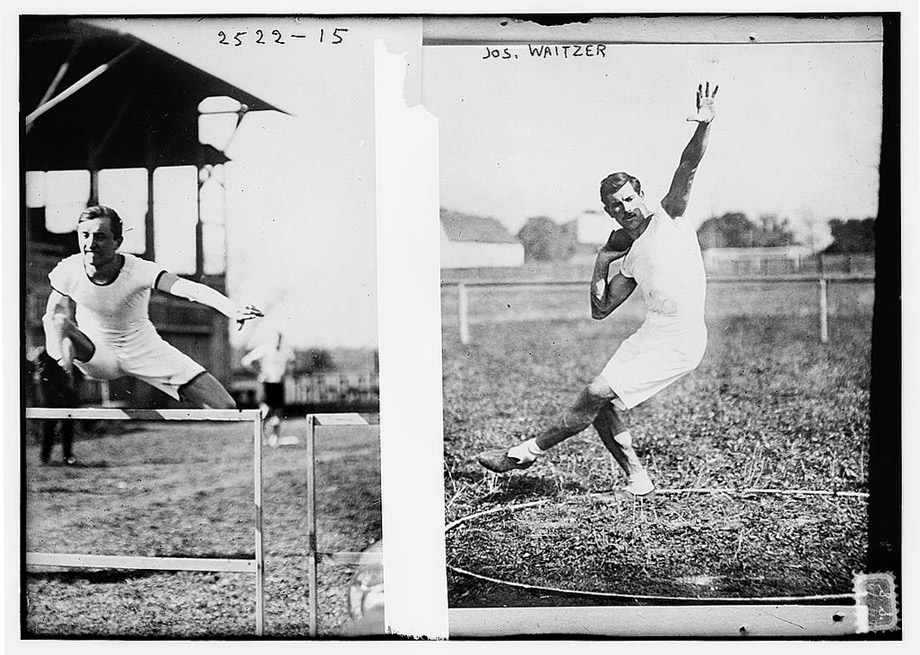
They go on to explain:
… the 1912 Stockholm Games were “the last Olympics where any individual could just turn up and hope to enter a competition.” In that era, the idea that “natural” skill might enable someone to win a competition without any specialized training was still widely embraced.
As I sit in my living room with twenty four high-definition BBC channels showing almost every Olympic event taking place live, with commentary and instant replay and now apparently optional 3D, it is nice to appreciate what we have now, but also to look back at a time when people were happy to be entertained by watching the tug-of-war and a master of ceremonies wielding a megaphone to address the crowds.

Isabel Hardman, writing in The Spectator’s Coffee House blog, is concerned that government ministers do not have any real power to effect changes to the London Olympic Games seating policy that would correct the scandal of so many seats remaining empty during popular and supposedly over-subscribed events:
The problem for ministers is that they do not have any official influence over this matter. Jeremy Hunt made this clear when he appeared on the World at One a few minutes ago. He said:
‘We want to be completely upfront with the public, this is a negotiation, we don’t have a right to demand these back, in fact contractually these seats do belong to the International Sports Federations and to the IOC. But, we got 3,000 back last night, including 600 for the gymnastics.’
Meanwhile, the Number 10 spokeswoman repeatedly said today that ‘this is a matter for Locog’, although when asked whether the government was powerless to change the seating situation, added: ‘We have influence: it’s the government.’ Whatever that influence is, it’s in the government’s interest to exert it as powerfully as possible: the public is unlikely to discriminate between ministers and Locog officials when apportioning blame for those empty chairs.
Come on, Spectator. Your Coffee House blog is one of the things that keeps me sane when I’m following British politics. You espouse sensible, Conservative, common sense solutions, and you echo my own beliefs that government doesn’t need to run everything.
The British government has already done enough for the Olympic Games organisers, even going so far as suspending the right to free speech and freedom of expression in some cases with provisions banning small businesses from using certain words or phrases which, if uttered by a non Olympic sponsor, would now constitute a criminal offence.
Of the various possible culprits responsible for the fact that far too many seats at Olympic events remain empty despite massive demand from the British public, David Cameron or Jeremy Hunt’s respective doorsteps are probably the last place I would think of pinning the blame. I would dare to believe and hope that a majority of Brits, despite Gordon Brown’s attempts to turn us into a state dependent society, also would not look to government to be the solution to this or every other problem, even ones that may impact on our national prestige.
Maybe in the case of the “empty seat fiasco”, the British people are not looking to the government for a solution, but to the people organising the Olympic Games. A quick solution, brought about by the people responsible for the problem.
Buzzfeed Sports have what I’m sure they thought would be a funny piece cataloguing the Queen’s sixteen most excited faces captured during the recent opening ceremony for the London 2012 Olympic Games. This is obviously in reference to the numerous remarks by commentators that Queen Elizabeth II seemed less than enthralled or impressed by many of the goings-on in the stadium.
However, as I started to look through the pictures I became more convinced that the bored and often distant facial expressions are much more a symptom of tiredness than boredom. And not just day-to-day tiredness, but a rather more profound one.
Take this, for example:

Here, the Queen is declaring the London 2012 Olympic Games officially open. This was a joyous moment, but I believe she spoke fewer than twelve words.
Or this one:

And compare these to this image of the Queen at the Commonwealth Games in Manchester, a decade ago:

Of course, she continues to fulfil all of her duties as head of state superbly, and beyond reproach. But, quite understandably, a decade older and with her husband in failing health, and fresh from an exhausting list of Diamond Jubilee commitments, she does appear to be slowing down markedly.
All of which is perfectly fine, but for the fact that more and more of her duties are likely to fall to her heir, the organic food-loving, modern architecture-hating, idiosyncratic Prince Charles.
Ah well.


In this case “the indefensible” refers to Michele Bachmann, also known as “Minnesota Palin”.
Eric Cantor – “Young Gun”, darling of the right and sadly House Majority Leader – has come out in defence of the Bachmann Witchhunts, and her attempts to smear US government workers by drawing tortuous and far-fetched links tying them to the Muslim Brotherhood or other radical Islamist organisations. Cantor, always one to try to out-conservative his boss, House Speaker John Boehner (even Boehner denounced the actions of Bachmann and her paranoid accomplices), came out swinging in an interview for CBS and refused to criticise or moderate Bachmann’s stance.
House Majority Leader Eric Cantor (R-Va.) Friday defended Rep. Michele Bachmann’s questioning of a top Hillary Clinton aide’s loyalty to the United States, saying the Minnesota lawmaker’s “concern was about the security of the country.”
Ah, well now I think I understand. We can say what we like and cast any aspersions we wish about a person’s character or patriotism, so long as we do so out of a concern for the security of America.
So here’s my attempt:
Michele Bachmann is a dangerously ignorant politician. Worryingly, and despite the fact that she sits on the House Foreign Intelligence Committee, she remains as woefully unknowledgeable about foreign affairs as she is on the history of her own country. She is deliberately divisive, will stoop at nothing to stoke the fears and resentments of those equally ignorant as her for political gain, and in doing so is undermining the fabric of American society and government. Her husband and family hold Swiss citizenship. As we all know, Switzerland is a neutral country and historically has not sided with the United States in some of the most important issues and conflicts in our nation’s history. I am sure I am not the only one concerned that Bachmann’s torn loyalties between the country of her birth and that of her husband might lead her to use her prominent position to influence US government policy in favour of the Swiss and at the expense of the United States. – Samuel Hooper, 30th July 2012.
And I say this not through any personal animus, but out of a genuine concern and fear for the future safety of the United States of America. So it’s okay.
I look forward to Eric Cantor’s endorsement.

 Semi-Partisan Politics