I wanted to write one last great exhortation encouraging people to vote Leave today – a grand summary bringing together all of the compelling reason to reject the miserabilist, pessimistic, soul-sickeningly unambitious case put forward by the Remain campaign and embrace instead the possibility of real democratic renewal which can only come about with a Leave vote.
But someone has already made the closing argument much better than I ever could. And they did so before I was even born, in 1975 at the time of our last referendum on whether to remain part of the European Economic Community.
If you read this blog, you already know my thoughts on the EU referendum. And if you follow the work of The Leave Alliance you know the type of Brexiteer that I am.I will not restate all of these arguments now. I will leave you instead with the words of the late Peter Shore MP, a man whose politics could hardly be more different to my own, but whose understanding of and commitment to British democracy is second to none.
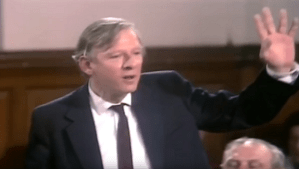
Speaking at a 1975 EU referendum debate at the Oxford Union, Peter Shore MP concluded his remarks with this devastating critique of Britain’s accession negotiation – all of which can be applied to David Cameron’s failed renegotiation – followed by a stirring rejection of the EU’s antidemocratic, supranational form of government in general:
I say to you this is not a treaty which in any way is a fair and equal treaty. It was not negotiated, it was accepted. Not one word, not a comma, let alone a clause, let alone a paragraph of the Rome Treaty – not one comma has been altered in order to meet the perfectly legitimate and serious differences that exist between Britain and the Common Market.
And now the experience itself – three and a half years ago, when they were urging us to go in. Oh, what a campaign it was. “You’ve got to get in to get on” was the slogan of that day. Five or six pounds a week better off for Britain, if we could only get in to the common market. All the goodies were read out – Donald Stokes of Leyland buying one-page advertisements saying all we need is a great domestic market of 250 million, and we will sweep Europe!
[..] When you add to that the burdens I mentioned a moment ago, and we are under great threat, we are in peril at the present time, and the country must know it.
Therefore now what do they say? What is the message that comes now? No longer to tell the British people about the goodies that lie there. No longer that – that won’t wash, will it? Because the evidence will no longer support it. So the message, the message that comes up is fear, fear, fear.
Fear because you won’t have any food. Fear of unemployment. Fear that we’ve somehow been so reduced as a country that we can no longer, as it were, totter about in the world independent as a nation. And a constant attrition of our morale, a constant attempt to tell us that what we have – and what we have is not only our own achievement but what generations of Englishmen have helped us to achieve – is not worth a damn, the kind of laughter that greeted the early references that I made that what was involved was the transfer of the whole of our democratic system to others. Not a damn.
Well I tell you what we now have to face in Britain, what the whole argument is about now that the fraud and the promise has been exposed. What it’s about is basically the morale and the self-confidence of our people. We can shape our future. We are 55 million people. If you look around the world today – I listened to Gough Whitlam and his 14 million Australians, and he trades heavily with Japan, I’m very fond of the Australians – but do you think he’s going to enter into a relationship with Japan where he gives Japan the right to make the laws in Australia? Do you think Canada, 22 million of them, and to the south a great and friendly nation, yes they are, but do you think Canada is going to allow its laws to be written by the 200 million people in some union in America? No, no, of course not. The whole thing is an absurdity.
And therefore I urge you, I urge you to reject it, I urge you to say no to this motion, and I urge the whole British country to say no on Thursday in the referendum.
All of this beautiful prose – a relic from a bygone age when political speeches didn’t make one want to jump out of the window to escape the boredom – was delivered while a stony-faced Edward Heath looked on, chastened.
God willing, today we will have the opportunity to chasten our current prime minister David Cameron – a man who has conducted himself in many ways like a lame Ted Heath tribute act – by ignoring his pro-EU campaign of lies, distortions and intimidation.
I can say no better than Peter Shore. But please – if you have not already done so, go to your polling station and vote for democracy, vote for Britain, vote to leave the European Union.
–
Agree with this article? Violently disagree? Scroll down to leave a comment.
Changing one’s mind about an existentially important constitutional and geopolitical question merely because of the tone of the campaign is either criminally idiotic or part of a deliberate campaign of deception
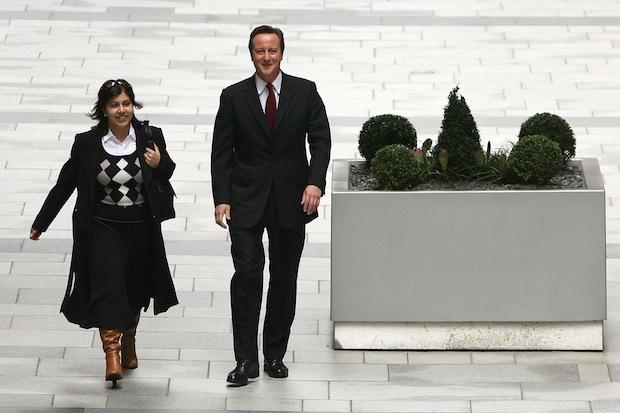
A former minister has announced that she is abandoning Brexit and defecting to the Remain campaign in protest at its “hate and xenophobia”.
Baroness Warsi has accused Michael Gove, the Eurosceptic Justice Secretary, of “peddling complete lies” and said her final decision was prompted by a Nigel Farage-backed poster depicting Syrian refugees with the slogan “breaking point”.
[..] Baroness Warsi, a former chairman of the Conservative Party, told The Times: “That ‘breaking point’ poster really was, for me, the breaking point to say ‘I can’t go on supporting this’. Are we prepared to tell lies, to spread hate and xenophobia just to win this campaign? For me that’s a step too far.”
She made the decision to defect despite Mr Gove saying that the poster made him “shudder” and describing it as the “wrong thing to do”.
This fails the smell test for a number of reasons, not least of which is that the natural action to take if one feels repulsed by the behaviour of other people arguing for something that you believe in is to disassociate yourself from them, not to join the other side and immediately adopt a completely different set of beliefs and arguments than you were professing moments earlier.
This is precisely what members of The Leave Alliance, including this blog, have done. As proponents of a small-L liberal vision for Brexit in which we leave the EU to better engage with the entire world (and hopefully reboot our democracy in the process), we were naturally repulsed by many of the anti-immigration arguments, as well as the rank amateurism of the official Vote Leave campaign. But this did not turn us into enthusiastic Remainers. Rather, it encouraged us to carve out our own niche of bloggers, experts and advocates to promote our message within the wider Brexit movement.
If Baroness Warsi was really that upset about the tone of the mainstream Leave campaign, she or one of her researchers could have discovered the Leave Alliance in the time it takes to do a quick Google search. Warsi could have found a community of passionate, knowledgeable and highly principled Brexiteers who would have welcomed her into the fold. But Warsi did not do so, either because her mind genuinely cannot conceive of a world and a referendum campaign beyond that waged in the Westminster bubble, or because she had no intention of looking for other Brexiteers with values closer to her own.
Of course, we have seen this before, with the defections of Tory MP Sarah Wollaston and Labour MP Khalid Mahmood, also ostensibly because of their disgust at the tone of the Leave campaign. As backbenchers, one might be more charitable and chalk this up to idiocy rather than political machinations, but in the case of a former Conservative Party chairman and minister like Sayeeda Warsi it all reeks very strongly of a PR stunt.
And shame on the Times newspaper, incidentally, for allowing themselves to be used quite blatantly as the prime minister’s personal propaganda mouthpiece rather than applying the most basic level of journalistic scepticism to their reporting – in their eagerness to report on the supposed “turmoil” created by an utterly inconsequential figure in the broader Leave campaign they made themselves look politically calculating and stupid at the same time.
As Guido Fawkes points out:
The Times have watered down their mischievous first edition claiming Sayeeda Warsi has ‘defected’ from Leave to Remain. No one in Vote Leave thought she was a Brexit supporter or is aware of her doing any campaigning for them at all. She has only tweeted about Vote Leaveonce – ten days ago – to attack them. She did not appear on the website of pro-Leave group Muslims for Britain. In February Warsi told Eurosceptic campaigners she had not declared. When Dan Hannan invited her to join the Leave campaign, she declined. Neil Kinnock even once backed her for EU commissioner…
Hardly the very model of an arch eurosceptic and committed Leave campaigner.
Much more admirable is the late decision by Bristol West MP Charlotte Leslie to support the Leave campaign. Unlike Baroness Warsi, Sarah Wollaston and Khalid Mahmood, Leslie did not seek to make herself look good by feigning horror at the conduct of the opposing side, but rather made up her mind after much careful thought and deliberation.
This comes through strongly in Charlotte Leslie’s official statement:
My decision is with nothing to do with either the Leave or Remain Campaign, but as an individual who has done their best to assess the situation and come to a conclusion based on my assessment of the facts to which I have access, my experience in working with European colleagues from many EU Member States over the years, and my own personal understanding of human behaviour and risk.
As I have said repeatedly, I do not necessarily think there is a right or wrong answer to this question, and I have the utmost respect and appreciation for those who disagree with me. I celebrate and welcome disagreement and debate.
After all my deliberations, I found myself coming back to a principle on which I try to lead my life: That you have to face realities, however difficult, because to attempt to deny a reality leads to more pain in the long term.
Personally, I cannot see the European Project, whose express aim is to further homogenise the very different nations of Europe into an ever closer political union, as anything but a fantasy, and as such, dangerous.
Therefore, however much I appreciate and understand the risks and challenges of voting ‘leave’, I find myself completely unable mandate this madness.
What a contrast in tone and class with the fiery, bitter and sanctimonious MP defections from the Leave campaign, which have never been based on a genuine reappraisal of the merits of Brexit but always out of a desire by MPs to publicly disassociate themselves from supposedly unsavoury people.
And this is key. Beyond the tawdry, transparent and frankly amateurish attempt at choreographing a political defection stunt, there is a serious point here. As we have seen, Baroness Warsi is not the first politician to rend their garments, reach for the smelling salts and publicly switch sides in the EU referendum in protest at the “tone” of the campaign.
Looked at more broadly, this is symptomatic of the same trend towards public virtue signalling that we see on social media and our university campuses now entering the world of politics. For many contemporary politicians, ideology and policy positions are not things to be adopted based on a serious consideration of their value and applicability to the modern world, but rather items of clothing to be worn or discarded like this season’s latest fashion.
Almost the entire official Remain campaign is based not on an enthusiastic defence of the European Union as it currently is or is likely to become, but rather the flimsy assertion that supporting the EU is somehow the progressive and virtuous thing to do. Hence you will almost never find a Shoreditch hipster or a Brighton artist proudly campaigning for Leave – it would go against the very grain of their “social uniform”. Hence Britain Stronger in Europe’s latest social media advertisement which asserts without a shred of evidence that voting Remain is the “kind, open, inclusive, tolerant” thing to do.
And in this age when politicians sometimes build up substantial social media followings and careers live and die by successful media appearances, is it really any wonder that the glibness of our political discourse now attracts equally glib politicians – MPs who will change their opinion on an issue as fundamental as Britain’s continued membership of the EU at the drop of the hat, depending on which hashtags are trending positively on Twitter?
In the case of Baroness Warsi, we can safely chalk up this non-defection to a good old-fashioned political stunt, a piece of theatre shamefully performed by the Remain campaign to help add to the illusion of momentum and inevitability going into the closing stretches of the EU referendum campaign.
At this time we need seriousness and depth in our politics – in parliament and outside -and not this growing superficiality motivated by the gnawing desire to loudly signal our virtue at all times.
Apparently there is panic in Number 10 Downing Street and among the slavishly pro-EU establishment. Good. They have waged a contemptible, negative and deceitful campaign, and whether or not it prevails on June 23 the hearts, minds and consciences of all those involved richly deserve to be troubled
Having done everything but fill in all of the ballot papers himself to ensure a “Remain” vote on 23 June, at this point in the unevenly fought EU referendum campaign we might expect to see a bit of magnanimity or statesmanship from the prime minister as he coasts toward the closing stages.
But the polls have tightened unexpectedly as the British public rightly begin to suspect that the near-unanimous hysterical screeching from the establishment in favour of Remain sounds more like naked self-interest and wretched pessimism about Britain than a realistic warning about what might happen in the event of Brexit. And this has caused David Cameron – a notably weak strategist only capable of thinking one step ahead, unlike his gifted general election campaign manager – to panic, and start behaving in a most un-prime ministerial manner.
Three interventions in particular mark out the descent of David Cameron from oleaginous, confident salesman to the nation’s Bully in Chief – the impromptu rooftop press conference at which Cameron openly accused ministers in his own government of knowingly peddling falsehoods, the statement that Cameron would take Britain out of the single market in the event of a “Leave” vote despite leaving the EEA not being on the ballot paper, and his shameful attempts to bully and coerce Britain’s pensioners, effectively holding a gun to their heads and commanding them to vote Remain or see their pensions fall.
David Cameron doesn’t do that many press conferences at all, despite promising in Opposition that he would hold a monthly one, and so when he summons hacks to the roof of a hotel at short notice, you know that there is a Crisis that the Prime Minister is taking Very Seriously indeed.
Cameron then proceeded to list six ‘complete untruths to the British people’ that the Leave campaign was guilty of producing. These were that the UK is liable to bail out eurozone countries, that our rebate is at risk, that we have given up our ability to veto EU treaties, that we have no ability to stop EU spending from going up, that we are powerless to stop Britain being forced into an EU army and that we would save £8bn if we left the EU.
Were these untruths really so heinous that he was forced to hold a press conference at short notice? Or was it, as one of the journalists sitting on the roof with the Prime Minister suggested, that the Leave campaign currently had the momentum and the debate was all about immigration, which damages Remain? Cameron replied:
‘Look, I was watching the news last night and it just came over to me so clearly that there is such a contrast between the weight of independent expert opinion that wishes our country well but is giving us an unvarnished view of the decision we could be taking, there’s a massive contrast between that – respected, independent experts warning us about lost jobs, about instability, about a smaller economy, about the effect on our country. The contrast between that and a series of assertions from the Leave campaign that just simply aren’t right…’
So the Crisis was that the Prime Minister had been watching the news last night.
Some archly dry humour there from Isabel Hardman. When The Spectator openly mocks a Conservative prime minister in this way, you know things are bad.
Cameron’s specific counterpoints are immaterial here – they were aimed at the ravings of the official Vote Leave campaign, which does not speak for all Brexiteers. But what is telling is the fact that David Cameron – a man who promised that he “ruled nothing out” in his renegotiation with the EU while actively colluding with business leaders to plan the eventual Remain campaign, and who then presented the empty gift bag given to him by Brussels as a deal which had fundamentally “reformed Europe” – is willing to go on live television and accuse his Brexit-supporting ministers of being liars.
More insidious than this, though, was the way that David Cameron pledged on the Andrew Marr show last weekend that in the event of a Leave vote he would seek to take Britain out of the single market, despite this being just one (incredibly sub-optimal) mode of Brexit, and the referendum question saying nothing at all about the single market or EEA.
Dr. Richard North of the eureferendum.com blog remarks on:
[..] an extraordinary interview on the Marr Show yesterday which had David Cameron pledging to take the UK out of the Single Market in the event of a Brexit vote. This was despite Andrew Marr suggested that we could stay in, with Cameron refusing to entertain the idea, “because the ‘leave’ campaign had specifically rejected that option”.
The segment of the interview started with Andrew Marr reminding the Prime Minister that he had promised to “carry out the wishes of the British people” if we vote to leave. The trouble is, Marr then said, is that “the wishes of the British people” is a rather indistinct thing – it’s a blunt “yes” or “no”.
Cameron responded by saying that if we vote to leave the Government would carry out the instructions of the British people. That, Marr averred, would put the Prime Minister in “a very strange position”. He’d be doing things like introducing an Australian-style points system that he didn’t believe in. As for, the Single Market, though, Marr said, “there is room for a Prime Minister to negotiate that”.
It was here that the role of Vote Leave came to the fore. “I think one of the most important moments in this campaign”, Cameron said, “was when the ‘out’ campaign said they wanted to leave the Single Market”. He continued: “They didn’t have to make that choice. They’ve made that choice. And what the British public will be voting for … would be to leave the EU and leave the Single Market”.
What the Prime Minister is doing, therefore, is using Vote Leave as a proxy for the entire British public. However, this is a small group of individuals with singular views, put in place by an unelected Electoral Commission to carry out the role of lead campaigner. This can’t in any way be taken to represent the will of even those who favour Brexit – much less the entire British population.
Dr. North is absolutely right to emphasise firmly that Vote Leave do not represent the ideas and wishes of all Brexiteers. They were not elected to represent us, and their most prominent figurehead (Boris Johnson) had not even decided which side he was going to support until a couple of months ago.
Just because the same idiots who stubbornly persist in peddling their “£350 million a week for the NHS” falsehood in the face of endless rebuttals and fact checks have airily decided that Britain should not Brexit to an interim state preserving single market access in no way precludes that option. As Richard North reminds us, the ballot paper asks whether we want to leave or remain in the European Union – nothing more and nothing less. We should know, we spent long enough haggling over the wording at the time.
All the evidence suggests that if Britain leaves the EU without securing an “off the shelf” deal to ensure continuity of access to the single market (while fully extricating us from political union, which is what the referendum is all about) there will be at least some negative short term economic consequences, as no new trade deals can possibly be negotiated in the two-year window provisioned in Article 50 of the Lisbon Treaty. By contrast, Brexiting to an interim EFTA/EEA arrangement (the so-called Norway Option) would maintain our full access to the single market in the short to medium term while we work on a better bespoke solution for Britain.
The attractiveness of the interim EFTA/EEA route is self-evident: Britain would immediately be free of ever-closer political union and democracy would be restored, while maintaining single market access (for which we would pay) would return our relationship with the EU to the state that people believed they were voting for in the 1975 referendum. Therefore, it is unsurprising that Remainers are desperate to slander and dismiss the option as unworkable – it represents dynamite which would obliterate their entire case for continuing to suffer the EU.
But while David Cameron’s eagerness to problematise the Norway Option is understandable politically, for the prime minister to flat-out state that he would not pursue this option and instead take Britain out of the single market (despite no mandate to do so from the electorate) is bordering on threatening self-harm. Any Brexit model not involving keeping interim access to the single market would inevitably come with higher risks and potential economic costs than adopting the Norway Option. By ruling it out, David Cameron is essentially threatening the electorate, saying that if we vote Leave he will pursue the most disruptive and costly form of Brexit within his power, purely as an act of spiteful vengeance.
Just stop and think about that for a moment. David Cameron has effectively told voters that if we vote to leave the European Union, he will sneer “your wish is my command” and then set about doing so in the most reckless and ill-considered manner possible, just to teach us a lesson. The prime minister of this country has just threatened our own national interests on live television. Is that something which we should just blink and accept, writing it off as “fair play” in a hard fought referendum? I profoundly disagree. I think that it is contemptible behaviour, the kind of action which immediately disqualifies the perpetrator from holding further public office.
And if this still wasn’t enough, David Cameron then went from threatening the British people in general to attempting to scare Britain’s older voters in particular, with despicable threats that Brexit would automatically and inevitably lead to pension cuts.
Project Fear has turned into Project Frightened. Remain are losing ground in opinion polls and running scared. So what do they do? Go positive? Make a better, brighter case for the EU? No. They double-down and turn to blackmail.
That’s the only word that suits David Cameron’s threat that Brexit might lead to pensions being cut, made today in this newspaper. His logic is that Brexit will create a gap in the finances that will have to be filled somehow. The triple lock on pensions, guaranteeing rising incomes, would probably have to picked. Even if it were a moral necessity to help the aged, it would suddenly become unaffordable.
This is rubbish for two reasons. First, it’s based on the Government’s assumption that Brexit will lead to a collapse in trade that will wipe billions off GDP. The Treasury forecasts that this is based on are alarmist and absurd – they suggest a retraction worse than the Great Depression. Businessmen who actually deal with Europe every day, such as Sir James Dyson, report that they don’t see such a risk and are confident that Britain will continue to grow.
Second, Cameron suggests that the Government would have no choice but to cut pensions – as though the invisible hand of the free market would be clasped around its throat. Nonsense. It would face spending choices and, Cameron is telling us, it would choose to cut pensions. Much as the Government has chosen in the last few years to cut the highest rate of income tax on the rich or chosen to cut benefits for the poor. If Brexit did trigger a recession, the Government would once again have to do what it’s supposed to do and make budget decisions based upon its political preferences. I humbly suggest it chases the tax evaders and closes some loopholes before it bleeds pensioners dry.
And Stanley’s devastating conclusion:
The bottom line is this: the Prime Minister has moved from warning the British people to threatening them. And picking on the elderly – some of whom are legitimately worried about the future – is one of the lowest things you can do in politics.
What utterly despicable and unmanly behaviour from our prime minister. What debased, fearmongering garbage this man is capable of spewing in order to get his way in the EU referendum. David Cameron’s legacy as prime minister has long been in question, having governed for five years as part of an unmemorable centrist coalition and latterly as a party which blind observers might guess to be the work of Blue Labour, if not Blair’s New Labour. But now that legacy has crystallised – Cameron is the prime minister who betrayed conservatism and bullied his own people, preferring to serve the interests of the EU than those of his country.
David Cameron doesn’t have a conservative bone in his body. He doesn’t have an ideological bone of any kind, and from his craven behaviour in this referendum campaign it is quite clear that he lacks a backbone, too. And like a common school bully, he is willing to throw the full weight of his office and government around, breaking conventions and standards of common decency left, right and centre as he seeks to gain every inch of advantage.
That’s why the prime minister’s days are numbered. At present he takes false courage from the fact that his normally sworn enemies in the Labour Party and on the generic Left are holding their fire in their shared desperation to keep Britain in the EU. But on June 24, Cameron will quickly realise that a good half of his own Conservative Party, together with everyone else in the country, will be straining at the leash to eject him from office, strip him of the bully pulpit he has so abused, and send him marching barefoot back to Witney in sackcloth and ashes.
And such is the amount of political capital and personal goodwill Cameron has squandered, barely a single person will come to his defence when the inevitable party leadership coup takes place. In the minds of many people – now including this blog – whether his successor is just as bad (i.e. Boris Johnson) is almost immaterial. The pleasure of seeing such an arrogant and dishonest man as David Cameron driven from power in disgrace, his reputation rightly in ruins, will be its own reward.
There is a legitimate and intellectually coherent case for Britain remaining in the European Union, but David Cameron has not made it. In fact, when it comes to the rarely heard (in this country) principled euro federalist case, its proponents all seem to have been abducted and held far away from any television studio so that they don’t open their mouths and drive thousands more people into the Brexit column.
Whether the prime minister is among their number is not known. It is possible that the man is catastrophically misguided and actually believes some of the nonsense he has spewed about securing a “better deal” for Britain, and that Britain could somehow prosper as a country inevitably on the margins of an ever more tightly integrating eurozone. Perhaps.
But either way he has not been honest with the British people. Worse than that, though, he treats the people with open contempt. Some politicians lie because they fear the people, but not so with Cameron. David Cameron lies because he despises the people, holds their intelligence in low regard, and is more than willing to alternately deceive, belittle and threaten the people in the service of his establishment masters and instincts.
This is a prime minister who, when given the choice between vociferously defending the national interest of his country against the EU elite or siding with that same elite and bullying his own people into submission to their will, gladly chooses the latter course of action every single time.
There are few words strong enough to adequately describe the prime minister’s odious character and behaviour as revealed over the course of this EU referendum campaign – certainly none which I am willing to publish on this blog.
Which is why I am ending this piece here, in utter disgust at the conniving, arrogant, untrustworthy and weak approximation of a man presently in charge of our country – before I say something that I might later come to regret.
–
Agree with this article? Violently disagree? Scroll down to leave a comment.
Having finally analysed every possible facile, gossipy and shallow angle on the EU referendum in breathtaking detail, finally the media get round to examining the ideas laid out long ago in the only existing comprehensive Brexit plan
Well, it had to happen eventually. Tired of adjudicating shrill and pointless contests in unsupported assertions and lying by omission from Vote Leave and Britain Stronger in Europe, some in the media have finally started paying attention to the safe, stable Brexit option which was there all along.
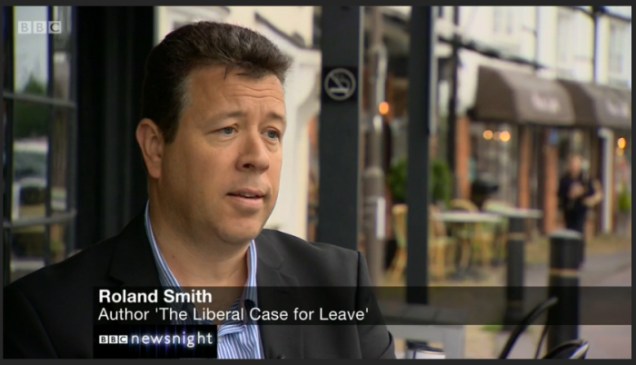
The Liberal Case for Leave, written by Roland Smith for the Adam Smith Institute, is based on the Flexcit plan. Roland is one of a number of us who have coalesced around this idea, proposed by Flexcit author Dr Richard North of the EU Referendum Blog, that Brexit should be a multi stage project. To avoid shocks, and to escape diplomatic impasse, we must take each stage in a safe and ordered manner. This not only avoids economic pitfalls, but reassures the people that will not vote to leave the EU, or would like to but are risk averse, that they are not being forced into some great leap of faith, that there is a sensible route to full democratic freedom.
And now, in the last week, Flexcit as a plan has finally broken cover and its first stage is being discussed openly by members of Parliament, Talk radio, the BBC, the Telegraph and today the rest of the print media (although sometimes not by name).
Tony goes on to point out an important point which is overlooked by many detractors on the Brexit side – that the EEA/EFTA arrangement is transitional, the departure lounge from the EU rather than the ultimate destination:
What is not always being heard in the public domain, and what Roland Smith explained last night, is that the EEA stage of Flexcit is transitory. It will last for a number of years for several reasons, but will not be the end point for a post EU membership UK.
Firstly, while we will want to build trade links with the rest of the world, we will also want to preserve our current markets while we do this. EFTA has been very good at negotiating FTAs, and while in EFTA there is no impediment for the UK in seeking deals within and without the group. We lose no competence in this area to EFTA as we do to the EU – that’s a massive difference in the level of freedom of action the UK will gain immediately.
Thanks to Roland “White Wednesday” Smith, our comprehensive Brexit plan made a bit of a splash these evening having been announced on Newsnight as the plan under consideration by the civil service. As ever Newsnight managed to make a pigs ear of it without expanding on the critical details but it’s free publicity.
Lost Leonardo of the excellent Independent Britain blog is pleased, but unimpressed by cynical efforts underway by assorted Remainers to slander the interim EEA/EFTA (Norway) Option as some kind of betrayal of a vote to leave the EU, when it is no such thing:
With the legacy media finally turning its attention to the realities of Brexit—even Newsnight is now name-checking Flexcit—now seems like a good time to look again at the great vistas of opportunity that await a post-exit Britain.
First of all though, one has to address the “criticism”—if one can really call shouting, stamping of feet and pulling of hair critique—that adopting a phased approach to EU exit has elicited from a portion of the legacy media and the oh-so-tedious legacy campaigns.
It scarcely needs saying, but the Remainers’ feigned concern for the most belligerent voices in the “leave” camp is beyond cynical. The same people who have spent weeks, months, even years, verbally abusing anybody who has expressed the view that immigration is a bit high are now saying that it would be a “betrayal” for the UK government, supported by the House of Commons, to insist upon using the European Economic Area (EEA) agreement as a staging post for disengaging from the EU’s political and judicial union without any of the economic after effects that David Cameron and George Osborne have so irresponsibly exaggerated. Give me a break.
The hysterical reaction of Vote Leave and its associated sycophants is particularly loathsome. That organisation has done everything in its power to prevent the idea of a pragmatic, practical and non-hostile Brexit plan, which addresses the political realities as we find them not as we might like them to be, from taking hold in the public imagination.
There is nothing on the paper whatsoever about the European Economic Area or “single market”. A vote to leave the EU is a vote for Britain to do exactly that – to leave an explicitly political, ever-tightening union of European countries all embarked on a journey to one day become a common state (as the EU’s founders and current leaders happily admit).
Many people are rightly now coming to the conclusion that the best way to achieve Brexit with the minimum of political and economic disruption is to exit to an “off the shelf” interim solution which already exists in the form of the EFTA/EEA membership enjoyed by Norway. This is why David Cameron has suddenly started talking about “a vote to leave the single market” over the past few days – it is a tacit admission that if we vote to leave the EU but remain in the EEA, every single one of the Remain campaign’s arguments are instantly negated.
Hence the [eagerness of Remainers] to do everything possible to slander the interim EFTA/EEA option, painting it as some kind of unconscionable scam when in fact it is an utterly pragmatic and realistic way of leaving the European Union while completely avoiding all of the apocalyptic economic scenarios which the Remain camp love to throw around.
The official Leave Alliance blog takes a deserved mini victory lap, while warning of the newfound hostility to the plan among Remain supporters and some unreconstructed Leavers. Proclaiming that reality is finally sinking in, Ben Kelly writes:
One of the most crucial elements of The Market Solution [..] is its aim of de-risking Brexit and neutralising the economic uncertainty associated with a vote to leave. We offer several scenarios that would minimise disruption and protect the economy and the most optimal of those is the EFTA/EEA route a.k.a the “EEA option” a.k.a the “Norway option”.
Leaving the EU will be a staged process; the EFTA/EEA route facilitates our transition from an EU Member State to an independent nation by protecting the economy, simplifying secession negotiations and providing us with a soft landing and a decent perspective of what “out” looks like for the near future. One of the key aims of The Leave Alliance was to disseminate this Brexit scenario amongst influential opinion formers; we were rebuffed by Vote Leave and Leave.eu, but we are now having great success late in the day as the EEA option is becoming potentially pivotal.
Due to the fact that it means leaving the EU in an economically secure way it has been the source of much fear for remainers, hence why they do everything they can to smear it. Many on the Leave side can’t get past the fact it means retaining freedom of movement, but their folly is to assume that controlling our borders is simple and abolishing free movement is a silver bullet. They are unreasonably uncompromising in refusing to accept the necessity of a transitional arrangement; we cannot leave the EU in one fell swoop.
Overall, a positive development, though we may wish to recall the words of Winston Churchill: “We may allow ourselves a brief period of rejoicing; but let us not forget for a moment the toil and efforts that lie ahead”.
Suddenly, at long last the interim EFTA/EEA option is being discussed seriously at the highest levels in politics and the media. It took an extraordinary effort to make it happen – involving the tireless work of many of my Leave Alliance colleagues, and more than a little subterfuge here and there to ensure that the Great And The Good of British political life actually took it seriously rather than summarily rejecting it as the work of mere citizens, but here we are.
But with little more than two weeks to go until we cast our votes, is there enough time to establish the right narratives about the Norway Option and rebut the desperate smears of the Remain campaign? Or will it be too little, too late?
–
Agree with this article? Violently disagree? Scroll down to leave a comment.
Semi-Partisan Politics: EU Referendum Live Blog – Cameron vs Farage (but not really)
#ITVEUref
21:57
And that’s it. Cameron off the hook, with no major hits landed on him.
Combative and effective as usual from Nigel Farage, but nothing new to suggest a recalibration to reach the essential 50%+1 on Referendum Day. Once again Farage will have pleased his supporters and disgusted his detractors.
What an utterly pointless “debate”, and what a useless format. I sincerely doubt that anybody in the country learned a single new thing from watching that “showdown”. Generally weak audience questions served little purpose other than to tee up the usual soundbites we are tired of hearing from Vote Leave and Stronger In.
Weak moderation too – Julie Etchingham seemed to be imposing rules and time limits which existed solely in her head, and which often ended up cutting through some of the more eloquent and discursive points on each side.
David Cameron, directly asked by an audience member whether he is “finished” regardless of the result of the EU referendum, waffles and talks about anything and everything else.
But it is very hard to see Cameron continuing. This is a supposedly conservative prime minister who gladly, joyfully shares a platform with Labour and Green Party politicians campaigning for an outcome which most party members detest. There is no love for Cameron, who will go down in history as a second-rate version of Ted Heath.
–
21:53
More scepticism about David Cameron’s assertion that Brexit means “quitting”:
David Cameron says he's not a "quitter" but he quit his own negotiation with the EU over the reforms he claimed were vital! #ITVEURef
Good point by audience member. Hardly anyone can name their MEP. Because the European Parliament is a chamber representing a demos which does not exist. There is no European demos. Hardly anybody feels European first and foremost, above their national or regional identity. And yet the EU seeks to acquire all of the trappings and powers of statehood. Shouldn’t that be setting off alarm bells?
–
21:48
Contra Cameron, “quitting” is staying in the EU and giving up on the ability of the fifth largest economy and second (by some rankings) military power to influence world events.
–
21:47
True democracy is about whether you can fire the people in charge if they start to do a bad job or if the people want a change.
The British people can’t fire the people who run the EU. There is no democracy.
–
21:44
No, Cameron. We will not be like a country with our faced pressed against the glass while the EU makes key decisions on trade. On the contrary, by leaving the EU we will regain our voice, our seat and our vote at the true global top tables which set key regulations and standards – organisations like UNECE, the IMO, ILO, Codex Alimentarius and many others.
These are the true originators of much regulation today, and for as long as we are in the EU with the Commission acting as middleman, we have a limited voice and a diluted influence in shaping these regulations – even ones which could obliterate entire British industries at the stroke of a pen.
Ooh, it’s NHS time. Everybody genuflect to our National Religion.
If you are basing your decision on whether Britain should leave or remain in the European union solely or primarily on the NHS, then you are doing it wrong.
–
21:40
I’m glad someone brought up Little England. Because it is the Remainers – with their declinist, pessimistic view of Britain – who have low horizons. Those who want Britain to be an independent country, fully participating in the true global top tables for trade (hint: not the EU) are the ones with bold, global aspirations.
–
21:38
Yes, David Cameron is doing his creepy “passion” thing again, in place of actually standing for things and leading:
Audience member takes David Cameron to task for his fraudulent renegotiation. Everything Cameron is saying now is false – the “agreement” he reached was negotiated with EU leaders acting in their capacity as heads of state and government. Many of them will soon no longer be in power. The EU is in no way obligated to honour the pitiful commitments in that agreement.
–
21:32
Immediately David Cameron pivots to talking about the single market, not the EU.
But leaving the single market is not on the ballot paper – we can (and almost certainly would, in the event of a Leave vote) leave the political institution of the EU while maintaining access to the single market – the so called interim EFTA/EEA or Norway Option. Adopting this plan immediately negates every single pessimistic, fearmongering argument put forward by the Remain campaign, which is why they are so desperate to slander or dismiss it.
–
21:31
David Cameron’s turn.
Good first question from the audience. 6 months ago Cameron was saying that Britain could thrive outside the EU, yet now he says it would mean economic Armageddon.
Was the prime minister lying then, or is he lying now?
–
21:27
Well, that was Farage. A typically assured performance. Ukippers will be happy. Liberal leavers like this blog and members of The Leave Alliance less so, for obvious reasons – Farage doubled down on all of the illiberal and protectionist arguments while doing nothing to reach those not already convinced that Brexit is the way to go.
In terms of moving the needle of public opinion, Nigel Farage certainly hasn’t done himself any harm. But it has made it harder for those of us arguing for a more progressive case for Brexit to do our work.
–
21:25
Moderator of this referendum is worse than useless so far. Staying silent when she should guide the debate, cutting across when actual interesting points are being made.
–
21:24
Audience member rightly notes that there are many separate means of cooperation between EU countries independent of the EU. Brexit doesn’t mean severing ourselves from the continent of Europe or from schemes like Europol. By freeing ourselves from the EU’s political union we restore our democracy and are able to choose the areas and nature of our cooperation.
–
21:23
Waving a passport around is not going to get us from 40-45% of the vote to the 50%+1 the Leave side needs to win the referendum. People who get misty eyed about blue passports are already going to turn out and vote to leave. We need to reach undecideds with a comprehensive, safe offering, showing them that it is possible to leave the EU while minimising economic risks.
–
21:21
I’m not the only one to note the markedly poor quality of questions coming from the audience so far. Roland Smith (author of the Liberal Case for Leave) sees it too:
That's three audience members coming across as very smug, not listening, arrived with their own prejudices. And I'm no Farage fan. #ITVEURef
Farage is a natural performer. One can only wonder what an asset he could have been to the Leave campaign had he only updated his 1990s-era euroscepticism and embraced a more progressive (or small-L liberal) case for Brexit.
–
21:16
Audience member with an utterly fatuous question about the Leave campaign supposedly whipping up anti-black fervour. As a mixed race person (not that it should matter), this is complete hogwash. Disagree with UKIP all you want (and I disagree with them on plenty), but disagree with their stance on immigration all you want, but fatuous, blanket assertions that their immigration stance is racist or “legitimises racism” is flat out false. And in fact it is this effort to slander euroscepticism and worries about immigration with the charge of racism that creates further resentment.
The good thing about Nigel Farage is that he doesn’t feel the need to flatter audience members, agree with them and accept their assumptions and premises. I think that some people do admire that, even if they disagree with him. Contrast it with David Cameron’s doubtless oleaginous performance once he takes the stage.
–
21:10
Every moment Nigel Farage spends talking about tariffs is time he could be spending reassuring wavering Brits that we can leave the EU’s political union while maintaining our access to the single market.
–
21:09
Tremulous audience member worried about Britain being “punished” if we vote to leave the EU. This takes us back nicely to the Remain side’s cognitive dissonance about whether the EU is a friendly club of countries who get together to knit and braid each other’s hair, or an abusive relationship where we will be beaten up if we try to leave. The Remain camp really do need to make up their minds…
–
21:08
Oh dear – the first appearance of “they need us more than we need them”. Farage is rightly being taken to task by an audience member for this point.
Far too much talking over one another going on already – Farage, audience members, the moderator.
–
21:06
Fair point from Farage – there is a marked difference between people in current positions of power in government and NGOs who tend to side with Remain, and those now out of power, who are more likely to back Leave. Something about the freedom of being able to speak one’s true mind seems to make people more likely to support Britain’s independence from the EU. Funny, that…
–
21:03
Okay, here’s Nigel Farage. The man who arguably did more than anyone else to secure this referendum, but failed to produce a plan for actually leaving the EU.
–
21:00
Well, here it is. The debate that is not a debate, because David Cameron doesn’t dare actually engage anyone in debate these days.
I’m far from certain that this event will be worth live-blogging, but it will be practice for the Semi-Partisan Politics live-blog of the referendum count and results on 23/24 June.





 Semi-Partisan Politics