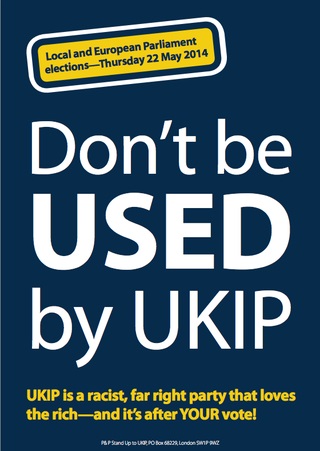
Abusing UKIP Supporters Will Backfire Horribly

UKIP attack

It’s official – there is nothing more fashionable in British politics than to accuse UKIP and their supporters of being closet (or indeed overt) racists. Everyone is at it, from the Scottish “artist” who has taken to painting over the party’s election billboards with grey paint to the scores of people who turned out to heckle and jeer at the UKIP public meeting in London on Wednesday.

Cooler heads might wonder if opposing unchecked immigration from European Union countries (as bad a policy as that may be) is actually more of an economic argument than a race-based one, and that fearing competition from eastern European workers actually indicates rather a high degree of respect for their work ethic and productivity rather than the sneering superiority of an English racial supremacist. But cooler heads are in short supply, and the three main political parties (with some noble exceptions in their ranks) are only too eager to pile on the attack to stave off their own looming electoral humiliation.

The fact that organisations such as Unite Against Facism think it worthwhile to picket UKIP events speaks to the success with which the liberal left have been able to equate opposition to economic migration with racism and nationalism, but more importantly it cheapens and diminishes the important work that they do. UAF rightly stand against racism and bigotry wherever it threatens, but using their name and status to attack a legitimate and moderate political party will rightly be construed by many as “crying wolf”, lessening the impact of their more considered protests.

The commentariat class seems amazed and bewildered that the non-stop repetition of the UKIP-racism mantra and frequent articles about wayward UKIP candidates is not causing a mass exodus among UKIP’s supporters. According to the conventional wisdom, we should all read these stories and extrapolate the bizarre or hateful opinions of the few to represent the many – if one UKIP candidate turns out to be an epic racist, so must all of the others, and the people who support them.

If they had slightly more awareness of their own personal biases and a lot less contempt for the British electorate, these commentators might realise that the yawning gap between reality and what they think should be happening results from the fact that the British people, broadly Eurosceptic and increasingly supportive of UKIP’s goals, are perfectly able to distinguish between the unhinged crazy people who exist at the fringe of a political party (and sometimes sneak through the vetting process) and the general goals and intentions of the party as a whole.
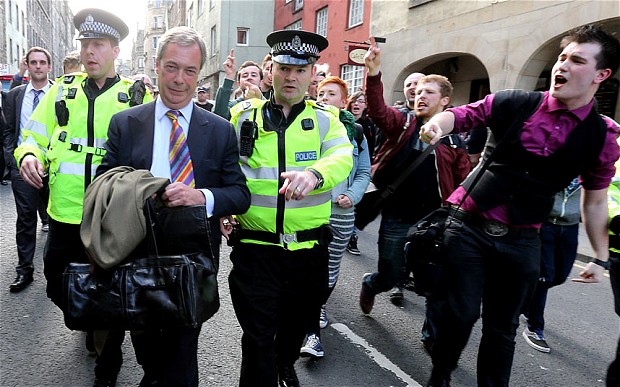
Critique the ideas, don't attack the messengers
Critique the ideas, don’t attack the messengers


UKIP’s stubbornly persistent high poll numbers are not some terrible reflection of the fact that British people turn a blind eye to racism and bigotry, but rather reflect the fact that voters know that the racist and bigoted people seizing the spotlight do not speak for the whole, and that opposition to economic migration (right or wrong) does not equate to racism.

The distinction is lost on much of the mainstream media and those in the public who are opposed to UKIP’s aims, largely because it suits their purposes to tarnish a growing political party and electoral threat with the toxic smear of racism. But these people delude themselves if they think that calling a moderate political party “racist” and insinuating that their many supporters are either nationalist sympathisers or credulous fools will come without a significant cost.

UKIP devotes its energies campaigning for what it sees – again, rightly or wrongly – as Britain’s national interests and has little to say about the main political parties other than pointing out that when it comes to addressing the inexorable growth of the European project, there is nothing to choose between them. The established parties, however, bereft of any honest or coherent arguments of their own when it comes to defining Britain’s relationship with Europe, have resorted en masse to base character attacks and smears.

Nick Clegg and the Liberal Democrats once liked the idea of a referendum on Britain’s EU membership, but now they disown the idea, the thought of consulting the British people only being appealing when they could be trusted to give the desired answer. David Cameron talks in woolly platitudes and promises negotiated EU reforms and British exemptions that he is unlikely to be able to deliver. None of the political parties who have had the chance to attempt meaningful reform of Britain’s relationship with the EU have followed through on their prior promises, and so the public are hardly fools – let alone racists – to reach out to the one party that has not yet let them down on the matter.

Some of the more intelligent critiques of UKIP have attempted to draw comparisons with the Tea Party movement in the United States. This is a lot closer to the truth. Nigel Farage would have no truck with Nick Griffin, the leader of the British National Party (despite the attempts of some to draw out similarities), but would probably get on famously with the likes of Sen. Ted Cruz of Texas or Rand Paul of Kentucky, both of whom, for all their flaws, have strong small government credentials.

Read UKIP’s manifesto or campaign literature and what you will see overall is a small-government oriented, non-interventionist party that believes in maximum personal freedom. They even support libertarian goals such as the establishment of a flat-rate income tax. Like the American Tea Party, an element of cognitive dissonance creeps in when you observe the discomfort with/opposition to gay marriage, but the general thrust of their policies is toward empowering the individual over the government, and the British government over undemocratic decrees from Brussels.

There is no excuse for ignorance about UKIP’s past and present policies – they are readily available on the internet, and any British political commentator still willing to throw around the accusation of racism should be able to draw on supporting evidence from these manifestos in order to maintain their credibility. But the anti-UKIP brigade will search in vain – the ‘smoking gun’ of racist or nationalist invective is simply not there to be found.

Eleanor Roosevelt once said “Great minds discuss ideas; average minds discuss events; small minds discuss people.” In the panic and scramble by the British political establishment to respond to the surging popularity of UKIP, there has been talk of events and an inordinate amount of talk about individual people – rogue candidates and their wacky, off-message personal views. The volume of discussion – and intelligent criticism – of UKIP’s actual policies, however, has been negligible. Small minds predominate.

Interestingly, the one and only time that UKIP’s ideas were put to the test thus far (in nationally televised debates),UKIP triumphed and the establishment lost, badly. So is it any wonder that armed with such unpopular policies of their own and facing a huge credibility gap, the major political parties and their respective cheerleaders in the media have been only too happy to promulgate the idea that UKIP is a racist party?

The only problem with their strategy is this: millions upon millions of normal, decent and tolerant people support UKIP’s stance on Europe and other matters. The establishment’s response to this fact so far has been either to pen hand-wringing and patronising columns fretting about how the public’s inchoate anger at politics-as-usual is causing them to be duped like fools into supporting a nascent far-right party, or to accuse them outright of harbouring racist views. In other words, as the establishment would have it, UKIP supporters are either racists or gullible fools. The third option – that they might be semi-intelligent people with a legitimate political point – is not widely accepted.

On Thursday 22 May, the British political establishment – Labour, Liberal Democrat and Conservative alike, and their friends in the press – will find out whether shaming and insulting up to one third of the electorate in the run-up to an election increases or decreases their resolve as they enter the voting booth.

If the aftermath is messy and humiliating for them, it will be no more or less than they deserve.

The Establishment Rounds On UKIP

nigelfarage_nickrobinson

It is neither astonishing nor controversial to observe that the British political establishment – politicians and their client political journalists alike – have only animosity and contempt towards the UK Independence Party and the 30 per cent or more of the British electorate who are likely to vote for them at the European Parliament elections later in May.

From their attempt to pre-ordain the outcome of the recent Nick Clegg vs Nigel Farage debates on Britain’s place in the EU to their laser focus on UKIP’s lunatic fringe, the British media has not been shy to express its negative opinion of euroscepticism or those who in any way seek to change the status quo of Britain’s place sulking at the periphery of EU decision-making.

But there are few examples of this bias – borne out of desperation to discredit the insurgent party and a refusal to engage on any issues of real substance – more telling than the BBC’s latest ‘interview’ with Nigel Farage. Nick Robinson asks the questions, and the thrust of his interrogation is this: because Farage employs his wife, a German citizen, as his personal secretary, UKIP’s arguments about unrestricted European immigration causing downward pressure on wages and reduced employment of indigenous workers are hypocritical, and that Nigel Farage is therefore totally discredited and borderline corrupt himself.

A couple of observations to start. Firstly, this blog is in agreement with the need to curb the persistent practice of politicians (be it MPs or MEPs) hiring family members purportedly to serve as ‘staff’. Sometimes it seems as though absolutely nothing was learned as a result of the parliamentary expenses scandal, when various relatives of politicians were found to be on official payrolls with nominal job titles but no demonstrable evidence of working to earn their money. Though the ideal of competitive and non-discriminatory hiring practices for political staffing jobs may never be reached, we could at least stop politicians from overlooking genuine talent in order to hire gormless relatives. That being said, there is no indication or suggestion that Nigel Farage’s wife is anything other than competent and qualified.

Secondly, this blog supports a liberal, open immigration policy. That is not to refute the various arguments on immigration made by UKIP, or to endorse them; whatever the net effect of unrestricted European immigration on wages and unemployment of British-born workers, it is best debated on other pages. But this blog sees only benefits to making it as easy as possible for skilled and talented people from all over the world to come and to contribute to Britain.

Back to the interview.

Not content with asking his simplistic question – “how can you claim to defend British jobs when you employ a German secretary?” – one time, Nick Robinson indulges himself with a lengthy Jeremy Paxman-style grilling, repeating the insinuation of hypocrisy and scandal (in his trademark bemused and facetious manner) in various different permutations:

You’ve warned about Europeans taking British jobs. Your wife is German! She is your secretary. She’s paid for by the British taxpayer … Was your wife taking someone else’s job then?

Farage’s response – that in his particular case, the hours and demands of the work (late nights at his house) made the secretary role particularly well suited to a spouse, making her the logical choice – did not satisfy Robinson, who continued:

You try to turn everything into a joke. You have a campaign that says that Europeans are taking British jobs. You employ a German woman to work in your office. She happens to be your wife. She happens to spend many hundreds of thousands of British taxpayers’ money. How do you justify it?

Nick Robinson knows full well that Farage’s (and UKIP’s) argument about British jobs being under threat – whether it is a legitimate concern or not – refers to the lower end of the job market, the low-skilled positions, and not to more highly skilled or specialised political staffers. But acknowledging this basic fact would undermine the attack on Farage’s credibility, and so Robinson declines to recognise the distinction.

Farage also points out that Robinson is singling him out for hiring a relative, something that is regrettably common and largely unremarkable in Westminster:

One in four MPs at Westminster employs a close family relative, but actually what’s happening the past two weeks, of 73 British MEPs, I’m the one who is being singled out, and [the press is] saying “goodness me Mr. Farage, you’re costing the British taxpayer an awful lot of money.”

At least one disaffected member of the public spoke wisdom, shouting “What about economic policies?” in the background. Quite right too – what about economic policy? What of the genuine economic costs and benefits of continued British EU membership vs a negotiated secession? The BBC was clearly not interested in following these important lines of enquiry. or asking about specific policy prescriptions.

Gazing on the scene from his adopted home in America, Andrew Sullivan (whose British political acuity has diminished with his years of absence) actually saw Nick Robinson’s glib attempt to concoct a scandal as an example to praise and emulate:

The idea that they [Washington press correspondents] would wreck their access by asking a politician questions that he really doesn’t want to answer – “Isn’t your wife German?” (see above), “Can you give us evidence for your crazy pregnancy stories?” – is preposterous.

So I give you the above video, by the intrepid BBC political reporter, Nick Robinson. Watch him go for the jugular, and watch him not release his grip until the prey is whimpering, near-lifeless on the ground. 

Nick Robinson, intrepid?

This really speaks more about the parlous state of political journalism in Washington D.C. than it does about anything else. So deferential are the Washington press corps to those in power – and Sullivan rightly refers to the recent annual White House Correspondents’ Dinner – that any hounding or questioning of a party leader must in itself seem dedicated and fearless. A closer attention to the specific question being asked, however, would have shown that Robinson’s approach was far from being brave or principled. Sullivan is right about the non-deferential tone of British political interviews being a positive thing, but dead wrong in singling out this particular establishment hatchet-job as  the pinnacle of good journalism.

The BBC had a golden opportunity to ask some real questions of Nigel Farage, to delve into policy differences with the other parties or at least to engage in a bit of speculation and expectations-setting with regard to the upcoming European elections. But they weren’t interested in the policy discussion (the noble option) or in analysing the polls (the political infotainment option). They went instead for the classic hatchet job, the interview ambush that neither educates the informed viewer or grabs the attention of the casual viewer, serving instead only to give David Cameron, Ed Miliband and Nick Clegg some weak ammunition for their negative anti-UKIP political ads.

This was the cheap and tawdry approach taken by a news organisation (if this interview and other recent form is anything to go by) that is becoming increasingly lazy and only comfortable discussing the European Union debate through the existing lens of Labour vs Conservative, more Europe vs a little bit less Europe. The alternative – an end to British membership of the EU – is seen as so radical and threatening to the establishment that it must simply be ignored, or (when feigning ignorance is no longer possible) loudly ridiculed and discredited.

Polling day is on Thursday 22nd May. Soon we will know whether the Nick Robinson strategy has been enough to save the British political establishment from electoral humiliation.

Maria Miller And The Government’s Contempt For The People

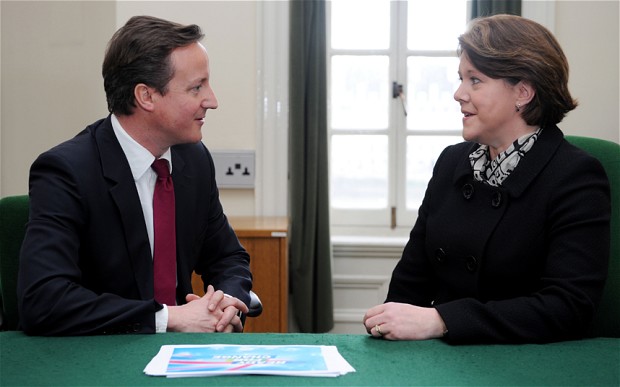
maria miller david cameron

According to the prime minister of the United Kingdom, it is both professionally and ethically acceptable for a Member of Parliament to use taxpayer money to house their parents and contribute toward the purchase of a property which is later sold having appreciated in value, the profits accruing to the lucky politician.

Furthermore, when questioned by the parliamentary expenses authority and by the media it is appropriate for an MP – in this case Maria Miller, the Culture Secretary – to obstuct, bully and harass those investigating the questionable expenses claims at every turn. There is nothing more to see here, the issue is closed and we should all stop fussing and just move on.

We know this because David Cameron tells us so.

The Telegraph summarises the tawdry scandal briefly enough to inform without entirely sapping the will to live:

[Culture Secretary Maria Miller] had to repay £5,800 in mortgage interest payments and also apologise for failing to cooperate with the parliamentary inquiry into her expenses. The Parliamentary Commissioner for Standards, Kathryn Hudson, had recommended that she pay back £44,000, an amount reduced by the MP-dominated Commons Committee on Standards.

But having housed her parents at the taxpayers’ expense, and made a capital gain in the process, Mrs Miller could be presented by the Tories’ opponents ahead of May’s European elections as the personification of alleged Westminster sleaze which so infuriates voters.

If any one image will come to symbolise this latest expenses scandal in British politics, it will be this – the picture of a haughty, self-entitled, unrepentant Maria Miller making her perfunctory, insincere and lightning-fast pseudo-apology to Parliament after having successfully reduced the amount which she was ordered to repay from the original £45,000 to an astonishingly low £4,500:

maria miller 1

Here, Maria Miller is flanked by a number of faces not commonly seen sitting on the back benches by virtue of their position – Health Secretary Jeremy Hunt and Chief Whip Sir George Young. This is no accident. They were ordered to sit with Miller to show the leadership’s determination to stand by the scandal-plagued politician no matter the public outcry.

The picture (from The Times) is essentially a freeze-frame image of Parliament once again conspiring to do right for themselves and act in the interests of the Old Boys (or, in this case, Girls) Club and against the interests of every single voter in the United Kingdom.

Iain Martin correctly surmises that the biggest beneficiary of this tawdry, self-inflicted crisis will be Nigel Farage and the UK Independence Party:

In such circumstances, the survival of the Culture Secretary is a dream for Ukip, as those Tory MPs observed. Having exploited the expenses system and made a sum most voters can only dream about, Miller then had her punishment watered down by a committee of MPs stuffed with the representatives of the mainstream parties. Farage can present Miller as a totem of all that he claims is wrong with the ruling elite.

Martin goes on to suggest that any benefit felt by UKIP would be the result of “scary populist politics”, which rather make one wonder whose side he is on – that of corrupt politicians or that of the people. But tactically speaking, he is quite right – the Maria Miller scandal can only redound to UKIP’s advantage because all of the other major British political parties are represented at Westminster and are consequently tainted by association.

Polly Toynbee, writing in The Guardian and no ideological soulmate of this blog, agrees that Cameron’s refusal to sack Miller – a case of misapplied loyalty at the worst possible time – will come back to haunt MPs from each and every political party and re-open the wounds from a parliamentary expenses scandal that had scarely been given time to heal since the original revelations:

The harm done to politics by the expenses scandal is felt by every MP in the blowback on the doorstep. Even the cleanest get the blame. Miller’s behaviour confirms the worst people think of politicians. How a £1.2m London property housing her husband, children and parents could be called a “second home” defeats most reasonable people. All those “second” bedrooms strike a wicked contrast with the bedroom tax. If her MP colleagues cutting a £45,000 payback to £5,800 was astounding, her 32-second stroppy teenager non-apology took the biscuit. Cameron should have sacked her that day, not for his government’s sake but to salvage a crumb of respect for the politician’s trade.

This really sums up the problem, a rather glaring one left conspicuously untackled since the expenses scandal blew up under the premiership of Gordon Brown – namely, the fact that the spirit of the rules governing expenses continue to be repeatedly violated and mocked, even if they are followed to the literal letter.

In the public mind, expenses exist to cover the necessary costs of performing a job, costs that can or should not be reasonably borne out of the employee’s own pocket. People tend to be reasonable and do not object to the idea of MPs being compensated for expenses incurred while conducting parliamentary or constituency business, just as they would never begrudge a business person legitimately claiming travel and accommodation costs when sent to visit a faraway client.

This blog advocates the introduction of a monitored charge card as the sole method of allowing MPs to pay for purchases to be expensed. Such a system – successfully deployed by many companies with vastly more employees than Westminster’s 650 serving MPs – would provide instant transparency and ease of auditing. In the twenty-first century, there is really no excuse for anything less.

Whenever talk of cracking down on expenses reaches a certain point, the counter-claim is often made that for our politics to work we must continue to attract the “brightest and best” talent to Westminster, and that frozen parliamentary salaries and stricter expenses policies will act as a grave disincentive. This is a self-serving and overblown threat, reliant on the assumption that the best statesmen and policymakers are motivated by cold hard cash. And while the 2015 general election will be the first to take place now that the new rules on expenses have bedded down, there seems little cause to worry that the next intake of MPs will be vastly different in composition to the bland automaton freshmen from 2010.

It is a popular conceit among MPs to believe that they are precious and irreplaceable altruists, but in reality there are many capable people willing and able to serve their country in parliament without also expecting the taxpayer to pick up the tab for their mortgage or second home as some kind of sick golden handshake deal-sweetener. Maria Miller belongs to a political generation that stubbornly refuses to acknowledge this new reality.

The longer that Miller’s petulant non-apology and the image of stony-faced Tory ministers supporting and flanking her on the backbenches remains forefront in the general consciousness, the more damage is done to what remains of public trust and engagement in the British political process.

It may be too late to claim any moral high ground for doing the right thing, but David Cameron needs to end the damage and guide the spirit of Maria Miller’s dying, unmourned political career towards the light.

Nigel Farage vs The Politically Correct Line On Russia

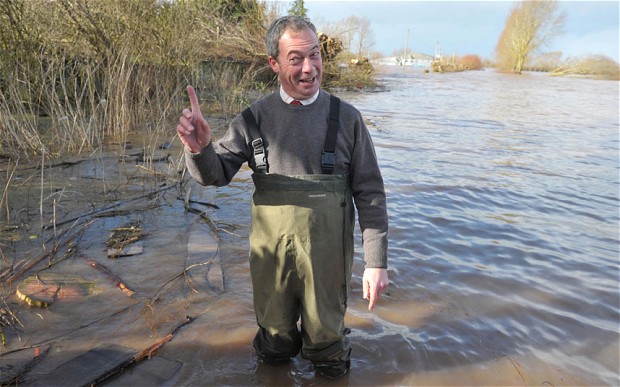
Attempts to sink Nigel Farage tend to fail


In the aftermath of last week’s debate on Britain’s place in the European Union, UKIP leader Nigel Farage had gall to say that he admired the tactics of the despotic Russian president Vladimir Putin. Not that he admired Putin as a person, agreed with his annexation of Crimea or supported his policies in any way, mind you – just that he thought Vladimir Putin had played a good hand and used methods both conventional and shady to advance the national interest of his country.

To hear Deputy Prime Minister Nick Clegg’s subsequent shrieks of outrage, quickly repeated and parroted thoughtlessly by numerous political commentators and talking heads, you would think that Nigel Farage had whipped a large Soviet flag out from behind his podium and paraded up and down with it during the debate, singing  the State Anthem of the USSR at the top of his lungs (incidentally, it’s a cracking piece of music).

The second live televised Leader’s Debate on the EU will take place tonight, and given the establishment media’s heroic efforts last week to spin the results of the first as a victory for the hapless Nick Clegg – until overwhelming reality and the results of a YouGov poll made their position indefensible and forced a sudden reassessment of Farage’s performance – this blog aims to clear the fog of war which still threatens to obscure what Nigel Farage actually said (eminently reasonable) and what he has subsequently been accused of saying (treachery).

Here is what Nigel Farage actually said, when asked by Alastair Campbell which world leader he most admired:

“As an operator, but not as a human being, I would say Putin. The way he played the whole Syria thing. Brilliant. Not that I approve of him politically. How many journalists in jail now?”

 The recognition of Putin’s moral failings and outrage at Russia’s insidious suppression of free speech was not enough to save Farage from what followed. The point was clearly that Russia has been running rings around a hopelessly divided (and in some cases, morally equivalent) international community, not that Russia pursued a just or worthy course of action.

Nick Clegg chose to see it somewhat differently:

“It shows quite how extreme people can be like Nigel Farage when their loathing of the European Union becomes so all-consuming that they even end up siding with Vladimir Putin in order to make their point.

The only reason we are able to seek to exert any influence – and it is difficult enough as it is – on Vladimir Putin is because we can act with the clout of being part of the economic superpower that is the European Union, upon which Russia depends a lot.”

A heady mix of deliberate misrepresentation and the sadly typical denigration and talking down of Britain’s capacity to act in it’s own interests on the world stage such as this would be remarkable coming from anyone other than the Liberal Democrat leader and our Deputy Prime Minister.

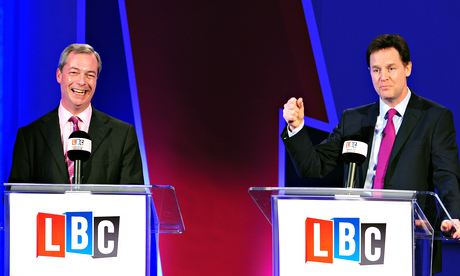
Clegg and Farage


Former Conservative Foreign Secretary Malcolm Rifkind also loses the plot over Farage’s comments, railing against the UKIP leader in his uniquely blustering, pompous style:

How very revealing. When asked which world politician he most admires, Nigel Farage chooses, of all people, Vladimir Putin. While others might have sought a successor to Winston Churchill or Nelson Mandela, Farage fawns over an autocrat who has made Russia the least free country in Europe – a man who locks up his political opponents and has just invaded his neighbour, annexing part of its territory.

Rifkind also chooses to go with the trusty trick of blatant misrepresentation. Nigel Farage was clear to add the caveat “as an operator, but not as a human being” before making his comments about Russia’s effective foreign policy. Those key words by Farage, which place his remarks in context and which came literally right before the ones that Rifkind quoted to support his diatribe, seemed to sail past his ears unnoticed.

Rifkind then goes on to miss the point entirely:

[Farage’s] irresponsibility has not just been restricted to Putin’s behaviour in Ukraine. He described Putin’s policy on Syria as “brilliant”. Does he not realise that Russia has vetoed every resolution in the UN Security Council that was aimed at pressing Assad to end his murderous violence – which has led to the deaths of over 140,000 Syrian men, women and children? Does he not know that without Russian arms supplies, the Assad regime would have been forced to negotiate an end to the civil war two years ago?

Again, we see the deliberate, false equating of Farage’s admiration of the brilliant execution of an terrible policy with actual support for that policy. But the two are clearly not one and the same, no matter how much the prevailing climate of political correctness may insist that because something is judged by the collective to be bad, all aspects of it must be denounced as equally terrible and any positive aspects be purged from discussion and memory.

Russia’s annexation of Crimea is outrageous and terrible – on that much, nearly everyone aside from Russia agrees. But to stop at saying that is not enough for the politically correct pundits of today. In this world, because Russia has done this terrible thing and made itself persona non grata in the international community, we all must now say that everything about Russia is bad, and never acknowledge any good until we are told by our superiors that it is safe to do so.

To be fair, Russia makes this task quite simple. Through their domestic and foreign policies on any number of issues, that country has placed itself on the wrong side of human rights, freedom of speech and even the arc of history. The lamentable implosion of Russia’s nascent democracy is well known, as are the stories about increasing suppression of free speech, the government takeover of the media and Russia’s appalling record on civil rights for gay people. But why must all of these misdeeds be meticulously restated before a British politician can say the truth – that despite Russia being completely wrong on all of these issues, they played their foreign policy hand really well in support of their own national interests?

Telegraph columnist Tim Stanley hits the nail on the head in support of Nigel Farage’s right to say the blindingly obvious:

Farage’s sin was to say that he admires Putin as a political leader, although not as a human being. Why this is controversial, I have literally no idea. Farage made it abundantly clear that he regards the Russian leader as a despot (“How many journalists in jail now?”); he simply thinks that he outwitted Obama on Syria. I think that; you think that; even Obama probably thinks that … Ah, but you can’t say such things out loud because the consensus in Westminster right now is that Putin is Hitler, Ukraine is the Sudetenland and anything less that outright Russophobia is treachery. And probably a little bit homophobic.

Precisely. Believing that Putin outwitted other world leaders in terms of the response to the awful situation in Syria does not imply support for Putin’s position, just as believing he is currently one step ahead with regard to Ukraine does not mean that Nigel Farage wants Russia’s gamble to succeed.

Tim Stanley continues, giving a brilliant summation of the current problem with British political discourse:

And that’s Farage’s real sin: he dares to be different. Contemporary British politics works by an unusual degree of consensus. All three party leaders want to stay in the EU, all wish to preserve the principle of the welfare state, all back gay marriage, all accept the need to go green, none will challenge the concept of open borders on immigration. Some or all of these positions may well be right – that’s not the issue. The issue is that this homogeneity of opinion is fundamentally undemocratic. In democracies, voters are supposed to be offered real choices rather than one establishment philosophy spun three different ways. To make matters worse, the party leaders now not only sound alike but also lookalike.

This much is true, and scarily so. The sad fact is that the British political elite have imposed a consensus on society that the people themselves have not yet reached. For good or ill (okay, for ill) there is a large rump of opinion within the British population that would bring back the death penalty in a heartbeat, scrap the new legalisation of gay marriage, become Fortress Britain for immigrants seeking the right to work, and undertake any number of other regressive policies. But in Britain the elite went ahead and determined the “correct” answer to all of these issues on behalf of the people but without seeking their input, and so the debate is continually suppressed – except for when it bubbles to the surface manifested as support for the insurgent or extremist parties.

Contrast the situation in Britain with that in the United States. The political debate there is no more enlightened or informed, but there is still the sense that they debate important issues, often from diametrically opposing viewpoints. The US senate hears strident views from such diverse characters as self-proclaimed socialist Bernie Sanders, the senior senator from Vermont, as well as the fire-and-brimstone filibusterings of Tea Party darling Ted Cruz. And people with views anywhere within this spectrum are made to feel welcome in the political debate. As a result, though the American process is a lot slower, louder and more contentious, when political unanimity is finally reached (and it takes a long time – civil rights has more or less just crossed the line, with gay rights looking at another 30 years of toil) it is much more strongly reflected in the people, and is consequently much more likely to stick.

The difference could not be clearer – a lively national debate where everyone feels they can speak and be heard, or the stultifying restrictions of an artificial consensus imposed by the political elite.

Now faced with a politician who refuses to follow the approved talking points on Russia, these weasely politicians who came scurrying out of the woodwork to denounce Nigel Farage over his comments are deliberately misleading the public and attempting to change the narrative. Hell, let’s call a spade a spade – they are lying, deliberately lying to the British people in the political establishment’s latest doomed attempt to make Nigel Farage, the UK Independence Party and the millions of people who share his viewpoint seem extremist, weird and dangerous.

All of these armchair pundits know what Nigel Farage meant when he said he admired the direct effectiveness of Vladimir Putin’s assertive foreign policy as compared to the dithering and retrenchment which have all too often characterised the governments of David Cameron and Barack Obama. But why let a non-story go to waste when words can be twisted and mischaracterised to falsely make their speaker sound like the CEO of the Vladimir Putin Fan Club?

Of course, all of this kerfuffle could have been avoided if Nigel Farage had chosen his words more carefully. Had Farage prefaced his words with a lengthy (but surely unnecessary) denunciation of Russia’s behaviour and Putin’s morals, he might have escaped censure by the self-appointed moral arbiters of British political debate. That’s exactly what they want to happen, and it is why they are now so furious with the idiosyncratic UKIP leader, resolved once more to try to drive him out of British politics.

In the heavily thought-policed world of Nigel Farage’s critics, no opportunity to say The Correct Thing should ever remain unseized. If you want to make a point about the effectiveness of Russia’s foreign policy then that’s okay, but by God you had better utter the cross-party approved talking points before you do so. Only once all of your political pronouncements become entangled in endless disclaimers and footnotes grounding them in established political correctness will these meddling people be satisfied.

Tim Stanley puts it well:

Westminster is going to continue hitting its head against the brick wall of public antipathy towards politics-as-usual. The more that Farage acts up, the more different he seems, the more the establishment will hate him, the more the voters will like him.

And there, right there, is the popularity of Nigel Farage. Political correctness and towing the establishment party line? He will have none of it, thank you very much. Whether you like his political stances or not, he is the only leader of a major political party in Britain who remains willing and able to speak honestly and passionately as though he isn’t reading from a focus group-approved script.

How richly will the voters reward him in May’s elections for daring to talk like a normal human being?


The next Leader’s debate on the European Union takes place tonight (Wednesday 2nd April) at 1900 BST, and will be shown on BBC Two.

Britain’s Future In Europe – Reviewing the LBC Debate

Image from BBC
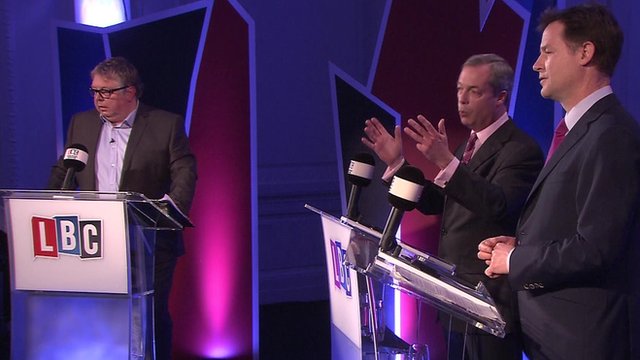
The LBC debate on Europe – Image from BBC


Finally, the British voters got what they had always wanted – a real debate between politicians on the merits and disadvantages of Britain’s continued EU membership. The political elite and main party leaders may have snubbed the debate and thumbed their noses at the concerns and sentiments of the people, but the discussion went ahead nonetheless, thus proving that important and thorny issues will be debated and tackled in Britain, even when it does not dovetail conveniently with the news strategies of the main political parties.

This blog offered a running, real-time commentary on the debate as it took place, on Twitter.

Nick Clegg, having been nominated to begin the debate, started with the risible and misleading suggestion so beloved of Europhiles that Britain’s trade with Europe and membership of the European Union are essentially one and the same thing – that to leave the political organisation that is the EU would be to build a wall and sever all trade ties with our continental European trading partners. Of course, in reality this is simply not the case, and Nigel Farage took the earliest opportunity to swat down this false argument.

Farage continued his strong start by cunningly reversing the question and asking if Britain were currently outside the EU, and given what we all now know about the costs and flaws and drawbacks of EU membership, whether the British electorate would likely vote to join. This simple shifting of the lens on the debate is clever, and moves focus away from distracting side-issues about the mechanics of secession, looking instead specifically at the merits.

The debate then moved on to whether a referendum on British membership of the EU is desirable at all. Here, Farage did a superb job of calling out the main political party leaders for repeatedly promising referenda in the run-up to elections and then back-peddling or stalling when the time came to deliver on the promises.

Here, Nick Clegg was firmly on the defensive, continually resorting to the official line that he might deign to grant the British people a say on future EU membership, but only in the event of some future treaty change. The justification for this particular stance, at one time used by all of the major political party leaders, has never been convincingly made. People in Britain are unhappy with the EU as it is now, not with how it might be after some as-yet unknown treaty modification. So why can the debate and the referendum not take place on Britain’s current status quo relationship with the EU? As this blog observed at the time, if you catch someone stealing from you, you don’t wait until the next theft before alerting the police, you would do so immediately. And so if Britain’s EU membership has been acting against our national interests, why should the British people have to wait until the next harm is caused to the country before seeking redress?

Of course, the topic of immigration was raised, thus exposing the major chink in UKIP’s armour – the perception that the party and its supporters are hostile to immigrants per se. The fact that the question was asked by an audience member of the ‘swivel-eyed lunatic’ type appearance and then heartily embraced by Farage did not help matters. A party that aims to abhor regulation and restrictions on business and the market really needs to ask itself if continued opposition to immigration is a sound policy in 21st century Britain.

Aside from this inevitable rocky point, Farage remained combative and humorous throughout, while Clegg – despite deploying his usual tricks of staring into the camera and repeating the names of audience members as many times as possible – seemed defensive and on the back foot. There was even time for an awkward Marco Rubio-style on-camera gulp of water from the Deputy Prime Minister.

Farage landed yet another blow on Clegg when he reminded viewers of the apocalyptic doomsday scenarios laid out by pro-Europeans in the 1990s, claiming that Britain’s economy would be dealt a mortal blow if we failed to sign up for the single European currency. “Thank God we didn’t listen,” thundered Farage, to loud applause.

This left Nick Clegg scrabbling around for any remaining mud to sling at Nigel Farage and the Eurosceptic movement. In the end, he resorted to a beloved bogeyman of British social discourse, paedophilia. Nick Clegg, in his desperation to score a final point against Nigel Farage, actually appeared to suggest that British secession from the EU would eradicate Britain’s ability to extradite and prosecute paedophiles – a ludicrous argument, and basically a reassertion of the false argument that Britain would leave the EU without drawing up replacement political, trading and justice treaties with the remaining member states.

And on that damp squib of a counter-argument, save only the closing statements, the debate was over. A solid victory for Nigel Farage, one might have thought, until one witnessed the commentary on television and the internet.

Several commentators rightly pointed out that the media showed several worrying signs of institutional bias. In the buildup to the televised debate, ably anchored by Kay Burley on Sky News, at one point a panel member – a visiting university student from America – was asked if she was ‘worried’ or ‘alarmed’ by the fact that Britain was debating the topic as she landed in the country. Never mind the fact that the poor girl clearly knew next to nothing about what the EU is or how it works, the question was so leading as to be risible. Rather than painting the in/out decision in more clinical terms and asking for a comment, it was suggested to the American student that the very idea of Britain leaving the European Union is alarming and scary. Naturally, the student – on live television – agreed with the questioner that it was indeed a scary prospect. So much for objective coverage.

Peter Oborne, writing in The Telegraph, also found significant institutional fault in the way that the mainstream media handled the coverage and the issue of Britain’s EU membership in general. Oborne saw a deliberate attempt to spin the results of the debate as a victory for Nick Clegg and the pro-European side, until the overwhelming results of the post-debate poll forced them to amend their stories:

Last night’s debate between Nigel Farage and Nick Clegg was a very good example of this phenomenon. The lobby wanted a Clegg win and … collectively called victory for Clegg the moment that the debate was over.

It was only when the YouGov poll came through showing that Farage had won the debate hands-down with the public that lobby journalists were forced into an abrupt U-turn.

I am not going to embarrass reporters by naming names. However, it is fair to hold both Sky and the BBC to account.

Oborne concludes that the UKIP and Eurosceptic-leaning side not only have to win their argument in the court of public opinion, but also overcome a second opponent in the British press:

Farage is leading a political insurgency. Last night was a reminder that Ukip’s opponents are not just the other political parties, but also the mainstream British media.

The Spectator also picked up on the media’s U-turn upon realising that their preferred narrative was falling apart in the face of the YouGov poll:

Nick Clegg had been given the night off babysitting; but, after the poll verdict on tonight’s EU debate with Nigel Farage, he may wish he’d stayed at home with the kids. As the dust settled, the Deputy Prime Minister was bundled into a car and fled the field of battle. Meanwhile, Nigel Farage headed for a victory lap at the Reform Club, where his party donors had been watching.

Backstage, Westminster’s hack-pack was necking cheap vino and Pret sandwiches after carrying out a spectacular volte face. Initially ‘the spin room’ had called the duel for Clegg, on both style and substance. But, as news of the Sun/YouGov poll filtered through to the scribblers, headlines were rewritten and awkward tweets deleted. Soon, only the BBC was left flying the Clegg flag, with the help of Danny Alexander and Tim Farron.

And even now, in the cold light of a new day, the general consensus from the headlines appears to be that that it was an honours-even draw, and that there were ‘no knock-out blows’:

The question of the hour, should Britain stay in the European Union? But the question now being asked? Who won, Nick or Nigel?

Well, it might be disappointing but both men certainly remain standing after tonight’s event. Neither was knocked to the ground and both sides will be pleased with how their leaders performed.

Given the testy nature of the debate and the fact that Nick Clegg was on the back foot for nearly the entire duration, one wonders what would have had to happen – short of either man accidentally lighting his podium on fire – for the news media to declare an actual victory for either side.

And this typifies a problem that is becoming endemic in the news media, not only in Britain but also in the United States. All too often, there is such a tremendous pressure to appear nonbiased and objective that news organisations are terrified to report on anything of a partisan nature without giving equal balance to both arguments. The compulsion to treat both sides of an argument as equally valid and legitimate – even when one is clearly correct and the other one wrong – is paralysing the ability of many news outlets to correctly report the news, even when there is no deliberate attempt to give favourable editorial treatment to a particular side.

The only news outlet with a convincing explanation (i.e. one not based on bipartisan spinelessness) for why both UKIP and the Liberal Democrats seem happy with last night’s debate is The Spectator:

Nick Clegg and Nigel Farage may have looks straight into the same camera and appeared to be addressing the same audience, but they were aiming for different listeners. That’s why the Lib Dems were happy with the 36 per cent that they polled last night. It demonstrates to them that there is some kind of constituency that likes to hear a politician being honest that he likes Europe and that he is pessimistic about Britain’s chances outside the EU.

Last night’s result also demonstrates that even if you appear a bit ratty and sweaty at times, as Nigel Farage did to those who are not instinctively his supporters, you can still win the debate, because there is a bigger constituency of voters who do agree with what you are saying, even if you’re not as polished as Nick Clegg. Thus the first of the two debates went very well for both parties: both were shoring up their own bases and motivating them to vote in elections with typically very low turnout. The real mission for these party leaders is to get their voters to go to the polling booths, not bother about people who haven’t made up their minds.

This ‘one debate, two audiences’ explanation makes a good deal of sense.

Of course, there is one further debate to take place, this one hosted by the BBC on Wednesday 2 April. Again, the Prime Minister and Leader of the Opposition have declined to participate. And once again, despite their resistance and the timidity of much of the British press, the public will continue to debate the issues in their absence.