At Long Last, Will The BBC Take Editorial Bias Seriously?

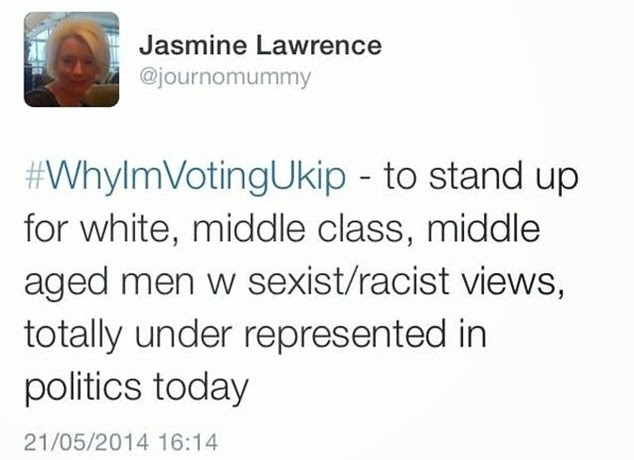
Jasmine Lawrence BBC UKIP bias tweet

It is a sign of the times that things which used to cause outrage are becoming commonplace and shrugged off as unimportant, a fuss about nothing. And so it was that barely anyone spoke up when Jasmine Lawrence, the editor of the BBC News Channel – Britain’s most watched news channel – caused a stir by posting a virulently anti-UKIP screed on Twitter (supposedly in a personal capacity) before quietly deleting it when it began to attract negative attention.

The Guardian summarises the incident:

Lawrence, who has now shut her Twitter account, posted a tweet on Wednesday that said: “#WhyImVotingUkip – to stand up for white, middle class, middle aged men w sexist/racist views, totally under represented in politics today.”

The tweet was posted the day before the local and European elections.

Of course, the story was seized upon by the likes of blogger Guido Fawkes, but outrage and indignation at such a flagrant breach of impartiality should not be the exclusive preserve of those on the right. It does no one any good if the national broadcaster, whose one supposed redeeming feature lies in its non commercial and impartial nature, permits its employees to go rogue without consequences.

And this was far from the only example of BBC journalists publicly showing contempt for political parties outside the “big three” – a BBC Radio 4 producer had this to say:
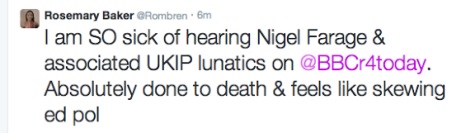
Rosemary Baker BBC election bias tweet

The BBC’s mail-merged response to Semi-Partisan Sam’s complaint (yes, a complaint was justified) came today via email, and read as follows:

Jasmine Lawrence was tweeting from a personal account. She has been reminded of her responsibility to uphold BBC guidelines. She has deactivated her twitter account and will now be playing no part in the BBC’s election coverage in coming days.

Nevertheless, we acknowledge the strength of your complaint and we can assure you that we’ve registered your comments on our audience log. 

Wow, the audience log. That will definitely stop anything like this from happening again.

What the BBC fail to address in their response is the fact that the remainder of the BBC’s election coverage is not the problem. The problem is the fact that Jasmine Lawrence will remain the editor of the BBC News Channel, presumably resuming full duties as soon as the election coverage is completed on Sunday.

Yes, it is certainly likely that she caused editorial harm and biased coverage in the weeks leading up to the election before her ill-advised tweet saw her stripped of her duties, but how much more damage can she now do in the coming year leading up to the general election?

We all have political preferences, and that’s fine. But the Jasmine Lawrence tweet doesn’t just reveal a tendency to lean one way or the other along the political spectrum. The editor of the BBC News Channel clearly has a deeply ingrained, long held antipathy toward UKIP and the people who support that party or agree with its policies.

Are we really supposed to believe that when she walks into the BBC offices in the morning, Jasmine Lawrence takes off her scornful, UKIP-denigrating hat and puts on her cap of unblemished impartiality, and that the decisions she makes regarding story selection, focusing of time and resources, determining which guests to interview, lines of questioning and other matters will not be influenced by the same sentiments that prompted her to call UKIP supporters white, middle aged sexists and racists?

From the muted BBC response so far, it appears that the corporation remains wholly ignorant or disdainful of the outrage that continued examples of personal bias create among its audience and the British population at large.

Rod Liddle captures and distils this outrage in the Spectator today:

‘I’ve fucking had it with these people. They are so smug; they think they know everything and they know nothing. They want a good kick in the face.’

So said a close friend of mine, more usually a Labour voter, before she went out to vote for Ukip earlier today. I think it was the Jasmine Lawrence thing which tipped her over the edge. Jasmine is, improbably enough, the boss of the BBC’s News Channel. She had ‘tweeted’ that Ukip was a sexist and racist party – yesterday.

Of course, she should be sacked. Right now. The BBC’s News Channel is supposedly impartial – that’s what we pay for, an impartial service. Either that or the BBC should accept that all of its employees possess political views and there is no problem in having them aired. But it will not sign up to that more enlightened position because it knows that 90 per cent of them are as smug, and stupid, and bien pensant as Jasmine.

The latest update from Guido Fawkes reports that a memo has been sent to BBC journalists drawing their attention to pre-existing policies on impartiality. The memo reads, in part:

But the guidance is clear when it comes to personal activity: “As a BBC member of staff – and especially as someone who works in News – there are particular considerations to bear in mind. They can all be summarised as: ‘Don’t do anything stupid’.”

I’d also specifically draw your attention to the following section: “You shouldn’t state your political preferences or say anything that compromises your impartiality. Don’t sound off about things in an openly partisan way. Don’t be seduced by the informality of social media into bringing the BBC into disrepute.”

Don’t do anything stupid – a warning issued rather too late, given the fact that the polls have now closed. But the real damage could lie ahead of Lawrence resumes her duties at the BBC News Channel after the election. If she is reinstated, everything you watch and everything you hear on the BBC’s 24-hour news channel will be filtered through the perspective of someone who thinks that the ~30% of voters sympathetic to UKIP are nothing more than Oswald Mosley blackshirt-style fascists in disguise.

If you believe that actions should have consequences, and that the BBC should have as editor of its news channel someone who is at least able to maintain the illusion of impartiality, you can quickly and easily submit an online complaint here.

Local Elections: Mid-Earthquake Progress Update

Nigel Farage UKIP voting


Over half of the local election results are in, and so far we see UKIP picking up an impressiv number of council seats (139 and counting), running a strong second in many areas (which is impressive but of course delivers no councils or councillors when it happens) and causing mayhem with the fortunes of the other main parties.

Many of the establishment politicians and journalists, who had clearly vested their hopes in the all-out assault on UKIP in the press, have been caught flat-footed and are struggling to agree a line and respond before being overtaken by events when the European election results are announced on Sunday.

Some politicians, who are capable only of showing condescension toward UKIP voters and sympathisers, tried to portray them as victims with neither intelligence or agency, who are primarily economic ‘losers’ with an axe to grind. Labour’s Douglas Alexander epitomised this view on BBC Radio 4 this morning:

I think there is not just a whole group of people who feel left behind by the economy but locked out of politics. ‘There is a deep anger and alienation there and the votes that we have seen for Ukip overnight are in part a reflection of that reality.

But others showed more nuance and tact:

When the left pipes up about Ukip voters’ worries being reducible to either the “cost of living crisis” or a tangle of concerns around job markets and public services, they get nowhere near the whole story … When you meet a Labour-Ukip switcher who expresses worries about immigration, you can’t simply reduce what they say to falling wages and the lack of social housing.

A plurality – including those who know how the main parties behave – clung to the naive belief that the only thing needed is a change of tone and marketing from the main political parties:

The success of Ukip is a direct and inescapable consequence of the abject failure of the mainstream parties to connect with deeply disillusioned voters. It doesn’t need Dave and Ed to light up a fag and be photographed from now on only with a pint of beer in their hands – perish the thought – it just needs them to start talking a language that vaguely resembles the language the rest of us speak.

Of course, this unlikely formula for success relies on the supposition that the establishment politicians can still remember how to speak the same language as the people they supposedly represent, and that the likes of David Cameron and Ed Miliband might suddenly startspeaking frankly and honestly about Britain’s difficulties and opportunities without having their statements parsed and filtered through party-approved talking points.

Some newspapers have at least had the self-awareness and humility to examine their roles in the anti-UKIP onslaught ahead of the polls, acknowledging that the wholesale, scornful vilification of UKIP supporters not only backfired but was actually wrong:

Over the past week or so … something interesting began to emerge … A collective outbreak of sneering, which started to transcend the party itself and blur into a generalised mockery of anyone minded to support it. You could see it most clearly in the rash of satirical(ish) #WhyImVotingUkip tweets that are piling up even now (e.g. “Because I’m uneducated,uncultured, white and old”) and it’s not pretty: an apparent belief that to vote UKIP is to be an idiot of some description, either bigoted or duped, and worthy of little more than contempt.

… if people are supporting Ukip in such large numbers – even after the media’s massed guns have been rattling at it for weeks – it is probably time to drop all the sneering and think about why.

Rod Liddle at The Spectator came out hard against the “London elite” and their attempt to halt UKIP’s progress at all costs:

But it wasn’t just [the BBC], it was a whole bunch of other stuff too. The splenetic fury which the London elite sprays, mindlessly, upon those who do not agree with its views. I’ve fucking had it with these people too, to tell you the truth.

And a commenter at the Spectator expressed his frustration with those national newspapers who are naturally sympathetic to UKIP’s policies but chose to join in the chorus of misinformation and one-sided anti-UKIP coverage:

Nah, what [did] it for me was to see The Sun, The Mail and The Telegraph sticking the boot into Nigel Farage for expressing concerns those papers usually share.

I mean any other day of the week these newspapers are full of immigration stories, Romanian crime gangs etc, but come election time the papers decided to reinvent themselves as metropolitan luvvies backing the establishment parties and pretending Nigel is a dangerous extremist.

The results are still coming in, so it is natural that the party responses (and attempts to lay the blame) are all over the place. But the local council elections clearly have the main political parties (the “legacy parties” to use Nigel Farage’s terminology) spooked, and a convincing first place for UKIP when the European election results are announced on Sunday will really give them reason to pause and look at themselves.

For those of us watching, the fact that the election results are spread out over three days may be a good thing. By the time the European election results come in, the stock answers and meaningless mea culpas of the politicians and the talking heads will have been used up – and they might be forced to start saying what they really think.

Live-Tweeting The Local Election Results

Local Council Election Results Live Tweet SPS

Real time, Semi-Partisan tweets and analysis of the incoming local council election results are accessible here.

The first results are only just coming in, but from those early towns and cities to declare, there is undeniable evidence of a strong UKIP result, with large jumps in their percentage of the vote and some early seat wins on local councils.

The UKIP surge is coming at the expense of all of the other political parties so far, with both Labour and Conservative leads significantly dented in a number of wards.

The political establishment are clearly spooked – Labour’s Chuka Umunna is hard at work on the BBC News Channel continuing the anti-UKIP smears and offering glib and oily platitudes in defence of the political establishment, while Tory MP Douglas Carswell is already appealing to UKIP to agree to a pact with the Conservatives for the 2015 general election.

It is shaping up to be a long, eventful day – and a potentially awkward one for everyone other than Nigel Farage.

Get Out And Vote

Google European Elections 2014


To my British and European readers:

Whatever your political convictions may be, PLEASE make the effort to get out and vote today. People have given their lives in defence of our democratic right to choose our representation; the least we can do is take time to read up on the candidates/issues and make the trip down to the polling station.

Remember: those who can’t be bothered to get out and vote forfeit their right to complain about all things political until the next election.

For those who want to read a final Semi-Partisan analysis of the European election landscape before voting, click here.

European Elections: Zero Hour

EU European Elections 2014


In less than twenty-four hours, the polls will close and British voters will render their verdict in the European elections – as best they can, given the negligible differences between the main political parties, the lack of debate about EU policy and the vast shortcomings of the media’s coverage throughout.

This blog would have relished the opportunity to provide coverage and commentary on the three main political parties, had they made any substantive policy proposals or generated interesting news of their own – but in terms of the European election in Britain, almost from the start, it has been UKIP driving the agenda and making the headlines.

Today has been another day of incessant attacks on UKIP and euroscepticism by the main political parties, the media and spontaneous social media efforts. The #WhyImVotingUKIP hashtag, announced by the party’s leadership in a naive bid to gain positive grassroots momentum, was immediately and predictably hijacked by anti-UKIP activists and self-proclaimed wits across the country, resulting in some occasionally amusing (but mostly tiresome and false) jibes at their expense.

UKIP’s support having remained solid despite the missteps of the past week and the concerted efforts of nearly every major media outlets to portray isolated, reprehensible racist and homophobic actions as being representative of the party as a whole, the final tranche of negative UKIP stories betrayed signs of desperation. Today’s burning new reasons not to vote UKIP ranged from cycling policy to the similarity between UKIP supporters and football hooligans.

More seriously, a UKIP candidate standing in the local council election in Lancashire was allegedly stabbed in the face by a neighbour as a result of his political views. A man has been arrested and bailed pending a police enquiry, but if it is determined that the attack was indeed politically motivated it should give serious pause to those who have so gleefully participated in the free-for-all effort to paint UKIP as the British Union of Fascists reborn and their supporters uniformly as hate-filled individuals deserving of public scorn and shaming.

Throughout the election campaign, this blog has been torn when considering the electoral options on the table. There is no easy, natural option for those with small-government or libertarian-leaning views, who are eurosceptic and in favour of nation state democracy but pro-immigration (in this blog’s view, an entirely consistent and strongly defensible worldview).

Those who still believe in the European project and want lots more – though such people are few and far between – have it easy. The Liberal Democrats will happily take their votes and translate them into continued and unquestioning rubber-stamping of European Union policies, borne out of the ingratiating desire to ‘harmonise’ with the rest of Europe and driven by their pessimistic assessment of Britain’s strength and place in the world. They will also happily patronise the more wavering pro-European with assurances that they too believe in EU ‘reform’, though the specifics of this reform remain forever unarticulated and unattempted.

Those who buy into Ed Miliband’s fuzzy socialist view of Britain and who couldn’t care less about European policy – the party certainly hasn’t offered any concrete ideas, just platitudes about “getting the best deal” and “bringing jobs and growth” to Britain – will always have a welcome home in the Labour Party.

The eurosceptics and the libertarians are left to choose between the Conservative Party (whose track record is long and verifiable, but decidedly mixed) and UKIP (who represent uncharted territory and unwelcome controversy but seem to hold closer to their convictions).

In truth, the Conservative Party has played the role of Lucy to the public’s Charlie Brown in their wavering policy toward the European Union, holding out the ball of an in/out or treaty ratification referendum to win eurosceptic votes only to yank it away and wrongfoot the gullible voters once safely returned to office:

Just kidding about that referendum.


Nonetheless, it must be acknowledged that many existing Conservative MEPs have worked effectively in the European Parliament to scupper some of the more damaging pieces of legislation, creating something of a much-needed opposition in an institution otherwise characterised by consensus and groupthink. Since Britain’s immediate withdrawal from the European Union is not on the cards, it is important (for those of a democratic mindset) that an effective rearguard action can be fought to defend British interests while a more comprehensive renegotiation with or withdrawal from the EU is completed.

The Conservative MEP and staunch eurosceptic Daniel Hannan reinforces the important point that the European election is not just a glorified opinion poll, and that the electorate’s verdict will have real-world consequences. But while this is true – and the new European Parliament will be making decisions long after the 2015 general election in Britain – the campaign has been fought along such determinedly domestic political lines that protest voting has been inadvertently encouraged from the start. And there is more than enough to protest.

The Telegraph’s Tim Stanley sums up some of the grievances:

London liberals believe that a) their liberalism is self-evidently smart and b) anyone who rejects it is a bigoted moron. For years, those who do not subscribe to London’s fashionable politics have had to put up with being told not only that they are wrong but also mentally deficient and prejudiced. Hence, the attacks on Farage as a racist fool inspire, if not sympathy, a recognition that this slight is daily inflicted upon almost everyone who lives outside the M25. By treating so many of their fellow Britons with contempt, the London establishment has built up a tide of bitterness against it. And, on Thursday, that tide will probably break against the shore.

Stanley goes on to add:

I’m probably a London liberal – but I’d be the first to say that we’ve got it coming and that it’s richly deserved.

This kicking is indeed coming – UKIP are still polling in first place, despite their recent missteps and the attacks from the establishment, as well as the uncovering of a decidedly nasty element of indeterminate size within the party.

But whether UKIP’s success is based on growing support for their policies or through being the main beneficiary of the protest vote (the truth lies somewhere in between), a good result for them will be a stunning rebuke to the main political parties – a rebuke too important to be dismissed as a simple act of blind protest.

National protest movements might capture 10 or 15 percent of the vote on a good day. An election result of 30 percent or more (as UKIP are predicted to achieve) isn’t evidence of a mere protest vote, or the electorate “letting off steam”. It’s a clear sign that a significant body of British public opinion is being ignored and not given a home within the three main political parties.

The rise of UKIP reflects the realisation among British voters that our democracy is becoming increasingly illusory. Regular elections may still take place and the campaigns may be boisterous as ever, but they are increasingly fought within a vanishingly small segment of the political spectrum, with an enormous degree of consensus among the ruling elite that has simply not been achieved among the population in general.

This spurning of popular opinion – on a range of issues from immigration to capital punishment – is epitomised by our politicians’ attitudes toward the European Union, with Britain being swept down the stream to ever-closer union without any public consultation since the referendum of 1975.

The point is not that the elites are always wrong – capital punishment is abhorrent and its reinstatement would be hugely regressive, while the idea that one additional immigrant automatically means one less job for a British worker is laughably misguided, for example – but at some point they must make the effort to change the hearts and minds of the people, rather than high-handedly overriding or ignoring them. Yet high-handed presumption seems to be all that the main parties now know and practice.

Suppose that an alien, familiar with and supportive of the concept of democracy but ignorant of modern British and European history, were to land on Earth in the midst of this election campaign. They would ascertain that Britain joined what was then known as the European Economic Community in 1973, following a campaign based largely on joining a free trade group. But they would then be aghast to see that organisation – with no new referendum through which the people gave their consent – grow into a political union negotiating its own trade deals, decreeing its own understanding of human rights, making its own foreign policy pronouncements and acting independently on the world stage on behalf of all, but with the consent of none.

The remarkable fact is that more people are not outraged at this betrayal by the political class – but the betrayal has taken place very slowly, with degrees of sovereignty handed over to the EU in imperceptible stages, until – like the frog placed in cold water and slowly boiled alive without ever realising the danger – Britain finds herself so enmeshed within the developed European institutions that any renegotiation or withdrawal becomes an inevitably traumatic prospect.

A British exit from the European Union – or a wholesale renegotiation of the terms of Britain’ membership – could have a net positive effect or a negative overall effect on Britain, depending on the terms under which they took place. This European election campaign – since it was never going to be about EU policy – was a golden opportunity to have this debate and consider the various proposals for renegotiation or exit and submit them to scrutiny. But instead it was spent making headlines out of gaffes and missteps, and throwing the kitchen sink at the one party whose views lie outside the pro-European consensus.

And yet the reviled anti-establishment party remains on course to win.

When Britain voted to remain within the EU in 1975, the late Tony Benn – then Secretary of State for Industry and leading figure from the No campaign – had these magnanimous words to say in the hour of defeat:

When the British people speak everyone, including members of Parliament, should tremble before their decision and that’s certainly the spirit with which I accept the result of the referendum.

Today, the British people will speak and deliver their verdict on 39 years of ever-closer union without consultation, but no one will tremble before our decision. The party PR machines will whir into action, the spin doctors will get to work and a herculean exercise in groupthink will take place until the establishment convince themselves – and many of us – that the result is an aberration, a blip, a flash in the pan which can be explained away with talking points until normal business can quietly resume.

No, they will not tremble or humble themselves. We do that now.


If you enjoyed this article, please Like and Share it on social media using the links below.