Let’s Talk About Multiculturalism

charlie hebdo multiculturalism

Let’s can the fake outrage and acknowledge a hard truth uttered by Nigel Farage

Eager to start making waves early in 2015, UKIP leader Nigel Farage hit the television studios today, giving interviews on Channel 4 News and America’s Fox News, to offer his thoughts on multiculturalism and the reasons behind the barbaric terrorist atrocity at the Charlie Hebdo offices in Paris.

Predictably, most politicians and commentators immediately rushed to criticise Farage, dismissing his remarks without ever stopping to look for the grains of truth in what he said. Was the intemperate rhetoric about a “fifth column” in Britain alarmist and potentially divisive? Yes, it probably was. But Farage and UKIP have continually raised important questions about the trajectory of Britain that others have wilfully ignored, because they preferred to bury their heads in the sand for short-term political expediency. And the fact that an idea is raised by someone with strong and rather pungent political views does not mean that it should not be discussed.

It should be pointed out that Channel 4 News presenter Jon Snow provoked Nigel Farage’s extended comments with a teasing question asking whether the terrorist attack didn’t mean that we needed to tear down our borders completely and become one big happy family, poking the UKIP leader where he was sure to get an impassioned reply.

The key exchange on the Channel 4 News went as follows (it’s quite long, but in it lies the clue to the whole problem with the multiculturalism debate at the moment):

Continue reading

2014: The Year Of UKIP

Year of UKIP defections mayor Gloucester


“…the core question of our time is how we meet the challenge of globalisation, and how we retool or retire the idea of the nation state in response. You can agree with UKIP’s stance or despise it with every fibre of your being, but right now they are the only British political party to have identified the core problem and gone before the electorate with a proposed solution.”

‘Tis the season for Year In Review blog posts and breathless predictions about what more to expect in 2015. And while these can be good fun to write, and even read, it is safe to say that none of the political predictions, at least, are worth the paper they are printed on, or the real estate they occupy on your smartphone screen.

The truth is, nobody knows what will happen as Britain enters the seismic election year of 2015. The outcome of this general election is almost impossible to predict, and certainly cannot be divined by examining national-level polling that fails to take into account the furious dynamics that will come into play in individual constituencies. Those who confidently predict the total electoral obliteration of the Liberal Democrats forget the huge effort expended by many LibDem MPs to effectively ingratiate themselves with their local electorates, for example, while those predicting that Nigel Farage’s People’s Army will occupy multiple benches in the House of Commons after May 7 overlook just how punishing Britain’s electoral system always is to new and insurgent parties.

But if it is not possible to look forward with much certainty – though a hung parliament and some form of ‘confidence and supply’ minority administration led by either the Tories or Labour seems increasingly likely – we can at least look back at the year that was 2014, in order to see who has been right and who has been calamitously wide of the mark.

Continue reading

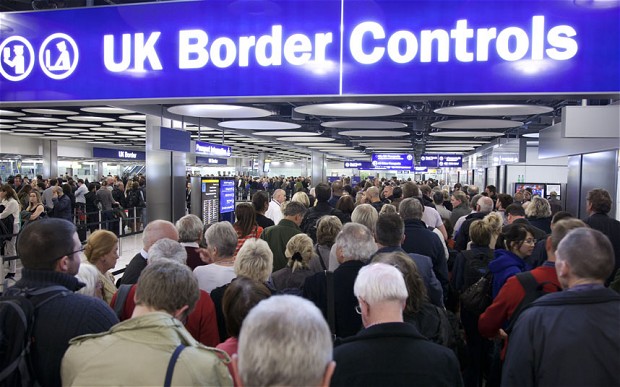
We Can’t Have An Honest Discussion About Immigration Unless We Actually Listen To Each Other

Immigration Debate UKIP Cover Ears Dan Hodges Samuel Hooper SPS


It has become fashionable of late to say that it’s high time  we had a frank, open and honest discussion about immigration.

Never mind that this empty platitude is primarily uttered by the same demagogues who owe their political or media careers to either whipping up excessive fears on the subject, or  sweeping it under the rug while smearing dissenters with the toxic charge of racism; that particular irony, though amusing, is beside the point. Zealots on both sides have come to realise that there is political capital to be made in positioning oneself as the straight-talking voice of reason, and pulling off that particular deception in the eyes of the voters requires going on the record saying how terribly important it is that we talk honestly about immigration.

Even casual followers of the news cycle will notice that the most strident calls for this long-awaited symposium on immigration funnily enough happen to coincide with each advance in the polls made by UKIP, or with every time that Nigel Farage contrives to leave the legacy party leaders looking impotent, or worse still, in active collusion with one another. This has led to accusations of cynicism – they’re only calling for a discussion about immigration now because UKIP are breathing down their necks, comes the predictable refrain. But in fact we have been holding a reasonably thorough and robust conversation about immigration for some time now – or, to be more precise, we have all been talking a lot about the subject. Where we have consistently fallen short, though, is the listening part, without which a truly meaningful conversation can never take place.

Continue reading

Chuka Umunna Is Not The Answer To UKIP, Or Labour’s Leadership Crisis

Chuka Umunna Labour Party Champagne Socialist 2


David Cameron has his fair share of problems, with Nigel Farage’s UKIP nipping at his heels and EU Commission president Jean-Claude Juncker goading him about Britain’s £1.7 billion EU surcharge. Nick Clegg faces a daily battle to fend off irrelevancy and the implosion of his party. But despite their tribulations, I doubt that either man would volunteer to switch places with the hapless Leader of the Opposition, Ed Miliband.

The Spectator sums up Miliband’s woes in their sketch of yesterday’s PMQs:

The Labour leader needed a win today. Badly. His poll ratings have dipped to the same level as Gordon Brown’s in 2010, but at least Brown had the excuse of being in a fag-end administration led by a scowling narcissistic tax-junkie.

Indeed. It’s one thing to have terrible personal ratings when you are an establishment figure associated with a party that has been in power for over a decade, but – wait a second, Ed Miliband was all of those things, and still he was installed as the Labour Party leader. The consolation would be that his personal ratings couldn’t possibly fall much further if he did win power and occupy 10 Downing Street, if only the chances of that happy event were not receding quite so rapidly.

Continue reading

Everyone Is Still Fudging The Truth On Immigration

Britain Immigration EU


The Telegraph’s Morning Briefing email, produced by Stephen Bush, always provides a good summary  of the day’s political highlights, but today one story in particular stands out. Riffing on the old complaint “They come here, they take our jobs”, Bush cites several articles citing a UCL study which point out that EU migrants actually made a net contribution to the British economy when tax contributions and welfare claims are compared, joking “Coming over here, adding £20bn to our GDP…”

Predictably, the newspapers immediately fall into their partisan groupings to spin the news. From the Morning Briefing summary:

“£120bn cost of Labour’s policy on immigration” is our splash. “UK gains £20bn from EU migrants” sayeth the Guardian. “EU migrants add £2obn to the economy in a decade” cheers the Indy.  A study running by two leading migration experts at UCL has thrown further light on the costs and benefits of migration. Migrants from within the EU contribute £20 billion to the British economy, with immigrants from the original 15 EU countries contributing 64% more to the Exchequer than they took out in services and migrants from eastern Europe added 12% more than they took out.

It would be hard to concoct a sample of headlines and statistics that did more to obfuscate and confuse an important political issue, even if you tried. And that’s no criticism of Morning Briefing – it has faithfully published a representative sample of the UK print media’s coverage of an important political issue.

Continue reading