Embracing ‘Compassionate Conservatism’ Will Not Make The Rootless Tories More Popular

The Good Right - compassionate conservatism

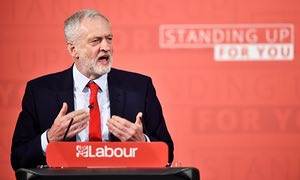
Compassionate conservatism barely won David Cameron a majority government in 2015, even against the hapless Ed Miliband. Rebooting the flawed concept, especially against Jeremy Corbyn’s turbo-charged ultra-compassionate socialism, means fighting the Left on their own terms and is doomed to failure

Despite its complete and utter failure to deliver a solid electoral victory for the conservatives, or to meaningfully detoxify the Conservative Party’s “nasty party” image, the woolly, nebulous and thoroughly unhelpful concept of “compassionate conservatism” refuses to die.

Following Theresa May’s abject failure in the 2017 general election – losing the Conservative Party their majority by failing to counter the appeal of a marauding socialist who actually has principles, stands for them unapologetically and convinces more and more people of their value – all manner of ideologically limp Wet Tories are now coming out of the woodwork to proclaim that the only way for conservatism to survive is to meet Jeremy Corbyn half way.

These appeasers of the Left (I won’t call them pragmatists because that kinder term suggests a kind of nobility and wisdom for which there is very little evidence) seem to sincerely believe that staying in power means accepting vast swathes of the Left’s argument about the welfare state, wealth redistribution and fiscal restraint. They would have the rest of us believe that conservatives face inevitable defeat unless the Tories compete with Labour to be the loudest cheerleaders of the bloated public sector.

Charlie Elphicke, Tory MP for Dover, is only the latest to advance this defeatist theory, writing in Conservative Home:

Step one to victory is to conquer the idea that the Conservatives are on the side of the rich. Every Conservative I know is in politics because we care about the vulnerable and the least well off. At the election, we failed to explain to people how our values offer the best for people and their families.

Conservatism is at its best when we communicate a vision of Britain as a land of opportunity, aspiration and success. A place where anyone, whatever their background, can achieve and succeed. Where they can climb the ladder of life. A country where people can get jobs, a home to call their own and achieve their full potential. Where Government gives people a hand-up, not handouts – and hard work brings rewards.

Our caring conservative tradition is also central to all that we are. This is why we must showcase our values as the party of compassion. The conservatism that seeks to protect people from the worst excesses of the system.

Protecting people, and being the party of compassion, matters every bit as the land of opportunity. This means standing up against rogue landlords, overcharging utility companies, loan sharks, tax dodgers, and unscrupulous employers.

And yet rather than proposing that the Conservatives do what Margaret Thatcher did to the hard left in the 1980s – namely, steamrollering over their socialist squeals, failed dogmas and entrenched special interests to speak directly to the people and sell them an alternative vision of Britain’s future – Charlie Elphicke proposes instead that we prance around humming The Red Flag and hoping to convince enough wavering voters that we are little more than the Labour Party with a brain and a calculator.

Elphicke proposes capitulation to the false leftist narrative that it is in any way “compassionate” to redistribute wealth and income from those who earned it in order to better fund a welfare machine which encourages dependency and helplessness more than self-sufficiency. Elphicke – though he would never say so out loud – effectively accepts the idea that we should give a man a fish, and then another fish, and then another one until the barrel is empty, rather than teaching people to fish for themselves.

Elphicke continues:

I’ve spoken to colleagues from across the country who were asked by people on the doorstep what our manifesto offered for them. They struggled to find positive things to say.

Now I’ve heard people say we didn’t have a “retail offer.” But, you know, we’re not selling soap powder here. We are about caring for people and changing lives. We failed to explain how we would do that – and so people didn’t know.

It’s not difficult to think how we could have done so much more to support traditionally Conservative motorists, aspirant home owners, small business people, and the elderly. Or how we could have reached out to families and younger people with lifelong learning, greater help for carers, and more support to get on the housing ladder.

We should have showcased our record of action, too, because it is pretty incredible. We brought Britain back from the brink. We have delivered record employment, a strong economy, a powerful recovery from Labour’s crash, along with pumping vast amounts of cash into the NHS. Our failure to highlight our record cost us heavily.

Many of these observations are correct, but the conclusion which Elphicke draws from them are depressingly wide of the mark.

Yes, the Tories did an abysmal job of standing up for their record. At a time when the Labour Party manifesto offered an series of calculated bribes catering even to firmly middle class voters, the Tories went to battle with their mindless slogan of “strong and stable”, and a deafening silence when it came to defending their limited efforts at fiscal restraint since 2010.

But Charlie Elphicke’s vision of “caring conservatism” is not the solution. Rather than standing up to the politics of Me Me Me or turning away from the notion of bribing voters with cynical manifesto pledges, Elphicke merely proposes that the Tories start using the same playbook. Even the term “caring conservatism” should raise the hackles of any self-respecting conservative, suggesting as it does the idea of government as an omnipresent, watchful auxiliary parent, charged with wiping our noses and keeping us safe at the expense of our freedom and individuality.

Worse still, to even talk of “compassionate” or “caring” conservatism is to concede that ordinary, vanilla conservatism is somehow cruel or lacking in compassion. It suggests that there is something fundamentally wrong with our worldview and our politics, and that only by being born again and accepting the “compassionate” modifier do we become semi-respectable people with whom it is just about acceptable to associate in public.

This is incredibly counterproductive. Economically speaking, conservatism at its best means government getting out of the way so that people can succeed according to their merits, and providing a limited but dependable safety net for those in real need by not lavishing unnecessary benefits on over half of the population who are arbitrarily declared “vulnerable” and in dubious need of government assistance. The point that conservatives should be screaming from the rafters is that real conservatism would do more for the truly needy, by rolling back a benefits culture which sees as much as 50% of taxpayers becoming net dependants on the state and compensating for that rollback by lowering general taxation and restructuring the welfare state so as to provide something more than grim subsistence for those who need to use it.

You don’t see Labour MPs or activists describing themselves as “sane Labour” or “grown-up Labour”, effectively conceding that the more statist, big-government policies of their party base are somehow insane or childish (even though they are). They own their left-wingery and proclaim it proudly, not apologetically. Centrist Tories or “compassionate conservatives”, meanwhile, come across as ashamed of their own party and apologetic for their own beliefs, and seem determined to tack as closely to Corbyn’s party as possible before the cognitive dissonance becomes too unbearable.

This is a contest that conservatives can never win. In the race to be more paternalistic, more restrictive of behaviour and more redistributive of wealth, the Tories will lose to Labour every day of the week. And with Jeremy Corbyn in charge of the Labour Party it won’t even be close.

Look, I get the superficial appeal of Charlie Elphicke’s proposal. It offers a quick and easy route to staying in power, where rather than having to do the hard work of challenging voter assumptions and telling the electorate difficult but authentic truths, instead we can just act a bit more like the Labour Party and stay in government forever. But it won’t work.

If the 2017 general election taught us anything, it is that an entire generation of young voters have grown up experiencing all of the wealth, liberty and opportunity which Thatcherism helped secure for them before they were even born, but that these same people have been taught to despise the very things – capitalism, free markets, a less activist state – which made our material wealth possible in the first place.

Corbyn’s cohort of young admirers literally share memes on social media using smartphones and personal computers which were only put in reach of ordinary people thanks to the free market they are busy disparaging, and they do so without a shred of irony because throughout their young lives, nobody has dared to forcefully defend Margaret Thatcher’s legacy or to suggest that real “compassion” means more than blindly firehosing taxpayer money at every social problem and expecting positive results.

An entire generation has grown up (and older voters gone over two decades) without really hearing a stirring argument in favour of smaller-government, pro-market policies from any senior politician. Even most Conservative MPs have preferred to talk about mitigating the “damage” done by the market, or as Elphicke puts it, “protect[ing] people from the worst excesses of the system” rather than explaining how “the system” is a good thing, not to mention a hell of a lot better than socialism.

Neither has there been an adequate effort on the part of Conservatives to rebut the Left’s cynical and dishonest attempt to portray every failure of regulation, every act of crony corporatism as a failure of capitalism itself. Here, Charlie Elphicke’s idea of a “rapid rebuttal” unit actually has real merit. Too often we cower and equivocate whenever the Left trot out their Capitalist Bogeyman of the Day – be it Philip Green or “the bankers” – rather than pushing back and explaining that criminal acts or regulatory failure does not discredit the economic system which has delivered more wealth and prosperity to more people than any other in human history.

But all of this needs to be done under the overall aegis of a vision of conservatism as a force which liberates people and sets them free rather than one which coddles them.

Sure, the Conservative Party might eke out another few general election victories (or at least 2017-style non-defeats) by playing up the “caring conservatism” angle and chasing Jeremy Corbyn’s Labour Party ever further to the left. But any such battles won will come at the expense of losing the wider war. If the Conservative Party is to be nothing more than the Labour Party with a modicum more economic sense then really, what’s the point in even bothering? A succession of such Conservative prime ministers, having totally forsaken their own raison d’être, could be in office for years yet never really in power. Theresa May in perpetuity.

The Thatcherite revolution was made possible partly because years of stultifying, socialist post-war consensus led Britain to a crisis point, teetering on the brink of irreversible national decline. In 1979, the Conservative Party took advantage of that crisis to discredit the status quo and present their alternative offering as both beneficial, necessary and inevitable, shifting the Overton Window of British politics firmly to the right. And while there were negative side effects which should not be overlooked or minimised – particularly outside the southeast – the Thatcherite medicine worked.

We are at another such crisis point today, this time brought about through the confluence of Brexit, the unmitigated side-effects of globalisation, an economic recovery which has been intangible for too many people, an over-centralised Westminster government and a terminally unreformed public sector. Labour are already moving to take advantage of this crisis and shift the Overton Window back to the left. And they are succeeding – ideas which were fringe absurdities twenty years ago, like wage councils and the renationalisation of industry, are now stunningly back on the agenda, while the man who promotes them is a few false moves by Theresa May away from 10 Downing Street.

Conservatives cannot afford to squander this opportunity, to allow the current political crisis (or state of flux) to be used by Labour to drag Britain further to the left without even putting up a fight for the small-government, conservative values which once saved this country. And breathing life back into the corpse of compassionate conservatism will only aid the Left in their endeavour. It will be a huge signal to our ideological foes that we accept the premise of their argument (compassion = a bigger state and more redistribution) and only encourage them to expand their demands move further and further to the left themselves.

It is ludicrous that we even find ourselves in this position. Jeremy Corbyn was twenty points down in the opinion polls until Theresa May launched her disastrous and thoroughly un-conservative general election campaign, and now he is within striking distance of 10 Downing Street. Red Conservatism or Blue Labour, a la Nick Timothy and his disciples, doesn’t work. If people want swivel-eyed socialism they’ll pick the real deal over the off-brand equivalent, every single time.

Corbynites believe that conservatives are evil, heartless, amoral “Tory Scum”. We will not suddenly win their friendship, or their respect, by deferring to them on a few specific issues or taking the sharp edge off our message of economic freedom, individual liberty and a smaller, more efficient state. No appeasement is possible or desirable. The only thing to be done is to get out and win the argument in public, to have a million difficult conversations with people who are currently quite sympathetic to the Corbyn worldview because of our shameful failure to adequately preach our own values.

The alternative – if we insist on reanimating the corpse of compassionate conservatism – is to doom ourselves to more centrist malaise at best, and a truly frightening Jeremy Corbyn socialist government at worst.

 

conservatism definition

Top Image: The Spectator

Support Semi-Partisan Politics with a one-time or recurring donation:

Agree with this article? Violently disagree? Scroll down to leave a comment.

Follow Semi-Partisan Politics on TwitterFacebook and Medium.

Are We Finally Witnessing The End Of Bland, Centrist Politics?

Jeremy Corbyn - Glastonbury crowds

Donald Trump, Jeremy Corbyn, Brexit… People want meaning in their lives and a purpose in their politics that dry, centrist managerialism cannot hope to provide

This, by Ted Yarbrough, is very perceptive:

Man does not live by bread alone. Though a religious statement by Jesus from the Gospel of Matthew I think that statement has never been more true- especially seen in geopolitics.

We humans have never been materially wealthier.  Yes, some people still live in abject poverty and many people don’t like that others have more money than them, but by historical standards we should be thanking our lucky stars each day for our blessings. We live longer than ever before and can communicate with people throughout the world at an instant. Yet, as especially seen in politics, many people are angry. Populists are rising on both right and left. Those in positions of power ie “establishment” people in the media, government etc are extremely perplexed. How could, for example, the people not want to send that nasty man Trump a message with some bright young man who checks all the boxes like Jon Ossoff? [referring to the Democrats’ failed attempt to take Georgia’s sixth congressional district in the recent special election]

I think the people shocked by the return of ideology miss one big point about humans. We are not animals, we don’t just like to be fed and wag our tail. We believe in justice, we dream dreams, we are not content because, yes often we are spoiled, but we want to believe in something. We want to be something bigger than ourselves- it’s why humans suffer enormously to go to Mt. Everest and the south pole and the moon- we want to do things because they are great. It is why people are constantly searching for the meaning of life and worshipping God (or gods). We want to change the world because we recognize the imperfections in it. We will not be content.

In politics, that means people are growing sick of “centrists” ie technocrats who don’t inspire the people but expect to govern because they are supposedly the best qualified for the job. Centrists are shocked to see the rise of nationalists and free-marketers and socialists and Islamists, but really they shouldn’t be. Those ideologies offer people something to believe in, a better world to dream of and fight for, rather than a shallow world of pop music, materials possessions and politics made occasionally spicy with some virtue signalling identity politics thrown in. People now, like our ancestors of old, want to battle over ideas. To work towards finding truth.

This blog has been screaming for years now that centrist politics is leading us nowhere good, entrenching privileges for those set up to gain from the current system while doing nothing to help those – particularly those at the sharp end of globalisation – who do not benefit from the post-patriotic, post nation state world that the elites are building without meaningful democratic consent.

But even I did not predict the degree to which the establishment’s insistence on clinging on to their bland, centrist model of governance would lead to disruptions to the political order on the level of Donald Trump, Brexit or Jeremy Corbyn’s takeover of the Labour Party (and nearly the country).

Some of these disruptions are welcome – Brexit is a great achievement, even if many of the benefits end up being lost through abysmal execution by the political class, while Jeremy Corbyn’s Jeckyll and Hyde leadership of the Labour Party reminds us both how ideology can reinvigorate a political movement but also just how far the party has drifted from the interests of working people. And others of these disruptions – cough, Donald Trump – are unwelcome and have almost zero upside.

But more such populist disruptions are almost inevitable until the political class realises that people want more from their politics than a ruling class of bland, superficial technocrats who promise nothing more than the smooth administration of the status quo. Jeremy Corbyn, for all of his faults, at least promises a radical reordering of society – one made all the more appealing by the fact that the Conservatives long ago ceased to make a bold, unapologetic case for free markets, individual freedom and a less suffocating state.

Nearly two years ago, this blog asked where is the Conservative Party’s own Jeremy Corbyn? Where is the small-C conservative version of the politician who dares to proclaim an unrepentantly neo-Thatcherite worldview, instead of pretending (a la Cameron, Osborne, Hammond and May) that “austerity” and fiscal restraint are a sad necessity brought about by recession rather than an innately good thing in and of themselves?

Theresa May led the Conservative Party to near-defeat in the general election this month because she never even attempted to take on Jeremy Corbyn in the battle of ideologies. And while conservatives were never likely to walk away with the lion’s share of the youth vote, shamefully allowing Jeremy Corbyn to be the only one to present the emerging generation of new voters with anything like a positive inspirational message made damn certain that the majority of them voted Labour.

Yarbrough’s conclusion is stark:

With that being said, if the centrist parties do not start treating people as humans who dream dreams, and offer a compelling hope for people, the people of the world will continue to be more polarized and radicalized. And if there is no hope more and more false prophets will emerge to fill the vacuum.

One of my favourite television shows is the twelve-part HBO series “From The Earth To The Moon”, executive produced by Tom Hanks, recounting the complete history of NASA’s Apollo Program which culminated in six manned missions to the surface of the moon. I like it because it represents, to me, a time when humanity stood for more than “reducing inequality”, deifying public services and promising to make the trains run on time. A time when our desire for achievement, like our plans for human spaceflight, aspired to something more than low-earth orbit.

The theme music at the start of each episode begins with JFK’s speech at Rice University in which Kennedy says “We choose to go to the moon in this decade and do the other things, not because they are easy, but because they are hard, because that goal will serve to organize and measure the best of our energies and skills, because that challenge is one that we are willing to accept, one we are unwilling to postpone, and one which we intend to win.”

Of course the 1960s and 70s were tumultuous decades with many of their own very real challenges – the very real threat posed by Soviet Communism, for one, and the ongoing struggle for civil rights. But how much worse would this era have been if there were no unifying objectives around which people could come together?

In our increasingly secular age, religion is no longer a unifying force within nations. Art stepped up briefly as a replacement, but our art and culture has become increasingly debased too. And so people, being spiritual beings, increasingly vest their faith in their political worldview, which has had two principle effects – toxifying our political discourse and making people more susceptible to the “false prophets” of which Yarbrough warns.

Professor David Hillel Gelernter once said in an interview:

The readiest replacement nowadays for lost traditional religion is political ideology. But a citizen with faith in a political position, instead of rational belief, is a potential disaster for democracy. A religious believer can rarely be argued out of his faith in any ordinary conversational give-and-take. His personality is more likely to be wrapped up with his religion than with any mere political program. When a person’s religion is attacked, he’s more likely to take it personally and dislike (or even hate) the attacker than he is in the case of mere political attacks or arguments. Thus, the collapse of traditional religion within important parts of the population is one cause of our increasingly poisoned politics.

We see this all the time in our political discourse. This is the Cult of Social Justice and Identity Politics writ large. This is the result of our ridiculous, overwrought obsession with inequality, even as living standards for nearly everybody continue to improve and we all benefit from technologies and inventions which were unthinkable half a century ago.

And if failed centrism really is leading to “radicalisation” by unscrupulous false prophets (and I don’t much like the use of that word outside of its applicability to terrorism, particularly because the Left is now eagerly using it to smear conservatives on any pretext, suggesting that newspapers like the Sun and Daily Mail are somehow “radicalising” the ignorant white working classes) then it becomes all the more important for our main political parties offer visions of their own which amount to more than technocracy and navel-gazing obsession with public services.

For a long time I thought that people actually liked the politics of Me Me Me, and that our craven politicians were simply responding to public demand with their endless manifesto bribes. But perhaps I was wrong. Though Jeremy Corbyn certainly offered a record-breaking basket of electoral bribes in the Labour Party manifesto, people also seem to have responded to him because of what he represents. In other words, Corbyn’s increasing viability amounts to more than the sum of the various bribes in the 2017 manifesto, even the student loans pledge.

The Conservatives, therefore, cannot afford to leave the ideological field open for Jeremy Corbyn to occupy on his own. The Tories need to do much better than mount their usual snivelling defence of fiscal restraint, couched in the craven acceptance of leftist frames of reference, and actually come up with an alternative vision of Britain worth voting for.

Theresa May isn’t going to do that, and neither are any of the dismal individuals tipped by the Westminster media as being most likely to replace her. So, who will come and save the Conservative Party from themselves, and save the country from Corbynism in the process?


Jeremy Corbyn - Glastonbury stage

Support Semi-Partisan Politics with a one-time or recurring donation:

Agree with this article? Violently disagree? Scroll down to leave a comment.

Follow Semi-Partisan Politics on TwitterFacebook and Medium.

Why Theresa May Needs To Go Now

Theresa May - Tory Leadership -resignation

Every day that Theresa May remains in office is another day that the Conservative Party is idling in neutral, failing to retool and re-energise itself to take on Jeremy Corbyn’s marauding socialists

Tim Montgomerie, writing in the Evening Standard, explains quite comprehensively why there is only downside and no upside to keeping Theresa May in 10 Downing Street a moment longer than it will take the Conservatives to organise a leadership contest to replace her.

Montgomerie writes:

Tory MPs, returning in a shell-shocked daze to Westminster for this week’s low-fat, low-content Queen’s Speech, must quickly recognise that Theresa May is as finished as Mrs Clinton. Every day she remains in charge is a wasted day. Every day the country inches closer to an election for which Jeremy Corbyn will have added more activists to his impressive turnout machine. Equally, the Conservatives will have one less day to rebuild their own offering and operation.

Mrs May’s flat-footed response to the Grenfell Tower tragedy was not just further proof she’s not that good at politics. It was another moment of not rising to the occasion as a leader with vision would do. The horrific burning alive of largely poor and marginalised people was — like 2008’s crash — another reminder of unjustifiable vulnerabilities at the bottom of society and inadequate responsibility from those at the top.

Yes. This blog has noted the number of commentators who leapt to the prime minister’s defence in terms of her out-of-step public response to the horrific Grenfell Tower fire last week. A significant minority seem to have convinced themselves that the prime minister’s excessive reserve terror at the thought of interaction with the public is somehow an admirable thing, the epitome of British stoicism, rather than further dismal evidence of Theresa May’s inability to lead.

These claims dismiss critics of Theresa May as reactionaries who just want to see the prime minister emote for the cameras and hug a few of the survivors, but this dismissive attitude completely misses the point. I don’t think anybody in Britain had any great desire to see the prime minister weeping with the Grenfell Tower victims on the evening news bulletins. They did, however, expect her to show up, even if it was politically awkward, just as American political leaders show solidarity with disaster victims in the United States and French political leaders in the aftermath of terror atrocities in France. This is not an unreasonable, irrational demand. It is Leadership 101, and Theresa May has been failing the test in manifold ways since well before the general election.

Montgomerie continues:

The most fitting memorial to those who perished [in the Grenfell Tower fire] is not to comfort the bereaved as all half-decent societies would. The best way of honouring the dead would be to deliver the scale of house-building that Conservative PMs such as Churchill and Macmillan championed but which an ideologically rigid Thatcherite dogma has since discouraged. For good measure, a government building more homes in the South would also significantly expand infrastructure in the North. The everyday so-called current government spending still needs trimming but leaving the next generation with inadequate roads, railways and broadband is just as irresponsible as leaving them up to their necks in debt.

I’d put believing that Elvis Presley is still alive on equal par with the claim that Mrs May could launch this agenda or something similar. Despite the words she uttered in Downing Street after first becoming PM she has done nothing of consequence for communities suffering most from the multigeddon of globalisation, open borders, automation and the collapse of the working-class family.

Rather than overhauling a threadbare party machine that helped lose a 20 per cent opinion poll lead, she has reappointed her Tory chairman. Those thinking the days of treating her Cabinet with disdain are over should look at her careless loss of two of the Brexit department’s four key ministers last weekend, a week before today’s starting gun for talks.

Also true. While this blog has focused on the need for conservatives to start transmitting a positive, optimistic message and defence of their worldview if they want to stand a chance of competing with the parties of the Left for the youth vote, good messaging alone is not enough. And while acts of pandering and voter bribery – such as matching Labour’s pledge for free university tuition – are rightfully unacceptable to conservatives, it should not be impossible for the Tories to recognise that their current housing policy (or lack thereof) is a punch in the gut to any young person not fortunate enough to inherit from their parents or be helped onto the housing ladder by them. Planning laws need to be urgently reviewed and liberalised. The Left wants to build council houses for all, so that everybody is dependent on the state for one more thing. Conservatives should counter with a bold proposal to expand the supply of private housing for rent and purchase.

Montgomerie is also right to criticise the party machine. CCHQ has presided over the near-total gutting of the party in recent years, from the winding up of the terminally dysfunctional Conservative Future youth movement to the neutering of the constituency associations and the megalomaniacal insistence of central control over candidate selection so as to ensure the continuance of the current system of patronage and nepotism which gave us such wonderful “rising stars” as Ben Gummer. Theresa May is not responsible for the party machine that she inherited when she became prime minister last year, but neither has she shown the slightest interest in revamping the party and opening it up to outside talent. The necessary change will not come so long as she remains leader.

Montgomerie’s conclusion is also strong:

A new PM and a contest necessary to establish who it should be will not be good for the nation’s immediate peace of mind or for business sentiment, but there are no easy options from where we are. What Britain does have is a two- to three-month window before September’s German elections. After that, Brexit negotiations will be fast and furious.

The Tories need a contest thorough enough to identify a team as much as a leader, and an agenda for social renewal as much as for Brexit. With both established, there is a real chance of stopping the momentum building behind Jeremy Corbyn — and it must be stopped. His views on tax, state power and defence would enfeeble this country.

We must not underestimate Corbyn. Voters who yearn for change may well roll the dice if forced to choose between Corbyn and “the same old Tories”. If, after all, people can convince themselves that the moon landings were staged, they may even believe Corbyn is equipped for Britain’s highest office.

There is never a good time to instigate a divisive, ugly leadership election campaign between general elections, but far better that Conservatives bite the bullet now than wait until a year into Brexit negotiations before swapping out the leader of the country. It’s bad enough to have to consider changing horses at the water’s edge of Brexit negotiations; changing horses mid-stream would only undermine the British negotiating position further.

And as Tim Montgomerie rightly says, a leadership contest is needed to identify not just a leader but also a team and a set of values – not just relating to Brexit – around which the party can coalesce and campaign. The 2017 general election campaign was a miserable affair in which Tories – led from the top by Theresa May – refused to make a bold, positive affirmation of free markets or other traditional conservative standards, instead portraying “austerity” and limits on the state as a necessary evil rather than as a potentially good thing in and of themselves.

The Tories were tricked into fighting on Labour’s turf (arguing about inequality) when they should instead have proudly made the case that conservative policies expand the pie for all while Jeremy Corbyn’s focus on equality of outcome promises only more equal slices of a rapidly diminishing national pie. Conservatives essentially went to fight in this general election only to discover that their leader had broken their best ideological weapon in advance of the battle. No wonder they lost ground against Jeremy Corbyn’s uplifting (if loopy and fiscally nonsensical) vision for Britain.

And then there is the elusive, undefinable sense of momentum. Whatever momentum Theresa May had when she took over from David Cameron, she has now squandered it all. Jeremy Corbyn, meanwhile, is on the march. Through her inept leadership and hopelessly prosecuted general election campaign, Theresa May literally gave 1970s style socialism a foothold back in our national politics, and raised the real risk that Corbyn could enter 10 Downing Street as prime minister if her shaky minority government were to fall. Prior to the election her aura of strength and stability was severely knocked by the multiple terror attacks on British soil, some of which exposed failings for which she was directly accountable as Home Secretary.

And now the Grenfell Tower disaster response has revealed the prime minister to be a shrunken, fearful and traumatised figure, clinging on day by day while colleagues openly worry about her mental state of mind. Jeremy Corbyn and Sadiq Khan between them have assumed the role of national Consoler-in-Chief, while Theresa May skulks in Downing Street and only meets with the survivors and bereaved relatives under duress. This might be partly excusable if she had organised a first-class disaster response plan a la Gordon Brown, but she didn’t. Instead there were days of chaos and confusion before Whitehall finally took over the response from Kensington & Chelsea council.

Rightly or wrongly – and the vast majority of criticism directed at Theresa may has been fully justified – the impression is of a prime minister in over her head, unable to regain her political footing and behaving in an entirely reactive way rather than giving the country the proactive leadership that it needs. There is no coming back from such a self-inflicted calamity. There is no PR job that can be done to repair the damage. And if Theresa May is hanging on in some desperate bid to burnish her legacy with a smattering of minor accomplishments before her inevitable removal then she is not only deluding herself but also putting herself before the Conservative Party, and party before the country.

So let’s bring on the contest. Let 48 Tory MPs submit their letters to the 1922 Committee and formally trigger a leadership challenge, forcing the prime minister’s resignation. There is no reason for us to continue to “bear those ills we have / Than fly to others that we know not of”. The undiscover’d country could hardly be any worse.


Theresa May - Downing Street

Support Semi-Partisan Politics with a one-time or recurring donation:

Agree with this article? Violently disagree? Scroll down to leave a comment.

Follow Semi-Partisan Politics on TwitterFacebook and Medium.

British Conservatives And The Youth Vote, Ctd.

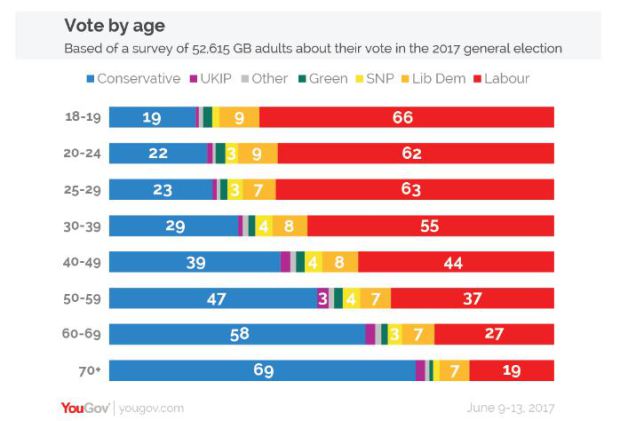
YouGov vote by age chart - general election 2017

Through their arrogance and sheer incompetence, the Tories have turned an entire generation away from conservative politics. But the solution is not to go marching off to the socialist Left

It doesn’t have to be like this.

It doesn’t have to be the case that people under 30 years of age vote so overwhelmingly for the parties of the Left, predominantly the Labour Party, while the Conservatives manage to sweep up barely a fifth of the youth vote.

The Tories have shot themselves in the foot by failing to court the youth vote or even speak to their concerns, the result of unbridled arrogance and sheer political incompetence. But the situation is not irreversible, if the right action is taken quickly. Unfortunately, the Tories – hopeless keepers of the conservative flame – look set to learn all of the wrong lessons.

I discussed this on my election night live blog and then again in this separate piece, but since that time several other commentators have jumped into the fray with their own takes, and it’s worth seeing what they have to say.

Former cabinet minister (sacked by Theresa May in her Weakness Reshuffle) and Harlow MP Robert Halfon won a lot of plaudits before the election for being one of few Tories to understand the need to reach out once more to the aspirational working class, and again after the election for criticising the Tories’ lack of vision going into the campaign.

From the Guardian:

Robert Halfon, who lost his frontbench role as minister for skills on Tuesday, said the Conservative party was “on death row” and had failed to offer a positive vision to voters.

The Harlow MP was scathing about the election campaign in which the prime minister lost her Commons majority, saying the Tories did not have a message to rival Labour’s promise to stand up “for the many not the few”.

Writing in the Sun, he said: “The Conservative party is on death row. Unless we reform our values, our membership offering and our party infrastructure, we face defeat at the next election – and potentially years of opposition.

“If we don’t change it wouldn’t matter if we had Alexander the Great or the Archangel Gabriel as leader. We face the wilderness.”

In an attack aimed at the Tory hierarchy – and campaign guru Sir Lynton Crosby – Halfon said: “Our election campaign portrayed us as a party devoid of values. ‘Strong and stable’ is hardly a battle cry. I cannot remember a time in the campaign when the Conservatives attempted to explain what we are really about: the party of the ladder, of aspiration and of opportunity.

“We let ourselves be perceived primarily as the party of ‘austerity’, failing entirely to campaign on our record of a strong economy or strong employment.

“Virtually nothing was said on the NHS or schools or the caring professions that work within them. Instead we created fear among pensioners, and threatened to take away school meals, handing a gift to our opponents. Is it any wonder that the Conservatives did not get a majority?”

Yes and no. Halfon is absolutely right to criticise the Tory campaign for its lack of a positive vision of any kind, let alone a coherent, recognisably conservative vision. But the specific targets of Halfon’s ire are all wrong. To follow his advice, the Tories should have engaged in a race with the Labour Party to shower praise and money on an unreformed NHS, wittered on endlessly about public services and exacerbated Britain’s corrosive culture of universal benefits, where everyone becomes accustomed to receiving handouts from the state regardless of their wealth or individual circumstances (see free school meals, the winter fuel allowance, child benefit and so on).

At least the Cameron/Osborne government, ideologically woolly as it was, made a token strike against universal benefits culture with their child benefit cap. Robert Halfon now sees support for giving benefits to people who don’t need them as the price of political survival. If this is true then there may as well not be a Conservative Party at all, because the Labour socialists will have won the war.

Here’s Nicholas Mazzei, writing in Conservative Home:

“Yeah I did; he was gonna write off my student loan. Come on!”

These were the words of a 25-year-old voter who text me early this morning, who had always voted Conservative and, up until the campaign began 5 weeks ago, was anti-Corbyn.

If you want to understand why the youth vote surged for Corbyn, I want you to read that line and look at the offer the Conservatives have made to the youth of Britain from our own manifesto. From this 25-year old’s own words, “the Conservatives have done nothing to reach out to those under-35”.

Now while most us would agree that the promises of wiping out debts and free university education by Labour were dangerous, unaffordable policies, we need to remember that the youth of the UK have been lumped with endless debts, rising costs in homes and education, and lower potential of earnings.

Much like in the US election, where voters turned out for Trump’s pro-employment message, youth voters in the UK turned out for a party which actually addressed their concerns.

Again, the problem is accurately diagnosed. The suite of Conservative Party policies, such as they were, did very little to even acknowledge the concerns of young people in a cosmetic way, let alone meaningfully address them. The Tories had no plan to encourage the building of sufficient houses to tackle the housing crisis because the status quo works just fine for their older core vote, thankyouverymuch. They remain obstinately committed to the most stubbornly self-harming form of Brexit possible, for absolutely no good reason, when most young people are sceptical of Brexit altogether.

And as icing on the cake, Theresa May and her lacklustre team preached a parsimonious message of fiscal restraint as a regrettable necessity – willingly accepting Labour’s framing of the economic debate! – rather than even attempting to sing the virtues of freedom, liberty and a smaller state dedicated to helping people in real need rather than a large state parcelling out insufficient morsels of assistance to everybody regardless of need.

Theresa May’s team seemingly forgot that people don’t become more conservative as they get older automatically or without some prompting, and that if the Tories continually screw somebody over through their formative years, young adulthood and early middle age then they won’t magically become Tory voters when they get their first grey hair. People become more conservative as they get older because historically, sensible government policy has allowed them to become greater and greater stakeholders in society, largely through property and equity ownership. Cut off millions of young people from this ladder to prosperity and security, and the conveyor belt which gradually moves people from political Left to Right as they age will come grinding to a halt. We see this in the YouGov poll. where the Tories now only overtake Labour among those aged over 50.

But while Mazzei effectively diagnoses the problem, his solutions also seem to involve lurching to the Left:

The UK has the highest average tuition fees in the world, second only to the USA (which is at around £5300 a year compared to £6,000 in the UK). We cannot lump all this debt on to young people. Education in general needs more investment and should be protected at all costs.

No. Why should somebody without a university degree subsidise the education (and future higher earning potential) of somebody who wants a free degree? While tuition fees at some American schools are horrendously expensive and poor value for money, UK fees are much cheaper, to the extent that they still often do not even cover the full cost of tuition. They are by no means outrageous, and those unwilling to make the investment in themselves are under no obligation to attend university. If anything, the presence of tuition fees clamps down on the number of pointless degrees in non-subjects being taken by students. Lower or remove tuition fees and we will likely see an explosion in gender studies and other pointless social justice-related pseudo-courses.

The unnamed government minister who spoke scathingly to the Telegraph about the Tory election campaign hits closer to the truth:

The Conservative Party has become “too shallow” and needs a “re-invigoration of political thought” that can draw young people to the party, a minister has said.

The MP warned that the Tory election campaign had relied on “poxy little slogans” to attract the youth vote and failed to counter Jeremy Corbyn’s offer of “free money” in the form of state-funded university tuition and other hand-outs.

The minister told The Telegraph: “You’ve got to persuade a new generation of people of what’s what. We never even tried, so Corbyn just came in and basically bribed people to vote for him with other people’s money that doesn’t even exist.”

[..] The minister said: “It’s all about political education and argument. The problem with the whole campaign is that it was about politics and politicians. “Everything is too shallow. Politicians have all got their experience but they lose if they forget to re-educate a new generation. You’ve got to persuade a new generation of people of what’s what.

“This is about political persuasion and think tanks and all that stuff.”

Another MP said the party had failed to properly engage younger votes on social media, where many users were instead targeted with videos attacking Mr Corbyn.

“Frankly the party has done very, very little to engage with young people,” he said. “We have made no real effort to garner support, even on social media, which is where everybody gets their news and views these days.

Yes, a thousand times yes. The case for conservatism has to keep being made for each new generation. The very presence of Jeremy Corbyn as the leader of the Labour Party should have been a huge wake-up call to the Tories that defunct, failed ideologies do not simply slink away to die once they are exposed and defeated.

Margaret Thatcher’s government may have rescued Britain from 1970s decline, but this was before the living memory of half the electorate. Two generations have come since the Winter of Discontent, with many in the millennial generation probably unable to even explain what it was, or how the failed socialist post-war consensus brought Britain to the brink of irreversible decline.

Thus we now have a generation of young people who take relative material abundance, peace and security for granted rather than appreciating that capitalism is the source of our prosperity, not a drain on it. A pampered generation who simply don’t realise that British and Western values need to be cherished and defended (as the Second World War and Cold War taught older generations).

Ross Clark makes the same point in The Spectator:

The under 35s have never been exposed to the negative images of socialism that were familiar to older generations. Growing up in the 1970s and 1980s, to my age group socialism was inescapably associated with the failures of the Soviet bloc: it conjured images of queuing half a day for a cabbage, putting your name down on a long waiting list for the prize of a choking, belching Trabant – and of getting shot if you tried to escape. To my generation, capitalism was synonymous with freedom. But I am not sure that holds for a generation who see only large, tax-dodging corporations and bankers who wrecked the economy yet carried on skimming off vast bonuses.

Neither, when reading of Jeremy Corbyn’s renationalisation plans, do the under-35s have memories of nationalised industries in Britain in the 1970s. They don’t recall the three day week, the Winter of Discontent, dirty, late trains, or realise that the chaos on Southern Railway was once symptomatic of labour relations in huge swaths of nationalised industry. All they see are over-priced trains run by private companies which have ruthlessly exploited the private monopolies which they were granted in this, the most botched of the privatisations.

The Corbynite Left (and even Labour centrists) have been incredibly adept at presenting what are really regulatory failures or corrupt crony corporatism as failures of capitalism itself, which – as shown by the willingness of young people to vote for politicians like Bernie Sanders, Jean-Luc Melenchon and Jeremy Corbyn – has led many young people to demand that we throw the baby out with the bathwater. They sit and angrily Tweet about the evils of capitalism using handheld computing devices that only capitalism made possible, and nobody in British conservative politics seemingly has the balls to point out the absurdity to them.

The anonymous government minister is absolutely right to point out that Conservatives have an existential duty to “persuade a new generation of people of what’s what”, that showering public services with endless money and taking back state control of industry would have already happened if repeated lessons from history did not show that this approach simply never works.

The minister is right too when he says “this is about political persuasion and think tanks and all that stuff”. Yes it is. But you won’t reach young people with think tanks and white papers, and it is becoming increasingly obvious that the toxic Tory brand will not persuade them of the merits of conservatism either. That’s why we need strong new independent grassroots organisations to emerge, to promote the idea of freedom, self-sufficiency and a smaller, better-targeted state as an inherently good thing in and of itself, rather than a regretful response to recession.

As I wrote the other day:

For reasons of branding and basic administrative competence, any future small-C conservative movement hoping to gain traction with young people must be distinct from the Conservative Party, free of that residual toxicity and free to criticise the Tory party in government and in opposition when it proposes policies which either betray core values or threaten the interests of young people. A British CPAC and Young Brits for Liberty-style organisation could nurture talent of its own, outside the corrupting, nepotistic influence of the Conservative Party hierarchy, and would greatly increase their collective clout by helping or withholding support from future Tory election campaigns and individual candidacies based on policy, not party loyalty.

It is only through outside groups like this that the image of conservatism stands a chance of being rehabilitated among young people. It is only through a British version of CPAC or YAF that young conservative or agnostic students at university stand a chance against being steamrollered by the fashionable left-wing identity politics which are almost de rigeur for social acceptance and advancement.

[..] We need a strong external repository for conservative principle, capable of engaging with young people who have been continually taught that leftist progressivism = forward-thinking “compassion” while liberty, independence and self-sufficiency from government are evidence of greed and moral failure.

We particularly need to work closely with conservative organisations in the United States, which face a similar uphill struggle in overcoming a historic disinterest in the youth vote but which are now starting to have some success, generated in part by their opposition to the illiberal Cult of Social Justice and Identity Politics sweeping American university campuses, with its disregard for freedom of speech and toxic obsession with the politics of victimhood.

We should be sharing best practice back and forth with American conservative organisations as to how to build strong redoubts for conservatism in overwhelmingly leftist places, so that conservatism isn’t washed away altogether. Frankly, British conservatism is in such a parlous state that we need their help. And then, once things have stabilised, we can look to reclaim some of the ground we have lost among young voters.

Skot Covert, Co-Chairman of the College Republican National Committee in the United States, offered this advice for a young conservative revival in the United States:

Due to an extended absence on the right’s part, winning the youth vote won’t be easy and it certainly won’t happen overnight.  However, when the GOP communicates our policy positions in culturally relevant terms in the right mediums, we see progress.  This means understanding how and where young voters communicate and having a discussion on the issues most important to them.

I believe it’s also critical to understand that there is no one-size-fits-all approach to winning young voters.  My generation is diverse and vibrant.  We thrive on uniqueness and self-definition and instinctively reject the notion that we should “go with the flow”.  Crafting an effective youth outreach strategy must be developed around this understanding.

This is certainly true. People crave authenticity in a politician – somebody willing to speak extemporaneously and answer straight questions honestly without first running them through a focus group or a Comms Team. Young people especially, it seems, like an optimistic, forward-looking message rather than lashings of grim tidings delivered by a malfunctioning, cautious android like Theresa May. Who knew? That’s why young people preferred socialist firebrand Bernie Sanders to calculating, establishment Hillary Clinton. That’s why Americans elected Donald Trump as their next president.

But there is no reason why these qualities of openness and relatability cannot be vested in a politician who doesn’t hail from the hard left or the populist pseudo-right. There is no reason why a liberty-minded Conservative MP could not similarly enthuse young people with a message of individual liberty, economic freedom and the advantages (rather than the costs) of restraining the state.

Anoosh Chakelian explains in the New Statesman just how Jeremy Corbyn and Corbyn-supporting outside groups used this quality of authenticity to their advantage:

Jeremy Corbyn’s campaign focused heavily on young people – a key manifesto pledge being to scrap tuition fees. His campaign style – rallies across the country, and fewer stage-managed speeches and press conferences than Theresa May – also appealed more to this demographic.

In addition, Labour had viral news on its side. As BuzzFeed reported, pro-Corbyn articles by “alt-left” sites were shared on an enormous scale on social media. I hear that nearly 25 per cent of UK Facebook users watched a Momentum video on the website in the penultimate week of campaigning. This is a particularly effective way of reaching young people, and inspiring them to vote – something the Tories weren’t as good at.

But who in the current Conservative Party hierarchy is remotely equipped for this task? Boris Johnson is probably the most charismatic of the senior Tories, but even he could never pack a large 2000-seat theatre for a political rally the way that Jeremy Corbyn can. And of course Boris Johnson is something of a charlatan, with sky-high negative ratings and absolutely no fixed political compass.

The cold hard truth is that the Tories don’t have anybody who can match Jeremy Corbyn for charisma right now – and how depressing that is. The best we can hope for is to give some of the better backbenchers (I keep banging on about Kwasi Kwarteng and James Cleverly) some ministerial experience to groom them for a few years down the road, but rather than looking to the future, Theresa May seems to have decided to keep her cabinet stuffed full of bland non-entities with her latest reshuffle. In her infinite wisdom.

That’s why we cannot rely on the Conservative Party to save conservatism from itself. The Tory party is corrupt, inbred, nepotistic, dysfunctional and ideologically bankrupt. Right now they are seriously considering skipping after Jeremy Corbyn on a fun political jaunt even further to the hard Left. Yes, somehow the Tories squandered the opportunity to use Corbyn’s rise to move the Overton Window of British politics further to the right, and instead are doing all they can to help him shift it to the left. These people are incompetent clowns who cannot be trusted to walk with scissors, let alone safeguard the ideology and worldview which we depend on to keep us prosperous and free.

We need outside groups to pick up the burden so shamefully dropped by Theresa May and her dysfunctional party. Student organisations, business organisations, bloggers, the works. The Tory Party as it currently stands will never persuade any more young people to vote Conservative. We need outside organisations with legitimacy and untainted reputations to make the positive case for conservative, pro-market values, and then pressure the Tories to hold the line rather than fight every battle on Labour’s terms.

I repeat: do not look to the Conservative Party to successfully engineer an improvement in the youth vote. The Tories are not going to make things any easier for themselves when it comes to youth outreach, and given the level of competence exhibited by CCHQ they have the potential to make things a whole lot worse.

We few young small-C conservatives need to pick up the slack ourselves.


Jeremy Corbyn - youth vote - t shirt

Support Semi-Partisan Politics with a one-time or recurring donation:

Agree with this article? Violently disagree? Scroll down to leave a comment.

Follow Semi-Partisan Politics on TwitterFacebook and Medium.

Labour Centrists Bend The Knee To Jeremy Corbyn, Once Again

Yvette Cooper

No courage, no backbone, no vision of their own

Telegraph sketchwriter Michael Deacon reports on the rapturous reception given to Jeremy Corbyn by the Parliamentary Labour Party when he entered the Commons yesterday:

Labour MPs cheered Jeremy Corbyn.

Genuinely. They really did. And when I say Labour MPs, I don’t just mean John McDonnell, Diane Abbott and the other members of his little band of loyalists. I mean all of them. As Mr Corbyn entered the Commons for the first time since the election, his MPs rose as one and awarded their leader a delirious standing ovation. Yes, the same MPs – well, apart from the 47 new ones – who not so long ago sat in scowling silence while Mr Corbyn floundered at PMQs, and voted by four to one that he must stand down.

On and on they clapped and whooped. Beaming from ear to ear, like a Wimbledon champion greeting his adoring public, Mr Corbyn waved, shook hands, did the thumbs-up, and basked in the acclaim. On the opposite side of the House, Tory MPs – including Theresa May – stared glumly.

What a sight it was. If this is how Labour celebrate losing an election, imagine what they’d do if they actually won.

Well, well, well.

It’s almost as though I wrote something warning about the spineless Labour centrists and their yawning lack of principle a year ago, after Jeremy Corbyn saw off their pathetic, ineptly executed leadership challenge. Oh wait, I did. Twice.

And just as they did when Corbyn vanquished the hapless Owen Smith, now the Labour centrists are prostrating themselves at their leader’s feet because his big government manifesto managed to bribe sufficient voters to win Labour a handful of additional seats, if not the general election. They are jostling for position, eager to worm their way back into the the Shadow Cabinet – which many of them previously deserted or refused to join, in an effort to destabilise Corbyn – because they taste the tantalising prospect of toppling Theresa May’s government, forcing another election and creeping across the finish line as part of some “progressive alliance”.

Yvette Cooper, Chuka Umunna, Owen Smith – all of the usual suspects quickly dropped their plans to revolt against Jeremy Corbyn after what they anticipated to be an electoral wipeout, and instead took to the airwaves to praise their leader and lay the groundwork for what they clearly hope is a return to power and prominence.

Jeremy Corbyn’s hard left worldview will destroy the Labour Party, we were once told. But more than that, his policies are wrong! So said the sanctimonious Labour centrists, despite failing to clearly articulate their own centrist vision for Britain or clearly explain which parts of the Thatcherite revolution they want to keep, which ones they want to reject and which ones they simply want to pretend to oppose in order to project the right image to their base. And now they come crawling back, ready and eager to serve, all previous ideological and moral objections to Corbyn having been conveniently compartmentalised and forgotten.

The Labour centrists have no courage and no backbone. This is Jeremy Corbyn’s party now, not theirs. Labour’s 40% vote share was driven by Corbyn, not by any of the B-lister centrists who can barely inspire their own family members to the polls. If the centrists meant what they said when they wept at Jeremy Corbyn’s election as leader, resigned from his Shadow Cabinet in a huff or explicitly repudiated his leadership on the campaign doorstep, they would break away and found a new party of the centre-left. But they won’t. The prospect of power – even hard left power which not so long ago they found utterly objectionable – is simply too alluring.

This blog will make time to hear a multiplicity of political perspectives, but I have no time for people who cannot manage basic ideological consistency. And I have no time for oleaginous political swamp creatures who stab their leader in the back one day only to lay garlands of flowers at his feet the next.

Such degeneracy can be rivalled only by the rootless Conservative Party, who seem to have concluded – God help us – that the best way to bounce back from Theresa May’s disastrous election campaign is to race the Labour Party in a sprint to the political Left.


UPDATE – 14 June

Lobbyist and former Labour MP Tom Harris concurs with my assessment, and lays into the Labour centrists – particularly the so-called “big beasts”:

They were the epitome of principled opposition to a philosophy that, although alien to Labour Party traditions, was, for the time being, in control of it. They would not overtly oppose Corbyn (out of respect for his mandate, naturally), but neither would they be complicit.

Until now. Because it turns out – and who could possibly have predicted this? – that their “opposition” was not founded on principle at all. At least, not the principle we all thought.

Jeremy Corbyn stood in silence to honour IRA terrorists. He said that the homophobic, misogynist, anti-Semitic terrorists of Hamas, when they weren’t chucking trade unionists off the top of tall buildings in Gaza, were “dedicated towards… bringing about peace and social justice.”

He called for Nato to be disbanded. But it turns out that the “big beasts” had no problem with any of this, oh no – shame on you for thinking that!

Their only concern – and, to be fair, it was one that was shared by many of us – was that Corbyn just wouldn’t have an electoral appeal that would be great enough to warrant their participation on his front bench.

These are important people, after all, whose time is more precious than everyone else’s – they can’t be expected to spend their days asking parliamentary questions and leading opposition debates unless there’s the serious prospect of ministerial office at the end of it.

And now there is. After last week, there is the every chance that Jeremy Corbyn will be Prime Minister of this country, conceivably by the end of the year.

Before that earth-shattering exit poll was published at 10.00 pm last Thursday, at least a couple of those “big beasts” had already sought the support of their colleagues in anticipation of a return to the front bench, not as Shadow something or other, but as Leader of the Opposition. Labour’s 40 per cent of the vote changed all that.

Now, those of us with less political abilities and intellect than the “big beasts” might take a cautious step backwards at this point. In our naïveté we might fear that extremists who prove themselves popular are even more dangerous than extremists who are unpopular. But we would be wrong to think so.

With the sudden realisation that, contrary to expectation and logic, there are no votes to be lost in anti-Semitism or in friendship towards terrorists, the “big beasts” have made it clear that they are willing, after all, to get with the programme.

Some sore losers might harbour the hope that Corbyn will tell them to sod off and that he’s doing just fine without them, thank you very much.

But whether they return to their (as they see it) rightful place at the heart of Labour’s front bench, or whether they continue to sulk (with principle, of course) on the back benches, the term “big beast” will always be preceded by the descriptive “so called”, and will always be used with inverted commas, in order to indicate irony.

Principle has no place in British politics anymore, at least as far as the political/media elite are concerned. Pragmatism is king. And if your route back to power and influence means executing a deft 180-degree turn on supposedly inviolable principles, so be it. This is the rotten core of the Labour Party’s centrist wing.


Jeremy Corbyn speech

Support Semi-Partisan Politics with a one-time or recurring donation:

Agree with this article? Violently disagree? Scroll down to leave a comment.

Follow Semi-Partisan Politics on TwitterFacebook and Medium.