Hysterical Remainiacs are now warning that Brexit will endanger the lives of the nation’s pets and farm animals
For the past four months, the British people have been subjected to some ridiculously childish hissy fits and the incessant catastrophisation of Brexit by self-regarding EU apologists in the media. But this latest tantrum by Ian Dunt, editor of politics.co.uk, is on another level.
Ian Dunt already has great form in portraying the slightest move to limit the growth of the state or safeguard national sovereignty as being part of a plot by the Evil Tor-ees to kill the poor and chuck out every last foreigner, but his increasingly bitter and alarmist Brexit coverage is starting to make him look particularly ridiculous. Because Dunt is now claiming that among the many other evils of Brexit, spurning the EU and demanding self-government will also put “people and animals at risk”.
Yes. Going ahead with Brexit means that kittens will die.
Look at any part of British society and you’ll see the damage Brexit is doing.
Take veterinary services. Yesterday afternoon, the Royal College of Veterinary Surgeons (RCVS) and the British Veterinary Association (BVA) wrote a letter to the prime minister. These are not radical organisations. They never really put out political statements of this sort. They stay in the background, concerning themselves mostly with relatively dry questions of policy detail. But they’ve been forced to issue a warning that Brexit – and Theresa May’s descent into anti-foreigner rhetoric – are putting people and animals at risk.
“Anti-foreigner”? Really? One can argue endlessly about the economic merits of Theresa May’s seeming determination to reduce net migration, but I challenge Ian Dunt to produce one example where the prime minister has actively sought to whip up anti-foreigner feeling in the population.
Wanting controls on immigration is not an extremist or unpalatable political viewpoint – many countries in the world (like Australia and the United States) don’t automatically accept anybody from their region or continent who wants to live and work. And at some point the British Left are going to have to take their collective finger off the nuclear button and stop screeching “racism” at anybody who dares to suggest that government should have control of who is allowed to come and settle in the country.
Regardless, Dunt continues:
Around half the veterinary surgeons registering to practise in the UK each year are from overseas – mostly the EU. Europeans are particularly prevalent in public health roles like the Government Veterinary Services. In the meat hygiene sector, some estimates put the number of veterinary surgeons who graduate overseas at 95%. And these people – the people who look after our pets, who check our food – are feeling increasingly uncomfortable in this country.
And this supposedly matters because:
The veterinary profession doesn’t just look after pets. It monitors and controls the spread of disease and assures the quality of the food we eat. If it goes into decline, the animals we love and share our homes with are in more danger. But there is also a very significant public health risk to go alongside the emotional one.
[..] while anti-immigrant newspapers and politicians whinged, immigrants were there: Treating your cat. Picking your fruit. Treating your condition. They are crucial to the running of this country and unless we start recognising that, it’ll be this country which suffers the consequences of their absence.
[..] The policy implications of Brexit are even more serious. In the future, the two organisations warn, “changes to the mutual recognition system or immigration restrictions could have a profound impact upon the veterinary workforce”. That means Britain may face a shortage of vets as it loses half its annual intake. It means a potentially catastrophic impact on TB testing and meat hygiene. It means abattoirs may be unable to export their products because the UK veterinary requirements are not recognised by European authorities.
So in other words, wanting to leave a deeply unpopular and dysfunctional continental supranational government is so terrible that it will kill our pets, causing us immense emotional harm, and also ensure that agricultural and food safety standards immediately fall off a cliff, leading to the immediate return of BSE and foot and mouth disease. Our democracy is hostage to the presumed fortunes of our household pets.
See? We warned you! Why didn’t you listen! Now Fluffy the Kitten is going to die, and it’s all your fault, you ignorant, hateful, xenophobic Brexiteer!
Will these histrionics from bitter, intellectually bankrupt Remainers never end?
The one valid point in this screaming tantrum of an article is that changes to (or severance of) the mutual recognition agreements governing veterinary standards or food safety – much of the latter of which actually falls under the purview of Codex Alimentarius – could cause real disruptions to trade. Too much of the political debate over Brexit has focused on buccaneering assumptions by government ministers and journalists that the avoidance of tariffs is the sole issue, when this is not at all true. The potential erection of non-tariff trade barriers by failing to extend mutual recognition of standards would have immensely more impact on British industry in terms of cost and complexity of doing business, and it is this which politicians need to wrap their heads around.
Dunt (inadvertently) raises an important issue here, and a timely warning. But his incessant, hysterical scaremongering (and pretence that there are no solutions or workarounds to the practical issue he flags) overshadows his argument. This is the polar opposite of constructive criticism – it is the kind of sulky fault-picking more worthy of a toddler than a grown man with a political website.
And yet I am coming to suspect that this is how it will always be. Never expecting victory in the EU referendum, I naturally didn’t devote much time to thinking about what it would actually feel like to be on the winning side, to finally overturn the 40-year pro-EU consensus. Now I’m starting to get an idea. And it is not pleasant.
Brexiteers had better get used to endless “won’t somebody please think of the kittens?!” caterwauling from aggrieved pro-Europeans, because it will probably last the rest of our lives. Even if Brexit ushers in the kind of democratic renewal that some of us hoped for – and even if we achieve secession from the EU on the most favourable terms possible – they will still criticise us and act as though we have ushered in an unprecedented calamity. And in the absence of counterfactuals, who can disprove Ian Dunt when in five years he whines that we would be enjoying hover cars and 200 year lifespans if only we had done the sensible thing, listened to him and voted to remain in the EU?
Brexiteers should settle in for the long haul. Yesterday it was Marmite, today it’s kittens and tomorrow it will be something else. And why? All because Ian Dunt and other pro-European can’t just bring themselves to say “I hate patriotism, I’m ashamed of my country, I feel more European than British and more than anything I hate the 52 percent of my fellow citizens for defying my will and causing me not to get my own way for once in my life”?
Maybe therapy would help some of the Remainiacs-in-denial towards a necessary moment of catharsis. One can only hope so. Their endless hysterics and catastrophisation of Brexit makes them look far more stupid than it makes Brexit seem reckless.
While advocating a “soft Brexit” as their fallback position, Remainers contradict themselves and expose the tawdry lies they told during the EU referendum
Even Open Britain, the shrivelled husk of Will Straw’s failed Remain campaign group Britain Stronger in Europe, has now effectively admitted that leaving the European Union need not be intrinsically economically harmful – thus undermining the central pillar of their case for staying in the EU.
The harsh light which Remainers are now knowingly shining on their prior scaremongering and lies is quite hilarious. By drawing a distinction between “hard” and “soft” Brexit and campaigning fervently for continued membership of the EEA, campaigners are effectively admitting that their many economic apocalypse warnings applied only to leaving the single market, and not the EU’s political union.
From an Open Britain campaign email sent to supporters yesterday:
Open Britain is campaigning for Britain to stay in the Single Market, which brings increased investment, trade, jobs and growth.
It seems the public agree. A new poll we commissioned has found that 59% of voters want the UK to stay in the Single Market, so there is no mandate for a destructive Brexit.
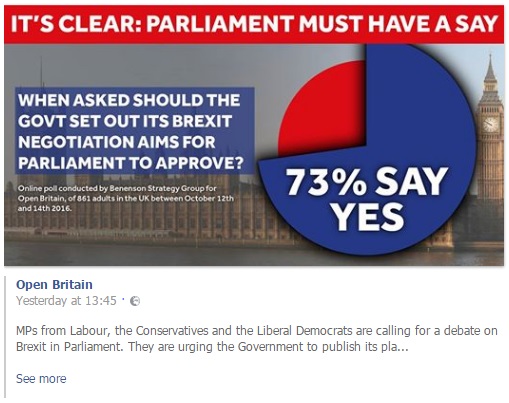
Now, MPs from Labour, the Conservatives and the Liberal Democrats are calling for a debate in Parliament. They are urging the Government to publish its plan for the forthcoming EU negotiations and to allow Parliament to approve it. A huge majority – 73% of people – support this.
Our future partnership with the EU should be not decided in secret but determined by democratic debate.
There is “no mandate for a destructive Brexit,” we are told. Well, that’s funny. Because not long ago, every Remainer in town – most certainly including Britain Stronger in Europe – was screeching about the automatic ruin which would befall Britain if we voted to leave the EU, regardless of how the Brexit process played out or whatever our eventual new trading and political relationship with the EU happened to be. For months we were told by sanctimonious Remainers that “destructive Brexit” was the only kind of Brexit available – yet now they acknowledge a benign version of Brexit and encourage us to adopt it.
Fast-forward four months and suddenly the story changes. Now, apparently, we need to fight tooth and nail to preserve our membership of and unimpeded access to the single market, because this is the lynchpin on which Britain’s economy rests. In other words, their entire economic scaremongering case was a giant lie.
Oh sure, they’ll come back and claim that most Brexiteers supposedly want a “hard Brexit” and that the major Leave campaigns envisioned Britain leaving the single market, which is why they felt justified in equating the European Union with the single market in their own campaign rhetoric. But this is the mealy-mouthed defence of someone who has been caught in a blatant lie. Remainers were desperate to bury the awkward fact that the EU and single market are not one and the same thing, and the fact that they did all they could to fudge the distinction (heck, they suggested that leaving the EU meant severing ourselves from the continent of Europe) shows that they were more obsessed with economic scaremongering than truth. It is Remainers, not Brexiteers, who dwell in a land of post-factual politics.
Funny. It’s almost as though [Remainers] are suggesting that leaving the EU needn’t necessarily mean “plung[ing] the UK into a period of recession and international decline”, and that Britain’s economic and diplomatic health is actually contingent on the kind of choices that Britain makes once we are free of the supranational political union.
Claiming that a mismanaged, uncontrolled or “hard” Brexit might cause serious economic harm is a perfectly respectable position. More than that, it is basic common sense. But that isn’t the argument that Remainers were making during the EU referendum campaign. No, they were claiming that any form of Brexit would be disastrous, that Britain leaving the European Union would be economically calamitous in and of itself, regardless of how Brexit unfolded or the model of our future trading relationship with the EU.
As it happens, this blog agrees with Open Britain’s revised position. Certainly as an interim measure Britain should remain in the EEA while working toward a longer-term solution which hopefully replaces the single market with a new framework which is more democratic and not part of a protectionist, beady-eyed, euro-federalist master plan. Given that the most skilled trade negotiators in the world (in which Britain is singularly lacking, despite generous help from our Commonwealth friends) take a decade or more to thrash out comprehensive bilateral agreements it is the height of idiocy to assume that a Brexit-inspired sense of urgency and the concerns of “German car makers” will get the job done in the initial two short years set out in Article 50 of the Lisbon Treaty.
But why couldn’t the Remainers just be honest from the beginning, level with the British people and tell them that it is Britain’s uninterrupted EEA access, not our membership of the supranational political union, on which our economic stability depends?
The answer, of course, is that for top Remainers the EU referendum was never about economics. It was about their craven desire to live in an amorphous internationalist blob where the nation state is fatally undermined and the strongest level of government and identity reforms at the European level. That’s what they wanted but couldn’t say in public. And so instead they falsely equated the EU with the single market in an attempt to scare low information voters and assorted unthinking lefties that voting for Brexit inherently meant economic doom.
Now that the decision to leave the EU has been made, these disingenuous people are having to regroup and come up with a new argument – that it is our future relationship with the single market, not the EU, which will have the greatest potential impact on our economy and future prosperity. And just as even a stopped clock tells the correct time twice a day, this time they happen to be correct.
Unfortunately, changing arguments mid-stream also reveals that nearly everything that the Remain campaign said prior to the EU referendum was a deliberate, filthy lie.
–
Support Semi-Partisan Politics with a one-time or recurring donation:
–
Agree with this article? Violently disagree? Scroll down to leave a comment.
By arguing that the British people “didn’t vote for recession” as part of their advocacy for soft Brexit, Remainers inadvertently reveal that there is nothing intrinsically economically damaging about leaving the EU’s political union. Whoops.
With the post-EU referendum debate having moved on from the establishment’s sheer incomprehension of the result to an arbitrary and rather redundant battle over whether the British people voted for “hard” or “soft” Brexit (answer: read the bloody ballot paper), a curious chink in Remainer logic has been exposed.
The first point to understand is that this is almost certainly the high water mark for her government. With Brexit negotiations not yet even underway, May is able to dismiss all questions about what exit from the EU will actually look like as being unpatriotic attempts to ignore the will of the British people.
As she told Corbyn repeatedly today: “Unlike the right honourable gentleman we think that we should deliver on what the people want.”
But while this approach may chime with the kind of attacks on ‘Remoaners’ we saw on the front page of today’s Daily Mail, it is a trick that can only be deployed for a limited amount of time. Yes the British people did vote to leave the EU, but they certainly did not vote to plunge the UK into a period of recession and international decline. And as the continuing collapse of sterling has shown this week, the sharks are already circling the UK economy. And pretty soon the prime minister is going to have to find a serviceable life raft.
My emphasis in bold.
Slavishly europhile politicians like Labour MP David Lammy are also now taking up the same “nobody voted for recession” refrain:
Businesses worried that the three Brexiteers are dragging us towards a hard Brexit and exiting the single market. No one voted for recession pic.twitter.com/0Pzb0rSJUw
Funny. It’s almost as though Bienkov and Lammy are suggesting that leaving the EU needn’t necessarily mean “plung[ing] the UK into a period of recession and international decline”, and that Britain’s economic and diplomatic health is actually contingent on the kind of choices that Britain makes once we are free of the supranational political union.
Claiming that a mismanaged, uncontrolled or “hard” Brexit might cause serious economic harm is a perfectly respectable position. More than that, it is basic common sense. But that isn’t the argument that Remainers were making during the EU referendum campaign. No, they were claiming that any form of Brexit would be disastrous, that Britain leaving the European Union would be economically calamitous in and of itself, regardless of how Brexit unfolded or the model of our future trading relationship with the EU.
Remain’s strongest arguments in this campaign are its warnings that Brexit would cause an economic shock that could cost jobs, increase prices and even push the UK into recession. These are warnings which have been endorsed by an overwhelming majority of economists, politicians, trade unions and international organisations.
One could chalk all of this up to normal political posturing were it not for the fact that Remainers are currently engaged in an insidious exercise to place themselves on the side of truth and reason while casting Brexiteers as bigoted and stupid enemies of truth and deniers of what should be indisputable facts.
But with the British public apparently so resistant to facts and the people whose job it is to deal in those facts so mistrusted, there does not seem to be overwhelming cause for optimism.
Even if Remain do somehow scrape a narrow win on Thursday, there should be little cause for joy on the left. Whatever the result next week, this referendum campaign should strike real terror into the hearts of all those on the progressive side of British politics.
If the UK does indeed vote for Brexit then it will open the door to a dark new political era. And it will do so at the same time as the left’s favourite weapons of facts, evidence and reason are less powerful than they have ever been before.
But of course this is a comforting leftist, pro-European lie. The British people did not suddenly become immune to facts. They simply cared about other, more important facts than the ones obsessed over by the Remain campaign – facts, hopes and fears which EU cheerleaders like Bienkov refused to even acknowledge.
Sudden geopolitical change inherently involves economic risk, and so Remainers gravitated toward the economic risk argument like flies to you-know-what, thinking that they could browbeat the public into voting Remain without ever having to do the thankless task of trying to make a positive case for the hated European Union. But it wasn’t enough, because even if Remainers were 100% right about the short to medium term economic risks of Brexit (and they certainly weren’t), the British people cared about other, more important facts.
The public cared about the continued self-governance of our nation and the self-determination of the British people. Even the lowest of low information voters could glance at the history of the EU, all of those furiously denied ratchets towards greater political integration, and see that much more was going on than the “friendship ‘n cooperation” tripe served by the Remain campaign.
The British people didn’t see why their country should remain part of an integrationist, 20th century euro-federalist experiment when every other advanced country in the world outside Europe manages just fine without a continental parliament, supreme court and unaccountable government. They didn’t see how a European Union made up of 28 countries could possibly fight Britain’s corner better than an elected government of the British people, by the British people and for the British people. And they were quite right to question all of these things.
But the leftists and the pro-Europeans had nothing to say to the British people about their legitimate concerns. Zip. Nada. Zilch. Tumbleweeds. They slobbered to stay in the European Union like rabid dogs, but they never gave a good reason why. Instead, they shouted louder and louder about the economic risk, wheeling out one politically compromised “expert” after another to warn us of the impending apocalypse, while pretending that arguments about democracy, sovereignty and national identity were silly, or somehow fringe concerns.
And having been so wrong about the facts which the people considered to be most important, now it also turns out that the key Remainer “fact” – that Brexit would inherently harm the economy, no matter its form – was a steaming pile of nonsense.
Adam Bienkov is free to go on making the argument that a “soft Brexit” in which the current single market access is maintained would be by far the best way to approach our secession from the EU. As it happens, this blog agrees with him – considering that Britain must rebuild atrophied political and diplomatic trade competencies from almost zero, and that the default secession period set out in Article 50 is nowhere near long enough to negotiate a comprehensive replacement, risking additional short term economic obstacles by forgoing the single market without a new framework in place seems ludicrous.
But in making a distinction between hard and soft Brexit, Bienkov is also effectively admitting that Brexit needn’t be economically harmful at all, if done the right way. And if that is now his position, as an advocate of soft Brexit, then he should do the decent thing and apologise to his readers for the thousands of words of pre-referendum doomsaying and post-referendum hysteria to fly from his keyboard.
–
Support Semi-Partisan Politics with a one-time or recurring donation:
–
Agree with this article? Violently disagree? Scroll down to leave a comment.
Since there seems to be no imminent end to the petulant, childish rage of disappointed Remain supporters at the prospect of being forcibly ripped away from their beloved European Union, we may as well start cataloguing some of the most hyperbolic and far-fetched tales of woe and prophesies of doom.
The inaugural submission comes, naturally, from the Guardian:
Social services for older and disabled people face crisis because post-Brexit migration restrictions could cause a massive shortage of care workers, leading care organisations have said.
The 1.4-million-strong UK care sector’s reliance on European migrant workers means it is vital they are given the right to remain in any future migration arrangements, the charities Independent Age and the International Longevity Centre UK (ILC-UK) said.
Currently about 84,000 care workers – equivalent to one in 20 of England’s growing care workforce – are from European Economic Area countries. About 90% do not have British citizenship and their future immigration status remains uncertain.
The charities said failure to tackle workforce shortages would mean thousands of older people would lose out on support, meaning they could be left housebound, struggle to recover properly from a stroke or fall, or fail to get assistance in getting up and dressed in the morning.
Translation: overturn the EU referendum result, or granny gets it.
(Note too the hyperbolic doomsday assumption of “a scenario which closed off all migration”, something which no serious person expects to happen).
The counterargument to this mini-tantrum, of course, is that cheap, young foreign labour from the EU and elsewhere has helped to ensure that care workers in Britain are paid an absolute pittance – often hovering around minimum wage – for performing a physically and mentally taxing job requiring skill, tact, empathy, good humour and great emotional intelligence in order to look after our loved ones in their final years.
The surly Guardianista charities moaning about the potential impact of Brexit on their sector clearly have no qualms or concerns that a worker can often make more money flipping burgers at a fast food restaurant than caring for our elderly and infirm senior citizens. This is just fine, apparently. But the mere possibility that free movement of labour restrictions might force employers to pay less desultory sums of money to frontline staff sends these “charities” into paroxysms of terror and rage. Whose side are they on? Not that of the patients or the care workers, that’s for sure.
Want to stop the endless drip-drip of care home abuse scandals? Try getting outraged that care is a borderline minimum wage occupation in this country, understand that people who might just as easily be flipping burgers for a living won’t always display the same dedication as Florence Nightingale – and be inordinately grateful for those care workers who do possess these criminally undervalued qualities. And in the meantime, forgive me for questioning the calibration of these charities’ moral compasses.
But why should we be surprised by their intervention? Everything about modern leftism and pro-Europeanism revolves around signalling virtue and ostentatiously displaying the “right” progressive beliefs to the right people.
And right now, it is far more important to be seen opposing those awful racist Brexiteers than it is to question the moral sustainability of an industry which hits its profit margin targets by providing our oldest and most vulnerable citizens with a Tesco Value standard of care.
–
Support Semi-Partisan Politics with a one-time or recurring donation:
–
Agree with this article? Violently disagree? Scroll down to leave a comment.
Apparently there is panic in Number 10 Downing Street and among the slavishly pro-EU establishment. Good. They have waged a contemptible, negative and deceitful campaign, and whether or not it prevails on June 23 the hearts, minds and consciences of all those involved richly deserve to be troubled
Having done everything but fill in all of the ballot papers himself to ensure a “Remain” vote on 23 June, at this point in the unevenly fought EU referendum campaign we might expect to see a bit of magnanimity or statesmanship from the prime minister as he coasts toward the closing stages.
But the polls have tightened unexpectedly as the British public rightly begin to suspect that the near-unanimous hysterical screeching from the establishment in favour of Remain sounds more like naked self-interest and wretched pessimism about Britain than a realistic warning about what might happen in the event of Brexit. And this has caused David Cameron – a notably weak strategist only capable of thinking one step ahead, unlike his gifted general election campaign manager – to panic, and start behaving in a most un-prime ministerial manner.
Three interventions in particular mark out the descent of David Cameron from oleaginous, confident salesman to the nation’s Bully in Chief – the impromptu rooftop press conference at which Cameron openly accused ministers in his own government of knowingly peddling falsehoods, the statement that Cameron would take Britain out of the single market in the event of a “Leave” vote despite leaving the EEA not being on the ballot paper, and his shameful attempts to bully and coerce Britain’s pensioners, effectively holding a gun to their heads and commanding them to vote Remain or see their pensions fall.
David Cameron doesn’t do that many press conferences at all, despite promising in Opposition that he would hold a monthly one, and so when he summons hacks to the roof of a hotel at short notice, you know that there is a Crisis that the Prime Minister is taking Very Seriously indeed.
Cameron then proceeded to list six ‘complete untruths to the British people’ that the Leave campaign was guilty of producing. These were that the UK is liable to bail out eurozone countries, that our rebate is at risk, that we have given up our ability to veto EU treaties, that we have no ability to stop EU spending from going up, that we are powerless to stop Britain being forced into an EU army and that we would save £8bn if we left the EU.
Were these untruths really so heinous that he was forced to hold a press conference at short notice? Or was it, as one of the journalists sitting on the roof with the Prime Minister suggested, that the Leave campaign currently had the momentum and the debate was all about immigration, which damages Remain? Cameron replied:
‘Look, I was watching the news last night and it just came over to me so clearly that there is such a contrast between the weight of independent expert opinion that wishes our country well but is giving us an unvarnished view of the decision we could be taking, there’s a massive contrast between that – respected, independent experts warning us about lost jobs, about instability, about a smaller economy, about the effect on our country. The contrast between that and a series of assertions from the Leave campaign that just simply aren’t right…’
So the Crisis was that the Prime Minister had been watching the news last night.
Some archly dry humour there from Isabel Hardman. When The Spectator openly mocks a Conservative prime minister in this way, you know things are bad.
Cameron’s specific counterpoints are immaterial here – they were aimed at the ravings of the official Vote Leave campaign, which does not speak for all Brexiteers. But what is telling is the fact that David Cameron – a man who promised that he “ruled nothing out” in his renegotiation with the EU while actively colluding with business leaders to plan the eventual Remain campaign, and who then presented the empty gift bag given to him by Brussels as a deal which had fundamentally “reformed Europe” – is willing to go on live television and accuse his Brexit-supporting ministers of being liars.
More insidious than this, though, was the way that David Cameron pledged on the Andrew Marr show last weekend that in the event of a Leave vote he would seek to take Britain out of the single market, despite this being just one (incredibly sub-optimal) mode of Brexit, and the referendum question saying nothing at all about the single market or EEA.
Dr. Richard North of the eureferendum.com blog remarks on:
[..] an extraordinary interview on the Marr Show yesterday which had David Cameron pledging to take the UK out of the Single Market in the event of a Brexit vote. This was despite Andrew Marr suggested that we could stay in, with Cameron refusing to entertain the idea, “because the ‘leave’ campaign had specifically rejected that option”.
The segment of the interview started with Andrew Marr reminding the Prime Minister that he had promised to “carry out the wishes of the British people” if we vote to leave. The trouble is, Marr then said, is that “the wishes of the British people” is a rather indistinct thing – it’s a blunt “yes” or “no”.
Cameron responded by saying that if we vote to leave the Government would carry out the instructions of the British people. That, Marr averred, would put the Prime Minister in “a very strange position”. He’d be doing things like introducing an Australian-style points system that he didn’t believe in. As for, the Single Market, though, Marr said, “there is room for a Prime Minister to negotiate that”.
It was here that the role of Vote Leave came to the fore. “I think one of the most important moments in this campaign”, Cameron said, “was when the ‘out’ campaign said they wanted to leave the Single Market”. He continued: “They didn’t have to make that choice. They’ve made that choice. And what the British public will be voting for … would be to leave the EU and leave the Single Market”.
What the Prime Minister is doing, therefore, is using Vote Leave as a proxy for the entire British public. However, this is a small group of individuals with singular views, put in place by an unelected Electoral Commission to carry out the role of lead campaigner. This can’t in any way be taken to represent the will of even those who favour Brexit – much less the entire British population.
Dr. North is absolutely right to emphasise firmly that Vote Leave do not represent the ideas and wishes of all Brexiteers. They were not elected to represent us, and their most prominent figurehead (Boris Johnson) had not even decided which side he was going to support until a couple of months ago.
Just because the same idiots who stubbornly persist in peddling their “£350 million a week for the NHS” falsehood in the face of endless rebuttals and fact checks have airily decided that Britain should not Brexit to an interim state preserving single market access in no way precludes that option. As Richard North reminds us, the ballot paper asks whether we want to leave or remain in the European Union – nothing more and nothing less. We should know, we spent long enough haggling over the wording at the time.
All the evidence suggests that if Britain leaves the EU without securing an “off the shelf” deal to ensure continuity of access to the single market (while fully extricating us from political union, which is what the referendum is all about) there will be at least some negative short term economic consequences, as no new trade deals can possibly be negotiated in the two-year window provisioned in Article 50 of the Lisbon Treaty. By contrast, Brexiting to an interim EFTA/EEA arrangement (the so-called Norway Option) would maintain our full access to the single market in the short to medium term while we work on a better bespoke solution for Britain.
The attractiveness of the interim EFTA/EEA route is self-evident: Britain would immediately be free of ever-closer political union and democracy would be restored, while maintaining single market access (for which we would pay) would return our relationship with the EU to the state that people believed they were voting for in the 1975 referendum. Therefore, it is unsurprising that Remainers are desperate to slander and dismiss the option as unworkable – it represents dynamite which would obliterate their entire case for continuing to suffer the EU.
But while David Cameron’s eagerness to problematise the Norway Option is understandable politically, for the prime minister to flat-out state that he would not pursue this option and instead take Britain out of the single market (despite no mandate to do so from the electorate) is bordering on threatening self-harm. Any Brexit model not involving keeping interim access to the single market would inevitably come with higher risks and potential economic costs than adopting the Norway Option. By ruling it out, David Cameron is essentially threatening the electorate, saying that if we vote Leave he will pursue the most disruptive and costly form of Brexit within his power, purely as an act of spiteful vengeance.
Just stop and think about that for a moment. David Cameron has effectively told voters that if we vote to leave the European Union, he will sneer “your wish is my command” and then set about doing so in the most reckless and ill-considered manner possible, just to teach us a lesson. The prime minister of this country has just threatened our own national interests on live television. Is that something which we should just blink and accept, writing it off as “fair play” in a hard fought referendum? I profoundly disagree. I think that it is contemptible behaviour, the kind of action which immediately disqualifies the perpetrator from holding further public office.
And if this still wasn’t enough, David Cameron then went from threatening the British people in general to attempting to scare Britain’s older voters in particular, with despicable threats that Brexit would automatically and inevitably lead to pension cuts.
Project Fear has turned into Project Frightened. Remain are losing ground in opinion polls and running scared. So what do they do? Go positive? Make a better, brighter case for the EU? No. They double-down and turn to blackmail.
That’s the only word that suits David Cameron’s threat that Brexit might lead to pensions being cut, made today in this newspaper. His logic is that Brexit will create a gap in the finances that will have to be filled somehow. The triple lock on pensions, guaranteeing rising incomes, would probably have to picked. Even if it were a moral necessity to help the aged, it would suddenly become unaffordable.
This is rubbish for two reasons. First, it’s based on the Government’s assumption that Brexit will lead to a collapse in trade that will wipe billions off GDP. The Treasury forecasts that this is based on are alarmist and absurd – they suggest a retraction worse than the Great Depression. Businessmen who actually deal with Europe every day, such as Sir James Dyson, report that they don’t see such a risk and are confident that Britain will continue to grow.
Second, Cameron suggests that the Government would have no choice but to cut pensions – as though the invisible hand of the free market would be clasped around its throat. Nonsense. It would face spending choices and, Cameron is telling us, it would choose to cut pensions. Much as the Government has chosen in the last few years to cut the highest rate of income tax on the rich or chosen to cut benefits for the poor. If Brexit did trigger a recession, the Government would once again have to do what it’s supposed to do and make budget decisions based upon its political preferences. I humbly suggest it chases the tax evaders and closes some loopholes before it bleeds pensioners dry.
And Stanley’s devastating conclusion:
The bottom line is this: the Prime Minister has moved from warning the British people to threatening them. And picking on the elderly – some of whom are legitimately worried about the future – is one of the lowest things you can do in politics.
What utterly despicable and unmanly behaviour from our prime minister. What debased, fearmongering garbage this man is capable of spewing in order to get his way in the EU referendum. David Cameron’s legacy as prime minister has long been in question, having governed for five years as part of an unmemorable centrist coalition and latterly as a party which blind observers might guess to be the work of Blue Labour, if not Blair’s New Labour. But now that legacy has crystallised – Cameron is the prime minister who betrayed conservatism and bullied his own people, preferring to serve the interests of the EU than those of his country.
David Cameron doesn’t have a conservative bone in his body. He doesn’t have an ideological bone of any kind, and from his craven behaviour in this referendum campaign it is quite clear that he lacks a backbone, too. And like a common school bully, he is willing to throw the full weight of his office and government around, breaking conventions and standards of common decency left, right and centre as he seeks to gain every inch of advantage.
That’s why the prime minister’s days are numbered. At present he takes false courage from the fact that his normally sworn enemies in the Labour Party and on the generic Left are holding their fire in their shared desperation to keep Britain in the EU. But on June 24, Cameron will quickly realise that a good half of his own Conservative Party, together with everyone else in the country, will be straining at the leash to eject him from office, strip him of the bully pulpit he has so abused, and send him marching barefoot back to Witney in sackcloth and ashes.
And such is the amount of political capital and personal goodwill Cameron has squandered, barely a single person will come to his defence when the inevitable party leadership coup takes place. In the minds of many people – now including this blog – whether his successor is just as bad (i.e. Boris Johnson) is almost immaterial. The pleasure of seeing such an arrogant and dishonest man as David Cameron driven from power in disgrace, his reputation rightly in ruins, will be its own reward.
There is a legitimate and intellectually coherent case for Britain remaining in the European Union, but David Cameron has not made it. In fact, when it comes to the rarely heard (in this country) principled euro federalist case, its proponents all seem to have been abducted and held far away from any television studio so that they don’t open their mouths and drive thousands more people into the Brexit column.
Whether the prime minister is among their number is not known. It is possible that the man is catastrophically misguided and actually believes some of the nonsense he has spewed about securing a “better deal” for Britain, and that Britain could somehow prosper as a country inevitably on the margins of an ever more tightly integrating eurozone. Perhaps.
But either way he has not been honest with the British people. Worse than that, though, he treats the people with open contempt. Some politicians lie because they fear the people, but not so with Cameron. David Cameron lies because he despises the people, holds their intelligence in low regard, and is more than willing to alternately deceive, belittle and threaten the people in the service of his establishment masters and instincts.
This is a prime minister who, when given the choice between vociferously defending the national interest of his country against the EU elite or siding with that same elite and bullying his own people into submission to their will, gladly chooses the latter course of action every single time.
There are few words strong enough to adequately describe the prime minister’s odious character and behaviour as revealed over the course of this EU referendum campaign – certainly none which I am willing to publish on this blog.
Which is why I am ending this piece here, in utter disgust at the conniving, arrogant, untrustworthy and weak approximation of a man presently in charge of our country – before I say something that I might later come to regret.
–
Agree with this article? Violently disagree? Scroll down to leave a comment.








 Semi-Partisan Politics