Justin Trudeau And Elbowgate: Safe Space Hysteria In Canadian Politics

It’s not just the students. Now fully grown adults – even elected MPs – are using the victimhood-soaked language of social justice and identity politics to score political points

As legislative brawls go, it hardly ranked with the fine example set by the likes of Turkey and Ukraine. But this most Canadian of restrained altercations is noteworthy for another reason – the fact that those parliamentarians on the side of the “victim” almost immediately resorted to the language of social justice and victimhood when establishing their narrative to the press.

The Guardian gives the background:

Justin Trudeau, Canada’s prime minister, apologised in parliament on Wednesday after he was accused of “manhandling” one member of parliament and elbowing another, in conduct that sparked an uproar in Canada’s normally staid parliament.

Footage from inside the House of Commons showed Trudeau striding purposefully across the floor of the chamber and into a group of MPs, pulling Conservative Gord Brown by the arm to lead him to his seat so that parliament could begin a procedural vote.

Trudeau swore as he made his way to Brown, according to the Canadian Broadcasting Corporation, reportedly telling MPs to “get the fuck out of the way”.

As Trudeau led Brown from the group, he elbowed New Democrat MP Ruth Ellen Brosseau in the chest. Parliament descended into mayhem as MPs heckled and pounded their desks while New Democratic party leader Tom Mulcair shouted at Trudeau. “What kind of man elbows a woman? It’s pathetic! You’re pathetic!” Mulcair can be heard shouting.

A close watching of the video shows that Trudeau is clearly impatient and exasperated, and quite possibly very rude in the way that he tried to grab opposition whip Gord Brown. But the elbowing of Ruth Ellen Brosseau was clearly unintentional, if still a likely consequence of the way that Trudeau went charging in to the tightly packed group of MPs.

So was an apology from Trudeau for an accidental physical contact enough to satisfy his critics? Of course not. CBC reports:

An emotional Brosseau said later in the House that she had been “elbowed in the chest by the prime minister,” bringing Trudeau to his feet once again to “apologize unreservedly.”

Brosseau said she was so upset from the incident that she had to leave the chamber, subsequently missing the vote.

Her NDP MP colleague Niki Ashton said she was deeply troubled by Trudeau’s actions.

“I am ashamed to be a witness to the person who holds the highest position in our country do such an act. I want to say that for all of us who witnessed this, this was deeply traumatic. What I will say, if we apply a gendered lens, it is very important that young women in this space feel safe to come here and work here,” she said.

“He made us feel unsafe and we’re deeply troubled by the conduct of the prime minister of this country.”

Far more disturbing than the incident itself is the fact that Brosseau, who clearly was not seriously hurt in the incident, nonetheless felt so emotionally overwhelmed by an accidental physical contact that she was unable to perform her duties in the House and had to leave the chamber. More depressing still is the way in which her colleague, Niki Ashton, whines about the incident using the same fragile, aggrieved tones that we have come to expect from student activists fully inducted into Cult of Social Justice and Identity Politics.

Ashton claims that the event was “deeply traumatic”, not just for Brosseau who was hit, but for every single other person who witnessed the event. It is worth replaying the video at this point, to marvel at the notion that “trauma” could be inflicted on anybody from so minor an incident. And then comes the inevitable cry that the Canadian House of Commons is no longer a “safe space” for women MPs – all because of an unintentional physical contact between a man and a woman.

Seriously. The Canadian House of Commons, an unsafe space. Aside from the terrorist shooting in 2014, there are probably few spaces in the world as safe as the Canadian parliament. To claim that a highly secure building protected by armed guards and filled with generally mild-mannered politicians is “unsafe” is not only incredibly self-obsessed, it also does a disservice to people who may work dangerous jobs, live in rough neighbourhoods or grow up in broken families, all of whom have legitimate cause to fear for their safety. But no, let’s all worry that the Canadian parliament is somehow a seething hotbed of misogyny, just because the prime minister lost his temper and brushed past somebody a bit roughly.

Even the safest of spaces – like the Canadian parliament – cannot prevent unfortunate accidents, or occasional random acts of stupidity. Trudeau’s was just such an act, for which he apologised fulsomely. But we should all be concerned by the reaction to the incident, for it reveals something festering and growing in our culture.

So far, this blog has covered 37 distinct “Tales from the Safe Space“, covering incidents of student authoritarianism, attacks on free speech and excessive mental fragility from young adults who appear unable to function in the real world. A frequent response to the concerns raised by this blog and others is that we are exaggerating the problem – that it only affects universities, and that only a small subset of students at those universities subscribe to the brittle, authoritarian mindset which demands trigger warnings, safe spaces, no-platforming and campus speech codes. Well, now we see that there is no exaggeration.

The idea of grown adults as chronically weak victims or soon-to-be-victims has leaked out from the university campus like a toxic oil spill, and now infects even the parliament of a major western country. Now, Canadian MPs, elected to represent their constituents, speak of being traumatised and made to feel unsafe by witnessing a minor moment of awkward physical contact between two other people.

So can we please start taking this seriously now? At long last, can we stop deluding ourselves that this is a silly non-issue only affecting a small number of hardcore student activists, and that those involved will soon grow out of their authoritarian, victimhood-soaked ways? Because we now have definitive proof that they do not grow out of these habits. They grow into (physically) mature adults who then get themselves elected as MPs. And when their numbers reach critical mass, they will begin to enact exactly the same draconian laws and regulations for the whole country as they were accustomed to seeing on their own college campuses. All of Canada will effectively become a “safe space”, with all the attendant consequences for freedom of thought, behaviour and speech.

And that prospect is far more terrifying and traumatic than watching slow-motion footage of one person brushing past another in the Canadian parliament.


Safe Space Notice - 2

Agree with this article? Violently disagree? Scroll down to leave a comment.

Follow Semi-Partisan Politics on TwitterFacebook and Medium.

Tales From The Safe Space, Part 36 – Michael Bloomberg’s University Of Michigan Commencement Address

https://www.youtube.com/watch?v=7i23pD38lpE

Michael Bloomberg delivers a college commencement speech worth hearing

While it is true that a generation of university students – the product of our therapeutic culture and “you can’t say that” attitude to political debate – is now being indoctrinated into the Cult of Social Justice and Identity Politics with alarmingly little resistance from the educational establishment, there is at least one graduating class which has been sent out into the world with a rather more inspiring (and small-L liberal) message ringing in their ears.

Former New York City mayor Michael Bloomberg was invited to address the University of Michigan’s graduating class of 2016, and from the first word of his speech he tore into the culture of safe spaces, trigger warnings and all of the other illiberal symptoms of this new orthodoxy.

From Bloomberg’s speech:

The most useful knowledge that you leave here with today has nothing to do with your major. It’s about how to study, cooperate, listen carefully, think critically and resolve conflicts through reason. Those are the most important skills in the working world, and it’s why colleges have always exposed students to challenging and uncomfortable ideas.

The fact that some university boards and administrations now bow to pressure and shield students from these ideas through “safe spaces,” “code words” and “trigger warnings” is, in my view, a terrible mistake.

The whole purpose of college is to learn how to deal with difficult situations — not run away from them. A microaggression is exactly that: micro. And one of the most dangerous places on a college campus is a safe space, because it creates the false impression that we can insulate ourselves from those who hold different views.

We can’t do this, and we shouldn’t try — not in politics or in the workplace. In the global economy, and in a democratic society, an open mind is the most valuable asset you can possess.

Think about the global economy. For the first time in human history, the majority of people in the developed world are being asked to make a living with their minds, rather than their muscles. For 3,000 years, humankind had an economy based on farming: Till the soil, plant the seed, harvest the crop. It was hard to do, but fairly easy to learn. Then, for 300 years, we had an economy based on industry: Mold the parts, turn the crank, assemble the product. This was hard to do, but also fairly easy to learn.

Now, we have an economy based on information: Acquire the knowledge, apply the analytics and use your creativity. This is hard to do and hard to learn, and even once you’ve mastered it, you have to start learning all over again, pretty much every day.

Keeping an open mind to new ideas is essential to your professional success — just as it’s crucial to our collective future as a democratic society.

Note the loud booing quickly drowned out by cheering when Bloomberg talks about the inherent intellectual and academic danger of a “safe space” – while his remarks were warmly received, there is clearly a very vocal group of students who did not want to hear this message, and who will step forth from the University of Michigan with very warped views about how political debate (and even ordinary interpersonal relationships) should be conducted.

Bloomberg then turns his attention to the presidential race and the state of American democracy in general:

Democracy in action can actually produce a lot of inaction, which we see every day in Washington and other levels of government, too. When governments fail to address the needs of the people, voters in both parties get angry and some politicians exploit that anger by offering scapegoats instead of solutions.

If we want to stop demagogues, we have to start governing again, and that requires us to be more civil, to support politicians who have the courage to take risks, and to reward those who reach across the aisle in search of compromise.

Here, Bloomberg is almost channelling Andrew Sullivan, who makes his incredibly welcome and sorely needed return to political commentary in the New York magazine with these words:

An American elite that has presided over massive and increasing public debt, that failed to prevent 9/11, that chose a disastrous war in the Middle East, that allowed financial markets to nearly destroy the global economy, and that is now so bitterly divided the Congress is effectively moot in a constitutional democracy: “We Respectables” deserve a comeuppance. The vital and valid lesson of the Trump phenomenon is that if the elites cannot govern by compromise, someone outside will eventually try to govern by popular passion and brute force.

(I’ll be blogging a response to Andrew Sullivan’s piece separately in due course).

Bloomberg closes with this warning:

Think about this: In 1960, only 4 to 5 percent of Democrats and Republicans said they would be upset if a member of their family married someone from the opposing party. In 2010, one in three Democrats and one in two Republicans said they would disapprove of such a marriage. In 1960, most people would never have believed that interparty marriage would attract such resistance, while interracial and same-sex marriage would gain such acceptance.

For all the progress we have made on cultural tolerance, when it comes to political tolerance, we are moving in the wrong direction — at campaign rallies that turn violent, on social media threads that turn vitriolic, and on college campuses, where students and faculty have attempted to censor political opponents.

As durable as the American system of government has been, democracy is fragile — and demagogues are always lurking. Stopping them starts with placing a premium on open minds, voting, and demanding that politicians offer practical solutions, not scapegoats or pie-in-the-sky promises.

This is a message which many students will not want to hear, but which needs to be transmitted nonetheless – and not only by commencement speakers, refreshing though it is to hear the likes of Bloomberg take up the cause.

University administrators and professors must also absorb and embrace this message and change the way they approach issues of free speech and academic freedom, for while they are not entirely responsible for the censorious and emotionally fragile nature of new students entering their institutions, they do represent the last and best hope of turning those students into robust and resilient young citizens by the time they graduate.

Michael Bloomberg delivering a crowd-riling, viral-ready commencement speech just as students are about to graduate cannot be our only firewall against the onslaught of this new illiberal movement. We must erect meaningful defences and interventions much earlier in the learning process – rather than simply bowing to the excessive demands and exaggerated sensibilities of perpetually offended students – if we wish to prevent our workplaces and government from going the same way as our university campuses.


Safe Space Notice - 2

Agree with this article? Violently disagree? Scroll down to leave a comment.

Follow Semi-Partisan Politics on TwitterFacebook and Medium.

Tales From The Safe Space, Part 34 – Harvard University No Longer Prepares Students For The Real World

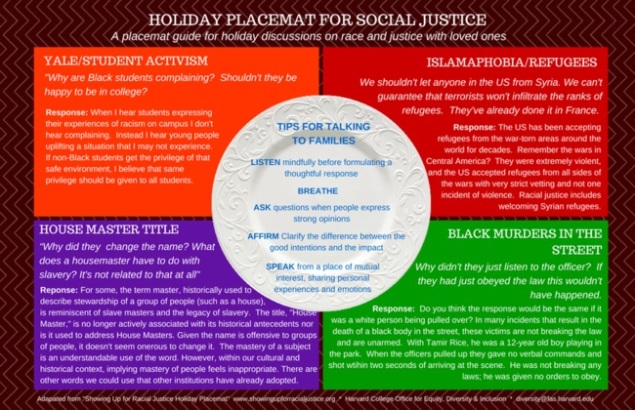
Harvard University - Holiday Placemat for Social Justice

Harvard University now makes it a point of pride to turn out fragile, unresilient graduates with little hope of functioning well in society

There was a time not long ago when universities used to take pride in turning out well-rounded graduates, young adults who were not only skilled in their chosen discipline but who could also hold their own in debate and ably relate to those from other walks of life or bearing different opinions.

But in 2016 it is increasingly evident that with their overwhelming focus on social justice – no longer a side issue but a common thread running through a contemporary student’s entire experience on campus and in the classroom – American universities in particular are actively harming the life prospects of their students by fostering such a therapeutic climate of social justice groupthink that the slightest intrusion of the rough real world is in some cases enough to provoke a real mental and emotional crisis.

Take this incredibly overwrought essay in the Harvard Political Review, which has apparently fallen so low that it now readily publishes weepy accounts from shellshocked students who happen to encounter hurtful words while on campus.

Student Aidan Connaughton writes:

I have heard hate speech in many situations in my life – so much so that I have become accustomed to it, even grown to expect it in some instances. Throughout middle and high school, I heard it so often that I knew the patterns, knew the lead-ins, and knew when I had to brace myself for the sting. Today, however, I did not brace myself.

“Faggot.” “Stop being a faggot.” “What is he? Some kind of faggot?” These all-too-familiar words continue to echo in my head. These are the words I have shielded myself against for years, the words I have learned to block out, coming from the people I have learned to avoid. These are the words that people use when committing hate crimes, and the words that were used for decades to oppress people just because they loved differently.

I never expected these words at lunch in Annenberg from a group of Harvard freshmen.

My guard was down, because I had forgotten what it felt like to hear these words. I know better now. I will not repeat that mistake.

Okay, so from this we can deduce that Aidan Connaughton is gay, and that he heard other students use the word “faggot” in what he felt was a derogatory way. Fair enough. As Connaughton makes clear, he has had this word directed at him from tormentors many times in his childhood, and quite understandably finds it upsetting.

But what follows is a damning indictment of how Harvard University, in a presumably well-intentioned effort to shelter people like Aidan Connaughton from ever encountering the rough and unpleasant views of the outside word so long as they are on campus, is actually retarding the ability of its students to withstand the unfair bumps and scrapes of real life. No gay person deserves to be called a faggot. But neither do young gay students deserve to be stripped of the ability to function and thrive in an imperfect world where hate and prejudice still exist.

Connaughton continues (my emphasis in bold):

Fair Harvard, the bastion of liberal values, a progressive environment where activists stand up against hate and students fight for progress in the belief that they can change the world. It is the place where workers and students unite to fight for health care, where students write plays about Black Lives Matter, where they organize rallies and marches to support survivors of sexual assault. It is the place where mental health is important and QSA is an established organization and where social justice is an integral pillar of student life. The students at Harvard have taught me how to embrace progressive movements and how to fight against administrative oppression. They have supported me, so much so that sometimes I can forget that the world outside of Johnston Gate does not care about social justice in the same homogeneous way as Harvard students. We fight against the Harvard administration to eradicate the structural oppression that continues at our school, and students may clash with each other over whether or not a classroom should be a safe space, but these disagreements seem to be more intellectual than hostile.

In other words, Harvard University is creating a very artificial environment in which their young adult students are expected to mature and grow into robust, well rounded people. By Connaughton’s own admission, the political climate on campus is so sterile and homogeneous that he is able to go for long stretches of time without encountering a contrary opinion, let alone an actively hostile one. This is a young man who has been consciously made fragile by the application of an ideology which preaches that words can cause real harm, and whose “immune system” to hearing non-affirming things has steadily atrophied in an environment where it has scarcely been needed.

And this is the result:

My little group of like-minded friends and I have frequent discussions on activism, politics, and campus issues, yet we usually come to a consensus on whatever issue we debate. I had grown so used to being understood and having my friends agree with me. I was no longer afraid to believe in social justice, the way I had been in my conservative hometown during high school. I had grown accustomed to a student body that was well informed and shared my beliefs. I thought that, at the very least, Harvard students are respectful and above making purposefully insensitive comments.

This is a young man whose idea of a debate is talking with his existing friendship circle, all of whom hold the same beliefs as him, and then (astonishingly) reaching a consensus. The only wonder is that they only “usually” come to a consensus, considering the homogenised intellectual atmosphere.

Worse still – for our democracy, at least – is Connaughton’s notion that this uniformity of thought exists because all of his fellow students are “well informed and shared [his] beliefs”. The obvious corollary to this is that anybody who does not share the worldview of Connaughton and his friends must be ignorant and wrong. There is no room in this worldview for the possibility that those who do not concur with each and every article of the Social Justice Catechism might do so from a position of honest, principled disagreement, and as the honest result of holding a different value system.

The article then builds up to the incident itself, in dramatic fashion:

But today, at table A11, as I sat down with my plate of red spiced chicken breast and broccoli, I overheard that word for the first time since leaving Colorado Springs to come to Cambridge. Two tables away, Dean Khurana was sharing a meal in Annenberg with a group of excited, overeager freshmen. But here were three Harvard students using this hate speech, laughing in their matching Harvard Men’s Lacrosse jackets, unaware that just three seats away, I was listening.

I said nothing to them. I was too shocked to think of anything to say. I held it in, reverted back to middle school, because I didn’t want to believe that I was hearing this word from one of my peers yet again – that I hadn’t left that behind.

So the word “fag” was not even addressed to Connaughton directly. While it was still undoubtedly unpleasant to hear, the suspense which builds throughout the piece makes it seem as though he was the victim of a direct homophobic diatribe, directed at him while he tried to enjoy his red spiced chicken breast (which hopefully, despite its name, was not a culturally appropriative dish). But this is not the case. Connaughton’s trauma – and this entire article – were prompted merely by overhearing the word being used in a conversation between other people.

If alarm bells are not already sounding at the evident mental fragility of this student, what follows is most concerning of all:

I thought that, at least at Harvard, we had won that battle. The culture of Harvard makes us believe that the world shares our views, and that what we believe in is right. Puncturing the bubble of liberalism at Harvard is painful, but it is as easy as hearing a single derogatory word from across the table.

This is almost childlike in its plaintive naivety. But one thing is crystal clear: the culture of Harvard University, now so fawningly tailored to the loud demands of the social justice warriors, is actively harming those who study there. For not only does pandering to the Cult of Identity Politics create a stultifying groupthink atmosphere on campus, it also encourages the utterly unrealistic belief that the rest of the world will be just as careful not to cause offence or tiptoe around any delicate sensibilities.

The most depressing thing in this case is that the student, Aidan Connaughton, is very aware that he is living in a bubble. He calls it a bubble of liberalism, which is obviously incorrect – for there is nothing liberal about maintaining an oppressive atmosphere where controversial or hurtful things can never be said. But the tragedy is that while he is aware that he is living in a bubble, he has no desire to escape and deal with the world as it really is. Living in the bubble has robbed him of the mental armour required to deal with the bumps and scrapes of life, and so rather than puncture the campus bubble and be free he seeks in vain to expand the bubble to encompass his whole world.

I don’t know how it can possibly be made clearer: social justice, identity politics and the idea of the university as a safe space are working together to gravely retard the emotional and intellectual development of today’s students – even Harvard students, who may be among the brightest minds of their generation, but many of whom will graduate incredibly ill prepared to function in the real world.

Harvard has failed Aidan Connaughton. But the failure was not that university administrators allowed a solitary hurtful phrase to be uttered within his earshot; the failure was that in their desperation to appease the demands of the social justice and identity politics movement, the university stripped away any and all of the means by which Connaughton might possibly have developed the intellectual robustness and emotional anti-fragility to deal with what could potentially be an everyday occurrence in the cold, harsh outside world.


Postscript: No wonder Harvard is in such a mess. This is now the declared mission of Harvard College (my emphasis in bold):

The mission of Harvard College is to educate the citizens and citizen-leaders for our society. We do this through our commitment to the transformative power of a liberal arts and sciences education.

Beginning in the classroom with exposure to new ideas, new ways of understanding, and new ways of knowing, students embark on a journey of intellectual transformation.  Through a diverse living environment, where students live with people who are studying different topics, who come from different walks of life and have evolving identities, intellectual transformation is deepened and conditions for social transformation are created.  From this we hope that students will begin to fashion their lives by gaining a sense of what they want to do with their gifts and talents, assessing their values and interests, and learning how they can best serve the world.

Abandon hope all ye who enter here.


Safe Space Notice - 2

Agree with this article? Violently disagree? Scroll down to leave a comment.

Follow Semi-Partisan Politics on TwitterFacebook and Medium.

Tales From The Safe Space, Part 32 – Student Artist Willingly Re-Educated In The Ways Of Social Justice

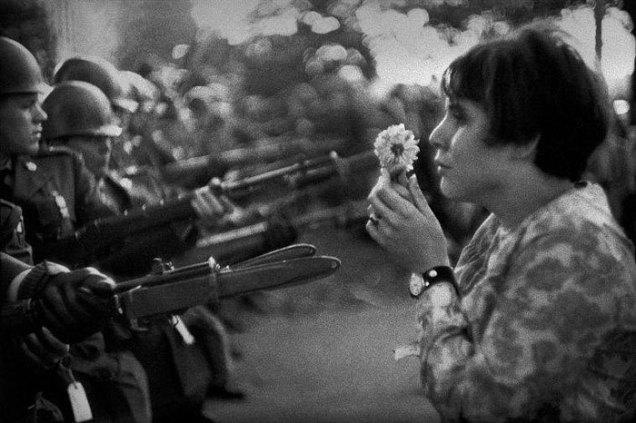
Vietnam War Protest - Hippies Flower Rifle Gun

Artistic freedom, like academic freedom, is at risk from the social justice / identity politics takeover of our universities

What is a poor social justice warrior student to do when confronted with a piece of campus artwork which causes them mental discomfort harm?

Simple! Just send a snivelling email to the entire student body complaining about how your feelings have been hurt and how you have been made to feel unsafe in your own community. And if you attend one of those academic institutions which has already completely capitulated to the identity politics/social justice coup, you need do nothing else – the offending artwork will be removed or modified at once, without so much as a hearing. And what’s more the artist will be glad to be corrected, just as Dmitri Shostakovich was so very thankful for Pravda’s denunciation of his opera “Lady Macbeth of Mtsensk”.

This time we are back in California, specifically Pitzer College, one of the liberal Claremont Colleges, and the “triggering” artwork was an homage to the famous Vietnam war protest image of a hippie placing a carnation into the barrel of a national guardsman’s rifle.

The Claremont Independent reports:

Early Monday morning, Gregory Ochiagha (PZ ’18), a Student Senator at Pitzer College, sent out an email to the student body criticizing a mural recently painted on campus. The mural, painted by Selena Spier (PZ ’19), depicts a handgun with flowers coming out of the end and was approved by the Pitzer College aesthetics committee.

“It’s truly in bad taste to have a large depiction of a gun in a dorm space—especially when students of color also reside there,” states Ochiagha. “Now let’s imagine there were countless videos of white teenagers, white teenagers that look like you, or your brother or your sister, get shot to death by police officers. Imagine scrolling down Facebook everyday and seeing a new video of the same thing, over and over again. Really put yourself in that headspace. Then ask yourself whether it’s the brightest idea to have white teenagers, who have a very real fear of getting shot, see a large gun every time they want to get food from the dinning [sic] hall.”

Ochiagha continues, “My Black Mental and Emotional Health Matters. I shouldn’t be reminded every time I leave my dorm room of how easy my life can be taken away, or how many Black lives have been taken away because of police brutality. This is emotionally triggering for very obvious reasons. And if you want to belittle or invalidate by [sic] black experience, I live in Atherton, come thru, let’s have that idiotic conversation.”

This being a Claremont college stuffed to the brim with students who live and breathe identity politics 24/7, of course where was zero pushback to Ochiaga’s demands. In fact, Selena Spier (the artist) willingly consulted with the offended party to agree changes to her creation that would keep him happy, all the while chastising herself in repentance for her privilege:

Spier plans to modify her mural. “I spoke with Gregory earlier and we agreed on a modification that preserves the integrity of the original piece while avoiding any potentially triggering content—it’s a change I was absolutely happy to make in the interest of creating a safe and inclusive environment for everyone in my community,” Spier told the Claremont Independent. “I have absolutely no right to decide whether or not my artwork is offensive to marginalized communities—nor does anyone else in a position of privilege, racial or otherwise.”

In other words, Spier offered her version of a “Soviet artist’s creative response to justified criticism“.

Re-education is not even necessary at Spitzer College. The student body is so perfectly drilled in the lore and language of social justice that everyone knows the correct protocol to follow when accused of unfairly exercising their privilege – they are to throw their hands up in surrender, accept the criticism unquestioningly, gratefully thank their accuser for sharing their pain and immediately modify their errant behaviour.

At no point, according to this new regime, is there to be any critical discussion as to whether the objection is valid or the offence warranted – as Spier herself confesses, “I have absolutely no right to decide whether or not my artwork is offensive to marginalized communities”. In other words, Spier is content for anything which she creates at any point in the future to be summarily labelled heretical by some wobbly-lipped social justice crybaby, and then either removed or altered to comply with her accuser’s demands.

Rod Dreher is equally unimpressed with accuser and artist:

I don’t know whether to pity Spier or to be revolted by her supine eagerness to satisfy and completely unreasonable request made by someone, simply because of the color of the complainer’s skin. It’s one thing for a gutless campus administration to silence free speech and expression on campus, but when the speakers and artists can be talked into silencing themselves, you know things are pretty damn hopeless. Conformists to the marrow, the lot.

But even an unwilling artist would likely have been forced against their will to bend to the demands of this social justice victimhood power play. In Social Justice Land, offending artists (together with campus conservatives) are given little practical choice but to conform or stay silent, hiding their true opinions and suppressing their creativity.

Imagine that instead of sitting down with this petty student tyrant, Spier had instead told him to go jump into a running jet engine, and that under no circumstances would she modify her piece of artwork from the original conception. If the artist had stood unrepentantly behind her own creation in this way, it is not difficult to see how this situation would have quickly escalated to a Twitter campaign, a sit-in at the dean’s office, a protest outside her own dorm room…

The Soviets used the threat of exile or execution to keep their artists in line. The Cult of Social Justice and Identity Politics borrows from the same playbook, using the threat of social ostracisation, protest and even intimidation to force willing cultists and heretics alike to bend the knee.

And so it is worth remembering that academic freedom is not the only thing at stake in this attempted social justice coup of our universities. Artistic freedom is also very much at risk from a movement which values “lived experience” over objective truth, and in which the limits of one’s free speech are determined by the position one supposedly occupies in the social justice Hierarchy of Privilege.


More “Tales from the Safe Space” here.


Safe Space Notice - 2

Agree with this article? Violently disagree? Scroll down to leave a comment.

Follow Semi-Partisan Politics on TwitterFacebook and Medium.

Sargon Of Akkad On Social Justice

https://www.youtube.com/watch?v=vN0oKIMlHyI

Popular YouTube political/cultural vlogger Sargon of Akkad is the (infinitely more popular) video equivalent of this blog in seeking to sound the alarm as universities and students’ unions fall under the spell of the Cult of Identity Politics.

Readers who do not already do so should consider following his YouTube channel.

At present, Sargon of Akkad (real name Carl Benjamin) is drumming up support for a petition to end social justice courses being taught as legitimate academic subjects at university. Those who are interested can sign it here.

In the video shown above, Benjamin makes an entertaining (and cathartic) case that the social justice / identity politics community is little more than a cult, the majority of whose complaints bear little resemblance to reality and whose philosophy is not deserving of the official imprimatur of the academy.


Safe Space Notice - 2

Agree with this article? Violently disagree? Scroll down to leave a comment.

Follow Semi-Partisan Politics on TwitterFacebook and Medium.