
“The America I know and love is not one in which my parents or my baby with Down Syndrome will have to stand in front of Obama’s ‘death panel’ so his bureaucrats can decide, based on a subjective judgment of their ‘level of productivity in society’, whether they are worthy of health care. Such a system is downright evil” – Sarah Palin, August 2009
“Barack Obama is the most dangerous president in modern American history. This administration has intellectually disarmed, it is morally disarmed, it is incapable of describing what threatens us” – Newt Gingrich, Republican Presidential Candidate, February 2012
“People have birth certificates. He doesn’t have a birth certificate. He may have one but there’s something on that, maybe religion, maybe it says he is a Muslim. I don’t know. Maybe he doesn’t want that. Or he may not have one. But I will tell you this. If he wasn’t born in this country, it’s one of the great scams of all time” – Donald Trump, Improbably Rich Idiot, March 2011
On the Federal Budget.
The US national debt stood at $10.6 trillion when President Obama took office, and in 2011 reached $14.6 trillion. Cue lots of self-righteous bluster from the American right that Obama is wrecking the national finances and, to use a much overwrought phrase “running up the national credit card” that the next generation will have to pay off.
You can agree or disagree with Obama’s economic stimulus, and TARP, and the auto bailouts – though as I remind my Republican friends, it is easy to criticise all of these measures and claim that they had no positive effect when none of us will ever have to live in an alternate reality where they had not taken place. What you cannot do, however, is pose as a staunch fiscal conservative and a concerned American worried about the financial stability of the United States if you have done any of the following:
- Voted to approve the wars in Iraq and Afghanistan without seeking additional revenues to fund them.
- Voted for Medicare Part D, the prescription drug programme for elderly Americans, again with no commensurate revenue increases (strange how “government-run healthcare” is an assault on individual liberty, with the huge exception of Medicare).
- Voted for or supported the Bush tax cuts of 2001 and 2003 that were not met with equal cuts to government spending.
- Obstructed the recent vote to raise the US debt ceiling, raising fears of a default and directly resulting in the downgrading of the government’s AAA credit rating.
On Religious Liberty.
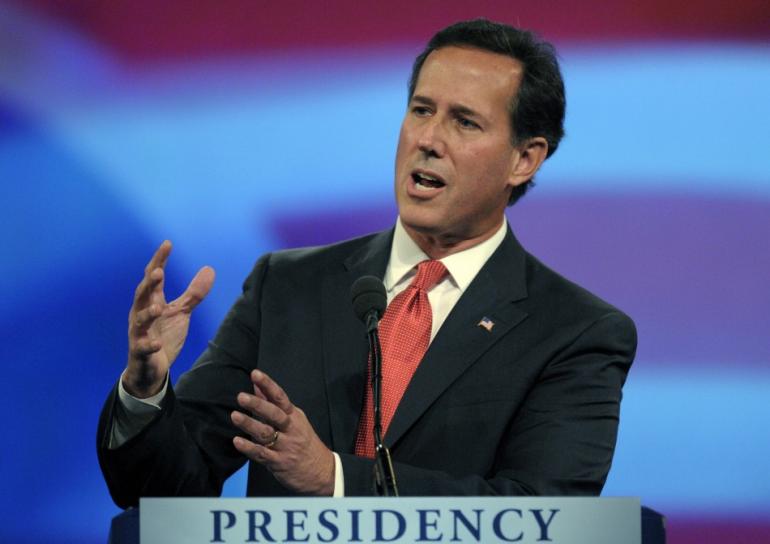
I have amused myself watching several of the Republican presidential candidates twisting themselves in rhetorical knots trying to make the case that the founding fathers were only joking when they enshrined a “wall of separation between church and state” in the constitution (in Rick Santorum’s case, he went as far as to say that it made him physically sick to contemplate). Or rather, that it exists in much the same way as a cell membrane permits osmosis, allowing religion (or rather, certain favoured religions and denominations) to impose their beliefs beyond their congregations on the entire US population while making religious organisations themselves immune from any requirement to conform to state or federal laws.
If we take as one example the recent furore over the fact that the Affordable Care Act (ACA, ObamaCare) mandates that insurance companies provide birth control coverage, it is telling that many of the religious prelates – including many Catholic Bishops – have lived under similar requirements to provide employees with insurance that includes birth control in their home states for many years without raising a chorus of objection, until the same issue came up at a federal level. One cannot help but feel that religion and the concept of religious freedom are being used as a convenient cudgel with which to bash the Democrats in an election year, rather than being truly respected and protected by the GOP.
In terms of the Tea Party, there seems to be a genuine if uneven split between the minority true libertarians (of the Ron Paul mould) who believe in a separation of church and state and have the courage to say so, and the bulk of those others who are able to maintain in their minds the cognitive dissonance that must surely arise when you advocate for individual liberty in the economic realm on one hand, but insist that people abide by select teachings from your holy book (whichever it may be) on the other.
On Healthcare.
Being a conservative used to mean being a realist, dealing with the world as it is and hopefully proposing pragmatic, typically non-radical solutions. One of the persistent problems with the US healthcare system is the “free rider” problem. Hospitals are required to treat and care for any patient that arrives suffering from a grave, life-threatening injury or illness, regardless of whether or not that patient carries health insurance. Of course, this includes the more than 30% of Americans who lack such insurance. Even the most fervent tea-partier would (probably) pause before proposing that people be left to die on the street if they are in need of medical care but lacked insurance.
Unfortunately, this creates a rather significant free rider problem, with US taxpayers and health insurance policyholders essentially paying to cover the cost of these uninsured healthcare expenses. This contributes to the unsustainable rate of inflation in US healthcare costs, makes no sense and is just plain silly. Even the conservative Heritage Foundation used to think so too, and at one time proposed an individual mandate requiring all citizens to purchase at least basic health insurance (http://www.forbes.com/sites/aroy/2011/10/20/how-a-conservative-think-tank-invented-the-individual-mandate).
But now any such mandate is considered a grave assault on liberty. Okay, constitutional scholars can debate that point for a long time. But pragmatic conservatives should surely try to find a way around this issue, to solve the serious free rider problem which makes healthcare more expensive for everyone. Instead, the tea party rail against the “tyranny” of having to purchase healthcare, and yet say nothing about the free rider problem which hurts lower income people most of all in the form of higher insurance premiums and medical bills. Neither do they propose an alternative solution to address the fact that so many of their fellow citizens – some through choice but many through no fault of their own – live with the daily fear that accident or sudden illness could bring them to ruin. And no, promising to clamp down on medical malpractice lawsuits and muttering quietly about perhaps allowing insurers to sell policies across state lines, while both sensible ideas, do not solve a problem of this magnitude.
I could go on to talk about “death panels” – the GOP’s term for the basic idea that end-of-life care counselling should be offered (not mandated, just offered) as part of health insurance policies in order that more people are given the opportunity to make these key decisions while they are young and healthy, and potentially avert the suffering and huge proportion of total lifetime medical expense which is incurred during the end stages of terminal diseases, through the issuance of Do Not Resuscitate Orders etc. But there is no need, because anyone who reads the language in the Affordable Care Act (ACA) and somehow extrapolates in their mind that offering end of life counselling as part of an insurance plan could in any way equate to a “death panel” that decides whether the disabled or infirm should live or die is clearly smoking something quite mind-alteringly potent and will not be swayed by anything committed to print here.
I could also talk about the fact that the GOP’s constant use of the term “government-run healthcare”, or suggestions that government has taken over the healthcare industry (i.e. nationalisation) are ludicrous, alarmist and clearly and demonstrably false. But again, there is no need, because any thinking person should be able to see that while government may have now infringed on the way that consumers choose their health insurance provider (to some limited extent, in certain cases), this insurance and the healthcare itself is still provided by private-sector or non-profit organisations as much as it ever was. Those who scream “government takeover” or “socialism” would do well to go back to school and relearn the meaning of those terms – were it not for the fact that getting a college education is, of course, a form of snobbery these days.
But there is no need to talk about these things. At present there is no reasoning or engaging at all on the topic of health reform with the Tea Party-beholden GOP, who, in the words of David Frum, “followed the most radical voices in the party and the movement, and [were led] to abject and irreversible defeat”. (http://www.frumforum.com/waterloo). ObamaCare is here now, with all of its benefits and imperfections. The Republicans had an opportunity to engage with the Democrats and ensure that some more conservative principles were included in the law. Instead, they chose obstructionism and got none of what they wanted.
Why Now?
I am curious about this, and I would love for any thinking, Tea Party-supporting readers to comment and to help educate me. I do not believe that the recent groundswell of constitutional originalism and small government fervour is entirely the result of resentment that a black man currently occupies the Oval Office. I think it is a factor, but not the only one, or even the main one necessarily.
However, given the fact that the US federal government expanded in terms of raw expenditure, percentage of GDP, scope of activities and power over the individual for many years prior to the election of Barack Obama, I would like to understand – why the Tea Party, why now? Why the sudden need in 2009 for people to buy pocket editions of the US constitution, to dress up in 18th century clothes, to attend these rallies and rail against the subversion of America? Why deselect long-serving and relatively competent congressional representatives in favour of unknowledgeable and in some cases laughable primary challengers who vowed even before getting to Washington (or declaring on television that they are not a witch and being comprehensively beaten, in one depressing case) that they would never seek to strike a bipartisan deal?
If you are a fiscal conservative, that’s great, campaign for greater fiscal responsibility. If you believe in small, limited government – marvellous, advocate strongly for it (I assume that your enthusiastic support of individual liberty applies to peoples’ bedroom and nuptial activities too though, right?) If you believe that some of the key edifices of the American social safety net and federal government are technically unconstitutional, then you can probably make that argument quite convincingly. But before you do any of those things, and if your name is not Ron Paul, please explain where you stood, and who and what you voted for in the months and years prior to Inauguration Day, 2009.


 Semi-Partisan Politics