The Left Wing Case Against Mass Surveillance And The Investigatory Powers Bill

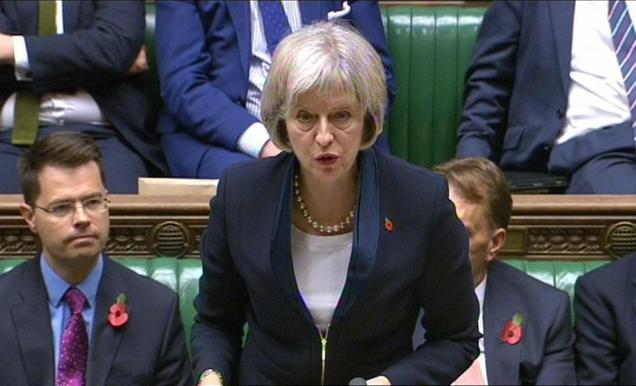
Theresa May - Investigatory Powers Bill - Mass Surveillance

The draft Investigatory Powers Bill will neither increase security nor effectively tackle extremism

Laura Westwood argues in Left Foot Forward that existing mass surveillance techniques have proved ineffective at stopping terror attacks, and that the new measures outlined in the government’s draft Investigatory Powers Bill would further undermine civil liberties with no commensurate reward:

Perhaps most unsettling is the potential harm caused by intruding on the lives of innocent people. Whatever the rationale, mass surveillance practices imperil our rights to privacy and freedom of expression. The UK’s Independent Reviewer of Terrorism Legislation himself warned that taking missteps could sow divisions in society and incubate the problem of ‘home-grown’ terrorists.

Why? Because extremists thrive on exploiting disenfranchisement and grievance. We are told so by former members of Islamist extremist groups. Taking blanket surveillance even further than it already goes is a calculated risk at best, and right now, the sums aren’t adding up.

Already, people languish in British prisons not for committing or inciting terrorist acts, but merely accessing articles and propaganda which praises terrorist acts, or expressing support for them on social media. Such actions may be reprehensible, but bringing the full weight of criminal law crashing down on people with odious foreign policy views and sharp tongues on social media is punishing thought, not words, and is incompatible with a free society.

Furthermore, locking up people like Runa Khan – imprisoned for “disseminating terrorist material”, which basically meant sharing pro-ISIS propaganda articles on Facebook – does nothing to confront and kill the noxious ideas in question, but rather elevates them to an unearned position of nobility, and makes a martyr of their speaker.

As Mick Hume argues in his book “Trigger Warning: Is The Fear Of Being Offensive Killing Free Speech?”:

If she had dressed her young children in suicide vests and sent them out to die in a bomb attack, that would be terrorism. But going online to argue that Muslim mothers should try to raise their sons to grow up as jihadis is something else entirely, more like perverse parenting advice than a military command. Words are not physical weapons and viewpoints are not violence, however ‘radical and extreme’ they might appear to most of us. The opinions expressed by the likes of Runa Khan need to be openly challenged. Trying to bury them instead in prison, on the ground that they are too dangerous to be let loose on Facebook, can only lend their radical message more credence.

At a time when almost all the serious business of governing has ground to a halt for the duration of the EU referendum campaign, mass surveillance is the one area where David Cameron’s ideologically rootless, authoritarian government seems determined to make progress. All other reforms and legislative activity have effectively been placed on hold, yet this most un-conservative government is formalising and expanding the powers of the state to indiscriminately collect and hold data on the private activity of citizens, with the kind of weak and unenforceable safeguards that you would expect from a country with no written constitution.

Why? Because while everything else is allowed to drift as David Cameron seeks to bully and scare the British people into fearfully voting to remain in the European Union, expanding the power and influence of the state over our lives knows no rest.

Those on the Left who oppose this are right to do so – not in pursuit of a political victory over the Evil Tories, but because the Investigatory Powers Bill is bad law and bad policy. And because it will be the poorest, most disadvantaged and least well-connected citizens who first fall prey to the surveillance state, as it always is.

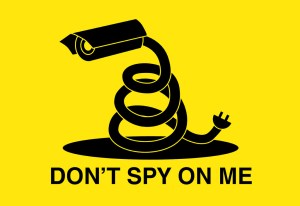
Don't Spy On Me - Mass Surveillance

Agree with this article? Violently disagree? Scroll down to leave a comment.

Follow Semi-Partisan Politics on TwitterFacebook and Medium.

One Year Later, Are We Still Charlie?

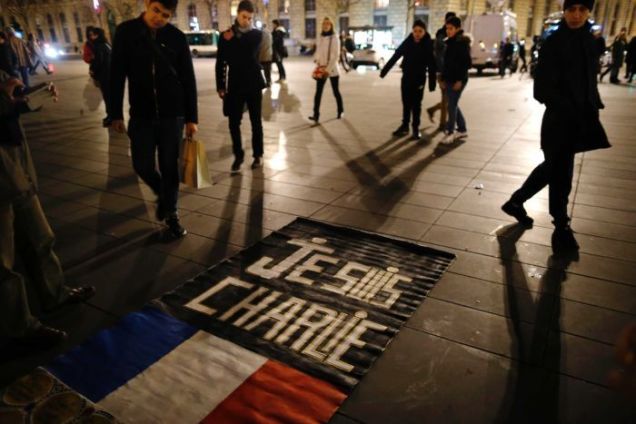
Paris - Charlie Hebdo Anniversary - Je Suis Charlie

As we pass the one year anniversary of the Charlie Hebdo attacks in Paris – the terrorist atrocity which prompted us to declare Je Suis Charlie in support of free speech – are we still Charlie, one year on? Were we ever?

This past week saw the first anniversary of the Charlie Hebdo attacks in Paris, a sickening assault on journalism and free speech, and the worst thing to happen to France until the Paris attacks of 13 November ensured that 2015 would end much as it started for Europe: in the shadow of Islamist terrorism.

At the time of the Charlie Hebdo shootings, many of us rallied to the cause of the small, satirical newspaper which found itself in the crosshairs of a primitive, totalitarian ideology, and we declared “Je Suis Charlie”.

It was a nice gesture, even if it wasn’t strictly true. Though David Cameron was eager to be seen marching arm-in-arm with other world leaders through the streets of Paris in support of free speech, those of us back in London knew that any British newspaper attempting to publish some of the satirical cartoons that Charlie Hebdo published would have been vilified, sued and shut down, and its editor would likely languishing in a British prison cell.

Things didn’t get much better as 2015 progressed, as Glenn Greenwald notes in his latest column for The Intercept:

It’s been almost one year since millions of people — led by the world’s most repressive tyrants — marched in Paris ostensibly in favor of free speech. Since then, the French government — which led the way trumpeting the vital importance of free speech in the wake of the Charlie Hebdo killings — has repeatedly prosecuted people for the political views they expressed, and otherwise exploited terrorism fears to crush civil liberties generally. It has done so with barely a peep of protest from most of those throughout the West who waved free speech flags in support of Charlie Hebdo cartoonists.

That’s because, as I argued at the time, many of these newfound free speech crusaders exploiting the Hebdo killings were not authentic, consistent believers in free speech. Instead, they invoke that principle only in the easiest and most self-serving instances: namely, defense of the ideas they support. But when people are punished for expressing ideas they hate, they are silent or supportive of that suppression: the very opposite of genuine free speech advocacy.

[..] In the weeks after the Free Speech march, dozens of people in France “were arrested for hate speech or other acts insulting religious faiths, or for cheering the men who carried out the attacks.” The government “ordered prosecutors around the country to crack down on hate speech, anti-Semitism and glorifying terrorism.” There were no marches in defense of their free speech rights.

Glenn Greenwald goes on to express his contempt for the fair-weather free speech advocates who are all to eager to shout their support for speech which offends people they happen to dislike, while simultaneously demanding that the authorities clamp down on speech which offends them or people with whom they sympathise.

Meanwhile, in Britain, the newly re-elected Conservative government was getting ready to “defend” free speech by expressing impatience with the fact that they did not have  more freedom to harass citizens acting in accordance with the law.

When David Cameron announced draconian new security measures, impatiently proclaiming “For too long, we have been a passively tolerant society, saying to our citizens ‘as long as you obey the law, we will leave you alone'”, this blog retorted:

These measures have the look and feel of a side which feels unable to win the argument in favour of British and western values through open debate, and so seeks to impose them by force of law instead.

A truly free and liberal society would not need to take such draconian steps as requiring “extremists” (never defined, and certainly not necessarily convicted) to submit advance copies of public remarks to the police for review and censoring, an astonishing proposal. But our society is becoming less and less free by the day, opting instead for security and a quiet life.

And at its depressing heart, this is what it comes down to – a desire for cloistered security above all else. On the economy, on foreign affairs and now on terrorism, our politicians have decided that we are too frightened and worn down by the dangers and threats of this world to face our challenges as a strong, independent nation.

But government has not been solely to blame. The desire to trade liberty for a chimerical sense of security has been coming from the bottom-up, with an increasing number of citizens – particularly those on the Left who ostentatiously proclaim their concern for issues of “social justice” – insisting that core liberties such as the right to free speech should be curtailed when they negatively infringe on the feelings of another person.

This corrosive new development has its roots in academia and the university environment, where a generation of liberal professors espousing political correctness as their religion are finally beginning to reap what they sowed – a new generation of coddled adult baby students who require trigger warnings, safe spaces and dawn-to-dusk parenting by their colleges just to make it through the day.

These New Age Censors and their petty authoritarianism are toxic to free speech, and their growing influence has already resulted in calls to outlaw clapping and booing, tearful temper tantrums about dress codes, stifling ideas by labelling them ‘problematic’, the insistence on safe spaces and mandatory sexual consent workshops.

As I recently explained, deep down this has nothing to do with “social justice”, but instead is all about gaining power by wrestling control over the language and laying verbal land mines with the intention of destroying opponents who – regardless of how they actually behave – happen simply to say the “wrong” thing:

That’s where the New Age Censors, the Stepford Students, the resurgent activist Left step in, always watching over your shoulder and always quick and eager to tell you when you have crossed one of the many invisible lines that they are busy drawing across our political and social discourse. Only the telling always seems to take the form of a social media lynching rather than a friendly pointer.

When the rules over precisely what can be said and how it must be phrased become so fiendishly complex that we are all liable to fall over them at some point, it grants enormous power to the gatekeepers, those swivel-eyed young activists at the forefront of modern identity politics. Not only do they get to write the rules, they and they alone get to sit in judgement as to whether those rules have been violated.

[..] Who knew that the petty tyrants of today would be cherubic-faced, smiley student activists, chanting mantras about keeping us safe as they imprison us in their closed-minded, ideological dystopia?

As far as 2015 Year In Reviews go, all of this makes for depressing reading. Indeed there are many reasons to be concerned for the future of free speech and civil liberties in general, particularly when many of our fellow citizens seem intent on destroying our freedoms from within.

And yet there have been some good news stories too, providing small glimmers of hope. One such case has been the exoneration of a Northern Irish pastor, James McConnell, who found himself on trial for sending “grossly offensive” communications following a sermon in which he described Islam as “a doctrine spawned in hell”.

This was a spiteful sting by the prosecution. McConnell’s sermon – in which the 78-year-old pastor said some highly unpleasant and inflammatory things about Islam – had been recorded and then later posted on the internet, allowing the authorities to accuse him of “causing a grossly offensive message to be sent by means of a public electronic communications network”.

Too often, such show trials have resulted in conviction and a prison sentence, which in this instance could have been six months. But in this case, Judge Liam McNally, threw the case out, saying “the courts need to be very careful not to criticise speech which, however contemptible, is no more than offensive”. If only this legal interpretation was more widely shared and disseminated throughout the English and Scottish legal systems, from the UK Supreme Court on downwards.

But the truly pleasing aspect of this case is the fact that one of the people who spoke outside the court in support of James McConnell was a Muslim academic, a senior research fellow in Islamic studies at the Westminster Institute named Muhammad al-Hussaini.

Taking a brave stance in support of speech which he himself must have found very distasteful, al-Hussaini nonetheless defended Pastor James McConnell’s right to say hateful things about the religion of Islam.

The Guardian reported at the time:

Speaking outside Belfast magistrates court to hundreds of McConnell’s supporters, Muhammad al-Hussaini, a senior research fellow in Islamic studies at the Westminster Institute, said he was in the city to back McConnell’s right to free speech.

Hussaini said: “This is possibly one of the most important things at our juncture in history; it could be the make or break for the continued survival of our planet actually.

“Against the flaming backdrop of torched Christian churches, bloody executions and massacres of faith minorities in the Middle East and elsewhere, it is therefore a matter of utmost concern that, in this country, we discharge our common duty steadfastly to defend the freedom of citizens to discuss, debate and critique religious ideas and beliefs – restricting only speech which incites to physical violence against others.

“Moreover, in a free and democratic society we enter into severe peril when we start to confuse what we perhaps ought or ought not to say, with what in law we are allowed to, or not allowed to say.”

At a time when freedom of speech is just as much under attack from safe space zealots and our own government as it is from radical Islamic terrorism, it is especially important that we stand in solidarity with those who defend free speech, and particularly those who have the moral courage to defend the speech that they personally hate.

In this regard, civil libertarians owe a debt of gratitude to Muhammad al-Hussaini and others like him. For in his defence of the rights of pastors – or anybody else – to say what they please, so long as they do not actively incite violence against another, this Muslim scholar is doing far more to defend the ancient British and enlightenment values of freedom and liberty than

In fact, one could quite easily say that al-Hussaini is more authentically British (in terms of extolling and living by the values which we supposedly hold dear) than our own government, the grunting anti-Muslim far-right and most of the academic safe space crowd put together.

This is the unusual situation in which we now find ourselves, with a British population and government cowed simultaneously by Islamic terrorism and by Islamophobia seriously discussing banning “hate preachers” like Donald Trump (of all people) from entering Britain, while it falls to a Muslim academic to stand up in defence of the free speech which the West supposedly holds so dear.

This landscape is not encouraging; few of us passed the Charlie Hebdo Test when those terrible shots rang out on 7 January 2015, and fewer still would do so now, based on their words and actions since that heinous attack.

But when a nation begins to forget its own values and once dearly-held principles, it is of some consolation on this first anniversary of the Charlie Hebdo shootings to see the flame of liberty being kept alive in some unexpected places, and by unexpected – but very welcome – custodians.
Freedom of Speech - Free Speech

Agree with this article? Violently disagree? Scroll down to leave a comment.

Follow Semi-Partisan Politics on TwitterFacebook and Medium.

The Daily Smackdown: Cynical Bishops Exploit Terrorism For Publicity

BBC Religion Television

Who will condemn the bishops for exploiting our fear of terrorism in their grubby bid to preserve taxpayer funding of the BBC’s religious output?

The Church of England is very upset that the BBC is considering cutting the amount of taxpayer money it spends on (predominantly) Christian television output.

From the Telegraph:

A spokeswoman confirmed that the BBC was planning to “look at ways we can reduce costs” as it faced “huge financial challenges” but added that cuts would come from across the corporation.

The Bishop of Norwich, the Rt Rev Graham James, the Church of England’s lead spokesman on media issues, said the move could threaten something which was “fundamental to our public life”.

“It seems to me that religion has already taken a hit,” he said.

“It has already been reduced certainly in terms of its scope as an independent part of the BBC, at a time when we already need – as everyone acknowledges – more religious literacy in the nation.”

Nothing unusual there. The Church of England is a well oiled lobbying machine, and any private organisation lucky enough to have a bloc of 26 unelected representatives sitting in parliament to influence our laws in their favour would be foolish not to make good use of them. Thus it is no surprise that the unelected theocrats of our state church have been hard at work speaking out against the BBC’s planned actions.

But the fact that the Church of England’s behaviour is understandable does not make it any less reprehensible. Firstly, because it makes a total mockery of the idea of the BBC as an independent broadcaster. Nobody seriously believes that an organisation whose budget is nearly totally dependent on taxpayer money can be truly independent, but the fact that the Lords Spiritual are now actually speaking in parliament about the internal decisions and strategy of the BBC makes any pretence of the BBC’s impartiality or the government’s non-involvement utterly ridiculous.

Worse than this, though, is the flimsy rationale now offered by the bishops as a pathetic excuse for more taxpayer funded religious programming:

Bishops have warned the BBC it risks turnings its back on efforts to tackle extremism and aid integration by slashing spending on religious programming.

[..] The first female cleric in the House of Lords, the Bishop of Gloucester, the Rt Rev Rachel Treweek, remarked that the decision had presumably been taken “to reduce the possibility of offending people with too much God stuff over the holiday”.

It is good to see the newly enobled Rachel Treweek, my Lord Bishop of Gloucester, is wasting no time in rolling up her sleeves and interfering in our national democracy as generations of theocrats have done before her. She will be making the home team very proud. But unfortunately, she and her fellow Lords Spiritual are talking nonsense.

The argument that cutting the amount of taxpayer money devoted to religious television and radio programming on the state broadcaster is somehow a threat to anti-extremism efforts is as ridiculous as it is unfounded.

More moderate Christianity on TV will not result in less Islamic extremism on the margins of British society. And pontificating, busybody bishops who abuse their parliamentary platform to suggest otherwise should provide evidence for the supposed link, or else retract the claim and admit that they are simply exploiting serious issues of national security in a cheap ploy to gain more taxpayer-funded airtime.

The real issue is not so much the pull factor of extremism as the push factor of the alienation of too many young Muslims from British society. It’s the fact that we have living among us too many self-segregated societies comprised of people who hold the same passports as us, but look upon us – and the enlightenment values of reason, education, liberty and democracy to which we try to adhere – as alien and unwelcome. By failing to inculcate a strong and inclusive sense of Britishness, out of craven fear of causing offence, we provide the Islamist recruiters with easy fodder.

Do my Lord Bishops of Gloucester and Norwich (flowery titles for a bygone age) seriously believe that the kind of alienated youths and their families who are now quietly slipping away to ISIS in Syria or seeking out radicalising materials online are the same type of people who tune in to BBC Two at six o’clock in the evening, ready to be reached out to and placated with a documentary about public spirited imams, rabbis and priests working together to open a new community centre? What nonsense.

The people most in need of the BBC’s moderate religious programming and generally liberal worldview are those whose eyes are glued to YouTube videos of anti-American 9/11 conspiracy theories or seditious social media conversations on their smartphone screens. More government intervention – be it through Prevent or the BBC – is not going to make meaningful inroads to these people. The only lasting solution must come from the bottom up, a revitalisation of patriotism and pride in Britain, and the promotion of a common British identity which transcends racial divides (rather than revelling in a multicultural dystopia which sees groups living side by side but separately in parallel, alienated lives.

Do the Lord Bishops have anything meaningful to say about that? No, they do not – perhaps with the exception of the Bishop of London, Richard Chartres.

This is in no way intended as an attack on religion, or on the Church of England (so long as it stays within its own boundaries and stops trying to play an undue role in our public life). I grew up watching Songs of Praise on a Sunday, and have happy memories of doing so. But it is not right for general taxpayers of an increasingly secular country to continue funding religious programming using a model that invites some appointed bureaucrat or another to choose which religions or denominations are to be favoured above others.

Perhaps the Lords Spiritual begin to grasp this. Perhaps they are grasping at these increasingly ludicrous excuses for their continued influence because deep down, they realise that they have no place in the government of a twenty-first century democracy.

But if these are the death throes of theocracy in Britain, they are still very offensive indeed. Claiming that the BBC should continue to spend taxpayer money on religious output favouring the established church because failing to do so will unleash more extremism – and note how the bishops cannot bring themselves to utter the name of the religion from which that extremism currently emanates – is cynical and manipulative, playing on the fears of British people just to win more free promotion.

I have never expected much from the Church of England’s upper hierarchy, or their antidemocratic parliamentary delegation. But this is low, even by their rock-bottom standards.

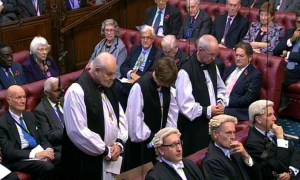
First female bishop to sit in House of Lords

Agree with this article? Violently disagree? Scroll down to leave a comment.

Follow Semi-Partisan Politics on TwitterFacebook and Medium.

The Daily Toast: Weaken The Nation State, Breed More Extremism

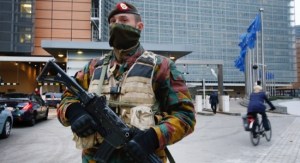
Brussels Lockdown - EU Building 2

When there is no healthy sense of national identity or commonly valued institutions, people inevitably start looking for different groups or subcultures to belong to. We should not be surprised that some turn to radical Islam

Why is one neighbourhood in Brussels rapidly becoming Europe’s chief exporter of homegrown terrorists, the Silicon Valley of Islamist extremism?

Daniel Hannan gives the most convincing answer by admitting something that many others have been furiously ignoring – that Belgium is essentially a “failed state”. It may be an advanced economy and home to the EU bureaucracy, but there is no real sense of national unity for first or second generation immigrants to embrace. And this lack of shared identity provides the fertile ground where extremism inevitably grows.

Hannan writes:

When Americans are afflicted by terrorism, they fly their flag. When Paris was violated, it turned red, white and blue. But in Belgium, you rarely see the national tricolor except on a state building.

Perhaps there is a connection between this lack of national feeling and the readiness with which several second-generation Belgians turn against their adopted country. Many Western European states have disaffected immigrant populations, but none has sent such a high proportion of its nationals to Syria. Molenbeek, the dreary quartier where most of the Paris murderers were raised, is Europe’s jihadi capital.

All human beings crave a sense of belonging. When they get no such sense from their nation, they cast around for more assertive identities. And what could be more assertive, more self-confident, than the monstrous cult of Islamic State?

And goes on to explain why this is a particular problem in Belgium:

The problem is especially severe in Belgium because Belgium is, so to speak, a mini-EU, a multi-national state whose political system is held together largely by public spending. There is no Belgian language, no Belgian culture, no Belgian history. The country is divided between a Dutch-speaking north, containing some 60 per cent of the population, and a French-speaking south. The two communities read separate newspapers, watch separate TV, vote for separate parties. To adapt René Magritte, one of those elusive famous Belgians, ceci n’est pas un pays.

[..] Unsurprisingly, the two communities have turned in on themselves. But where does this leave, say, a Moroccan-origin boy in Molenbeek? What is there for him to be part of? Neither Flemish nor Walloon, his every interaction with the Belgian state will have taught him to despise it. If he got any history at all in school, it will have been presented to him as a hateful chronicle of racism and exploitation. Is it any wonder that he is in the market for something stronger, more assertive?

The frightening thing here is that as goes Belgium, so will go the rest of Europe – at least if the master planners of European unity have their way. They have long regarded the nation state and patriotism as something gauche and vaguely embarrassing, and longed for the time when national identities and borders ceased to matter. Belgium’s unique circumstances mean that they are slightly further along the road to oblivion than the rest of us, having not had a very solid or cohesive identity even before the European Union project landed in their laps. But the same forces are at work in France and Germany and Sweden and Britain, too.

If there is no sense of common identity and purpose in a country, soon it will begin to fracture into an angry group of competing special interests and subcultures, each jostling for favour and becoming increasingly hostile to one another. Only last year, we saw how decades of failing to inculcate a sense of Britishness nearly led to Scotland voting to leave the union. And those kind of consequences are the best case scenario.

The worst case scenario – if we do not get serious about promoting and celebrating our values – is that we see more and more Paris style attacks, committed by people who went to school with us and who carry the same passports as us, but feel absolutely no connection or affinity with us.

We fail to promote and defend British, Western and enlightenment ideas at our peril.

Brussels Lockdown - EU Building

Agree with this article? Violently disagree? Scroll down to leave a comment.

Follow Semi-Partisan Politics on TwitterFacebook and Medium.

The Daily Toast: The Right Reasons For Britain To Bomb ISIS In Syria

Britain - Airstrikes - ISIS - Islamic State - Syria - David Cameron - Francois Hollande

Building the case for military action against ISIS in Syria solely on the proposition that it will make us safer at home is over-optimistic, unprovable and damaging to the other, less alarmist (but stronger) arguments in favour of intervention

In his Telegraph piece today, Fraser Nelson understands that airstrikes and other military action against ISIS in Syria are nothing like a magic bullet method of keeping us safe from terrorist attacks, but that they are nonetheless the right thing to do.

Nelson goes on to echo this blog’s concern that building a case for military intervention in Syria based solely (or even primarily) on the overly-optimistic proposition that it will make the streets of London safer will only undermine the other, better reasons for attacking ISIS:

This is a political mission more than a military one. For years, Britain has been haemorrhaging influence in Washington – diplomats there have been shocked to hear France being mentioned as America’s most reliable European partner. Our absence from the Syria campaign stands out – and sends worrying signals about our reliability as a partner. With our troop numbers being cut back, we need partnerships. And this means stepping up to join alliances when the time comes.

This is harder for the Prime Minister to explain. It’s fairly easy to talk in terms of Britain bombing Isil into submission before sending in a 70,000-strong army. It’s harder to admit that bombing hasn’t really worked, and that that army doesn’t really exist and that a better strategy is needed. But if we want a chance of influencing that strategy, we need to join the US-led coalition.

The best case for intervention in Syria yesterday was made not by any minister but by Bob Stewart, a former colonel and now a Tory MP. He had been talking to senior officers in France, he said, and they told him that the country feels attacked and would very much appreciate the support of its closest ally. So it’s time, he said, for a “highly potent gesture” to let our allies see that we’re fully behind them. It’s a less dramatic case for war, but it’s more credible. And far more likely to give the Prime Minister the parliamentary vote that he so badly needs.

Obviously Britain cannot base the decision of whether or not to intervene militarily in another country solely on the affect our participation (or non-participation) will have on the esteem of our friends and allies. There must also be both a legitimate and compelling reason for intervention and a reasonable chance of a satisfactory outcome in order to justify such a grave decision. And though it is very hazy, on balance Britain probably can make a positive contribution if we work with our allies toward a clearly agreed strategy.

But Fraser Nelson is right – equally important in this debate is the way that Britain views its own role on the world stage, and (I would add) the degree to which we continue to live in the fearful shadow of the second Iraq war.

Britain has indeed become an “unreliable ally” over the past few years, not just because of the previous vote against military action in Syria but because of the degradation of our armed forces by a nominally conservative government with messed up priorities. We pared back the army by a magnitude of thousands of experienced, veteran soldiers. We greatly weakened the RAF with cutbacks. And we decommissioned our existing aircraft carriers years before the new ships come on stream, seriously weakening our ability to project force in distant places.

Those brutal cutbacks sent a message. They reeked of a country which had lost faith in its values, its power, its effectiveness and its ability to robustly defend both our allies and our own vital national interest. They spoke to a country which has lost its way, led by politicians more interested in being seen as competent technocrats administering decent public services than fighting evil or changing the world for the better.

Hopefully that shameful time is now finally coming to an end.

The time has come for the British government to show as much commitment to fighting evil and supporting our allies as it does to ramping up the autocratic surveillance state in the dubious name of national security. The time has come to wield the stick abroad where necessary once again, and ease up on the draconian policies which have come to typify our national security response at home.

But first and foremost – as this blog argued yesterday – the time has come for Britain to get up off the mat post-Iraq, and reassert our place in the world. The conflicts of the first decade of this century – with their weak justification and unclear objectives – must not colour our present day judgement to the extend that we freeze in indecision when decisive action and engagement with our allies is needed.

And while nobody can truthfully promise that striking ISIS in Syria will significantly reduce the terrorist threat in Britain, we can say with reasonable certainty that dithering and failing to act against the murderous death cult responsible for attacking our good ally France – slaughtering scores of innocent people in Paris – will help consign Britain to the ranks of middling, introspective and insignificant nations at the mercy of world events rather than shaping them.

This nuanced argument is much harder to make than simplistic pledges about keeping us safe from terror, especially when trying to build support for military action in a cynical and war-weary country. But it is the right argument.

As Fraser Nelson argues – and this blog concurs – it is far better to be upfront about the real motivations for intervention, and trust the British people to understand that it is in all of our interests to ensure that Britain continues to be taken seriously as a major player on the world stage.

Britain - Airstrikes - ISIS - Islamic State - Syria - RAF


ISIS Convoy Syria

Agree with this article? Violently disagree? Scroll down to leave a comment.

Follow Semi-Partisan Politics on TwitterFacebook and Medium.