On EU Secession And Straw Man Arguments

Another day, another newspaper column from a political has-been lecturing us on why leaving the European Union or renegotiating our terms of membership would be terrible, just terrible, and consign us to the lowly status of a third world country, adrift in the sea of globalisation with no friends and no influence.

The newspaper columns tend to follow the exact same template, and this time it was the turn of Kenneth Clarke, writing in The Telegraph, to gently explain to us stupid “swivel-eyed” nationalist loons exactly why our views are undermining Britain and putting our future at risk. He writes, with reference to the potential EU-US free trade agreement currently being discussed at the fringes of the G8 meeting in Lough Erne:

For, irony of ironies, it is of course the EU that is making deals with America and Canada possible. It should come as no surprise that President Obama’s officials have commented that they would have “very little appetite” for a deal with the British alone. Quite simply, the political commitment and dedication that the creation of a free market encompassing over 800 million people, 47 per cent of world GDP, and boosting the combined economies of the EU and the US by nearly £180 billion, could only ever be made by the leaders of evenly matched economic blocs.

What nonsense. While this statement may be true for some of the smaller EU member states, until you reach about Spain size, it certainly does not apply to the United Kingdom. Why would any country not wish to negotiate bilaterally with the sixth largest economy in the world, and miss out on the many benefits of tariff-free access to such a large hub of industry, innovation, technology, arts and sciences? Ken Clarke would have us tremble in fear that the mighty President Obama might overlook pathetic, little old Britain if we dared to stand on our own, but he certainly pays attention to the likes of India, Russia, Mexico, Saudi Arabia and countless other countries with much lower nominal GDP than the United Kingdom, so that argument hardly stands up.

But of course, Ken Clarke doesn’t need his arguments to bear scrutiny, because they are straw men. He assumes that a Britain outside of the European Union would automatically be isolated, introverted and inward-looking, seeking to shut itself off from the world, but he is putting words into the mouths of the Eurosceptics. He disingenuously proclaims:

There always has been something of the romantic in the British soul. We can’t fail to be stirred by Charge of the Light Brigade visions of Britain standing alone against the odds. It is the same sentiment behind the idea of exchanging the EU for Nafta.

But, in the end, we are a practical race. We know that the empire on which the sun never set was created by intrepid, relentlessly outward-facing adventurers and administrators, not isolationist John Bulls. That “Brexit” would mean curtains for our ability to have any leadership role in world-defining plays like these free-trade agreements would greatly disturb us. Accepting a diminished situation in which the UK is forced to trade by EU rules which it has had no say in setting is simply not in our nature.

I don’t know of any anti-EU people who want to create a Fortress Britain and isolate ourselves from the world – in fact, quite the opposite is true. We feel that the ever more onerous conditions and regulations that must be observed as part of our EU membership damage our national competitiveness and make it harder for us to do the business that we want to do with the rest of the world. If the EU were simply a free trade area then remaining an EU member to negotiate an agreement with NAFTA or the US would make the utmost sense. But the ever-closer union has become so much more than that, spawning parliaments, commissions, foreign policy chiefs, “human rights” courts, and generally extending its tentacles into every aspect of national life. How does Ken Clarke imagine being beholden to all of these anti-democratic institutions improves our leverage or bargaining position when it comes to discussing matters of free trade?

Of course, Clarke is deeply invested in the success and longevity of the European project. He himself is a current member of the secretive Bilderberg group which in the post-war years was instrumental in formulating many of the policies and initiatives that have helped to bring us to our ever-closer union with our European neighbours and allies. Indeed, at the most recent Bilderberg Group meeting in Watford, England, one of the agenda items specifically focused on “the politics of the EU”, which you can read as “how to make the masses support our floundering European project”. The last thing that he would want is to undo his organisation’s stated objectives of weakening the institution of the nation state in favour of larger, pan-national, anti-democratic organisations. The European Union serves the needs of his political and corporatist friends very well indeed; the average voter, less so.

Personally, I don’t appreciate being talked down to by the likes of Ken Clarke, so in retaliation I am going to post this video of him, taken at a campaign event while he still held fairly high political office, being too fat to get out of a racing car that he was inspecting (skip to the 7 minute mark):


I’ll change my views on Britain’s need to leave the European Union, or at least drastically renegotiate our terms of membership the day that Ken goes on a diet.

Taxes, The Answer To Everything

HMRC taxes


When your default position holds that Government should always be bigger and seek to do more, and play an ever larger role in the life of the citizenry, it generally follows that you will also be obsessed with tax policy, and ingenious ways to come up with new revenues. After all, the all-seeing, all-knowing behemoth has to be funded somehow.

Polly Toynbee, in her latest Guardian column, lambasts the Conservative-led government for “giving up” on trying to find new revenues, and imagines a world where tax avoidance (perfectly legal) and tax evasion (not so much) can be eliminated at the click of her fingers. She writes:

Cutting the 50% top rate suggests no great enthusiasm for rigorous taxing. Last week’s ONS figures revealed gigantic avoidance of the 50% top rate. It could have been collected but George Osborne needed to prove it didn’t work. The Treasury estimated raising the rate to 50% should bring in £6.2bn, but the actual return was a puny £100m.

In year one, before its official start date, high earners gamed the tax by rushing to take dividends and bonuses early. They paid more into pensions, gaining undeserved higher tax relief. Or they used trusts, or took income as capital gains. (That can be stopped, by fixing capital gains, as Nigel Lawson did, at the same rate as income tax, as the Institute for Fiscal Studies advocates.) Once Osborne announced the top rate would fall to 45%, high earners gamed it again. Incomes Data Services reports a massive delay in bonuses until after 6 April, when they leapt up by 107% in the finance sector to catch the new 45% rate. That could have been forestalled.

In Polly Toynbee world, a 50% top rate of tax is absolutely worthy and to be encouraged, and she sees nothing wrong with this, but we already know that. What is more striking, however, is the glib way in which she assumes that the population, outraged by such high taxes, can simply be stopped from taking perfectly legal measures to limit their tax bill. Phrases such as “that can be stopped” or “that could have been forestalled” are boldly laid down, but are not followed up with the how to do it when it comes to implementation.

When she does offer specific prescriptions for raising more tax revenues, she picks and chooses from the worst and most counter-productive tax policies from around the world, including this gem:

Britain can do plenty alone: we could adopt US tax laws that make every UK passport holder, wherever they are in the world, pay UK tax.

Ah yes, double taxation. The United States is the only major western country to enforce this policy of taxing their citizens on money earned overseas, and the policy is universally despised and acts as a significant disincentive for many Americans to work abroad for any length of time. But by all means Polly, let’s adopt that hated policy.

This is not to say that there is not a very real problem of tax avoidance, but it is far more on the business side than the individual side. People are rightly outraged when companies such as Starbucks use crafty mechanisms (“oh, we have to pay all the money we make in our UK stores as a royalty to our European headquarters in Amsterdam, so we don’t have any UK profits to be taxed this year, sorry”) to avoid paying tax on profits earned in Britain. And somehow it seems even worse when those same corporations, under the harsh glare of the media spotlight, deign to cut the government a cheque, to throw the exchequer a small bone to help solve their PR crisis.

Of course, the whole quagmire could be cleaned up very easily if only there was a political party (hi, UKIP) willing to take a scythe to the existing British tax code and rebuild it from the ground up, based on the tenets of real fairness, which of course means a flat tax. A flat rate of tax on income, corporate profits, capital gains and (if we must keep it) on value added, i.e. sales. Wherever possible, double taxation should be avoided – if you have paid tax on income or a purchase already, HMRC should not be allowed to come back for a second bite of that asset later on. And if we have learned nothing else from our friends across the sea in the United States, deductions should be avoided at all costs, as should Gordon Brown’s labyrinthine system of tax credits that you can claim for everything under the sun. Eliminate deductions and tax credits so that you can lower rates for everyone.

Toynbee concludes:

Tax cheating should be Labour’s chance to tell honest political truths: you get what you pay for, you can’t have Swedish services on US tax ideology. Tax is the price we pay for civilisation. At elections, all parties promise the impossible, more with less and cuts in “bureaucracy” to pay for everything. Treating the public like children on tax does nothing for trust in politics. The door has opened for that conversation.

In her mind, big government is synonymous with “civilisation”. The more responsibilities that the government takes on, and the more that citizens are subservient to the government, the more “civilised” that society becomes. Polly Toynbee probably knows more history than me, but I can think of at least a couple of great civilisations from the past that survived and prospered just fine without 50% top rates of income tax, married couples allowances, earned income tax credits or personal allowances.

And if Polly Toynbee really thinks that the door has opened for a conversation about the government going back to talking half of every pound that you earn above a certain threshold, and preventing citizens from making private financial decisions and transactions at a time of their own choosing so as to limit their tax liability, I am reasonably confident that she will find that door slammed very hard in her face by the British people.

The Santorum Threat

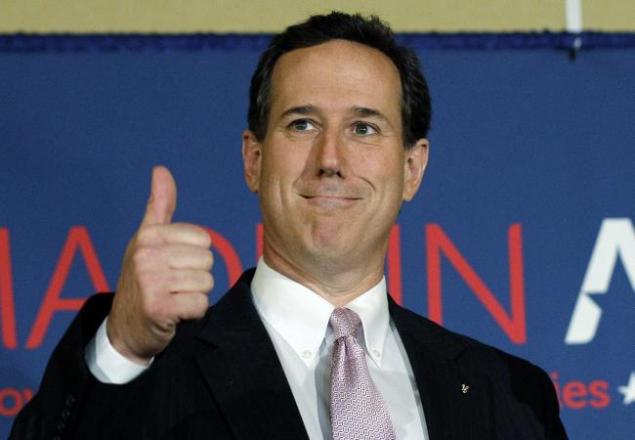
Rick Santorum

You would be forgiven for thinking that Rick Santorum disappeared back into the political wilderness with the end of the 2012 presidential campaign, destined only to pop up occasionally on Fox News to wring his hands about the private sex lives of his neighbours, or to pen wacky columns for World Net Daily.

But you would be wrong.

The great and the good of the Republican Party (and Mark Sanford) have been showing up at the annual Faith & Freedom Coalition conference this past week, to stroke the egos of the evangelical “Christians” and “moral majority” Bible-thumpers therein assembled. Featured prominently among the speakers, none other than Rick Santorum.

Politico reports his speech in the context of Santorum’s implicit criticism of the Mitt Romney 2012 campaign, specifically the focus on the “You Didn’t Build That” theme:

The former Pennsylvania senator recalled all the business owners who spoke at the Republican National Convention.

“One after another, they talked about the business they had built. But not a single—not a single —factory worker went out there,” Santorum told a few hundred conservative activists at an “after-hours session” of the Faith & Freedom Coalition conference in Washington. “Not a single janitor, waitress or person who worked in that company! We didn’t care about them. You know what? They built that company too! And we should have had them on that stage.

Rick Santorum is dangerous, because he alone (with the partial exception of Ron Paul’s principled candidacy) instinctively gets something about the American electorate that is all but completely lost on all of the other past and potential Republican presidential candidates over the past two election cycles.

He understands that – as we saw with the recent Bilderberg Meeting protests – an increasing number of people are becoming disenchanted with the status quo system of economic and financial governance, and are losing faith in the American dream and any hope of regaining the middle class lifestyles that they once took for granted. And he understands the undercurrent of resentment resulting from this realisation, and the corrosive effect on Mitt Romney’s base of support.

The article continues:

Santorum did not mention Romney, whom he challenged in the primaries, by name during a 21-minute speech in a dim ballroom at the Marriott (a company on whose board Romney sits). But there was no doubt who he was talking about.

“When all you do is talk to people who are owners, talk to folks who are Type A’s who want to succeed economically, we’re talking to a very small group of people,” he said. “No wonder they don’t think we care about them. No wonder they don’t think we understand them. Folks, if we’re going to win, you just need to think about who you talk to in your life.”

Trying to carve out a role as a leading populist in the 2016 field, Santorum insisted that Republicans must “talk to the folks who are worried about the next paycheck,” not the CEOs.

This really gets to the rub of the problem, and is an exact restatement of my recent arguments against the secretive Bilderberg group. The Bilderberg attendees meet in secret with other highly successful people just like themselves, and presume to prescribe policies and solutions for the entire world based on their extraordinarily narrow range of experience. Similarly, the majority of GOP presidential candidates wouldn’t spend a moment of their lives in the company of someone who couldn’t write them a fat campaign cheque at the end of the day, but instinctively understand the preoccupations and concerns of business owners and rich financiers. And based on this narrow set of acquaintances they presume to create solutions “for the good of the country”.

Rick Santorum stands out among a sorry crowd of potential Republican contenders as someone who can not only talk to the “47 percent”, but also speak up for them.

Never mind that the solutions that he proposes – more protectionism, propping up inefficient, declining American industries and preventing the inevitable and needed transition toward a more knowledge-based economy – would actually harm this constituency so dear to his heart, as I explained last year when I dubbed him the “Pied Piper of Pennsylvania”. By virtue of the fact that he actually takes the time to understand and advocate for this group of downtrodden Americans, he will inevitably pick up a lot of support should he choose to enter the 2016 Republican presidential primary race.

Unfortunately, by voting for Rick Santorum not only do you get his special nostalgic, doomed-to-failure (but very populist) economic policy, you also get the basket of socially regressive and (in some cases) out-and-out bigoted policies for which he proudly and unapologetically stands. Hence the danger.

Yes, it is slightly ridiculous to be thinking about 2016 already. But at the present time, there is only one Republican who really gets it when it comes to the economic frustrations of the American middle and working class. And the danger – the Santorum Threat – is that if the economic outlook has not significantly improved by the time of the next election, and if the rest of the Republican field remains incapable of sympathising with anyone other than hedge fund managers and “job creators”, the man who lost out to Mitt Romney in 2012 could steal the nomination in three years’ time.

Law? What Law?

I have so much to say about the shocking NSA unconstitutional spying scandal blown wide  open by whistleblower Edward Snowden and journalist Glenn Greenwald that I barely know where to begin.

So I shall begin with a tangent – the repercussions of the case over in Britain, where scandal has erupted because it turns out that Britain’s intelligence-gathering departments have had access to the US PRISM system for a number of years, and have made use of it on occasions to eavesdrop on the conversations of British citizens.

This should be causing people to light flaming torches and take to the streets, but as it stands today in docile modern day Britain, Prime Minister David Cameron is just being made to squirm a bit. The Huffington Post reports:

The foreign secretary, who is due to make a statement on the allegations in the Commons later, has said the law-abiding British public had “nothing to fear” from the work of GCHQ.

However MPs are likely to press Hague on whether the intelligence service has always abided by the legal framework.

Sir Malcolm Rifkind, the chairman of the ISC, told BBC Radio 4’s Today programme that GCHQ would have needed to ask ministers before requesting information on British citizens’ internet activity from the United States.

How comforting. But worst of all were the comments from David Cameron himself, who thought that these flimsy, meaningless words would serve somehow to placate us:

David Cameron has said British intelligence agencies operate “within a legal framework”, as MPs prepare to grill William Hague on GCHQ’s involvement with the American Prism internet surveillance system.

“I think it is right that we have well-organised, well-funded intelligence services to help keep us safe,” the prime minister said on Monday morning.

“But let me be absolutely clear. They are intelligence services that operate within the law, within a law that we have laid down, and they are also subject to proper scrutiny by the intelligence and security committee (ISC) in the House of Commons.”

What the hell does this garbage even mean?

British intelligence agencies are operating within a legal framework. Okay, what legal framework?

He thinks that it’s right to have an intelligence service? Who on earth was saying that it wasn’t?

But the final line is the worst, where he says that the intelligence services are operating within “a law that we have laid down”. Oh, well that’s fine then, let’s all go home.

Does David Cameron at any point mention the particular law under which the intelligence services are operating? Or when this law that “we” laid down was written, voted on and approved? Of course he doesn’t! And I, for one, would rather like to know.

Do you see the difference between having a written constitution and not having one? Do you?

Even if (as in the United States), the President and his administration choose to brazenly flout it, the written constitution at least gives a frame of reference when it comes to determining whether an action is acceptable or unacceptable. Contrast this with Britain, where the most basic laws of the land can (and often are) changed on a whim by the elected dictatorship of a majority government. In Britain, if we are told that a government action that we disagree with is “lawful”, there is no end of Acts and Amendments and revisions and EU law and whatever else to sort through in order to work out whether or not it is so.

The result, of course, is that the British don’t even try. We might kick up a bit of a fuss if someone catches David Cameron devouring live puppies in the alley behind Downing Street one warm summer night, but once his spokesman assures us that he was acting “within the law, within a law that we have laid down”, we would all meekly nod, and let him get back to his puppy-butchering.

This is unacceptable. William Hague and David Cameron need to make crystal clear not only the laws currently on the statute books which allow for spying on the communications of a British citizen (with or without a warrant), but also the specific criteria that the intelligence services use, or at least the threshold of evidence that must be met, when selecting an individual for such a breach of their privacy.

Not that it much matters. David Cameron has lost my vote today.

Patriot Watch, Ctd. 5 – Bilderberg Meeting

I’m removing the ” ” quotation mark symbols around this particular edition of Patriot Watch, because I think Alex Jones is right and undeserving of parody on something rather crucial currently taking place. His show from Wednesday 5th June, broadcast from London, is shown in full below:


Currently, the Bilderberg group of elites from the worlds of royalty, finance, media and industry are meeting at an exclusive hotel in the town of Watford, Hertfordshire, England.

For those who hear the word “Bilderberg” and immediately think “nonsensical conspiracy theory and black helicopters” – it is not – at least not as much as in the group is real and exists. They actually have a website now, which briefly details their official public aims, and meeting dates (but crucially, no minutes of those meetings or list of decisions taken or policies approved to be implemented). You can find their own website here to verify.

Why should any of this matter?

Well, as Alex Jones of InfoWars.com fame (or notoriety) says, if 150 of the biggest entertainers, movie stars and other celebrities, mostly very wealthy private individuals, were meeting for several days at an exclusive resort with tight, taxpayer-funded security around it, not only would the TMZ.com helicopter be flying overhead capturing live footage, but hundreds of thousands of people would converge on the scene to see their favourite stars and find out what was taking place inside.

But when people who hold the real reigns of power in our world – the heads of the largest banks, tech companies, royalty and others – meet with people who are currently in government (both George Osborne and Ed Balls, the UK’s chancellor and shadow chancellor respectively are attending, along with various heads of state and politicians from other countries, no one seems to care.  Even though surely, the least crazy conclusion to reach is that those people serving in government are going to come away from their luxurious meeting and enact policies that primarily serve the interests of the high-flyers with whom they were consorting?

Fortunately, more people are now starting to pay attention to this hide-in-the-open-air tactic of our elites meeting in wide open but unapproachable view to stitch up policies that benefit them but harm almost everybody else. See this interview on-site outside the Bilderberg steel wall, with UKIP MEP for London, Gerard Batten:


As Batten correctly states, people increasingly feel that government is something that is done to them, rather than of them, by them and for them, as is the ideal that we all hopefully still share, and was so eloquently expressed by Abraham Lincoln in his Gettysburg Address of 1863.

Hence, partly, the appeal of the Tea Party in America, and UKIP in Britain. Anything anti-establishment and perceived of being outside the rotten, corrupted system is being embraced with ever-increasing fervour.

I’m not writing this post to announce that I am now a card-carrying InfoWars subscriber, or that now I suddenly believe that the JFK assassination was a conspiracy, in “false flags”, or that the US government perpetrated or allowed the 9/11 attacks or the Boston Marathon bombings. Not at all.

But is it not a mightily strange coincidence that the people currently gathered at the Grove Hotel in Watford, Hertfordshire, UK – the royalty and dignitaries and media moguls and industry titans and captains of finance – have all done extraordinarily well financially and professionally, even since the great recession tore through our countries, while we have faced lost jobs, long term unemployment, fewer prospects, food insecurity, rising inflation, increased taxation and reduced living standards?

If Bilderberg were just a club for the rich of the world to get together and play golf, protected by their own privately-funded security, that would be one thing – even though, as Adam Smith wisely and presciently wrote in The Wealth of Nations:

People of the same trade seldom meet together, even for merriment and diversion, but the conversation ends in a conspiracy against the public, or in some contrivance to raise prices. It is impossible indeed to prevent such meetings, by any law which either could be executed, or would be consistent with liberty or justice. But though the law cannot hinder people of the same trade from sometimes assembling together, it ought to do nothing to facilitate such assemblies; much less to render them necessary. (Chapter X, Part II)

But Bilderberg is more than this because (1) we the people, through our taxes, are paying for these people to be shielded with privacy and protected with armed police, and (2) our elected officials are going to meet with them, and we will have no record of with whom they met, what was discussed in their meetings, or what was decided at the outcome.

There will be no press conference or public statements, as at least you get from self-congratulatory back-slapping events such as the Davos Forum. Just silence, silence that we are supposed to accept from our elected leaders after they share lobster dinners year after year with these elites, whilst meanwhile year after year these elites magically manage to continue to prosper, even as we the people suffer.

And as for the argument that our intrepid media would of course bring it to our attention if anything untoward or bad were taking place, when it comes to journalists and their role covering and exposing nefarious deeds or acts that are contrary to the public good, their credentials and reputations are totally and utterly undermined, in the US by their fawning over power and inability to question the Bush Administration’s feeble reasoning for war with Iraq, and in the UK by the phone hacking scandal, as just two of their most recent abdications of professional ethics failures.

So it can hardly be a surprise when the BBC’s lone reporter on the scene accuses Alex Jones of conspiracy theorising, shares none of his curiosity about what might be going on behind the big steel fence, and tries to provoke him into another one of his famous Piers Morgan show-style rants:


This video clip is many things, but good journalism it is not, from the BBC, and I would defy any right-thinking person to disagree with me. And if this is what we get from one of the most “prestigious” news and media organisations in the world, who knows what other news organisations might have overlooked, disdained, ignored, covered up or fawned over in the past, leaving us all in the dark? Can we then trust Sky News in the UK, or Fox News in the US, given their ownership? Of course not.

I find it strange and somewhat of a stylistic and political departure to be writing this article, but I’m sick and I’m tired. I don’t think it’s right that someone like Mitt Romney can pay a far lower effective rate of tax than me because he derives his income from investments whereas I derive mine from a salary. I think that if fairness means anything, tax rates should be flat.

I don’t understand why it should be that shoplifting or marijuana possession can see a person sent to prison and their life ruined, but conspiring to fix the LIBOR rate doesn’t result in any conviction for any of the people involved.

Oh, I understand why it is, but not why it should be.

And for all of his over-exaggerations, egotism, self-promotion and tendency to see the New World Order in every single event that happens around the world, Alex Jones and others like him are some of the only ones talking about this, even while they are mocked by the haughty, semi-secure, comfortable middle class journalists and newsreaders who are much closer to the edge of the economic precipice than they realise.

I’ve had enough of it. I want to know who my elected representatives are meeting at that sealed-off, taxpayer funded security protected site for wealthy private individuals. I want to see the pertinent minutes after the meeting detailed lists of what was discussed with elected officials, what was decided, and what new cack-handed policies we can expect to germinate in our national and EU legislatures as a result of the super-rich gala bash taking place in Watford this week.

Call me an idealist, but I still believe that my government should be first and foremost accountable to me, a British citizen, and not to Amazon or Starbucks or Google or Jeff Bezos or Eric Schmidt or Bill Gates (for all the excellent philanthropic work his foundation may do), or anyone or anything else other than other living, breathing, British citizens.

Semi-Partisan Sam is saying No.