Drama in Australia – Kevin Rudd Returns – Julia Gillard Out

An evening of political intrigue and drama tonight in Australia, in what The Guardian describes as “an unprecedented day of political bloodletting in Canberra”:

The day of high drama began in the morning, when supporters of Rudd, who had advocated his return to the leadership for the past three years of the hung parliament, began circulating a petition to try to force a contest in this, the last sitting week of parliament before the September election.

Within hours, Gillard went on the attack and made the decision to hold a snap vote on her position. “It is in the best interest of the nation and the Labor party for this to be resolved,” she said. “This is it. There are no more opportunities, tonight’s the night.”

Wednesday’s change of leader follows months of speculation, during which Gillard made clear she would not stand down despite opinion polls that repeatedly showed Rudd to be the more popular leader.

With the party’s support dwindling to about 30%, and the prospect of Labor losing at least half of its parliamentary seats, she stood firm while Rudd’s backers plotted.

After enduring near continual speculation about her grip on the Labor party leadership, very troubling polling numbers heading into the coming general election, and several very unpleasant personal attacks from people who should know better and be ashamed of themselves, Prime Minister Julia Gillard called a snap leadership election of the Federal Labor Party – and lost convincingly to longtime rival and former Prime Minister Kevin Rudd.

Gillard was, of course, the first woman prime minister of Australia, and her notable achievements include guiding the Australian economy relatively unscathed through what has been a torrid economic period for most western countries, enacting educational reform, improving foreign relations with the US, China and India and starting a crackdown on child sexual abuse in institutional settings, a problem that has plagued many countries.

Kevin Rudd’s eloquent and moving resignation speech following his loss of the Labor Party leadership to his then-deputy, Julia Gillard, in June 2010:


And Julia Gillard having to give way under much the same circumstances in June 2013:


Certainly a remarkable comeback for Kevin Rudd following once-abysmal personal polling numbers, several abortive attempts at a comeback and two separate efforts by fellow Labor colleagues to draft him back as leader.

But what is perhaps most remarkable are the anti Tony Abbott sentiments expressed by so many of the Labor party politicians who have been commenting on television today, from Kevin Rudd on downwards. Indeed, some parliamentarians and even cabinet members seem to have been willing to fall on their swords and potentially risk the wrath of the electorate and their colleagues not just to bolster Labor’s chances of clinging to power in the coming election, but more to deny Opposition Leader Tony Abbott and the Liberal Party (currently surging in the polls) the chance to form a new government.

There are significant fears that an Abbott government would implement austerity measures similar to those enacted to such remarkable and stimulative effect in the United Kingdom, and the prevailing opinion is that Labor can best mitigate their losses at the coming election under the leadership of Kevin Rudd rather than Julia Gillard.

The two leaders seem to have very different leadership styles; it remains to be seen whether Rudd will have time to stamp his authority on his restive party and turn the polls around before the general election.

UPDATE – Kevin Rudd’s remarks to young people at the end of his brief speech to the media, his apology for the low skulduggery of politics that has alienated many young voters and promise to do better, was a nice touch.

UPDATE 2 – The Telegraph reminds us that the current constitutional settlement in Australia is far from satisfactory. Without making any comment on whether Australia should retain the Queen as Head of State or become a Republic, it is clear that an appointee from London should not be making decisions in another countries’ internal political affairs:

But Mr Rudd’s return as Labor leader leaves serious questions about Australia’s immediate political future. Labor holds power in a hung parliament, so Mr Rudd’s leadership win does not automatically mean he will become prime minister. The matter may need to be decided by the Governor-General, Quentin Bryce; complicating the matter further, her daughter is married to a senior minister, Bill Shorten, who openly supported Mr Rudd’s leadership bid.

Disaster averted on this particular occasion, but someone might want to consider tinkering with the rules and the Constitution some time soon before we risk ending up in hot water.

Who Needs The Voting Rights Act, Anyway?

On a day that ushered in what is seen by many as one of the biggest setbacks for the civil rights movement in many years, with the Supreme Court decision to strike down key provisions of the 1965 Voting Rights Act, we can at least take some small solace in the principled and well-argued dissent, written by Justice Ruth Bader Ginsburg and read by her from the bench.

Yes, it was exactly the usual suspects that you would expect to vote down key VRA provisions.

First, an overview of the day’s events and the court ruling, courtesy of The Guardian:

The US supreme court struck down 48-year-old protections for minority voters in states with a history of racial discrimination on Tuesday, in a decision lamented by campaigners who argued that it gutted the most important civil rights law ever passed by Congress.

The conservative-dominated court argued the act had largely served its purpose in encouraging equal access to the ballot box and said it was unconstitutional to continue singling out southern states for extra scrutiny without new legislation to determine signs of ongoing discrimination.

For nearly 50 years, the law forced certain, mostly southern states to seek permission from federal authorities in Washington for any changes to electoral rules, such as introducing literacy tests to reduce voter registration among minority groups.

However, chief justice John Roberts ruled on Tuesday that although there were some signs of continued racial discrimination, it was no longer sufficient to justify legal discrimination against the southern states caught up by the rules.

This has been a long-cherished goal for many conservatives, and we are already seeing some states (the usual suspects) moving almost immediately to implement new laws that had previously been stymied by section 5 of the Act.

As a general and broad supporter of localism, limited government and states rights, I am naturally sceptical about laws and provisions that make local laws subject to review, alteration or invalidation by an external authority. However, in the case of the Voting Rights Act, specifically the part that makes local authorities with a history of voter discrimination seek approval for changes to voting laws, I believe that the “lesser of two evils” doctrine clearly takes effect. So egregious were the measures used in an attempt to suppress the black and minority vote in many areas, and so important is the ability for all citizens to be able to participate in the democratic process, that a small infringement on local democracy in terms of oversight of local voting laws seems preferable to the larger threat to democracy of risking the exclusion of those same minorities once again.

Of course, the conservative activism which has become an increasingly prevalent hallmark of the Roberts court is unable to see nuance or shades of grey, dealing – as do most ideologues – purely in black and white.

Unfortunately, as Justice Ruth Bader Ginsburg notes in her dissent, numerous instances of blatant attempts to suppress the vote persist to this very day, and are by no means a distant relic of the Jim Crow era. MotherJones summarises some of the more recent examples in a “hall of shame” from Ginsburg’s dissent:

  • “Following the 2000 Census, the City of Albany, Georgia, proposed a redistricting plan that DOJ found to be ‘designed with the purpose to limit and retrogress the increased black voting strength…in the city as a whole.'”
  • “In 2001, the mayor and all-white five-member Board of Aldermen of Kilmichael, Mississippi, abruptly canceled the town’s election after ‘an unprecedented number’ of AfricanAmerican candidates announced they were running for office. DOJ required an election, and the town elected its first black mayor and three black aldermen.”
  • “In 1993, the City of Millen, Georgia, proposed to delay the election in a majority-black district by two years, leaving that district without representation on the city council while the neighboring majority white district would have three representatives…DOJ blocked the proposal. The county then sought to move a polling place from a predominantly black neighborhood in the city to an inaccessible location in a predominantly white neighborhood outside city limits.”
  • “In 2004, Waller County, Texas, threatened to prosecute two black students after they announced their intention to run for office. The county then attempted to reduce the avail ability of early voting in that election at polling places near a historically black university.”

It rather beggars belief that Chief Justice John Roberts and his fellow justices in the majority opinion can look at a political landscape still full of examples such as those shown here, and conclude that the problem is anywhere close to being solved. Or, as Ginsburg puts it:

Throwing out preclearance when it has worked and is continuing to work to stop discriminatory changes is like throwing away your umbrella in a rainstorm because you are not getting wet.

Quite.

The full dissenting opinion can be read here.

Brazil Explodes

Another day passes, and is followed by another night of rioting in cities across Brazil, in scenes that are becoming increasingly familiar.

Protesters in Sao Paolo - Credit: AP
Protesters in Sao Paolo – Credit: AP

The Guardian reports on the latest night of unrest and police heavy-handedness:

A vast crowd – estimated by the authorities at 300,000 and more than a million by participants – filled Rio’s streets, one of a wave of huge nationwide marches against corruption, police brutality, poor public services and excessive spending on the World Cup.

A minority of protesters threw stones, torched cars and pulled down lamp-posts. Police responded by firing volleys of pepper spray and rubber bullets into the crowd and up onto overpasses where car drivers and bus passengers were stuck in traffic jams. At least 40 people were injured in the city and many more elsewhere.

Simultaneous demonstrations were reported in at least 80 cities, with a total turnout that may have been close to 2 million. An estimated 110,000 marched in São Paulo, 80,000 in Manaus, 50,000 in Recife and 20,000 in Belo Horizonte and Salvador.

This isn’t going away any time soon – as President Dilma Rousseff seems finally to realise, as she has now cancelled her upcoming overseas visit to Japan. But what is becoming increasingly clear is the fact that the protests – ostensibly about nominal increases in public transport fares – have now taken on a life of their own, tapping into a lingering and deep-seated resentment of the Brazilian political and business establishment, and that the relatively minor affront of an increase in travel fares was merely the straw that broke the camel’s back.

Indeed, the article continues:

Matheus Bizarria, who works for the NGO Action Aid, said people had reached the limit of their tolerance about longstanding problems that the Confederations Cup and World Cup have brought into focus because of the billions of reals spent on new stadiums rather than public services. Rio is also due to host a papal visit to World Youth Day next month, and the Olympics in 2016.

“It’s totally connected to the mega-events,” Bizarria said. “People have had enough, but last year only 100 people marched against a bus price rise. There were 1,000 last week and 100,000 on Monday. Now we hope for a million.”

I must admit that I am only now starting to familiarise myself with the political situation in Brazil and the huge, until-recently untapped reserves of anger and contempt that the population has for the incompetence of their political leaders – as manifested by a creaking infrastructure, inadequate education and healthcare outcomes, and the mismanagement of large projects such as the preparations for the 2014 World Cup.

Andrew Sullivan (and his knowledgeable readers) has a couple of excellent primers on the situation over on his blog at The Dish.

Certainly there are some very acute problems specific to Brazil which are providing much of the fuel to this particular fire. But step back and look at the causes rather than the symptoms and we realise that they are exactly the same motives that drove people onto the streets and to protest in many other countries (most notably Turkey in recent days) – an arrogant, disengaged government that wears its contempt for the people on its sleeve.

Watch Brazil closely – when public anger can explode like this in the sixth largest economy in the world, all those other countries in the top ten should be getting nervous.

Our Superficial Media

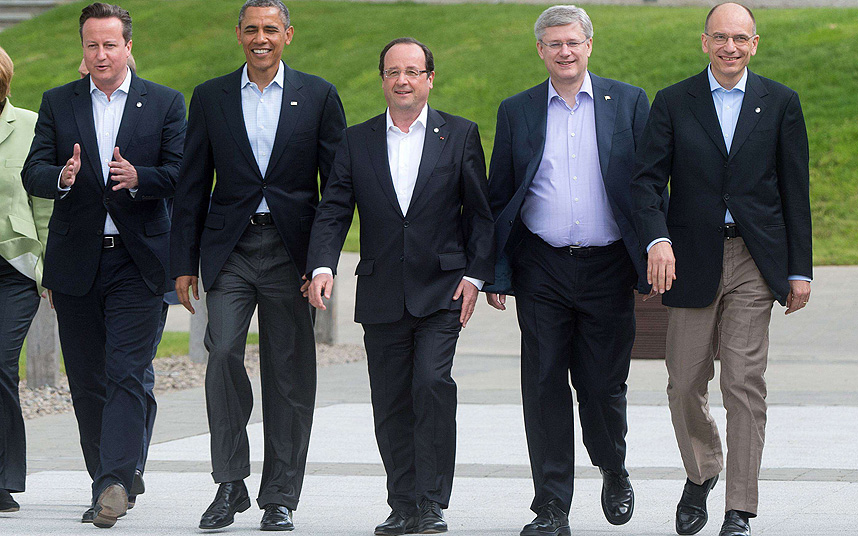
The G8 summit in Lough Erne, Northern Ireland, finished some days ago now, but our intrepid journalists in the press are still on the case, poring over and analysing the ramifications and outcomes of this latest summit.

Unfortunately, the minds of our (supposedly) best journalists and bloggers are not concentrated on the policy substance of what was (and was not) agreed at the meeting, distracted as they are by something far more important and consequential – the fact that David Cameron insisted on a smart-casual dress code for the world leaders at this year’s G8, rather than the buttoned-up suit and tie look that is par for the course at these events.

They mean serious business because the ties have come off

Iain Dale, writing at Conservative Home, sniffs:

Whoever chose Lough Erne as the venue for the G8 should get some kind of honour. As a PR exercise it couldn’t be faulted. The countryside backdrops to all the interviews and press conferences were simply stunning. Less stunning, though, was the fact that David Cameron seemed to have a physical aversion to wearing a tie at any point during the event. Orders had clearly gone out from Number Ten that this was a ‘dress down’ G8, although it was rather difficult to tell whether Angela Merkel had got the message, as in all the pictures I saw she seemed to be wearing the same, tired old lime green jacket. I assume she brought a change of underwear.

What penetrating insight. In The Telegraph, Benedict Brogan thunders:

G8 summits are notorious for their sartorial excesses: matching floral shirts, ponchos, stetsons, it has become a commonplace for the host country to rope the visitors into trying on some sort of local dress. Yet what happens when the world’s most powerful men (sic) gather in the UK? We make them dress like bachelors emerging into the bleary dawn after a vigorous stag party. We might as well ask them to wear jeans. What’s wrong with a bit of understated English tailoring, as a way of plugging one of our more successful exports? In fact, it’s London Fashion Week. There’s all kind of natty pastel numbers available, rather than the blue blazers. But for my money, they should tie one on to show they take the taxpayer – and their responsibilities – seriously.

Someone might be so kind to remind Mr. Brogan that he would be taking his responsibilities as a journalist for a prestigious newspaper more seriously if he focused on the policy agenda of the G8 summit, and not the dress code.

Even The Guardian gets in on the act, with a dedicated feature in their Fashion section:

Not for the first time, the dress code has proved to be one of the trickier aspects of the G8 agenda. Style novice George Osborne underlined the dilemma with his sartorial excuse to BBC Breakfast on Tuesday. “I’m doing what I was asked,” he said. “I got out my jacket and blue shirt.” Forget tax and Syria, smart-casual is tough for these guys.

Cameron demonstrated yet again that for him sleeves rolled up and no jacket semaphores getting down to business. He famously did it on the campaign trail all-nighter and he’s done it at Lough Erne. For him a suit jacket and tie is for everyday prime ministerial humdrum but real power dressing – when he’s hosting international leaders – means pale blue cotton and unironed chinos.

But the real gem comes from the sub-headline to that same Guardian article, which reads as follows:

Forget tax and Syria, smart-casual is tough for these guys. Cameron demonstrated yet again that for him sleeves rolled up and no jacket semaphores getting down to business.

Forget tax and Syria. Indeed. Some people certainly have; unfortunately, they are the people whose job it is to hold our elected leaders to account, to scrutinise, analyse and challenge their activities and policy decisions. With a barely growing economy, persistently high unemployment (we recently celebrated the economy adding 5000 new jobs – a paltry 5000 in country of 65,000,000!) and widespread dissatisfaction with his leadership, David Cameron must have been delighted to be taken to task over his sartorial choices rather than his lacklustre/harmful economic policies and desire for more middle-east adventuring in Syria.

The journalists will no doubt counter that there is a “legitimate public interest” in stories like this, that the public are interested and want to know, justifying all of their column inches on rolled-up shirtsleeves and ties, and the dearth of column inches on the outcomes of the G8 summit. This argument is complete claptrap. The journalists themselves generate the public interest in these process-driven non-stories, thus justifying (in their minds) their decision to cover them in ever increasing detail. After all, it’s far easier to sit at your laptop for twenty minutes and bang out a vapid column about the fashion choices of our politicians than it is to do some real journalism, and pore through meeting minutes and policy papers to educate and inform the public as to what is really going on.

Enough of superficial political “journalism”. David Cameron, Barack Obama and the other six can wear matching gimp costumes to the G8 for all I care; what matters is whether they (for once) manage to cook up some policies that actually benefit the non-elites in our respective countries, and (wishfully thinking) take positive steps toward hammering out a comprehensive EU-US free trade treaty.

But I’m not holding out much hope. Our leaders don’t have the best track record when it comes to acting in our interests, and “journalists” such as Iain Dale and Benedict Brogan seem more interested in clucking disapprovingly at their outfits than scrutinising the decisions that they make.

The GOP’s Immigration Reform Game Theory Dilemma

My Nemesis

When I was in primary school, at about the age of eight, we had a class assignment to make our own abacuses out of wood. We lovingly spent ages glueing them together and painting them with bright colours – to this day, I am still quite proud of that piece of craftsmanship.

The next day, we were due to use our homemade abacuses in class as part of the maths lesson, and it was then that I brought disaster upon myself and earned the wrath of my entire class. There was a girl who had been sick at home the previous day when we were engaged in our arts & crafts, and who consequently didn’t have an abacus of her own to use when the time came. Our teacher approached my desk, where I sat with my best friend Scott, and asked us if we could lend one of our abacuses to the girl so that she could participate in the lesson.

Uh-oh. I looked at Scott. He looked at me. I didn’t want to let me new abacus out of my sight – it was brand new and I hadn’t had a chance to use it yet. Scott clearly felt the same way, even though his model was crooked, garishly painted and looked as though someone had taken an axe to it. I broke the silence first: “Scott, do you want to…?” but he countered “Sam, do you want to…?” (originality was never his strong point).

The teacher became impatient and told us to make up our minds who would lend out their abacus, or the lesson would go ahead sans abacuses for everyone in the class. And still we prevaricated. Even though both Scott and I knew that everyone else in the class was getting increasingly pissed off with us, and that we were in grave danger of ruining the fun lesson for everyone, we couldn’t compromise. So the lesson was cancelled, and Scott and I sat alone at lunch that day.

I recall this long-winded story because the Republican Party is currently making the exact same error that I made when I was eight years old and in primary school, with respect to their stance on immigration reform. Only they have infinitely less excuse, because they are not eight years old (perhaps in mental age) and are paid handsome federal salaries to produce legislation to solve problems.

The Huffington Post reports:

Many House Republicans are chilly or openly hostile to the bipartisan bill before the Senate, embraced by President Barack Obama. Even substantial changes to the bill may do little to placate these lawmakers, who demand strict crackdowns on unlawful border crossings and no “amnesty” for people here illegally.

These Republicans don’t deny that weak support from Hispanic voters is hurting GOP presidential nominees. And they concede the problem may worsen if Latinos think Republicans are blocking “immigration reform.”

These House members, however, worry much more about their own constituents’ opposition to the proposed changes. And they fear a challenge in the next Republican primary if they ignore those concerns.

“It’s hard to argue with the polling they’ve been getting from the national level,” said Rep. Kenny Marchant, R-Texas, referring to signs of serious problems for Republican presidential candidates if immigration laws aren’t rewritten. “I just don’t experience it locally.”

Even the house members themselves admit this gap between the interests of the national party and their local districts. The article goes on to explain the reasoning behind House Republicans’ stances in more detail:

House Republicans, however, spend far more time talking and worrying about their own election prospects, not the next presidential nominee’s.

“It’s a classic challenge when the best interests of the party are at odds with the best interests of the majority of the members individually,” said Rep. Tom Cole, R-Okla. He is close to Speaker John Boehner and other Republican leaders who want a major immigration bill to pass.

“What it takes to get a deal with a Democratic Senate and a Democratic president makes it extraordinarily difficult for a lot of (House) members,” Cole said, “because it can cause you a big problem in your primary.”

Ah yes, the much-feared Tea Party challenge from the right. That nagging fear in the back of the minds of all Republican congressmen and women in this age of the Unreasonable GOP. The fear that leads to gems like this:

Rep. Paul Broun, also seeking Georgia’s Senate nomination, said any immigration deal “must make English the official language of the country.” The U.S.-Mexican border, he said, must be secured “totally, whatever it takes. A double fence high enough to make sure it’s secure.”

Some Republicans wince at talk of massive double fences and making English the official language. They say it fuels arguments that the GOP is unwelcoming to all Hispanics, legal or not.

Hispanic voters are not a homogeneous block, and it would be patronising in the extreme to assume (as many do) that Hispanic disenchantment with the GOP is exclusively due to their policy on immigration reform and what to do with illegal immigrants already settled in the country. Hispanics, like every other voter block, have a whole web of different voting priorities. But with language like this from Rep. Paul Broun (incidentally nominated as America’s Craziest Congressman by Bill Maher), it is not hard to understand how the Republicans managed to lose the Hispanic vote 27-71% in 2012.

I generally don’t like to write articles about process, i.e. the mechanics of how a particular bill gets passed, or the ways in which parties and politicians manoeuvre for advantage. That stuff is usually personality-based gossip of secondary importance, and is covered more than enough by the likes of Politico. But in this case, the process is genuinely interesting and has ramifications that go way beyond who wins the news cycle on a given day, and therefore I decided that it is worthy of comment and discussion.

At some point the Republicans are going to have to make a choice. They cannot claim to be a national party with aspirations of winning future presidential elections without addressing the fact that they overwhelmingly lost the Black, Hispanic, Asian and Female vote in 2012. Yes, in the immediate aftermath of Mitt Romney’s implosion there was a little bit of hand-wringing and soul-searching, but we are now very much back to business-as-usual.

Scarcely a week passes without some new Republican (male) politician deciding to hold forth on the topic of rape in front of a live microphone, or accuse American Muslims of being complicit in terrorist attacks when they don’t denounce them as loudly as is apparently required, or talking about the superiority of a “man’s brain” when it comes to analysing the implications of laws such as ObamaCare.

These cheap, nasty little stunts might play very well back home in their heavily gerrymandered conservative districts, but they will be fatal for the Republicans in 2016. But right now, the party that likes to campaign under slogans such as “Country First” is fragmented, self-serving and unable to step back and solve any problem bigger than avoiding a Tea Party primary challenge.