Let’s play pretend.
Suppose that you are a British voter who happened to express admiration for Nigel Farage back in 2010. Your friends were aghast and asked how you could possibly support such an eccentric right-wing oddball, so you kept quiet for awhile, putting your feelings down to maybe not knowing as much about politics as you should, and feeling a bit chastened by the reaction you received.
Imagine that you then found yourself agreeing with Farage and the UKIP position even more on things like immigration and leaving the European Union when the local elections rolled around in May 2013 and the party made headlines for doing so well. Surely now you could admit to your friends and family that you were becoming a fan of this new kid on the block, especially since one in four voters supported UKIP this time around and they were receiving so much press coverage? But once again, as soon as you mentioned your political sentiments people looked at you as though you must have fallen over and hit your head.
Fast-forward to spring 2014. The things that you think are important issues are still not being addressed by the main political parties,and now the European and local elections are coming up. Only UKIP are offering the policy proposals that seem like common sense to you, and they are the only party whose candidates seem able to express themselves freely and persuasively without sounding like they are reading aloud from (at best) a teleprompter or (more usually) the telephone directory. Surely now people must see the appeal of UKIP? Surely now it must be safe to come out?
At the pub one evening, you admit that you are planning to vote UKIP in the European election, and maybe for the local council too. Outrage! That won’t do at all, it’s quite simply the end of the world. Your horrified friends dive for their smartphones, and before you can blink five brightly-lit screens are shoved in your face, each one blaring “top ten” lists of reasons not to vote UKIP, or trumpeting the misdeeds of a dodgy-looking UKIP councillor on the other side of the country.
Didn’t you know? Nigel Farage wants to rescind women’s suffrage! Godfrey Bloom once chartered a Boeing 767 at his own expense and set up a stall at the Notting Hill carnival, offering dark-skinned people £100 each to hop onboard and fly home to Bongo Bongo Land! How can you think of lending your support to people like that? Are you crazy?
You go home in a sour mood and turn on the computer. You’re sure you had more Facebook friends than that this morning. And why have you received nine invitations to “like” the Liberal Democrats and see the amazing work their MEPs are doing in Brussels, protecting the environment and “standing up to the bankers”? Disgusted – and determined never to vote for Nick Clegg’s party again, no matter how much your overbearing aunt cajoles – you switch on the television. The newsreader is reporting that Nigel Farage was hit by an egg while out campaigning earlier that day. “Wow”, you think. “I know just how he feels”.
Election day rolls around. For the past two weeks, every newspaper article and news segment has seemed to be about UKIP one way or another – and none of them positive. But the UKIP you know from looking at the website and talking to the volunteer on the doorstep doesn’t look anything like the monstrous effigy being held up by the media. You decide to quietly vote UKIP, and just not tell anybody about it. To hell with them anyway, you never said a word when they all decided to jump on the bandwagon and grow pretentious hipster beards.
As the election results start coming in, pandemonium breaks out. David Dimbleby has a meltdown in the BBC studio, the swing-o-meter self-destructs in a shower of sparks, the Labour shadow cabinet form an orderly queue to tell Adam Boulton exactly how Ed Miliband led them to disaster and the Tories are cursing you and your kind for costing them their precious flagship councils in Essex.
What’s more, in the space of two breathless minutes, the all-knowing BBC panel packed with manicured, London-dwelling upper-middle class “experts” has solemnly suggested at least five ludicrous reasons why you voted for UKIP:
You were left behind by the modern information economy. Actually no, you have a decent skilled job; you’re not Alan Sugar but it has good prospects and pays the bills.
Your local community looks nothing like it did in 1960 and it’s scary for you to see the change. Well you were born in the 80s, and you managed to take the internet, iPhones and the falafel restaurant round the corner in your stride without wetting yourself in terror, so that probably isn’t the reason.
You feel persecuted for holding on to your traditional values. Hardly. Two of your friends are gay (the first ones to grow the stupid hipster beards, come to think of it) and although you know that some UKIP councillors have said pretty nasty things about gay people, you’re not homophobic at all, that’s not what attracted you to the party.
You feel like no one listens to you, your vote was just a blind stab at the hated political elite. Well it used to feel like no one listened, but Nigel Farage and his party came and listened. A protest vote would be a spoiled ballot paper or a write-in for the Monster Raving Loony Party. What you did was positive and purposeful, a vote for certain policies you agreed with.
You’re angry, you’re furious, you’re consumed with blind rage. Well yes, but only since the start of this election broadcast!
So many reasons offered by the Westminster commentariat, and none of them the simple truth:
You looked at the Conservative platform and you don’t trust them to deliver on the things that they say they would do – the government is failing to meet its immigration targets again, and the Tories already broke one “cast-iron” promise to hold a referendum on Europe.
You looked at Labour and saw a party that hasn’t even accepted that they did anything wrong when they were in government leading up to the recession, who never mention Europe or immigration at all unless you beat it out of them with a stone, and whose leader can’t even eat a bacon sandwich without getting on the front page of the papers for doing it wrong.
You didn’t bother to look at the Liberal Democrats too closely, because you’re not weird and it isn’t 2010 any more.
But you looked at UKIP and found that their policy prescriptions fit your list of concerns rather handily, and gave them your vote because isn’t that precisely how democracy is supposed to work?
Yes! The truth is that you voted UKIP for the same reason that other people voted for their parties – because you thought through the issues and liked UKIP’s policies. Now why is that so hard for the politicians and people in the media to understand?
Now before you stop reading – yes, there was a point to that tortuous exercise in imagination. Consider:
In the aftermath of the election, all that anyone has been able to talk about is the question of how so many people were conned, duped or tricked into voting UKIP. Earnest, well-intentioned (and less well-intentioned) commentators and newspaper articles have been encouraging us to imagine what it must be like to be a UKIP voter, as though the very thought is so alien that ‘normal’ people actually need a tourist guide into the mind of a Ukipper in order to make sense of the election results. Did you know that they are omnivores and base their waking hours on the rising and setting of the sun, just like us? Fascinating!
But does the media (and they are almost all guilty) ever stop to think what it must be like – purely by virtue of subscribing to some fairly commonly held political views – to be talked about as though you are a symptom of a terrible and shameful national venereal disease, or a wayward prodigal child that needs to be rehabilitated back into the family?
Do the newspaper columnists and TV talking heads ever stop to think just how maddeningly patronising they sound to UKIP voters when they write their anguished, hand-wringing columns on what to do about Britain’s awful UKIP problem?
Most of the time, a conservative can read the Guardian or a liberal the Telegraph and not necessarily feel loved and perfectly understood, but at least see their opinions treated with a very basic level of respect. There were no psychological inquests in the Guardian as to why the voters ignored Gordon Brown’s self-evident brilliance in such large numbers and rudely cast him from Downing Street in 2010, the answer was clearly political.
But with UKIP it is different. It is as though believing in UKIP’s worldview and policies doesn’t deserve acknowledgement, understanding and then persuasion by those who vote differently – it requires correction by those who know better. You’re not thinking properly, UKIP voter. If you were, you would have selected from one of our pre-existing bland political flavours.
Only one article (in the Guardian of all places) shows any degree of contrition at all for the way that UKIP supporters were hounded, bullied and vilified in the press over the past few weeks. Apologies are in very short supply, but there is an abundance of smug condescension packaged as expert political analysis.
A host of British politicians have already been wheeled through the television studios to offer their own variants on the standard post-election-upset mea culpa: we hear their concerns, we need to start speaking their language, we need to show that we are relevant to their lives, we need to stop them from being exploited by the far-right.
You can be sure that all the main parties are plotting their next moves already. The only idea missing from all of their plans? Actually talking to UKIP supporters, and treating them as though they are fellow human beings.
To be a UKIP voter watching or reading the news today must feel as though you are a dangerous but valuable specimen kept in a lab, with a curious Guardian reader in a hazmat suit poking you through the safety glass to see how you respond to political stimuli while someone from CCHQ takes notes and a BuzzFeed staffer snaps pictures and adds mocking captions. I CAN HAZ PINT WITH NIGEL NOW?
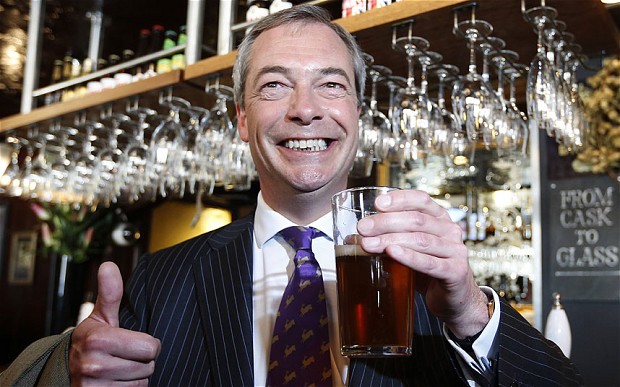
This can’t be a very pleasant experience – the resultant emotion is likely to be one of immense irritation at being so misunderstood and publicly belittled. In fact, the only thing likely to make the whole damn experience any better is watching Nigel Farage’s smiling face as he sinks another pint and poses for photographs with his victorious local candidates.
It’s the political and media establishment’s turn to play pretend now:
You are that UKIP voter. After being subjected to this barrage of disbelief turned to mockery turned to outrage turned to hate turned to amazement turned to curiosity turned to pity from the big three political parties and most of the press, where do your political sympathies lie, looking ahead to the 2015 general election?




 Semi-Partisan Politics