Ed Miliband’s Failure To Relaunch


This dated, early-colour TV footage of President Lyndon B. Johnson addressing the University of Michigan’s graduating class of 1964 stands as a simple, self-evident example of a great political speech.

It’s necessary to point this out because those of us who came of age under the New Labour governments of Tony Blair and Gordon Brown, or even more recently in the Lib-Con Coalition years, may well never have heard one in our lifetimes – at least not in contemporary British politics.

2014 marks fifty years since the unveiling of LBJ’s Great Society initiative, in which Johnson unveiled a sweepingly bold and progressive agenda of domestic programmes intended to combat poverty, inequality and racial injustice in America. Only two years previously, the slain president John F. Kennedy had also called upon his country to dedicate itself to a bold new purpose: landing a man on the surface of the moon and returning him safely to Earth, within the decade. Kennedy’s goal – America’s goal – was achieved on 16th July, 1969.

That’s what leaders do. As citizens of modern Western democracies we are more or less capable of handling the day-to-day business of living life – working, raising families, finding meaningful recreation – ourselves, only looking to government to provide or assist with that which ordinary human beings and families cannot do by or for themselves alone. Great, even competent political leaders understand this truth, and devote their energies to setting the big picture, steering the ship of state, even daring and accomplishing mighty things when the occasion arises.

Or at least, that’s what leaders and prospective leaders are supposed to do.

Continue reading

Chuka Umunna Is Not The Answer To UKIP, Or Labour’s Leadership Crisis

Chuka Umunna Labour Party Champagne Socialist 2


David Cameron has his fair share of problems, with Nigel Farage’s UKIP nipping at his heels and EU Commission president Jean-Claude Juncker goading him about Britain’s £1.7 billion EU surcharge. Nick Clegg faces a daily battle to fend off irrelevancy and the implosion of his party. But despite their tribulations, I doubt that either man would volunteer to switch places with the hapless Leader of the Opposition, Ed Miliband.

The Spectator sums up Miliband’s woes in their sketch of yesterday’s PMQs:

The Labour leader needed a win today. Badly. His poll ratings have dipped to the same level as Gordon Brown’s in 2010, but at least Brown had the excuse of being in a fag-end administration led by a scowling narcissistic tax-junkie.

Indeed. It’s one thing to have terrible personal ratings when you are an establishment figure associated with a party that has been in power for over a decade, but – wait a second, Ed Miliband was all of those things, and still he was installed as the Labour Party leader. The consolation would be that his personal ratings couldn’t possibly fall much further if he did win power and occupy 10 Downing Street, if only the chances of that happy event were not receding quite so rapidly.

Continue reading

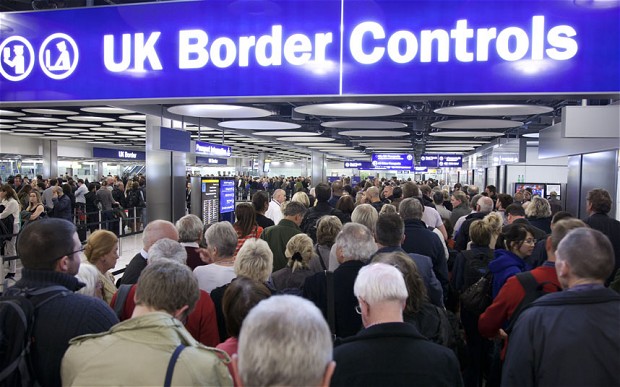
Everyone Is Still Fudging The Truth On Immigration

Britain Immigration EU


The Telegraph’s Morning Briefing email, produced by Stephen Bush, always provides a good summary  of the day’s political highlights, but today one story in particular stands out. Riffing on the old complaint “They come here, they take our jobs”, Bush cites several articles citing a UCL study which point out that EU migrants actually made a net contribution to the British economy when tax contributions and welfare claims are compared, joking “Coming over here, adding £20bn to our GDP…”

Predictably, the newspapers immediately fall into their partisan groupings to spin the news. From the Morning Briefing summary:

“£120bn cost of Labour’s policy on immigration” is our splash. “UK gains £20bn from EU migrants” sayeth the Guardian. “EU migrants add £2obn to the economy in a decade” cheers the Indy.  A study running by two leading migration experts at UCL has thrown further light on the costs and benefits of migration. Migrants from within the EU contribute £20 billion to the British economy, with immigrants from the original 15 EU countries contributing 64% more to the Exchequer than they took out in services and migrants from eastern Europe added 12% more than they took out.

It would be hard to concoct a sample of headlines and statistics that did more to obfuscate and confuse an important political issue, even if you tried. And that’s no criticism of Morning Briefing – it has faithfully published a representative sample of the UK print media’s coverage of an important political issue.

Continue reading

British Politics Has Become A Centrist, Ayn Rand-Style Dystopia

Westminster train 02


Readers of Atlas Shrugged will recall the Taggart Tunnel disaster, a seminal moment in Ayn Rand’s novel. The deadly train accident, an avoidable, man-made calamity, highlights the devastating but inevitable consequence of having too few people of moral fibre, wisdom and intelligence left in positions of power and authority.

For those unfamiliar: in the build-up to the disaster, the Taggart Railroad’s flagship transcontinental service breaks down while passing through Colorado, stranding a trainload of passengers in the mountains. Taggart Transcontinental’s best engineers and executives have long since deserted the company, resigning out of frustration with the endless bureaucratic meddling and the glorification of consensual mediocrity which has taken hold of corporate and political culture in the dying days of the United States. With no replacement diesel locomotives available and with nobody willing to take responsibility or speak truth to power, a self-important politician travelling on the train is able to bully reluctant and inexperienced railroad employees to use a coal-burning engine to pull the train through the long, airless mountain tunnel, resulting in the death by asphyxiation of everyone on board.

The grey characters of modern British politics are far less compelling than those in Ayn Rand’s dystopia, but alarming parallels are starting to appear between the groupthink and instinct for self-preservation shown by  the elite in Atlas Shrugged and the recent behaviour of the Westminster village as it faces the intertwined problems of unfinished constitutional reform, voter apathy, the relentless march of UKIP and an economic recovery that may as well not exist for the low-paid.

Continue reading

The Tipping Point

UKIP Opinium Poll 31 Percent


“To win new recruits, motivate their activists and sustain the interest of politicians and the media, UKIP need to overcome the wasted vote syndrome and appear as a credible choice at general elections” – Robert Ford and Matthew Goodwin, Revolt on the Right: Explaining Support for the Radical Right in Britain


UKIP’s victory in the Clacton by-election, giving the party their first MP, was bad for the political establishment.

The ComRes poll giving UKIP’s Mark Reckless a 13-point lead ahead of the Rochester by-election was awful.

But these local by-elections, history-making as they are, can only do so much damage – they give the main political parties, particularly the Tories, a black eye, and not much more. Even if UKIP go on to win the by-election in Rochester and Strood as now seems likely, Mark Reckless and Douglas Carswell will still only form a caucus of two at Westminster, hardly enough to start flexing their parliamentary muscles or influencing legislation.

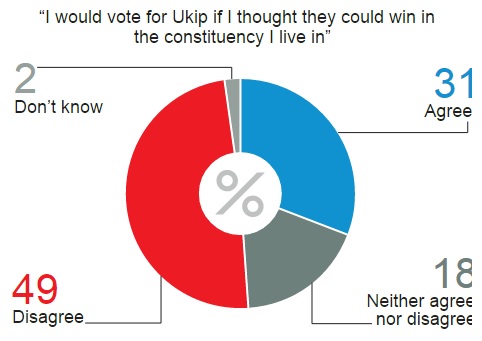
However, a poll just released by Opinium and The Observer reveals something that could shake the establishment to its foundations: 31% of voters would now support Nigel Farage’s party if they believed UKIP had a credible chance of winning in their local constituency. Nearly a third of the electorate are ready to wash their hands of big three political parties entirely, and vote for a new, untested alternative. Not just in the local or European elections, where UKIP are already establishing a track record of success, but in the United Kingdom’s general election next year.

Continue reading