On Gun Control In Britain

UKguns


It’s difficult at the moment to know precisely how seriously to take Nigel Farage’s public pronouncements. In a matter of days he has managed to offend a great number of people by suggesting that once you adjust for maternity leave, women working in finance have at least a level playing field with (if not an easier time overall than) men; he appeared to prevaricate when confronted with another loony UKIP local councillor, this one publicly attributing the UK’s recent bad weather to the coalition government’s legalisation of gay marriage; and he publicly disowned the 2010 UKIP manifesto, which he personally helped to launch.

All of this is rather unfortunate, because in many ways Nigel Farage remains one of the most principled and straightforward politicians in Britain today. Aside from some heavy-handed and paternalistic conservative attitudes to social issues such as gay marriage and an excessive obsession with immigration restrictions, the policies currently espoused by UKIP are ones which would appeal to many a libertarian-minded voter grown disenchanted with the Tories under David Cameron – myself included. Therefore, I hope and trust that the PR wobbles of this week will soon be behind him.

But more importantly, I hope that the current furore does not drown out a more important debate that Farage has initiated – whether or not to relax Britain’s stringent gun control laws and relax the blanket ban on handguns. Farage is of the opinion that to do so is right in accordance with conservative principle, with individual liberty and with common sense.

The Guardian reports:

Asked about gun controls, Farage said: “I think proper gun licensing is something we’ve done in this country responsibly and well for a long time, and I think the kneejerk legislation that Blair brought in that meant that the British Olympic pistol team have to go to France to even practise was just crackers.

“If you criminalise handguns then only the criminals carry the guns. It’s really interesting that since Blair brought that piece of law in, gun crime doubled in the next five years in this country.”

“I think that we need a proper gun licensing system, which to a large extent I think we already have, and I think the ban on handguns is ludicrous.”

The initial arguments brought to bear against Farage are not terribly convincing:

Ian Mearns, Labour MP for Gateshead, said the comments were an example of “how extremely dangerous Ukip are”.

“Families facing a cost-of-living crisis will find it bizarre that one of Nigel Farage’s priorities would be to relax Britain’s tough gun controls,” he added.

So we are told that the policy is “dangerous”, and then fed the old line that the British public believe that politicians can and should only ever focus on one issue at the time, and that the economy must crowd out everything else. When someone leads off with the “why aren’t we focusing on something else?” argument, they generally don’t have much else in the way of persuasive arguments.

As a libertarian-minded voter, given a blank slate and in an ideal world I would like to see the blanket bans on handguns in the UK repealed. While recognising that Britain is very different culturally to America on this issue, where the Second Amendment enshrines the right to bear arms very clearly, I believe that our country (at least the people, if not our government) do also place great value on the freedom to defend oneself with any force necessary if required. The strength of public feeling in the Tony Martin case rather proves my point, no matter how much gun control advocates might desire to wish it away.

Where we differ more substantially is the fact that in America, the Constitution makes clear that the right of the people to bear arms shall not be infringed not only for reasons of protection and self-defence against personal violence, but also against oppression by the government. In Britain, where our rights are granted to us by the government and it is our lot to bow and scrape and be thankful for what we are given by way of freedoms, this is clearly not the case. The government is not ours; rather, it belongs to Her Majesty. This may seem like a quibbling detail, but when looking at issues of civil rights and liberties it is an important one.

As a general principle, I don’t think it should be the government’s business to ban or to allow small arms, or to do many other things. I would be quite happy if the government could content itself with competently undertaking its core functions of defending the nation, protecting property rights, providing law and order and providing a framework for other institutions to deliver much of what currently falls under the welfare state. I have sufficient belief in the goodness of human nature to think that, if properly guided and harnessed, this might be achievable.

However, I also recognise that this is not the seventeenth century, and I am not a stockinged, bewigged colonist in the New World. We do not live in a time of attempting bold new methods of self governance – or bold new methods of doing anything at all, and there is little desire among the public to become the kind of country where such experimentation takes place. And this is where conservative pragmatism comes into play. On the topic of gun control specifically in the UK, I cannot support Nigel Farage’s belief that gun control laws should be repealed.

Guns are not plentiful in the UK as they are in the United States. Making it legal for average members of the public to own firearms again would initially empower those people, but there would be a gradual and inexorable drift of firearms from law-abiding citizens to active criminals. Like almost anything, if you are criminally minded and you want to lay your hands on a gun, you can do it if you invest time making the right connections. But it is difficult to do unless you already have those links with the criminal world, and so guns are not purchased in the UK on a whim, or by ordinary folk for use in a moment of high passion – the supply is small and in the hands of professional criminals, and therefore it simply takes too long for someone not in the know to make the purchase. Why expand the supply and start to make it exponentially easier?

In the United States, the case is very different. Guns are a dime a dozen, and any blanket ban on firearms in America, as well as being grossly unconstitutional, would leave law-abiding citizens defenceless in a country where almost every criminal has ready access to a gun. In short, banning guns in the United States would put the population at risk while the population of the United Kingdom would be more endangered by the legalisation of firearms.

I freely admit that a bulk of conservatism and libertarian opinion may differ with me on this issue. Indeed, The Commentator last year revealed something of the depth of feeling on the repeal-gun-control side:

The choices include term limits for Prime Ministers, a flat tax, a law to encourage the ‘greening’ of public spaces and the repealing of Britain’s hand gun ban. Following the Dunblane massacre in 1996, in which 16 schoolchildren were killed, Parliament passed The Firearms Act of 1997, which essentially banned handguns for the atrocity.

But Britons seem unconvinced by the law. The proposer, known as “Colliemum” asked, “…why should only criminals be ‘allowed’ to possess guns and shoot unarmed, defenceless citizens and police officers?”

While the poll continues, so far over 80 percent of the 11,000+ respondents have told the Telegraph that they want to see the handgun ban repealed.

Unscientific, yes. But also highly emphatic.

I have called often and loudly for a constitutional convention for the United Kingdom, to decide once and for all the powers we are willing to give to the government and those which we insist on keeping for ourselves, as well as to fairly and equally devolve powers to the four home nations under a federal system. Part of the output of such a convention would inevitably be a decision on whether we are happy to continue being granted our rights or having them taken away by the whim of each successive Parliament, or if we want to enshrine certain inalienable rights in a more permanent and unyielding document.

But until my call is heard and a Constitution is written and adopted, there is no document to which we British can point to say that government shall not deprive us of the right to own guns. Neither is there precedent, or a persuasive common sense argument. Ceteris parabus, just as there is no sound or legal way in which American citizens can be deprived of their right to bear arms, so there is no reason rooted in law why the British should have theirs returned.

As the American civil war drew to an end, James Russell Lowell wrote:

Among the lessons taught by the French Revolution there is none sadder or more striking than this, that you may make everything else out of the passions of men except a political system that will work, and that there is nothing so pitilessly and unconsciously cruel as sincerity formulated into dogma.

Sincerity formulated into dogma. We see this a lot today, both in Britain and America. In the United States it is manifested most obviously in the Tea Party and the demands of its more fanatical members to immediately roll back the functions of government regardless of the potential suffering of those who have come – and in many cases been encouraged – to depend on it. Pitiless yes, and often cruel too. And in Britain we see this dogmatic approach, I am sad to say, in Nigel Farage’s call to repeal the gun control laws.

When my libertarianism meets the fact of modern Britain, the conservative in me must side with the real world as I find it, and for that I do not apologise.

Missing The Point On Immigration

They're a' comin...


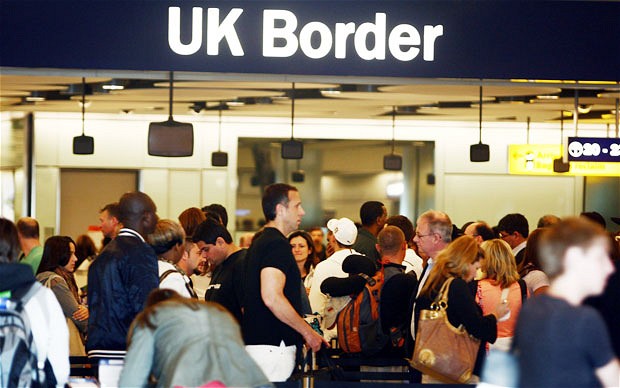
James Kirkup, writing in The Telegraph, asks “How much would you pay to reduce immigration?”, in an article praising UKIP’s Nigel Farage for making the supposedly bold proclamation that he would rather be slightly less well-off in return for lower levels of immigration into the United Kingdom – in other words, that he is willing to pay out of his own pocket to reduce immigration.

[Farage] added: “If you said to me, would I like to see over the next ten years a further five million people come in to Britain and if that happened we’d all be slightly richer, I’d say, I’d rather we weren’t slightly richer, and I’d rather we had communities that were united and where young unemployed British people had a realistic chance of getting a job.

“I think the social side of this matters more than pure market economics.”

Kirkup, who considers this to be a “genuinely interesting” way for Farage to reframe the debate, phrases the quandry this way:

How much economic growth should we give up? How much of your fellow citizens’ prosperity, are you willing to sacrifice in order to cut the number of people entering Britain from abroad?

To be precise, how much — to the nearest £1, please — would you pay to reduce immigration?

Unfortunately, by accepting Farage’s premise that immigration is harmful in all spheres other than the economic – and the idea that immigration must automatically be a negative thing, a cause for concern or something to be ameliorated.

This is yet another argument where the two opposing sides seem to argue back and forth over an irrelevant distraction rather than the main issue. Why is it that immigration has, at times, led to divided communities and fractured society? Why must it be that immigration puts the young British unemployed at even more of a disadvantage? If only we could begin to address and turn around these key issues, surely the matter of net immigration into the UK would cease to be of almost any importance at all.

For example, we should re-examine how Britain can better to integrate and assimilate new immigrants into our society, avoiding the mistakes of countries such as France and learning from those such as the United States. How can we ensure the right balance between providing support and assistance to help new arrivals find their feet and integrate into society, and using “tough love” where necessary to ensure that the state is not enabling immigrant communities to isolate and refuse to become part of British society?

We should take a long, hard look at our education system and parenting culture and ask why it is that a young adult born and raised behind the iron curtain in an economic, political and social environment far less prosperous and nurturing than that of the UK is so often preferable, in the eyes of so many reputable and rational employers, to a British-born young jobseeker who has enjoyed all of these advantages.

And yes, we should look at the topics of welfare and the terms of our relationship with the European Union, and decide whether allowing brand new economic migrants to our shores to benefit from the welfare system that the rest of us have paid into over a longer period is really a cost that we are willing to continue to pay in order to maintain our EU membership in its current form.

None of this debate will happen as long as we accept the premise that economics aside, immigration is an inherently bad thing – to shrug our shoulders and go along with Nigel Farage’s line of reasoning, as James Kirkup and others do so willingly.

How much would people pay to have an informed debate about the real social, educational and economic issues around immigration? More than our politicians and media seem to realise.

UKIP Panic Sets In

Nigel Farage UKIP voting


Yesterday I wrote about the rise of the UK Independence Party (UKIP), and the way in which they have transformed themselves over just a few years from being an upstart fringe party full of “fruitcakes and closet racists” (thanks, David Cameron) into a populist, compelling electoral force to be reckoned with.

I set out the reasons why I think that UKIP offer a compelling manifesto, and how they may well escape the usual fate suffered by smaller parties in general elections, i.e. falling back into obscurity, single-digit vote shares and zero parliamentary representation.

Evidently other people see the writing on the wall for the traditional Labour/Conservative/LibDem trifecta too, and none do so with more trepidation than loyal-but-ideologically-compromised traditional Conservative supporters, who rather than re-examining and changing their own faulty policies would rather destroy the newcomers who make them look bad by comparison.

Cue this hit piece from Mary Riddell, writing in The Telegraph. She thunders:

So consider, this morning, what a Ukip Britain would look like. it would be a locked-down land, armed to the hilt, where good foreigners were repelled and bad ones expelled, no questions asked. It would be a country concreted over for extra jails (though never for high speed rail lines). It would be a quaint place – an old curiosity shop of matrons and smoking rooms.

It would be a nation of wild spending, of derisory taxes for the rich and – not least because all talk of climate change would be abandoned – a country programmed for ruin. Welcome to Mr Farage’s Britain.

That future should not only alarm Ed Miliband. It should horrify us all.

More insidiously, she continues the old-guard Tory attempt to paint UKIP as the British National Party in a pin-stripe suit disguise, warning:

Moreover, today’s results are the first sign that Britain is far from immune to the lurch towards extremism that has shadowed other European countries and been exacerbated by recession. For sure, Ukip is no Golden Dawn and Mr Farage no dangerous rabble-rouser. Even so, his party’s performance invites comparison with the progress made by Marine Le Pen’s Front National in France.

If UKIP is no dangerous party and it’s leader no Jean-Marie or Marine Le Pen, why is Liddell then inviting comparison with those very same people and entities? Such a heinous accusation, so innocuously put. And of course the answer is as obvious as the motive of her rhetoric is tawdry – you can put two groups together in the same sentence and protest loudly that you are not comparing one with the other, but all that people will take away and remember is that UKIP and the far right are somehow associated.

Note also the total lack of any evidence to back up her words. Is Mary Riddell being serious? From where is she conjuring this nightmarish dystopia of a UKIP-ruled Britain? Certainly not from their own manifesto, which reads like a broadly libertarian (though a touch too socially authoritarian) set of policies that many Tories and centrists could get behind.

If she is choosing to smear UKIP based on some of their whackier supporters or representatives, she should remember that less mature parties have a harder time screening their candidates as they work to develop a national presence, and that there are plenty of thoroughly cringeworthy people in the Conservative, Labour and Liberal Democrat ranks, too.

I was a UKIP doubter once, but now I’m not so sure. Their advocacy of smaller government, more competition and less regulation in both private and state sectors, and a flat tax are all very appealing to me. If the Conservative Party and their allies in the right wing media want to keep my loyalty and win my vote at the 2015 general election, the surefire way to fail in that task is to tell me that I am an ignorant reactionary being seduced by a borderline nationalist outfit favoured only by curtain-twitchers, closet racists and little-Englanders.

Mary Liddell and her ilk would do well to remember that.


UPDATE (16.25PM) – I took a closer look at the article byline and realised that Mary Riddell is actually a Labour supporting journalist, so my mistake. Of course, she has her own reasons for wishing to bash UKIP. What actually makes my misunderstanding funnier, and even more pertinent, is that her words could be so easily confused with those of any right-leaning journalist or commentator wringing their hands at the rise of UKIP.

The UKIP Insurgency

Nigel Farage UKIP voting


Well, those local council elections across England this past week were quite interesting.

The United Kingdom Independence Party has firmly established itself as Britain’s fourth (or maybe even third) party with a strong showing in which they received over 25% of the vote across those wards where they were able to field candidates.

And this despite a volley of negative and dismissive statements ahead of the elections, in which UKIP’s leadership, membership, policy positions and candidate screening processes were all mocked and derided.

Cue lots of hand-wringing about what the Tories can do to win back their disaffected supporters, etc. etc. As The Guardian reports:

A contrite David Cameron has promised to show a surging UK Independence party respect after it gained more than 130 seats in the English county elections and polled 25% of the national vote. The result led the party’s leader, Nigel Farage, to claim the birth of a new and irreversible era of four-party politics.

Cameron, who once described Ukip as fruitcakes and closet racists, admitted his mistake, saying it was no good insulting a political party that people had chosen to vote for: “We need to show respect for people who have taken the choice to support this party. And we’re going to work really hard to win them back.”

Cue also some quite entertaining journalism about the quirky, eccentric nature of British local politics. As Iain Martin writes in The Telegraph:

What is even funnier is the confusion it is causing the leaders of the established political class. They are already emerging for a round of local election bingo, with the key phrases drawn from the standard issue manual used by all the major parties. “We hear what people are saying… people want to make a protest… they want us to get on with the job… people have very real concerns… it’s mid-term… we’ll be reflecting.” But this time, when they mouth the words, they look as though they know their platitudes have been rumbled.

The distress the voter rebellion causes the bigger parties does seem to be an important part of the appeal of Ukip. Voting for Farage is an entertaining way of giving the Tories, Labour and the Lib Dems two fingers. Of course the longer-term implications are not necessarily funny. This is a country, not a comedy club. But large numbers of voters are so disenchanted that they see no possibility of an answer in the old parties. They are having a lot of fun trying to blow up the system.

Of course, this runs contrary to the counterargument that these were only local elections, that off-cycle elections always see the governing party (or parties in this case) punished at the ballot box, and that people will return to one or other of the Big Three come the general election in 2015.

But a 25% share of the vote, and a national second place position, can start to shift perceptions, a fact that Nigel Farage, UKIP’s leader, is no doubt counting on. If people absorb the consequence of these election results and no longer see UKIP as a party of “fruitcakes and closet racists”, as David Cameron once uncharitably called them, their support may not peel away as it has previously done, and we could see a number of newly minted UKIP MPs entering parliament.

But what is contained within the UKIP manifesto? Well, quirky though some of their individual members and candidates may be, the manifesto on which they are running is actually quite appealing to those who favour smaller government. The BBC offers a fair overview, which includes the following:

EUROPE: Nigel Farage says he wants an “amicable divorce” from the European Union. Britain would retain trading links with its European neighbours but would withdraw from treaties and end subscription payments, adopting a similar relationship with the EU to Norway or Switzerland.

TAX: UKIP favours a flat tax – a single combined rate of income tax and national insurance paid by all workers. It claims this would end the complexity of the current system and allow people to keep more of the money they have earned. It would also lead to a major shrinking of the size of the state, which would revert to a “safety net” for the poorest. The party has yet to decide the rate at which the flat tax would be levied. Its policy at the 2010 election was 31% but a recent policy paper suggested 25%. It is having an internal debate about whether there should be two rates.

EDUCATION: UKIP backs selection by ability and would encourage the creation of new grammar schools. It would give parents vouchers to spend in the state or private education sector. It also advocates the return of the student grant system to replace loans.

DEMOCRACY: The party wants binding local and national referendums on major issues.

Freedom from EU meddling and over-regulation. A fair, flat tax. Freeing the education system from those who want uniform mediocrity at the expense of individual excellence. A strong national defence. All of these are causes dear to the hearts of the small-government conservative, and make the party worthy of support.

Of course, with the good also comes the less-good:

ENERGY AND CLIMATE CHANGE: UKIP is sceptical about the existence of man-made climate change and would scrap all subsidies for renewable energy. It would also cancel all wind farm developments. Instead, it backs the expansion of shale gas extraction, or fracking, and a mass programme of nuclear power stations.

GAY MARRIAGE: UKIP supports the concept of civil partnerships, but opposes the move to legislate for same-sex marriage, which it says risks “the grave harm of undermining the rights of Churches and Faiths to decide for themselves whom they will and will not marry”.

LAW AND ORDER: UKIP would double prison places and protect “frontline” policing to enforce “zero tolerance” of crime.

THE ECONOMY: UKIP is proposing “tens of billions” of tax cuts and had set out £77bn of cuts to public expenditure to deal with the deficit.

Anti-science climate change denial is tempered with a pragmatic approach to ensuring energy security through next generation nuclear power. The unfortunate opposition to gay marriage is at least balanced with support for civil partnerships. The spirit of cutting taxes and controlling spending is absolutely right, but the wisdom to wait until a stronger recovery exists is lacking. And the draconian, counter-productive policies on law and order are just bad.

So there is good and bad in the UKIP manifesto, just as there is in the manifestos of the other main political parties. As always, the ultimate question must be who delivers the best package of policies to improve the country?

Until now, I have been fairly dismissive of UKIP’s offering to the electorate, but no more. Here is a broadly libertarian-leaning party, offering a no-nonsense, very pro-British package of policies. And while there is a little too much authoritarianism and social conservatism still in the mix, the failings of the present Conservative-led government to revitalise the economy and enact any of the urgently-needed supply side reforms in Britain make UKIP a potentially viable alternative for my vote.

The UKIP manifesto is worth a read. Are there unsavoury fringe elements within UKIP, and endorsements from without? Certainly. Are there some rather eccentric characters representing the party at the moment, yes. Are all of the policies fully costed and backed with feasibility studies? Of course not – UKIP has never seen power, and remains a less mature political party. But then so were the Liberal Democrats until the 2010 general election gave them the chance to wield real power and become as dour and unappealing to the electorate as Labour and the Conservatives.

We currently suffer under a Conservative-led government that has done barely anything to shrink the scope and size of the state, and the meddling influence of all levels of government in our lives. UKIP promises to do differently.

And, based on their manifesto if not their fringe supporters, would that not potentially be a very good thing for the cause of smaller government and individual liberty?