Britain’s Future In Europe – Reviewing the LBC Debate

Image from BBC
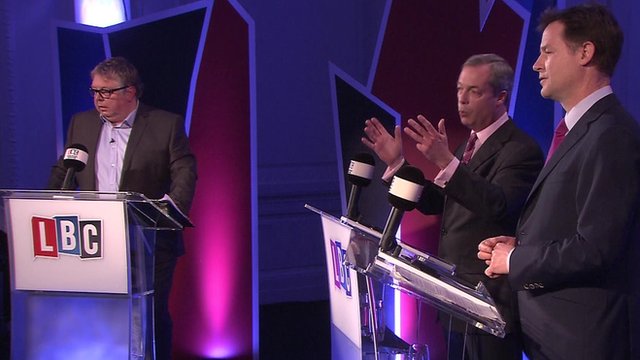
The LBC debate on Europe – Image from BBC


Finally, the British voters got what they had always wanted – a real debate between politicians on the merits and disadvantages of Britain’s continued EU membership. The political elite and main party leaders may have snubbed the debate and thumbed their noses at the concerns and sentiments of the people, but the discussion went ahead nonetheless, thus proving that important and thorny issues will be debated and tackled in Britain, even when it does not dovetail conveniently with the news strategies of the main political parties.

This blog offered a running, real-time commentary on the debate as it took place, on Twitter.

Nick Clegg, having been nominated to begin the debate, started with the risible and misleading suggestion so beloved of Europhiles that Britain’s trade with Europe and membership of the European Union are essentially one and the same thing – that to leave the political organisation that is the EU would be to build a wall and sever all trade ties with our continental European trading partners. Of course, in reality this is simply not the case, and Nigel Farage took the earliest opportunity to swat down this false argument.

Farage continued his strong start by cunningly reversing the question and asking if Britain were currently outside the EU, and given what we all now know about the costs and flaws and drawbacks of EU membership, whether the British electorate would likely vote to join. This simple shifting of the lens on the debate is clever, and moves focus away from distracting side-issues about the mechanics of secession, looking instead specifically at the merits.

The debate then moved on to whether a referendum on British membership of the EU is desirable at all. Here, Farage did a superb job of calling out the main political party leaders for repeatedly promising referenda in the run-up to elections and then back-peddling or stalling when the time came to deliver on the promises.

Here, Nick Clegg was firmly on the defensive, continually resorting to the official line that he might deign to grant the British people a say on future EU membership, but only in the event of some future treaty change. The justification for this particular stance, at one time used by all of the major political party leaders, has never been convincingly made. People in Britain are unhappy with the EU as it is now, not with how it might be after some as-yet unknown treaty modification. So why can the debate and the referendum not take place on Britain’s current status quo relationship with the EU? As this blog observed at the time, if you catch someone stealing from you, you don’t wait until the next theft before alerting the police, you would do so immediately. And so if Britain’s EU membership has been acting against our national interests, why should the British people have to wait until the next harm is caused to the country before seeking redress?

Of course, the topic of immigration was raised, thus exposing the major chink in UKIP’s armour – the perception that the party and its supporters are hostile to immigrants per se. The fact that the question was asked by an audience member of the ‘swivel-eyed lunatic’ type appearance and then heartily embraced by Farage did not help matters. A party that aims to abhor regulation and restrictions on business and the market really needs to ask itself if continued opposition to immigration is a sound policy in 21st century Britain.

Aside from this inevitable rocky point, Farage remained combative and humorous throughout, while Clegg – despite deploying his usual tricks of staring into the camera and repeating the names of audience members as many times as possible – seemed defensive and on the back foot. There was even time for an awkward Marco Rubio-style on-camera gulp of water from the Deputy Prime Minister.

Farage landed yet another blow on Clegg when he reminded viewers of the apocalyptic doomsday scenarios laid out by pro-Europeans in the 1990s, claiming that Britain’s economy would be dealt a mortal blow if we failed to sign up for the single European currency. “Thank God we didn’t listen,” thundered Farage, to loud applause.

This left Nick Clegg scrabbling around for any remaining mud to sling at Nigel Farage and the Eurosceptic movement. In the end, he resorted to a beloved bogeyman of British social discourse, paedophilia. Nick Clegg, in his desperation to score a final point against Nigel Farage, actually appeared to suggest that British secession from the EU would eradicate Britain’s ability to extradite and prosecute paedophiles – a ludicrous argument, and basically a reassertion of the false argument that Britain would leave the EU without drawing up replacement political, trading and justice treaties with the remaining member states.

And on that damp squib of a counter-argument, save only the closing statements, the debate was over. A solid victory for Nigel Farage, one might have thought, until one witnessed the commentary on television and the internet.

Several commentators rightly pointed out that the media showed several worrying signs of institutional bias. In the buildup to the televised debate, ably anchored by Kay Burley on Sky News, at one point a panel member – a visiting university student from America – was asked if she was ‘worried’ or ‘alarmed’ by the fact that Britain was debating the topic as she landed in the country. Never mind the fact that the poor girl clearly knew next to nothing about what the EU is or how it works, the question was so leading as to be risible. Rather than painting the in/out decision in more clinical terms and asking for a comment, it was suggested to the American student that the very idea of Britain leaving the European Union is alarming and scary. Naturally, the student – on live television – agreed with the questioner that it was indeed a scary prospect. So much for objective coverage.

Peter Oborne, writing in The Telegraph, also found significant institutional fault in the way that the mainstream media handled the coverage and the issue of Britain’s EU membership in general. Oborne saw a deliberate attempt to spin the results of the debate as a victory for Nick Clegg and the pro-European side, until the overwhelming results of the post-debate poll forced them to amend their stories:

Last night’s debate between Nigel Farage and Nick Clegg was a very good example of this phenomenon. The lobby wanted a Clegg win and … collectively called victory for Clegg the moment that the debate was over.

It was only when the YouGov poll came through showing that Farage had won the debate hands-down with the public that lobby journalists were forced into an abrupt U-turn.

I am not going to embarrass reporters by naming names. However, it is fair to hold both Sky and the BBC to account.

Oborne concludes that the UKIP and Eurosceptic-leaning side not only have to win their argument in the court of public opinion, but also overcome a second opponent in the British press:

Farage is leading a political insurgency. Last night was a reminder that Ukip’s opponents are not just the other political parties, but also the mainstream British media.

The Spectator also picked up on the media’s U-turn upon realising that their preferred narrative was falling apart in the face of the YouGov poll:

Nick Clegg had been given the night off babysitting; but, after the poll verdict on tonight’s EU debate with Nigel Farage, he may wish he’d stayed at home with the kids. As the dust settled, the Deputy Prime Minister was bundled into a car and fled the field of battle. Meanwhile, Nigel Farage headed for a victory lap at the Reform Club, where his party donors had been watching.

Backstage, Westminster’s hack-pack was necking cheap vino and Pret sandwiches after carrying out a spectacular volte face. Initially ‘the spin room’ had called the duel for Clegg, on both style and substance. But, as news of the Sun/YouGov poll filtered through to the scribblers, headlines were rewritten and awkward tweets deleted. Soon, only the BBC was left flying the Clegg flag, with the help of Danny Alexander and Tim Farron.

And even now, in the cold light of a new day, the general consensus from the headlines appears to be that that it was an honours-even draw, and that there were ‘no knock-out blows’:

The question of the hour, should Britain stay in the European Union? But the question now being asked? Who won, Nick or Nigel?

Well, it might be disappointing but both men certainly remain standing after tonight’s event. Neither was knocked to the ground and both sides will be pleased with how their leaders performed.

Given the testy nature of the debate and the fact that Nick Clegg was on the back foot for nearly the entire duration, one wonders what would have had to happen – short of either man accidentally lighting his podium on fire – for the news media to declare an actual victory for either side.

And this typifies a problem that is becoming endemic in the news media, not only in Britain but also in the United States. All too often, there is such a tremendous pressure to appear nonbiased and objective that news organisations are terrified to report on anything of a partisan nature without giving equal balance to both arguments. The compulsion to treat both sides of an argument as equally valid and legitimate – even when one is clearly correct and the other one wrong – is paralysing the ability of many news outlets to correctly report the news, even when there is no deliberate attempt to give favourable editorial treatment to a particular side.

The only news outlet with a convincing explanation (i.e. one not based on bipartisan spinelessness) for why both UKIP and the Liberal Democrats seem happy with last night’s debate is The Spectator:

Nick Clegg and Nigel Farage may have looks straight into the same camera and appeared to be addressing the same audience, but they were aiming for different listeners. That’s why the Lib Dems were happy with the 36 per cent that they polled last night. It demonstrates to them that there is some kind of constituency that likes to hear a politician being honest that he likes Europe and that he is pessimistic about Britain’s chances outside the EU.

Last night’s result also demonstrates that even if you appear a bit ratty and sweaty at times, as Nigel Farage did to those who are not instinctively his supporters, you can still win the debate, because there is a bigger constituency of voters who do agree with what you are saying, even if you’re not as polished as Nick Clegg. Thus the first of the two debates went very well for both parties: both were shoring up their own bases and motivating them to vote in elections with typically very low turnout. The real mission for these party leaders is to get their voters to go to the polling booths, not bother about people who haven’t made up their minds.

This ‘one debate, two audiences’ explanation makes a good deal of sense.

Of course, there is one further debate to take place, this one hosted by the BBC on Wednesday 2 April. Again, the Prime Minister and Leader of the Opposition have declined to participate. And once again, despite their resistance and the timidity of much of the British press, the public will continue to debate the issues in their absence.

At Last, A Debate On Europe


Europe: The LBC Debate


Tonight at 7PM, the British public will finally be granted what they have wanted – and been consistently denied – for years: a debate on Britain’s continued membership of the European Union. This would be a great milestone to celebrate, were it not for the fact that the two most important protagonists in British politics – Prime Minister David Cameron and opposition leader Ed Miliband – are entirely absent from the festivities.

Nonetheless, the match-up between Deputy Prime Minister Nick Clegg and UKIP leader Nigel Farage should be one to watch.

Tim Stanley at The Telegraph has the best preview of the debate, which is well worth a read:

We might wish that Ed and Dave were debating the EU, but at least someone is. It’s proof that the Europhiles realize they can no longer rely on public uninterest in what Brussels does to keep the status quo and proof that Euroscepticism has finally come of age.

So we shouldn’t expect a debate that changes the course of history, but we ought to welcome the fact that continued membership of the EU is up for discussion at all. I’m old enough to remember when the argument for leaving was the preserve of clinically insane Tory backbenchers, half a dozen pig farmers in Devon and Edward Fox. Times, they are a-changin’.

Indeed they are. For all the efforts of the pro-European apologists to cast any Eurosceptic thought as little-England lunacy bordering on outright racism, and all of the falsely apocalyptic suggestion that Britain’s trade with Europe is solely contingent on membership of the political superstate-like entity that the EU has become, the debate could not be suppressed any longer.

This blog will offer trademark semi-partisan analysis and commentary after the fact.

What UKIP Does Well

nigelfarage

The normal model for distracting media attention away from your political party when negative stories start swamping the agenda goes something like this:

1. Party member says or does something offensive

2. The media picks up on the story and it becomes widely circulated

3. If the political party is small, the received wisdom is that the story is a symptom of the party’s immaturity and extremism. If the political party is large, the commentary will be that it is a sign of general malaise in the political system

4. Party leader comes out swinging, criticising the media for focusing on sensationalist, insubstantial nonsense rather than serious policy differences

When the big three party leaders (Cameron, Miliband, Clegg) attempt this move for the hundredth time, it sounds formulaic and insincere, an obvious attempt to wrench the media’s attention back to their scripted talking points. But somehow, when Nigel Farage adopts the same strategy, he actually appears convincing. And he had the need to do so yesterday at UKIP’s conference in Torquay, when he was inevitably asked to defend or renounce those members of his party who have strained or flat-out violated the boundaries of political correctness.

James Kirkup praised Farage’s approach in his Telegraph Evening Briefing:

Ukip’s virtues came to the fore when Mr Farage was talking about the curious and colourful views expressed by some of his party. Instead of doing what other politicians do and disowning the off-message stuff, Mr Farage embraces it and turns it into an attack on homogenised political class:

“We’re not career politicians, you’re absolutely right. Unlike [Nick] Clegg, Cameron Miliband, d’you know what? I actually had a job – I worked. And this is obviously fairly extraordinary in modern-day politics when almost everybody goes straight from Oxford University into a research office, they become Members of Parliament in their middle-to-late 20s and they’re all very PC and no one really says anything or stands up for their convictions, and with us you’ve got people from all walks of life. There are 34,000 paid-up members of the party and some people have views that are mildly eccentric. I would have thought that was just consistent with democracy.”

How refreshing it is to hear an honest answer from a political leader, and how sad that examples of this kind are so rare. As I wrote on this subject last year:

And so we have a whole generation of MPs from all parties – people like Chukka Umunna – who are basically airbrushed, well-groomed and telegenic candidates who never really lived in the real world before entering politics and who have no idea what they would do with their lives if they ever had to leave it … [We should not] be looking for the next bland, cookie-cutter candidate who has gone through the 7-step “become an MP by the age of 35″ programme. If a candidate’s life up until that point has been all about gaining political power, what chance is there that they will ever want to relinquish it and do anything else after their first term? Their second? Their third? Their fourth? Until retirement beckons?

Blaming the recent flooding in England on the government’s pro-gay marriage stance, or suggesting that the country has become something akin to a foreign land (as Farage regrettably went on to do later in the same appearance) are ludicrous. But there is something to be said for a big tent political party that doesn’t automatically excommunicate its members for going off-script.

The upcoming European elections will prove a good test of just how much the British electorate values this trait.

UKIP’s Choice

I like the commitment to giving the British people a say on our future membership of the European Union. I like the commitment to stripping away burdensome regulation from business. And I really like the libertarian streak which says (with the shameful and notable exception of opposing gay marriage) that you can do what you damn well like in your eating, drinking or recreational life without fearing either chastisement or prosecution by the government. But the recent scandals and dramas within UKIP are making me realise all over again that having a few really great core principles is simply not enough. Not for a political party with serious national electoral ambitions, at any rate.

In moment of great frustration with British politics and the day-to-day compromise of coalition government I have flirted with the idea of giving UKIP my vote. There are parts of the UKIP agenda – you’ll only find them on the UKIP website, the British media generally fails to report the serious stuff – that make perfect sense and which should appeal to anyone of a conservative-libertarian leaning. And in the past it has frustrated me that the focus on UKIP’s more sensible ideas has been continually taken away by the actions of some of UKIP’s more unhinged, out-of-the-mainstream supporters.

I continued to make this argument in good conscience throughout the Godfrey Bloom saga and then the David Silvester affair, because the first was a nonsense and the second was a nonentity. But not so this time.

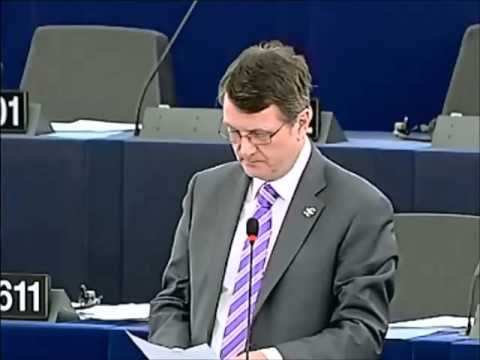
Gerard Batten is a serving MEP and a serious voice within his party – not a swivel eyed lunatic from the fringe. And so when he publicly advocates making Muslims effectively sign an oath of loyalty and nonviolence to prove their harmlessness to the state, this represents a very real problem for UKIP, damages their pro-liberty credentials and alienates many people (myself included) who were otherwise inclined to give them a fair hearing.

gerardbatten

The Guardian gives some of the detail:

Gerard Batten, who represents London and is member of the party’s executive, told the Guardian on Tuesday that he stood by a “charter of Muslim understanding”, which he commissioned in 2006.

The document asks Muslims to sign a declaration rejecting violence and says parts of the Qur’an that promote “violent physical Jihad” should be regarded as “inapplicable, invalid and non-Islamic”.

Critics said his comments represent the “ugliest side of Ukip” and “overlap with the far-right”, in spite of the efforts of party leader Nigel Farage to create a disciplined election machine ahead of the European elections.

Asked on Tuesday about the charter, Batten told the Guardian he had written it with a friend, who is an Islamic scholar, and could not see why “any reasonable, normal person” would object to signing it.

One hardly needs to restate their horror and revulsion at all forms of violence and terrorism in the name of religion before condemning this politician’s attempt to take a redacting pen to the holy book of a faith not his own – but I shall do so anyway. We can abhor the violence, but that does not make it right to propose amendments to the religious texts of a faith that you do not yourself practice. Indeed, if Gerard Batten is to apply his editing skills to every major religious text touting a menu of violent and uncivilised punishments to be meted out to those who accidentally violate the etiquette of their ancient day, he will not only raise Muslim ire but also the outrage of other religions perhaps much closer to his own heart.

Seeing the “I have Muslim friends” card played as a defence by Godfrey Bloom is also quite depressing, and hardly mitigates the fact that he is basically advocating state interference in the workings of a religion, state interpretation of religious texts and state monitoring of compliance with religious teaching.

And in a final flourish, Batten also failed to repudiate his 2010 call for a ban on new mosques in Europe, apparently confirming the suspicions of many that UKIP is concerned about freedom of religion and freedom from religious persecution only when it can be used as an argument to allow certain Christians to continue discriminating against gay people.

The latest UKIP scandal has, naturally and rightly, drawn condemnation from across the political spectrum, with Conservative MP Robert Halfon (of the Jewish faith) describing Batten’s “Islamic code of conduct” as the first step toward making a persecuted people wear a visible gold star on their clothing:

Halfon, who is Jewish and has spoken out repeatedly against Islamic extremism, told the Guardian he considered Batten’s views “unbelievably sinister” and “frightening”.

He tweeted: “Big difference btwn lawful Muslims & extreme Islamists. UKIP MEP Batten’s statement a 1st step to wearing a Yellow Star.”

Sarah Ludford, a Liberal Democrat MEP for London, also criticised the comments, saying they “rip apart Ukip’s pretence” that it treats everybody equally.

“His offensive blanket stereotyping of Muslims speaks volumes about Ukip’s extremism and should warn voters that voting Ukip means associating with hatred and Islamophobia,” she said.

These shenanigans within UKIP must come to an immediate halt if the party is to staunch the bleeding and begin to repair its tarnished reputation. The existing media portrayal of the party as a club for closet racists, little-Englanders and swivel eyed loons is harmful enough without having senior MEPs throwing more fuel on the fire. The fact that some of the provocative statements in question were given in the year 2006 is no defence or mitigating factor here – all that means is that eight years have passed without a public apology and withdrawal of the remarks.

True to recent form, Nigel Farage has been slow to respond to this latest volley of bad publicity – and so, for the moment, Gerard Batten is left to twist in the wind. This, in itself, is unacceptable. This is a time for the leader to lead. Perhaps UKIP wants to be a party of unapologetic Islamophobia and a cheerleader for freedom of religion, but only when Christian freedoms are perceived as being threatened. And if so, that is their choice to make – free speech is still just about protected in this country, and UKIP are entitled to campaign on that platform. In turn, I would also then be freed from the desire to give them any further serious consideration and airtime on this blog, because I would exercise my right to avoid associating myself with such a party.

But if the UK Independence Party actually stands for personal liberty and does not wish to associate itself with religion-specific loyalty tests and bans on practicing Islam (because that is what withholding permission to build new mosques would ultimately mean), with fearmongering or with discriminatory policies, then Nigel Farage needs to speak up and show any recalcitrant members the door.

Newer, less established and experienced political parties eventually have to choose between their fiery, populist rhetoric and the need for sober policymaking; between courting any stray vote that can easily be won and accepting that the votes of some other people are fundamentally undesirable. The Liberal Democrats faced their reality-check on the topic of undergraduate tuition fees, and for better or worse they chose responsible government over delivering on their tuition fee cap bribe to their starry-eyed voters. It increasingly looks as though UKIP will have a dual reckoning – with their attitude to gay marriage on one hand and the decision to condone or condemn Islamophobia on the other.

If Mr. Farage could please make up his mind on these issues and convey the message to his troops, the rest of us will know whether to keep giving UKIP the time of day, or letting them jog on by.

UKIP In The Spotlight

Cognizant of the UK Independence Party’s likely strong performance in the upcoming European Parliamentary elections, some reputable publications have joined the long-established monitors such as UKIP Watch in paying closer attention to the daily goings-on within the resurgent party. Displaying great originality, The Telegraph calls their version…UKIP Watch too. So no possibility of confusion there, then.

To their credit though, The Telegraph’s UKIP Watch redeems itself with some insightful analysis on Day 1, effectively countering the oft-repeated myth that UKIP’s support is comprised almost exclusively of disaffected “grumpy” Tories:

Why is the myth of Ukip as an army of angry, middle-class suburbanites who are obsessed by Europe and having a referendum so widespread and persistent, when the reality is so different? Most likely because of the difference between Ukip’s activists and their voters.

Committed activists and politicians, the kind of Ukipper the media are most likely to encounter, very often are middle-class, Southern and suburban former Tories (particularly the Ukippers you are likely to stumble across in the Westminster village, where most journalists congregate). Add to this the continual fascination in the media with Conservative splits over Europe and it is easy to see how the “Ukip = angry Tories + Euroscepticism” formula has taken hold.

A very good point. Why would UKIP be immune from the phenomena that affects the main three parties, namely that their most strident activists little represent their average voter? It is good to hear this point addressed in the media, and it would be even more encouraging to see the stories about the kooks and crazies in UKIP’s midst covered in the same way – namely that those on the cutting edge, whether for good or bad reasons, tend not to represent the whole.

Godfrey Bloom will be sitting out the next few rounds. Image from ITV News.
Godfrey Bloom will be sitting out the next few rounds.
Image from ITV News.

The column’s authors, Robert Ford and Matthew Goodwin, also make clear that the ‘typical’ UKIP voter is nothing like the cartoonish stereotype of a stuffy, old-fashioned Conservative, and that the retired colonel or Women’s Institute stalwart image is misplaced:

If Spitting Image were still around they would most likely portray the average Ukipper as a ruddy faced, middle-class, middle-aged golf club bore, who lived in a suburban semi-detached house in the Home Counties, wore lots of tweed and bored his neighbours to death by droning on about the evil Eurocrats in Brussels. But this stereotype could scarcely be further from the truth.

Ukip’s supporters look more like Old Labour than True Blue Tories. Ukip’s supporters tend to be blue-collar, older, struggling economically, and often live in poorer, urban areas, with big pools of support in the Labour heartlands of the North. Middle-class suburbanites do not dominate Ukip. They shy away from it.

In fact, Ukip are Britain’s most working-class party. Blue-collar workers are heavily over-represented. Middle-class professionals are scarce. Such voters often express as much hostility to the Conservative party as they do to Labour. This news should not be surprising. Earlier research on Goldsmith’s Referendum Party in the mid-1990s found that they too came from across the spectrum. But despite this research the “disaffected Tory thesis” has become entrenched in the Westminster village, and now dominates misguided coverage of the party.

This, if anything, is the area on which UKIP will need to focus the most if they are to make the perilous transition from successful protest party to a real general election player capable of winning seats in the House of Commons – the fact that the spot in their party reserved for middle-class professionals is currently Tumbleweed Central. These higher-information voters are key to credibility, and they are also primarily the movers and shakers who keep the British economy ticking over. Not having these people in your camp in any significant numbers is a cause for concern, and one that will certainly need to be addressed after the upcoming European elections.

So far, however, UKIP seems to be showing no signs of wilting under the increased scrutiny – indeed, their affable leader Nigel Farage MEP seems to have recovered some of the form which deserted him last week, going so far as to record this spoof weather forecast segment for the BBC’s Sunday Politics show:


Perhaps this further helps to explain the reason for UKIP’s continued popularity and appeal – which of the other party leaders, emerging from a week of very difficult and in some cases embarrassing press coverage, would be so relaxed and willing to poke fun at themselves in so self-deprecating a manner? There is something inherently appealing about a politician who is willing to speak

Nigel Farage is confident, and as more and more of the media is coming to realise, his confidence may be well placed.