Responding To The Junior Doctors’ Strike

An inspiring (if unattainable) example from across the Atlantic

How to respond to a national walkout by government employees who perform a critical job for a large organisation, and who cynically advance their demands for more money under the false banner of concern for public safety?

Ronald Reagan offers us one blueprint, from back in that dim and distant time when both Britain and America were blessed with leaders who (for their various faults and blind spots) were not afraid to lead, and to take bold and decisive action when necessary.

This is the speech Reagan gave in August 1981 when PATCO, the American air traffic controllers union, called an illegal strike (federal workers being prohibited from striking under the Taft-Hartley Act) demanding, among other things, a 32-hour work week:

This morning at 7 AM the union representing those who man America’s air traffic control facilities called a strike. This was the culmination of 7 months of negotiations between the Federal Aviation Administration and the union. At one point in these negotiations agreement was reached and signed by both sides, granting a $40 million increase in salaries and benefits. This is twice what other government employees can expect. It was granted in recognition of the difficulties inherent in the work these people perform. Now, however, the union demands are 17 times what had been agreed to – $681 million. This would impose a tax burden on their fellow citizens which is unacceptable.

I would like to thank the supervisors and controllers who are on the job today, helping to get the nation’s air system operating safely. In the New York area, for example, four supervisors were scheduled to report for work, and 17 additionally volunteered. At National Airport a traffic controller told a newsperson he had resigned from the union and reported to work because, “How can I ask my kids to obey the law if I don’t?” This is a great tribute to America.

Let me make one thing plain. I respect the right of workers in the private sector to strike. Indeed, as president of my own union, I led the first strike ever called by that union. I guess I’m maybe the first one to ever hold this office who is a lifetime member of an AFL – CIO union. But we cannot compare labor-management relations in the private sector with government. Government cannot close down the assembly line. It has to provide without interruption the protective services which are government’s reason for being.

It was in recognition of this that the Congress passed a law forbidding strikes by government employees against the public safety. Let me read the solemn oath taken by each of these employees, a sworn affidavit, when they accepted their jobs: “I am not participating in any strike against the Government of the United States or any agency thereof, and I will not so participate while an employee of the Government of the United States or any agency thereof.”

It is for this reason that I must tell those who fail to report for duty this morning they are in violation of the law, and if they do not report for work within 48 hours, they have forfeited their jobs and will be terminated.

Obviously such a feat could not be repeated by the British government in its dealings with striking NHS staff – though the case for banning strikes by national public sector workers becomes more compelling by the day.

But if repeating Reagan’s actions are not possible for political and logistical reasons (firing 11,000 air traffic controllers is much easier than firing 55,000 junior doctors, not to mention the fact that the junior doctors are operating within the current law), at least we might hope that the government will act in the spirit of Reagan. And in the spirit of Reagan, the government should refuse to give any further ground to striking public sector workers who are willing to cynically jeopardise public health in a dispute which now rests primarily on the question of Saturday payand is certainly nothing to do with patient safety or the continued existence of the NHS.

This blog firmly believes that the NHS model is broken and than a system conceived in the 1940s is barely adequate to the demands of the 2010s, and will be hopelessly inadequate to the demands of the 2040s. If we are to persist with a public option, then there is no reason why healthcare should continue to be provided by a monolithic government organisation, the fifth largest employer in the entire world (with all the baggage, internal politics and resistance to change which that stunning fact implies).

There is no good reason why we cannot look closely at the healthcare systems of countries such as France, Germany, Japan or Canada and redesign our system accordingly – if only we could rediscover our sense of national ambition and shed our increasingly unwarranted pride in the NHS. We could even still call the new healthcare system “the NHS” if our cult-like attachment to the brand really runs so deep.

The time is long overdue for Britain to have that national conversation, endlessly kicked down the road by politicians terrified of upsetting nervous voters and governments which have proved constitutionally incapable of daring mighty things. But first we need to overcome this peculiar, anachronistic industrial dispute – one which belongs more comfortably in 1976 than 2016 – and end the junior doctors’ strike, by imposing the current contract offered if necessary.

And in that effort, let the spirit of Ronald Reagan guide Jeremy Hunt.
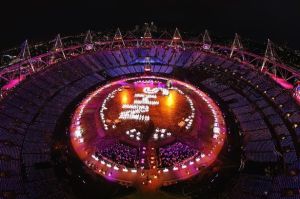
 

NHS Worship - London Olympic Games 1

Agree with this article? Violently disagree? Scroll down to leave a comment.

Follow Semi-Partisan Politics on TwitterFacebook and Medium.

The Immaturity And Cynicism Of The NHS Junior Doctors’ Dispute

Junior Doctors Strike - NHS - National Health Service - Vigil

The junior doctors lost the moral high ground when they decided to portray a debate about pay and conditions as a high-minded effort to “save the NHS”

James Kirkup has a great piece in the Telegraph in which he charges that the junior doctors’ dispute has reached an impasse not because of government intransigence but because many junior doctors are arguing an inherently political case from a position of naivety and political inexperience, and so will not concede the validity of any opinions other than their own.

Read the whole thing. But it is worth noting these excerpts in particular:

Some of this is about basic competence. The doctors and their leaders have done a very poor job of explaining why they are striking, offering a range of confused and changing justifications. Many doctors seem unaware of the position taken in negotiations on their behalf by their trade union (short summary: if the Government had agreed to pay more for Saturday working, the BMA would have settled and there’d be no strikes) and believe their strike is not about money.

This in itself is quite damning. All the high-minded talk about patient safety and “tired doctors making mistakes” suddenly begins to look a wee bit cynical when it turns out that the BMA would have taken the deal if only there was more money on offer. Was the extra pay all going to be spent on Pro Plus and Red Bull? Unlikely.

But this is the really interesting point:

Yet the doctors’ failure of understanding goes beyond tactics into something more fundamental, an unwillingness or perhaps just an inability to appreciate that politics is about reconciling the diverse interests and desires, that no one gets things all their own way.

Simply they don’t understand the conflict they’re in. Many, engaged in politics for the first time, cannot understand why the Government will not do exactly as they want; for them it’s unthinkable that others would not accept the doctors’ word on how to fund and structure the NHS as final. Any course of action but theirs is not just unacceptable but immoral.

As for those on the other side of this dispute, there is apparently no possibility that their motives could be honourable. Throughout this dispute I’ve not yet seen a junior doctor admit even the possibility that Jeremy Hunt, NHS Employers, David Dalton, Bruce Keogh or any of the main players on the employer side might also be acting in good faith, doing things they believe necessary and in the public interest.

Instead, Mr Hunt and his officials are routinely accused of venality and self-interest, and worse. I keep a little file of choice emails and tweets from doctors. It contains evidence of members of the profession making statements in public forums that Mr Hunt is psychopathic or suffering from various other clinical conditions. (There were also a number of homophobic slurs aimed at Mr Hunt, but that was a senior consultant, not a junior.) I can only conclude that the doctors concerned are so convinced of their own righteousness that they cannot admit that those who take a contrary view are anything but immoral.

Here we have Labour’s self-righteousness syndrome all over again, but this time the patient is not a political party but a large and vocal special interest group within the public sector. Just as was the case with those convinced that the Tories are evil vampires and that Ed Miliband was heading for victory in last year’s general election, so the junior doctors and their supporters seem convinced that the government is motivated purely out of malice, and that they are unambiguously in the right. And we all know what happened on May 7th.

Kirkup continues:

Other doctors display an almost touching lack of insight into how some aspects of their own working lives (a job for life, steep pay progression, huge pensions) are simply unobtainable dreams for most workers, even those who also got good A-levels and spent years studying at good universities.  One junior doctor (again, I won’t name him) last week reprimanded me for writing about doctors’ £1 million pension pots on the grounds that the retirement such funds deliver is “comfortable” but “not extravagant”.

Likewise the tendency to overlook (or simply not know) the fact that many of their problems (antisocial hours, weekend working, growing workloads and static or falling workforces) are common to many other professions and trades, many of whom do not enjoy the same benefits as doctors.

What the junior doctors (and those who support them) fail to understand is that nearly every public sector industrial action is fought on the grounds of public safety while really being about something else. Relatively well paid people (compared to the average wage) walking off the job in a dispute about money and working hours does not elicit as much public sympathy as casting themselves as the only people willing to take on the government on a grave matter of public safety, so simple self-interest dictates that any union (including the BMA and junior doctors) will emphasise the latter over the former.

Consider: how many striking junior doctors living in London would have tutted with frustration during the last tube strike called by the RMT, and fumed to their friends that tube drivers are incredibly well paid, should be grateful for what they have and get back to work, Night Tube be damned? The RMT’s dispute was based in large part on safety concerns, just like the junior doctors. Are the tube drivers lying while the junior doctors are telling the truth? Is there something inherently more virtuous in a doctor than a train driver?

This, too, is worrying:

Spare a thought here for the impact this outlook has on the doctors themselves.  Having become so utterly convinced of the rightness of their cause, many suffer genuine distress when their cause meets resistance or challenge.  Some, sadly, are not robust enough to encounter such pressures without experiencing genuine harm. That harm should weigh heavily on the consciences of the BMA leaders who have encouraged young and politically-inexperienced people to seek out confrontation in the harsh arena of public debate.

This rings alarm bells, because it is the same way that we now speak of Safe Space-dwelling students, grown adults who by adopting a toxic ideology have come to see themselves as perpetually vulnerable victims in constant need of protection from higher authorities. One could take this sentence – “some, sadly, are not robust enough to encounter such pressures without experiencing genuine harm” – and apply it equally to those wobbly-lipped students who are now killing academic freedom and free speech on our university campuses.

In fact, we may now be witnessing the first major conflict between the Safe Space generation (many junior doctors have only recently graduated university) and the realities of the labour market and public sector wage restraint – only everything is made doubly toxic because the dispute involves the one subject about which almost no Briton is capable of thinking rationally: the NHS.

This blog contends that the mere fact that national collective bargaining is still making headlines in 2016 rather than 1976 shows that Thatcher’s work is far from finished, and that if we were not still lumbered with a national health service we would not be facing the prospect of an all-out national walkout by healthcare professionals. After all, nothing about public healthcare mandates that it must be provided through a monolithic state-owned organisation, despite the best efforts of NHS apologists to pretend that our options are the status quo or the American system.

Maybe the doctors holding candles in an overwrought silent vigil for the NHS (see cover picture) are entirely genuine. Maybe they have convinced themselves that this dispute really is purely about patient safety and “saving the NHS”, and nothing more. But the junior doctors can no longer plausibly claim that this is about patient safety, or “saving the NHS”, because we now know that these are side issues brought cynically into the debate by the BMA and credulous activists in a well worn attempt to drum up public support.

This does not mean that each one of the Conservative government’s intended reforms are sensible. The idea of a 24-hour NHS is more slogan than policy, while statistics about weekend deaths have been cynically misrepresented – that much we can concede to the BMA. But when your pay dispute is with one of the largest organisations in the world, and by far the largest employer in Britain, then everyone who pays for that service gets to have a say, including (or even especially) a government elected partly on a manifesto to make changes to that health service, whether or not those changes happen to be smart. By taking the public coin the NHS is inherently political, and those working for it cannot complain when those outside the organisation seek to wield their own influence.

And from a purely tactical standpoint, James Kirkup is right – the junior doctors and their representatives in the BMA have bungled this dispute badly. With their overwrought, hysterical claims that a new national contract will somehow be the end of the NHS when it turned out that the final sticking point in the negotiations was over nothing more noble than Saturday pay, their credibility is squandered. And neither they nor their supporters should not escape censure for their part in what is to come.


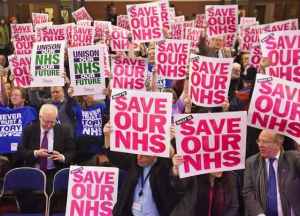
Save Our NHS

Top Image: Guardian

Agree with this article? Violently disagree? Scroll down to leave a comment.

Follow Semi-Partisan Politics on TwitterFacebook and Medium.

Love Our NHS? Prove It With Your Vote In The EU Referendum

Brexit - NHS - European Union - EU Referendum - Brexit

The EU referendum meets our national religion

The major campaigns on both sides of the EU referendum are currently slugging it out in a tawdry contest for the affections of fearful, NHS-idolosing simpletons.

No British political campaign is complete without eye-rolling attempts by those without ideas or vision to trawl for votes by pretending that Our Blessed NHS (genuflect) is mere moments away from being abolished.

From Vote Leave’s latest mailshot, entitled “Save Our NHS”:

Lord Owen, the former Labour Foreign Secretary and Health Minister, today launches the Vote Leave ‘Save our NHS’ campaign with an important speech: ‘Protecting our NHS from the EU’.

He argues that the our National Health Service should not be under the control of the EU and cites serious flaws in The Transatlantic Trade and Investment Partnership (TTIP), which is a major new deal being negotiated behind closed doors between the EU and the USA.  This he says, disregards the purpose of social health care and undermines the responsibility each member state has for its own healthcare policy.  This is highly detrimental to our NHS.

And from Britain Stronger in Europe, the charmingly personalised “Love the NHS Samuel? You need to read this”:

When it comes to the NHS, you can’t listen to the people campaigning to leave Europe.

They describe the NHS as a “60-year mistake” (Vote Leave’s Dan Hannan), say there’s “plenty of room for cuts” (Nigel Farage), and think people should have to pay for services so they “value them more” (Boris Johnson).

No – instead, we should listen to the doctors and NHS workers who make our health service so special.

This week, 200 medics wrote a letter stressing that “the NHS, medical innovation and UK public health” are stronger in Europe.

They warned “Brexit should carry a health warning” – because the economic damage caused by leaving Europe would “jeopardise an already cash-strapped NHS.”

Samuel, those who work in the NHS couldn’t be clearer – we need to stay in Europe to protect investment in our health service. Volunteer for our campaign today, and help secure the NHS for future generations:

Well, that’s that then. Your friendly local NHS urologist is clearly such an expert on statecraft, diplomacy and constitutional matters that they are ideally positioned to tell you how to vote on a matter of existential importance to Britain.

The obvious, simple-minded manipulation being attempted by both campaigns would be offensive were it not so amateurish. And to think that political consultants and strategists are actually being paid money to come up with this stuff.

Vote Leave and you’ll get cancer, because Brexit is so dreadfully scary that it should come with a health warning!

Vote Leave and we’ll save so much money that we can build a brand new hospital every week. Just think of it! That’s fifty two massive new hospitals every year. In a decade, we’ll have 520 new hospitals! By the year 2036 we could have 1040 new hospitals! Enormous ones! Your descendants could live in a Britain with a humongous, fully staffed new hospital for every single person living on this island! Oh, what a paradise it will be.

What pathetic, manipulative nonsense.

Whether we vote to leave the European Union or remain in the burning building, the NHS will continue to exist. We can’t seem to shake it. And it will continue to churn out moderately priced but increasingly substandard levels of care while nearly the entire population gathers round to uncritically praise the holy creation of St. Aneurin Bevan of Tredegar from dawn to dusk. Nothing, absolutely nothing, will change.

Do you really believe Britain Stronger in Europe when they suggest that “medical innovation” will cease or be harmed if Britain leaves the political construct known as the European Union? Exactly what is it about forsaking a foreign flag, anthem and parliament which will slow down the cure for Alzheimer’s?

Or do you seriously buy this idea that Brexit means that we can throw up a brand new hospital in every major British city within a year, and keep on doing that until the NHS is not only our largest employer but our only employer?

Don’t be taken in by this execrable, manipulative, transparently idiotic nonsense from the major Leave and Remain campaigns, all of which seem to be managed by B-student politicos and all of which are operating on the hopeful assumption that you are a frightened, credulous simpleton.

Recognise that this referendum is about sovereignty, sovereignty and sovereignty. Do your own research, and then make the right decision. And whatever you decide, don’t waste your vote virtue-signalling your love for Our Blessed NHS.


Save Our NHS

Top Image: Daily Express

Agree with this article? Violently disagree? Scroll down to leave a comment.

Follow Semi-Partisan Politics on TwitterFacebook and Medium.

Is This The Beginning Of The End Of Britain’s NHS Idolatry?

NHS Logo - Cross - National Religion - Worship - Idolatry

Are we witnessing the high water mark of mindless NHS-worship?

Regular readers will know that this blog is a constant critic of the British cult of NHS-worship. Not of the NHS specifically, but of the fawning, servile and uncritical way in which the National Health Service is viewed and debated in the public discourse.

Whether one prefers state-provided everything and harbours intense suspicion of privatisation, or yearns for the innovation and competition that the private sector (at its best) can bring, any reasonable person should be sickened by the stultifying atmosphere which has surrounded the NHS debate for decades. And yet we tolerate it, even demand it from our leaders.

It is not healthy that in this one specific area of our national life, politicians cannot make important criticisms without feeling obligated to counterbalance the truth with obsequious words of praise. And our stubborn refusal to look around the world for guiding examples of best practice in healthcare delivery has all the arrogance of American exceptionalism, in blinkered defence of something which is very far from exceptional.

At times, this blog has felt like a very lonely voice in the wilderness on the subject of our true national religion. The NHS being the supercharged third rail of British politics that it is, few mainstream commentators (and almost no serious politicians) have traditionally shown any willingness to touch the issue.

But there may now be a few encouraging signs that we have reached the high-water mark of our NHS adulation; that even the NHS’s most ardent supporters are coming to realise that making every arcane debate about healthcare policy or junior doctors’ pay a screeching matter of “Saving Our NHS” is not in their interests or those of British healthcare in general.

Simon Jenkins has a piece in the Guardian in which – shockingly, for that publication – he admits that “our adoration is killing the NHS”:

People may dislike other public services. They see the police as dodgy, train drivers as bolshy, utilities as run by crooks. But the NHS “saved my mum’s life”. So leave the doctors and nurses alone. Just give them money. Give everyone money.

Nothing dents this love. Day after day, the headlines scream of NHS woe. Last month half of all doctors said they offered a worsening service. Eleven thousand heart patients “die because of poor care”. The NHS wastes £12bn on a computer system that “does not work”. One in four hospital staff feels “harassed and bullied”. Three-quarters of them tell care quality commissioners that “patient safety is now at risk”. If the NHS is to the British, as former chancellor Lord Lawson said, “not a service but a religion”, the religion must be juju.

These are the words of someone who is frustrated (as well he should be) by the fact that our blind, unthinking adulation of the NHS – the healthcare equivalent of an ingratiating politician naming Nelson Mandela as his hero – prevents us from recognising the real and intractable flaws in the system.

Jenkins continues:

The NHS’s carapace of love has to be its biggest danger. On Wednesday it was revealed that, despite last year’s Francis report on whistleblowing, not a single sacked NHS whistleblower has been re-employed or manager reprimanded. Instead doctors are eulogised for the “daily miracle of saving lives”. This is despite the OECD reporting that they save fewer lives per head than insurance-based health services in Germany, Switzerland and the Netherlands. Britain’s record on tracing cancer is dreadful.

Doctors are in the business of saving lives. It is their job. Firefighters are not “miracle workers” for putting out fires, or teachers for getting pupils through exams. Healthcare may benefit from fear of death and disease, and we are rightly appreciative of those who relieve it. But when other professionals such as social workers or carers of the elderly fail, they are publicly excoriated. Why is the NHS immune?

Jenkins goes on to talk about the strange sense of security which comes from the “familiar NHS surgery”, with its “wartime air” and feeling of national solidarity. This is something that even I, a heathen free marketeer, have experienced and can relate to. Walk into a large NHS hospital in any of Britain’s big cities and you feel as though you have entered the belly of the beast – a vast, thrumming, living organisation of buildings, computers, machines and human beings, which functions according to its own time zone and alien protocols.

When you are sick, being enveloped in the warm embrace of this organisation – knowing that you will experience the same colour schemes, uniforms, routines and brisk bedside manner anywhere in the country – can feel quite reassuring. And because we tend to be at our most vulnerable when we encounter the NHS – when something is wrong with us, or with a loved one – we crave that reassurance.

But with the power dynamic thus skewed in favour of the state (providing healthcare) and against us (unwell, and receiving it), we have a natural tendency to be uncritically grateful for whatever service we are given, rather than subjecting it to the proper scrutiny of a consumer. Something usually has to go very, very wrong in order for us to complain.

If the NHS delivered your baby, set your broken arm, diagnosed and effectively treated your cancer or gave you a heart and lung transplant, you are likely to be well-disposed toward the NHS. You may even find yourself cheering along when populist politicians shoot for cheap applause by lavishly praising and vowing to defend it from mysterious external threats (usually in the form of the Evil Tories).

Never mind the fact that healthcare systems in developed countries around the world deliver babies, set broken limbs, treat cancer and transplant organs every day, to rich and poor people alike. The NHS Industrial Complex has been very effective in conflating “healthcare” and “the NHS” in the public mind, so that many people genuinely seem to believe that if they experienced the same medical condition as a citizen of another country, they would now be either bankrupt or dead. It is masterful propaganda, but it is most certainly not conducive to measured public debate about healthcare policy.

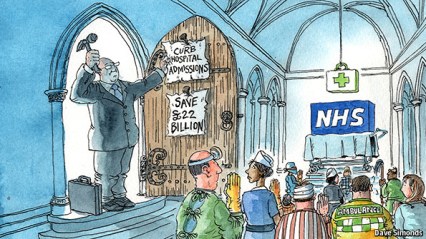
NHS - National Religion - Cartoon

This is why it is good to see the first cracks starting to appear in the massive metaphorical golden idol of St. Aneurin Bevan of Tredegar, which the British people now worship like those before us worshipped Baʿal. Most encouraging of all comes this recognition from Simon Jenkins that “free at the point of delivery” has become more of a quasi-religious chant than unquestionably wise healthcare policy:

I have never understood why so many self-inflicted “health needs”, such as sports injuries, drunkenness and overeating, should be charged to the state. Some fire brigades are charging for careless callouts. Mountain and lifeboat rescues often request “contributions”. Free at the point of delivery has long been a proud boast of the NHS. But that is policy, not papal doctrine.

The drug companies always made sure “free” did not apply to NHS prescriptions. With demand rising exponentially, supply of care must be rationed by something: if not by some form of payment and insurance, it will be by queueing and quality.Last year it emerged that more than 300,000 patients waited in ambulances for more than half an hour just to get into A&E.

It is ironic that Jenkins’ questioning article is published in the Guardian, the newspaper which has arguably done the most harm in terms of inculcating a blindly and aggressively worshipful attitude toward the health service, to the total exclusion of any of the radical thinking for which that paper claims to stand. Only last week, the Guardian concluded a month-long “celebration” of the NHS in which journalistic scepticism and intellectual curiosity were suspended and replaced with a barrage of articles telling the NHS-supporting Left everything that they want to hear. I critiqued their “This Is The NHS” series here and here.

But here we have – from an NHS supporter, and one who says “there is nothing wrong with loving the NHS” – an admission that rationing by price in some certain situations can actually be preferable to our current settlement of rationing by time and quality. This is a breakthrough indeed. If only we could also break the Left’s demand for uniformity at all costs (mediocrity for all rather than excellence for any) then we would really be getting somewhere.

I must admit that I thought things would have to get a lot worse before we finally turned a corner in our misplaced reverence for the NHS – more scandals, more falling metrics, much longer waiting times. But the current level of bipartisan NHS fervour (partly whipped up by the BMA and junior NHS doctors, who are cynically pretending that their current dispute with the government over pay and conditions is actually about patient safety or, laughably, the very survival of the NHS) is clearly proving to be too schmaltzy and blindly uncritical even for some stalwart NHS defenders.

Perhaps the shrieking of the NHS priests and priestesses is most like the closed-minded rhetoric of the Biblical creationists, who shout ever louder and demand ever more concessions to their peculiar sensibilities the more their fundamentalist beliefs are debunked and discredited, eventually pushing the embarrassed moderates away.

Perhaps we are witnessing all of this sound and fury – the constant and strictly enforced praising of the NHS model, on pain of political death – because the NHS Clerisy know that theirs is ultimately a losing fight; that the British people will not long persevere in their belief that the only possible choice is between the NHS and dying in the street of untreated TB.

Perhaps, then, there is real (if still very limited) hope for genuine healthcare reform in Britain, after all.

Save Our NHS

Middle image: Cartoon by Dave Simonds, published in The Economist

Agree with this article? Violently disagree? Scroll down to leave a comment.

Follow Semi-Partisan Politics on TwitterFacebook and Medium.