
–
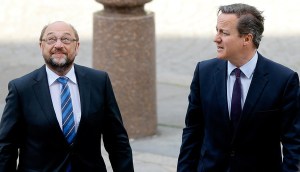
After David Cameron and Donald Tusk’s arrogant two-finger salute to the British public comes Martin Schulz’s risible Bad Cop routine
It has been a couple of days now, and the anger about the government’s unchanging approach to the EU has started to dissipate – only to be replaced by a dull sense of abandonment and cynicism.
Of course David Cameron was not going to announce any kind of meaningful deal with the European Union – expecting Dave to represent our interests in a negotiation with Brussels is like being on trial, spilling your guts to the chief prosecutor and still expecting him to bend over backward to get you acquitted. That is, it’s implausible because of a flawed assumption about whose side they are on.
This was not a renegotiation between Britain and the other member states of the European Union; rather, it was a game of wits with the prime minister and his fellow EU leaders on one side, and the British people on the other side. The objective was not to present British demands to Brussels and seek to win as many concessions as possible; on the contrary, the aim from Day One was to identify how little the British people could be persuaded to accept as crumbs from the EU’s table while still doing what they were told.
When you realise that democracy and the restoration of national sovereignty were never on the table, everything makes a lot more sense. And yet David Cameron is clearly stretching his luck. The few meagre statements of intent in Donald Tusks’s formal response to the British letter are completely irrelevant, and certainly will do nothing to address the concerns of most people. And the press has realised, and duly given the prime minister a roasting for his feeble negotiating skills.
Thus there is still a possibility – however slight – that if the referendum goes ahead on the accelerated timescale in June this year, the Leave side may be able to squeak a victory by painting David Cameron’s half-hearted renegotiation as part of a bipartisan establishment conspiracy of the political elites against the British people, to keep us in the European Union come hell or high water.
Or as this blog noted yesterday:
With nearly every authoritative voice in Britain about to begin earnestly intoning the many benefits of Brussels, our most potent weapon may be the British people’s strong sense of fair play, and their likely discomfort at seeing the Leave campaign being outspent, outmanoeuvred, outgunned and shouted down. We have been weak and ineffectual enough thus far – so we may as well ham it up for the cameras and work to build the narrative that this referendum is in fact The Establishment vs The People.
Bearing all this in mind, what the Remain campaign could really do with to twist the knife would be for a senior EU politician to come out swinging and playing Bad Cop to David Cameron’s Useless Cop. What they really need is for one of the EU’s big beasts – preferably someone with a suitably scary Teutonic name – to barge onto the scene and warn Britain that we are testing his patience with our pesky demands for sovereignty and self-determination, and that unless we soon shut up and accept what we are being offered, he and his chums can make no guarantees for our safety.
Step forward president of the EU Parliament Martin Schulz, who used a speech in London today to do just that. Schulz said:
Europe needs the UK with its foreign policy experience and clout, its open market policies and its trade track record if we want to have hope of solving any of these crises – and even more so, if we want to maintain the global security architecture and shape the future world order.
This is why personally I am a strong supporter of the UK remaining in EU. And this, despite the fact – and I admit this quite frankly – that the British often test our patience and good will with their continuous demands.
They are demanding. They push hard. They insist. They just don’t let go. Many of my colleagues say behind closed doors: ‘Don’t stop a rolling stone. If the Brits want to leave, let them leave.’
I do not support this line that just because the UK can be frustrating it would be in our interest to let it go. I believe we need the UK to make the EU stronger and better. And to make something stronger and better sometimes it’s necessary to push hard and be critical.
In other words: “Hey, you know I love you, Britain. You’re great, I would do anything for you. But some of my friends have had enough; they think you are getting ideas above your station. In fact, they think that you are itching to be taught a lesson in humility. Not me, of course. I think you’re just swell. But what say we put this whole silly euroscepticism business behind us and carry on as normal? I think that would be much better that way. And I wouldn’t want anything bad to happen to you…”
Basically, this is a threat dressed up as friendly concern.
My first thought on reading this was: is Martin Schulz confusing the UK with another country – one which is actually assertive in standing up for its national interest and kicking up a fuss when it doesn’t get its way? Because this description doesn’t sound anything like the Britain I recognise.
What “continual demands” has Britain been making of the European Union? And which demands have been conceded by a reluctant Brussels which supposedly feels bullied and taken advantage of by our selfish stance? You would think that if Britain had such a notable track record of standing in the way of EU goals and projects, that a nominally eurosceptic government like David Cameron’s would be busy talking up all of these filibustering victories to buy some credibility from a sceptical public. You would think that David Cameron’s stump speech would be littered with Brussels pet projects which he thwarted for the good of the taxpayer and in defence of Britain’s national interest.
So where are those success stories? Where are the examples of Britain “pushing”, “insisting” and “not letting go”? Does Martin Schulz mean the time that Britain was presented with a £1.7 billion supplementary bill from the EU as a penalty for economically outperforming the Eurozone? Because if my recollection serves me correctly, our prime minister gave a red-faced, foot-stamping press conference in which he insisted that Britain would not pay a further penny, before quietly authorising George Osborne to pay the entire sum as soon as the general election is out of the way. Is this the kind of obstructionism that Martin Schulz means? The totally illusory kind?
But what of France and its angry insistence on violating the EU stability and growth pact, for reasons both real and confected? If the rules were put in place for the benefit of all, what does it say about France that they rage against the European Commission for daring to point out their lack of compliance? Is this not being “demanding” and “pushing hard” to get their own way?
And what about Germany’s constant, selfish running of a current account surplus in excess of the maximum 6 per cent allowed under the Macroeconomic Imbalance Procedure (MIP)? Where is the European solidarity there? And what might Martin Schulz have to say about the stubborn behaviour of his own compatriots? Don’t expect an answer any time soon.
The truth is that by most measures, you could not find a more pliable, easy-going and constructive member of the European Union than Britain. We pay our dues, enforce and abide by the rules and laws a lot more rigorously than many other countries, and while the public may complain a lot, our elected representatives hardly ever filter that dissatisfaction upward to disturb the smooth running of EU summits.
The only way that your average EU leader or bureaucrat could possibly be troubled by British euroscepticism is if they were to spend their days clicking through the comments sections of the Daily Mail website – which presumably they have no time to do, what with being such busy and efficient people. They certainly have not encountered any euroscepticism from Downing Street for thirteen years of New Labour or five subsequent years of rootless Cameronism.
But how well it aids the Remain campaign for a prominent EU leader to come to London with the message that Brussels is getting sick and tired of our irritating demands for national sovereignty, that the world is a scary and unpredictable place, and that we wouldn’t want to find ourselves in their bad books just in time for a big Chinese economic slowdown. What absolutely marvellous timing. Really, you couldn’t have co-ordinated it any better if you wanted to orchestrate an event to distract attention from the fact that Cameron and the EU are standing before the British electorate absolutely stark naked.
But we should see this for what it is – a cheap and tawdry act of scaremongering from a political establishment (and assorted allies such as Schulz) who are utterly incapable of making a bold, unabashed and unambiguous argument in favour of the EU as a good model for future human governance and the preservation of democracy.
In place of any attempt (however foolhardy) at real, tangible reform of the European Union, taking into account some of the actual concerns of the British people, instead we have David Cameron’s big bag of nothing followed by Martin Schulz issuing sinister threats wrapped in faint praise.
Having the prime minister announce a renegotiation “outcome” so pitifully short of addressing even his own original and desperately unambitious areas for discussion is bad enough. But to then be on the receiving end of passive-aggressive threats from the EU aristocracy, chiding us for being “demanding” – really the pot calling the kettle black with this supranational group of obstinate prima donnas – is an insult too far.
As always, we are denied the big picture and forced to operate in the blind because the leader of our country does not view us as fellow citizens with a right to have a say on Britain’s future based on full and complete information, but rather as a potentially dangerous mob whose every thought and sentiment must be carefully curated by our betters, to guide us toward the “correct” decision.
We never had any reason to believe that it would be otherwise. But it is still galling to experience this intellectual, emotional and psychological manipulation strategy unfolding in real time.
–
Agree with this article? Violently disagree? Scroll down to leave a comment.
Follow Semi-Partisan Politics on Twitter, Facebook and Medium.





 Semi-Partisan Politics