A Musical Glass Ceiling, Finally Broken

For the first time ever, the person given the honour of conducting the Last Night of the Proms, that great British musical occasion, will be a woman. An exceptionally well qualified woman, Marin Alsop.


Yes, I’m biased. Alsop is a protege of one of my musical heroes, Leonard Bernstein. But she has also distinguished herself through her very well-received tenures with the Baltimore Symphony Orchestra, Royal Scottish National Orchestra and Bournemouth Symphony.

Female conductors are still an incredibly rare site on the podium, as the Telegraph article relates:

Female conductors are about as common as hen’s teeth. A comedian friend of mine once said that a comic is always the person facing the wrong way, and this is doubly true of a conductor. If a comedian onstage is the only individual in the room facing the audience, then a conductor is the only person on stage facing the performers.

To put yourself in a position where you are neither orchestra nor audience, that is to say, a unique figure, elevated on your own little platform, essentially telling everyone in the room what to do (you listen; you play) requires a rather particular set of personal characteristics that we probably traditionally associate with men, slightly crazy, arrogant, wild-eyed men.

The series of summer musical concerts at the Royal Albert Hall and associated venues, collectively known as the BBC Promenade Concerts, have expanded boundaries in a number of areas. We have already had the first American conductor to take charge of the Last Night – the excellent (and underappreciated) Leonard Slatkin, of St. Louis fame. The Proms now include outdoor concerts, late night concerts, and science fiction themed concerts (to the delight of many Doctor Who fans). This is all well and good. But the announcement that Alsop will be the first woman to conduct the BBC Symphony on this illustrious occasion should serve as a reminder that much more needs to be done before women are fully represented at the highest levels of classical music. Alsop has blazed a trail, but there are far too few younger women following in her wake.

That is not to say that there are no other women conductors of great talent and some renown – one might think of the excellent Xian Zhang, who occasionally guest conducts the London Symphony Orchestra – but this wikipedia page shows the depressing truth of the matter. Just 61 entries.

As always, I shall look forward to the upcoming Proms season, and to the Last Night. But the fact that we are celebrating this particular milestone only in the year 2013 should give us all pause for thought.

The Best Thing Of 2012

I know that it is only the first day of August, but I am supremely confident that nothing will surpass this story reported by ITV News.

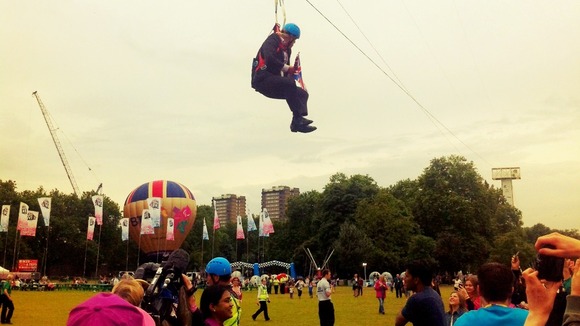
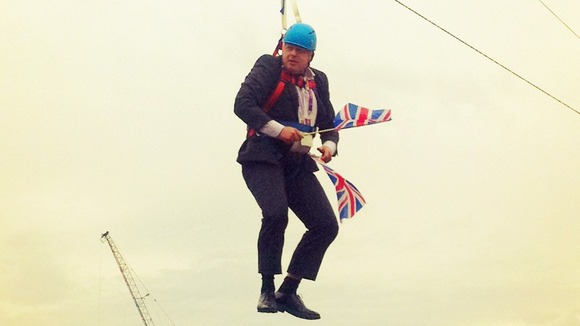
Apparently the Mayor of London, Boris Johnson, was at an Olympic event in Victoria Park, trying out a zipwire ride, when it malfunctioned and he became stuck, suspended some distance above the ground:

Boris Johnson flies the flag for Britain. Image from ITV News.

He spent several minutes in this indecorous pose, to the amusement of the crowds, apparently shouting “Get me a rope, get me a ladder!” until he was able to be winched to safety.

London Mayor Boris Johnson dangles above the ground before being rescued. Image from ITV News

I more or less support Boris Johnson’s mayoralty of London (he’s a zillion times better than “Red” Ken Livingstone, anyway), and while it is a little mean-spirited to laugh at another person’s misfortune, I seriously think that this may have made my political year.

Olympics Past And Present

Today seems to be the day to look back at Olympic Games past and marvel how far we have come. Both NPR and Slate have pieces documenting the differences in styles, fashions and sporting events that a spectator might have seen at the Olympics in 1908 and 1912 respectively.

NPR looks at the 1908 London games, the first time that the United Kingdom’s capital hosted the competition:

Topical Press Agency/Getty Images

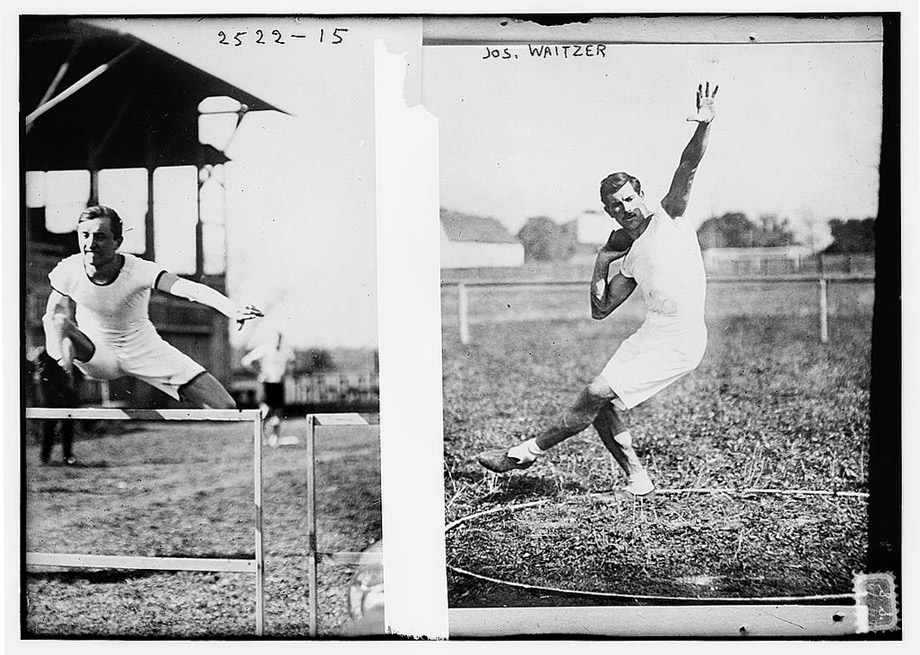
Slate reviews the following games, which took place in Stockholm in 1912:

Flickr Commons project and database, 2008, via Library of Congress.

They go on to explain:

… the 1912 Stockholm Games were “the last Olympics where any individual could just turn up and hope to enter a competition.” In that era, the idea that “natural” skill might enable someone to win a competition without any specialized training was still widely embraced.

As I sit in my living room with twenty four high-definition BBC channels showing almost every Olympic event taking place live, with commentary and instant replay and now apparently optional 3D, it is nice to appreciate what we have now, but also to look back at a time when people were happy to be entertained by watching the tug-of-war and a master of ceremonies wielding a megaphone to address the crowds.

In Defence Of Olympic Free Speech

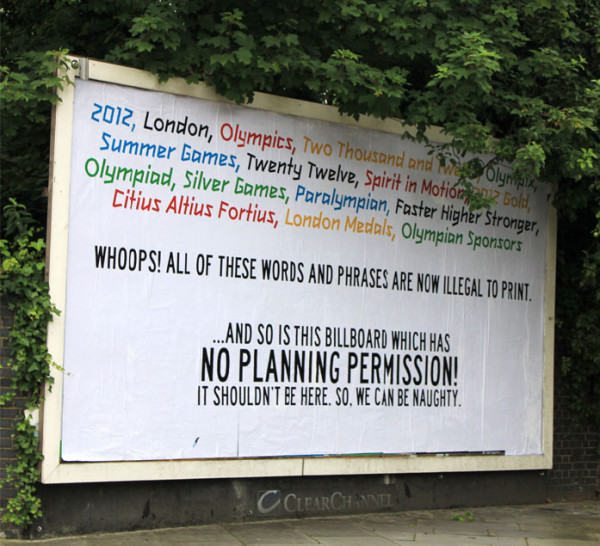
Marbury finds a wonderful example of people not being cowed or bullied by the over-reaching, un-democratic London Olympic Games and Paralympic Games Act 2006:

Image from marbury.typepad.com


2012, London, Olympics, Two Thousand and Twelve, Olympix, Summer Games, Twenty Twelve, Spirit In Motion, 2012 Gold, Olympiad, Silver Games, Paralympian, Faster Higher Stronger, Citius Altius Fortius, London Medals, Olympian Sponsors.

Our government, in their infinite wisdom, have decided that any business using two or more of the words or phrases from this list in their advertising, products or promotional materials without having signed a sponsorship agreement with the London Olympics authorities, is committing a criminal offence. Long live free speech…

They can bite me. Seriously.

Music For The Day

“Let All The World In Every Corner Sing”, part of Five Mystical Songs by Ralph Vaughan Williams:


Performed here by the choir of St. Paul’s Cathedral, London.