David Cameron, the Prime Minister I supported for much of these past five years – and for whose party I voted in 2010 – spent the last day of the election campaign not making a powerful case for real conservative stewardship of the country, but by indulging in petty scaremongering about a Labour victory and pre-emptive expectation setting around the “legitimacy” of rival claims to power in the certain event of a hung parliament.
Well, inspiring or not, the Prime Minister’s strategy worked magnificently. David Cameron may have failed to inspire the British people with a burning, urgent vision for conservative government, but at least he managed (through endless repetition) to remind us that the economy is growing again under the Tories, and that a Labour-SNP coalition could put it all at risk.
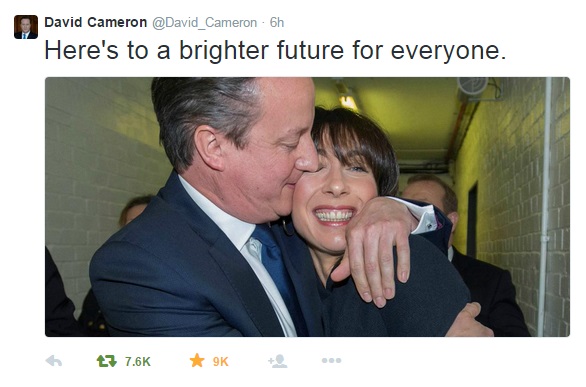
And now, where only hours ago we expected the political parties to be commencing the first of many fraught rounds of coalition negotiations, instead we see David Cameron being driven to Buckingham Palace to meet the Queen, while the other parties (save the astonishing SNP) quickly and mercilessly dispatch their failed leaders.
First and foremost, this election result is a resounding defeat for Labour, and the confused non-values it stood for during the 2015 campaign. Having both repudiated the centrism of New Labour and failed to return the party to its ideological roots, putting himself in the ludicrous position of being against the Tories but not for a tangible vision of his own, Ed Miliband has brought Labour to complete and utter electoral ruin.
Ed Miliband went to his political Armageddon today flatly refusing to accept that Labour had made any mistakes during their last thirteen year spell in government, at least as far as the economy and public spending were concerned. The electorate took one look at this outright denial of reality and determined that the Son of Brown could not be trusted to take stewardship of the finances again.
But almost nobody expected the Labour Party to perform this badly against the Conservatives – poll after poll showed the Tories and Labour in a virtual dead heat. So when the exit poll results were announced at ten o’clock last night, people scarcely believed them. Paddy Ashdown confidently remarked that he would eat his hat if the Liberal Democrats were reduced to ten MPs. They currently have just eight. UKIP supporters (including yours truly) were convinced that UKIP would win more than two seats, picking up at least Thanet South or Thurrock. But only Douglas Carswell now remains, cutting a lonely figure.
An interesting (and concerning) poll in Conservative Home this week reveals that more Conservative supporters would prefer David Cameron to enter into a future coalition with the Liberal Democrats (again) rather than UKIP.
Liberal Democrats – 73 per cent. This finding may be a proof that familiarity doesn’t necessarily breed contempt. To some degree it reflects the fact that Tories have simply got used to working with the LibDems. It is also a tribute, in its own way, to the staying power of the Coalition: I put my hand up to not having expected it to last all the way to the end.
UKIP – 49 per cent. Some members will see UKIP as a natural partner for the Party. Others won’t, but will believe that differences can be fudged. Others still, as with the Liberal Democrats, will feel that coalition is a price worth paying to keep a Conservative-led administration in office: in some cases, respondents will have selected both options.
What does it say about the modern Conservative Party and the mindset of its supporters, that they would prefer to enter into coalition with a party that is rabidly pro-EU and in favour of an ever-expanding public sector funded through ever-increasing tax bills on the successful, rather than UKIP, the party which (just about) believes in smaller government, lower and flatter taxes, personal responsibility, a stronger military and secession from the European Union?
The answer, of course, it that it says nothing good at all.
The fact is that some Conservatives have quite enjoyed having Nick Clegg and the Liberal Democrats as bedfellows for the past five years – the coalition has helped the wet Tories to cover their left flank, giving the party a plausible excuse for making little progress on shrinking the size of the state and zero progress on reclaiming power and sovereignty back from the EU.
But if the current course of the 2015 general election campaign tells us anything, it is that the bland centrism that characterises the modern Labour and Conservative parties is increasingly unattractive to voters. True, the smaller parties are seeing some shrinkage in their support as polling day nears, but we remain on course to see the largest ever number and percentage of national votes cast for parties outside the big three.
Whether left or right wing, people are finally getting tired of seeing their core convictions (be it trade union solidarity and income redistribution on the left, or personal liberty and small government on the right) bartered away in pursuit of ineffectual policies calculated to cause minimal offence to anyone.
Yes, the Tories still have work to do in order to detoxify their brand. But the answer is not for them to dress up in Labour Party clothing and bang on endlessly about the importance of public services and “our NHS”. Such an approach will never work – it has been tested to destruction by David Cameron and George Osborne, and has convinced no one.
To move to the left is to sidestep the issue and avoid the hard work detoxifying conservatism in Britain, when what is needed most is patient explanation and passionate promotion of the idea that small government and less state (and EU) interference in our lives would be something to celebrate, not to fear.
Here is an interesting – and different – way to frame the question to Tory activists and the Conservative Party leadership. Rather than simply asking whether they would prefer the devil they know or the devil they don’t when choosing a future coalition partner, let’s ask which of these UKIP policies and ideas have suddenly become so offensive to the modern Conservative Party that they would sooner jump back into bed with Nick Clegg than with Nigel Farage:
A smaller government, with less than 52% of British citizens as net dependants on state benefits and services
The reassertion of the continued relevance of the nation state, expressed by a rejection of the European Union and the holding of an immediate in-out referendum
Sadly we already know many of their answers, and they give us very little hope for the immediate future of British conservatism.
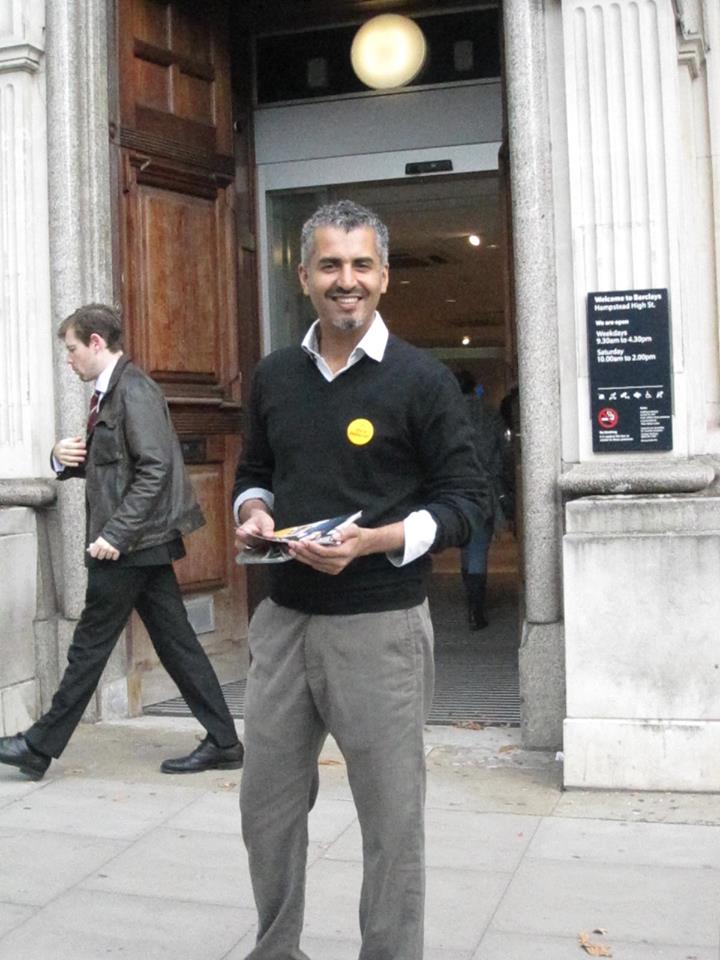
Maajid Nawaz is by far the most high profile of the candidates standing for election in Hampstead and Kilburn, perhaps befitting the seat currently held by Labour’s Glenda Jackson. But Nawaz was adamant that his high profile and personal causes (such as the Quilliam anti-extremism think tank, which he founded) would dovetail closely with his work as a constituency MP, not distract from it.
On the LibDem’s performance in coalition, Maajid Nawaz emphasised the “stabilising effect” that the Liberal Democrats have had, softening the “harder edges” of an outright Conservative government. The LibDems have been “a moderating influence on some of the more ideological elements of the Conservative party”, says Nawaz.
Maajid Nawaz spoke most passionately on the subject of mental health, claiming that the LibDems have introduced measures to ensure that “people who go to a hospital complaining of anxiety or depression are treated exactly as somebody who complains of a physical ailment”.
Click here for interviews with each of the 2015 candidates standing for election in Hampstead and Kilburn, and a summary of the recent hustings organised by West Hampstead Life.
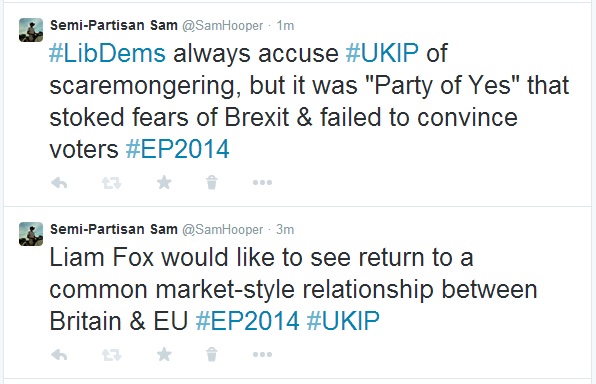
Real time, Semi-Partisan tweets and analysis of the incoming European election results are accessible here.
There are a lot of moving parts at the moment. As expected, UKIP are performing very well and are still on track to win the vote in the United Kingdom. But interestingly, the Conservative vote is proving quite resilient in many areas – it’s the Liberal Democrats who are haemorrhaging support and staring the possibility of losing all their MEPs in the face.
Nigel Farage appears confident – even jubilant – on television, saying “Who’s to say what UKIP can and cannot achieve in the 2015 general election … Anything’s possible after tonight’s result”.
So far, London is dark – the returning officer is not releasing information from the various London regions individually as they become available, opting to release all of London’s results simultaneously. A much clearer (and more final) view of the new electoral map will be available once we know London’s verdict.
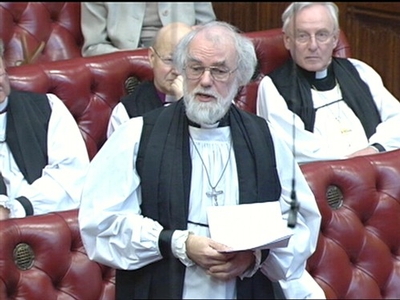
A walking, talking advertisement for the benefits of separation between church and state
In their latest editorial on the subject, The Guardian appears to have given up on the one-step, transformative reform of the House of Lords that was set in motion by the last Labour government and the next steps enshrined in the coalition agreement (before the Tories and LibDems blew the plan to bits in a fit of politically childish pique). Instead, they now advocate a slower (if that were possible), multi-step process of gradual and incremental reforms before we arrive at the cherished goal of having a working bicameral legislature where both houses hold democratic legitimacy.
We begin with the usual wailing and gnashing of teeth at the current state of affairs, and lamentation that the yearly spectacle of undeserving people being honoured with the privilege of sitting in the upper house has taken place yet again:
What an embarrassment to the so-called mother of parliaments. Thirty more cronies and party donors, leavened by a handful of the genuinely worthy and the downright eccentric (what’s an active journalist like Danny Finkelstein doing on the list?), appointed to the democratic world’s largest legislative chamber. It’s hard to imagine where they’ll find room to sit, never mind a job to do, in a chamber where in some debates there’s a 90-second limit on speeches. Yet proposals for reform are discarded. Even a modest suggestion of voluntary retirement founders. And prime ministerial patronage continues more or less unchecked.
The whole exercise is, in the widest sense of the word, corrupt: a system where individuals who make huge party political donations and – however sound their judgment and broad their experience – are awarded a place in the legislature as a gift from the leader of the party is just as much a scandal waiting to happen now as it was when Maundy Gregory was operating the system in the interests of Lloyd George.
But after this strident denunciation of the way things work, The Guardian goes turncoat on us:
Yet despite its Ruritanian appointments process, the Lords is generally acknowledged to be working unexpectedly effectively. Peers do take seriously their duty to scrutinise legislation, they have a good record for improving it, and some have been doughty defenders of individual freedoms. And look closely at who actually sits in the Lords: since the hereditaries were largely ejected in 1999, it’s become a more representative cross-section of the electorate – and the share of the votes cast – than the Commons, and more ethnically diverse. Even the gender balance is at least no worse. The danger is that the more useful it is, the harder it will become to reform.
Well, yes. This is why bicameral legislatures are a good thing. A more ruminative upper house will generally act as a brake (if not a stop) on the more reckless or short-term politically calculating moves of the lower house (and Lord knows that countries like Britain and America need such a check). This fact holds true even when the upper house in question has no real democratic legitimacy. But the fact that the House of Lords is doing okay-ish at the moment (if we choose to ignore the recent lobbying scandal and the fact that 26 lords spiritual continue to exert the not-always-benign influence of the Church of England over our lawmaking) is insufficient reason to reduce the pressure for comprehensive reform.
Most of the hereditary peers are now gone, so Britain is at least spared the indignity of having nascent laws scrutinised by the inbred landed gentry of the realm. We are just left to tackle the political appointees, the favoured party fundraisers and other beneficiaries of prime ministerial patronage who continue to occupy the place. We must also end the ridiculous, anachronistic idea that it is in any way appropriate to reward a person for their deeds (no matter how worthy or altruistic) by giving them a seat in our legislature. The honours system must be divorced from the political system as a matter of great urgency.
The Guardian concludes:
No one supposed, in 1999, that removing the hereditary peers was where reform would end. But since then, the next step has invariably been too much for some and not enough for others. So without abandoning the ambition for an elected upper chamber, perhaps it is time to make progress in smaller steps.
I would rather abandon any expectation of further changes in the next two years in the hope that more comprehensive reform can be achieved following the 2015 general election. This is not an unrealistic goal. True reform was part of the coalition agreement and very much on the cards until the Tories and Liberal Democrats decided to have a mutually destructive bust-up over linking the policy to changing electoral boundaries. Assuming the parties can find it within themselves to grow up slightly, Lords reform can be part of a future coalition agreement (or single party manifesto) too.
Semi Partisan Sam says no to any more slow, incremental reform of the House of Lords. The nation would be better off suffering through another two years with the upper house stuffed full of bewigged, enrobed anachronisms and political patronage beneficiaries before finally kicking the lot of them out after 2015 rather than enduring another decade or more of hand-wringing and glacial progress.





 Semi-Partisan Politics