Isabel Hardman Is Right To Criticise The Labour Party’s Toxic Brand Of Feminism

Isabel Hardman has a great piece in The Spectator in which she rightly castigates Harriet Harman and the Labour Party for their narrow, possessive and parochial attitude towards feminism and gender equality.

Hardman writes:

Harriet Harman also described the Prime Minister as ‘no sister’, arguing ‘we’ve got a new Tory prime minister – and she’s a woman. But like Margaret Thatcher before her, Theresa May is no supporter of women’.

Now, it’s probably quite irritating for Labour to have to hold a women’s conference while the Tories are still crowing that they’ve got another female Prime Minister. But is this sort of ‘you’re not a real feminist’ moaning very, well, feminist? Naturally, Theresa May has a different interpretation of what a feminist politician should do to some Labour MPs: though perhaps not as different as they might think. After all, she did set up Women2Win, which has increased the number of female Tory MPs in parliament by lobbying the Conservative party and mentoring candidates. And after all, she did do quite a lot of work on domestic violence when in the Home Office, including working with the now Labour MP Jess Phillips when she was working as a national adviser on domestic abuse, and introducing the offence of coercive and controlling behaviour. And she also introduced a number of measures on female genital mutilation and forced marriage. But still, she’s not a Labour MP, so that means that obviously she’s not really a feminist.

Sorry, ladies, but feminism is even more important than partisanship. If you start claiming that only women who meet with your politics are real feminists, then you break into the People’s Front of Judea when feminists haven’t run out of problems to solve. You also alienate those on the right who are feminists but who you tell aren’t welcome in your special exclusive left-wing ladies’ club. Feminism has to span the political spectrum, otherwise it gets stuck in one party. And given the Labour party isn’t going anywhere right now, that’s not much use to the women who still need a politician who’ll show them what a feminist in government looks like.

Amen to that. Feminism (or egalitarianism) is much bigger than the Labour Party – thank God. And Lord knows that it needs to be.

Labour’s brand of feminism views women as weak supplicants and perpetual victims, helpless waifs entirely dependent on government largesse, social protection and financial support from the state.

It is a toxic creed of inferiority which imagines that women cannot make it on their own without help from enlightened white knights in the Labour Party to vanquish their foes and smooth their path in life. And that’s why Harriet Harman and other left-wing feminists hate Theresa May, and hated Margaret Thatcher before her. For here are two unapologetically conservative women who strove and succeeded on their own merits, and and overcame an (at times) extremely sexist culture and workplace by quietly getting on with the job rather than exulting in their own supposed fragility and victimhood.

Harriet Harman views Theresa May as a traitor to Proper Socialist Feminism because Theresa May (and other independent conservative women like her) never asked for Labour’s help on her path to success, and because Britain’s new prime minister is a living, breathing example to girls and young women (and men, for that matter) that success and full equality are not contingent on swallowing Labour’s nasty, backbiting politics of identity and victimhood.

For in reality, it has been the Conservative Party who have put egalitarian and meritocratic principles into practice when it really counted, electing not one but two female party leaders. Labour is the party of the all-woman shortlist, affirmative action, gaudy pink minibuses and thinly-veiled misandry. The Tories are the party of Britain’s two first female prime ministers.

So three cheers for Isabel Hardman reminding us that believing in gender equality should not and does not also require swallowing whole Labour’s politics of grievance, weaponised victimhood and government dependency.

Feminism and egalitarianism are bigger than the Labour Party, which is probably just as well – because Labour’s leading feminists are looking mighty churlish and downright small right now.
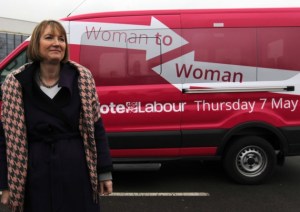
 

harriet-harman-labour-party-pink-bus-feminism-identity-politics

Support Semi-Partisan Politics with a one-time or recurring donation:

Agree with this article? Violently disagree? Scroll down to leave a comment.

Follow Semi-Partisan Politics on TwitterFacebook and Medium.

Live Blog: Jeremy Corbyn Elected Leader Of The Labour Party (Again)

jeremy-corbyn-victory-labour-leadership-contest-2016

Jeremy Corbyn destroys Owen Smith’s pathetic candidacy, is re-elected leader of the Labour Party – Live Blog

Contact: semipartisansam@gmail.com


13:26

At this point I’m not sure what more there is to say. All of the arguments about how the Labour Party ended up in this position have been stated and restated over and over.

Inglorious defeat was long predicted by this blog – not least here, here and here.

One can only think that the restless, self-entitled centrists have shot themselves (and their party) in the foot with this reckless and doomed leadership challenge – and for what? Corbynism, however misguided, has earned the right to be tested at a general election. And all of these furious attempts by the PLP to circumvent that process and disenfranchise Jeremy Corbyn’s base have only hardened his support – and strengthened the impression that the centrist Westminster establishment do not trust the British electorate to choose from a full palette of political shades, insisting on artificially limiting our choice beforehand lest we make the “wrong” choices.

As this blog recently noted:

One way or another, the establishment seems determined not to give the quaintly antiquated socialism of Jeremy Corbyn the opportunity to fail on its own. Labour’s centrist MPs do so because they are hungry to pursue what they see as the quickest route back to power (and some fear losing their seats in a 2020 anti-Corbyn landslide), and the rest of the political and media establishment do so because they are alarmed by Corbyn’s views on NATO, Trident and other issues, and do not trust the British people to likewise see the flaws in these ideas and reject them.

Of course, the sad irony is that by going to such extreme lengths to prevent Jeremy Corbyn’s socialist ideas being tested in a general election, the establishment is doing more than anyone else – more even than Corbyn himself – to harden support for those failed ideas, ensuring that they live on even longer past their “sell by” date.

Furthermore, the idea of centrist MPs enforcing what is essentially a de facto ideological test for any politician seeking high national office is grossly offensive to our democracy, revealing the establishment’s contempt for the people in all its hateful glory. We the people are more than capable of determining which political ideas are good, bad, offensive, dangerous or otherwise, and we have no need for a sanctimonious elite to pre-screen our choices for us.

The only things necessary to defeat Corbynism are Jeremy Corbyn himself and the British electorate. It’s sad that Labour MPs and the political / media establishment are simultaneously too selfish and too distrustful of the British people to realise this obvious truth.

This failed coup against Jeremy Corbyn has also revealed the utter dearth of talent among Labour’s centrist MPs. Even the supposed “big beasts” are little more than field mice – none of them had the courage to put their own political careers and future leadership ambitions on the line by challenging Jeremy Corbyn, leaving it to the underwhelming Owen Smith to carry their banner.

But worse than failing to field a serious candidate, the centrists had no vision to offer. Like Jeremy Corbyn or loathe him, he has a vision for a different Britain and principles which he has stuck to for decades, not bending and shapeshifting in an attempt to flatter different interest groups. The centrists offered no vision at all, other than their naked hunger for power. But if you cannot articulate in an inspiring way what you choose to do with that power, it will not be granted to you.

Will the Labour centrists finally learn this lesson? I have absolutely zero confidence that they will.

12:40

Submission.

See my “submission” series – Part 1, Part 2, Part 3.

12:29

Good question from Norman Smith to Diane Abbott – “why shouldn’t local parties deselect local MPs who continue to be vocally critical of a popularly elected leader?”

Abbott deflects, choosing to be polite and magnanimous today – but Norman Smith’s question is a fair one. Why should pro-Corbyn CLPs continue to tolerate Labour MPs who do not share their beliefs and actively seek to undermine Corbyn’s leadership?

In fact – mandatory reselection for all!

12:24

To do otherwise would have required competence and vision, qualities with which the angry, self-entitled centrists are not exactly brimming over.

12:22

Thinking of starting an “it’s time for the Labour Party to come together” counter on this blog. Nearly everybody interviewed on the BBC so far has used that phrase, however unconvincingly.

12:16

Interesting report from Huffington Post – apparently Owen Smith “won” among under 24s (and pre-2015 members) according to an exit poll:

Owen Smith beat Jeremy Corbyn among Labour party members who joined the party before 2015, a new exit poll has revealed.

Although he was defeated in the overall election, the YouGov/ElectionData poll found that Smith also won among 18-24 year-olds and Scottish party members.

The survey found that 63% of pre-2015 party members had backed the Pontypridd MP, to just 37% for Corbyn.

But the current leader had a huge lead among the tens of thousands who have joined the party since Ed Miliband quit, with 74% of them backing him to just 24% for Smith.

Among those who had joined since Corbyn became leader, a massive 83% said they had voted for him in the 2016 leader election, and 15% voted Smith.

While this sounds quite surprising at face value, digging a little deeper I’m not so sure that it is unexpected. Look at the young people who typically get into politics – a significant number of them tend to be university Labour/Conservative types, people who entertain either vague or determined ambitions to one day climb up the greasy pole and launch political careers of their own. Young Labour activists such as these likely want to taste political power one day rather than dwell in permanent opposition, and since prevailing wisdom (right or wrong) is that Jeremy Corbyn is unelectable is it really surprising that many of them fell into line behind the candidate who looked the part of the typical, professional political candidate? I don’t think so.

12:14

Yeah, I picked up on this too:

12:11

Not a whole lot of sympathy for Owen Smith from the Left:

Good. Owen Smith is an awful politician and was a terrible leadership candidate. He deserves neither consolation nor sympathy.

12:06

Chuka Umunna on the BBC, on the defensive against the potential deselection of “good, hardworking and popular” local Labour MPs.

Newsflash, Chuka – if they were so tremendously “popular” among the party activists who sweat blood to get them elected to Parliament in the first place, they wouldn’t be at risk of deselection. But since they have openly defied the wishes of their own local party members, they must now steel themselves to face the consequences.

12:02

Hilarious watching sulking centrists stalking out of the conference hall and refusing to even talk to the BBC reporter (Norman Smith) stationed outside. They have only themselves to blame for pitching the biggest hissy fit in the world against Corbyn’s leadership while utterly failing to come up with a compelling vision of their own for the future of the Labour Party and Britain.

12:00

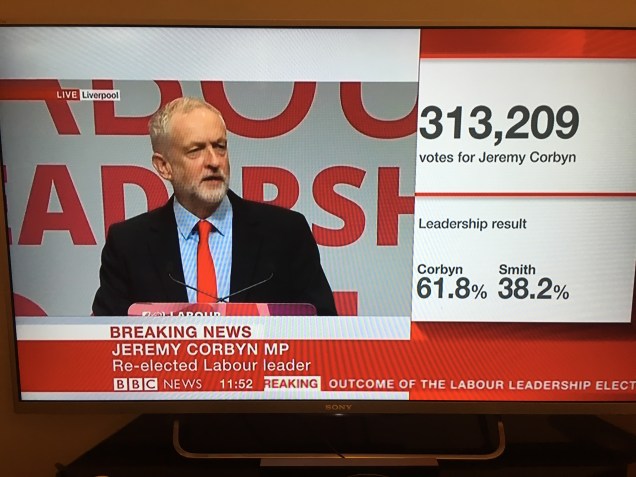
Well, that wasn’t a bad victory speech from Jeremy Corbyn – far more magnanimous than I would have been under the circumstances. He congratulated the supporters and activists of both leadership campaigns in a general paean to political activism, and tried to immediately move the focus forward by plugging some big campaign for education (basically against grammar schools) next week.

I’m not sure if that will be enough to glue the warring Labour Party back together – however many times the phrase “we all need to come together” are uttered by different Labour MPs and officials over the course of the day. But for Jeremy Corbyn, it is clearly now business as usual.

11:50

And it’s Jeremy Corbyn (naturally), with 313,209 votes of 506,428 cast, meaning a breakdown of Corbyn 61.8% / Smith 38.2%.


Jeremy Corbyn - Paris Attacks - Terrorism - Appeasement

Support Semi-Partisan Politics with a one-time or recurring donation:

Agree with this article? Violently disagree? Scroll down to leave a comment.

Follow Semi-Partisan Politics on TwitterFacebook and Medium.

Julia Hartley-Brewer Is Wrong To Fear Mandatory Reselection Of MPs

Why are conservatives so concerned that the Labour Party is moving in a more socialist direction?

On last night’s Question Time, journalist Julia Hartley-Brewer – a journalist with whom this blog often agrees – held forth on the state of the Labour Party, and calls by some activists for the implementation of mandatory re-selection of MPs prior to a general election in order to make the Parliamentary Labour Party more representative of the membership.

Huffington Post reports:

Journalist Julia Hartley-Brewer said Britons would “never elect a Socialist Government” on Thursday’s edition of the programme, as Corbyn is expected to be re-elected Labour leader easily on Saturday.

She was speaking after Blairite Labour MP Liz Kendall was the target of an audience member who advocated the mandatory re-selection of MPs before they could defend their seats in a General Election, something Corbyn supporters could use to remove those critical of the Labour Party leader.

“What a depressing conversation, genuinely,” Hartley-Brewer said.

“I’m a great believer in democracy. The thing about democracy is you have a Government but you also have Her Majesty’s Opposition.

“The reality is the Labour Party needs to make a decision about whether it wants to be a serious alternative Government in waiting or a Friday night Marxist book club. It can’t be both.”

This, of course, is a common refrain from conservative types either hoping to have some fun at Labour’s expense or express genuine concern about what they see as an unbalancing of Britain’s political system.

Personally, I don’t understand why so many prominent movement Conservatives – people who would never vote Labour in a million years – are so upset that the Labour Party is once again expressing genuine socialist tendencies, and desperate for it to tack back to the centre and become an electoral threat to the Tories again. Even after the EU referendum have these people learned nothing about the dangers of a stultifying cross-party consensus in the middle of British politics which shuts out whole swathes of people who dare to hold staunchly conservative or socialist (or individualist/authoritarian) beliefs?

The Huffington Post continues:

Hartley Brewer then defended [Liz] Kendall, calling her a “very good, very sensible hard-working MP” who “talks about the real issues affecting real people”. She bemoaned the fate of Labour MPs who face either “deselection for speaking sense” or losing their seats at an election.

I can’t help but feel that Julia Hartley-Brewer is failing to consider the upside of mandatory reselection for conservatives. Finally, real small government conservatives would have a mechanism to get rid of statist, pro-European Tory-lite interlopers like the pointless Anna Soubry, and those numerous other MPs who pretended to be staunchly eurosceptic during their initial constituency selection procedures only to come running to the Remain campaign like loyal dogs the moment that David Cameron snapped his fingers. Don’t Conservative Party members deserve a parliamentary party – and a government – which more closely reflects their interests and priorities, too? And what better way to do this than through mandatory reselection?

Yet many people with whom this blog usually finds common cause seem to see this issue differently. They seem aghast at the idea that a party founded on socialist ideals should actually dare to be socialist, which is puzzling to me. Julia Hartley-Brewer will probably never vote Labour for the remainder of her lifetime – so why the concern that Labour avoid becoming a “Marxist book club”? At a time when the Conservative Party is so soul-sappingly centrist in outlook, would she really rather have a battle-ready, equally centrist Labour Party nipping at its heels?

As this blog recently commented:

It is as though it is no longer enough for the party we personally support to reflect our own views and priorities – we now expect opposing parties to reflect them too. This is a politically stultifying and increasingly ludicrous state of affairs. As a small-c conservative I believe strongly in maintaining our nuclear deterrent, a strong military, the NATO alliance, low taxes and small government. But I don’t for a moment expect the leader of the Labour Party to hold these exact positions, too. And while it would be calamitous were Jeremy Corbyn to become prime minister by some dark miracle and actually enact all of his policies, I trust in the wisdom of the British people to see through his policies and reject Corbynism at the ballot box.

And that’s the difference, I suppose, between this blog and the political and media establishment. I trust the people to look at the political parties and refuse to vote for a party campaigning on a manifesto which is so clearly damaging to our economy and national interests. The establishment do not trust the people, because they do not respect the people. They have no faith that the British people will make rational decisions when presented with a range of political alternatives – therefore they see it as their job to artificially limit our choice beforehand, taking certain options off the table by declaring them “unacceptable” and suppressing their very discussion by mainstream politicians.

Besides, who should be the judge of whether an MP is “sensible” and “hardworking”? Come general election time, surely the best people to pass judgment are those from the local constituency party, who know best whether their MP is adequately representing their values. If they are dissatisfied with their candidate, why should their views be steamrollered by a cliquish Westminster conspiracy to protect the centrist Good Old Boys (and Girls)?

If Labour’s centrist MPs really do speak such “sense”, they will surely have no difficulty in winning the support of thousands of non-aligned voters who do not subscribe to the Jeremy Corbyn agenda. If they are so wise and pragmatic, surely they could not fail to succeed by striking out on their own and forming a new centrist party?

And yet the centrists are going nowhere, because they have no compelling vision of their own to offer the electorate, and many of them would struggle to even win back their deposits if they ran as independent candidates or under the banner of a new centrist party. Therefore their only hope, in the short term, is to cling on to their seats despite often being loathed by their own local parties, in the hope that one of them will come up with an alternative policy agenda which actually commands enthusiasm and respect. And frankly, few Labour centrist MPs have done anything to deserve such an unfair helping hand.

The cold, hard truth is that the Labour Party has shifted decisively to the Left. Julia Hartley-Brewer’s attitude seems to be “to hell with the party members who actually do all of the hard work and unglamorous campaigning – they should be lumbered with a centrist leader they despise, just so that British politics can continue to be fought over a vanishingly small sliver of real estate in the centre ground”. Personally, I find that idea repellent.

In a democracy, decisions are made and influence is wielded by the people who actually bother to show up. And right now, the Corbynite Left are showing up and making their voices heard, while the various centrists (despite their prestige) are able to conjure up all the excitement of a cold bucket of sick. The left-wing have earned the right to be heard, while the centrists have demonstrably not. Hearing what the Corbynites have to say and abiding by their wishes is therefore not only the fair thing for the Labour Party to do, it is the only remotely democratic thing for the Labour Party to do.

And the proper reaction from conservatives is not to brim over with sympathy for the poor Labour centrist MPs who have so grievously lost touch with their own party base – it is to demand a similar rebirth of radicalism on the Right.

Julia Hartley-Brewer is aghast at the idea of mandatory reselection for Labour MPs, but I say bring it on. Let the Tories have their own version of Momentum too, something to put a rocket up the government’s complacent and depressingly un-ideological posterior – and then give Conservative Party members the same opportunity to shape the future of their party, hopefully by dragging it away from the smoking ruins of Cameron-era centrism.


Jeremy Corbyn - Labour Leadership Election - Victory Nears

Support Semi-Partisan Politics with a one-time or recurring donation:

Agree with this article? Violently disagree? Scroll down to leave a comment.

Follow Semi-Partisan Politics on TwitterFacebook and Medium.

Submission, Part 3

jeremy-corbyn-owen-smith-labour-leadership-coup-2

As they go down in flames for the second time in a year, Labour’s rootless and uninspiring centrists deserve neither respect for their “principles” nor sympathy for their plight

Quick, everybody reach for the tiny violins. The Telegraph’s Asa Bennett has penned a tremulous ode to Labour’s centrist MPs, encouraging these noble Men and Women of Principle (…) to never surrender in the face of Jeremy Corbyn’s imminent re-election as Labour leader.

Read the whole thing – entitled “Labour moderates have nothing to gain by kissing and making up with Jeremy Corbyn“. It is hilariously overwrought, and conjures much the same air as the Titanic’s band calmly playing “Nearer My God To Thee” as the doomed vessel slowly slipped beneath the icy waters of the Atlantic.

Money quotes:

Corbynistas know who their enemies are in the party. Don’t forget they have already divided up MPs by how loyal they are in secret lists. People like Mr Jarvis and Ms de Piero have made their disquiet known about Mr Corbyn, with the former believing he would lead the party to “electoral annihilation”. They have stuck their heads above the parapet to call for new leadership – a brave decision, but not one they can pretend never happened.

And Corbyn is not in a similar position? At least the centrists have one clear enemy and know exactly on who to focus their attempts at destabilisation. Jeremy Corbyn, despite being overwhelmingly popular among the party membership, is surrounded by disloyal MPs who have been working to undermine his leadership from Day 1. If the people who were supposed to work for you in your shadow cabinet were leaking damning quotes and incendiary opinions to the media like a broken tap, wouldn’t you try to implement some rudimentary system to remind yourself of who could be trusted and who would simply abuse any trust and autonomy to further their own aims rather than those of the party? I know I would.

Besides, that is the trouble with saying incendiary things to the media. There was always the risk that by attacking Corbyn in public, he would go on to triumph nonetheless, leaving his critics in an awkward position. But the answer is not to go on as an increasingly bitter heckler from the back benches. The answer is to either accept the overwhelming verdict of party members and try to cooperate constructively, or if this is impossible, to maintain a position of dignified silence on the backbenches. And then there is the nuclear option, which none of the centrist MPs will take out of overwhelming regard for their own political careers – if they really can no longer abide being in the Party of Corbyn they can always leave and join a different political party.

More:

Some MPs must be tempted to return in order to help Labour fight Theresa May’s government (even if their fellow moderates may think them scabs). This may help the Opposition put up a vaguely professional front, but it will be a gift to the Tories, who can relentlessly use these new shadow ministers’ past criticisms of their leader against them. Mr Corbyn is already struggling to convince voters that he could be a better Prime Minister than Mrs May, so how would that change by him bringing back a bunch of MPs who think he’s useless?

Again, this is shallow partisan thinking. As we are hopefully discovering in the aftermath of the EU referendum and the vote for Brexit, there is more to life than optics and how well things lend themselves to snappy soundbites. Might working alongside Jeremy Corbyn lead to some awkward questions from the media for those MPs who were vocally critical of him in the past? Sure. So power through the awkwardness. Reach out to Keith Vaz for tips on doing so, he has oceans of experience.

More:

Jeremy Corbyn’s former critics would be foolish to think that they can be welcomed back into the fold without any problem. Their return would be taken as sign of ultimate capitulation, and Corbynistas will not forget which side of the Labour leadership contest they fought on.

Asa Bennett is acting like Jeremy Corbyn is uniquely thin-skinned and petty, when in fact the opposite is the case. Corbyn has remained courteous even to MPs who have vented really quite unprofessional sentiments to the media. Will the insults be forgotten? No, probably not – that’s just human nature. But if any Labour leader in recent history is likely to work with his public critics, it would be Jeremy Corbyn.

Besides, in his overwhelming concern for the fate of centrist Labour MPs, Asa Bennett seems to be forgetting the pantheon of misfortunate MPs who were purged from the Courts of Tony Blair or Gordon Brown, their government careers abruptly terminated simply for showing too much favour to one or other of these egotistical megalomaniacs. Is Bennett really suggesting that Jeremy Corbyn being a bit frosty to MPs who openly called him “useless” on television is less acceptable than Prime Minister Gordon Brown throwing staplers and mobile phones at cowering aides who incurred his wrath?

And finally (my emphasis in bold):

This year’s Labour leadership election is drawing to a close, and Mr Corbyn’s survival is all but assured. Labour MPs have to decide whether to stay true to their beliefs and carry on the fight, or surrender and beg for a job. Moderates may seek a deal which means they can serve, but what is the point in carrying on such a charade?

WHAT BELIEFS?

Will somebody please tell me what high and noble principles these saintly centrist MPs consider so inviolate that they are honour-bound to refuse to serve alongside Jeremy Corbyn? Because for the life of me I cannot figure it out. Indeed, the very nature of being a centrist typically involves either a willingness to compromise on absolutely core and fundamental ideological principles, or the complete lack of any such principles in the first place. So what one Jeremy Corbyn policy is so offensive to the centrist rebels that they could not bring themselves to support it if focus groups suddenly showed it to be overwhelmingly popular?

Refusing to serve alongside Jeremy Corbyn because of deep and irreconcilable differences over policy matters would be understandable, even noble – but that is clearly not the case here. After all, Labour centrist MPs have enthusiastically thrown their support behind Owen Smith, who is campaigning on a nearly equally retro socialist programme as Corbyn. No, the Labour centrists are rebelling not because of unbridgeable differences but because they think Corbyn’s presence at the top of the ticket makes it harder for the party to get back into government and for their own pampered posteriors to get back into ministerial limousines. And that is contemptible.

That’s the rub. The only “belief” which unites the Labour centrist is the New Labour instinct to be all things to all people – to say anything and compromise on any belief in the pursuit of power for its own sake, while sanctimoniously pretending to be wiser than partisans on either side. The centrist creed, such as it is, would be “nothing is sacred, everything is negotiable”. Jeremy Corbyn disagrees, and for thus making Labour’s mountain back to power that much harder to climb they cannot forgive him.

If these centrists genuinely believe that the best policies for Britain would involve tacking just ever so slightly to the left of Theresa May’s centrist Conservative Party while warbling on about “compassion” and “equality” then they should say so – maybe not in so many words, as that would be political suicide, but they should make clear where they accept centrist Tory orthodoxy and where they would move to the Left. But they won’t do this.

The Labour centrists love to prance around in public as though there is some vast ideological gulf between the Evil Tor-ees and their noble selves, yet give them a leader who can actually put clear water between his own policy ideas and those of the Conservative government and they all scramble over one another to knife him in the back.

Asa Bennett could not be more wrong – the Labour centrist rebels of the PLP could not be less deserving of sympathy or respect. They had their opportunity to stand for something, anything clearly different, yet all of their remaining big beasts were too selfish and cowardly to run for the leadership, while the man who eventually became their champion – Owen Smith – spent the entire leadership contest asking members to vote for him because he was just as socialist as Jeremy Corbyn.

So when should we begin to feel sorry for the centrists, or give their incessant complaints another hearing? How about when one of them dares to stand up and articulate a positive, alternative vision for centre-leftist government which doesn’t just sound good on paper, but which actually generates the faintest amount of interest from the general public.

I suspect that we will be waiting a good, long while.


UPDATE: Read Submission Part 1 here, Part 2 here.


Jeremy Corbyn - PMQs

Top Image: Mirror

Support Semi-Partisan Politics with a one-time or recurring donation:

Agree with this article? Violently disagree? Scroll down to leave a comment.

Follow Semi-Partisan Politics on TwitterFacebook and Medium.

Jeremy Corbyn’s Labour Party – No Home For Centrists

jeremy-corbyn-rally

Jeremy Corbyn and his supporters vastly outnumber the Labour centrists. So whose party is it really?

Very slowly – journalist by journalist, publication by publication – the realisation is beginning to dawn that the unwelcome outsiders in the Labour Party are now the centrist members of the PLP, and not Jeremy Corbyn and his leftist support base.

From the Spectator (my emphasis in bold):

A few months ago, Watson and his fellow MPs thought Corbyn was the anomaly. That if he was dislodged, the natural balance of the Labour Party would be restored. Now it’s clear that there are tens of thousands of Corbynites who now hold party membership cards and are itching to use them. Labour MPs are starting to ask if they are the anomaly. And an anomaly that the new far-left members will seek to correct when Westminster boundaries are redrawn and MPs are selected.

Slow hand clap.

Yes, centrist MPs are indeed now the anomaly, just as centrists should always be the pitiable, wishy-washy anomaly in a political party. Finally, realisation dawns that maybe it is the centrist machine politicians who are the parasites in the so-called Labour Party, and not the socialists.

A political party is nothing if not the voice and champion of its members. Any other arrangement – such as the noxious idea that MPs, once selected, should have license to ignore their local party at will while being at no risk of ever losing their seat – makes the party membership little more than a fan club for some generally rather unremarkable career politicians. And under Jeremy Corbyn, the Labour Party is finally becoming less of a fan club and more a champion of its members.

Naturally, there are losers in this reconfiguration, namely the centrist MPs who have enjoyed utter dominance since the late 1990s, who suddenly find themselves out of favour and at theoretical risk of deselection. But what is the alternative? That Blairite and Brownite machine politicians, despised by the very constituency associations who will be tasked with pounding the pavements and handing out leaflets to get them elected, have the right to a “job for life”?

This is why we need to radically re-examine the way in which MPs are selected and removed from office. We need real powers of recall, so that constituents (on gathering a sufficient threshold of signatures in a petition) can recall from Westminster an MP who is underperforming, betraying their election pledges or dishonouring themselves and Parliament through scandal. But more than that, we need to move toward to mandatory re-selection and a competitive primary system.

As this blog recently pointed out:

This would bring Britain into line with other countries like the United States, where Representatives and Senators do not have “jobs for life” and must compete in party primaries if they wish to run for their seat at the next election. Such a move would put the wind up an often self-entitled political class, forcing MPs to justify their worthiness of a place on the ballot at regular intervals and forcing many of the older, less useful bench warmers off into retirement.

No constituency should be lumbered with a doddering old MP who doesn’t care any more, or a sharp-elbowed go-getter who ignores their constituency as they focus on climbing the greasy pole. Mandatory reselection goes a long way to solving those problems.

The current system, by contrast, is an abomination – incumbent MPs, often initially selected to stand for parliament in their constituencies through dubious, opaque or even downright corrupt means are then largely free from scrutiny by their own party for the rest of their career. As soon as they enter parliament they are enveloped in the Westminster self-protective cloak which serves to insulate parliamentarians from the consequences of their behaviour and political decisions.

If you know that nothing you can do will ever get you fired – if there is no political betrayal (like, say, pretending to be a eurosceptic during selection and then turning around and supporting the Remain campaign) for which you will ever be held to account – then there is every incentive to lie about your real political beliefs and motivations during selection, and then behave in as abominable and self-serving a way as you please as soon as your are elected to the Commons.

The Labour Party now has two choices if it wants to avoid a permanent schism:

  1. Rig the leadership election process (deceptively known as “restoring the electoral college”) to ensure that pesky party members and their awkward convictions never again elect an ideological leader, or
  2. Embrace a system of mandatory contested primaries, where sitting MPs have to win a party primary in order to stand as the Labour candidate for their constituency at each general election

Failure to adopt one of these two solutions (and this blog strongly favours the second) will ensure that the party remains permanently vulnerable to irreconcilable differences between the directly elected leader and the PLP, thus rendering Labour ungovernable.

Either it must be made harder for ordinary party members to choose the leader they want, or it must be made significantly easier for party members to remove MPs who prove themselves unwilling to work constructively with that elected leader.

The past year has been a viscerally painful case study in what happens when the can is endlessly kicked down the road and people pretend that some other magic solution will offer itself, saving them from having to pick one of these harsh medicines. And whatever harm Jeremy Corbyn’s left-wing positions may have done to Labour’s electoral fortunes pales in comparison to the harm inflicted by the centrist-led campaign to undermine and destabilise their leader.

Either the centrist Labour MPs must take a hike (at least resigning themselves to a few years of quiet irrelevance on the back benches) or the hundreds of thousands of new party members must take a hike, for they have proven themselves incapable of co-existing.

And while this blog disagrees with nearly the entire Corbynite platform, I side strongly with the ordinary Labour Party members who are about to overwhelmingly re-elect their man.


Jeremy Corbyn - PMQs

Top Image: Mirror

Support Semi-Partisan Politics with a one-time or recurring donation:

Agree with this article? Violently disagree? Scroll down to leave a comment.

Follow Semi-Partisan Politics on TwitterFacebook and Medium.