Clarence Darrow vs The Rotten Soul Of Today’s Labour Movement

Kevin Spacey Clarence Darrow 2


What would the famous labour lawyer and anti-death penalty advocate Clarence Darrow say to the late RMT union leader Bob Crow if the two men were to meet in Heaven?

The mental image of their fictional meeting would not leave my mind after I watched Kevin Spacey’s remarkable portrayal of the former unfold in the eponymous one-man play Clarence Darrow at London’s Old Vic Theatre on Friday.

The production – which is well reviewed here, here and here, and in which an elderly Darrow looks back on the many victories and tribulations of his long legal career – gave considerable attention to Darrow’s union activism through his defence of the American Railway Union leader Eugene Debs in the 1894 Pullman Strike, and of the McNamara brothers charged with dynamiting the Los Angeles Times building in 1910, among other famous episodes.

But watching Kevin Spacey portray Clarence Darrow is to see an impassioned and eloquent defence of the rights and dignity of working people that today’s current and recently departed left wing political and union leaders could never hope to equal.

Witnessing the spirit and passion of Clarence Darrow flicker to life on a London stage made it starkly apparent just how close the modern labour movement is to purposelessness and death in the Age of Miliband.

While Darrow in full rhetorical flight could have convinced Ronald Reagan or Margaret Thatcher themselves of the need to concern themselves with the welfare and aspirations of the mother and father working minimum wage jobs on zero hour contracts, today’s left-wing figureheads come across as whiny, self-entitled and spitefully partisan by comparison.

Here are the stirring words of Clarence Darrow in an address to the inmates of Cook County Jail in 1902, the theme of which would be taken up by Ed Miliband and the Labour party in a bold reassertion of conviction politics were today’s labour movement not so politically calculating and intellectually inert:

To take all the coal in the United States and raise the price two dollars or three dollars when there is no need of it, and thus kills thousands of babies and send thousands of people to the poorhouse and tens of thousands to jail, as is done every year in the United States — this is a greater crime than all the people in our jails ever committed, but the law does not punish it. Why? Because the fellows who control the earth make the laws. If you and I had the making of the laws, the first thing we would do would be to punish the fellow who gets control of the earth. Nature put this coal in the ground for me as well as for them and nature made the prairies up here to raise wheat for me as well as for them, and then the great railroad companies came along and fenced it up.

How relevant to today, given the present Labour Party’s focus on the “cost of living crisis” and its apparent determination to freeze consumer energy bills.

But here instead is Ed Miliband warning us of the supposedly mortal threat to the unions posed by David Cameron’s Conservative-led coalition government, in a typically unmemorable speech to the 2013 TUC conference:

We have a Prime Minister who writes you and your members off. Who doesn’t just write you off, but oozes contempt for you from every pore. What does he say about you? He says the trade union movement is a “threat to our economy”. Back to the enemy within.

Six and a half million people in Britain. Who teach our children. Who look after the sick. Who care for the elderly. Who build our homes. Who keep our shops open morning, noon and night. They’re not the enemy within. They’re the people who make Britain what it is.

How dare he? How dare he insult people – members of trade unions – as he does?

Terrible speechwriting aside, Miliband’s suggestion that David Cameron spends his every waking hour plotting against the trade union movement like a modern-day Iago is patently absurd. While the Conservative Party – as one would expect – raises objections to various union policies and rhetoric and their self-interested leadership, you will search in vain to find any evidence of the prime minister “oozing contempt”.

Ed Miliband (in his halting, aggrieved and ineffectual way) and others try hard to continue the life-and-death struggle narrative laid out by Darrow a century earlier, but the fact that their comments are aimed at a modern British audience – even the poorest of whom likely own smartphones, personal computers and enjoy access to universal healthcare via the NHS – renders them ridiculous.

Where Darrow wore his heart on his sleeve and walked the walk of labour advocacy – foregoing a more lucrative career in order to oppose his old railroad bosses who were oppressing their workers – today’s leaders such as Miliband and his union counterparts often hail from the same metropolitan middle and upper-middle classes who form the middle management and ranks of senior civil servants for whom so many working Brits toil. And what’s more, Labour politicians and the management class now talk and sound alike.

Whereas Clarence Darrow stood firmly for worker’s rights without lapsing into sentimental and unworkable socialism, the response of the likes of Ed Miliband, Len McCluskey and Mark Serwotka to our present pale shadow of real austerity has been snarling and misleading hyperbole about the Conservatives “hating” the poor and taking an obscene delight in their suffering.

(It is conveniently forgotten by these anti-Tory crusaders that the suffering was largely created by a gradual bipartisan expansion of the state, and by making so many British people dependent on the government for one thing or another that any retrenchment of spending now has a widespread, painful effect that would not be the case if the government didn’t try to do so much.)

The victories won by organised labour in Clarence Darrow’s day saved lives and liberated millions of people from what William Beveridge would later describe as the five “Giant Evils” in society: want, disease, ignorance, squalor and idleness. And they are immortalised in rights and traditions which endure to this day, such as the annual May Day march and rally in London, and the Labor Day federal holiday in America.

The victories won by the left wing establishment of today (and the debauched, rudderless trades union to whom they are captive) are comparatively petty and trivial, and each passing ‘victory’ incrementally serves either to perpetuate inefficient public sector service delivery or entrench benefits for union members at the expense of the ranks of the budding entrepreneur class, the self employed, the underemployed and the jobless.

The union men of Darrow’s America (and their British counterparts) would be horrified to witness the tanned, bloated, self-satisfied swagger of men like Bob Crow, who delighted in tormenting other ordinary working people with their undemocratic strikes in order to preserve the gold-plated salary and benefits of, say, a tube driver on the London Underground who gets paid well over twice as much as a newly trained Private fighting for his or her country in the British Army.

So how would Clarence Darrow feel upon meeting the likes of Bob Crow?

One can only imagine, but in fairness, it is not unreasonable to think Darrow would first feel immense satisfaction and relief that the causes for which he fought have come to fruition and done so much good, not just in the United States but throughout the Western world.

His heart might swell to know that not only have child labour and the exploitative company towns of his day been cast into history, but that the strength of public sentiment stands firmly against multinational companies who try to take undue advantage of lower standards and regulations in other parts of the world – although there is undeniably still much work to be done.

But a man of such conviction as Clarence Darrow would also likely recoil at the nanny-state socialism, self-entitled smugness and the bitter, envious rhetoric of people like Bob Crow and today’s labour movement leaders, who have casually sauntered in his hard-fought footsteps across what is now much easier political terrain.

And a final bold prediction: A century from now, in the year 2114 – no matter how much the current generation of labour leaders try to portray themselves as intrepid generals locked in an ongoing epic battle for the rights of the downtrodden and the dignity of man – nobody will spend hours queueing for return tickets to a play honouring the life’s work of the likes Ed Miliband, Bob Crow or others of their calibre.

Truly great women and men like Clarence Darrow fought and won ninety percent of the battle before today’s privileged, metropolitan, self-appointed guardians of the common man ever picked up a protest placard or stumbled into their first Labour Students Society meeting.


Clarence Darrow finishes its run at The Old Vic Theatre tonight. Kevin Spacey also portrayed Clarence Darrow in a PBS biopic movie of the same name, the climactic speech of which is shown above.


If you enjoyed reading this article, please take a second to LIKE or SHARE it on social media using the buttons below. Help to spread the word and continue the debate.

One Nation – The Intellectual Bankruptcy Of The Labour Party

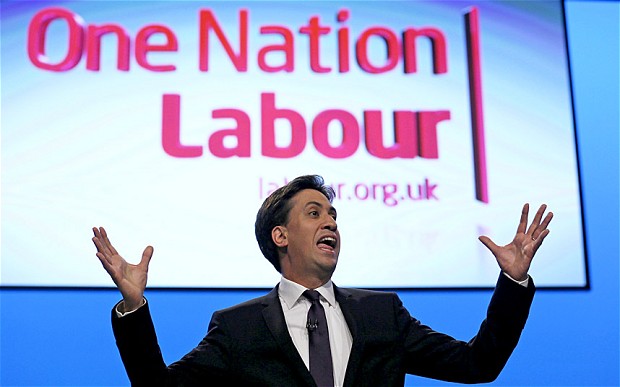
Ed Miliband Labour One Nation


Today’s events, far more so than the weekend’s unimpressive election results and murmurings of panic-tinged dissent from the shadow cabinet, represent a low point for Ed Miliband, the Labour Party and for left-wing thinking in Britain.

For today was the day when, irritated by yet another press question about his continuing inability to connect with voters and asked to sum up his political outlook and ambition in a single word, Ed Miliband offered two words instead, and inadvertently revealed the yawning gulf where ideas, policies and conviction should be sparking together with a general election less than a year away.

Responding to a perfectly innocuous – yet increasingly urgent – question that can be effectively paraphrased as “What makes you tick, and why should anyone vote Labour in 2015 and install you as Prime Minister?”, Ed Miliband’s response had all the resonance of a broken drum (ruptured through repeated banging):


In other words, Ed Miliband’s all-singing, all-dancing pitch to the electorate was this incisive, eternally quotable piece of oratory:

“One Nation. One Nation is an idea about how you bring every person in the country to make their contribution, and how you can change Britain. And that’s what I’m about. And that’s what I’m about for Britain. And I think it shows that Labour is a party that is reaching out to people across our country, and that Labour has the answers. But in the end, the question is does our country succeed with a few people at the top doing well, or does it succeed when actually ordinary people are supported? And that is the big question for Britain. And actually I believe that will be the big question for Britain in the next eleven months.”

One Nation. Forget the dull repetition of meaningless phrases that makes Ed Miliband sound like a skipping record. Forget the petulant innumeracy of his answer. This wasted opportunity to stake out a purpose, a reason for his leadership of the Labour Party, belies a more serious deficit – an intellectual deficit making its disturbing presence felt within the highest ranks of the Labour Party and the left-wing opposition in general.

Ed Miliband managed to speak one hundred and fourteen words without saying anything at all, but let us go line-by-line anyway:

“Bringing every person in the country to make their contribution”. Okay, so there are shades of JFK’s “Ask Not” inaugural address – albeit JFK on a heavy dose of Valium and sleeping pills – in what Ed is saying here. But the idea of drawing on patriotic or civic duty to contribute is squashed no sooner than it is suggested, as Miliband reverts to classic Labour language about what people can expect to get out of their government (“succeed when actually ordinary people are supported”).

“Labour is a party that is reaching out to people across our country”. All the people, that is, except for those who voted UKIP in last week’s election, who are viewed by the party as either out-and-out racists or gullible fools who were seduced by Nigel Farage’s party and need to be shouted at increasingly loudly until they come to see the error of their ways. Dan Hodges was right to warn that Labour is retreating toward an unwinnable 35% per cent strategy.

 “Does our country succeed with a few people at the top doing well?”. The question is rhetorical and the answer obvious, but what Labour intends to do remains unexplored. Is this all about income redistribution, or soak-the-rich taxes that punish high earners regardless of the net effect on the Treasury? Are we closer to the ideal of “One Nation” if we slide back into recession but manage to reduce the inequality gap on our descent down the ranks of economic powers, or has Ed Miliband outsmarted Thomas Piketty and stumbled upon a way for those who earn a living selling their labour to catch up with the capital-owners while growing the economy as a whole?

And that’s it. A request for a one-word answer spawned a two-word brand name, an incomprehensible definition by way of follow-up and more questions than Ed Miliband seems likely to answer between now and election day 2015.

The concern is not that this complete lack of original ideas or strongly-held convictions will necessarily damage Labour in the 2015 general election campaign. Rather, the growing fear must be that Labour could be returned to power despite this ideological and policy vacuum where ideas and core beliefs are supposed to reside.

Sure, there will be a manifesto written, launched with great fanfare and disseminated for all to see, resplendent with glossy pictures and catchy quotes. No doubt it will have a seemingly-profound title: “One Nation”? “Making Your Contribution”? “Reaching Out Across Britain”? All of the key words and hackneyed phrases from Ed Miliband’s response today will have their place.

But what is the next level of detail? How will Labour, under Ed Miliband’s leadership, actually enable everyone to make ‘their contribution’ (and overcome any obstacles to doing so which currently stand in their way), ‘support’ ordinary people and reach out to those who are no longer politically engaged?

Politicians can talk all they like about the inspirational stuff – though apparently Ed Miliband cannot even do this with any degree of competence – but at some point they have to come down to Earth and get specific. The big picture has to be broken down into achievable segments, each supported by their own policies – tax cuts, spending increases, organisational change, diplomatic manoeuvres, whatever the case may be. And in turn, these various policies and initiatives have to be coherent and link back to the high-level stuff clearly and unambiguously.

The real danger with Ed Miliband’s “One Nation” gamble is that it is so vague as to be essentially useless – it does not naturally inspire any real tangible policies that could bring it about, and likewise any policies ultimately announced by Labour will be difficult to link back to the overarching message.

Basically, it’s the Big Society on steroids. Or rather, more Valium.

But at least David Cameron’s Big Society, if not wildly popular and ultimately discarded, was a coherent idea. David Cameron could stand in front of a Big Society poster and talk about the need for government retrenchment at a time of economic recession and budget deficits, and the consequent impetus for civil society, once unburdened of awkward regulations and red tape, to step into the breach and pick up the slack. None of these things ever actually happened, which only goes to show that even a well supported, easily explainable governing philosophy does not guarantee success – but it was a start, something to prevent David Cameron’s segments of the 2010 television debates being filled with awkward dead air.

Ed Miliband does not even have this security blanket. His big idea doesn’t mean anything, and can’t be explained without sending a room full of prospective voters from Essex to sleep. No one expects a full manifesto at this early stage, but where Labour does have policies (or people working on policies), too often they are pulling in opposing directions, as Dan Hodges points out:

Labour has never really had a core political strategy in the classic sense of the word. Instead, half a dozen disparate strategies have been allowed to evolve, all of them pulling in mutually destructive directions.

John Cruddas, Miliband’s policy guru, is working on a classic Blue Labour policy agenda, designed to reach out to soft Tories. At the same time his leader is pursuing a bright yellow metropolitan liberal agenda, one that aligns most closely with his personal liberal metropolitan worldview.

Bashing the evil Tories and their stupid Liberal Democrat sidekicks may have worked for the first few years of the coalition government – indeed, shouting about the heartless Conservatives and stoking up some old-fashioned class warfare helped Ed Miliband to steady the ship as Labour adjusted to life in opposition for the first time in thirteen years.

But at some point you have to present an alternative. And even if you’re not quite ready to come out with the details of your alternative offering to the electorate one year out from the general election, people shouldn’t be left grasping at straws for the first hint of what you want to do.

What does “One Nation” mean? At the moment – absolutely nothing. Which actually makes it the perfect slogan for the Labour Party under Ed Miliband.

Local Elections: Mid-Earthquake Progress Update

Nigel Farage UKIP voting


Over half of the local election results are in, and so far we see UKIP picking up an impressiv number of council seats (139 and counting), running a strong second in many areas (which is impressive but of course delivers no councils or councillors when it happens) and causing mayhem with the fortunes of the other main parties.

Many of the establishment politicians and journalists, who had clearly vested their hopes in the all-out assault on UKIP in the press, have been caught flat-footed and are struggling to agree a line and respond before being overtaken by events when the European election results are announced on Sunday.

Some politicians, who are capable only of showing condescension toward UKIP voters and sympathisers, tried to portray them as victims with neither intelligence or agency, who are primarily economic ‘losers’ with an axe to grind. Labour’s Douglas Alexander epitomised this view on BBC Radio 4 this morning:

I think there is not just a whole group of people who feel left behind by the economy but locked out of politics. ‘There is a deep anger and alienation there and the votes that we have seen for Ukip overnight are in part a reflection of that reality.

But others showed more nuance and tact:

When the left pipes up about Ukip voters’ worries being reducible to either the “cost of living crisis” or a tangle of concerns around job markets and public services, they get nowhere near the whole story … When you meet a Labour-Ukip switcher who expresses worries about immigration, you can’t simply reduce what they say to falling wages and the lack of social housing.

A plurality – including those who know how the main parties behave – clung to the naive belief that the only thing needed is a change of tone and marketing from the main political parties:

The success of Ukip is a direct and inescapable consequence of the abject failure of the mainstream parties to connect with deeply disillusioned voters. It doesn’t need Dave and Ed to light up a fag and be photographed from now on only with a pint of beer in their hands – perish the thought – it just needs them to start talking a language that vaguely resembles the language the rest of us speak.

Of course, this unlikely formula for success relies on the supposition that the establishment politicians can still remember how to speak the same language as the people they supposedly represent, and that the likes of David Cameron and Ed Miliband might suddenly startspeaking frankly and honestly about Britain’s difficulties and opportunities without having their statements parsed and filtered through party-approved talking points.

Some newspapers have at least had the self-awareness and humility to examine their roles in the anti-UKIP onslaught ahead of the polls, acknowledging that the wholesale, scornful vilification of UKIP supporters not only backfired but was actually wrong:

Over the past week or so … something interesting began to emerge … A collective outbreak of sneering, which started to transcend the party itself and blur into a generalised mockery of anyone minded to support it. You could see it most clearly in the rash of satirical(ish) #WhyImVotingUkip tweets that are piling up even now (e.g. “Because I’m uneducated,uncultured, white and old”) and it’s not pretty: an apparent belief that to vote UKIP is to be an idiot of some description, either bigoted or duped, and worthy of little more than contempt.

… if people are supporting Ukip in such large numbers – even after the media’s massed guns have been rattling at it for weeks – it is probably time to drop all the sneering and think about why.

Rod Liddle at The Spectator came out hard against the “London elite” and their attempt to halt UKIP’s progress at all costs:

But it wasn’t just [the BBC], it was a whole bunch of other stuff too. The splenetic fury which the London elite sprays, mindlessly, upon those who do not agree with its views. I’ve fucking had it with these people too, to tell you the truth.

And a commenter at the Spectator expressed his frustration with those national newspapers who are naturally sympathetic to UKIP’s policies but chose to join in the chorus of misinformation and one-sided anti-UKIP coverage:

Nah, what [did] it for me was to see The Sun, The Mail and The Telegraph sticking the boot into Nigel Farage for expressing concerns those papers usually share.

I mean any other day of the week these newspapers are full of immigration stories, Romanian crime gangs etc, but come election time the papers decided to reinvent themselves as metropolitan luvvies backing the establishment parties and pretending Nigel is a dangerous extremist.

The results are still coming in, so it is natural that the party responses (and attempts to lay the blame) are all over the place. But the local council elections clearly have the main political parties (the “legacy parties” to use Nigel Farage’s terminology) spooked, and a convincing first place for UKIP when the European election results are announced on Sunday will really give them reason to pause and look at themselves.

For those of us watching, the fact that the election results are spread out over three days may be a good thing. By the time the European election results come in, the stock answers and meaningless mea culpas of the politicians and the talking heads will have been used up – and they might be forced to start saying what they really think.

More Reasons For UKIP’s Popularity

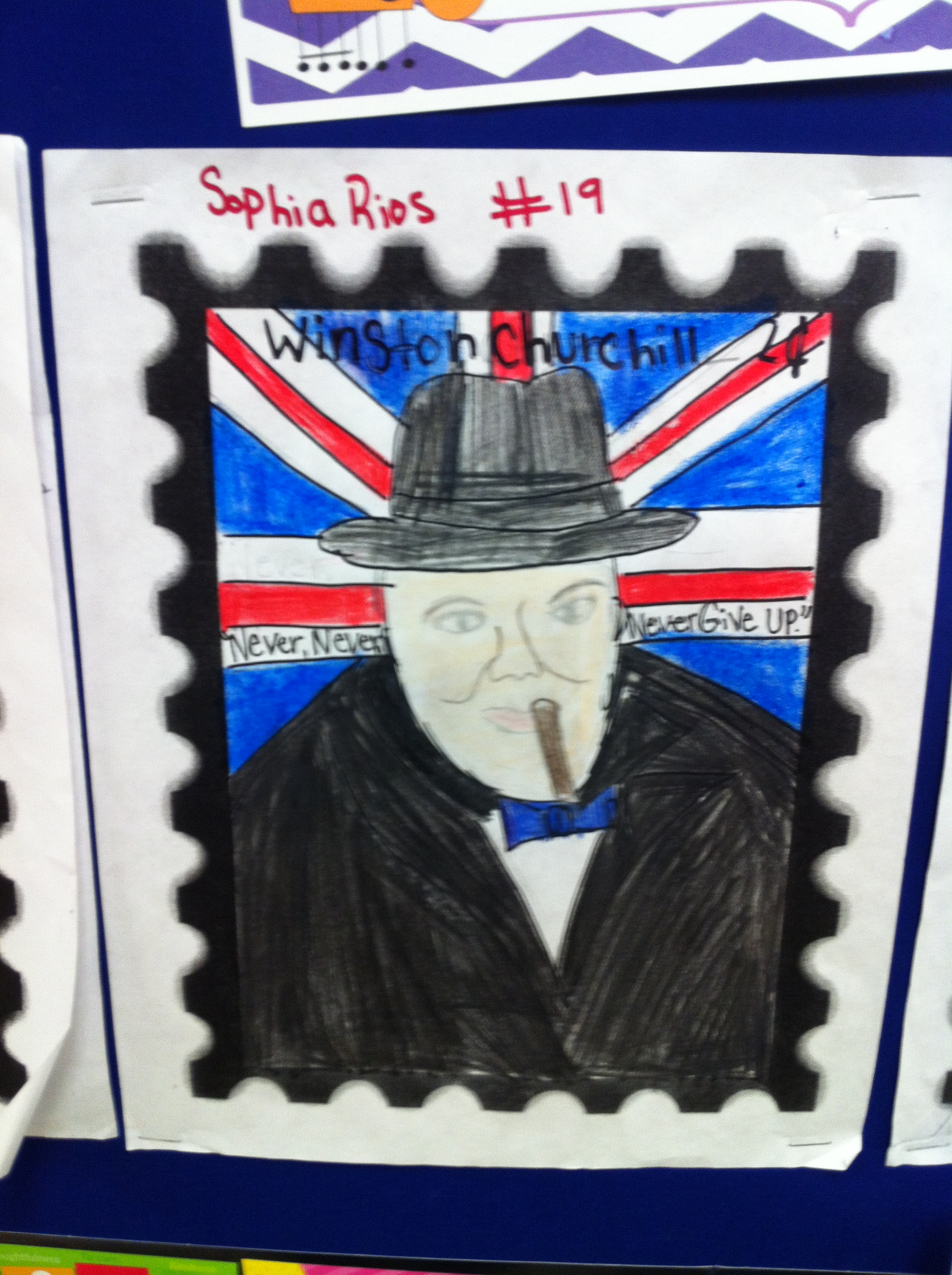
Winston Churchill Texas

The commentariat class continue to scratch their heads in puzzlement as to how UKIP’s support is not melting away in the face of wall-to-wall attacks from the media and the political establishment, and this blog continues to patiently explain why this is the case.

Well, for those who obstinately refuse to learn, here is yet another reason – Labour and the Conservative Party have given a clear demonstration of their ideological muddle by both hiring former Obama campaign officials to help with their respective 2015 general election messaging efforts.

First Labour (whose rollout of former Obama senior adviser Axelrod went hilariously badly):

Ed Miliband hailed the appointment as “excellent news” and predicted the strategist would be a “huge asset to our campaign as we work to show the British people how we can change our country for the better”.

Mr Axelrod said he had been struck by the power of the Labour leader’s ideas and the “strength of his vision”.

He drew a comparison between Mr Miliband’s economic policies and the arguments articulated by Mr Obama in 2008, saying both have at their core “the experience of everyday people”.

And then the Conservatives:

The Conservatives have also recruited another former adviser to Barack Obama, his ex-campaign manager Jim Messina, to work on their 2015 election team.

As with Mr Axelrod, Mr Messina is not leading the campaign on the ground but remains in the US, reporting to the Conservatives’ senior management team.

It is common knowledge that the Britain sits well to the left of the United States on the political spectrum, so in one sense it is not surprising that an American Democrat such as Axelrod might still find common cause with Britain’s centre-right party (he wouldn’t be caught consorting with a Republican in a million years).

But in another sense, it is a terrible indictment of the British political system that both main political parties – our two ‘polar opposites’, the alpha and the omega of our choices come election day – are either so intellectually bankrupt or coldly calculating that they can both recruit from same same American political talent pool and still present themselves to the British public as though they are different as chalk and cheese.

Intellectually bankrupt or coldly calculating. In truth, there is a fair measure of both at work in the Labour and Conservative parties. Both have followed the example of ‘triangulation’ pioneered so successfully by Bill Clinton, in order to win over the undecided middle while hanging on to just enough of their restive core voters to make it over the finish line.

Tony Blair’s New Labour certainly took the triangulation strategy and moulded it into a political work of art. But make no mistake, the Conservatives are at it, too. Even when accounting for the fact that they have governed only in coalition since 2010, the fact that they have allowed harmful defence cuts and continued encroachments on civil liberties while largely tolerating Labour’s legacy of tax hikes and fiscal drag shows that they, too, see more value in playing to the woolly undecided voters in the middle than making a convincing ideological case for their core principles.

Which brings us back to Nigel Farage and UKIP.

Say whatever else you like about them, but here is a party that has a set of core beliefs and is unafraid to articulate them plainly and simply. (If you are reading this and thinking “but surely all UKIP stand for is leaving the EU, with a portion of racism on the side” then you have been indoctrinated well by the media who have slavishly served the interests of the main political parties – but UKIP do actually have a broadly libertarian policy platform that can be easily researched).

Leaving aside the coming European elections on Thursday 22 May, UKIP’s increasing (and surprisingly solid) popularity is not just a function of the British people having nowhere else to meaningfully express their euroscepticism or their dislike of politicians in general (the protest vote). It is driven also by the fact that conviction politics is all but dead in Britain, leaving many thoughtful and politically aware people with no one who speaks their language, but a host of politicians willing to patronise and double-cross them to gain votes, before discarding them once they are delivered into power.

Tony Benn and Margaret Thatcher are no longer with us, and British politics is suffering the absence of them and their kind. The few conviction politicians left in the House of Commons tend to be curmudgeonly old men and women (think Glenda Jackson or John Redwood) whose prime days are behind them and who will never be brought back in from the margins. And this leaves the political future to be shaped by the oily likes of Ed Miliband in the labour party (with young guns such as Chuka Umunna or Gloria de Piero to look forward to when he is inevitably deposed), and Cameron-Osborne for the Tories.

So forget about the European Union and the Newark by-election. Forget about the mudslinging and accusations of racism from one side and intimidation from the other. In many ways, it’s all just noise, the kind of nonsense we are left to argue about when there is so little left to distinguish the three main political parties from each other when it comes to real life policy.

When Labour and the Conservatives are so indistinguishable that they both instinctively look to buy Barack Obama’s 2008 message of “hope and change” from across the Atlantic, is it any wonder that the only party with an authentic, home-grown message is reaping the rewards in the polls?


Picture: Student drawing from an elementary school in Texas

Where Are The Women In British Politics?

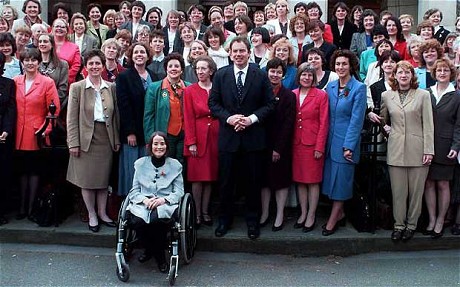
Blair Babes women British politics


The conventional wisdom holds that Ed Miliband managed to land a serious blow on David Cameron at this week’s Prime Minister’s Questions, exposing the Tory leader and his party for their chronic shortage of women in leadership positions and the key offices of state. Miliband makes a good point – an abysmal 4 out of 22 cabinet ministers in the coalition government are women, and only one of those, Theresa May at the Home Office, occupies a position that really matters (Culture, Northern Ireland and International Development, the other ministries headed by women, are either irrelevant or decidedly junior-league). That simply is not good enough, and David Cameron has just cause to feel ashamed.

The Guardian makes the case:

[David Cameron] was taunted about the Conservatives’ “women problem” by Ed Miliband in the same week it emerged several prominent women have recently been sacked from government jobs and Anne McIntosh, a high-profile female Tory MP, was deselected by her local association.

The Labour leader also claimed a prominent businesswoman, who is the wife of a Tory donor, had been greeted by Cameron with the remark: “Where’s your husband?”

He then accused the coalition of failing women across the UK by allowing the pay gap between men and women to widen for the first time in five years.

“You promised to modernise your party, but you are going backwards. You run your government like the old boys’ network – that’s why you are failing women across your party and across the country,” Miliband said.

And the initial exchange between the two leaders at Prime Minister’s Question Time can be seen here:


Less reported is the fact that the Labour Party has a record on promoting women every bit as appalling as do the Conservatives, as Dan Hodges correctly observes in his Telegraph column:

Women still aren’t allowed to hold senior positions in the Labour party. The three major political briefs are Prime Minister/Leader, Chancellor and Foreign Secretary. Apart from a short period during the fag end of Tony Blair’s administration when Margaret Beckett was placed in charge of the Foreign Office, and 14 weeks when Yvette Cooper oversaw the shadow post under Ed Miliband, none of those offices have been held by women. The Labour party has been in existence for 114 years. And during that time – under Labour – a woman has held or shadowed one of three major offices of state for a period of 14 months.

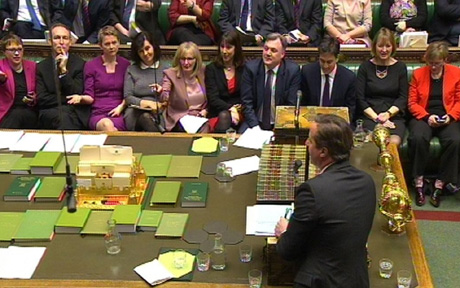
Fourteen months. And yet you would not think that Labour was sitting on such a poor record when Ed Miliband stood preening at the dispatch box in the Commons on Wednesday. One could have been forgiven for thinking that women made up a statistically and politically perfect 51% of Labour seats in Parliament and in the shadow cabinet, particularly given the rather unusual concentration of the Labour Party’s female talent on the front bench alongside their leader:

When PMQs started, several people commented on the fact that a number of Labour’s women shadow cabinet members were artificially concertinaed together close to Miliband. The reason they did that was because if they hadn’t done that they wouldn’t have been in camera shot. And that’s because there’s a convention that people sit alongside their leader based on seniority.

If something about the picture below strikes you as odd – don’t worry. There is indeed something different about the Labour front bench at PMQs this week – namely, a lot more women clustered on either side of Eds Miliband and Balls than is usually the case. It is hard to determine which is worse – Ed Miliband’s disingenuous photo opportunity, or the willingness of a number of female Labour MPs to go along with it by essentially allowing themselves to be used as props by their leadership.

Not your standard distribution.


A less-reported fact amid the furore is that all four women cabinet ministers in the coalition government are Conservative MPs, which rather begs the question of how the Liberal Democrats have managed to fly under the radar and avoid being called out for their own shameful inability to recognise and promote female talent within their own ranks. But somehow the party of Lord Rennard seems to be scoring a free pass on their own institutional sexism for the time being – at least as far as Ed Miliband’s focus is concerned.

The lack of women in senior positions in all political parties is a real problem, one which Miliband does little to debate or address by trading barbs with the Prime Minister. Some advocate all-woman shortlists as a solution to the problem, and of course the Labour Party has adopted this particular approach. This blog disagrees with it – firstly on the grounds that it robs local constituencies of the opportunity to select from the widest possible pool of talent when choosing who they want to represent them in Parliament, and secondly because if we must tolerate reverse discrimination as a necessary evil to help put right historic wrongs (and I’m far from convinced that we should), it should be done at the earliest stage possible and certainly not at the point of parliamentary candidate selection.

But while we may condemn Miliband’s posturing on the subject and question his methods, we must also acknowledge that at least the Labour Party under Ed Miliband is engaged in a bona fide effort to increase the number of women in their parliamentary party. There is a lot of rueful head-shaking from the Conservatives at the conspicuous lack of women in theirs, but not much action of any kind at all.

Four women out of twenty-two cabinet members in the British government, in the year 2014. This is a national scandal, far more serious than localised spats about the deselection or resignation of individual constituency MPs, or accusations of politicising quango appointments. This is about the integrity of our democracy and our desire to be a more practically and visibly meritocratic country.

The Conservatives, the party of Margaret Thatcher, should be leading the charge on anything to do with meritocracy. The fact that they are not currently doing so is alarming.