On Dissent In The Mainstream Media

Not in Abby Martin's name
Not in Abby Martin’s name


Glenn Greenwald, now writing for The Intercept, makes a very good point about journalistic integrity in the context of the ongoing Russian invasion and occupation of Crimea.

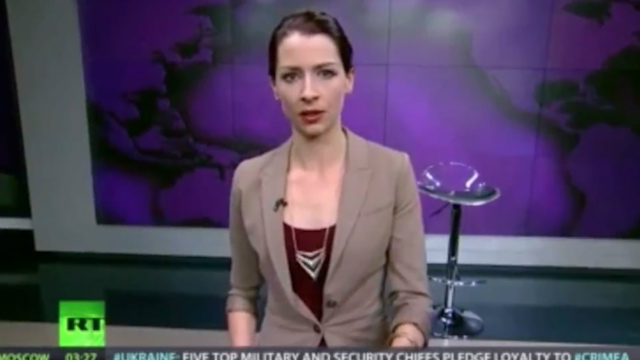
In the midst of this developing story, one of the anchors at Russia Today, the Kremlin-funded English-language news channel presenting a Russian perspective on the world, made news of her own by denouncing Russia’s actions at the end of her segment. The clip is available to view here:


The money quote is this:

I can’t stress enough how strongly I am against any state intervention in a sovereign nation’s affairs. What Russia did is wrong. I admittedly don’t know as much as I should about Ukraine’s history or the cultural dynamics of the region, but what I do know is that military intervention is never the answer. And I will not sit here and apologise or defend military aggression.

Greenwald wonders aloud how so many of those voices condemning Russia for invading a sovereign country can do so with a straight face when they themselves agitated for, or were apologists for the US-led war in Iraq:

Enthusiastic supporters of a wide range of other U.S. interventions in sovereign states, both past and present and in and out of government, are equally righteous in their newfound contempt for invasions – when done by Russia. Secretary of State John Kerry – who stood on the Senate floor in 2002 and voted to authorize the invasion of Iraq because “Saddam Hussein [is] sitting in Baghdad with an arsenal of weapons of mass destruction” and there is “little doubt that Saddam Hussein wants to retain his arsenal of weapons of mass destruction” – told Face the Nation on Sunday: “You just don’t in the 21st Century behave in 19th Century fashion by invading another country on completely trumped-up pretext.” The supremely sycophantic Face the Nation host Bob Schieffer – as he demanded to know how Russia would be punished – never once bothered Kerry (or his other Iraq-war-advocating guests, including Defense Secretary Chuck Hagel and Washington Post columnist David Ignatius) by asking about any of that unpleasantness (is it hard at all for you to sermonize against invasions of sovereign countries given, you know, how often you yourself support them?)

This is just as true for the press as it is for television talking heads or armchair generals. As Greenwald shows by quoting the example of CBS’s Bob Schieffer, the implicit assumption in many questions asked by television news hosts in America (and indeed in Britain) is that the invasion is unprecedented, wrong and contrary to international law. And while the invasion is indeed all of these things, this same level of proper journalistic scepticism was mysteriously missing when we were the aggressor.

Indeed, those few brave American media personalities who did speak out against the impending invasion of Iraq, and who dared to question the legitimacy of the Bush Administration’s every unconstitutional action, soon found themselves banished to the western journalistic equivalent of Siberia. Well known journalists or personalities such as MSNBC’s Phil Donohue and Ashleigh Banfield certainly felt the consequences, as Greenwald points out in an addendum to his piece:

Both Donahue and Arnett were fired because of their opposition to the U.S. war. Arnett was fired instantly by NBC after he made critical comments about the war effort on Iraqi television, while a memo from MSNBC executives made clear they were firing Donahue despite his show being the network’s highest-rated program because he would be “a difficult public face for NBC in a time of war”.

During that same time, MSNBC’s rising star Ashleigh Banfield was demoted and then fired after she delivered a stinging rebuke of misleading pro-war TV coverage by U.S. outlets, while Jessica Yellin, at MSNBC during the time of the war, admitted in 2008 that “the press corps was under enormous pressure from corporate executives, frankly, to make sure that this was a war that was presented in a way that was consistent with the patriotic fever in the nation and the president’s high approval ratings” and that executives would change stories to make them more pro-war.

While it is too soon to determine the medium-longer term impact of Abby Martin’s words on her career at RT, the contrast between this act of journalistic independence on a news channel so close to the Kremlin and the recent history of the American (and British) news media is sobering and discomforting. Though the post-PATRIOT Act consensus is finally starting to fray given the recent NSA scandals and revelations, at a crucial period in American history significant dissent or journalistic scepticism was almost entirely absent from the domestic press.

That is not to say that press freedom in America/Britain and Russia are in any way comparable – despite a worrying background noise of increasing official encroachments, regulation and intimidation, the press is far more free in America than in Russia, and any sane journalist would wish to operate in the former climate rather than the latter.

But while infinitely preferable to homogenised Russian state propaganda, western media has shown itself capable of being bullied into self-censorship on occasions, be it the panicked urge to appear ‘acceptably’ pro-war and support the policies of George W. Bush in 2003 or the far more recent insidious suggestion by David Gregory in 2013 that journalists who report on leaked classified information should consider themselves co-conspirators.

As always, before climbing atop the highest parapet and waving the Stars and Stripes or the Union Jack, we would do well to re-examine our own recent, tarnished history – be it our history of military intervention abroad or journalistic coverage of those adventures.

Doing so will not make Russia’s egregious actions in Crimea any more palatable or legitimate, but it will at least allow us to look Russia in the eye as we denounce them.

Who Really Wants A Free Press?

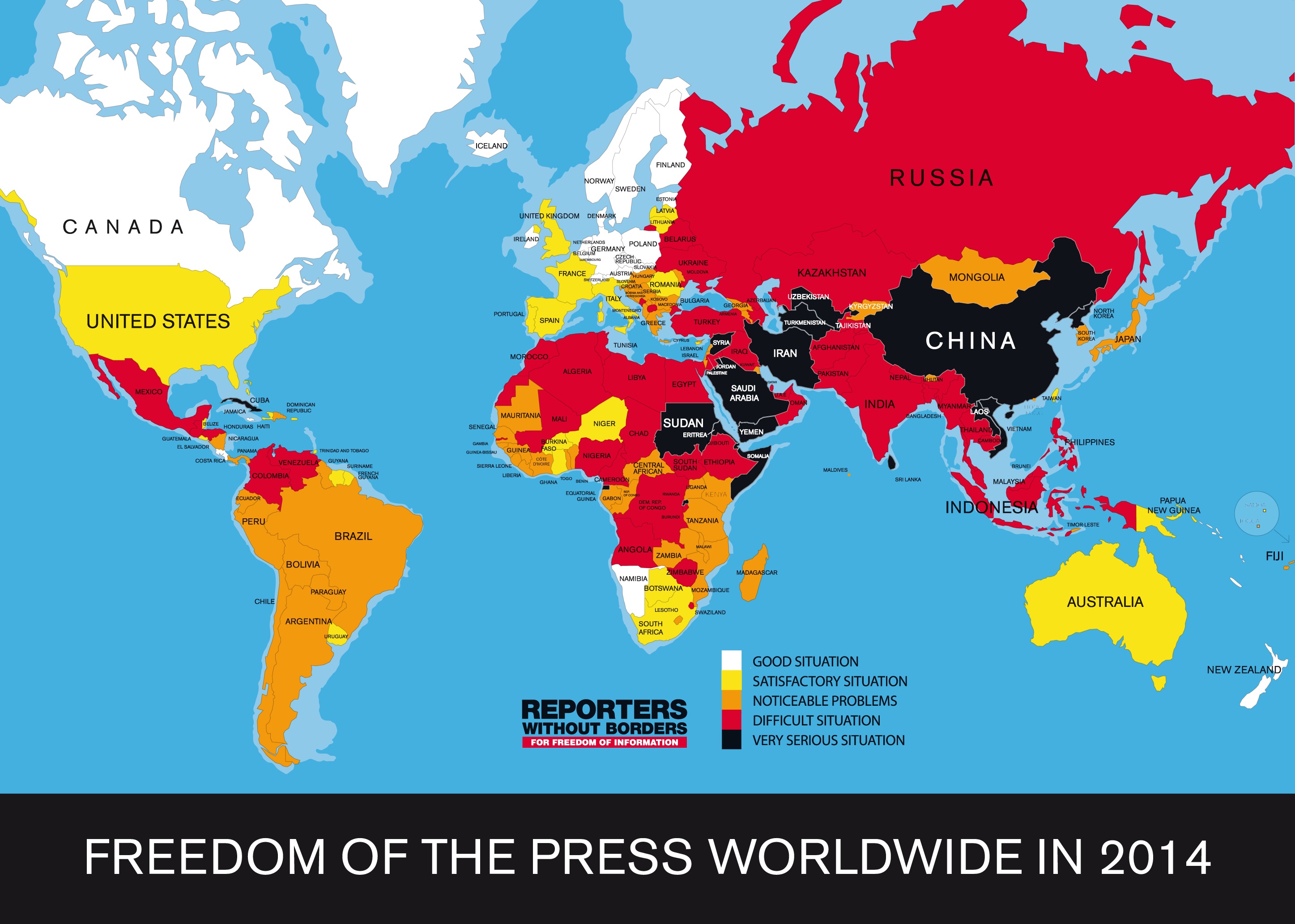
MapRSF


The United Kingdom has fallen from 29th to 33rd in the world in the World Press Freedoms Index 2014.

The report, compiled annually by Reporters Without Borders (RSF) is scrupulous in methodology and incorporates both qualitative and quantitative data. And for a country like Britain, which likes nothing more than to strut around the world proclaiming its comparative virtues, it makes for some dismal reading.

RSF’s summary of Britain is dominated by the British government’s chilling and bullying treatment of the Guardian newspaper as it sought to suppress the publication of information based on the NSA leaks by Edward Snowden, as well as the fallout from the Leveson Enquiry into the press behaviour and the prospect for further stultifying regulation of the industry:

In the United Kingdom, the government sent officials to The Guardian’s basement to supervise destruction of the newspaper’s computer hard disks containing information from whistleblower Edward Snowden about the practices of GCHQ, Britain’s signals intelligence agency. Shortly thereafter, the partner of Glenn Greenwald, the former Guardian star reporter who had worked closely with Snowden, was held at Heathrow Airport for nine hours under the Terrorism Act. By identifying journalism with terrorism with such disturbing ease, the UK authorities are following one of the most widespread practices of authoritarian regimes. Against this backdrop, civil society could only be alarmed by a Royal Charter for regulating the press. Adopted in response to the outcry about the News of the World tabloid’s scandalous phone hacking, its impact on freedom of information in the UK will be assessed in the next index.

Britain isn’t always called out by name, but there can be little doubt which European country was the intended target of this particularly barbed comment:

These developments showed that, while freedom of information has an excellent legal framework and is exercised in a relatively satisfactory manner overall in the European Union, it is put to a severe test in some member countries including those that most pride themselves on respecting civil liberties.

How true this is. Britain has long been (and has long considered itself) a stalwart defender of free speech, but the recent thuggish attempt to use anti-terrorism laws to detain a relative of a journalist and to threaten a national newspaper with closure unless it destroyed information which had the potential to embarrass the government are more worthy of Vladimir Putin’s Russia than the land of Magna Carta.

The New York Times, on the other hand, looks at the same report and seems to take succour from it, which is very surprising given the fact that their journalists have worked so closely with their beleaguered colleagues at The Guardian.

Their editorial board is celebrating the 50th anniversary of the landmark New York Times vs. Sullivan case, which set the bar for winning libel or defamation claims much higher than in Europe and thus created a bulwark protecting press freedom in the United States. This excerpt from the majority opinion in that case should be mandatory reading for all British politicians and those involved in public life, who are often all too keen to clamp down on free speech at the first sign of discord:

The Supreme Court voted unanimously to overturn that verdict. The country’s founders believed, Justice William Brennan Jr. wrote, quoting an earlier decision, “that public discussion is a political duty, and that this should be a fundamental principle of the American government.” Such discussion, he added, must be “uninhibited, robust, and wide-open,” and “may well include vehement, caustic, and sometimes unpleasantly sharp attacks on government and public officials.”

While the New York Times is absolutely right to recall and celebrate this landmark victory – libel laws in many other countries, especially Britain, are far too plaintiff-friendly – they seem all too willing to ignore the negative actions that have chipped away at this victory in the intervening half century, the various acts of craven self-censorship or collusion with imperial government overreach or the undermining of factfinding by the ongoing war on whistleblowers.

This selective amnesia leads to the following self-congratulatory pronouncement by the Times editorial board:

Still, American press freedoms rank among the broadest in the world. Citizens and media organizations in countries from China to India to Britain do not enjoy the same protections. In many parts of the world, journalists are censored, harassed, imprisoned and worse, simply for doing their jobs and challenging or criticizing government officials. In this area of the law, at least, the United States remains a laudable example.

The only problem with this statement? The United States ranks thirteen places behind the United Kingdom, at 46th in the world.

Fortunately for the New York Times and the reputation of the American press, the RSF world press freedom index does not take quality of journalism into account, only the ability of the journalist to practice their trade freely – otherwise they could have found themselves docked another few positions for that howler of an America-must-be-best presumption.

The truth is that neither Britain or America have anything to be proud of faced with this latest report. In an ideal world, David Cameron and Barack Obama would be held to account and hauled over the coals for presiding over such a poor performance. A backbench MP looking to bolster his or her civil liberties credentials could do worse than to ask the prime minister to defend or account for his government’s performance on press freedom at Prime Minister’s Questions this coming Wednesday.

But regrettably, a place in the mid-low 30s ranking is exactly where David Cameron, Barack Obama and many of those in power in Britain and America want their respective countries to sit. It allows for a press that is boisterous and noisy in all of the areas that don’t really matter (and so showing every outward appearance of being free), but that meekly tows the line when it comes to critical issues such as national security, civil liberties and holding those in power to account for their actions.

We in Britain or America may not think of countries such as Finland, Norway, Luxembourg or Liechtenstein as shining role models to emulate, if indeed we ever think about them at all. But in some key aspects, it is they who now carry the torch for freedom of speech and the free press, not the traditional Anglo-American partnership who held it aloft so dutifully for so long.

Week 2: Samuel’s Photos

Your blogger has been learning the rudiments of photography as part of the Big Issue Online Journalists training programme. Here are some of my halting early efforts, taken while out and about in east London where it was surprisingly difficult to persuade passers by to consent to being photographed.

bigissueonlinejournalists's avatar

DSCF1728

DSCF1737

DSCF1734

DSCF1731

DSCF1727

View original post

On American Exceptionalism

A word of advice for all of the American pundits and commentators who puffed up their chests in wounded outrage when the president of Russia dared to suggest in a New York Times op-ed that it was dangerous for a country or a people to consider themselves exceptional: look at the image below.

Not very encouraging.

There are really only two possible ways to explain the fact that the US cover of Time Magazine diverged from all of the global editions on this occasion. The first is that the publishers of Time believe their American readership to be so shallow, insular or dumb that a story about important geopolitical developments would deter them from reading the magazine, and that featuring a story about college sports would be less intimidating and off-putting. And the second possibility is that the Bad Man, Vladimir Putin, said some nasty things about America a few days ago and hurt our feelings, so now we have to pretend that he doesn’t exist so that we can get back to our happy place as quickly as possible.

Neither scenario is really screaming “exceptional” at me.

This isn’t a post to denigrate America – clearly, any regular reader of this blog will soon sense my deep admiration of the United States and the belief that it remains, in some very important ways, exceptional in the world. And neither do I think it necessary to list (again) the many flaws of Russia, as they are manifold and frequently in the news, as a counterweight to what I have written here. Most people, given the choice of where to live, would choose the United States over Russia; it doesn’t need to be shouted from the mountaintops.

But I will say this to those “patriotic” Americans who feel slighted when every visiting foreign head of state doesn’t issue a statement declaring America to be superior to their own country, and who get upset when President Obama doesn’t take time out to lecture other nations about how the United States is the role model to be emulated in all matters (because we all know that would be such a successful diplomatic stance):

You sound like a spoiled, coddled toddler, always needing reassurance that you are special and perfect. Frankly, it must be quite embarrassing for your less insecure compatriots to be associated with you. Instead of stomping around the world, hammering out angry op-eds about how the USA is A-OK and super, super exceptional, how about you go out and actually do something exceptional to contribute to that exceptionalism? And if you can’t do that, how about just sitting at home and enjoying the exceptionalism in silence without bothering anyone else? Actions speak louder than words.

Ronald Reagan used the term “a shining city on a hill” to describe his aspiration for America, a really quite moving and wonderful phrase. It evokes a beacon of light, guiding people to America’s example through her very existence and perseverance; her deeds and not just her words.

By contrast, today’s neo-conservatives and others who wrap themselves in the cloak of exaggerated “patriotism” resemble not so much a shining light in the distance, leading others to prosperity, but rather a shrill, incessant car alarm, parked outside the house of every foreign nation, its loud, unceasing warble continually scolding them for not living up to America’s own ideals.

I will let comedian Lewis Black have the last word on this subject:


Are we clear, neo-cons? Good.

In Praise of Glenn Greenwald

Glenn Greenwald, former blogger at Salon.com and now writing at The Guardian, is one of the best and most articulate people talking about civil liberties and pressing back against the intrusive power of the government today.

Exhibit 1, in which he tears apart the war criminal Dick Cheney for the casual way in which he celebrated his own lawbreaking and contempt for the US constitution on the eve of the publication of his memoirs:


Exhibit 2, in which he rips into CNN (both the network, the host and her former Bush administration talking head stooge) for their coverage of Julian Assange and the WikiLeaks scandal:


And finally exhibit 3, in which he takes on Bill Maher and Andrew Sullivan in a roundtable discussion on the morality and constitutionality of extra-judicially ordered drone strikes on US citizens.


Keep fighting the good fight, Glenn.