Gunning For UKIP

Guardian UKIP attack


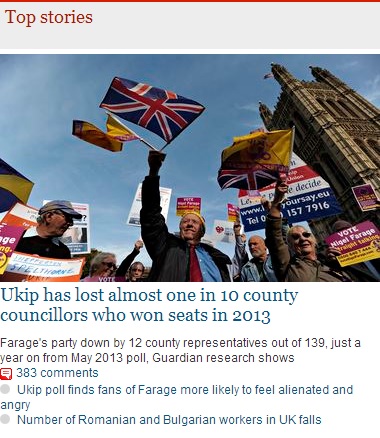
This is a screenshot of the Guardian’s top political stories taken from their website at 00.54 on Thursday 15 May, one week before election day.

All three leaders are attacks on UKIP in one guise or another. The first article points out that UKIP has experienced an unusually high degree of defections and resignations from the ranks of its 2013 intake of local councillors. The second basically suggests that UKIP supporters are paranoid and ignorant hillbillies to the last man, while the third deconstructs UKIP’s talking points on immigration from Romania and Bulgaria.

The concern is not that the Guardian’s stories necessarily lack truth or validity. But it is glaringly apparent from the choice and placement of the stories on the homepage – to the total exclusion of any other coverage – that there is a concerted effort underway at the newspaper to chip away at UKIP’s credibility and support. Given the dearth of articles analysing Conservative, Labour or Liberal Democrat policies it is clear that the newsroom’s finite resources are being used disproportionately to undermine the insurgent party, whilst allowing the established parties (even the hated Tories) almost completely off the hook.

Note also what is entirely absent from The Guardian’s political coverage of the local and European elections, not just tonight but over the course of the campaign as a whole:

No coverage of the latest polling numbers and UKIP’s strength vis-a-vis the established political parties.

No probing or questioning of the Labour and Liberal Democrat stance, which is to refuse the British people a referendum on continued membership of the European Union, despite the widespread public support for such an in/out debate.

No discussion of the ‘state of the union’, i.e. the budget, the misuse of EU funds, the incidences of corruption and the increasingly pervasive influence of corporate lobbyists in Brussels.

No discussion of proposed EU-wide financial transactions taxes, their pros and cons and their likely impact on the City of London and the overall UK economy.

No discussion for the parallel campaign for the presidency of the powerful European Commission.

A visitor to the Guardian’s website might reasonably conclude that the main three national political parties in Britain have inexplicably gone into hibernation, and that UKIP have been given the run of the house. But while it is certainly the case that UKIP have consistently provided the most attention-grabbing stories (thanks in large part to policies with grassroots appeal and a leader who doesn’t have to practice looking genuine in front of the mirror every morning), it is unforgivable for a national newspaper to so thoroughly abdicate its responsibility to cover the also-rans.

The Guardian prides itself on having a readership that is a cut above the rest in terms of book smarts, education and general worldliness. But even accounting for their audience’s generally left leaning stance – let’s not deny anyone their political biases and preferences – you would think that among these luminaries there might be some basic level of curiosity about what the other parties (you know, the ones who actually have MPs and win elections) are up to this election season.

Not that this lack of curiosity provides an excuse – even in its apparent total absence, a political editor might think to include an article or two on the policies and strategic positioning of the other parties, just as a byproduct of doing their job properly. And yet the Guardian (and many others) are content to follow the heard and serve up a constant stream of anti-UKIP sentiment to the exclusion of everything else.

For anyone still wondering, this right here is the reason why UKIP remain in contention this election season, despite the unremitting volley of negative press coverage (yes, some of it self-inflicted) and attacks from all sides of the political spectrum:

The Guardian – not to mention the leaders of the three main political parties – seem to have forgotten two rather endearing truths about the British people for whom they claim to work and speak. Firstly, the British cannot abide a bully, and anyone with even a modicum of sympathy for any of UKIP’s positions is likely to feel that the party has been unfairly singled out for criticism.

But secondly and most importantly, we British love an underdog. You can sense Nigel Farage’s frustration and impatience every time one of his improperly-vetted candidates or publicity-seeking spokespeople says something outrageous or defects in a blaze of negative publicity. One gets the impression that UKIP’s leader is fighting a solitary David and Goliath-style battle against the establishment and against the odds, very much alone. And as the immature party apparatus creaks and groans around him as it tries to fight a national campaign, one catches oneself rooting for the man. Or at least, 31% of the voters do.

When the European elections have taken place and the dust settles, much will be written and wondered aloud about how UKIP performed as well as they did given the unified forces ranged against them. Responsibility will be parcelled out, to the great recession for making people dissatisfied, to the expenses scandal for making people distrustful of mainstream politicians, to the people themselves for being credulous fools with borderline racist tendencies.

In short, the blame will be placed everywhere but the one place that it most belongs – at the feet of the smug, left-liberal bloc and their terrified counterparts on the right, who are witnessing a groundswell of legitimate dissatisfaction and demand for change from the British people, but see only a pesky political mosquito to be swatted out of existence.

The Establishment Rounds On UKIP

nigelfarage_nickrobinson

It is neither astonishing nor controversial to observe that the British political establishment – politicians and their client political journalists alike – have only animosity and contempt towards the UK Independence Party and the 30 per cent or more of the British electorate who are likely to vote for them at the European Parliament elections later in May.

From their attempt to pre-ordain the outcome of the recent Nick Clegg vs Nigel Farage debates on Britain’s place in the EU to their laser focus on UKIP’s lunatic fringe, the British media has not been shy to express its negative opinion of euroscepticism or those who in any way seek to change the status quo of Britain’s place sulking at the periphery of EU decision-making.

But there are few examples of this bias – borne out of desperation to discredit the insurgent party and a refusal to engage on any issues of real substance – more telling than the BBC’s latest ‘interview’ with Nigel Farage. Nick Robinson asks the questions, and the thrust of his interrogation is this: because Farage employs his wife, a German citizen, as his personal secretary, UKIP’s arguments about unrestricted European immigration causing downward pressure on wages and reduced employment of indigenous workers are hypocritical, and that Nigel Farage is therefore totally discredited and borderline corrupt himself.

A couple of observations to start. Firstly, this blog is in agreement with the need to curb the persistent practice of politicians (be it MPs or MEPs) hiring family members purportedly to serve as ‘staff’. Sometimes it seems as though absolutely nothing was learned as a result of the parliamentary expenses scandal, when various relatives of politicians were found to be on official payrolls with nominal job titles but no demonstrable evidence of working to earn their money. Though the ideal of competitive and non-discriminatory hiring practices for political staffing jobs may never be reached, we could at least stop politicians from overlooking genuine talent in order to hire gormless relatives. That being said, there is no indication or suggestion that Nigel Farage’s wife is anything other than competent and qualified.

Secondly, this blog supports a liberal, open immigration policy. That is not to refute the various arguments on immigration made by UKIP, or to endorse them; whatever the net effect of unrestricted European immigration on wages and unemployment of British-born workers, it is best debated on other pages. But this blog sees only benefits to making it as easy as possible for skilled and talented people from all over the world to come and to contribute to Britain.

Back to the interview.

Not content with asking his simplistic question – “how can you claim to defend British jobs when you employ a German secretary?” – one time, Nick Robinson indulges himself with a lengthy Jeremy Paxman-style grilling, repeating the insinuation of hypocrisy and scandal (in his trademark bemused and facetious manner) in various different permutations:

You’ve warned about Europeans taking British jobs. Your wife is German! She is your secretary. She’s paid for by the British taxpayer … Was your wife taking someone else’s job then?

Farage’s response – that in his particular case, the hours and demands of the work (late nights at his house) made the secretary role particularly well suited to a spouse, making her the logical choice – did not satisfy Robinson, who continued:

You try to turn everything into a joke. You have a campaign that says that Europeans are taking British jobs. You employ a German woman to work in your office. She happens to be your wife. She happens to spend many hundreds of thousands of British taxpayers’ money. How do you justify it?

Nick Robinson knows full well that Farage’s (and UKIP’s) argument about British jobs being under threat – whether it is a legitimate concern or not – refers to the lower end of the job market, the low-skilled positions, and not to more highly skilled or specialised political staffers. But acknowledging this basic fact would undermine the attack on Farage’s credibility, and so Robinson declines to recognise the distinction.

Farage also points out that Robinson is singling him out for hiring a relative, something that is regrettably common and largely unremarkable in Westminster:

One in four MPs at Westminster employs a close family relative, but actually what’s happening the past two weeks, of 73 British MEPs, I’m the one who is being singled out, and [the press is] saying “goodness me Mr. Farage, you’re costing the British taxpayer an awful lot of money.”

At least one disaffected member of the public spoke wisdom, shouting “What about economic policies?” in the background. Quite right too – what about economic policy? What of the genuine economic costs and benefits of continued British EU membership vs a negotiated secession? The BBC was clearly not interested in following these important lines of enquiry. or asking about specific policy prescriptions.

Gazing on the scene from his adopted home in America, Andrew Sullivan (whose British political acuity has diminished with his years of absence) actually saw Nick Robinson’s glib attempt to concoct a scandal as an example to praise and emulate:

The idea that they [Washington press correspondents] would wreck their access by asking a politician questions that he really doesn’t want to answer – “Isn’t your wife German?” (see above), “Can you give us evidence for your crazy pregnancy stories?” – is preposterous.

So I give you the above video, by the intrepid BBC political reporter, Nick Robinson. Watch him go for the jugular, and watch him not release his grip until the prey is whimpering, near-lifeless on the ground. 

Nick Robinson, intrepid?

This really speaks more about the parlous state of political journalism in Washington D.C. than it does about anything else. So deferential are the Washington press corps to those in power – and Sullivan rightly refers to the recent annual White House Correspondents’ Dinner – that any hounding or questioning of a party leader must in itself seem dedicated and fearless. A closer attention to the specific question being asked, however, would have shown that Robinson’s approach was far from being brave or principled. Sullivan is right about the non-deferential tone of British political interviews being a positive thing, but dead wrong in singling out this particular establishment hatchet-job as  the pinnacle of good journalism.

The BBC had a golden opportunity to ask some real questions of Nigel Farage, to delve into policy differences with the other parties or at least to engage in a bit of speculation and expectations-setting with regard to the upcoming European elections. But they weren’t interested in the policy discussion (the noble option) or in analysing the polls (the political infotainment option). They went instead for the classic hatchet job, the interview ambush that neither educates the informed viewer or grabs the attention of the casual viewer, serving instead only to give David Cameron, Ed Miliband and Nick Clegg some weak ammunition for their negative anti-UKIP political ads.

This was the cheap and tawdry approach taken by a news organisation (if this interview and other recent form is anything to go by) that is becoming increasingly lazy and only comfortable discussing the European Union debate through the existing lens of Labour vs Conservative, more Europe vs a little bit less Europe. The alternative – an end to British membership of the EU – is seen as so radical and threatening to the establishment that it must simply be ignored, or (when feigning ignorance is no longer possible) loudly ridiculed and discredited.

Polling day is on Thursday 22nd May. Soon we will know whether the Nick Robinson strategy has been enough to save the British political establishment from electoral humiliation.

Editor Willing To Publish Anything Doesn’t Think Public Deserve To Know About Government Surveillance

Only honourable men wear poppies


The ongoing public debate about the Snowden NSA leaks and government surveillance was effectively settled once and for all today, as former News of The World editor Andy Coulson informed the world how he would have acted had Edward Snowden approached him – rather than The Guardian’s Glenn Greenwald – with his cache of classified security documents.

The Guardian reports:

The former NoW editor Andy Coulson said he would have rejected the Edward Snowden story if it had been offered to him when he was editing the newspaper, the Old Bailey has heard.

Coulson told the phone hacking trial on Tuesday he felt the news story about US National Security Agency surveillance, based upon a cache of documents leaked by the whistleblower Snowden, would have endangered lives.

Andy Coulson – known by many of his peers as the Saint of Fleet Street – distinguished himself throughout his career by his unimpeachable journalistic ethics, frequently declining to run lucrative stories picked up by other newspapers because he could not be absolutely certain that the information had been gleaned from reputable sources or that its publication would serve the public interest.

Showing the steady, high-handed professional judgement which was the hallmark of his tenure as editor of the News of the World, The Guardian reports Coulson as saying:

“It’s a topical example, Edward Snowden. If they came to me at the News of the World, I think I would have turned them down,” he said, adding that the story on sweeping surveillance by the US government had “a potential for lives to be put at risk”.

The fact that Andy Coulson decided to weigh in on this contentious issue can only add further weight and moral credibility to the government’s argument that it has the unlimited right to take any action in the name of national security without either informing or seeking the consent of the public.

Coulson’s intervention is also a tremendous setback for The Guardian and The Washington Post newspapers, who only yesterday were boasting about their newly-won Pulitzer Prize for reporting on the Edward Snowden NSA leaks. Indeed, the judgement and reputation of the entire Pulitzer Prize committee must surely now be called into question for conferring an award on two newspapers who so egregiously violated what is already becoming known as the ‘Coulson Doctrine’ of fastidiously weighing the public interest before publishing sensational material.

Coulson could not be reached for further comment as he is currently standing trial at the Old Bailey on charges of phone hacking and committing perjury, absurd and hurtful accusations that were probably concocted by jealous rivals who can never live up to Coulson’s exemplary standards of professional and moral conduct.

Spot The Bully – Journalism or Government?

SPS Polis 2014 journalism conference

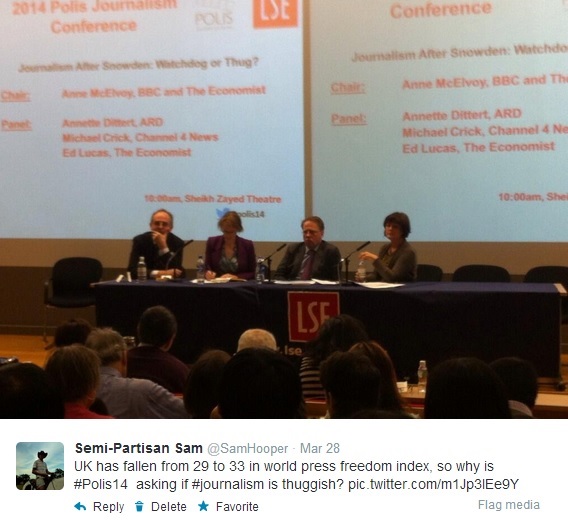
The POLIS 2014 Journalism Conference, held on the campus of the London School of Economics, played host to a number of luminaries from the British media establishment and debated some important issues. But among the various items on the agenda – including riveting discussions on the methods and ethics of investigative journalism, an interview with Guardian editor Alan Rusbridger and a forum on the use of social media in the newsroom – was a slightly incongruous, strangely titled session.

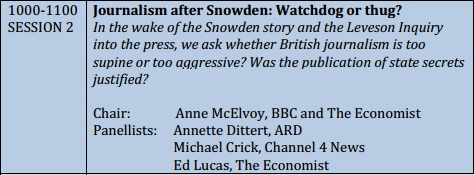
In the second session of the day, the panel – comprised of chair Anne McElvoy (BBC and The Economist), Annette Dittert (German broadcaster ARD), Michael Crick (Channel 4 News) and Ed Lucas (The Economist) debated the following topic:

Journalism after Snowden: Watchdog or thug?

In the wake of the Snowden story and the Leveson Inquiry into the press, we ask whether British journalism is to supine or too aggressive? Was the publication of state secrets justified?

SPS_Polis2014_01

Semi-Partisan Sam, attending the POLIS Journalism Conference for the first time, took the opportunity to ask the following question of the panel:

QUESTION – Given the facts: that Reporters Without Borders downgraded the UK from 29th to 33rd in the World Press Freedoms rankings for 2014;  that the British government now assumes the right to stop and detain partners and relatives of journalists at Heathrow airport under grossly misapplied anti-terror laws; that the Prime Minister last year saw fit to dispatch his Cabinet Secretary to the offices of a major national newspaper in order to threaten it with closure unless they desisted with the publication of materials embarrassing to the government; and that the government forced that same newspaper to destroy their privately owned computers and hard drives under the watchful presence of intelligence and GCHQ officers – why are we sitting here having an introspective debate about whether or not journalists are behaving like thugs when the real thug is clearly the bullying, heavy-handed British government?

The question was extremely well received among the attendees in the hall, prompting a significant round of applause from delegates. Sadly, this did not translate into a a full or robust answer from the panel, who at times had been happier to wander off-topic and waste time debating side issues such as America’s merits as a country and the proper role of the intelligence services.

The panel’s complete answer – such as it was – to the question can be seen in the video below (Semi-Partisan Sam is “the gentleman” referred to by Anne McElvoy):

The Economist’s Ed Lucas, an enthusiastic apologist for anything and everything that the government decides to do in the name of ‘security’, was obviously unsympathetic to the idea that the British government has displayed thuggish behaviour. But since even Lucas was unable to justify what the government has been caught doing without public knowledge or consent, he instead diverted attention by building up and then destroying a straw-man argument of his own creation – namely that those who speak out against government persecution of journalists who expose overreach by the security services are somehow naive pacifists who want to abolish the military and the intelligence services entirely.

Lucas said: “If you want to have a country which has no intelligence and security services, where there are no state secrets or no penalty for stealing state secrets, then fine – I guess that may be the world that the Green Party would like. I suspect it’s a minority point of view.”

This is a patently false and absurd proposition. No serious critic of the British or American governments as pertaining to their secretly allowing their security services to infringe on citizen privacy is suggestion that GCHQ, MI6, the CIA or NSA be disbanded, and Lucas insults our intelligence to cast this aspersion. The issue is not whether we have security and intelligence services, but the lengths to which we as a society are prepared to let them act in our interest.

The other fatuous argument sometimes made by apologists – and indeed by Ed Lucas himself during this same session – goes along the lines of: “Why are people so surprised that we have spies, and that they are involved in acts of spying?” Again, this is a deliberate and misleading attempt to change the terms of the debate. Citizens fully understand the need for foreign and domestic intelligence, but they also have the right to expect that the technology and bureaucracy of surveillance will not be turned inwards upon themselves. While no one expects (or demands) a list of current surveillance targets to be posted and regularly updated on the  internet, the public should have input as to the criteria for targeting through the democratic process.

It is a rather sad statement on the current status of British journalism that the only panellist to seriously engage with the question and agree that it is government – not the press – who have been acting the bully, was Annette Dittert from German broadcaster ARD.

Even the panel chair, Anne McElvoy, felt the need to reframe the question and make the unsubstantiated claim that Glenn Greenwald’s partner, David Miranda, had been carrying “shedloads of secrets with him” when he was detained at Heathrow airport, and that rather than being an outrage, this was just one of the “more difficult areas” where the public “might begin to have some doubts” and feel that the government has a case to answer.

In her response, Dittert correctly identified the apathy of the British people as being partly responsible for the lack of public outcry at the Edward Snowden revelations, saying that Britain has an “almost romantic relationship with the security services” – our experiences of the fictional James Bond being somewhat different to the German experience of the Stasi.

Responding to the question, Dittert said: “I thought it was really concerning – the Prime Minister threatening in the House of Commons a newspaper and journalists … in case they go on publishing is something that shouldn’t happen in a democracy.”

Dittert then went on to describe the way that The Guardian newspaper was treated as being “entirely wrong”.

It is profoundly worrying that even at a prestigious journalism conference such as POLIS 2014, so few of the attendees (and only one of the panellists – a German television correspondent) felt able to push back against the notion that it is the journalistic profession that has become the bully and the thug rather than the British government, whose track record on secrecy, paranoia and intimidation speaks for itself.

And while the POLIS 2014 conference was excellent, the fact that the whole day passed with virtually no observance or mention of the harrassment and intimidation of the British press by the goverment will only reinforce the belief that the establishment media with their well-connected sources and comfortable positions within the Westminster bubble are, at times, quite incapable of holding to account the government that they simultaneously both depend on and fear.

England In The United Kingdom

SPS_BBC_politics_section

Above is a screenshot taken from the Politics section of the BBC News website.

There are clear and clickable links leading to separate sections for Northern Irish politics, Welsh politics and Scottish politics. However, the largest nation within the United Kingdom is given the more cryptically condescending heading “Around England”, which cannot be clicked and which does not lead to its own dedicated section.

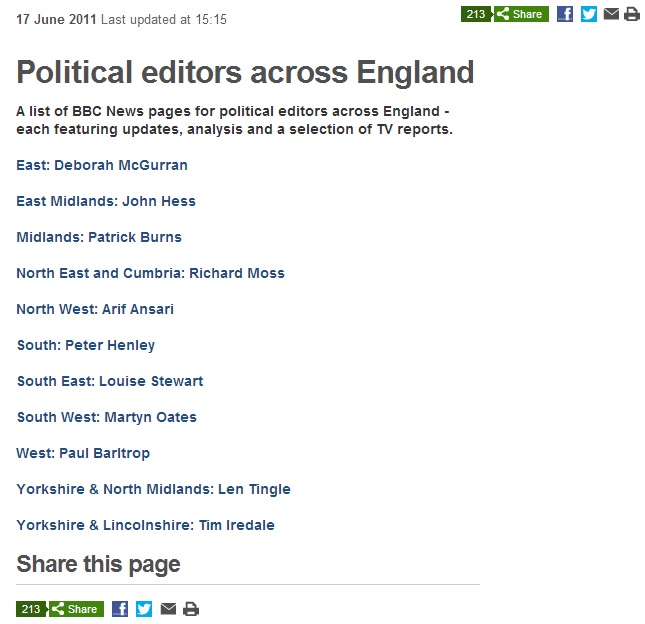
Furthermore, clicking on the obscure “Political analysis around England” link leads to the the following badly laid-out page listing the BBC’s English political editors by region (presumably outdated since it was last updated nearly three years ago):

SPS_BBC_politics_section_2

Who made the decision to slice and dice our United Kingdom in this way when it comes to political coverage? Who decided on behalf of the British population that the Welsh, Scots and Northern Irish should see their politics primarily at a national level, while the English must be given news at a regional basis?

More importantly, is this discrepancy in political coverage a result of  organisational efficiency (so that political editors cover “patches” roughly equal in population, for example) or is it for another, perhaps more sinister reason?

The answer, of course, is that the BBC’s way of splitting its political coverage is merely a reflection of the way that the political elite want us to see ourselves – with all of the home nations save England deserving of a degree of individual recognition and autonomy.

But this way of organising news coverage – and structuring our political system – does everyone a disservice. People living in Wales, Scotland or Northern Ireland are denied the chance to view or shape events in their respective nations from anything other than a macro level, while English residents are not given the chance to look at issues which affect England in particular.

At a time when the Scottish people have a referendum to determine their future participation in the United Kingdom, and issues of devolution of power are coming increasingly to the fore, why does the BBC persist with a political reporting structure that is fundamentally out of touch with the sentiment of the country?

On Wednesday 23rd April, England will celebrate – or at least observe – St. George’s Day. This blog would not be surprised if there was a significant popular backlash or uprising of English nationalist sentiment around this time, given the fact that so much of our leaders’ energies are currently taken up talking about how best to cater to the needs of Scotland while the West Lothian question remains – as ever – conspicuously unaddressed.

Of course, if a debate does bubble to the surface around this time, it could well be diffused into obscurity by the BBC’s eleven English regional political editors.