A Sermon On Justice And Reconciliation From Ferguson, Missouri

Ferguson Missouri MO Fourth 4th July parade 2


What to say about the slow-motion tragedy unfolding in Ferguson, Missouri?

The few known facts – that a black teenager, Michael Brown, was shot to death by Darren Wilson, a white police officer, in disputed circumstances – belie the visceral anger that has consumed the town.

The subsequent actions by the authorities, notably the St. Louis County Police – stonewalling on releasing the name of the officer involved, refusing to release the autopsy details, waging an increasingly military-style war of aggression against legitimate protesters and journalists, and releasing CCTV footage of Michael Brown purportedly robbing a convenience store in what can only be interpreted as an act of pre-emptive character assassination – have only compounded the sense that a predominantly white establishment have more interest in protecting their good names and quelling dissent than administering justice.

St. Louis is a city that I know, have spent much time in, and feel close to. People should not be put off St Louis, Missouri and the surrounding area by the horrible scenes unfolding there now on television and Twitter, because the current crisis is not representative of the state and its citizens. But having personal experience of the area,  it is also glaringly evident that the violence and racial tension that forced itself into our collective consciousness with the shooting of Michael Brown last week was looming, unaddressed, for a long time.

Since I have known St Louis, it has been a city of two halves – the still somewhat dicey downtown area and select suburbs with higher black and lower income populations on one level, and the highly desirable enclaves and suburbs (such as Clayton and University City) that surround them, populated by a much wealthier (and whiter) demographic on the other. Everyone may cheer on their hometown St. Louis Cardinals baseball team on game day, but there is a clear divide between those who can afford tickets to watch the game at Busch Stadium and those who have to tune in on the radio or TV.  Tensions between the city’s two halves, while not ordinarily visible to the casual observer, have roiled this part of Missouri for years.

The New York Times thoroughly summarised the history of this divide in a recent article, revealing the underlying causes of the difference between St. Louis City and County:

Back in 1876, the city of St. Louis made a fateful decision. Tired of providing services to the outlying areas, the city cordoned itself off, separating from St. Louis County. It’s a decision the city came to regret. Most Rust Belt cities have bled population since the 1960s, but few have been as badly damaged as St. Louis City, which since 1970 has lost almost as much of its population as Detroit.

This exodus has left a ring of mostly middle-class suburbs around an urban core plagued by entrenched poverty. White flight from the city mostly ended in the 1980s; since then, blacks have left the inner city for suburbs such as Ferguson in the area of St. Louis County known as North County … 

Many North County towns — and inner-ring suburbs nationally — resemble Ferguson. Longtime white residents have consolidated power, continuing to dominate the City Councils and school boards despite sweeping demographic change. They have retained control of patronage jobs and municipal contracts awarded to allies.

This history lesson may seem a million miles away from the reality on the streets of Ferguson today, but it is directly relevant. It is because of structures such as this, where the now-minority white establishment continues to wield almost unchallenged control over the levers of local government, that allow the scenes of high-handed crackdowns on civil assembly and free speech as practiced by the predominantly white County Police.

The attitude – sometimes explicit, sometimes more subtle – of many of the wealthy St. Louis County residents to their St. Louis City and poorer County neighbours – has often been one of impatience and grudging forebearance on one end of the spectrum, and wilful ignorance on the other.

In 2009, St. Louis residents faced draconian cuts to their Metro public transportation service, the network of buses and light rail that connects the city. Residents of generally wealthy St. Louis County voted against an increase in the transit sales tax that would have raised $80 million to fund the Metro’s operation. They made little use of public transportation themselves – they were wealthy and drove cars. But the subsequent service cuts predominantly impacted the poorer County residents and the City residents who rely on public transport to get around. One figure implied that access to jobs in St. Louis County was reduced from 98 to 71 per cent.

Why does this matter? Because it was the poorer, predominantly black workers who served the coffee, sold the groceries and worked in the nursing homes used by the wealthy St. Louis county residents. A measure came up for vote that would have prevented it from becoming exponentially harder for these people to get to work in their low paid jobs every day. And the response of the County voters: Tough luck, we won’t pay a penny more to fund the civic infrastructure that you need. Screw you, we got ours.

Take this attitude and repeat it in every area, from education to police traffic stops, and you get a sense of the climate in which the Michael Brown shooting took place, and how little the two sides of St. Louis have historically been able to empathise with one another.

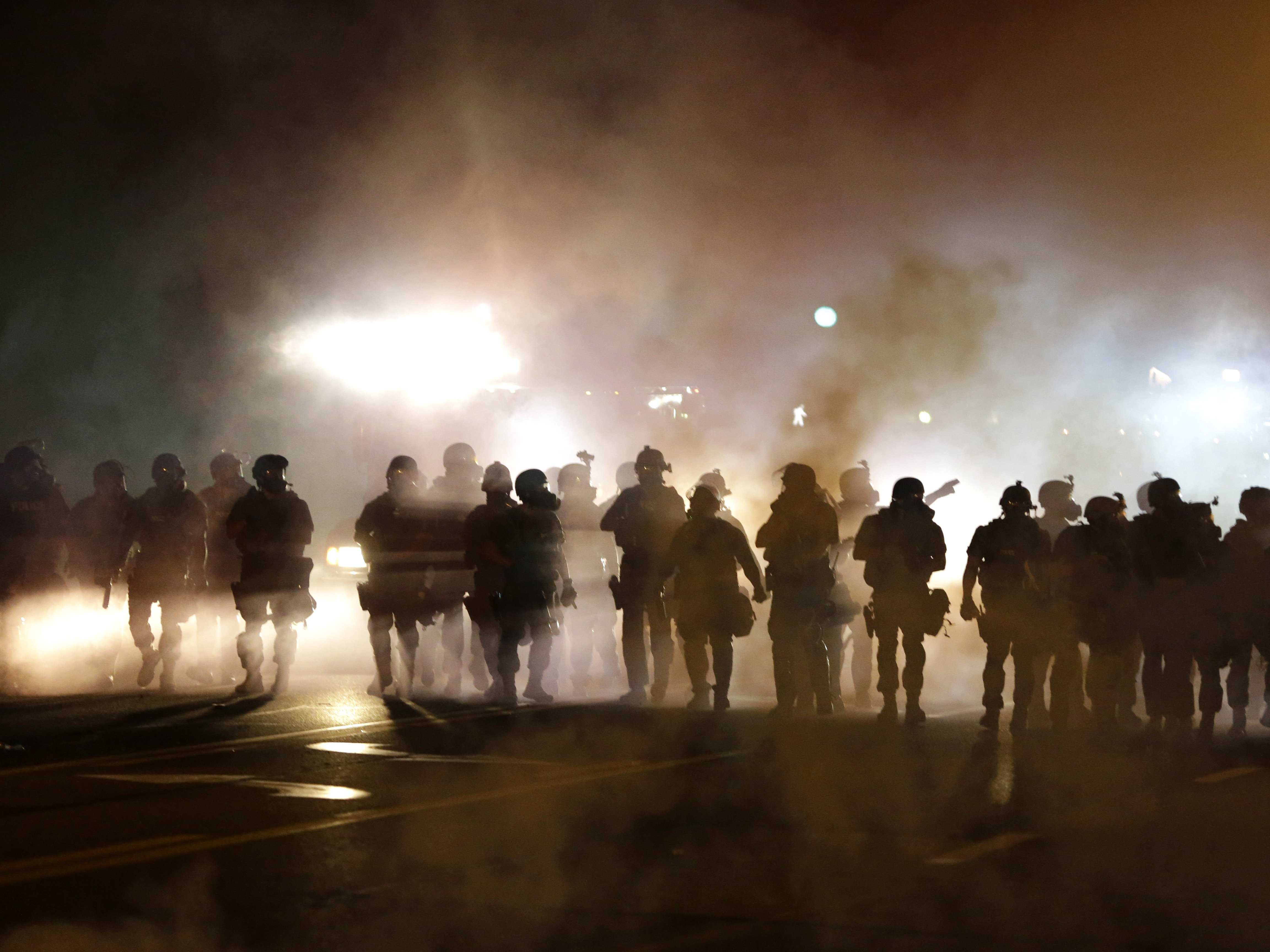
And on Saturday 9th August, it led to this:
Ferguson Missouri Michael Brown Protests Police


On my visits to St. Louis, a visit to the Episcopalian Christ Church Cathedral was always on the itinerary. The church and its community made a lasting impression on me with their many acts and expressions of love, welcoming and tolerance which sometimes seem so much at odds with the prevailing impression of Midwestern Christianity in America.

The way that Christ Church Cathedral (both in its grand stone home on Locust Street and its lively Facebook presence online) is responding to the crisis as it roils the city is perhaps a model to be studied and followed by all of the jostling interest groups – police forces, politicians, civil rights groups, the media and the oft-reported but scarcely-heeded residents – that have descended upon the area.

Yesterday, the Cathedral’s Dean Michael Kinman had this to say:

“The police and the justice system needs to hear the cries of the people and the people need to hear the cries of the police and the justice system, and we as followers of Jesus are the ones to stand in the breach between and even as we are being convicted and converted ourselves, help everyone on every side have their Jesus moment of conviction and conversion, of truth and reconciliation….

“The cry is ringing out from St. Louis around the world. The mothers are crying “Save my child,” and it is time for us to hear that cry and let it change our hearts and with changed hearts together lead this change in the world.

“St. Louis, this is our moment. And we know that this is not a child that will be healed instantly. The tasks are many, the obstacles are large and the journey will be long. But we are the Body of Christ and, with God’s help, together we will get the job done.”

Amen to this. Thus far, the police and the justice system have not been hearing the cries of the people. And in many cases they have conspicuously not been listening, either. Not in Ferguson, Missouri, and, sadly, not in many other towns and cities across America. For black Americans, the police are not automatically the reassuring presence on the street that they are to most whites – in fact, quite the opposite.

The protests taking place now would not be happening on their current scale and intensity if the death of Michael Brown was not just the latest of a litany of tragedies – and perhaps even injustices, depending on the outcome of this investigation – to disproportionally befall black victims and black communities. Looting and violence are reprehensible, but the situation in Ferguson does not exist in a vacuum, and it is not fair or intellectually honest to haughtily condemn them exclusively as failures of personal responsibility and ethics without taking the context of deprivation and repression in which they are happening.

That is not to say that a better, more peaceful path is not there for the taking. The police captain whose empowerment to take over control of the ongoing Ferguson situation from the hapless (and very culpable) St Louis County Police initially caused such a lull in the violence and bitter feeling showed the way with his early remarks:

“And we all ought to be thanking the Browns for Michael. Because Michael is going to make it better for our sons to be better black men. Better for our daughters to be better black women. Better for me so I can be a better black father. And, our mothers, so they can be even better than they are today. Lets continue to show the nation who we are. But, when these days are over and Michael’s family is still weeping, still on their knees praying. No matter what positive comes out, we still need to get on our knees and pray. We need to thank Mike for his life. We need to thank him for the change that he is going to make in America. I love you, I stand tall with you and I’ll see you out there.”

The difference that good leadership – and one man – can make is telling, and is encapsulated in this quote from a local resident, given last Thursday when hopes that the crisis was easing were still high:

But the presence of Johnson was clearly the difference between Thursday and the four nights of turmoil that preceded it.

 “I love this man so much,” said Angela Whitman of Berkeley. “He’s been here since the beginning,giving us encouragement and letting us know we’ll get through this.”

Conversely, the fact that the residents of Ferguson are not yet “through this” shows the limitations of good leadership and one man. Putting a local police chief – with black skin and roots to the community – in charge was a good first step, but it does not make up for the woefully slow response of Missouri Governor Jay Nixon. Nor does it make up for the fact that America’s libertarian political cheerleaders paused so obviously to test the waters before finally jumping into the fray.

The parachuting in of a black police captain does not make up for the many blatant violations of civil liberties – and the dignity of Ferguson protesters – inflicted by the overequipped and underprepared St Louis County Police in the preceding days. It does not make up for the flagrant inequalities in the American justice system, which incarcerates and punishes a huge number of young black men, stamping an indelible black mark on their records and making it even harder for them to ever break free from their circumstances and achieve the American Dream. And it does not make up for the false but universally known fact – reinforced over and over again, in lessons from cautionary tales like those of Trayvon Martin and now Michael Brown – that in America, a black life is worth far less than a white one.

One way or another, the protesters will eventually leave the streets of Missouri. So will the riot police, the clouds of tear gas and the world’s media filming it all. Michael Brown’s family will continue to grieve. These facts are certain, predictable, unchangeable. What remains within the power of people to influence is the legacy of this latest tragic black death on a city street. Will there be a meaningful and lasting change in police tactics, and a broader change in the way that the police seek to interact with – and reflect – the communities that they serve? And will there be a recognition that on America’s present trajectory, Michael Brown’s death was every bit as inevitable as that of the next person shot down without justification or consequences?

It takes a lot to change the culture of a local police department, let alone the judicial system of an entire nation. And for all the good that the players in Ferguson can do to bring these issues to our attention and make us face uncomfortable facts as they seek to reconcile and come to terms with what has taken place, it is usually at the state and national level where any lasting, widespread changes are enacted.

Unfortunately, this means that it is left to the slow-moving and cautious Missouri governor Jay Nixon, the vacationing President Obama (himself hamstrung in his response after failed interventions in the Trayvon Martin shooting and other incidents) and a host of national politicians who are more inclined to use the pain of Ferguson, Missouri for their own ends than to solve a common problem. With this predictable cast list, there seems little hope that we will not be reassembling in a few months’ time to beat our breasts over the next police shooting, mass shooting or other act of wanton violence.

But still, we must hope. And in the absence of any meaningful national leadership, the people of Ferguson, Missouri must lead the way themselves in turning a case study in “Community Policing – How Not To Do It” into a model of outreach and reconciliation for the rest of America.

For the sake of everyone, black and white, city and county, this dark chapter in American history must not be endured for nothing.
  

Statue of Reconciliation Coventry Cathedral Britain


Cover Picture: Fourth of July Parade in Ferguson, Missouri – NOCO magazine

Middle Image: Police in riot gear advance through clouds of tear gas in Ferguson

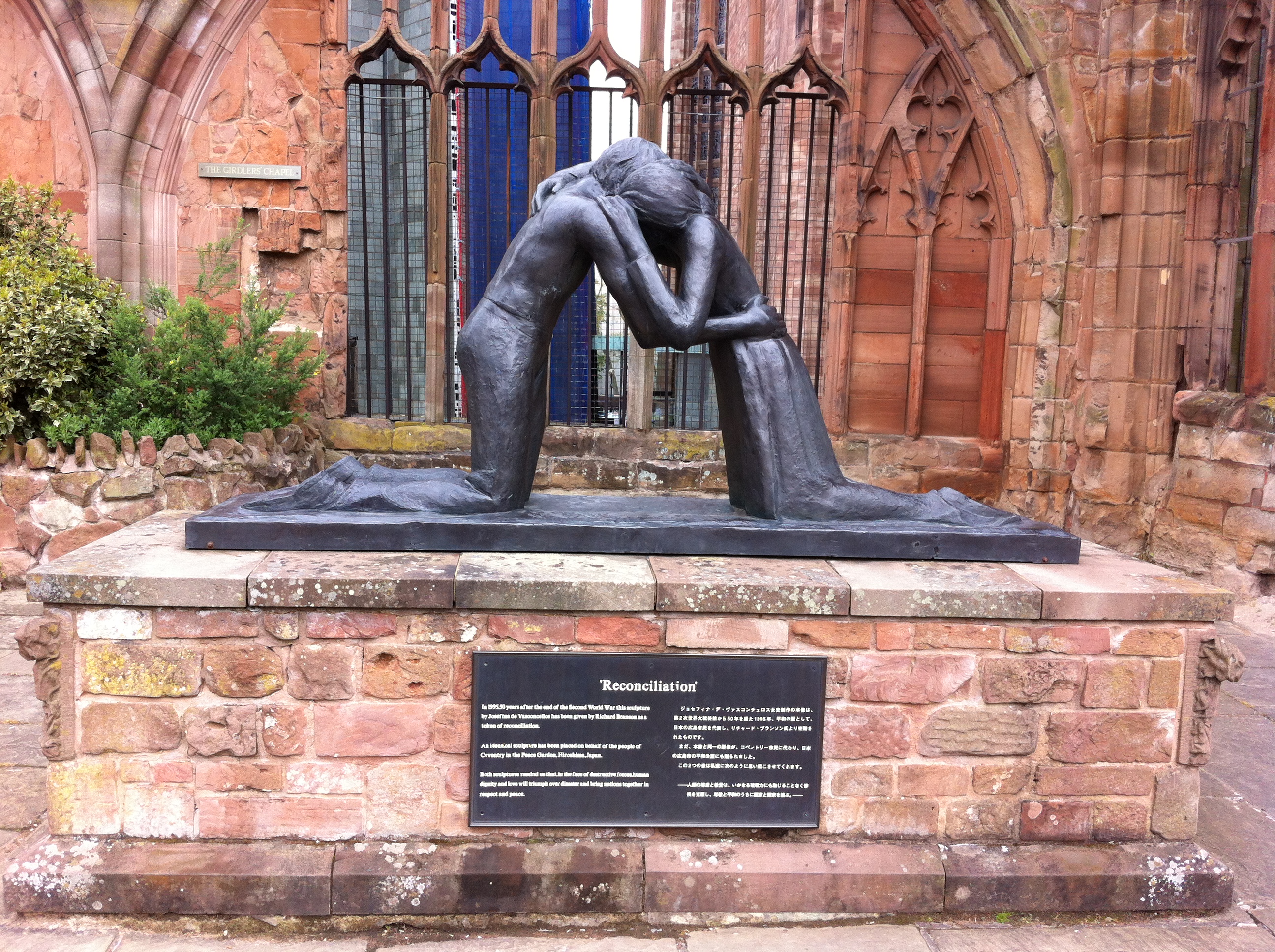
Closing Image: Statue of Reconciliation, Coventry Cathedral, Coventry, UK


Biased Or Not, The BBC’s Political Coverage Is Shockingly Bad

BBC Daily Politics Political Journalism SPS


The BBC – our national treasure or money and creativity-sapping black hole (depending on your viewpoint) has been given due notice by Sajid Javid, the new Culture Secretary, that every aspect of its future funding and existence is under review.

The Huffington Post reports:

All aspects of how the BBC is run and paid for will be reviewed when its charter comes up for renewal, the Culture Secretary has said. Sajid Javid said “everything” would be looked at, including licence fees and governance structures, when negotiations get under way … Tory Party chairman Grant Shapps warned the corporation last year it could lose its exclusive right to the £3.6 billion raised by the licence fee if it failed to tackle what he believes is a culture of secrecy, waste and unbalanced reporting in the organisation.

For those who believe that on balance the BBC is currently doing more harm than good, this is welcome news. Indeed, this kind of root-and-branch re-evaluation of public services is precisely what many people who voted Conservative in 2010 expected but have not seen thus far under the coalition government.

Re-evaluation and reform is sorely needed. The BBC has recently struggled to defend itself against allegations of incompetence and institutional corruption following the Jimmy Savile sexual abuse scandal, excessive remuneration of top talent and high level executives, and catastrophically poor editing of it’s flagship nightly news programme. And only last week the corporation defiantly kept the editor of the BBC News Channel in her post despite the fact that she posted highly partisan and derogatory comments about a political party on her Twitter account, in flagrant violation of BBC rules.

This blog is not alone in noting the gradual fall in the quality of the BBC’s political output in particular. The Telegraph’s Dan Hodges rightly lambasted the corporation’s recent election results coverage for being both lightweight and unresponsive to complex, dynamic situations. Hodges notes that despite token efforts by the legacy broadcasters to acknowledge the existence of social media, the BBC’s election results programme (for the recent local council and European elections) was way off the mark in its analysis, seizing upon the first narrative that emerged and stubbornly sticking with it throughout the evening even as Twitter started to better reflect the more nuanced results which later emerged.

It is worth quoting Hodges at length, because he makes a vital point:

I’m usually quite sceptical about the whole “social media is taking over the world” meme. But on Sunday night it became very obvious. Twitter and the other social media outlets are making the big election night programs utterly redundant.

It wasn’t apparent when they were the only outlet for results and analysis. But last week both main broadcasters were horribly exposed. What was amazing was the way it was clear neither Sky nor the BBC were taking the slightest bit of notice of their own output. They were engaged in a logistical exercise – “Let’s make sure we don’t miss the returning officer from Torquay” – rather than an analytical one.

What I also couldn’t understand was who they thought their audience was. The same headline mantra was chanted – “Ukip earthquake, Ukip earthquake” – over and over again, but no serious effort was made to deconstruct it. Surely the only people watching local election results at one in the morning are political geeks like me. And what we’re looking for is serious analysis.

Watching the difference between the discussion in the election studios and the discussion on Twitter was like the difference between watching Gary Lineker and Alan Shearer on Match of the Day and Gary Neville and Jamie Carragher on Monday Night Football. The former talk blandly about great attacking or terrible defending. The latter explain in granular detail precisely why it’s great attacking or terrible defending.

Sadly, that just about sums up the BBC’s approach to political programming today. There is a heavy focus on the personality-based politics (epitomised by the need to muckrake, sensationalise and have a “gotcha” moment in every interview) and the logistics of electioneering, but a rapidly fading focus on the comparative assessment and scrutiny of opposing policies. These days, the BBC’s political coverage is all about The Game – who’s up and who’s down at any given moment. Who’s wrong and who’s right barely gets a look-in any more.

What’s worse, the increasingly lightweight personalities – journalists and contributors – deployed by the BBC to cover the political beats are often incapable of the latter, more serious type of reporting, able only to offer superficial ‘analysis’ of the ups and downs of parties and personalities as measured by the twenty-four hour news cycle. Over time, the BBC divested itself of much of the expensive, skilled talent needed for good quality political coverage, either reshuffling them, demoting them or letting them go – and with them, their vital knowledge.

Before the BBC apologists leap to their feat in protest, no it does not have to be this way. High quality, penetrating analysis is not thwarted by the need to remain impartial (an imperative that the BBC fails to achieve anyway), but the BBC is in danger of succumbing to the worst current instincts of political coverage on American network television – giving each ‘side’ of an argument equal weight and validity out of desperation to appear non-partisan, even when the truth is quite clear-cut and largely occupied by one particular party.

The liberal comic Bill Maher perfectly skewers this unnecessary impulse, increasingly seen in BBC political broadcasting, as it pertains to the non-existent flat-Earth debate:


In other respects, though, Americans enjoy far better political coverage than their British cousins. America benefits from the existence of C-SPAN, a private but nonprofit cable network set up by the US cable television industry, who pooled their resources to establish a one-stop shop that they could all draw on for in-depth political coverage.

The BBC’s own effort, BBC Parliament, does not compare favourably with C-SPAN. BBC Parliament occupies one channel, while C-SPAN has three. C-SPAN provides much more extensive and flexible coverage of both houses of Congress, while BBC Parliament is bound by the ludicrous and archaic rules governing the televising of Parliament. C-SPAN offers a much wider range of other programming such as book talks, public debates and call-in shows, while BBC Parliament has to fit its own meagre offerings of this type in the periods when Parliament is not sitting. C-SPAN’s online presence vastly outstrips that of BBC Parliament in terms of depth of analysis and availability of archive footage.

But most importantly of all, C-SPAN has a reputation for balanced programming and is well-regarded by both liberals and conservatives. British conservatives, by contrast, have long since given up trying to get a fair shake from the BBC – though this article makes a persuasive case for the BBC’s innate small-C conservatism.

It is impossible to properly compare the entire outputs of two news networks in this short space, but a lot can be learned by watching the following excerpts of political output from the BBC and C-SPAN respectively.

First the C-SPAN show, a typical and broadly representative example of their output; in this case a call-in show featuring the national security journalist Glenn Greenwald as special guest:


And here is a C-SPAN StudentCam short film, also on the topic of national security. Such segments form a regular part of C-SPAN programming, filling the time slots between regular programming and encouraging young people to take an active interest in civic issues:


Contrast these with the BBC’s recent efforts, this exerpt taken from the flagship Daily Politics show:


The difference in focus, tone and overall quality could not be more striking. Even the student effort on C-SPAN outmatched the quality and seriousness of the BBC’s political output – and again, these examples are fairly representative of each network’s normal output, not chosen to unduly embarrass the BBC.

The obvious question that must be asked is this: Why the grave disparity in service, given the deep pockets and institutional clout of the BBC compared to its upstart American counterpart?

(In the interest of fairness, it must be mentioned that much of the BBC’s radio coverage is of significantly higher quality, particularly Radio 4’s Today in Parliament).

It’s not that there are necessarily more smart people with a burning interest in politics and public policy in America than there are in Britain. But because the BBC’s omnipresent dumbed-down approach crowds out all other offerings in the marketplace, politically interested citizens are much better catered to in the United States than they are in Britain, where the Daily Politics-style cartoonification of politics insults those with real knowledge and interest.

The truth is that the quality gap between C-SPAN and BBC Parliament has not always existed – it was brought about fairly recently by people who should be ashamed of their decisions, and whose CVs should carry indelible black marks as a consequence.

Before the Daily Politics came along and ruined everything, the BBC’s flagship political programming consisted of shows such as On The Record, Despatch Box and Westminster Live. Much like C-SPAN’s offerings in the United States, the budgets were small and the production values cheap; but this had the beneficial effect of making it all about the programming – the quality expertise and the analysis shared with the viewer.

This all changed when former BBC Director General Greg Dyke commissioned a review of the BBC’s political output, leading to a wholesale relaunch and rebranding. By 2003, out had gone the old shows with their dull but informative content, and in came the quirky, zany future where everything is a joke, everything is accompanied by a jaunty animation and theme tune, and everything is lightly mocked from the couch by host Andrew Neil and his unglamorous assistants.

Viewers can discern everything they need to know about the Daily Politics from the opening title sequence, without sticking around to suffer the show itself:


Portraying the British political system as some kind of sputtering, wheezing steam engine perpetually on the verge of breakdown may sometimes be uncomfortably close to the truth, but the BBC’s flagship daily political programme should not lead with this suggestion. Disillusionment with politics is high enough as it is without making jocular reference to all the reasons why in the opening credits.

To be clear, this is not to say that the politician themselves should be necessarily be treated with respect, reverence or deference, particularly when their actions have merited the opposite – but there should be a baseline of respect for the political process itself that now seems entirely absent from the BBC’s output. And all for what? What grand prize is the BBC seeking that is worth so much debasement?

The BBC is chasing a pipe dream if they believe their new dumbed down approach will result in more people tuning in and engaging with politics. Tacky, irreverent output better suited to satirical comedy shows will not draw in viewers who currently favour watching repeat episodes of Top Gear on Dave – it only serves to patronise and alienate those viewers who are interested in political coverage anyway, without the added allure of bright colours and jaunty theme tunes.

This isn't helping
This isn’t helping.


The point is not that the BBC should be disbanded entirely, or that the license fee should necessarily be scrapped (although it certainly should), or any one other prescription. The point of shaming the BBC with the woeful quality gap in its political programming is to point out that there are other delivery models out there in the world that work and which could produce good results back here in Britain, if only we would allow ourselves to consider them without feeling that we are somehow “cheating” on Auntie.

Those who become overly sentimental about the BBC in its current form suffer from the same forgiving and idealistic delusion as people who create Twitter hashtags or found political parties to “save the NHS”. Just as some NHS activists prize the survival and continuity of that organisation over the outcomes it was created to deliver (the best possible healthcare for British citizens), so BBC defenders cling to nostalgia rather than acknowledge the fact that the beeb can learn a lot from other broadcasters, at home and abroad.

There are many ways in which the BBC must prove its continued legitimacy other than in the field of news and political reporting. Why, for example, does a state-owned broadcaster need to operate eight national television channels, sixteen national radio stations and forty local stations when there is a thriving commercial sector?  But the BBC also gets many things right when it comes to news coverage – no one else in the world can match its depth and breadth, while British audiences tend to trust it above commercial rivals at times of crisis or when major incidents are unfolding.

The BBC’s political coverage, however, goes from bad to worse; and if left unaddressed for much longer it not only runs the risk of negatively colouring Sajid Javid’s upcoming review, but it will start to undermine British democracy itself.

As a first step in the right direction, the BBC News Channel’s editor, Jasmine Lawrence, needs to be reassigned to another role where her toxic anti-UKIP beliefs are in no danger of bringing the corporation’s impartiality into further question. But above all, the BBC needs to stop dumbing down in the one key area where dumbing down offers no benefits at all in terms of audience engagement or viewing figures.

The BBC’s Royal Charter – a delightfully worded document whose preamble would not be out of place in a Shakespeare play – defines the corporation’s public services (in part) as follows:

(a) sustaining citizenship and civil society;
(b) promoting education and learning;

Unless our national broadcaster is happy to continue fostering a state of cultural apartheid, where radio listeners receive tolerably decent political news output while television viewers are talked down to and belittled at every turn, the BBC must acknowledge that it is currently failing to meet these public service requirements.

And as it goes for anyone finding themselves on the wrong path in life, the first step toward the BBC’s redemption will be admitting that they have a problem.

How Do You Solve A Problem Like Nigel Farage?

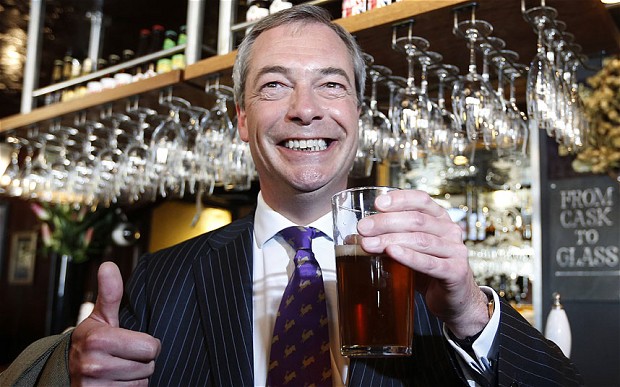
Nigel Farage Pint Elections 2014


Let’s play pretend.

Suppose that you are a British voter who happened to express admiration for Nigel Farage back in 2010. Your friends were aghast and asked how you could possibly support such an eccentric right-wing oddball, so you kept quiet for awhile, putting your feelings down to maybe not knowing as much about politics as you should, and feeling a bit chastened by the reaction you received.

Imagine that you then found yourself agreeing with Farage and the UKIP position even more on things like immigration and leaving the European Union when the local elections rolled around in May 2013 and the party made headlines for doing so well. Surely now you could admit to your friends and family that you were becoming a fan of this new kid on the block, especially since one in four voters supported UKIP this time around and they were receiving so much press coverage? But once again, as soon as you mentioned your political sentiments people looked at you as though you must have fallen over and hit your head.

Fast-forward to spring 2014. The things that you think are important issues are still not being addressed by the main political parties,and now the European and local elections are coming up. Only UKIP are offering the policy proposals that seem like common sense to you, and they are the only party whose candidates seem able to express themselves freely and persuasively without sounding like they are reading aloud from (at best) a teleprompter or (more usually) the telephone directory. Surely now people must see the appeal of UKIP? Surely now it must be safe to come out?

At the pub one evening, you admit that you are planning to vote UKIP in the European election, and maybe for the local council too. Outrage! That won’t do at all, it’s quite simply the end of the world. Your horrified friends dive for their smartphones, and before you can blink five brightly-lit screens are shoved in your face, each one blaring “top ten” lists of reasons not to vote UKIP, or trumpeting the misdeeds of a dodgy-looking UKIP councillor on the other side of the country.

Didn’t you know? Nigel Farage wants to rescind women’s suffrage! Godfrey Bloom once chartered a Boeing 767 at his own expense and set up a stall at the Notting Hill carnival, offering dark-skinned people £100 each to hop onboard and fly home to Bongo Bongo Land! How can you think of lending your support to people like that? Are you crazy?

You go home in a sour mood and turn on the computer. You’re sure you had more Facebook friends than that this morning. And why have you received nine invitations to “like” the Liberal Democrats and see the amazing work their MEPs are doing in Brussels, protecting the environment and “standing up to the bankers”? Disgusted – and determined never to vote for Nick Clegg’s party again, no matter how much your overbearing aunt cajoles – you switch on the television. The newsreader is reporting that Nigel Farage was hit by an egg while out campaigning earlier that day. “Wow”, you think. “I know just how he feels”.

Election day rolls around. For the past two weeks, every newspaper article and news segment has seemed to be about UKIP one way or another – and none of them positive. But the UKIP you know from looking at the website and talking to the volunteer on the doorstep doesn’t look anything like the monstrous effigy being held up by the media. You decide to quietly vote UKIP, and just not tell anybody about it. To hell with them anyway, you never said a word when they all decided to jump on the bandwagon and grow pretentious hipster beards.

As the election results start coming in, pandemonium breaks out. David Dimbleby has a meltdown in the BBC studio, the swing-o-meter self-destructs in a shower of sparks, the Labour shadow cabinet form an orderly queue to tell Adam Boulton exactly how Ed Miliband led them to disaster and the Tories are cursing you and your kind for costing them their precious flagship councils in Essex.

What’s more, in the space of two breathless minutes, the all-knowing BBC panel packed with manicured, London-dwelling upper-middle class “experts” has solemnly suggested at least five ludicrous reasons why you voted for UKIP:

You were left behind by the modern information economy. Actually no, you have a decent skilled job; you’re not Alan Sugar but it has good prospects and pays the bills.

Your local community looks nothing like it did in 1960 and it’s scary for you to see the change. Well you were born in the 80s, and you managed to take the internet, iPhones and the falafel restaurant round the corner in your stride without wetting yourself in terror, so that probably isn’t the reason.

You feel persecuted for holding on to your traditional values. Hardly. Two of your friends are gay (the first ones to grow the stupid hipster beards, come to think of it) and although you know that some UKIP councillors have said pretty nasty things about gay people, you’re not homophobic at all, that’s not what attracted you to the party.

You feel like no one listens to you, your vote was just a blind stab at the hated political elite. Well it used to feel like no one listened, but Nigel Farage and his party came and listened. A protest vote would be a spoiled ballot paper or a write-in for the Monster Raving Loony Party. What you did was positive and purposeful, a vote for certain policies you agreed with.

You’re angry, you’re furious, you’re consumed with blind rage. Well yes, but only since the start of this election broadcast!

So many reasons offered by the Westminster commentariat, and none of them the simple truth:

You looked at the Conservative platform and you don’t trust them to deliver on the things that they say they would do – the government is failing to meet its immigration targets again, and the Tories already broke one “cast-iron” promise to hold a referendum on Europe.

You looked at Labour and saw a party that hasn’t even accepted that they did anything wrong when they were in government leading up to the recession, who never mention Europe or immigration at all unless you beat it out of them with a stone, and whose leader can’t even eat a bacon sandwich without getting on the front page of the papers for doing it wrong.

You didn’t bother to look at the Liberal Democrats too closely, because you’re not weird and it isn’t 2010 any more.

But you looked at UKIP and found that their policy prescriptions fit your list of concerns rather handily, and gave them your vote because isn’t that precisely how democracy is supposed to work?

Yes! The truth is that you voted UKIP for the same reason that other people voted for their parties – because you thought through the issues and liked UKIP’s policies. Now why is that so hard for the politicians and people in the media to understand?

Now before you stop reading – yes, there was a point to that tortuous exercise in imagination. Consider:

In the aftermath of the election, all that anyone has been able to talk about is the question of how so many people were conned, duped or tricked into voting UKIP. Earnest, well-intentioned (and less well-intentioned) commentators and newspaper articles have been encouraging us to imagine what it must be like to be a UKIP voter, as though the very thought is so alien that ‘normal’ people actually need a tourist guide into the mind of a Ukipper in order to make sense of the election results. Did you know that they are omnivores and base their waking hours on the rising and setting of the sun, just like us? Fascinating!

But does the media (and they are almost all guilty) ever stop to think what it must be like – purely by virtue of subscribing to some fairly commonly held political views – to be talked about as though you are a symptom of a terrible and shameful national venereal disease, or a wayward prodigal child that needs to be rehabilitated back into the family?

Do the newspaper columnists and TV talking heads ever stop to think just how maddeningly patronising they sound to UKIP voters when they write their anguished, hand-wringing columns on what to do about Britain’s awful UKIP problem?

Most of the time, a conservative can read the Guardian or a liberal the Telegraph and not necessarily feel loved and perfectly understood, but at least see their opinions treated with a very basic level of respect. There were no psychological inquests in the Guardian as to why the voters ignored Gordon Brown’s self-evident brilliance in such large numbers and rudely cast him from Downing Street in 2010, the answer was clearly political.

But with UKIP it is different. It is as though believing in UKIP’s worldview and policies doesn’t deserve acknowledgement, understanding and then persuasion by those who vote differently – it requires correction by those who know better. You’re not thinking properly, UKIP voter. If you were, you would have selected from one of our pre-existing bland political flavours.

Only one article (in the Guardian of all places) shows any degree of contrition at all for the way that UKIP supporters were hounded, bullied and vilified in the press over the past few weeks. Apologies are in very short supply, but there is an abundance of smug condescension packaged as expert political analysis.

A host of British politicians have already been wheeled through the television studios to offer their own variants on the standard post-election-upset mea culpa: we hear their concerns, we need to start speaking their language, we need to show that we are relevant to their lives, we need to stop them from being exploited by the far-right.

You can be sure that all the main parties are plotting their next moves already. The only idea missing from all of their plans? Actually talking to UKIP supporters, and treating them as though they are fellow human beings.

To be a UKIP voter watching or reading the news today must feel as though you are a dangerous but valuable specimen kept in a lab, with a curious Guardian reader in a hazmat suit poking you through the safety glass to see how you respond to political stimuli while someone from CCHQ takes notes and a BuzzFeed staffer snaps pictures and adds mocking captions. I CAN HAZ PINT WITH NIGEL NOW?

This can’t be a very pleasant experience – the resultant emotion is likely to be one of immense irritation at being so misunderstood and publicly belittled. In fact, the only thing likely to make the whole damn experience any better is watching Nigel Farage’s smiling face as he sinks another pint and poses for photographs with his victorious local candidates.

It’s the political and media establishment’s turn to play pretend now:

You are that UKIP voter. After being subjected to this barrage of disbelief turned to mockery turned to outrage turned to hate turned to amazement turned to curiosity turned to pity from the big three political parties and most of the press, where do your political sympathies lie, looking ahead to the 2015 general election?

At Long Last, Will The BBC Take Editorial Bias Seriously?

Jasmine Lawrence BBC UKIP bias tweet

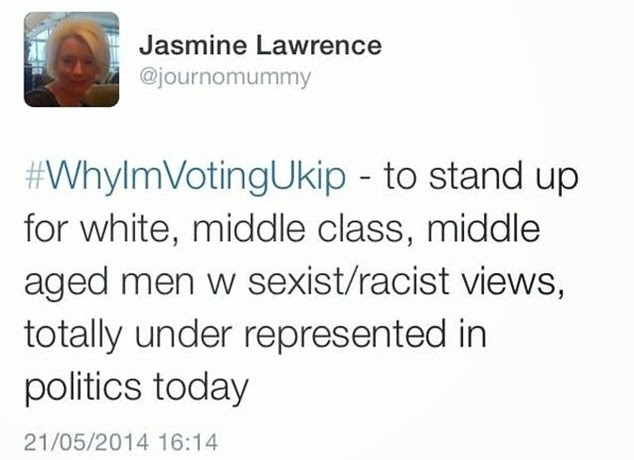
It is a sign of the times that things which used to cause outrage are becoming commonplace and shrugged off as unimportant, a fuss about nothing. And so it was that barely anyone spoke up when Jasmine Lawrence, the editor of the BBC News Channel – Britain’s most watched news channel – caused a stir by posting a virulently anti-UKIP screed on Twitter (supposedly in a personal capacity) before quietly deleting it when it began to attract negative attention.

The Guardian summarises the incident:

Lawrence, who has now shut her Twitter account, posted a tweet on Wednesday that said: “#WhyImVotingUkip – to stand up for white, middle class, middle aged men w sexist/racist views, totally under represented in politics today.”

The tweet was posted the day before the local and European elections.

Of course, the story was seized upon by the likes of blogger Guido Fawkes, but outrage and indignation at such a flagrant breach of impartiality should not be the exclusive preserve of those on the right. It does no one any good if the national broadcaster, whose one supposed redeeming feature lies in its non commercial and impartial nature, permits its employees to go rogue without consequences.

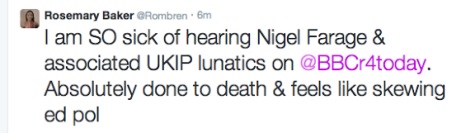
And this was far from the only example of BBC journalists publicly showing contempt for political parties outside the “big three” – a BBC Radio 4 producer had this to say:

Rosemary Baker BBC election bias tweet

The BBC’s mail-merged response to Semi-Partisan Sam’s complaint (yes, a complaint was justified) came today via email, and read as follows:

Jasmine Lawrence was tweeting from a personal account. She has been reminded of her responsibility to uphold BBC guidelines. She has deactivated her twitter account and will now be playing no part in the BBC’s election coverage in coming days.

Nevertheless, we acknowledge the strength of your complaint and we can assure you that we’ve registered your comments on our audience log. 

Wow, the audience log. That will definitely stop anything like this from happening again.

What the BBC fail to address in their response is the fact that the remainder of the BBC’s election coverage is not the problem. The problem is the fact that Jasmine Lawrence will remain the editor of the BBC News Channel, presumably resuming full duties as soon as the election coverage is completed on Sunday.

Yes, it is certainly likely that she caused editorial harm and biased coverage in the weeks leading up to the election before her ill-advised tweet saw her stripped of her duties, but how much more damage can she now do in the coming year leading up to the general election?

We all have political preferences, and that’s fine. But the Jasmine Lawrence tweet doesn’t just reveal a tendency to lean one way or the other along the political spectrum. The editor of the BBC News Channel clearly has a deeply ingrained, long held antipathy toward UKIP and the people who support that party or agree with its policies.

Are we really supposed to believe that when she walks into the BBC offices in the morning, Jasmine Lawrence takes off her scornful, UKIP-denigrating hat and puts on her cap of unblemished impartiality, and that the decisions she makes regarding story selection, focusing of time and resources, determining which guests to interview, lines of questioning and other matters will not be influenced by the same sentiments that prompted her to call UKIP supporters white, middle aged sexists and racists?

From the muted BBC response so far, it appears that the corporation remains wholly ignorant or disdainful of the outrage that continued examples of personal bias create among its audience and the British population at large.

Rod Liddle captures and distils this outrage in the Spectator today:

‘I’ve fucking had it with these people. They are so smug; they think they know everything and they know nothing. They want a good kick in the face.’

So said a close friend of mine, more usually a Labour voter, before she went out to vote for Ukip earlier today. I think it was the Jasmine Lawrence thing which tipped her over the edge. Jasmine is, improbably enough, the boss of the BBC’s News Channel. She had ‘tweeted’ that Ukip was a sexist and racist party – yesterday.

Of course, she should be sacked. Right now. The BBC’s News Channel is supposedly impartial – that’s what we pay for, an impartial service. Either that or the BBC should accept that all of its employees possess political views and there is no problem in having them aired. But it will not sign up to that more enlightened position because it knows that 90 per cent of them are as smug, and stupid, and bien pensant as Jasmine.

The latest update from Guido Fawkes reports that a memo has been sent to BBC journalists drawing their attention to pre-existing policies on impartiality. The memo reads, in part:

But the guidance is clear when it comes to personal activity: “As a BBC member of staff – and especially as someone who works in News – there are particular considerations to bear in mind. They can all be summarised as: ‘Don’t do anything stupid’.”

I’d also specifically draw your attention to the following section: “You shouldn’t state your political preferences or say anything that compromises your impartiality. Don’t sound off about things in an openly partisan way. Don’t be seduced by the informality of social media into bringing the BBC into disrepute.”

Don’t do anything stupid – a warning issued rather too late, given the fact that the polls have now closed. But the real damage could lie ahead of Lawrence resumes her duties at the BBC News Channel after the election. If she is reinstated, everything you watch and everything you hear on the BBC’s 24-hour news channel will be filtered through the perspective of someone who thinks that the ~30% of voters sympathetic to UKIP are nothing more than Oswald Mosley blackshirt-style fascists in disguise.

If you believe that actions should have consequences, and that the BBC should have as editor of its news channel someone who is at least able to maintain the illusion of impartiality, you can quickly and easily submit an online complaint here.

Local Elections: Mid-Earthquake Progress Update

Nigel Farage UKIP voting


Over half of the local election results are in, and so far we see UKIP picking up an impressiv number of council seats (139 and counting), running a strong second in many areas (which is impressive but of course delivers no councils or councillors when it happens) and causing mayhem with the fortunes of the other main parties.

Many of the establishment politicians and journalists, who had clearly vested their hopes in the all-out assault on UKIP in the press, have been caught flat-footed and are struggling to agree a line and respond before being overtaken by events when the European election results are announced on Sunday.

Some politicians, who are capable only of showing condescension toward UKIP voters and sympathisers, tried to portray them as victims with neither intelligence or agency, who are primarily economic ‘losers’ with an axe to grind. Labour’s Douglas Alexander epitomised this view on BBC Radio 4 this morning:

I think there is not just a whole group of people who feel left behind by the economy but locked out of politics. ‘There is a deep anger and alienation there and the votes that we have seen for Ukip overnight are in part a reflection of that reality.

But others showed more nuance and tact:

When the left pipes up about Ukip voters’ worries being reducible to either the “cost of living crisis” or a tangle of concerns around job markets and public services, they get nowhere near the whole story … When you meet a Labour-Ukip switcher who expresses worries about immigration, you can’t simply reduce what they say to falling wages and the lack of social housing.

A plurality – including those who know how the main parties behave – clung to the naive belief that the only thing needed is a change of tone and marketing from the main political parties:

The success of Ukip is a direct and inescapable consequence of the abject failure of the mainstream parties to connect with deeply disillusioned voters. It doesn’t need Dave and Ed to light up a fag and be photographed from now on only with a pint of beer in their hands – perish the thought – it just needs them to start talking a language that vaguely resembles the language the rest of us speak.

Of course, this unlikely formula for success relies on the supposition that the establishment politicians can still remember how to speak the same language as the people they supposedly represent, and that the likes of David Cameron and Ed Miliband might suddenly startspeaking frankly and honestly about Britain’s difficulties and opportunities without having their statements parsed and filtered through party-approved talking points.

Some newspapers have at least had the self-awareness and humility to examine their roles in the anti-UKIP onslaught ahead of the polls, acknowledging that the wholesale, scornful vilification of UKIP supporters not only backfired but was actually wrong:

Over the past week or so … something interesting began to emerge … A collective outbreak of sneering, which started to transcend the party itself and blur into a generalised mockery of anyone minded to support it. You could see it most clearly in the rash of satirical(ish) #WhyImVotingUkip tweets that are piling up even now (e.g. “Because I’m uneducated,uncultured, white and old”) and it’s not pretty: an apparent belief that to vote UKIP is to be an idiot of some description, either bigoted or duped, and worthy of little more than contempt.

… if people are supporting Ukip in such large numbers – even after the media’s massed guns have been rattling at it for weeks – it is probably time to drop all the sneering and think about why.

Rod Liddle at The Spectator came out hard against the “London elite” and their attempt to halt UKIP’s progress at all costs:

But it wasn’t just [the BBC], it was a whole bunch of other stuff too. The splenetic fury which the London elite sprays, mindlessly, upon those who do not agree with its views. I’ve fucking had it with these people too, to tell you the truth.

And a commenter at the Spectator expressed his frustration with those national newspapers who are naturally sympathetic to UKIP’s policies but chose to join in the chorus of misinformation and one-sided anti-UKIP coverage:

Nah, what [did] it for me was to see The Sun, The Mail and The Telegraph sticking the boot into Nigel Farage for expressing concerns those papers usually share.

I mean any other day of the week these newspapers are full of immigration stories, Romanian crime gangs etc, but come election time the papers decided to reinvent themselves as metropolitan luvvies backing the establishment parties and pretending Nigel is a dangerous extremist.

The results are still coming in, so it is natural that the party responses (and attempts to lay the blame) are all over the place. But the local council elections clearly have the main political parties (the “legacy parties” to use Nigel Farage’s terminology) spooked, and a convincing first place for UKIP when the European election results are announced on Sunday will really give them reason to pause and look at themselves.

For those of us watching, the fact that the election results are spread out over three days may be a good thing. By the time the European election results come in, the stock answers and meaningless mea culpas of the politicians and the talking heads will have been used up – and they might be forced to start saying what they really think.