–
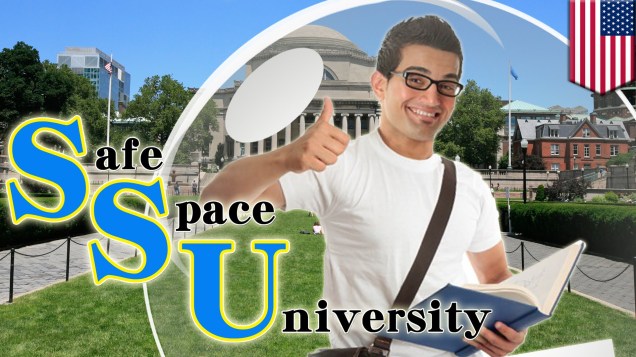
If unchecked, identity politics and Social Justice Warrior tactics will lead to a stalemate on university campuses where everything is offensive, everyone is offended and both protest and counter-protest become impossible
Recently, this blog speculated as to what would happen if and when conservatives on university campuses finally get sick of being shouted down and censored on campus by social justice activists using the tactics of identity politics, and begin to adopt the same kind of arguments and tactics themselves as a kind of self-defence mechanism.
As I concluded at the time:
Nobody likes a pity party, but that is exactly what will get if conservative and liberal students face off against each other not as they should, through lively debate, but rather through constant, tear-stained appeals for the university authorities to intercede on behalf of their respective sides.
And in a sense, one cannot blame [conservative students] for behaving in this way. They have watched for months and years while identity politics-wielding left-wing students get every little thing that they demand from spineless university administrations, and shame into submission anybody who stands in their way.
It is not therefore an illogical leap when other students conclude that this is the best and most effective way of advancing one’s own agenda. If the Social Justice Warriors can mobilise support and win concessions by emphasising (and frankly, grossly exaggerating) their supposed victimhood and oppression, why should conservatives not do the same?
[..] But in the longer term, if through repeated practice young students become adept at flaunting their fragility and exalting in their helplessness, both sides will fight to a bloody draw, with nobody able to say or do anything on campus without immediately triggering a protest and counter-protest. University will truly no longer be a place for the discussion of ideas, but a sheltered place of “comfort and home” for weak-minded adult babies, an intellectual demilitarised zone protected by a field of verbal landmines laid by every competing minority group over the academic and political discourse.
And an “intellectual demilitarised zone” is exactly what we are now just beginning to see, with those people and groups who were traditionally the target of social justice warrior tactics now adopting the same language of victimhood and fragility in an attempt to deflect criticism of themselves and shame their accusers into dialling back their criticism.
The context in this case is that of UC Davis and the ongoing protests on that campus to force the resignation of their Chancellor, Linda Katehi. Much of the criticism of Katehi is actually justified in this case – she came to prominence for presiding over an infamous incident in 2011 where Occupy protesters were pepper sprayed by campus police, and subsequent efforts to scrub the internet of mentions of the event in the name of “online reputation management. Some of her failings are detailed in this local press report.
But the rights and wrongs of Katehi’s actions are irrelevant for the purposes of our analysis. What is if interest here is the fact that Katehi’s defenders among the university student population, faculty and administrators are now using the same language of beleaguered and bullied “victims” in an attempt to win public sympathy as well as respite from their accusers.
Jonathan Haidt comments on this phenomenon at The Atlantic:
At UC Davis, where student activists still hope to oust Chancellor Linda Katehi, critics of their activism are using concepts like “safe space” and “hostile climate” to attack it.
The student activists had occupied a small room outside Katehi’s office, planning to stay until their chancellor resigned or was removed from her post. By the time they left 36 days later, a petition that now bears roughly 100 signatures of UC Davis students and staff were demanding that they prematurely end their occupation, criticizing their tactics, and alleging a number of grave transgressions: The signatories accused the student activists of sexism, racism, bullying, abuse, and harassment, complaining that many who used the administration building “no longer feel safe.” The student activists say that those charges are unfair.
While regarding a different protest at Ohio State University, Conor Friedersdorf notes that this is not the only time that targets of a student protest have used the language and tactics of social justice warriors to plead vulnerability and seek to escape from criticism or protest:
Insofar as campus concepts like safe spaces, microaggressions, and claims of trauma over minor altercations spread from activist culture to campus culture, the powerful will inevitably make use of them. Where sensitivity to harm and subjective discomfort are king, and denying someone “a safe space” is verboten, folks standing in groups, confrontationally shouting out demands, will not fare well. When convenient, administrators will declare them scary and unfit for the safe space, exploiting how verboten it is to challenge anyone who says they feel afraid.
In cases like this one, it won’t matter that one of the least scary experiences in the world is walking into a university administration building at 7 a.m., well-rested and ready for work, to be greeted by a bunch of exhausted 18-year-old OSU students groggily looking up from the corner where they curled up with college hoodies as pillows. After years of reporting on occupations like this one, I’ve never heard of even one case of a college staff member of administrator coming away with even a scratch. Yet in the name of preserving “safe space,” these protesters were evicted.
This emergence of competitive grievance culture is only going to grow. Only last month, this blog remarked that competition between different identity groups all using the same anti free speech tactics is currently less marked on American university campuses compared to British institutions, but already it seems that the United States has caught up.
This is what our new victimhood culture has wrought. Expect to see this same scenario repeated again and again in the coming months, as those people who are traditionally the target of leftist campus activism – conservatives, university administrators and others – realise that they can “appropriate” the language and tactics of the SJWs to portray themselves as the real victims and get themselves off the hook.
As yet, the SJWs have no response to this tactic. As we have recently seen, many students indoctrinated into the Cult of Identity Politics are so terrified of putting a foot wrong themselves by saying or doing something “offensive” that their first reaction when confronted with any identity politics claim is to freeze like a deer in the headlights and then automatically accept it as valid.
According to this mindset, if a university administrator – heck, even a university Chancellor – claims that student protests and disagreement are making them feel unsafe, then it is the duty of the identity politics adherent to withdraw in deference to the fragility of the supposed victim. Thus any debate or protest, regardless of the participants, can now potentially be shut down simply by uttering the three words “I feel unsafe”.
As Jonathan Haidt notes, by using these illiberal tactics so freely and excessively, student activists have effectively created the weapon with which campus authorities may now attempt to silence them:
The civil-rights movement, the free-speech movement, the anti-Vietnam protests, and protesters on both sides of the gun and abortion questions have all deliberately tried to make others uncomfortable, intellectually if not physically. They’ve all shouted, insulted, provoked, and tried to deny their opponents “safe spaces.”
Today’s strain of campus progressivism has a more ambiguous relationship with traditional liberal values, finding them too viewpoint neutral and rough-and-tumble.
Still, most campus protests are left-leaning. And administrators cannot help but realize that almost all of that activism is, on some level, about confrontation—that it frequently involves a lot of shouting or chanting or marching or banging on drums. Now, any time such protests challenge the interests of the administration, or make their jobs marginally harder or their lives marginally more inconvenient, they can always pinpoint some folks who are earnestly upset or unnerved by all the ruckus.
They can always undermine the activists of the moment by finding the students experiencing “trauma” from all the conflict; the staff members who feel “unsafe” around protesters, the community member who, in the new paradigm, somehow feel “silenced.”
As best I can tell, this does not worry leftist activists yet, perhaps because they mostly operate on shorter time-horizons than other campus power brokers, or perhaps because they see themselves as marginalized and mistakenly believe these standards will never be applied to them, even though it’s already happening.
Haidt concludes his own analysis:
In the end, unreformed social justice activism may destroy itself.
One gets the slight impression that Haidt, despite his sterling work drawing attention to the growing illiberalism within universities, sees this as something at least partially regrettable.
This blog would regard the collapse of social justice activism under the weight of its own sanctimony – at least for as long as it is so closely intertwined with poisonous identity politics – as a great and unexpected triumph. But a prolonged stalemate with both sides using identity politics tactics to shame the other and parade their supposed victimhood in front of authorities and the observing public – with free speech rights being continuously eroded at both ends – still seems like the more likely outcome, at least in the medium term.
In short, our new victimhood culture is not going anywhere in a hurry. Therefore, those who oppose it must find other means of fighting back besides the counter-productive instinct to play the social justice warriors at their own game.

–
Agree with this article? Violently disagree? Scroll down to leave a comment.
Follow Semi-Partisan Politics on Twitter, Facebook and Medium.


 Semi-Partisan Politics