General Election 2017: The Unbearable Light-weightedness Of British Politics

rainbow unicorn

We can’t go on like this

I’m just going to come out and say it: given the appallingly weak options available, Jeremy Corbyn probably deserves to be the next prime minister of the United Kingdom.

Don’t get me wrong: if his hard-left socialist policies and aspirations were fully enacted, Corbyn would also likely be the last prime minister of the United Kingdom, but that’s another matter.

After all, is not the point of democracy, of elections, to give the people their right to choose political leadership and representation which they want to see take their communities and their country forward? And if so, who during this miserable general election campaign has done more to convince the British public that they are a person of principle and conviction, willing to tell uncomfortable truths as they see them while standing up to entrenched special interests – Theresa May or Jeremy Corbyn?

Let’s compare.

Who produced an election manifesto which represented some of the best traditions (and sincerely held political views) of their party? That would be Jeremy Corbyn. Who huddled together with two unelected aides to produce in secret a manifesto which declared war on her own voters, repudiated Thatcherism, threw the libertarian wing under the bus and pandered to the worst instincts of everybody who thinks that the state should be like a third parent to them? That would be the “conservative” prime minister, Theresa May.

Jeremy Corbyn’s Labour manifesto, in all its leftist, spendthrift glory: costed. Theresa May’s Coke Zero Conservative manifesto – “coke zero” because like the drink, it has the same branding as the real thing but none of the ideological, calorific ooomph which makes it taste good and perk you up – not so much.

Who has made gaffe after gaffe and exacted numerous self-inflicted political wounds, missteps and humiliating U-turns on her party and campaign? That would be Theresa May, whose claim to unruffled, grown-up leadership looks more and more tarnished by the day. Who seems to have finally stopped his penchant for weekly PR disasters and learned not to intervene when his enemy is making a mistake? That would be the old rube, Jeremy Corbyn, despite the fact that he faces a highly antagonistic press.

Who has behaved like an adult and at least accepted the necessity of a Brexit deal with the European Union (however weak a negotiator he would otherwise likely be) as a precursor for economic stability? That would be Corbyn. Meanwhile, who still publicly entertains the confidence-sapping notion of no deal and a disastrous crash out of the EU? That would be strong ‘n stable Theresa.

And who found the courage to go on national television and articulate their party’s values and vision for Britain in tonight’s BBC election debate? Jeremy Corbyn. Who was frightened and cowered away in Downing Street, risibly sending a surrogate minister to fight her battles? That would be the ever-formidable Theresa May.

Whatever one thinks of Jeremy Corbyn, there is mounting evidence that Theresa May simply does not have what it takes to be a successful British prime minister in the 21st century. Perhaps being a diligent, hardworking, non-telegenic, secretive authoritarian with a tiny circle of close-knit advisers helped Theresa May when she was Home Secretary. Lord knows it allowed her to become prime minister despite the party and the country barely having any idea of her core values or guiding philosophy. But as prime minister in the television and internet age, May’s natural reticence doesn’t play well.

You can say that this is a small and petty criticism, and in some ways it is. And perhaps personality should matter less, but we must deal with the world as it is rather than as we would like it to be. When Theresa May skulks in the back row of G7 summit family photos while Donald Trump gladhands with the boy wonder French president Emmanuel Macron and “leader of the free world” Angela Merkel, one gets the strong impression that she similarly fails to win hearts and minds in the all-important closed door sessions.

For all their arrogance and vapidity, the American political elite positively purr over Emmanuel Macron, bulwark against Evil Brexit and saviour of the “liberal world order”. I would wager that far fewer could even name Theresa May. And this advances British interests with our closest and most important ally how, precisely? Donald Trump is one man, quite possibly soon to be an ex-president if the slow-motion coup against him ultimately succeeds. Meanwhile the vast apparatus of American government remains a juggernaut fully committed to the internationalist status quo, and Theresa May is doing nothing to persuade them that any of their preconceptions about the evilness of Brexit and the EU’s self-evident splendour are wrong. A better, more natural communicator would have a fighting chance.

Two provisos: First, Jeremy Corbyn would do no better in this regard, and quite possibly far worse, given that his worldview is based in no small part on anti-Americanism. But Theresa May only looks vaguely acceptable in this regard because Jeremy Corbyn would be so appalling. That’s not a ringing endorsement or a solid qualification for remaining prime minister.

And second, it is hardly as though the Conservative front benches are brimming over with talent one thinks of as solid alternative prime ministers – Boris Johnson is rightly known in America and around the world as a fool who uses a bumbling persona and a smattering of Latin phrases to mask an insatiable vanity and hunger for the spotlight. Who else to choose? Philip Hammond? Well, at least Theresa May makes him look fiscally responsible by comparison, but he’s no media performer. Amber Rudd? She’s a loyal soldier and did a highly commendable job stepping into Theresa May’s shoes for tonight’s debate, particularly so soon after the death of her elderly father earlier this week, but a potential leader? Who else, then? Seriously, I’m asking? Who?

If you had to design the perfect Tory party leader and prime ministerial candidate for this moment in time specifically, what would they look like? Well, everybody probably has their own preferences, but here would be my take on what would work best both politically in Britain and as a person capable of commanding interest and admiration on the world stage:

Ex armed forces (of either gender), mid to senior rank, with an illustrious overseas deployment history. Someone who exudes unapologetic patriotism yet never lapses into cheap jingoism, and whose commitment to defence, national security and veterans affairs is beyond question.

Followed up by a successful later career, possibly in the third sector or the arts but better still in the private sector, having founded a stonking great big corporation that also gives back to the community by employing ex-offenders or partnering with charities to do meaningful work in society.

A solid and consistent record (at least dating to the start of the EU referendum campaign) on Brexit, able to tell a compelling story about how Brexit – properly done – can be good for our democracy and at least neutral on the economic front.

A person who believes that until somebody comes up with a viable alternative to (or augmentation of) the democratic nation state, this institution remains the best method yet devised of ordering human affairs, and that consequently we should not needlessly undermine and vandalise it by vesting power in antidemocratic supranational organisations or pretending that we can sidle our way into a post-patriotic world by stealth rather than with the consent of the people.

Somebody who will not bargain away our civil liberties chasing the chimera of absolute security from terrorists and madmen – particularly while refusing to face down radical Islamism as an ideology to be confronted and defeated – but who will also stand up to expansionist, nonsensical definitions of human rights and an identity politics / political correctness agenda that values hurt feelings more than freedom of expression.

Somebody with the articulateness, gravitas, sincerity and quickness of thought capable of doing the near impossible in 2017: single-handedly turning the tide away from the vapid, broken politics of me, me, me. Somebody willing to ask – as John F. Kennedy once did – not what our country can do for us, but what we can do for our country. Somebody who dares to call us to a higher purpose than merely living in a country with “good public services”, deifying “Our NHS” and having the goddamn trains run on time.

Somebody who chooses for us to go to the moon (or rather its current day equivalent in terms of spectacular human achievement) “and do the other things, not because they are easy, but because they are hard, because that goal will serve to organize and measure the best of our energies and skills”. Kennedy again.

Somebody who realise that unless we as a society nurture and maintain some kind of higher common purpose with one another – and we’ve largely done away with organised religion in Britain, while the Left’s commitment to unlimited multiculturalism has made even the suggestion of unifying around non-negotiable core values prima facie evidence of seething intolerance or racism – we are doomed to fracture into separate warring special interest groups and victimhood lobbies jockeying for position. A country so lacking in confidence in its own values that it refuses to proclaim them, let alone insist upon them. A country in name only, led by a conservative in name only.

So where is such a potential transformative, neo-Thatcherite Tory leader? Where is such a potential leader of any political party in Britain? Good luck finding them. Look at the typical calibre of people who now become MPs. Sure, you get some who are diligent constituency MPs or single issue campaigners, but this only highlights the flaw of a system of government which draws the executive from the legislature. Look at the new or new-ish MPs of any party with serious ministerial ambitions and you’ll generally find nothing but focus group-approved platitudes and a yawning chasm where ideology or principle ought to reside. Look at the seven characters who lined up behind podiums to debate the issues on primetime TV.

No such party leader (or surrogate) standing on stage at tonight’s BBC televised election debate in Cambridge lived up to even one of these tests. The seven parties of the Left – Labour, Liberal Democrat, Green, Scottish National, Plaid Cymru, UKIP and now Theresa May’s rootless Tories – only know how to campaign by promising people stuff. Lots of stuff, any stuff. More more more. Better, bigger, shinier public services. A welfare state blindly doling out the same universal benefits in disbursements which are laughably small for the wealthy (who don’t need them but are hooked on them because that’s how universal benefits do their dirty work) yet which too often allow the genuinely sick and disabled to barely subsist. Promise after promise. No call to citizenship, to personal responsibility. Just endless promises of safety, security and more stuff, all for free.

Vote for me, I’ll keep you safe from terror. Just gonna need your Facebook password, please. No, vote for me, I’ll keep the economy strong because we all know the only point of a strong economy is to raise more tax to spend on the NHS. Liar! You want to destroy Our Precious NHS! You want people to die in the streets when they get sick, just like they do in America. No, we are now the true party of the NHS! Anything for Our NHS, oh god, anything and everything, my very life for Our Blessed NHS.

Oi! Look over here, free university tuition! Yeah, it’s subsidised by the taxes of other people who never went to university and whose earning power has not been boosted through having a degree, but still. Fairness! Young people are the future! No, no, no, it’s all about the environment. That evil party wants to build an experimental nuclear fusion plant in your grandmother’s basement. But we will bulldoze nasty, Brexit-supporting Stoke-on-Trent and replace it with a massive solar panel field. Much better.

No, look over here! We will bring back British Rail; remember how great British Rail was? Who needs Pret when you’ve got a trusty British Rail egg and cress sandwich? Nice and warm, of course, just like the good old days. Let’s have car-commuting taxpayers in Gainsborough subsidise the travel of London-based city commuters, because fairness. British Rail? Scoff. I’ll see your British Rail and raise you British Leyland! Woohoo – nationalisation, baby! For the Common Good.

All immigrants are a godsend, to the last man. If it weren’t for immigrants, your inflamed appendix would have been dug out by a native-born, chain-smoking school dropout with a can of special brew in his spare hand, and don’t you forget it. No, of course we should have a sensible, measured conversation about immigration. It’s just that I’ll stand here and shriek into the TV cameras that you’re an evil, divisive racist if you disagree with me. But please, go ahead. No no, we should listen patiently to people’s concerns and then carefully explain to them why they are wrong. People love that.

Oh, you? No dear, you don’t have to do anything. We, the politicians, are here to promise you stuff, to pander to your every passing whim. If I’m prime minister, I will make it my overriding personal concern to fix the broken chairs at your GP surgery waiting room – I’ll come round and do it myself, I’ve got some tools in the shed – and make sure that New British Rail adds free wifi to your single-carriage metro train between Stoke and Crewe. Seriously, no worries. I’ll call the boss at 6AM every day until it happens. NATO summit? Geopolitics? Statecraft? Boring! Why be a statesman when I can be a glorified town councillor for 65 million insatiable people? I’m on the case for you, and your every last petty concern. I’ll read foreign policy briefings when I’m on the can, that stuff doesn’t matter.

Heavens no, of course we don’t need to properly empower local politicians to make decisions in the local interest, raising and spending taxes independently of Westminster. For I am running to be Comptroller of British Public Services, and my sole job, my only care in the world is to make your passage through life as easy and painless as possible. You and 65 million of your fellow citizens. The buck stops with me, because public services are everything. After all, Britain didn’t do anything of value or renown on the world stage until we starting implementing the Beveridge Report. Not a damn thing. And now we’ve jacked up the size of the state so much and you have to deal with it so bloody frequently that we’d darn well better make sure you come skipping away happy from every last interaction – too many bad experiences for you are political suicide for us.

All seven of them, yapping away on stage like this as the minutes ticked by and the left-wing Cambridge audience dutifully clapped along to each pledge of More Free Stuff like so many trained seals. But at least Jeremy Corbyn sounded like he meant it, like he was advocating all of these things because they flowed from a sincere and coherent – if utterly misguided – worldview. The rest were just preening, moralising virtue-signalling charlatans. With the exception of Amber Rudd, who did sterling work in the face of her leader’s cowardice, and whom I will not criticise given the circumstances of her appearance.

Now, all of that being said, the prospect (raised by new YouGov polling showing a tightening race) of Jeremy Corbyn overperforming expectations, gaining seats in parliament and entering 10 Downing Street as prime minister backed by a “pwogwessive alliance” of Britain’s childlike left-wing parties, is simply untenable. And so I will vote Conservative on June 8, because my constituency of Hampstead & Kilburn is a tight two-way marginal and the Labour incumbent MP, Tulip Siddiq, was a staunch Corbyn supporter and an unrepentant enemy of Brexit.

So yes, I’ll vote Tory this time. But Lord knows I’ll feel unclean and deeply depressed while doing so, with zero expectation that it will result in anything positive for the country and with considerably more admiration for the man I hope to see defeated than the woman I barely want to win.

Britain, we can do better than this. Probably not much better realistically, at least right now – because as a society we have fallen and been infantilised to such a worrying degree – but still we can do better than these paltry political party leaders. They’re all just so very…small.

Somebody, anybody else, please step up soon. Deep down, as a nation we want more than is being offered to us by Jeremy Corbyn, his provincial Mini Me’s and a confused Tory leader who thinks the path to victory involves dismantling – rather than building upon – the legacy of our greatest post-war prime minister.

Step forward, find the spirit of public service and call us to action, too. Ask us to set our sights beyond our own narrow interests, beyond our bank balances, our bin collections, our next step on the property ladder, the feelings of our intersectional identity groups, the fate of our free mobile roaming calls in Tuscany. Help give us a new purpose, a common purpose, a higher purpose.

Set us a challenge.


People skipping beneath a rainbow

Support Semi-Partisan Politics with a one-time or recurring donation:

Agree with this article? Violently disagree? Scroll down to leave a comment.

Follow Semi-Partisan Politics on TwitterFacebook and Medium.

Labour Manifesto: Voters Know Left Wing Policies Are Individually Alluring But Collectively Foolish

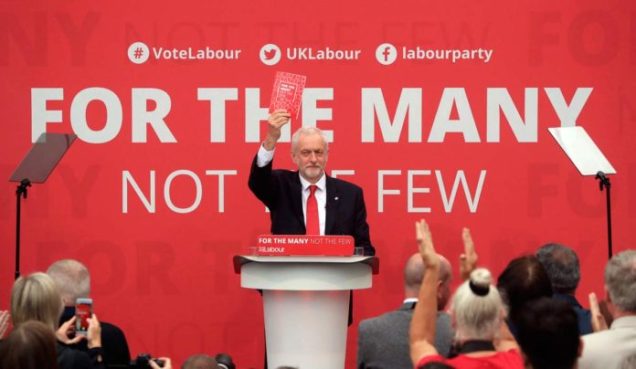
Labour Party General Election 2017 Manifesto - Jeremy Corbyn - For The Many Not The Few

Left-wing party manifestos fail to deliver electoral wins despite the popularity of their individual components because voters are smart enough to realise that promising the moon on a stick is not realistic

One self-deceiving mantra that we hear time and again from the Labour and the British Left is that people supposedly love individual left-wing policies but fail to vote Labour in the same numbers, and that if only they change X, Y or Z then the public will fall in love with the great package deal of free stuff + no responsibility and usher in a perpetual era of socialist government.

Currently, the excuse for failure is Jeremy Corbyn, and a number of leftist activists are busy consoling themselves that the Labour leader’s reputation is the only problem. Swap him out and keep the same policies, the self-deception goes, and everyone will suddenly start clamouring to vote Labour at all times.

How many times have we heard the likes of Polly Toynbee sanctimoniously declaring in a TV news debate that people “overwhelmingly” support left-wing policies like the renationalisation of the railways and the utilities sectors, hiking taxes on “the rich” or funnelling ever-increasing sums of money toward “Our NHS”? Too many to count.

And yes, certain individual policies can be very popular, particularly left-wing ones. If you prance around promising more stuff for less money – better public services, faster healthcare, higher welfare payments, all conveniently paid for by somebody else – you are bound to pick up a number of gullible admirers. But more importantly, when pollsters test the appeal of individual policies, people are likely to be very warm to left-wing, redistributive ideas when they are named individually.

It is only when you look at the systemic effect of implementing a basket of left-wing policies all at once that the appeal begins to wear off, as people engage more deeply with the question and the shine starts to come off the socialist Utopia. You might be able to convince voters that a punitive tax raid on the most productive people in society will cobble together enough money for one shiny new government programme, but when you start spending the revenues from that same tax hike multiple times and promising to do fifteen wonderful things with the same small pot of cash, that’s when voters’ natural scepticism kicks in.

Here’s the Guardian, falling into the same trap:

Renationalising the railways was backed by 52% of voters, with 22% opposed and 26% saying they did not know. Nationalising the energy market was supported by 49% with 24% against and 28% saying they did not know.

Labour’s most popular policy among those surveyed was banning zero-hours contracts, with 71% in favour and 16% against.

Despite the strong support for the party’s policies, only 30% agreed with the sentiment that Corbyn should be given a fair chance at leading the country, while 56% said he would be a “disaster” as prime minister.

And the Mirror, doubling down:

There is also widespread support for increasing income tax on those earning more than £80,000 a year.

This is backed by 65% of voters, with just 24% opposed.

A small majority (51%) of Tories also support the policy as do 80% of Labour voters, 72% of Lib Dems and 69% of UKIP voters.

Labour’s pledge to limit the state pension age to 66 is supported 74% of voters, with 15% against and 11% don’t know.

Again this policy goes down well with Tory voters, with 67% of them supporting it and just 22% against.

Here’s Manuel Cortes banging the drum at LabourList:

Make no mistake, Labour’s programme is transformative in a way not seen since 1945 or, Thatcher’s counter-revolution. We know our policies are overwhelmingly popular. Our challenge between now and June 8, is to turn the debate in our country away from Brexit onto the bread and butter issues which our policies tackle.

The polls tell us this will be a Herculean task but they are also saying that our manifesto commitments, on a raft of issues, have huge majorities in favour.

Meanwhile, Josiah Mortimer at Left Foot Forward at least recognises that voter preference is more complex than approval for a basket of individual policies, but still manages to miss the point:

It begs the question: if voters agree with most of Labour’s headline policies – what’s going wrong?

The latest poll of polls has Labour on around 30% – 16 percentage points behind the Conservatives. It’s a divide that makes sense only if you understand politics as being about much more than policies – but leadership, and above that: presentation of those policies and that leadership.

There are of course the usual misgivings over Jeremy Corbyn’s qualities as a statesman (56% say they think he would be ‘a disaster’ as Prime Minister while 30% think he should be given a ‘fair chance at leading the country’).

But beyond that, there is the issue of presentation. It’s been said time and again that Labour’s current policies aren’t significantly to the left of his predecessor (‘warmed up Millibandism’). From renationalising the railways and ending private involvement in the NHS, to prioritising council housing and clamping down on the energy companies: all this has been done and said before.

But it often feels that the left do ourselves few favours – in presenting policies as more radical than they really are – and voters do perceive Corbyn as much more left-wing than he is: with 0 being effectively a communist, and 10 being the most right-wing, voters put Corbyn at 2.2, and Labour at 3.

But the discrepancy between individual policy popularity and overall opinion poll performance is due to more than the “Corbyn effect”, and it is disingenuous of the Guardian and other left-wing media to pretend otherwise.

We see similar enthusiasm gaps between individual left-wing policies and overall voting intention throughout recent British political history – support for rail renationalisation has been high since the railways were privatised – and also in the United States, where Democrats love to crow that many voters actually support their high-taxing, pro-union, pro-redistribution policies only to be disappointed on election day when conservative Republicans keep being elected to various levels of public office.

But many leftists genuinely seem to struggle with this notion. To their minds, if one promises one wonderful free thing after another, the cumulative effect will be enormous and should result in nothing but a Labour landslide in the general election. They make no allowance for the diminishing returns of left-wing fiscal incontinence, or realise that each further promise makes the complete package less believable rather than more.

Owen Jones actually gets closer to the truth, admitting to Varsity:

However, Jones is quick to point out that popular policies aren’t enough saying “individual policies don’t win elections, you need a clear vision to inspire people in terms of what you’re going to do.”

And developing his point in the Guardian:

As has been noted, Labour’s recent policies are indeed electorally very popular. You don’t win elections, though, with policies that – taken individually – have high levels of support, as Ed Miliband discovered. There has to be a vision to bring them together. If you don’t define what you are for, you will be defined by your opponents, already the critical problem afflicting Labour’s leadership. You need a sunny, optimistic vision, not a miserable shaking of the stick at everything that’s wrong.

Jones is right and wrong here. A vision certainly helps. However, the Tories have just launched their 2017 general election manifesto which contains no discernible vision or philosophy of government at all, beyond a final repudiation of Thatcherism, a spiteful kick at libertarianism and a pledge to make random gestures to the Just About Managing (JAMs) by pinching from the Labour playbook.

This blog certainly wishes that it were otherwise; that Theresa May had decided to fight the 2017 general election on an unapologetically small-government, conservative platform – particularly since electoral victory is all but guaranteed, together with the opportunity to reshape the country if only the political will was there. But the Conservatives’ imminent victory is proof that one does not need a logical set of policies or a coherent philosophy of government in order to win support.

If anything, the problem is that many voters know the left-wing vision only too well, and simply want nothing to do with it. Jeremy Corbyn may be bad at communicating an appealing left-wing worldview, sometimes couching even relatively pedestrian policies in the off-putting language of revolutionary struggle, but his predecessor Ed Miliband was as bland as bland can be, and still nobody took the bait. Likewise, since leaving office the heavy fisted Gordon Brown has developed a talent for giving angry TED-style intervention speeches at crucial political junctures, but he too was unable to sell an attractive, convincing left-wing vision to voters tired of centre-left New Labour rule.

The problem is not that the left-wing vision does not exist, or lacks decent salespeople to pitch it. The problem is that people who know it tend to dislike it. Envy of the rich, a desire to tear the successful down rather than build the underprivileged up, a seething antipathy to business and entrepreneurship, the stubborn insistence on inviting the government deep into the private lives of every citizen, treating half the country as perpetually helpless and “vulnerable” people in need of constant nurturing by the state, endless moralising about being the sole keepers of compassion, and now the embrace of toxic and divisive identity politics – there is no confusion about what Labour stands for, only dislike ranging from mild indifference to complete revulsion.

Unfortunately, though, these beliefs and attitudes run deep through the political Left. Even when voters like a particular individual Labour policy they are too often unconvinced to give Labour their vote because they rightly perceive that the policy is borne from the wrong motives.

Labour could promise to cut income tax to zero for everybody earning below £50,000 and throw in a £10k rebate on top, funded by punitive taxes on millionaires and confiscatory wealth taxes on assets, which would be a hugely popular policy, but they will not persuade an election-winning coalition of voters to back them based on it because in the back of their minds, voters know that even if they are to personally benefit from one of Labour’s pie-in-the-sky ideas, everybody will suffer – themselves included – when they quickly succeed in driving the country into the ground.

Hard as it is for some on the Left to believe, voters sometimes actually appreciate it when political parties level with them rather than endlessly trying to flatter and bribe them with “free” stuff. It was a Democratic president, John F. Kennedy, who exhorted his fellow citizens to ask what they could do for their country rather than what their country could do for them. Somewhere along the way, on both sides of the Atlantic, the Left seems to have lost this spirit, and replaced it with the gnawing certainty that voters want a shopping list of bribes, a promise to be perpetually looked after by the state and alleviated of all responsibility for their lives.

Fortunately this is not the view of most voters, which is why the Labour Party and the British people look set to continue talking past one another, on June 8 and into the future.


Labour Party Manifesto 2017 - For the many not the few

Support Semi-Partisan Politics with a one-time or recurring donation:

Agree with this article? Violently disagree? Scroll down to leave a comment.

Follow Semi-Partisan Politics on TwitterFacebook and Medium.

General Election 2017: An Unpredictable Race In Hampstead & Kilburn

General Election 2017 - Hampstead and Kilburn Conservatives attack leaflet - Tulip Siddiq Labour Party Jeremy Corbyn - 1

Game On in Hampstead & Kilburn

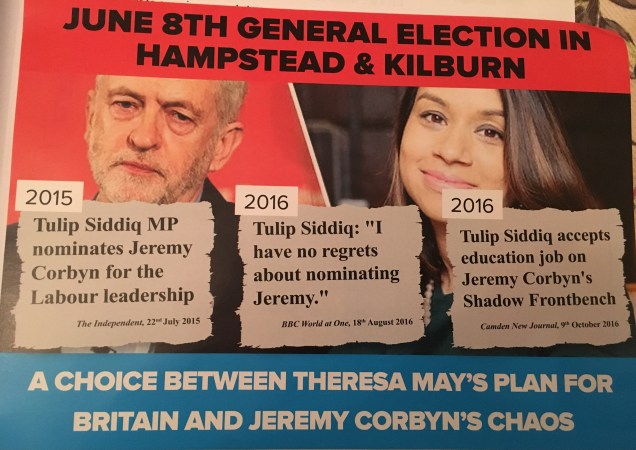
Today I received the above piece of campaign literature from the Hampstead and Kilburn Conservatives. It isn’t exactly subtle, and it perfectly encapsulates the problem facing incumbent Labour MP Tulip Siddiq, defending her slim majority of 1,138.

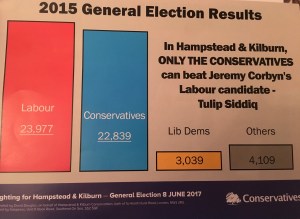
When Glenda Jackson was defending the seat in 2010, Labour squeaked home with a majority of just 42, making the seat the most marginal in England. And crucially, back then the seat was a tight three-way marginal, with the Liberal Democrats less than a thousand votes off the pace. In 2015, the LibDems suffered in Hampstead & Kilburn as they did nationwide, despite fielding an excellent candidate in Maajid Nawaz, and slumped to just 3,039 votes.

By way of further context, Hampstead & Kilburn voted strongly in favour of remaining in the European Union during the referendum, 75% Remain to 25% Leave,  with nearly 23,000 constituents signing an angry petition demanding a second referendum when things didn’t go their way with the first one.

So what will happen in the snap general election on 8 June 2017?

Given Labour’s current polling, and the personal polling of leader Jeremy Corbyn, by all rights Tulip Siddiq should be packing her office in Portcullis House and looking for something new to occupy her time. A majority of 1,138 puts Hampstead & Kilburn high on the Tories’ target list, and a few ministerial campaign visits and perhaps a drive-by from the PM herself ought to flip the seat, all other things being equal.

However, all other things are not equal.


The Brexit Factor

Brexit is a real factor here. Following the EU referendum I sat on the 139 bus from West Hampstead alongside numerous “March for Europe” protesters bearing placards weepily declaring themselves to be not British but European. Anger at Brexit runs deep here, as I discovered when I inadvertently carried a Brexit-themed shopping bag into the local Waitrose supermarket on Finchley Road during the campaign. The strength of pro-Remain feeling and the depths of the anger (and let’s face it – the arrogant refusal to even attempt to empathise with the opposing side) on display in this constituency throws everything up in the air when it comes to predicting general election results.


The LibDem Factor

To my mind, the key question is what happens to the Liberal Democrat vote. Nationally, the LibDems have come back from the dead, more in spite of Tim Farron’s leadership than because of it, and driven almost entirely by that party’s near-unambiguous anti-Brexit position. One knows that a successful vote for a LibDem candidate would result in an MP determined to delay or even scupper Brexit altogether were it remotely possible to do so, and this will be very attractive to a lot of voters here – the kind of people who abandoned the party in a hissy fit back in 2015 because of their coalition with the Evil Tor-ees, but who suddenly realise that they have common cause with Farron & Co. once again.


The Tory Factor

This is likely to see a number of voters – the “wetter”, less ideological and pro-EU Tories – switching their support from the Conservatives back to the Liberal Democrats. If your imagined “European identity” is the most important factor in your vote, then going LibDem is the only smart decision here.

In 2015, the Tories pandered to the constituency by running an extremely wet, centrist candidate – Simon Marcus was against the “bedroom tax” and welfare reform, and even against Trident renewal – and still came up short. I have yet to get a good sense of where 2017 candidate Claire-Louise Leyland stands on core ideological identifiers like tax policy, welfare reform, education, defence spending and civil liberties, but it seems likely that as an embryonic career politico (she stood for the Northern Irish constituency of West Tyrone back in 2015) she would generally toe the party line, perhaps diverging to the left on occasions.

Voters basing their decision on economic competence and basic credibility will probably therefore feel safe in voting Tory with Leyland on the ballot. Even though the Hampstead & Kilburn Conservatives probably don’t have any wiggle room to move further to the left, what else can centrist voters do – plump for Jeremy Corbyn? Hardly likely. That leaves the threat posed by the LibDems to the Tory europhile wing as the only real danger to be addressed.

However, just as Brexit is pushing some soft conservatives out of the Tory Party toward the LibDems, Jeremy Corbyn’s leadership of the Labour Party is likely to push a number of Hampstead & Kilburn voters away from Labour, also to the LibDems. Quite how much this will occur is hard to predict.


The Labour Factor

The more Hampstead side of the constituency has its share of trustafarian Corbynista types who think that reheated 1970s socialism is the best thing since sliced bread, but I suspect that there are far more young lefty creative professionals here who recoil from Corbyn’s haphazard management of the party and the very real chance that he will significantly hike their taxes given half a chance. There are a lot of people here for whom being seen as a “lefty” is important for social and professional acceptance and/or advancement, but who also quite like having disposable income and a functioning economy in which to spend it. Thus Jeremy Corbyn isn’t really their guy.

Meanwhile, the more Kilburn side of the constituency contains an awful lot of Corbyn true believers – as I saw when I attended a Corbyn rally at the Kilburn State Cinema during the post-Brexit leadership coup. However, there are also a number of working and lower-middle class constituents who might recoil from the kind of metropolitan identity politics that the Labour Party currently peddles, as Channel 4 news discovered when they trawled Kilburn High Road for vox pops.

In short, the Labour vote here is even more unpredictable than the Tory vote. The Guardian suggests that Hampstead & Kilburn may be part of a “metropolitan firewall” for Labour. Hmm, now where have I heard vastly over-optimistic talk of an electoral firewall before?


Too Many Moving Parts

While it is safe to say that the Liberal Democrats will exceed their 2015 vote total (despite fielding a candidate without Maajid Nawaz’s household name factor), it is hard to predict just how strongly the party will rebound, or at whose expense. Theresa May’s Brexit position (and revulsion at Brexit in general) will drive some Tory voters over to the LibDems, while lack of confidence in Jeremy Corbyn will drive some Labour voters the same way.

Will the combined effect be sufficient that the LibDems manage a miraculous come-from-behind victory, sneaking past the two big parties to snatch the seat? Unlikely. It would take an awful lot of defectors to bump up the LibDem total by such a large amount. But it is not impossible. The LibDem vote here fell by 13,452 between 2010 and 2015 just because their voters were in a strop with Nick Clegg for his decision to pragmatically enter a coalition with the Evil Tor-ees in the national interest rather than propping up the rotting carcass of Gordon Brown’s Labour government. Stung by Brexit, how much more reason have they now to return to the fold, more motivated than ever before?

However, I think it is more likely that the Hampstead & Kilburn constituency will be won by the party which manages to do the best job preventing their peripheral supporters from defecting to the LibDems. And it seems to me that the Conservatives have an advantage here.

While 2017 candidate Claire-Louise Leyland remains something of an unknown quantity (former Stronger In campaigner turned Theresa May supporter, passionate about mental health and otherwise fill in the blanks), she at least represents a party viewed rightly or wrongly as basically competent. This article is not the place to relitigate the many ways that Theresa May’s government is endangering our national interests through their glib and superficial approach to Brexit negotiations, but in a head-to-head between Tory ideologues and fratricidal Labourites you pick the swivel-eyed Tory every time.

Labour, on the other hand, risk losing their most pro-European supporters – the kind of tedious people who paint the EU flag on their face at public demonstrations and call themselves “citizens of the world” – to the LibDems, together with portions of their young professional vote and working class anti-Corbyn vote.

In other words, while even an ardently pro-European Conservative voter has many reasons to think long and hard before abandoning the party, pro-European Labour voters with little real expectation of a general election victory have every incentive to shrug and vote for LibDem candidate Kirsty Allan (while furiously humming “Ode to Joy”, naturally).

And that is why the piece of campaign literature which came through my door today should be extremely worrying for Labour’s Tulip Siddiq. The helpful chart on one side makes it look as though this is a straight-up fight between Jeremy Corbyn’s loopy, crackpot Labour Party and the Tories (thus underplaying the possibility of a LibDem fightback), while the reverse side trumpets three “damaging” headlines in which Siddiq proudly takes credit for nominating Jeremy Corbyn to the Labour leadership, refuses to concede that it was an error and then actually joins his Shadow Cabinet (while conveniently omitting the fact that Siddiq later resigned from the shadow frontbench in order to clutch the EU flag and vote against Article 50).


Where Things Stand

If this is indeed a scenario in which the two leading parties – Labour and the Conservatives – are attempting to win by losing the least number of votes to the Liberal Democrats, then the Tories presently have the advantage, and if they are smart they will do everything they can to tie Tulip Siddiq to Jeremy Corbyn in the public imagination. This will certainly be the advice/orders filtering down from Lynton Crosby and CCHQ in any case.

The more that Hampstead & Kilburn constituents are seeing and talking about how Tulip Siddiq helped inflict Jeremy Corbyn on the country and repeatedly enabled his chaotic leadership of the party (fair characterisation or not) rather than how the Tories have a childlike understanding of Brexit and an increasingly tarnished reputation for economic competence, the more likely it is that the Conservatives will prevail on 8 June and Claire-Louise Leyland will be returned as our new MP.

To survive and retain the seat for Labour, Tulip Siddiq must find a way of beating the Labour Party’s unbeatable Brexit conundrum while also distancing herself from Jeremy Corbyn – but not to the extent that it keeps the Corbynista vote at home or threatens any support she might need from the party leadership. In other words, Siddiq really has to thread the needle to prevail here.

Meanwhile, the Liberal Democrats need to make the local race all about Brexit, and nothing else. Kirsty Allan needs to paint herself as the only candidate with the courage to stand up for all of Hampstead & Kilburn’s heartbroken “citizens of the world” by acting with other LibDems as a drogue parachute on Britain’s departure from the European Union. Then she must hope that she can tempt enough such people away from their 2015-era partisan loyalties in order to pull the LibDems back to their 2010 levels of support, plus a little bit extra. It is a tall order, but not quite an impossible one.

So, all to play for at the moment. Bring on the hustings!


Update – 30 April

This interesting analysis from the Guardian and Electoral Calculus uses ICM polling to suggest that the Liberal Democrat resurgence may be a paper tiger – an attractive theme (and one eagerly picked up by the Remain-sympathising Westminster press) but with little basis in actual reality.

In particular, it shows that while a number of previously Labour-voting Remainers are indeed likely to jump ship to the LibDems, the Conservative vote looks far stickier, with 2015 conservative voters far less likely to jump ship even if they disagree with Brexit. This would seem to pour cold water on any hopes of a LibDem resurgence here.

The upshot of their analysis:

Our model sees the Tories on 422 seats, with Labour reduced to just 150, and the Lib Dems declining from 9 to 6. The Conservative majority would be north of 190. Labour would be wiped out beyond what most people are currently predicting. Leadership candidates like Clive Lewis would no longer be leadership candidates, because they would no longer be MPs.

The Lib Dems could lose a third of their MPs even after gains in places like Cambridge, with seats like Carshalton & Wallington, Richmond Park and Southport especially vulnerable. The danger in these seats is pretty clear. In Carshalton, Tom Brake won a majority of 1,510 in 2015. If a fraction of the town’s 7,000 UKIP voters return to the Tories, that majority will be wiped out. Southport is almost identically poised. Unless a major influx of Remain voters arrives from somewhere – and there’s no indication in any of this data that it will – then these seats will be lost. The Lib Dems don’t face the same problem in Richmond Park, which only turned back to the Lib Dems in December; but with a majority of less than 2,000 and a recent history of flipping, you wouldn’t bet the mortgage on a hold.

Devastating if correct.

On the plus side for Labour, there is hardly any UKIP vote in Hampstead & Kilburn to drift back to the Tories, unlike some other constituencies where the potential backwash of ex-UKIP voters to the Conservative Party threatens to sink LibDem and Labour candidates alike. This means that Tulip Siddiq’s fate as the constituency MP is firmly in Labour’s own hands, and their ability to hold on to their vote in the face of Jeremy Corbyn’s broad unpopularity.


General Election 2017 - Hampstead and Kilburn Conservatives attack leaflet - Tulip Siddiq Labour Party Jeremy Corbyn - 2

Support Semi-Partisan Politics with a one-time or recurring donation:

Agree with this article? Violently disagree? Scroll down to leave a comment.

Follow Semi-Partisan Politics on TwitterFacebook and Medium.

Labour And The Left Simply Do Not ‘Get’ Patriotism, And Their Patron Saints Holiday Proposal Proves It

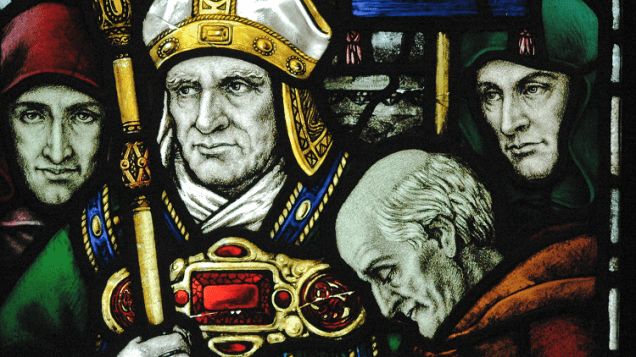
UK Britain Patron Saints

The Labour Party’s genius plan to “unite the nation” by further Balkanising the United Kingdom

The Labour Party and the British Left in general just don’t get it. With the honourable exception of a few Cassandra-like voices warning that the Left must learn to re-embrace patriotism in order to reconnect with millions of lost voters, most on the Left seem intent on screeching “multiculturalism” at the top of their lungs until the United Kingdom (and even its constituent parts) are nothing more than historic entries in an encyclopaedia.

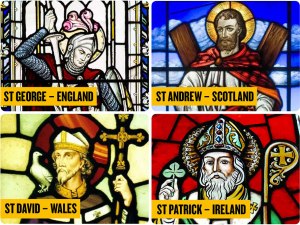
Labour’s latest great initiative is to create four new public holidays celebrating the individual patron saints of the four home nations. From the HuffPost:

A Labour government will seek to create four new UK-wide bank holidays on the patron saint’s day of each of the home nations, Jeremy Corbyn has announced.

The Labour leader said the move would bring together England, Scotland, Wales and Northern Ireland, while giving workers a well-deserved break.

Under the plan, it would mean there would be public holidays on St David’s Day (March 1), St Patrick’s Day (March 17), St George’s Day (April 23) and St Andrew’s Day (November 30).

“The four nations that make up our great country have rarely been more divided due to the damaging and divisive policies of this Conservative Government,” Corbyn said.

“But where Theresa May divides, Labour will unite our four nations. A Labour government will make St George’s Day – England’s national day and Shakespeare’s birthday – a public holiday, along with St David’s Day, St Andrew’s Day and St Patrick’s Day.”

This is the kind of idiotic idea that could only come from a leader, a party and a political movement which have so lost touch with the idea of what patriotism and national identity mean that they can communicate only in meaningless grunts and gestures, like a parrot mimicking speech without understanding the language. Or perhaps an elephant painting with its trunk.

Right now there is a problem with British national identity, inasmuch as it is increasingly missing from the people who are supposed to possess it. Why is this the case? Well, try the fact that our schools fail to teach students a balanced, cohesive and chronological history of their own country, while any attempts to teach citizenship or civics tend to degrade into leftist agitprop pushed by an almost universally left-wing corps of teachers.

Try the fact that national pride and British exceptionalism had become so embarrassing, gauche and ultimately rare among the left-wing establishment that whole explanatory articles were written explaining to people the peculiar warm, fuzzy and hitherto-unknown feeling they felt in their chests when London hosted the 2012 Olympics.

Try the fact that we just went through a bruising EU referendum in which the Remain campaign spent nearly all their time talking – against all available evidence – about what a small, puny and ineffective country we are compared to the swaggering might of, say, Malaysia or Norway.

Try the fact that Scotland has taken the decision to transform itself into a one-party SNP state despite that party’s jackboot authoritarianism and mind-boggling incompetence at governing, while agitating for independence every three years in the hope that certain childlike adults dwelling there might be better protected from the Evil Tor-ees in England, thus further fraying the bonds of our union.

Or the fact that for decades now, leftists have been insisting that we must observe, celebrate and even exaggerate the smallest of our cultural differences rather than celebrate and strengthen the bonds which unite us. Because multiculturalism.

And now that Brexit has given them a scare, Scottish secessionism refuses to die back down to the angry grumblings of the 1990s and 2000s, English nationalism is increasingly demanding acknowledgement and policemen are being killed at the gates of Parliament by homegrown terrorists, these wise mavens of the Left have decided that just maybe it might be worth throwing patriotism a bone after all. Not because of a sincere rethink of their worldview but because someone at Labour HQ thought it would make a good campaign gimmick and a way to garner positive headlines on St George’s Day.

Unfortunately, Labour’s inexplicable response to the challenges we face is to propose the creation of four new public holidays, saints days, which would further emphasise the separateness and uniqueness of the home nations rather than drawing us together in a common celebration of what we have achieved and will achieve together as a single United Kingdom.

One might think that the Left would instinctively realise that in our increasingly secular age, putting the focus of our national identity and patriotism on historical religious figures otherwise unacknowledged by non-Christians is not the smartest pull factor among subpopulations which have until now been encouraged to do their own thing in terms of integrating or not integrating with wider British society. As a Catholic, the saints and their lives have meaning to me. For millions of others, they do not.

Martin Luther King Jr. DayPresident’s Day and Independence Day have meaning for all Americans because they are rooted in shared history, not in waning faith. I know that the Left often like to talk down Britain and our substantial contributions in world commerce, arts, sciences, culture and diplomacy, but I’m sure that if they scratched their heads they might find something in the last few centuries of our national story worth elevating as a day in which all Britons can be proud (but please, not the Fifth of July).

Now, there’s nothing wrong with celebrating the unique histories, culture and achievements of our four home nations, and indeed we should do so more often. But too often this comes at the expense of celebrating British or UK-wide identity. As this blog has long argued, what we need more than anything is a single day to celebrate our entire United Kingdom, along the lines of France’s Bastille Day or America’s Independence Day.

And this should be backed by a myriad of other policies and gestures, large and small, which together might serve to nurture a positive sense of British identity around which we can all gather – regardless of ethnicity, colour, national origin, gender or any other grouping.

Some ideas that come to mind: a daily or weekly pledge recited by pupils at public schools; a return to playing the national anthem before top flight (and even lower level) sporting events, rather than reserving such gestures for the FA Cup final; continuing the investment in Team GB at the Olympic games and then celebrating their achievements back home after the fact; doing more to honour the armed forces and others who serve in uniform, both in public life and by encouraging businesses to acknowledge, reward and employ veterans; expanding on the National Citizen Service scheme, one of the few positive legacies from the Cameron government. I’m sure there are a thousand other, better ideas to be added to this list.

Instituting four new public holidays where the British people take the day off from work at significant cost to the economy, just to dwell on the fact that we are four rather than one people, is not the answer. One can’t even call it stupid – it is more the product of politicians who have so lost touch with the idea and importance of patriotism and national identity that they are no longer able to engage in sensible policy discussion on the matter. Rather than criticise Jeremy Corbyn and the Labour Party for this cack-handed policy suggestion, one pities the limitations to their thinking.

You don’t unite and strengthen a fraying union by chopping it even more firmly into four parts and then frantically celebrating the differences. And though the word “diversity” is almost branded into the minds of many leftists as an unquestionably good thing, Jeremy Corbyn, the Labour Party and the British Left in general would do much better to reflect instead on the far more inspiring words “E Pluribus Unum”.


Patron Saints UK Britain - St George England - St Andrew Scotland - St David Wales - St Patrick Ireland

Support Semi-Partisan Politics with a one-time or recurring donation:

Agree with this article? Violently disagree? Scroll down to leave a comment.

Follow Semi-Partisan Politics on TwitterFacebook and Medium.

2017 General Election Campaign: The Last Stand For Conviction Politics?

https://www.youtube.com/watch?v=1JsV51RSc-w

The only national party leader with clear political convictions and the courage to publicly defend them is rendered unelectable on the basis of those convictions, while cowardly and triangulating politicians with more superficially palatable opinions are poised to do well in the general election. How depressing.

Here’s the thing: While Jeremy Corbyn may be wrong about economic policy, foreign policy, national defence, the size and role of the state and a million and one other things, he is also the only major party leader (with the very occasional exception of Tim Farron) who can be fairly described as a man of conviction, somebody with a coherent worldview and the political courage to stand up and unapologetically argue for it.

Covering this general election will be hard for me, not just because (as usual) there is no party which reasonably represents this blog’s conservatarian stance but because the only party leader potentially worth admiring from a political courage perspective is the man that nobody in their right mind can reasonably vote for. If some nervous voters believe Brexit Britain is bad, that’s nothing compared to the kind of sudden confiscatory wealth raids, punishing tax rates and ramping up of the state we would see under Prime Minister Jeremy Corbyn.

The most plausible prime minister on 9 June – incumbent Theresa May – has gravitas and the outward appearance of baseline competence, yes. But she is ideologically rootless, her only real defining trait being a consistent hard lean towards authoritarianism. Beyond that, what does she stand for? Helping the JAMs, people who are just about managing? Surely every politician in government should strive to do that anyway. Theresa May was against Brexit before she became its most ardent champion, unable to take a bold stand on the most pressing question to face Britain in the post-war era until her hand was forced by the referendum result.

Then look at the other party leaders. Nicola Sturgeon is an expert at spinning her grievance-soaked tale of Scottish persecution and the need for supposedly childlike, simple Scots to be protected from the Evil Tor-ees, but while she campaigns in poetry (or rather crude limericks) the SNP governs in single-minded, authoritarian prose and is busy constructing a one-party statelet north of the border. At one point the Scottish Parliament failed to pass any legislation for over a year, so consumed were the SNP with manoeuvring for a second independence referendum. And when they did pass laws, they were frighteningly authoritarian schemes like the “named person” scheme which makes Sturgeon’s government an unwanted auxiliary parent to every newborn Scottish baby.

Under Paul Nuttall, UKIP – when they are not infighting and twisting in the wind – continue their lurch to the left, abandoning their original voter base of libertarian types in ever more fevered pursuit of hardcore immigration opponents and the disaffected Northern Labour vote. UKIP (or rather, Conservative fear of UKIP) played a significant role in forcing the referendum and achieving the outcome, but now the party has nothing left to say beyond defending the Leave campaign’s most indefensible promises and pledging to fight for the hardest of hard Brexits with nary a thought for how uncontrolled exit from the EU would impact our economy and diplomatic standing.

The Green Party remain an irrelevance outside their stronghold of Brighton, not helped by their visceral antipathy toward material human progress. And besides, the Green Party are…well, the Green Party.

And to be clear, Labour are in a mess, too. Not everybody subscribes to the Jeremy Corbyn agenda. But at least Jeremy Corbyn has a coherent worldview, as risible or abhorrent as some people may find it. What is the Labour centrist worldview? What are their inviolable beliefs and convictions? What gets Chuka Umunna, Yvette Cooper or Dan Jarvis out of bed every morning? Being a bit more left-wing than the centrist Tories while prattling on about “fairness” a lot more? Pretending to be heroic tribunes of the working classes but then ignoring their opinions on key issues like the EU and immigration?

One might have more sympathy for the Labour centrists, if A) they hadn’t bottled their cowardly post-referendum coup against Jeremy Corbyn, with all of the shrunken people who now pass for “big beasts” within the party electing to save their political hides while sending out the risible Owen Smith as their stalking horse, and B) they had a solid, work-in-progress alternative to Corbynism in their back pockets. No such alternative is being proposed.

And so we are in a position where the one candidate with a coherent worldview and the glimmer of a sense that the British people should be called to overcome a challenge rather than being soothed, placated and made safe, cannot be elected because his political ideas are broadly wrong. Meanwhile, a bunch of politicians whose views are slightly less wrong than Jeremy Corbyn’s will benefit from the 2017 general election thanks to their ability to conceal what they really think and bend, flatter and shapeshift their way into the public’s good graces.

Just compare the opening campaign speeches made by Jeremy Corbyn and Theresa May respectively.

Here’s Jeremy Corbyn, opening with a stridently anti-establishment message which could almost be described as Trump-like:

The dividing lines in this election could not be clearer from the outset. It is the Conservatives, the party of privilege and the richest, versus the Labour Party, the party that is standing up for working people to improve the lives of all.

It is the establishment versus the people  and it is our historic duty to make sure that the people prevail.  A duty for all of us here today, the duty of every Labour MP, a duty for our half a million members – including the 2,500 who have joined in the last 24 hours.

Much of the media and establishment are saying that this election is a foregone conclusion.

They think there are rules in politics, which if you don’t follow by doffing your cap to powerful people, accepting that things can’t really change, then you can’t win.

But of course, they do not want us to win. Because when we win it is the people, not the powerful, who win.

The nurse, the teacher, the small trader, the carer, the builder, the office worker, the student, the carer win. We all win.

It is the establishment that complains I don’t play the rules: by which they mean their rules. We can’t win, they say, because we don’t play their game.

We don’t fit in their cosy club. We ‘re not obsessed with the tittle-tattle of Westminster or Brussels. We don’t accept that it is natural for Britain to be governed by a ruling elite, the City and the tax-dodgers, and we don’t accept that the British people just have to take what they’re given, that they don’t deserve better.

And in a sense, the establishment and their followers in the media are quite right. I don’t play by their rules. And if a Labour Government is elected on 8 June, then we won’t play by their rules either.

They are yesterday’s rules, set by failed political and corporate elites we should be consigning to the past.

This is good because it is not a message which resonates only with Labour’s traditional voter tribes.

Especially now, following an EU referendum which literally pitched the establishment of this country and their sycophantic allies against the ranks of the people, voters may be receptive to this message of fighting against a political, economic, media and cultural establishment which arrogantly seeks to rule in its own interest. Even as a conservative libertarian type, this passage resonates with me.

And here is Corbyn waxing lyrical about the benefits of wealth distribution:

Britain is the sixth richest economy in the world. The people of Britain must share in that wealth.

If I were Southern Rail or Philip Green, I’d be worried about a Labour Government.

If I were Mike Ashley or the CEO of a tax avoiding multinational corporation, I’d want to see a Tory victory.

Why? Because those are the people who are monopolising the wealth that should be shared by each and every one of us in this country.  Everyone, and I mean everyone, has a contribution to make and a life to lead. Poverty and homelessness are a disaster for the individual and a loss to all of us.

It is wealth that should belong to the majority and not a tiny minority.

Labour is the party that will put the interests of the majority first, while the Tories only really care about those who already have so much.

That is why we will prove the establishment experts wrong and change the direction of this election. Because the British people know that they are the true wealth creators, held back by a system rigged for the wealth extractors.

He is dead wrong, obviously – coercive, large scale redistribution destroys wealth faster than it can parcel it out, dooming people to receive ever more equal slices of a rapidly miniaturising pie. But by God, Corbyn sounds convincing when he makes his case because he actually believes what he is saying, and because it fits into a coherent wider narrative which supports the entire Corbynite worldview.

Meanwhile, here is the prime minister launching the Conservative Party’s election campaign in Bolton:

And that’s what this election is about. Providing the strong and stable leadership this country needs to take Britain through Brexit and beyond. It’s about strengthening our hand in the negotiations that lie ahead. And it’s about sticking to our plan for a stronger Britain that will enable us to secure that more stable and secure future for this country and take the right long term decision for the future. It’s about strong and stable leadership in the national interest. And you only get that strong and stable leadership by voting for the Conservatives. Because that’s what Conservatives government provides. And just look at what we’ve done.

[..] when I took over as Prime Minister, the country needed clear vision and strong leadership to ensure that we got on with that job of delivering on Brexit for the British people and that’s exactly what we did. We delivered that strong and stable leadership, we delivered the certainty that strong and stable leadership can give. And that’s what leadership looks like. Now there’s a very clear choice at this election. It’s a choice between strong and stable leadership under the Conservatives, or weak and unstable coalition of chaos led by Jeremy Corbyn.

And that is very clear. Let’s look – the other parties are lining up to prop up Jeremy Corbyn. We’ve seen it with the Liberal Democrats, and we see it with Nicola Sturgeon’s Scottish nationalists. They’re very clear that they want to do everything they can to frustrate our Brexit negotiations. To undermine the job that we have to do, the task that lies ahead. Do everything to stop us from being able to take Britain forward. And it’s their tunnel vision focus on independence that actually provides uncertainty. They want to pull the strings, try to pull the strings of this election, prop up Jeremy Corbyn and provide more risk and uncertainty for the British people and that’s not in Britain’s interests.

So it’s only a vote for the Conservatives that can deliver, and every vote for the Conservatives is a vote for me and local Conservative candidates, and it’s a vote to ensure that we have that strong and stable leadership that we need to take us through Brexit and beyond. Every vote for me and the local Conservative candidates here and across Britain is a vote to deliver on that plan for a stronger Britain and a more secure future for us all. And if we have that certainty of five more years of strong and stable leadership then we can ensure that we’re delivering for people, for ordinary working people up and down the country, across the whole United Kingdom.

This isn’t a speech. It is a soundbite delivery mechanism, the flavourless rhetorical equivalent of a Ryvita cracker, designed to drill the phrase “strong and stable leadership” so deep into the minds of voters (the exact phrase is repeated twelve times) that we all walk zombie-like to the polling stations on 8 June, muttering the phrase to ourselves as we dribble down our chins.

As a political speech, it has no poetry because it was conceived by partisan political calculation rather than any deep conviction about what’s best for Britain. “Vote Tory to prevent the other parties from either influencing or thwarting Brexit” is Theresa May’s message – an implausible message in itself, considering that the prime minister only came to believe in the deep wisdom of Brexit after the British people had voted to Leave.

As a modern political speech (with the bar set accordingly low), Theresa May’s effort will probably be quite effective though. Getting up on a stage and ranting about strong and stable leadership is a very effective way of implying that the various jabbering parties of the Left will screw everything up given half the chance, either by naively giving everything up to Europe in the negotiations for no commensurate return, or by descending into infighting over whether to push for a softer Brexit or seek to thwart Brexit entirely.

The Tory position – advocating a hard Brexit and exit from the single market, to be replaced with a fictional comprehensive deal within two years – is moronic. But it does have the advantage of being easy to understand. Now imagine Corbyn, Sturgeon, Lucas and Farron all sat around the Cabinet table. Do they collectively push to stay in the EU or just for the closest relationship with the EU? Who knows? Ergo chaos, versus Theresa May’s “strong and stable” leadership.

But what of other issues than Brexit? Where is the ringing defence of Conservative principle? The speechwriter crams this material – such as it is – into the final paragraphs, very much as an afterthought:

But it’s also about getting the right deal for ordinary working people here at home, and that’s about building a strong Britain. Britain is the strongest country in Europe in terms of economic growth and national security.

It’s about building a stronger economy. It’s about creating well paid secure jobs. It’s about ensuring that there is opportunity for all. That we provide a good school place for every child. That there is affordable housing. That people can get on in their lives. It’s about ensuring that we create a more united nation. That we take action against the extremists who want to divide us, and that we stand up to the separatists who want to break up our country. So it’s providing that strong and stable leadership.

That certainty. That stability for the future ,and that’s going to be our message as go out in to our election campaign. And I’m looking forward to it. We’re going to fight a positive and optimistic campaign about the future of this country. I’m going to be getting out and about around the country. I’m going to be visiting communities in every part of the United Kingdom.  And I’m looking forward to taking our case out there to people. Because this is the case – that it is only with the Conservatives that you get the strong and stable leadership that this country needs to see us through Brexit and beyond.

That’s it. In other words: “blah blah authoritarianism blah, angrily insisting that the country be united while proposing zero tangible policies to actually rekindle shared British values and identity, blah. Cheap houses for everyone with no explanation of how or where they will be built, oh and I guess we’ll make schools great too, blahdy blah. Strong and stable leadership! Blah”.

What does Theresa May actually believe about anything? How does she intend to remake British society with her (hopefully) increased parliamentary majority? Who knows? I’m not remotely convinced that the prime minister knows herself.

What about tax reform, maybe simplifying the code, eliminating loopholes and lowering the burden on ordinary people?

What about constitutional reform, recognising that Brexit is the beginning and not the end, and pledging to devolve power to the home nations and regions, so that nobody can complain about the “Evil Tory” government in Westminster when their own local officials have greater power over taxes and services?

What about our national defence, committing to serious spending increases to reverse years of decline in our capabilities in order to increase our hard power?

What about an energy policy which frees Britain from dependence on rogue or ambivalent states while keeping costs low for consumers?

What about getting a move on with critical infrastructure projects like Heathrow Airport expansion, allowing other airports to expand too, and cutting the outrageously high Air Passenger Duty tax on flying, which increasingly makes Britain a pariah state for international business travellers?

What about – and I’m shooting for the moon on this one – an end run around the Labour Party, integrating health and social care, and doing it with a dispassionate fixation on healthcare outcomes rather than weepy tributes and pledges of loyalty to Our Blessed NHS?

Perhaps it will all become clear when the Conservative Party release their 2017 general election manifesto. But I wouldn’t count on it. I confidently expect to download that document and read a hundred more exclamations of “strong and stable leadership” while key policy questions are studiously ignored.

And yet all the smart money says that party whose leadership has a coherent worldview and the political courage to argue for it will lose seats in the general election, while the opportunists (Sturgeon, Farron), authoritarians (May, Sturgeon) and nonentities (Wood, Nuttall) do well, or at least escape cosmic justice for their ineptitude.

Assuming that the election goes as expected, rest assured that the next generation of political leaders will be watching and taking note.

Be opportunistic. Short-term tactical gain over long-term policy coherence. Soundbites over substance. Promise voters an easy, consequence-free life. Never tell the public difficult truths or call them to any kind of civic duty.

Message received.


Theresa May - General Election 2017 campaign launch speech Bolton - Strong and stable leadership - 2

Theresa May - General Election 2017 campaign launch speech Bolton - Strong and stable leadership

Support Semi-Partisan Politics with a one-time or recurring donation:

Agree with this article? Violently disagree? Scroll down to leave a comment.

Follow Semi-Partisan Politics on TwitterFacebook and Medium.