What Are The Aims And Values Of The Labour Party?

Labour Party Values - Leadership Election - Jeremy Corbyn

Thousands of new members are being purged from the Labour Party ranks, accused of not supporting the “aims and values” of the party. But the stated aims and values of the Labour Party are so bland and generic that they encompass nearly everyone, Tories and militant entryists included.

Do you agree with the aims and values of the Labour Party?

That was the probing question posed to each of the 121,000 new supporters who have swelled Labour’s ranks since May’s general election defeat by providing the party with a name, email address and the princely sum of £3.

With bookmakers already paying out on a Jeremy Corbyn victory in September’s leadership election, the Labour Party is fighting a rearguard effort to thwart potential ‘entryists’ and troublemaking Tories from infiltrating the party with dishonourable intentions. And the test applied to new supporters as part of the vetting process is intended to ensure that  prospective supporters share the same aims and values as the Labour Party.

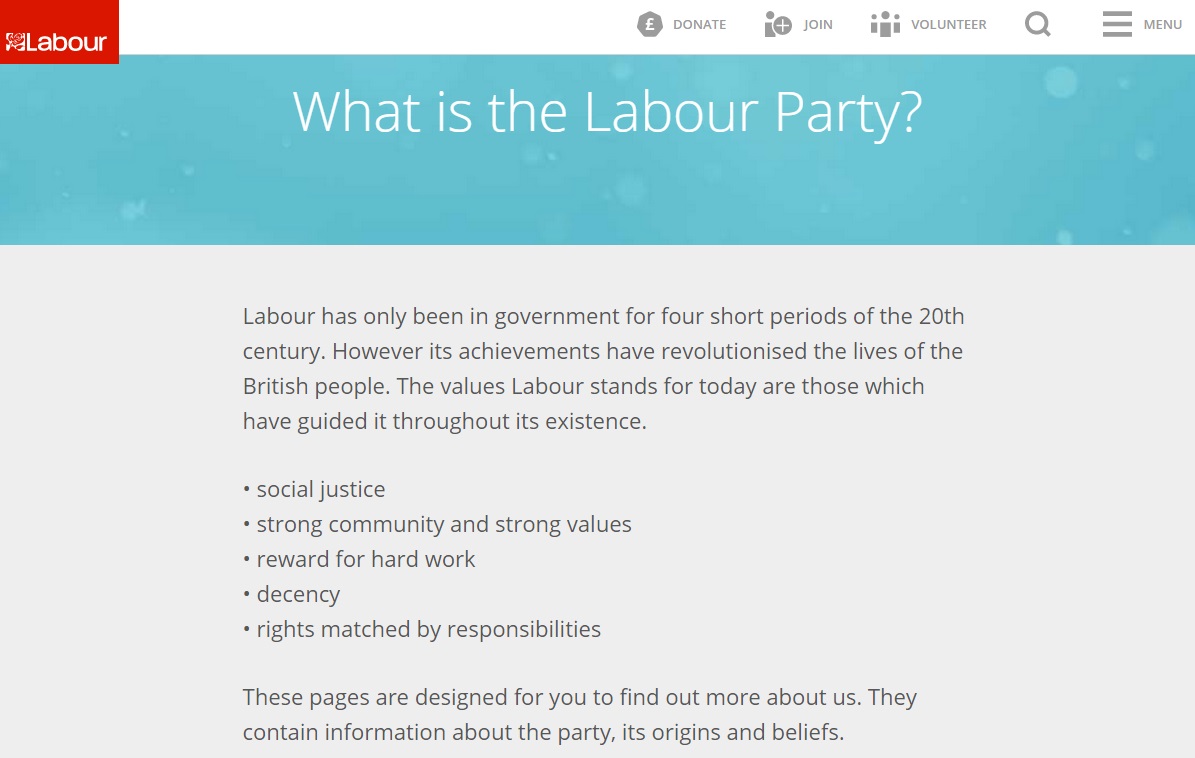
But what are these values? Fortunately, the Labour Party website tells us precisely what they are:

Labour has only been in government for four short periods of the 20th century. However its achievements have revolutionised the lives of the British people. The values Labour stands for today are those which have guided it throughout its existence.

• social justice
• strong community and strong values
• reward for hard work
• decency
• rights matched by responsibilities

That one of the Labour Party’s core values is “strong values” tells you everything you need to know about the decline of Labour as a social, intellectual and ideological force, and the utter vacuity at the heart of British politics in general.

Continue reading

It’s Time For Jeremy Corbyn Detractors To Put Up Or Shut Up

Assailing the veteran left-winger for being “unelectable” is the coward’s way out. Jeremy Corbyn opponents should spell out to the Labour Party membership exactly which of his policies they disagree with, and why.

The three candidates running against Jeremy Corbyn for the Labour Party leadership are willing to talk about almost anything, it seems, other than why Jeremy Corbyn’s policies would be bad for Britain.

Don’t misunderstand – they are more than happy to talk about why a Jeremy Corbyn victory would harm the Labour Party. But pinning them down to any specific criticism of Jeremy Corbyn’s policies is close to impossible. In fact, for every one specific criticism of a Corbyn policy coming from within the Labour Party, there are at least ten other generic complaints that he is “divisive”, or that he will “split the party”.

Why is this so?

The 2015 general election result proved that there are still just enough votes in David Cameron’s wishy-washy, watered down conservatism for the Tories to win an outright majority in Parliament. The margin was not comfortable, but the Tories were able to haemorrhage right wing votes to UKIP and still carry the day.

But Labour no longer have this luxury. Following their wipeout in Scotland, and with the Green Party nibbling at their heels in England, Labour need all the centrist votes they can muster to ever win again – barring some major external shock or unforeseen realignment of British politics.

Continue reading

Gordon Brown Joins The Anti-Corbyn Fray, With Lecture On Electability

Labour’s vote-losing ex prime minister offers his thoughts on electability

Since leaving office, Gordon Brown seems to have gotten it into his head that he is an inspiring, motivational speaker with political opinions that people are clamouring to hear.

Watch any of the former prime minister’s recent speeches, and regardless of the venue or topic he acts like he is delivering a TED talk, roaming the stage and sawing the air with his hands as though he were proposing an end to world poverty or recounting the time he founded a global software firm working out of his garage.

Unfortunately, in reality it is just the same, tedious old Gordon Brown whom the voters were so pleased to be rid of back in 2010. But this hasn’t stopped Labour Party chiefs from drafting him to give a speech on electability, the latest desperate attempt to pour water on Jeremy Corbyn’s inferno.

And yesterday, on a stage overlooking the River Thames and the Houses of Parliament, Gordon Brown duly delivered, pacing the platform like a caged animal as he imparted his wisdom to a grateful nation.

The Spectator nods its approval:

Continue reading

The Tories Should Steal Jeremy Corbyn’s Plan For A National Education Service

Jeremy Corbyn - National Education Service - Education Policy

A version of this article was first published on the Conservatives for Liberty blog.

A top-down reorganisation of Britain’s education system, giving the state full control over education at all levels and for all ages would be a terrible, frightening idea. But could conservatives pick up Jeremy Corbyn’s proposal for a National Education Service and give it a libertarian twist to inspire a genuine consumer-focused revolution in life-long learning?

Whether you hail Jeremy Corbyn as the left wing saviour of British politics or intend to hide behind the sofa on 12 September lest his election as Labour Leader ushers in a dark new era of Soviet communism, no one can deny that Corbyn’s candidacy has brought a certain level of partisan excitement back to drab, consensual British politics.

But as always happens when an outsider threatens to show up the bipartisan political elite and their soul-sapping sameness, the media has focused on whipping up hysteria about some of Corbyn’s off-the-cuff pronouncements, like his remark that we might potentially learn something from Karl Marx (as though we can only learn from historical figures who we 100% agree with) or twisting Corbyn’s words to suggest that he supports re-instating Clause Four and the historic Labour commitment to public ownership of industry.

You don’t have to be a fully paid-up Tory to realise that this headline-bating and click-chasing detracts from the serious discussion of any policy specifics which Corbyn has announced, and which might lead to the start of a real debate if only the media did their job properly. Take Jeremy Corbyn’s recent proposal for a National Education Service to rival the National Health Service.

While failing to provide many concrete details of what this “cradle to grave” education system might look like, Corbyn did offer this glimpse:

Continue reading

Will The Anti-Corbyn Backlash Change Labour’s Attitude To Capitalism?

Capitalism Isn't Working Banner - Jonathan Jones - Socialism - Jeremy Corbyn

If Jeremy Corbyn is not the answer to the Labour Party’s creeping irrelevance, the party must make peace with capitalism and free markets once and for all – and then decide what it stands for.

Is Guardian columnist Jonathan Jones the great new hope of the British Left?

No, of course not. This is still the same odious man who poured scorn on the Tower of London poppy display and who thinks that the Union flag – our national flag – is ‘provocative’ and offensive. But between the usual self aggrandisement and marvelling at his own peerless ethical virtue, a small but noteworthy sliver of realisation crept into Jones’ latest column.

Jonathan Jones is a committed Labour centrist, you see, and it is driving him absolutely crazy to watch Jeremy Corbyn’s acolytes seize the mantle of principled socialism for themselves, leaving him looking like just another rootless, ideologically compromised member of the establishment.

All of which led to this mini tantrum in the Guardian:

I can’t listen any more to rhetoric that contrasts the idealism of Corbyn’s supporters with the supposed cynicism, hollowed-out power worship and futile pragmatism of the centre-left. I am a Labour centrist supporter not out of cynicism but out of principle, because I believe the only ethical politics of the left today has to be moderate, reasoning, and sceptical. I am Labour, but I am not a socialist any more.

But it’s what Jones writes next which is really interesting:

Continue reading