Donald Trump vs Hillary Clinton: A Nauseating Choice But An Easy Decision

Faced with a choice between Donald Trump and Hillary Clinton, nobody will come away from this American presidential election looking very good. But there is still a right choice, and a wrong one

Faced with the choice between Donald Trump and Hillary Clinton, I’m with her.

I do so with zero enthusiasm – certainly far less than Andrew Sullivan, once the most vocal of Clinton’s enemies, now seems to be displaying:

Some readers think I’ve been too negative, even cynical, tonight. Believe me, I am utterly uncynical about this election. I’m worried sick. We need to put behind us any lingering beefs, any grudges, any memories from the past – and you know how I feel about the Clintons’ past – in order to save liberal democracy. The only thing between him and us is her. So – against all my previous emphatic denials – I’m with her now. As passionately as I ever was with Obama. For his legacy is at stake as well.

I support Hillary Clinton over Donald Trump not in the expectation that a second Clinton family presidency will do anything to make America significantly better – she is nothing if not a continuity candidate, the living embodiment of a third (and quite possibly fourth) Obama term. I find myself supporting Clinton because the anti-establishment wave which helped deliver Brexit and the hope of return to self-government for Britain promises no equally great benefits for America so long as it is led by a charlatan like Trump.

However tawdry and oversimplified the mainstream Brexit campaign may have been, the dream of freeing Britain from a suffocating, steadily tightening political union with Europe was and remains a noble and vital goal. Trump’s goal for his own country consists of Making America Great Again (MAGA), which he plans to accomplish by building a massive wall and sending the bill to a country who will refuse to pay it, and by defeating the Islamic State and ending the scourge of Islamist terror attacks “very quickly” with a few harsh words from the Oval Office and no American boots on the ground.

Of course the United States has constitutional firewalls and checks & balances to prevent excessive overreach by the executive branch, but the man is just appalling – a shallow, vindictive egotist with almost zero attention span (as proved by his reputed offer to give John Kasich complete control of foreign and domestic policy, and nearly every speech he has ever given).

Many of Trump’s apologists in the Republican Party have been reduced to saying “oh, it’s just a persona” as if that somehow makes it better. Either he means what he says when he promises authoritarian, big government solutions or his populism is just a lie and he is going to massively let down his voters in office, creating an even more wild backlash which nobody will be able to control. Neither option bodes well for sensible conservative government.

And so while a Hillary Clinton presidency will be technocratic, soul-sappingly un-ideological, politically calculating and almost certainly stymied by furious GOP obstructionism, at least it buys time for the Republicans to wake up and try to engage with the public anger against the political elites in a more constructive way.

The Republicans have tried riding the Tea Party tiger, and were consumed by it. Now they have hitched their fortunes to Donald Trump, who will (barring further Islamist attacks or police shootings) lead them to defeat with dishonour. It is difficult to imagine a rock bottom lower than being led to defeat against Hillary Clinton by Donald Trump. Hopefully this is that rock bottom, and the party of Abraham Lincoln will rise from the ashes of defeat in 2016 chastened and renewed.

But even if none of this comes to pass, even if the GOP learns absolutely nothing and goes on to nominate Herman Cain or Sarah Palin in 2020, at least we have bought four more years of relative stability. If you take Donald Trump at his word, he is a dangerous demagogue. If you belong to the school of thought which says that it is all an act, then he is perpetrating a fraud on those millions of his supporters who take his public utterances seriously. Neither option is good. This is not somebody fit for the presidency.

Many of the scandals hanging over Hillary Clinton have substance, and she undoubtedly has been dishonest in her handling of the email scandal – she was wrong to conduct sensitive government business over a bootleg server installed in her home, and she was most definitely wrong to be so evasive and even downright false in her subsequent explanations of her behaviour. In any other circumstance – and I mean any other circumstance – this alone would disqualify Clinton from the presidency.

But these are extenuating circumstances. I’m sorry Trump supporters, but I have searched and searched and I cannot see in Donald Trump the principled, fearless happy warrior fighting the elite on behalf of ordinary Americans which you see. I see a shrewd, calculating and undeniably effective demagogue, one who understands better than any other recent insurgent politician how to command public attention, and who was aided in this tawdry work by a debased American media class whose great crime in giving undeserved oxygen to the Trump campaign in the hunt for ratings surpasses even their craven and servile attitude toward the Bush administration in the years after 9/11.

And in these exceptional times, the only responsible thing to do is to pick the lesser of two evils. Hillary Clinton continues the dubious tradition of American presidential dynasties. She has a perpetual cloud of scandal hanging over her head which cannot all be dismissed as the fact-free imaginings of Newt Gingrich. And she is a political weathervane with seemingly no fixed political convictions or guiding ideology. But even for all of these flaws, at least she is not Donald J Trump.

However, this blog is concerned that the current Hollywood celebrity love-fest taking place at the DNC convention in Philadelphia, while buoying the spirits of Hillary fans (and disappointed Bernie Sanders supporters) is actually feeding the Trump campaign’s effective – and partially true – message that the American cultural elite is bullying ordinary people into feeling ashamed of their often perfectly legitimate political concerns.

And never more so than on the topic of immigration, where whatever racism and xenophobia exists at the fringe of the Republican Party is more than cancelled out by the gleeful subversion of law and language encouraged by many mainstream Democrats, with their embrace of the exculpatory term “undocumented immigrants” and repeated, tawdry attempts to ennoble the idea of living in America illegally.

As Jeremy Carl fumes in the National Review:

Witness what we have just seen: One candidate for president has been the first-ever candidate for president endorsed by the union of Border Patrol agents. The other candidate proudly features, on the first night of her convention, illegal aliens up on the main stage, while Democrats nationwide cheer.

If you wanted to understand the hold that Donald Trump has on a large swathe of conservatives and even fed-up Democrats and independents, the Democratic convention is pretty much a living explanation.

At this point, we’ve become so accustomed to the Democrats’ immigration lawlessness that too many of us accept it. We think there is simply nothing strange about one of our two political parties happily parading lawbreakers in a forum where they are celebrated for their law-breaking.

As a future American citizen (proudly married to a Texan, with the ultimate intention of living back in the United States) who will one day gratefully join the back of the line and emigrate the lawful way, nothing enrages me more than this holding-hands-underneath-a-rainbow celebration of people who either snuck into America illegally or otherwise outstayed their visas. But the Clinton campaign’s emotion-based, identity politics-ridden position on “undocumenteds” (whoops, where did their documents go? Never mind, no point being a stickler for the rules) should not just be offensive to current and future legal immigrants who played by the rules. It should be offensive to every single person who places value in the rule of law.

And still Clinton is better than Trump. Some of Trump’s ideas on immigration – such as defunding “sanctuary cities” which refuse to cooperate with federal immigration rules and officials, and ending the anachronism of birthright citizenship – are entirely sensible. But the sanctions with which Trump intends to threaten Mexico in order to coerce payment for building his wall would greatly hamper cross border trade and actually put people out of work, as would many of his other protectionist policies.

Donald Trump has the greatest potential to harm America in the sphere of foreign policy. When it comes to domestic matters, the ability of the executive branch to take drastic or radical action is fairly well constraint by the checks and balances built into the American system of government. But in managing America’s relationship with other countries, President Donald Trump would have wide-ranging abilities to antagonise or alienate other countries in a way which the Constitution is not designed to constrain. Now, some of those countries may well deserve a tongue-lashing from Donald Trump – that is a large part of his appeal, the ability to come out strongly against the indefensible. But if Donald Trump has a coherent foreign policy, it is a closely guarded secret. There is certainly no mention on his campaign website. Therefore, there is no guarantee that Trump will antagonise only those countries which America can afford to alienate.

One may disagree with many of Hillary Clinton’s decisions while serving as Secretary of State, but at least she knows her way around foreign policy and will not need to keep Wikipedia to hand as she takes congratulatory calls from world leaders if she wins the election. That matters. Leadership matters, even if the direction of that leadership is sometimes less than optimal. While the American presidency always involves on-the-job training with incredibly high stakes, to bestow that office on somebody with no record of or interest in public service prior to this point would be reckless in the extreme.

Yet Hillary Clinton can easily lose this election. More to the point, her supporters can lose this election for her with their sanctimonious moral grandstanding, finger-wagging lectures to Middle America and constant diminution of the issues and concerns which motivate Trump supporters. In Britain we have already seen how endless celebrity interventions accusing Brexit supporters of racism and evil intent quite rightly provoked a backlash against the bien-pensant clerisy who haughtily preached that Britain is no good and that we could not survive without the EU’s antidemocratic supranational government. Piling up the celebrity endorsements could end up harming Hillary Clinton more than helping her.

And so the need now comes hardest upon the Clinton campaign manager, Robby Mook, to be a skilled and fearless strategist. Trump will not be beaten easily. The gaffes and missteps which harm normal political candidates only further cement his popularity among his most ardent supporters. And Hillary Clinton is a famously weak political candidate, less effective on the campaign trail than she is when in office.

This blog takes absolutely no delight in making its choice for the 2016 presidential race. I would have leapt at the chance to support a smart, sane conservative alternative to Democratic Party occupancy of the White House. But eight years of hysterical, hyperbolic opposition to Barack Obama effectively put rocket boosters on the GOP’s crazy wing, and now there is no smart, sane conservative left to support. In fact, there is no small-c conservative running in this presidential race at all.

That failure is not the fault of Barack Obama. He did not spike the juice of every Republican politician with crazy powder over the past seven years. This is an entirely self-inflicted wound struck by obstructionist conservative politicians who chose to make American politics this angry and volatile, aided by the conservative-industrial complex of media and punditry who cynically portrayed what has been a frustratingly uneven economic recovery and an overly timid and contradictory foreign policy as an unprecedented American decline brought about by Kenyan socialism.

In short, it is the fault of the political-media class, and the opportunistic Republican Party in particular, that Donald Trump was able to take over the GOP so easily. It is their fault that the only semi-responsible choice on the ballot paper will be for Hillary Clinton’s predictable, uninspiring centre-leftism.

And it is their fault that this blog is left with no choice but to follow my conscience and support Hillary Rodham Clinton for president – very much the lesser of two evils.

 

Hillary Clinton - Tim Kaine

Support Semi-Partisan Politics with a one-time or recurring donation:

Agree with this article? Violently disagree? Scroll down to leave a comment.

Follow Semi-Partisan Politics on TwitterFacebook and Medium.

The Labour Party’s Soul Searching Exercise Is Off To An Unpromising Start

Finally, a glimmer of self-awareness from within the perennially self-satisfied Labour Party. But there is a long, difficult road ahead if Labour are serious about reaching out to their legions of disaffected former voters, and it is far from certain that senior party figures have either the stamina or the humility to make the journey


What makes us great as a country is not our culture, it’s not our wealth, and it’s definitely not currently our footballing abilities.” – Suzy Stride, Labour Parliamentary Candidate for Harlow, 2014


Apparently Tristram Hunt has been filling the time freed up through refusing to serve in Jeremy Corbyn’s shadow cabinet by having a good, long think about why the Labour Party imploded quite so badly under the hapless leadership of Ed Miliband.

Hunt’s principle contribution to this process of soul-searching has been to assemble and edit a book of essays by various people within the party, each one ruminating on the cause of their defeat. The common thread which emerges, unsurprisingly, is the profound extent to which the increasingly metropolitan, middle-class core of the modern Labour Party has diverged from the “white working class”, to the extent that the Labour leadership (and many activists) had almost nothing to say to Britain’s strivers going in to the 2015 general election.

Hunt previews this new book – “Labour’s Identity Crisis” – in an article for the Guardian, and it makes fascinating reading, though probably not for the reasons that its author would like. For it reveals the absolute mountain which Labour has to climb just in order to appear relevant to those voters who have deserted the party for UKIP or the Tories.

Hunt begins:

“I’m a white working-class Englishman who isn’t on benefits, Labour isn’t for people like me.” That was the brutal message that confronted the Labour party candidate Suzy Stride on a doorstep in Harlow, Essex, during last year’s general election.

It was a sentiment repeated across the country: Labour didn’t speak for England. Worse, in that remarkable tweet from the Islington MP Emily Thornberry  – picturing St George’s crosses adorning a semi in Rochester – we seemed to mock it.

It’s very interesting that Tristram Hunt should kick off his article with a quote from failed 2015 Labour parliamentary candidate for Harlow (my hometown), Suzy Stride. Because this is what Stride had to say about the country which gives her life and liberty back during the 2014 Labour Party Conference:

“What makes us great as a country is not our culture, is not our wealth, and it’s definitely not currently our footballing abilities. What makes us great is that we have the dignity to care for those who are most vulnerable. So when did it become acceptable to make parents queue for food at foodbanks?”

This is someone who stood before the electorate asking for their vote only months after boasting on television that she believes there is nothing special about her country, its culture, history or achievements, and that the only thing which we on this rainy island have to be proud of is the fact that we confiscate ever more money from the most productive people in society and blast it indiscriminately at anybody declared by the Labour Party to be “vulnerable” (currently hovering at around 50% of the population, in terms of net welfare recipients).

And yet up pops Suzy Stride in Tristram Hunt’s book, acting as though the seeds of her defeat were sown not by her own contemptuous attitude toward her country, but rather by the mistaken priorities and poor leadership of the national party. The man who went on to beat Stride by 8,350 votes, incumbent Conservative MP Robert Halfon, understands that in fact our culture is great, as is our history, our wealth and global power. And while he is far from being a Thatcherite right-winger, Halfon at least appreciates that the greatness of our country is more than the sum of our public services. Faced with a choice between the two candidates, it was no contest for the voters of the bellwether constituency of Harlow.

Tristram Hunt quotes Stride again, at the end of a long passage on immigration:

For too many voters, we were still the party that had once dismissed Gillian Duffy as “bigoted” for raising the question of mass migration and cultural change. Labour still has a long way to go to acknowledge the post-2004 influx as one of the most dramatic demographic surges in the history of England. As a result, England has changed in cultural and ethnic composition with an intensity many voters understandably find deeply unsettling.

For at the same time as new migrants found work, manufacturing was laying off workers in the face of increased global competition. There was no direct link between the jobs gained and those lost, but the conjunction of immigration, globalisation and job losses left a toxic political legacy: industrial communities in England saw their way of life change under a Labour policy for which democratic consent was never sought, let alone given. Even worse was an unwillingness by Labour activists to acknowledge the problem. According to Tim Bale, professor of politics at Queen Mary, University of London, eight out of 10 Labour party members think that immigration is good for the country. This is not the case on most doorsteps in Labour areas. And when, in 2015, English voters raised cultural concerns about changes in language, dress and social norms, we answered with crass, material responses. “Many middle-class Labourites scoffed at such views,” according to Suzy Stride in Harlow. “Where would the NHS be without immigrants?” was a common response from canvassers, she said.

This is actually a very good passage, and is the closest we have yet come to anything approaching contrition for the way that the New Labour government of Tony Blair waved through an unprecedented influx of immigrants without so much as mentioning it to the British electorate, let alone seeking their permission. Whether one is generally pro or anti-immigration (and this blog is very much pro), we should all be able to agree as democrats that such a significant national change, brought about by stealth, was an unconscionable act of arrogance by the Blair government. The fact that many Labour activists still have to be coaxed ever so gently toward this realisation is itself a sign of how much atoning the party still has to do.

Tristram Hunt then gets to the core of it:

A failure to appreciate the value of Englishness played an important role in our 2015 defeat and nothing Corbyn has done as leader has changed this. Indeed, his cosmopolitan views on immigration, benefits, the monarchy and armed forces are likely to have exacerbated the disconnect.

As George Orwell put it: “In leftwing circles it is always felt there is something slightly disgraceful in being an Englishman and that it is a duty to snigger at every English institution, from horse racing to suet puddings.” He was right: in no other progressive European tradition – from the French Socialist party to Spain’s Podemos – do you find a similar reluctance to fly the flag.

So there are obvious reforms for Labour to pursue: an English Labour party; a referendum on an English parliament; radical devolution to cities and counties. Alongside that, we have to be careful during the EU referendum campaign not to alienate those millions of Labour voters opting for Brexit. But more than that, what these tales from the 2015 campaign expose is Labour’s need to shed its metropolitan squeamishness about England. It needs to express its admiration and love for the people and culture of this great country.

An admirable sentiment, but at present a futile hope. As Hunt himself admits, the election of Jeremy Corbyn to the leadership of the Labour Party has done nothing to change the core of the party’s disdain for that bulk of people lumped together under the umbrella term “white working class”. While this blog hailed Corbyn’s leadership bid not because of his odious foreign policy opinions but because of the opportunity he represents to inject some real partisan choice back into our domestic political debate, there is sadly little evidence that the army of new members Corbyn helped attract to the party hail from outside the urban, middle class clerisy first identified by Brendan O’Neill as the Labour Party’s new de facto rulers.

You see the effect in Jeremy Corbyn’s immediate U-turn on the European Union the moment he became Labour leader. Corbyn had always held a principled eurosceptic stance and had voted to leave back in the 1975 referendum, and yet here he is in 2016, chanting the praises of Brussels. Why? Because while the Labour party membership will forgive many things (including supporting the IRA, as Alex Massie reminds us), the one thing they cannot abide is a failure to support the mindless, anti-democratic pseudo-internationalism of the EU, or the failure to take a firm, unapologetic stance in favour of unlimited immigration. Those things are simply non-negotiable for Labour activists, most of whom can scarcely conceal their disdain for anybody who fails to hold the “correct” view on immigration in particular.

And that’s the problem. Too many Labour activists actually hate the people of this country – or at best they view those not already convinced of Labour’s righteousness as dangerously ignorant, as Tristram Hunt goes on to explain:

Jamie Reed, MP for Copeland, in Cumbria, takes the analogy further by suggesting that, if Labour fails to embrace Englishness, it will face in northern towns and villages the same fate as the Democrats in the US south: a failure to connect “culturally” with a socially conservative working-class electorate, increasingly willing to vote against their own material interests.

Jamie Reed presumptuously declares that it is the cultural issues surrounding English identity which make natural Labour supporters spurn the party and vote against their own material self interest. But this lazy “what’s the matter with Kansas?” attitude is itself part of the problem – the arrogant assumption that people are voting Tory or UKIP despite rather than because of their right wing economic policies, and that of course they would see that good old fashioned socialist policies would be much better for them, if only they were a little more educated.

The headline of Hunt’s piece in the Guardian is “There’ll always be an England – and Labour must learn to love it”. But from all the evidence currently on display, aspiring for love is setting the goal far too high. First, Labour must learn simply to tolerate the country again – to look upon the white working class and others of their former supporters not as godless infidels who spurned the One True Faith and threw their lot in with the genocidal Tories and racist Ukippers, but as decent and rational human beings who simply don’t like what the Labour Party is currently selling.

Meanwhile, Labour shadow ministers and the army of activists who knock on doors and deliver leaflets need to dial down the moral sanctimony from 100 to about 50, and accept that maybe they, rather than the electorate, made the mistake on May 7 (and the days leading up to it) last year.

If these extracts from “Labour’s Identity Crisis” – and the behaviour of Labour supporters in the year since that fateful general election – are anything to go by, the party has a lot of unresolved anger toward the British electorate. If this were a marriage, couples therapy would most definitely be in order. All of which is quite ridiculous, because it is Britain which has every right to be angry at the Labour Party, and not vice versa.

The white working class and many others spurned the Labour Party in 2015 not because they are morally defective, but because the centre-left, urban, woolly Fabianism of the Miliband era had absolutely nothing to offer them.

And what remains uncertain, despite a radical change in leadership and a plucky first attempt at introspection from Tristram Hunt, is just how the Labour Party ever expects to win a future majority when they continue to hold such a large segment of the population in open contempt?


Tristram Hunt - Labour Leadership

Support Semi-Partisan Politics with a one-time or recurring donation:

Agree with this article? Violently disagree? Scroll down to leave a comment.

Follow Semi-Partisan Politics on TwitterFacebook and Medium.

Stronger Together? The Mighty European Union Is Dancing To The Tune Of A Petty, Minor League Tyrant

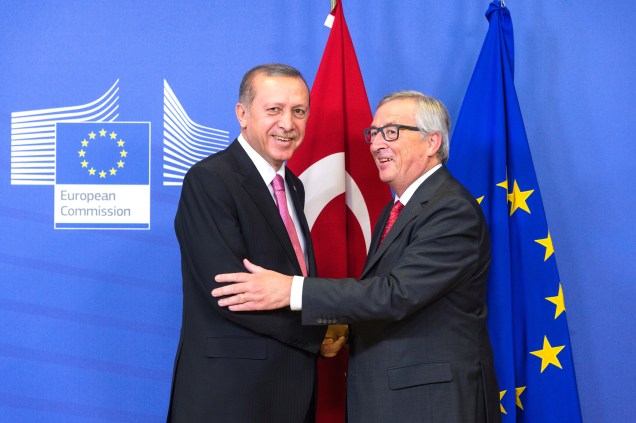
Greeting between Recep Tayyip Erdoğan, on the left, and Jean-Claude Juncker

The unedifying sight of European leaders falling over themselves to flatter and persuade the two-bit despot of Turkey to help solve a problem largely of their own making is damning proof that EU member states are definitively NOT stronger together

The most common refrain heard from Remainers and assorted EU apologists is that by pooling (read: surrendering) sovereignty with 27 other nations, we are “stronger together” and mysteriously greater than the sum of our collective parts – that something magical happens when Ireland, Britain, Slovakia and Croatia act through a supranational government based in Brussels which (for reasons they never explain) could not be achieved through friendly inter-governmental cooperation between sovereign countries.

This tiresome and unsupported claim is fatuous beyond words, and usually uttered by people who don’t understand the first thing about either the history of the European Union or how it operates, but who nonetheless cheer on the idea of European political integration in order to virtue-signal the fact that they hold the “correct” progressive  opinions to their equally vapid friends and peers.

And if you want proof that being part of a remorselessly politically integrating club of 28 diverse countries actually makes us the very opposite of “stronger together”, one need only look at how the European Union is being hoodwinked and bullied by that beady-eyed, egotistical, embryonic dictator from Turkey, president Recep Tayyip Erdogan.

Douglas Murray writes in the Spectator:

Recep Tayyip Erdogan, the Turkish president, has persuaded the EU to grant visa-free travel to his 75 million countrymen inside Europe’s passport-free Schengen area. In so doing, he has made more progress than any of his predecessors. Using a combination of intimidation, threats and blackmail, he has succeeded in opening wide the doors of Europe.

Erdogan’s success matters, because it says much about the EU — and the idea that it exerts ‘soft power’. This was the theory in 1999 when the EU declared Turkey to be ‘a candidate State, destined to join the Union’ so long as it fulfilled the standard criteria for membership. Its state should have ‘achieved stability of institutions guaranteeing democracy, the rule of law, human rights, respect for and protection of minorities’.

And it was all going so swimmingly. Oh, wait:

As Erdogan has worked out, however much Turkey fails to live up to the EU’s expectations, the EU’s attitude to Turkey is ‘ever onwards’. Its 2013 ‘Visa Liberalisation Dialogue’ set out 72 conditions on security, migration, public order, fundamental rights and readmission of irregular migrants that Turkey needed to achieve. Despite failing them, in November last year the EU and Turkey agreed that visa-free travel should start this October. All the time Turkey demanded more and faster.

As well they could. Because last year — after the German Chancellor opened the borders of Europe to anyone who could get here — the tables turned. Persuaded that every problem in the Middle East, Far East, North and Sub-Saharan Africa was Europe’s fault and Europe’s responsibility, millions duly came. And will again. Today, even the European Commission and Frau Merkel realise that in order to avert political catastrophe in Europe, they must bring the number of entrants down. Suddenly, as Erdogan himself said, ‘The European Union needs Turkey more than Turkey needs the European Union.’

So this is the European Union’s much-vaunted “soft power”. This is how forcing 28 separate countries – incidentally, countries which often lavish money on social programmes but completely neglect their own security and defence – to act through a single supranational government actually works in practice. How other nations must tremble when Europe speaks.

The supposed soft power of Brussels is supposed to be European political union’s chief advantage and a key foundation of the Remain campaign’s case for staying in the EU, yet on the most important of issues it is virtually non-existent, a paper tiger. Turkey’s president openly mocks and belittles EU leaders to their faces, even as they roll out the red carpet and treat him “like a prince” (in the word’s of the European Commission’s own pandering  President Juncker).

But as Tom Slater correctly points out in Spiked, the real fault is not with Turkey and Erdogan, thin-skinned, authoritarian despot though he is. The problem is with Europe and its profound crisis of values:

As for the migrant deal, it was EU incompetence that ceded Erdogan all of his leverage in the first place. Having chosen to ignore the fact that it had long lost control of its southern borders – not least because of some of its members’ cack-handed crusades in the Middle East and North Africa – the EU’s response to the refugee crisis was chaotic and can-kicking. The EU elite’s attempt to enforce migrant quotas on member states was a typically anti-democratic move. But it couldn’t even pull that off. The EU is as inept as it is tyrannical, meaning cutting a deal with Turkey became the only option.

The ground-shaking power of Turkey is the fantasy of a continent that doesn’t know what it is anymore. The more Europe drifts from its founding values, the more EU elites struggle to execute anything other than a photo-op, the more Erdogan, the ‘tall man’ of Ankara, grows in stature. Bashing Turkey can only distract us from this profound crisis.

But how can this be? How did this “profound crisis” come about? Forcing 28 separate countries under the suffocating umbrella of one supranational government with one collective presence on the world stage was supposed to amplify our voice. Hell, the EU’s most starry-eyed lovers even dream of Brussels rivalling and eventually supplanting the United States as the most consequential actor in world affairs. And yet here we are, failing in our negotiations with a pathetic little tin-pot dictator, throwing away billions of taxpayer euros in the hope of the slightest concession from Turkey, while the eurocrats are bested and humiliated at every turn.

This is what happens when the EU tries to prance around on the world stage as though it were a legitimate country, despite not having the one thing most fundamental to any nation state – a cohesive demos, a people with a shared European identity, let alone common interests. This is what happens when the conflicting priorities, fears, red lines and neuroses of 28 separate countries are forcibly mashed together – the result is a laughable compromise backed with the weakest of wills, easily picked apart by a half-competent negotiator.

Erdogan isn’t stupid. He knows that having eliminated internal borders, the EU’s Schengen area countries are desperate to stop the immigration crisis at (or at least near) source, and that consequently he holds all of the cards. Erdogan knows that the EU is hopelessly divided, with German chancellor Angela Merkel having made the grandiose and criminally irresponsible gesture of welcoming anybody with the means to enter Europe – seeking to expunge Germany’s past national guilt in a single stroke, knowing that hundreds of thousands more would be encouraged to come while other countries would end up footing much of the bill.

A Europe that was not intent on forcing itself against common sense and natural law to become a single political entity might be able to deal with the Syrian (and broader) refugee and economic migration crisis in a rational, productive way. A Europe based on inter-governmental cooperation rather than supra-national control might be able to hammer out a deal to accept more genuine refugees, share them equitably, take only the brightest and best of the economic migrants, and offer real assistance and solidarity to countries like Greece and Italy which bear the brunt of the crisis. But this is not the Europe we have. Once again, the stubborn desire for European political union is actively killing people.

So let’s hear it again from the Remainers and desperate EU apologists. Let them continue to lecture us about how the European Union “amplifies our voice” and enables us to “punch above our weight“. Let them tell us how Europe’s representative on the world stage, former Young Communist Federica Mogherini, is universally feared and respected, the modern day hybrid of Charlemagne and Henry Kissinger.

Let them continue to peddle the preposterous myth that little old France, Germany and Britain – two of them nuclear powers, and the other the world’s fourth largest economy – are helpless on their own and only worthy of sitting across the table from the mighty President Erdogan to seek his favour because they cower behind the EU’s skirts.

Let them tell us again how being in the European Union gives us the diplomatic clout that countries like Australia, Canada, Japan, India and Russia so effortlessly wield every day, but which pathetic little Britain would struggle to replicate on our own.

Go on. Tell us. Read the latest account of hundreds of migrants drowning in the Mediterranean Sea and tell us again just how star-spangled awesome the European Union is, and how successfully it helps us grapple with the most pressing challenges in today’s world.

Seriously. I’m all ears.


European Union - United Kingdom - Britain - Flags

Agree with this article? Violently disagree? Scroll down to leave a comment.

Follow Semi-Partisan Politics on TwitterFacebook and Medium.

An Anti-Immigration Brexit Campaign Is Doomed To Failure

Michael Gove - EU Referendum - Vote Leave - Immigration

Ben Kelly of Conservatives for Liberty and The Sceptic Isle has an excellent new piece explaining why a Leave campaign focused on immigration is both depressingly regressive and doomed to failure.

Kelly’s warning is in response to Michael Gove’s latest contribution to the Vote Leave campaign, as reported today by ITV:

Michael Gove has warned the UK faces a migration “free for all” unless it leaves the EU, as the Leave camp moved to exploit an admission from the Government that EU free movement of labour rules make it harder to curb immigration.

The Justice Secretary insisted potential new members of the EU posed a “direct and serious threat” to public services such as the NHS, and social harmony.

He said five countries “due to join the European Union” – Albania, Macedonia, Montenegro, Serbia and Turkey – which he warned would mean Britain’s public services would not be left in a “strong position”.

Writing from the perspective of The Leave Alliance (an independent grassroots movement for Brexit supported by this blog) which advocates exiting the EU’s political union and using EFTA/EEA membership to maintain access to the single market, Kelly writes:

A recent ComRes poll that asked the question “what is the most important issue in your decision on the EU Referendum?” was illuminating. 47% said the economy was the most important factor, with immigration trailing on 24%. So the belief that it doesn’t matter that the Leave campaign loses the economic argument because they can win on immigration is bunkum.

First and foremost, people will vote according the economic risk. That is why we propose an EEA based solution; it de-risks Brexit, secures the economy and gives us a soft landing. That is stage one of the secession process, a safe platform to build on. This is the key to winning the referendum and thereby restoring democracy and self-governance in the United Kingdom. In any case, it will likely be the only offer on the table for Article 50 negotiations and is the likely government course of action.

Although the EFTA/EEA solution puts on hold changes to freedom of movement it crucially protects our Single Market participation and thereby neutralises the economic uncertainty surrounding Brexit. In the long term we can make the case for reforms to freedom of movement, but pending such reform there is plenty of scope for improving the management of our borders with a coordinated set of policies designed to address push/pull factors. We would also gain the option of activating the “emergency brake” provision in the EEA Agreement as a temporary safeguard measure against exceedingly high net migration numbers.

Many who unrealistically seek a clean break Brexit and want everything at once will see this position as sub-optimal, but the alternative – pulling out of the EU’s freedom of movement provisions – would lose us access to the Single Market.  Without continued access to the Single Market, we cannot win the referendum because we lose the economic argument.

Those who insist on ending freedom of movement and imposing strict new immigration controls on Day 1 are letting their own “perfect scenario” be the enemy of the good. The type of Brexit necessary to deliver what Vote Leave are promising inevitably means losing access to the single market, membership of which is contingent on adopting free movement of people. This creates a degree of economic uncertainty which is gleefully seized upon by the Remain campaign and makes it virtually impossible for Leave to win the referendum.

By contrast, exiting to an EFTA/EEA holding pattern allows Britain to extricate herself from political union with the EU while maintaining the stability in the economic sphere which is necessary to reassure the 47% of voters for whom this will be the deciding factor. Further changes to immigration policy can then follow according to the democratic will of the British people, subject to various economic and political constraints.

It should be pointed out, too, that the accession of the next group of EU candidate countries – Albania, Macedonia, Montenegro, Serbia and Turkey – could be more than a decade away from joining, and in Turkey’s case this may well not happen at all. This gives plenty of time for Britain to secure freedom from political union, and then flex our independent policy levers to address push and pull factors as Kelly advocates.

Kelly concludes:

Stepping back into the EEA means leaving political and judicial union safely.  From that position of security and strength a world of opportunity opens up. Over time we can take advantage of regaining control over a vast swathes of policy making and review the statute books. Gradually we can move towards a more bespoke “British model” of relations with the EU and form a coalition to push for necessary reforms.

Disastrously, this is seemingly unacceptable to a number of inflexible and uncompromising Eurosceptics who reject freedom of movement and the Single Market and are therefore actively adding to the perceived uncertainty of Brexit. Regressive Euroscepticism, which is unwilling to compromise and refuses to acknowledge that freedom of movement actually has many great positives, is a disease that will lead only to abject failure.

We need an optimistic message and a positive, liberal vision. The ability to move freely across Europe is hugely beneficial in so many ways and a great many Britons enjoy those benefits and will fear losing their rights.  EEA immigration has been good for this country in many clear and measurable ways, economically and socially, and this absolutely has to be said.

An independent Britain must be a positive, diverse and liberal country with an open economy; this is the key to our cultural and social dynamism and how we can make a great success of Brexit. Leave cannot possibly win with a regressive vision that contradicts this. An anti-immigration campaign arguing for the abolition of freedom of movement and the loss of Single Market access is guaranteed to lose, and the failure will be richly deserved.

The New Statesman’s political editor George Eaton is also devastatingly accurate with his take on Vote Leave’s pivot back to immigration:

Britain’s high immigration rate is undeniably of concern to many voters. The boast that EU withdrawal would exempt the UK from free movement (though Norway and Switzerland show it may not) is perhaps the best card the Brexiters have to play. But it may not deliver victory. The Remain campaign speaks of a “plateau” beyond which Leave cannot advance. There are millions of people whose priority is reducing immigration – just not enough for the outers to win. The issue is to them what the NHS was to Ed Miliband’s Labour – a strategic comfort blanket.

[..] The more the Brexiters play the migration card, the greater the risk that they animate their core voters while alienating others. It was for this reason that Vote Leave resolved to run an optimistic campaign, non-centred on immigration. Gove’s rhetorical escalation shows that they are struggling to abide by this vow.

In raising the salience of immigration, Leave is playing to its strengths. Until it is able to neutralise its weaknesses, that will remain a displacement activity.

Continuing to place this uncompromising immigration message front and centre in the Leave campaign is the quickest and surest way to a 45-55 defeat on June 23. The only ones not to realise this seem to be the official Leave campaign, who are more interested in covering their blushes and resetting the agenda after having their flimsy economic case taken apart last week by a gleeful Remain campaign.

Any campaign aimed at motivating core supporters at the expense of alienating swing voters (by preventing the adoption of a plan which would ease their economic concerns) is not helpful at this stage. Persisting with exactly the same unfocused, populist message which helped to secure the referendum will not also help to win it, and telling the UKIP contingent exactly what they want to hear rather than challenging them to think more strategically and longer-term could well be looked back on as the single biggest failure of the campaign.


European Union - United Kingdom - Britain - Flags

Top Image: Independent

Agree with this article? Violently disagree? Scroll down to leave a comment.

Follow Semi-Partisan Politics on TwitterFacebook and Medium.

An Anti-Trump Protest In Portland, An Unbridgeable Divide On Immigration

Congratulations, American leftists. By deliberately and persistently conflating legal and illegal immigration in the public discourse, it is no longer possible to have any kind of rational dialogue on the subject

I’m not normally in the habit of sharing Infowars videos other than the few occasions when I have had a chuckle at Alex Jones, but I encourage you to watch this video.

This is footage of a calm and eminently reasonable man debating with two left-wing women on the subject of immigration at an anti-Donald Trump protest in Portland, Oregon.

Background: The man’s own parents were legal immigrants, and he is attempting to get the two protesters to acknowledge that there is a difference between legal and illegal immigration, and that the former should be welcomed but the latter not tolerated.

They totally refuse to give any ground, refusing to acknowledge any difference between legal and illegal immigration and becoming ever more nonsensical as the video progresses. It’s not so much that they are deliberately conflating the two types of immigration in the way that so many cynical politicians have done. In the case of these protesters – having no doubt percolated in an ideological echo chamber where everyone thinks and says the same liberal thoughts – they are genuinely unable to discern the difference.

Key moment in the dialogue:

Man: My parents came here from Cuba, they came through Ellis Island through the proper channels and they became citizens.

Woman: Sir, it’s not about it being legal, it’s about that America — is open to help people. You’re just being closed minded.

Man: I’m not against immigration or immigrants, never was. My parents were immigrants.

Woman: But saying you’re against illegal immigrants is the same thing.

Man: It is not! Legal and illegal immigration is not the same thing.

Woman: Why does it matter if someone’s not “legally”…

Man: Of course it matters.

Woman: Why?

The two women in this film genuinely cannot see why joining the queue, waiting, paying money and taking a citizenship test is more virtuous and honourable than sneaking across the border or overstaying a visa, and they become increasingly agitated the more the man persists in trying to explain the difference. While the man is able to debate and discuss, all that the protesters can do is shout accusations and repeat talking points, so when he quickly discredits their stock responses (illegal immigration is great, just like rainbows and puppies) they have no intellectual fallback position. This is why they become so evidently distressed a few minutes into the video.

It’s worth watching this to remind ourselves of what the Left has been trying to accomplish in the immigration debate. Conflating legal and illegal immigration has long been a core goal, because not only does it then become much easier to tar opponents of the latter with the stain of racism, it also produces brainwashed young activists and voters who mindlessly parrot the phrases they are given and accept these positions without question.

And when anything – like, say, a Donald Trump Rally – penetrates their hermetically sealed ideological echo chamber? Since they cannot debate, they have only one response:

Shut it down! Shut it down! Shut it down!

And since even taking a moderate position on illegal immigration (such as granting permanent residence but not citizenship to those who have already come) prompts exactly the same vicious reaction, is it any wonder that many American conservatives are now spurning compromise themselves and gravitating toward the presidential candidate who says “screw it, just build the wall”?

Congratulations, American liberals. This is what you have wrought on the American political discourse, all in the name of tolerance.


Donald Trump protest

Bottom Image: Press Herald

Agree with this article? Violently disagree? Scroll down to leave a comment.

Follow Semi-Partisan Politics on TwitterFacebook and Medium.