Centrism Is The New Extremism

Owen Jones - Brexit - Hardline Remainers - Extremism

For many years, the most angry and bitter invective in our political discourse hailed from the far Left and Right. But now it is the supposedly rational and pragmatic centrists who are becoming unhinged and increasingly uncivilised.

Like the stopped clock which still tells the correct time twice a day, once in awhile Owen Jones has a passing moment of clarity and perception and utters a statement with which a normal person can actually agree.

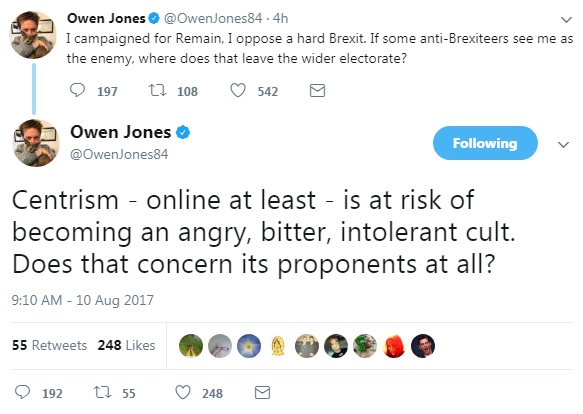
Today is one of those days. Noting that he is taking increasing amounts of flak not from hard Brexiteers but from hardcore ideological Remainers, Owen Jones noted on Twitter that “centrism – online at least – is at risk of becoming an angry, bitter, intolerant cult. Does that concern its proponents at all?”

Jones follows up by noting that “a certain type of Hard Remainer online have become angry, bitter, intolerant, and determined to root out the impure on their own side”:

Slow hand clap.

Jones isn’t wrong, and while one might legitimately question whether he is the best person to be accusing others of being angry and bitter, he makes a fair point – there is a very real and growing rage building among the pro-EU centre-left, a rage which is spilling over and causing people to say all manner of outlandish things.

In the immediate aftermath of the EU referendum there was a sort of stunned silence from the Remain camp. Many arch-Remainers were also the same establishment centre-left figures who found themselves banished to the margins of the Labour Party by the Jeremy Corbyn ascendancy back in 2015. To be cast from power and influence within their own party and then to feel Britain’s EU membership – which has become emblematic of their perception of themselves and the country as enlightened, progressive internationalists – slip through their fingers only a year later was more than many centrists could bear. At first.

But it did not take long for shock to turn into anger and defiant resolve. Harnessing huge amounts of denial (“the referendum was only advisory”, “the Leave campaign had a monopoly on lies and so the result should be invalidated”) many centre-leftists, realising that their entire worldview was not only under attack but on the verge of defeat, stirred themselves into action.

We saw this with the court case brought by Gina Miller, in which the Supreme Court ultimately ruled that Parliament must have a say on the final Brexit deal negotiate by the government. We saw it too in the flourishing of groups and social media accounts dedicated not to making the best of Brexit now that the country had voted for it, but rather trying to overrule that vote and remain in the EU at all costs.

I noted this phenomenon myself a few weeks ago, admitting that we Brexiteers had underestimated the ability of the pro-EU, centrist establishment to launch a reactionary hissy fit several orders of magnitude bigger than the anti-establishment backlashes which led to Brexit in Britain and President Trump in America:

Perhaps we should have seen it coming. Effectively overruling the establishment’s carefully laid out plan for our lives was always going to generate a huge backlash, from powerful and well-connected people with the ability to make traditional grassroots anti-establishment backlashes look like a cake sale at the Women’s Institute.

Perhaps we forgot this fact because we Brexiteers and defenders of nation state democracy were so used to being part of a backlash ourselves – the backlash against the establishment – that we didn’t give enough credence to the fact that globalists, disinterested “citizens of the world” and other assorted types are equally as invested in their worldview as we are in ours, and in a far stronger position to defend it from attack.

And now that they have experienced repudiation at the ballot box, the establishment’s ability to turn howls of outrage into a full-on filibuster of democratically-made decisions is stronger than many of us planned for.

We are definitely witnessing an ossifying or hardening of positions among many Remainers. Before the EU referendum last year, some of these people could occasionally be found admitting that the European Union was not perfect and urgently needed reform, and even that membership had some downsides (even if outweighed by the positives).

You won’t find arch-Remainers talking like this in the press or on social media any more. Now that the prospect of Brexit looms, the EU is perfect and irreproachable, and Brexiteers aren’t just misguided but actively evil for casting Britain into the abyss. (Well, to be fair, many hardcore Remainers always asserted that Brexiteers were evil racists, but they now do so with increased frequency and venom).

The Guardian recently published a piece by Will Hutton, who declared that Brexit is “our generation’s Dunkirk”, as though tactical retreat in the midst of an existential world war is in any way comparable to the peaceful, diplomatically negotiated departure from a supranational political union.

In a spittle-flecked fury, Hutton wails:

Last week, Labour peer Lord Adonis compared leaving the EU as a mistake analogous to appeasement. He is right. Brexiters Davis, Fox and Johnson are from the same anti-modern, delusional world view that produced the strategic foreign policy mistakes of the 1930s and the emasculation of the mixed-economy, state-led approach that underpinned the economic success of 1931-50.

Then, at least, we had underlying strengths, representing the opposite of their philosophy, upon which to fall back on. Brexit is our generation’s Dunkirk, but with no flotilla of small boats and no underlying economic strength to come to the rescue. It’s just defeat.

Now this blog has no time for Liam Fox or Boris Johnson, but even if Theresa May’s government drops the ball completely on Brexit the economic ramifications (bad though they may be) will still fall several degrees short of colossal military failure and impending invasion. To compare Brexit to Dunkirk or to Chamberlain’s policy of appeasement is wild hyperbole of the first order.

But this is what you now have to look and sound like to be accepted into the Remainer / centrist tribe – at least on social media, where nuance and restraint have never been in great supply. Just as the Cult of Social Justice and Identity Politics doles out “victimhood points” and social status depending on the number of ways that a person can describe themselves as oppressed, the Cult of the EU demands ever more flamboyant declarations of love for the European, furious denunciations of those who disagree and pledges of extreme measures to be taken to stop Brexit at all costs. Because being pro-EU is bound up so tightly in the centrist psyche, Brexit is making many establishment centrists behave like any other identity group that feels under attack, blindly lashing out and playing the role of the victim.

And so in many ways it was inevitable that arch-Remainers would be suspicious of the likes of Owen Jones, and seek to publicly denounce him. Back in 2015, when the EU was turning the screws on Greece and effectively subverting Greek democracy, Jones came close to openly advocating for Brexit. Of course, like many others (most notably Ian Dunt, who had virtually nothing good to say about the European Union until he realised that the EU referendum could boost his profile if only he switched sides) Jones eventually returned to the fold, taking the wishful thinking Varoufakis position that we should remain in the EU in order to reform it.

But like all extremist movements, the hardcore ideological Remainers have long memories and no statute of limitations when it comes to heresy. Owen Jones once expressed doubts about Our Beloved EU, Fount of All Good Things. And he compounded this thoughtcrime by accepting the reality of Brexit rather than raging against it, even penning a lengthy account entitled “Why I’m a remainer who accepts the EU referendum result”. Therefore he must be punished and cast out. As Jones notes, “the Hard Remainers want to overturn the EU referendum and regard the likes of me as traitors and impure for wanting a soft Brexit instead.”

The centrists of old – back when they were free and easy, on the ascendancy, certain that their basic worldview was coming to fruition and would perpetuate itself forever – had a reasonable degree of tolerance for differing opinions. That’s why the likes of Ken Clarke could fit (ideologically at least) under the same political umbrella as someone like Tony Blair, Yvette Cooper or Chuka Umunna. A few honest differences on a few political points were expected and allowed, since everybody was pulling in the same basic direction. But no longer. Cast out of power, hardcore centrists increasingly use a person’s attitude toward Brexit as an acid test to determine whether they are Good or Bad.

Where will this end? Well, certain excitable centrist MPs and their media cheerleaders seem to be itching to set up a new political party, first with the sole objective of stopping Brexit and remaining in the European Union, and once that deed is accomplished to turn into some kind of new centrist party, a shelter from Theresa May’s authoritarianism and Jeremy Corbyn’s unabashed socialism.

I wrote an entire blog post yesterday about why this idea is idiotic and will never come to fruition. But what would such a party look like, if the normal constraints of British electoral politics were magically removed and a new “centrist” party formed?

By definition it would be full of extremists – the kind of people whose fanatical devotion to the European Union is such that it overrides their previous party loyalties and makes them willing to jump into bed with other people who might have quite different ideas about the optimal size and function of the state, spending priorities, social issues or a million and one other policies.

Such a party would be full of EU-worshipping zealots who would pay any price and bear any burden to thwart Brexit – ironic, since many of them complain about so-called Brexit extremism. But more than that, it would be full of deluded souls who think that if only Brexit can be stopped, everything would just go back to how it was before David Cameron called the referendum; that the anti-establishment backlash which helped to deliver Brexit would simply melt away as people shrugged their shoulders and accepted being overruled by their social betters.

This is delusional. The reason that Blairite and Cameronite centrism lies discarded in the gutter right now is because its most ardent practitioners were content with a system which rewarded people like themselves while leaving millions of others in dead-end jobs or left on the welfare trash heap with little realistic prospect for self-betterment – and because they were openly, snarlingly contemptuous of anybody who dared point this out or raise an objection. Centrism is discredited because it inspired successive British governments to effectively outsource whole swathes of governance and policymaking to the European Union, with MPs and ministers enjoying the trappings of power despite having vested many of their responsibilities in a supranational government even less accountable or responsive to the popular will than Westminster.

A new political party (or government) full of centrist extremists, bitter and vengeful at having been temporarily dethroned, would immediately seek to roll Britain back to 2015 (or 2010, depending on whether they are centre-left or centre-right extremists). But the British people have moved on. A majority want to get on with Brexit even if they voted to Remain in the referendum. They want to move forward, not backward.

But despite being totally impractical and doomed to failure, expect to hear more talk of a new, dedicated anti-Brexit party. Expect to hear more overwrought headlines and tweets comparing Brexit to such and such atrocity or genocide. The rage continues to grow among the dispossessed centrists, and they have a vastly bigger platform to air their grievances than those on the ideological Left or Right.

You see, these people have never lost before. They are accustomed to winning, and do not know how to behave in the face of defeat. Since 1997, whichever party was in power, Labour or Conservative, the centrists’ worldview inched ever closer to fruition. And if that consensus failed to deliver for millions of Britons – those at the sharp end of globalisation or those who simply care a lot about democracy and constitutional matters – then so be it. They got theirs, and that’s all that mattered.

Thank goodness that this cosy centrist consensus has finally been broken, and that these arrogant, selfish and overrated people will have to take their failed and discredited ideology to battle in the political arena along with the rest of us, rather than continuing to win by default.
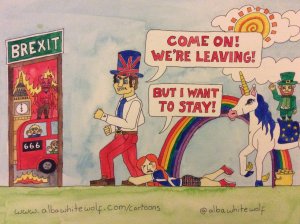
 

madaleina-kay-european-union-brexit-cartoons-unicorns-and-leprachauns-2

Support Semi-Partisan Politics with a one-time or recurring donation:

Agree with this article? Violently disagree? Scroll down to leave a comment.

Follow Semi-Partisan Politics on TwitterFacebook and Medium.

Are We Finally Witnessing The End Of Bland, Centrist Politics?

Jeremy Corbyn - Glastonbury crowds

Donald Trump, Jeremy Corbyn, Brexit… People want meaning in their lives and a purpose in their politics that dry, centrist managerialism cannot hope to provide

This, by Ted Yarbrough, is very perceptive:

Man does not live by bread alone. Though a religious statement by Jesus from the Gospel of Matthew I think that statement has never been more true- especially seen in geopolitics.

We humans have never been materially wealthier.  Yes, some people still live in abject poverty and many people don’t like that others have more money than them, but by historical standards we should be thanking our lucky stars each day for our blessings. We live longer than ever before and can communicate with people throughout the world at an instant. Yet, as especially seen in politics, many people are angry. Populists are rising on both right and left. Those in positions of power ie “establishment” people in the media, government etc are extremely perplexed. How could, for example, the people not want to send that nasty man Trump a message with some bright young man who checks all the boxes like Jon Ossoff? [referring to the Democrats’ failed attempt to take Georgia’s sixth congressional district in the recent special election]

I think the people shocked by the return of ideology miss one big point about humans. We are not animals, we don’t just like to be fed and wag our tail. We believe in justice, we dream dreams, we are not content because, yes often we are spoiled, but we want to believe in something. We want to be something bigger than ourselves- it’s why humans suffer enormously to go to Mt. Everest and the south pole and the moon- we want to do things because they are great. It is why people are constantly searching for the meaning of life and worshipping God (or gods). We want to change the world because we recognize the imperfections in it. We will not be content.

In politics, that means people are growing sick of “centrists” ie technocrats who don’t inspire the people but expect to govern because they are supposedly the best qualified for the job. Centrists are shocked to see the rise of nationalists and free-marketers and socialists and Islamists, but really they shouldn’t be. Those ideologies offer people something to believe in, a better world to dream of and fight for, rather than a shallow world of pop music, materials possessions and politics made occasionally spicy with some virtue signalling identity politics thrown in. People now, like our ancestors of old, want to battle over ideas. To work towards finding truth.

This blog has been screaming for years now that centrist politics is leading us nowhere good, entrenching privileges for those set up to gain from the current system while doing nothing to help those – particularly those at the sharp end of globalisation – who do not benefit from the post-patriotic, post nation state world that the elites are building without meaningful democratic consent.

But even I did not predict the degree to which the establishment’s insistence on clinging on to their bland, centrist model of governance would lead to disruptions to the political order on the level of Donald Trump, Brexit or Jeremy Corbyn’s takeover of the Labour Party (and nearly the country).

Some of these disruptions are welcome – Brexit is a great achievement, even if many of the benefits end up being lost through abysmal execution by the political class, while Jeremy Corbyn’s Jeckyll and Hyde leadership of the Labour Party reminds us both how ideology can reinvigorate a political movement but also just how far the party has drifted from the interests of working people. And others of these disruptions – cough, Donald Trump – are unwelcome and have almost zero upside.

But more such populist disruptions are almost inevitable until the political class realises that people want more from their politics than a ruling class of bland, superficial technocrats who promise nothing more than the smooth administration of the status quo. Jeremy Corbyn, for all of his faults, at least promises a radical reordering of society – one made all the more appealing by the fact that the Conservatives long ago ceased to make a bold, unapologetic case for free markets, individual freedom and a less suffocating state.

Nearly two years ago, this blog asked where is the Conservative Party’s own Jeremy Corbyn? Where is the small-C conservative version of the politician who dares to proclaim an unrepentantly neo-Thatcherite worldview, instead of pretending (a la Cameron, Osborne, Hammond and May) that “austerity” and fiscal restraint are a sad necessity brought about by recession rather than an innately good thing in and of themselves?

Theresa May led the Conservative Party to near-defeat in the general election this month because she never even attempted to take on Jeremy Corbyn in the battle of ideologies. And while conservatives were never likely to walk away with the lion’s share of the youth vote, shamefully allowing Jeremy Corbyn to be the only one to present the emerging generation of new voters with anything like a positive inspirational message made damn certain that the majority of them voted Labour.

Yarbrough’s conclusion is stark:

With that being said, if the centrist parties do not start treating people as humans who dream dreams, and offer a compelling hope for people, the people of the world will continue to be more polarized and radicalized. And if there is no hope more and more false prophets will emerge to fill the vacuum.

One of my favourite television shows is the twelve-part HBO series “From The Earth To The Moon”, executive produced by Tom Hanks, recounting the complete history of NASA’s Apollo Program which culminated in six manned missions to the surface of the moon. I like it because it represents, to me, a time when humanity stood for more than “reducing inequality”, deifying public services and promising to make the trains run on time. A time when our desire for achievement, like our plans for human spaceflight, aspired to something more than low-earth orbit.

The theme music at the start of each episode begins with JFK’s speech at Rice University in which Kennedy says “We choose to go to the moon in this decade and do the other things, not because they are easy, but because they are hard, because that goal will serve to organize and measure the best of our energies and skills, because that challenge is one that we are willing to accept, one we are unwilling to postpone, and one which we intend to win.”

Of course the 1960s and 70s were tumultuous decades with many of their own very real challenges – the very real threat posed by Soviet Communism, for one, and the ongoing struggle for civil rights. But how much worse would this era have been if there were no unifying objectives around which people could come together?

In our increasingly secular age, religion is no longer a unifying force within nations. Art stepped up briefly as a replacement, but our art and culture has become increasingly debased too. And so people, being spiritual beings, increasingly vest their faith in their political worldview, which has had two principle effects – toxifying our political discourse and making people more susceptible to the “false prophets” of which Yarbrough warns.

Professor David Hillel Gelernter once said in an interview:

The readiest replacement nowadays for lost traditional religion is political ideology. But a citizen with faith in a political position, instead of rational belief, is a potential disaster for democracy. A religious believer can rarely be argued out of his faith in any ordinary conversational give-and-take. His personality is more likely to be wrapped up with his religion than with any mere political program. When a person’s religion is attacked, he’s more likely to take it personally and dislike (or even hate) the attacker than he is in the case of mere political attacks or arguments. Thus, the collapse of traditional religion within important parts of the population is one cause of our increasingly poisoned politics.

We see this all the time in our political discourse. This is the Cult of Social Justice and Identity Politics writ large. This is the result of our ridiculous, overwrought obsession with inequality, even as living standards for nearly everybody continue to improve and we all benefit from technologies and inventions which were unthinkable half a century ago.

And if failed centrism really is leading to “radicalisation” by unscrupulous false prophets (and I don’t much like the use of that word outside of its applicability to terrorism, particularly because the Left is now eagerly using it to smear conservatives on any pretext, suggesting that newspapers like the Sun and Daily Mail are somehow “radicalising” the ignorant white working classes) then it becomes all the more important for our main political parties offer visions of their own which amount to more than technocracy and navel-gazing obsession with public services.

For a long time I thought that people actually liked the politics of Me Me Me, and that our craven politicians were simply responding to public demand with their endless manifesto bribes. But perhaps I was wrong. Though Jeremy Corbyn certainly offered a record-breaking basket of electoral bribes in the Labour Party manifesto, people also seem to have responded to him because of what he represents. In other words, Corbyn’s increasing viability amounts to more than the sum of the various bribes in the 2017 manifesto, even the student loans pledge.

The Conservatives, therefore, cannot afford to leave the ideological field open for Jeremy Corbyn to occupy on his own. The Tories need to do much better than mount their usual snivelling defence of fiscal restraint, couched in the craven acceptance of leftist frames of reference, and actually come up with an alternative vision of Britain worth voting for.

Theresa May isn’t going to do that, and neither are any of the dismal individuals tipped by the Westminster media as being most likely to replace her. So, who will come and save the Conservative Party from themselves, and save the country from Corbynism in the process?


Jeremy Corbyn - Glastonbury stage

Support Semi-Partisan Politics with a one-time or recurring donation:

Agree with this article? Violently disagree? Scroll down to leave a comment.

Follow Semi-Partisan Politics on TwitterFacebook and Medium.

2017 General Election Campaign: The Last Stand For Conviction Politics?

The only national party leader with clear political convictions and the courage to publicly defend them is rendered unelectable on the basis of those convictions, while cowardly and triangulating politicians with more superficially palatable opinions are poised to do well in the general election. How depressing.

Here’s the thing: While Jeremy Corbyn may be wrong about economic policy, foreign policy, national defence, the size and role of the state and a million and one other things, he is also the only major party leader (with the very occasional exception of Tim Farron) who can be fairly described as a man of conviction, somebody with a coherent worldview and the political courage to stand up and unapologetically argue for it.

Covering this general election will be hard for me, not just because (as usual) there is no party which reasonably represents this blog’s conservatarian stance but because the only party leader potentially worth admiring from a political courage perspective is the man that nobody in their right mind can reasonably vote for. If some nervous voters believe Brexit Britain is bad, that’s nothing compared to the kind of sudden confiscatory wealth raids, punishing tax rates and ramping up of the state we would see under Prime Minister Jeremy Corbyn.

The most plausible prime minister on 9 June – incumbent Theresa May – has gravitas and the outward appearance of baseline competence, yes. But she is ideologically rootless, her only real defining trait being a consistent hard lean towards authoritarianism. Beyond that, what does she stand for? Helping the JAMs, people who are just about managing? Surely every politician in government should strive to do that anyway. Theresa May was against Brexit before she became its most ardent champion, unable to take a bold stand on the most pressing question to face Britain in the post-war era until her hand was forced by the referendum result.

Then look at the other party leaders. Nicola Sturgeon is an expert at spinning her grievance-soaked tale of Scottish persecution and the need for supposedly childlike, simple Scots to be protected from the Evil Tor-ees, but while she campaigns in poetry (or rather crude limericks) the SNP governs in single-minded, authoritarian prose and is busy constructing a one-party statelet north of the border. At one point the Scottish Parliament failed to pass any legislation for over a year, so consumed were the SNP with manoeuvring for a second independence referendum. And when they did pass laws, they were frighteningly authoritarian schemes like the “named person” scheme which makes Sturgeon’s government an unwanted auxiliary parent to every newborn Scottish baby.

Under Paul Nuttall, UKIP – when they are not infighting and twisting in the wind – continue their lurch to the left, abandoning their original voter base of libertarian types in ever more fevered pursuit of hardcore immigration opponents and the disaffected Northern Labour vote. UKIP (or rather, Conservative fear of UKIP) played a significant role in forcing the referendum and achieving the outcome, but now the party has nothing left to say beyond defending the Leave campaign’s most indefensible promises and pledging to fight for the hardest of hard Brexits with nary a thought for how uncontrolled exit from the EU would impact our economy and diplomatic standing.

The Green Party remain an irrelevance outside their stronghold of Brighton, not helped by their visceral antipathy toward material human progress. And besides, the Green Party are…well, the Green Party.

And to be clear, Labour are in a mess, too. Not everybody subscribes to the Jeremy Corbyn agenda. But at least Jeremy Corbyn has a coherent worldview, as risible or abhorrent as some people may find it. What is the Labour centrist worldview? What are their inviolable beliefs and convictions? What gets Chuka Umunna, Yvette Cooper or Dan Jarvis out of bed every morning? Being a bit more left-wing than the centrist Tories while prattling on about “fairness” a lot more? Pretending to be heroic tribunes of the working classes but then ignoring their opinions on key issues like the EU and immigration?

One might have more sympathy for the Labour centrists, if A) they hadn’t bottled their cowardly post-referendum coup against Jeremy Corbyn, with all of the shrunken people who now pass for “big beasts” within the party electing to save their political hides while sending out the risible Owen Smith as their stalking horse, and B) they had a solid, work-in-progress alternative to Corbynism in their back pockets. No such alternative is being proposed.

And so we are in a position where the one candidate with a coherent worldview and the glimmer of a sense that the British people should be called to overcome a challenge rather than being soothed, placated and made safe, cannot be elected because his political ideas are broadly wrong. Meanwhile, a bunch of politicians whose views are slightly less wrong than Jeremy Corbyn’s will benefit from the 2017 general election thanks to their ability to conceal what they really think and bend, flatter and shapeshift their way into the public’s good graces.

Just compare the opening campaign speeches made by Jeremy Corbyn and Theresa May respectively.

Here’s Jeremy Corbyn, opening with a stridently anti-establishment message which could almost be described as Trump-like:

The dividing lines in this election could not be clearer from the outset. It is the Conservatives, the party of privilege and the richest, versus the Labour Party, the party that is standing up for working people to improve the lives of all.

It is the establishment versus the people  and it is our historic duty to make sure that the people prevail.  A duty for all of us here today, the duty of every Labour MP, a duty for our half a million members – including the 2,500 who have joined in the last 24 hours.

Much of the media and establishment are saying that this election is a foregone conclusion.

They think there are rules in politics, which if you don’t follow by doffing your cap to powerful people, accepting that things can’t really change, then you can’t win.

But of course, they do not want us to win. Because when we win it is the people, not the powerful, who win.

The nurse, the teacher, the small trader, the carer, the builder, the office worker, the student, the carer win. We all win.

It is the establishment that complains I don’t play the rules: by which they mean their rules. We can’t win, they say, because we don’t play their game.

We don’t fit in their cosy club. We ‘re not obsessed with the tittle-tattle of Westminster or Brussels. We don’t accept that it is natural for Britain to be governed by a ruling elite, the City and the tax-dodgers, and we don’t accept that the British people just have to take what they’re given, that they don’t deserve better.

And in a sense, the establishment and their followers in the media are quite right. I don’t play by their rules. And if a Labour Government is elected on 8 June, then we won’t play by their rules either.

They are yesterday’s rules, set by failed political and corporate elites we should be consigning to the past.

This is good because it is not a message which resonates only with Labour’s traditional voter tribes.

Especially now, following an EU referendum which literally pitched the establishment of this country and their sycophantic allies against the ranks of the people, voters may be receptive to this message of fighting against a political, economic, media and cultural establishment which arrogantly seeks to rule in its own interest. Even as a conservative libertarian type, this passage resonates with me.

And here is Corbyn waxing lyrical about the benefits of wealth distribution:

Britain is the sixth richest economy in the world. The people of Britain must share in that wealth.

If I were Southern Rail or Philip Green, I’d be worried about a Labour Government.

If I were Mike Ashley or the CEO of a tax avoiding multinational corporation, I’d want to see a Tory victory.

Why? Because those are the people who are monopolising the wealth that should be shared by each and every one of us in this country.  Everyone, and I mean everyone, has a contribution to make and a life to lead. Poverty and homelessness are a disaster for the individual and a loss to all of us.

It is wealth that should belong to the majority and not a tiny minority.

Labour is the party that will put the interests of the majority first, while the Tories only really care about those who already have so much.

That is why we will prove the establishment experts wrong and change the direction of this election. Because the British people know that they are the true wealth creators, held back by a system rigged for the wealth extractors.

He is dead wrong, obviously – coercive, large scale redistribution destroys wealth faster than it can parcel it out, dooming people to receive ever more equal slices of a rapidly miniaturising pie. But by God, Corbyn sounds convincing when he makes his case because he actually believes what he is saying, and because it fits into a coherent wider narrative which supports the entire Corbynite worldview.

Meanwhile, here is the prime minister launching the Conservative Party’s election campaign in Bolton:

And that’s what this election is about. Providing the strong and stable leadership this country needs to take Britain through Brexit and beyond. It’s about strengthening our hand in the negotiations that lie ahead. And it’s about sticking to our plan for a stronger Britain that will enable us to secure that more stable and secure future for this country and take the right long term decision for the future. It’s about strong and stable leadership in the national interest. And you only get that strong and stable leadership by voting for the Conservatives. Because that’s what Conservatives government provides. And just look at what we’ve done.

[..] when I took over as Prime Minister, the country needed clear vision and strong leadership to ensure that we got on with that job of delivering on Brexit for the British people and that’s exactly what we did. We delivered that strong and stable leadership, we delivered the certainty that strong and stable leadership can give. And that’s what leadership looks like. Now there’s a very clear choice at this election. It’s a choice between strong and stable leadership under the Conservatives, or weak and unstable coalition of chaos led by Jeremy Corbyn.

And that is very clear. Let’s look – the other parties are lining up to prop up Jeremy Corbyn. We’ve seen it with the Liberal Democrats, and we see it with Nicola Sturgeon’s Scottish nationalists. They’re very clear that they want to do everything they can to frustrate our Brexit negotiations. To undermine the job that we have to do, the task that lies ahead. Do everything to stop us from being able to take Britain forward. And it’s their tunnel vision focus on independence that actually provides uncertainty. They want to pull the strings, try to pull the strings of this election, prop up Jeremy Corbyn and provide more risk and uncertainty for the British people and that’s not in Britain’s interests.

So it’s only a vote for the Conservatives that can deliver, and every vote for the Conservatives is a vote for me and local Conservative candidates, and it’s a vote to ensure that we have that strong and stable leadership that we need to take us through Brexit and beyond. Every vote for me and the local Conservative candidates here and across Britain is a vote to deliver on that plan for a stronger Britain and a more secure future for us all. And if we have that certainty of five more years of strong and stable leadership then we can ensure that we’re delivering for people, for ordinary working people up and down the country, across the whole United Kingdom.

This isn’t a speech. It is a soundbite delivery mechanism, the flavourless rhetorical equivalent of a Ryvita cracker, designed to drill the phrase “strong and stable leadership” so deep into the minds of voters (the exact phrase is repeated twelve times) that we all walk zombie-like to the polling stations on 8 June, muttering the phrase to ourselves as we dribble down our chins.

As a political speech, it has no poetry because it was conceived by partisan political calculation rather than any deep conviction about what’s best for Britain. “Vote Tory to prevent the other parties from either influencing or thwarting Brexit” is Theresa May’s message – an implausible message in itself, considering that the prime minister only came to believe in the deep wisdom of Brexit after the British people had voted to Leave.

As a modern political speech (with the bar set accordingly low), Theresa May’s effort will probably be quite effective though. Getting up on a stage and ranting about strong and stable leadership is a very effective way of implying that the various jabbering parties of the Left will screw everything up given half the chance, either by naively giving everything up to Europe in the negotiations for no commensurate return, or by descending into infighting over whether to push for a softer Brexit or seek to thwart Brexit entirely.

The Tory position – advocating a hard Brexit and exit from the single market, to be replaced with a fictional comprehensive deal within two years – is moronic. But it does have the advantage of being easy to understand. Now imagine Corbyn, Sturgeon, Lucas and Farron all sat around the Cabinet table. Do they collectively push to stay in the EU or just for the closest relationship with the EU? Who knows? Ergo chaos, versus Theresa May’s “strong and stable” leadership.

But what of other issues than Brexit? Where is the ringing defence of Conservative principle? The speechwriter crams this material – such as it is – into the final paragraphs, very much as an afterthought:

But it’s also about getting the right deal for ordinary working people here at home, and that’s about building a strong Britain. Britain is the strongest country in Europe in terms of economic growth and national security.

It’s about building a stronger economy. It’s about creating well paid secure jobs. It’s about ensuring that there is opportunity for all. That we provide a good school place for every child. That there is affordable housing. That people can get on in their lives. It’s about ensuring that we create a more united nation. That we take action against the extremists who want to divide us, and that we stand up to the separatists who want to break up our country. So it’s providing that strong and stable leadership.

That certainty. That stability for the future ,and that’s going to be our message as go out in to our election campaign. And I’m looking forward to it. We’re going to fight a positive and optimistic campaign about the future of this country. I’m going to be getting out and about around the country. I’m going to be visiting communities in every part of the United Kingdom.  And I’m looking forward to taking our case out there to people. Because this is the case – that it is only with the Conservatives that you get the strong and stable leadership that this country needs to see us through Brexit and beyond.

That’s it. In other words: “blah blah authoritarianism blah, angrily insisting that the country be united while proposing zero tangible policies to actually rekindle shared British values and identity, blah. Cheap houses for everyone with no explanation of how or where they will be built, oh and I guess we’ll make schools great too, blahdy blah. Strong and stable leadership! Blah”.

What does Theresa May actually believe about anything? How does she intend to remake British society with her (hopefully) increased parliamentary majority? Who knows? I’m not remotely convinced that the prime minister knows herself.

What about tax reform, maybe simplifying the code, eliminating loopholes and lowering the burden on ordinary people?

What about constitutional reform, recognising that Brexit is the beginning and not the end, and pledging to devolve power to the home nations and regions, so that nobody can complain about the “Evil Tory” government in Westminster when their own local officials have greater power over taxes and services?

What about our national defence, committing to serious spending increases to reverse years of decline in our capabilities in order to increase our hard power?

What about an energy policy which frees Britain from dependence on rogue or ambivalent states while keeping costs low for consumers?

What about getting a move on with critical infrastructure projects like Heathrow Airport expansion, allowing other airports to expand too, and cutting the outrageously high Air Passenger Duty tax on flying, which increasingly makes Britain a pariah state for international business travellers?

What about – and I’m shooting for the moon on this one – an end run around the Labour Party, integrating health and social care, and doing it with a dispassionate fixation on healthcare outcomes rather than weepy tributes and pledges of loyalty to Our Blessed NHS?

Perhaps it will all become clear when the Conservative Party release their 2017 general election manifesto. But I wouldn’t count on it. I confidently expect to download that document and read a hundred more exclamations of “strong and stable leadership” while key policy questions are studiously ignored.

And yet all the smart money says that party whose leadership has a coherent worldview and the political courage to argue for it will lose seats in the general election, while the opportunists (Sturgeon, Farron), authoritarians (May, Sturgeon) and nonentities (Wood, Nuttall) do well, or at least escape cosmic justice for their ineptitude.

Assuming that the election goes as expected, rest assured that the next generation of political leaders will be watching and taking note.

Be opportunistic. Short-term tactical gain over long-term policy coherence. Soundbites over substance. Promise voters an easy, consequence-free life. Never tell the public difficult truths or call them to any kind of civic duty.

Message received.


Theresa May - General Election 2017 campaign launch speech Bolton - Strong and stable leadership - 2

Theresa May - General Election 2017 campaign launch speech Bolton - Strong and stable leadership

Support Semi-Partisan Politics with a one-time or recurring donation:

Agree with this article? Violently disagree? Scroll down to leave a comment.

Follow Semi-Partisan Politics on TwitterFacebook and Medium.

The Liberal Elite, Here To Stay

Are the liberal elite living on borrowed time?

Rod Liddle thinks so:

For a start, the elite is not liberal in the classical liberal sense, but closer to the American sense of the word. It is certainly not ‘liberal’ if by that you mean tolerant: it is intolerant and authoritarian. And by elite I do not mean the elected government: establishment elites can survive most forms of government and easily outlast them.

The liberal elite we talk about today is beholden to a leftish cultural and political paradigm which predominates in all the non-elected institutions which run our lives. In the judiciary, for example. Within the BBC. In the running of our universities and in the courses they put before students. In the teaching profession. In the social services departments of every council in the land. At the top of the medical profession. On the boards of all the quangos — the lot of them, from those which hand out money in the arts to those which regulate our media and our utilities. It is a left-liberal paradigm, informed by affluence, which has been swallowed whole by all of these institutions and which is utterly intolerant of dissent.

Try being a social worker who thinks gay adoptions are problematic. Or a doctor who disapproves of abortion or transitioning. Or a student who quite likes Germaine Greer and wearing a sombrero. Or a teacher who thinks Trump is maybe OK. (The headmaster at a school in south London recently told pupils that if any child uttered the same sorts of words as Donald Trump about immigration, they’d be excluded.)

Try being a judge who thinks an awful lot of hate crimes are imaginary or vexatious. In all cases you’d be drummed out. No job. You’d be finished. There would be tribunals — where you would be judged by other upholders of the liberal elite — and you’d be out.

That is what we mean by the liberal elite. The template for how our society is governed and which antithetical political parties may battle, but in the short to medium term, lose.

Elites do change, though. I remember as a speechwriter for the Labour party in the early 1980s suggesting that we do something in support of the teachers, who were complaining about pay. ‘Fuck them — they’re all Tories,’ I was told. And so statistically they were, at the time. And in the 1970s the BBC, the Church of England, the judiciary and the emergent quangos were small ‘c’ conservative. Elites last for about two generations. Our liberal elite has lasted since about 1985. And my guess is that right now it is on the way out, which is why we are hearing this continual howling.

Liddle’s summary of the Control Left is pretty accurate, but I cannot share his confidence that the power and influence of this deeply anti-intellectual group of “intellectuals” and elites is on the wane – at least not yet.

Perhaps, if the counter-revolution were led by somebody other than Donald Trump, there would be cause for hope. Somebody with unimpeachable ethics, a record of respect toward women and minorities and impulse control greater than that of a ten-year-old might just be able to prevail against decades-old vested interests and a self-regarding and frequently biased media.

But unfortunately we have Donald Trump in America (whose successful recent speech to a joint session of Congress may have finally given him the veneer of presidentialness, but none of the substance) and Theresa May in Britain (who seems eager to combine the establishment’s usual haughty paternalism with a desire to be led by the Tory Right into the most calamitous and disruptive form of Brexit possible). These are hardly the two torchbearers one would choose to “Drain the Swamp” or do anything else remotely transformative.

And so there is the very real risk that Donald Trump’s floundering new administration will either drop the ball so badly in response to some external crisis, or else precipitate a crisis of their own through poor legislative and executive decisions, that they actually manage to make the establishment opposition – led by fresh young anti-establishment faces like Nancy Pelosi and Chuck Schumer – look good by comparison. And if these people get back into power, will they take even a moment of introspection to consider their role in the rise of Trump, or show any regard for the more legitimate concerns of his supporters? I think we all know the answer.

Similarly, if Theresa May’s government miscalculates in our EU secession negotiations and triggers some sort of abrupt and traumatic departure with no carryover provisions in place to govern customs, regulatory matters and the myriad programmes of cooperation with other EU countries, the economic pain will be real and the Tories will no longer look quite so invincible.

Besides, Rod Liddle devoted paragraphs to pointing out the extent to which so many of our institutions – from academia to the charity sector to the state church – are corrupted from within and turned into the exclusive domain of the liberal elite. It would be great to see reasoned conservatism re-establish a beachhead in some of these places, but it does not look very likely at present.

The hair-trigger sensitivity of many of these people leads them to see a harmful microaggression in the smallest and most inconsequential of human interactions, and they have shown no qualms about persecuting even those from their own tribe who happen to deviate even 1% from the current social justice / identity politics orthodoxy. What hope, then, do conservatives have of breaking back into those workplaces and institutions from where they have been so comprehensively exiled?

So while the screeching and whining from left-wing commentators and their allies embedded in our institutions has become deafening, I see little evidence that it will be followed by retreat. Like a transatlantic flight spent sitting in front of a screaming baby, we are in for a long and tortuous ride.


child-screaming-on-airplane

Support Semi-Partisan Politics with a one-time or recurring donation:

Agree with this article? Violently disagree? Scroll down to leave a comment.

Follow Semi-Partisan Politics on TwitterFacebook and Medium.


How The Corbynites Would Behave In Government – A Lesson From The 1980s

Conservatives should not feel smug about the hard left takeover of the Labour Party. History shows us that these people are tenacious and capable of inflicting real damage on people and communities in pursuit of their warped ideology, from the lowest seats of power

What would Jeremy Corbyn and the hard left of the Labour Party do if they actually gained political power? It is a question we tend not to ask ourselves or discuss, the possibility seeming so laughably remote that we naturally fixate more on what the Conservative Party is likely to do, given a small majority in government but no real organised opposition.

But it is a question that we should ask ourselves. This blog has been unashamedly supportive of Jeremy Corbyn’s leadership of the Labour Party, not because I agree with his ideology or any Corbynite political positions but because Corbyn represents (together now with Brexit) one of the only agents for breaking British politics out of its current stale, centrist consensus.

The managerial, technocratic politics of the last twenty years has alienated people and drives them away from political discussion, essentially boring them to death while the two main parties squabble over relatively trivial differences in attitude toward taxation, regulation, culture and foreign policy. The 2010 general election, taking place at the height of the Great Recession at a time when bold and original thinking was most needed, hinged on a puny £6bn difference in big spending commitments between Labour and the Conservatives. And though the EU referendum and the subject of Brexit divided the country in half, every political party but one came down hard on the side of remaining in that sclerotic and anti-democratic union.

There is not nearly enough choice in British politics. Being a centrist Labour MP today means broadly accepting the status quo on nearly all fronts while droning on continuously and sanctimoniously about “equality” and “fairness” to anyone who will listen, while being a typical Tory means waxing lyrical about personal freedom and responsibility while doing nothing to shrink the state or bring an end to government paternalism. Even the third parties, so long a pressure release valve, tend to fall in line with the consensus. The SNP is nothing but a slightly more authoritarian and social democrat-leaning Labour Party with a sprinkle of anti-English resentment, while UKIP seems to have betrayed its roots as a radical right-wing party in favour of appealing to disaffected left-wing Labour voters.

In this bland, homogenised context, anything which offers people real choice – a real varied palette of political colours to choose from – can only be a good thing, if for no other reason than that bad ideas will fester and grow out of sight of the country at large unless they are regularly expressed, challenged and defeated. So for all of these reasons, having a genuinely left-wing leader of the Labour Party again is not only jaw-droppingly obvious, it is also essential for the renewal of our democracy.

And yet…

One must also consider what ideologues actually do when they are in power. The Left in particular love to use the Thatcher government as a bogeyman and an emblem of everything evil about conservatism as an ideology, while conveniently glossing over the fact that Britain was a terminal patient receiving half-hearted palliative care before Margaret Thatcher gave the economy and the country some painful, revolutionary but absolutely necessary shock treatment.

But what do the ideological Left do when they are in power? Well, thankfully they have never grasped the reins of national government – the suffocating bipartisan post-war consensus was bad enough. But the hard left do have a track record in local government, and it is not a pretty one.

And that’s where this video comes in – kindly shared with me on Twitter by @eddiecoke. It is about fifteen minutes long, and well worth your time. The video is an excerpt from a 1980s American documentary about the behaviour of the hard, ideological (or “loony”) left in British local government. And some of what you see is quite shocking.

Of course, I knew about all of this in theory. Writing daily about politics, one hears about Red Ken and the GLC, or Derek Hatton and Liverpool City Council. But for early millennials like me, born when Thatcher was already in power and coming of age during late Blairism, the antics of the loony left are often now understood only in theory, while it takes seeing them in practice for the mind to recoil.

Watch the whole video.

What do we see?

Council censorship committees literally going through library books and purging those which do not convey a Social Justice message (in one case a picture book is banned because a white girl character has the temerity to tame a black horse with the aid of sugar cubes).

Snow White and Dr. Doolittle similarly banned.

Beauty and the Beast, Rupert Bear and Thomas the Tank Engine, too.

Replaced by books which go far beyond encouraging tolerance and equal rights, with one book for five-year-olds featuring a section entitled “Masturbation (Touching Yourself to Feel Good”.

The phasing out of competitive sports at school, replaced with open-ended games in which there are no rules, no score is kept and everybody “wins”.

Emboldened Marxist history teachers indoctrinating children with unashamedly pro-communist, anti-American diatribes.

The Brent African Women’s Council being invited to suggest changes to the school lunch menus, and then filibustering a meeting when okra soup and plantain were found not on the menu every single day.

A school governor bragging that he has effectively banned the police from setting foot on his school campus by threatening the headteacher’s job.

Social Justice pantomimes, with the traditional stories modified to shoehorn in messages of liberation and equality (because leftists can’t leave a good story unmolested).

Efforts to get schoolchildren to draw comparisons between the introduction of legislation to crack down on militant trade unionism and the Holocaust.

Viewing this litany of crazy, authoritarian leftist social engineering programmes run amok is quite sobering. And it does make one reconsider whether supporting Jeremy Corbyn and the ascendancy of the Labour Left is the right thing to do. After all, they have unleashed horrors like this on ordinary citizens while controlling only local authorities – how much more harm could they do if unleashed again, or (heaven forfend) on national government?

The answer: a lot. They could do a lot of harm. But that is no reason to recoil in horror at a democratic decision made by ideologically fervent members of the Labour Party. The correct reaction is to ensure that conservative thinking is similarly renewed and emboldened so that it presents an attractive alternative to voters.

Conventional wisdom says that this is already the case – that the UK electorate would pick Theresa May to stay on as prime minister over Jeremy Corbyn in a heartbeat, and that all the Tories need to do is remain as blandly inoffensive / desperately boring and unambitious as possible, so as not to spook voters into reconsidering.

I think this is dangerous complacency. After the past year in politics (on both sides of the Atlantic), nobody has any business making confident predictions about what will or will not happen, or to declare the status quo to be a cast iron certainty forever. Politics at its inclusive and inspiring best is about convincing people to consider new or different ideas, including ones which they had previously rejected. The Leave campaign would never have prevailed in the EU referendum had many people who were ambivalent or even warmly disposed towards the EU persuaded that Britain’s future would be brighter outside. Jeremy Corbyn is asking the British people to consider a radically different political settlement too, and while it is highly likely that the people will tell him to take a hike, it cannot be guaranteed.

Smug right-wing columnists may chortle that Jeremy Corbyn will never see electoral success, but they don’t know what economic or geopolitical shocks lie in await around the corner, or how those will impact British politics. Neither can they guarantee that the British political Right will not undergo a similar schism as is now taking place on the Left, instantly making everything competitive again.

It is not enough for small and large-C conservatives to sit back complacently and laugh at the Labour Party’s turmoil, while doing absolutely nothing to revitalise our own thinking and policymaking. It is not enough to assume that the country knows that conservative solutions are inherently better and more in tune with human nature than socialist dogmas.

If we really are about to enter a new political age where ideology actually starts to matter again, then conservatives should be worried, because we have been caught by surprise. The left’s answer was clearly to re-awaken the socialism of the 1980s and the GLC. What is our answer to be?

Hopefully Theresa May will spell out some broad strokes during the upcoming Conservative Party Conference. But I wouldn’t hold out much hope – the government has its hands full trying to deal with Brexit, and Theresa May’s reputation is that of an authoritarian traditionalist, not a small government, pro-market radical.

And until we conservatives can come up with a coherent and appealing vision for what small government conservatism should look like in 2016 (rather than the post-Cameron fudge we are currently presenting to the public) then our best defence – our only defence, really – against the Corbynites will be their own appalling record in government, going back some thirty years.


ken-livingstone-john-mcdonnell-labour-party-loony-left-socialism

Support Semi-Partisan Politics with a one-time or recurring donation:

Agree with this article? Violently disagree? Scroll down to leave a comment.

Follow Semi-Partisan Politics on TwitterFacebook and Medium.