Another Reason To Dislike Gordon Brown

I am only allowed by my wife to rant about Gordon Brown and his toxic impact on British life and politics a maximum of three times per week. Yes, she keeps track, and yes, even I will acknowledge that this has sometimes been necessary. No such restriction applies to this blog, however, which is just as well given recent revelations made by former Labour spin-doctor Damian McBride.

Apparently, Brown’s first instinct upon realising the gravity of the situation brought about by the global economic crisis and Britain’s unique unpreparedness to deal with it (thanks to eleven years of big spending Labour government) was not to issue a heartfelt mea culpa and apology to the British people for the upcoming lost decade that he was unleashing, but instead to start plotting the implementation of martial law on the streets of Britain.
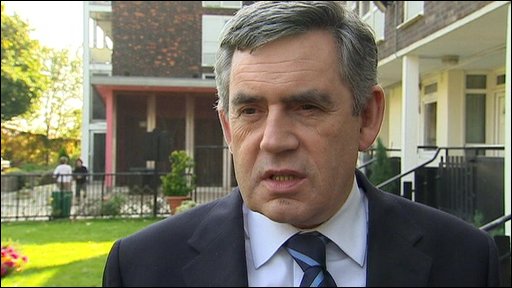
Help to engineer a global financial calamity and then propose banning people from protesting about it - that's the Gordon Brown way.
Help to engineer a global financial calamity and then propose banning people from protesting about it – that’s the Gordon Brown way.

The BBC reports:

Gordon Brown discussed deploying troops on Britain’s streets as news of the 2008 financial crisis became clear, an ex-Labour spin doctor has claimed. In extracts of a book published in the Daily Mail, Damian McBride said the former prime minister feared “anarchy” once the scale of the crisis was known. According to the book, Mr Brown said: “We’d have to think: do we have curfews, do we put the Army on the streets, how do we get order back?”

I am continually accused of being too hard on Gordon Brown. He was a good person, interlocutors on his behalf insist. His heart was in the right place, they plead. He was a simple humble methodist man who just wanted to do good for his country, they tell me. Blah, blah, blah.

This man, uniquely responsible for ensuring that Britain entered the great recession as the least well prepared of all of the major world economies, thought that the best way to deal with the potential fallout would be to deploy troops on the streets to stop us from looting and pillaging our country back to the stone age.

The article continues:

Mr Brown is quoted as saying: “If the banks are shutting their doors, and the cash points aren’t working, and people go to Tesco and their cards aren’t being accepted, the whole thing will just explode.

“If you can’t buy food or petrol or medicine for your kids, people will just start breaking the windows and helping themselves.

“And as soon as people see that on TV, that’s the end, because everyone will think that’s OK now, that’s just what we all have to do. It’ll be anarchy. That’s what could happen tomorrow.”

According to Mr McBride’s book, Power Trip, Mr Brown feared panic from other countries could spread to the UK.

I am genuinely unsure which is worse – the fact that the man brought our nation to a place where such draconian, apocalyptic scenarios even had to be considered, the fact that he thought they might be the best way of tackling the problem, or the fact that his current proteges are this very day standing giving speeches at the Labour party conference in Brighton where they are denying any responsibility for or complicity in Britain’s continuing economic malaise. There are no words or phrases critical enough of the premiership of Gordon Brown.

The book’s author, Damian McBride, does not do himself any great favours as he relates the tale. Grateful as we must be to him for shedding this additional light on the Brown terror, of course McBride was personally supportive of everything that Brown did:

“It was extraordinary to see Gordon so totally gripped by the danger of what he was about to do, but equally convinced that decisive action had to be taken immediately,” Mr McBride wrote.

He claimed the then prime minister understood the situation better than other world leaders, his UK opponents and senior bankers.

And the former spin doctor rated Mr Brown’s actions as “up with those of President Kennedy and his advisers during the Cuban Missile Crisis”.

John F. Kennedy and Gordon Brown – historical equals and political peers. Aside from the fact that they both ghost-wrote books about the meaning of courage, I’m not really feeling the similarity right now.

Labour Party Balderdash On Jobs

Ed Miliband Jobs Guarantee


Good news, everyone. Ed Miliband has solved the youth unemployment crisis in Britain. I guess he was lying in bed last night and the ghost of Michael Foot visited him and told him what had to be done to make everything better again.

Once he and his merry band of super-competent cabinet colleagues are sworn in as the next government in 2015, everything will be fine. Rainbows will appear in the sky and bunny rabbits will hop across the land. We know this because, at the one-day Labour Party conference in Coventry today, Mr. Miliband unveiled his “real jobs guarantee”.

The nasty Conservative Party, of course, likes young people to be unemployed. It gives us right-wingers a kick to pay taxes so that people can receive Jobseekers Allowance indefinitely.

His plan – to give every young person who has been unemployed for 12 months or more a guaranteed internship with a company, paid at the minimum wage – would be paid for by another £600m arbitrary raid on bankers bonuses.

Miliband says:

“To business we say, we’ll pay the wages, if you provide the training … To young people: if you’re out of work for a year we’ll guarantee you the opportunity to work.”

The BBC article goes on to mention:

“Those taking part will be expected to turn up for work, as well as looking for a full-time job and complete training, or face “tough consequences” – including possible benefit sanctions.”

What other tough consequence could there possibly be for failing to turn up for work or complete the other requirements for receiving government benefits, other than to lose those benefits? Being scolded by someone at the Job Centre? Being sent a letter of disapproval? Anyway.

I almost don’t feel as though it is worth delving into the flaws in this dystopian policy, especially given the fact that Labour’s deputy leader, Harriet Harman, was apparently clueless when it came to how much the scheme would cost, and whether this cost would be fully met by their proposed one-time (but seemingly all-the-time) tax on bankers’ bonuses.

Nonetheless, a couple of points of rebuttal, just to go through the motions:

1.Guess what, not all “bankers” had a hand in bringing about the global economic downturn. In fact, a lot of people in quite a lot of industries, and government positions also had a hand in it. So when will the Labour Party get over trying to use banks as a piggy bank to raid at will to fund their latest scheme? Gordon Brown was either Chancellor of the Exchequer or Prime Minister for the decade leading up to the collapse, so how about we also arbitrarily add a 10% tax surcharge on all of his future income to help him atone for the consequences of his calamitous incompetence?

The time to extract penance from the banks was at the time of the bailouts, but it didn’t happen. The Labour government missed the opportunity. Businesses cannot plan for the future and grow and prosper if they don’t know if they will be hit by a new punitive tax at any moment to fund the latest socialist pipe dream. Should the country have extracted more of a toll from the financial sector at the time? Almost certainly. But we didn’t, and now it is too late, and we have Gordon Brown and his heirs and successors in today’s Labour Party to thank for it.

2. This policy is so vague as to be worthless. Mr. Miliband says that “saying ‘no’ is not an option”, but doesn’t outline the consequences of saying no. After never once having gotten tough before in their history, does anyone really expect that this Labour policy, if implemented, would actually have any real teeth?

3. Youth unemployment currently stands at around 22.5%, or 1.042 million people. How, exactly, is a future Labour government going to coerce enough firms to take people on in order to reduce this to 0%? The answer is, of course, that they won’t. And if they even come close, it will only be because they bully firms into taking on people to do non-jobs that are of no training value, just to help the government meet its target.

4. Go away, and come back when you have a real jobs policy or any kind of plan that will actually solve the problem of youth unemployment. And in the meantime, perhaps stop demonising the current government’s “Welfare to Work” plans, which are much more cost-neutral and much more likely to succeed.