Left Wing Self-Awareness Award, Part 1

Samuel Hooper - Left Wing Self-Awareness Award - British Politics - Socialists

An award to honour the courageous few on the British Left who have come to realise that blindly screaming “Tory Scum!” at half the country might not be the surest path to victory, and who instead risk life and limb (or at least their careers) to propose speaking to conservatives as though they are human beings

Credit where credit is due to Peter Ormerod, who foresees the British Left’s imminent collision with reality on June 8, writing in the Guardian:

It seems many on the liberal left are determined to repeat the mistakes of the 2015 general election, the EU referendum and the US presidential race. There is a widespread failure – perhaps even a refusal – to understand the reasons May and the Conservative party are so popular. Until we try to do so, we will always lose.

We will break this cycle only by condemning less and understanding more. If the appeal of May’s Tory party eludes us, we surely need first to appreciate that we are relatively unusual, and then try and see what all those others see. This is not to say that they are right and we are wrong, or to ditch any of our principles; only that May evidently represents something that huge numbers of people in our country want, and that it is worth our while to analyse that and take it seriously.

Only then can we win back the people whose support we need. This is something the New Labour project, for all its flaws, understood: we must meet people where they are, not where we would like them to be. Only then can we take them with us. It just takes some emotional imagination on our part. And this brings us to the heart of our problem.

For all our supposed touchy-feeliness, many on the liberal left seem to forget that elections are fought not only on the grounds of reason but also on the battlefields of emotion. It should be obvious that responding with snark and hostility to people with whom we disagree just raises defences and entrenches beliefs: after all, we know how we react when we are mocked and insulted. But we should also have learned by now that facts in themselves are often unpersuasive too. If we have not grasped this from experience, then there is plenty of scientific research to make that clear. We can recite statistic after statistic, pointing to failing after failing, and they’ll just bounce off our intended target because Theresa May gives them a sense of confidence that Jeremy Corbyn does not. You can win a hundred arguments and change not a single mind.

This is also good, on the role of the media in influencing public opinion – one of this blog’s pet peeves:

We can believe that these millions of people are wrong, but we cannot say they are stupid. Nor are they all zombies, or all brainwashed, or all unenlightened. And it’s not enough to blame “the media”, either: newspapers are commercial operations and if the public mood changes, the media often changes with it. This was the case in 1997 and continues to be the case today: it is why, say, the political position of the Scottish Sun may differ from that of its English counterpart. It would obviously be naive to underestimate the extent to which some newspapers shape public opinion, but these publications would not exist if they failed to reflect it.

Peter Ormerod’s conclusion? Listen more, judge less. Meet the people where they are, not where the Left would like them to be. Dare to imagine that a political disagreement may be borne not out of a catastrophic moral failure on the part of the other person, but from a legitimate different perspective on life, one worth exploring and understanding if not necessarily accepting.

One can still quibble with parts of Ormerod’s article – despite the general thrust being correct, he still manages to accuse conservative-leaning voters of irrationality in the opening paragraph. But to focus on likely rhetorical slips like this would be churlish, particularly when so few others on the British Left – either among the political leadership, the commentariat or the grassroots – are willing to be so introspective or make such a concession.

Ormerod admits that it will take a “concerted effort” from his ideological colleagues to “lay off the sneering”, and right now I’m just not sure that the appetite is there. Certainly not before the general election on June 8. For better or worse, the two main parties will butt heads on election day more or less screaming their current war cries – “strong and stable leadership!” from the Conservatives, and something about the Evil Tories being worse than Hitler from the Left. The only question remaining is precisely how many voters this petulant strategy will manage to alienate by polling day.

There will then doubtless be a period following Theresa May’s victory – as there was when David Cameron vanquished Ed Miliband in 2015, breaking the hearts of many a Tumblr Milifandom blogger – when the red mist descends even deeper over the British Left. We will hear about how the stupid working classes voted against their own interests for Goebbels to be prime minister, and for the government to wage a deliberate holocaust of the sick, the disabled and the otherwise perpetually “vulnerable” (a term which the British Left have conveniently extended to cover over half the country).

But every such outburst is only a further step taken in the wrong direction; one which must be re-trodden when the fever cools, the temper abates and the Left finally decides that they want to make up with the British people rather than continue to bitterly rage at them.

As things stand, though, every angry leftist outburst on Twitter, every snarky and sanctimonious meme shared on Facebook, every slanderous anti-conservative status proudly shared, every “Tories are vermin” t-shirt proudly worn around the streets of London, every weepy Huffington Post article about how some precious little “citizen of the world” can no longer bear to look at the parents who raised and sacrificed for them simply because they dared to vote for Brexit – all of this must be paid for in a lump.

Peter Ormerod is one of the few to sense the impending crash before it takes place. Perhaps, before long, he will be joined by others.


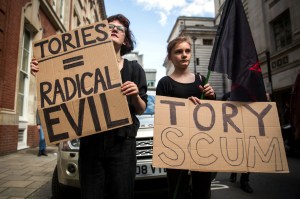
Bankers Toffs And Tory Scum - General Election 2015 - London Protests - Downing Street

Support Semi-Partisan Politics with a one-time or recurring donation:

Agree with this article? Violently disagree? Scroll down to leave a comment.

Follow Semi-Partisan Politics on TwitterFacebook and Medium.

General Election 2017: An Unpredictable Race In Hampstead & Kilburn

General Election 2017 - Hampstead and Kilburn Conservatives attack leaflet - Tulip Siddiq Labour Party Jeremy Corbyn - 1

Game On in Hampstead & Kilburn

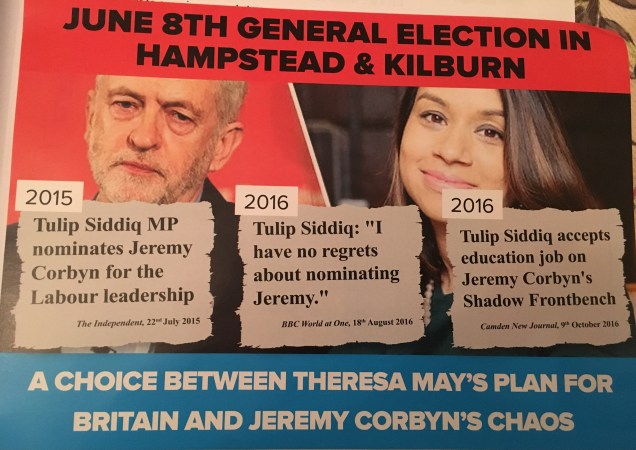
Today I received the above piece of campaign literature from the Hampstead and Kilburn Conservatives. It isn’t exactly subtle, and it perfectly encapsulates the problem facing incumbent Labour MP Tulip Siddiq, defending her slim majority of 1,138.

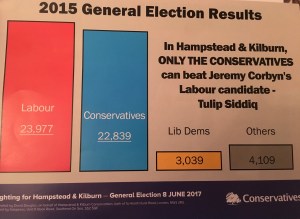
When Glenda Jackson was defending the seat in 2010, Labour squeaked home with a majority of just 42, making the seat the most marginal in England. And crucially, back then the seat was a tight three-way marginal, with the Liberal Democrats less than a thousand votes off the pace. In 2015, the LibDems suffered in Hampstead & Kilburn as they did nationwide, despite fielding an excellent candidate in Maajid Nawaz, and slumped to just 3,039 votes.

By way of further context, Hampstead & Kilburn voted strongly in favour of remaining in the European Union during the referendum, 75% Remain to 25% Leave,  with nearly 23,000 constituents signing an angry petition demanding a second referendum when things didn’t go their way with the first one.

So what will happen in the snap general election on 8 June 2017?

Given Labour’s current polling, and the personal polling of leader Jeremy Corbyn, by all rights Tulip Siddiq should be packing her office in Portcullis House and looking for something new to occupy her time. A majority of 1,138 puts Hampstead & Kilburn high on the Tories’ target list, and a few ministerial campaign visits and perhaps a drive-by from the PM herself ought to flip the seat, all other things being equal.

However, all other things are not equal.


The Brexit Factor

Brexit is a real factor here. Following the EU referendum I sat on the 139 bus from West Hampstead alongside numerous “March for Europe” protesters bearing placards weepily declaring themselves to be not British but European. Anger at Brexit runs deep here, as I discovered when I inadvertently carried a Brexit-themed shopping bag into the local Waitrose supermarket on Finchley Road during the campaign. The strength of pro-Remain feeling and the depths of the anger (and let’s face it – the arrogant refusal to even attempt to empathise with the opposing side) on display in this constituency throws everything up in the air when it comes to predicting general election results.


The LibDem Factor

To my mind, the key question is what happens to the Liberal Democrat vote. Nationally, the LibDems have come back from the dead, more in spite of Tim Farron’s leadership than because of it, and driven almost entirely by that party’s near-unambiguous anti-Brexit position. One knows that a successful vote for a LibDem candidate would result in an MP determined to delay or even scupper Brexit altogether were it remotely possible to do so, and this will be very attractive to a lot of voters here – the kind of people who abandoned the party in a hissy fit back in 2015 because of their coalition with the Evil Tor-ees, but who suddenly realise that they have common cause with Farron & Co. once again.


The Tory Factor

This is likely to see a number of voters – the “wetter”, less ideological and pro-EU Tories – switching their support from the Conservatives back to the Liberal Democrats. If your imagined “European identity” is the most important factor in your vote, then going LibDem is the only smart decision here.

In 2015, the Tories pandered to the constituency by running an extremely wet, centrist candidate – Simon Marcus was against the “bedroom tax” and welfare reform, and even against Trident renewal – and still came up short. I have yet to get a good sense of where 2017 candidate Claire-Louise Leyland stands on core ideological identifiers like tax policy, welfare reform, education, defence spending and civil liberties, but it seems likely that as an embryonic career politico (she stood for the Northern Irish constituency of West Tyrone back in 2015) she would generally toe the party line, perhaps diverging to the left on occasions.

Voters basing their decision on economic competence and basic credibility will probably therefore feel safe in voting Tory with Leyland on the ballot. Even though the Hampstead & Kilburn Conservatives probably don’t have any wiggle room to move further to the left, what else can centrist voters do – plump for Jeremy Corbyn? Hardly likely. That leaves the threat posed by the LibDems to the Tory europhile wing as the only real danger to be addressed.

However, just as Brexit is pushing some soft conservatives out of the Tory Party toward the LibDems, Jeremy Corbyn’s leadership of the Labour Party is likely to push a number of Hampstead & Kilburn voters away from Labour, also to the LibDems. Quite how much this will occur is hard to predict.


The Labour Factor

The more Hampstead side of the constituency has its share of trustafarian Corbynista types who think that reheated 1970s socialism is the best thing since sliced bread, but I suspect that there are far more young lefty creative professionals here who recoil from Corbyn’s haphazard management of the party and the very real chance that he will significantly hike their taxes given half a chance. There are a lot of people here for whom being seen as a “lefty” is important for social and professional acceptance and/or advancement, but who also quite like having disposable income and a functioning economy in which to spend it. Thus Jeremy Corbyn isn’t really their guy.

Meanwhile, the more Kilburn side of the constituency contains an awful lot of Corbyn true believers – as I saw when I attended a Corbyn rally at the Kilburn State Cinema during the post-Brexit leadership coup. However, there are also a number of working and lower-middle class constituents who might recoil from the kind of metropolitan identity politics that the Labour Party currently peddles, as Channel 4 news discovered when they trawled Kilburn High Road for vox pops.

In short, the Labour vote here is even more unpredictable than the Tory vote. The Guardian suggests that Hampstead & Kilburn may be part of a “metropolitan firewall” for Labour. Hmm, now where have I heard vastly over-optimistic talk of an electoral firewall before?


Too Many Moving Parts

While it is safe to say that the Liberal Democrats will exceed their 2015 vote total (despite fielding a candidate without Maajid Nawaz’s household name factor), it is hard to predict just how strongly the party will rebound, or at whose expense. Theresa May’s Brexit position (and revulsion at Brexit in general) will drive some Tory voters over to the LibDems, while lack of confidence in Jeremy Corbyn will drive some Labour voters the same way.

Will the combined effect be sufficient that the LibDems manage a miraculous come-from-behind victory, sneaking past the two big parties to snatch the seat? Unlikely. It would take an awful lot of defectors to bump up the LibDem total by such a large amount. But it is not impossible. The LibDem vote here fell by 13,452 between 2010 and 2015 just because their voters were in a strop with Nick Clegg for his decision to pragmatically enter a coalition with the Evil Tor-ees in the national interest rather than propping up the rotting carcass of Gordon Brown’s Labour government. Stung by Brexit, how much more reason have they now to return to the fold, more motivated than ever before?

However, I think it is more likely that the Hampstead & Kilburn constituency will be won by the party which manages to do the best job preventing their peripheral supporters from defecting to the LibDems. And it seems to me that the Conservatives have an advantage here.

While 2017 candidate Claire-Louise Leyland remains something of an unknown quantity (former Stronger In campaigner turned Theresa May supporter, passionate about mental health and otherwise fill in the blanks), she at least represents a party viewed rightly or wrongly as basically competent. This article is not the place to relitigate the many ways that Theresa May’s government is endangering our national interests through their glib and superficial approach to Brexit negotiations, but in a head-to-head between Tory ideologues and fratricidal Labourites you pick the swivel-eyed Tory every time.

Labour, on the other hand, risk losing their most pro-European supporters – the kind of tedious people who paint the EU flag on their face at public demonstrations and call themselves “citizens of the world” – to the LibDems, together with portions of their young professional vote and working class anti-Corbyn vote.

In other words, while even an ardently pro-European Conservative voter has many reasons to think long and hard before abandoning the party, pro-European Labour voters with little real expectation of a general election victory have every incentive to shrug and vote for LibDem candidate Kirsty Allan (while furiously humming “Ode to Joy”, naturally).

And that is why the piece of campaign literature which came through my door today should be extremely worrying for Labour’s Tulip Siddiq. The helpful chart on one side makes it look as though this is a straight-up fight between Jeremy Corbyn’s loopy, crackpot Labour Party and the Tories (thus underplaying the possibility of a LibDem fightback), while the reverse side trumpets three “damaging” headlines in which Siddiq proudly takes credit for nominating Jeremy Corbyn to the Labour leadership, refuses to concede that it was an error and then actually joins his Shadow Cabinet (while conveniently omitting the fact that Siddiq later resigned from the shadow frontbench in order to clutch the EU flag and vote against Article 50).


Where Things Stand

If this is indeed a scenario in which the two leading parties – Labour and the Conservatives – are attempting to win by losing the least number of votes to the Liberal Democrats, then the Tories presently have the advantage, and if they are smart they will do everything they can to tie Tulip Siddiq to Jeremy Corbyn in the public imagination. This will certainly be the advice/orders filtering down from Lynton Crosby and CCHQ in any case.

The more that Hampstead & Kilburn constituents are seeing and talking about how Tulip Siddiq helped inflict Jeremy Corbyn on the country and repeatedly enabled his chaotic leadership of the party (fair characterisation or not) rather than how the Tories have a childlike understanding of Brexit and an increasingly tarnished reputation for economic competence, the more likely it is that the Conservatives will prevail on 8 June and Claire-Louise Leyland will be returned as our new MP.

To survive and retain the seat for Labour, Tulip Siddiq must find a way of beating the Labour Party’s unbeatable Brexit conundrum while also distancing herself from Jeremy Corbyn – but not to the extent that it keeps the Corbynista vote at home or threatens any support she might need from the party leadership. In other words, Siddiq really has to thread the needle to prevail here.

Meanwhile, the Liberal Democrats need to make the local race all about Brexit, and nothing else. Kirsty Allan needs to paint herself as the only candidate with the courage to stand up for all of Hampstead & Kilburn’s heartbroken “citizens of the world” by acting with other LibDems as a drogue parachute on Britain’s departure from the European Union. Then she must hope that she can tempt enough such people away from their 2015-era partisan loyalties in order to pull the LibDems back to their 2010 levels of support, plus a little bit extra. It is a tall order, but not quite an impossible one.

So, all to play for at the moment. Bring on the hustings!


Update – 30 April

This interesting analysis from the Guardian and Electoral Calculus uses ICM polling to suggest that the Liberal Democrat resurgence may be a paper tiger – an attractive theme (and one eagerly picked up by the Remain-sympathising Westminster press) but with little basis in actual reality.

In particular, it shows that while a number of previously Labour-voting Remainers are indeed likely to jump ship to the LibDems, the Conservative vote looks far stickier, with 2015 conservative voters far less likely to jump ship even if they disagree with Brexit. This would seem to pour cold water on any hopes of a LibDem resurgence here.

The upshot of their analysis:

Our model sees the Tories on 422 seats, with Labour reduced to just 150, and the Lib Dems declining from 9 to 6. The Conservative majority would be north of 190. Labour would be wiped out beyond what most people are currently predicting. Leadership candidates like Clive Lewis would no longer be leadership candidates, because they would no longer be MPs.

The Lib Dems could lose a third of their MPs even after gains in places like Cambridge, with seats like Carshalton & Wallington, Richmond Park and Southport especially vulnerable. The danger in these seats is pretty clear. In Carshalton, Tom Brake won a majority of 1,510 in 2015. If a fraction of the town’s 7,000 UKIP voters return to the Tories, that majority will be wiped out. Southport is almost identically poised. Unless a major influx of Remain voters arrives from somewhere – and there’s no indication in any of this data that it will – then these seats will be lost. The Lib Dems don’t face the same problem in Richmond Park, which only turned back to the Lib Dems in December; but with a majority of less than 2,000 and a recent history of flipping, you wouldn’t bet the mortgage on a hold.

Devastating if correct.

On the plus side for Labour, there is hardly any UKIP vote in Hampstead & Kilburn to drift back to the Tories, unlike some other constituencies where the potential backwash of ex-UKIP voters to the Conservative Party threatens to sink LibDem and Labour candidates alike. This means that Tulip Siddiq’s fate as the constituency MP is firmly in Labour’s own hands, and their ability to hold on to their vote in the face of Jeremy Corbyn’s broad unpopularity.
 

General Election 2017 - Hampstead and Kilburn Conservatives attack leaflet - Tulip Siddiq Labour Party Jeremy Corbyn - 2

Support Semi-Partisan Politics with a one-time or recurring donation:

Agree with this article? Violently disagree? Scroll down to leave a comment.

Follow Semi-Partisan Politics on TwitterFacebook and Medium.

Quote For The Day

Brendan O’Neill, writing on Facebook:

With trustafarian Corbynistas on one side and media Blairites on the other, Labour is now entirely the property of people who do not labour, and have never laboured, and will never labour, and whose only experience of labour is when they keep an eye on the stupid bloke from Barking who probably voted Brexit as he fixes their boiler, to make sure he doesn’t steal anything.

An insult made devastating because it is so undeniably true.

This is not to say that there are not still (potentially) many good people within the Labour Party – people who perhaps voted Remain but who do not see Brexiteers as unthinking, subhuman trolls with racist tendencies, people who want to bend markets to do more of the state’s bidding but who have fundamentally made their peace with capitalism.

In fact, Brendan O’Neill was at pains to say that the Labour Party is now the “property” of the elites, not that the entire composition is rotten – just the Corbynite and centrist factions together with their sycophantic allies. Meanwhile, the decent people of moderate left-wing persuasion are utterly out of power and deep in the political wilderness right now. The direction of the party is firmly out of their hands.

Instead, with one hand on the reins of power we have the die-hard Corbynistas with their coherent but deeply unpopular worldview, and on the other we have the angry, bitter centrists, furious at having been forced from power since 2015 and eager to snatch back control so that they can pick up right where they left off, ratcheting up the size of the state, bowing down to public sector interests and eagerly fellating the NHS-Industrial Complex.

Both groups are led (if not wholly constituted) by elites – on the Corbyn side, the kind of “trustafarians” who will never have to worry if far-left policies tank the economy and render millions permanently unemployed, and on the centrist side, London-dwelling political and media types locked in an unhealthy symbiotic parasitic relationship and utterly beholden to the previous pro-EU status quo.

Where are the Labour MPs who rise up through the trades union, who might have some tangential claim to represent the interests of ordinary workers? Where are the Labour parliamentary candidates with actual firsthand knowledge of working in modern day call centres, warehouses and retail environments? Where is the great body of Labour MPs and candidates who represent the 52% of British voters who voted for Brexit in a non-partisan referendum? As a solid caucus within the Parliamentary Labour Party, they simply do not exist.

The Labour Party is not run for their benefit and so does not require their input.


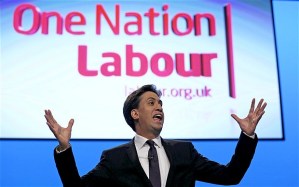
Ed Miliband Labour One Nation

Support Semi-Partisan Politics with a one-time or recurring donation:

Agree with this article? Violently disagree? Scroll down to leave a comment.

Follow Semi-Partisan Politics on TwitterFacebook and Medium.

Stop Applauding “Election Fatigued” Brenda From Bristol

If you are emotionally taxed by having to trundle off to your local polling station once a year, maybe you don’t deserve the privileges of citizenship

I know that the cardinal rule of politics is that the people are always right (unless they happened to vote for Brexit) and must be praised, flattered, bribed and otherwise pandered to at all times, but sometimes individual people are wrong and need to be told as much.

Among this category of people: those who have been extravagantly expressing election fatigue, as though having to spend 30 minutes travelling to their local polling station and putting a cross in a box is far too arduous a task to be demanded on anything more than a biannual basis.

On the day that Theresa May announced that she would seek an early general election on 8 June, “Brenda from Bristol” became an overnight celebrity for her comically exaggerated negative response to a BBC reporter’s request for a vox pop asking her opinion on having to choose a government again.

Naturally in this day and age, Brenda from Bristol immediately went viral, as George Osborne’s rag the Evening Standard reports:

A woman from Bristol whose nonplussed response to news of the General Election sparked a wave of support across the country has told reporters she cannot believe her new “celebrity” status.

Brenda from Bristol caused a stir this week when she was asked what she thought of the election and replied: “You’re joking? Not another one!”

“Oh for God’s sake, I can’t honestly… I can’t stand this.

“There’s too much politics going on at the moment. Why does she need to do it?”

She was later tracked down by BBC reporter John Kay who asked her what she thought of her newfound fame.

According to the same report, Brenda from Bristol is now being “inundated with offers” from other media outlets to offer her comically exaggerated world-weary take on the election campaign on an ongoing basis, by news outlets that would rather get their viewers to chuckle along to something inane than attempt the hard work of educating them on matters of policy.

Meanwhile, nobody seems to have stopped to question whether throwing a hissy fit about being summoned back to the polling station is actually praiseworthy behaviour in the first place.

Even the normally aloof and anti-populist New Statesman sycophantically applauds Brenda from Bristol’s anti-election tirade:

What was your reaction when you found out that there would be yet another election?

That your doormat would no longer be a doormat but a hellish rectangle tiled with garish leaflets of smiling white men making hollow promises? That the only thing on the news now will be people saying the word mandate with increasing passion and intensity? That your Facebook wall will no longer be a heartwarming collage of when you first virtually connected with your lifelong friends but one long sincere ill-written political screed with neither paragraph nor point, but asterisks nonetheless? That you will have to wake up, yet again, dead-eyed and clammy-skinned, on the morning after an election, yet again, to your radio telling you your country voted, yet again, to kick itself wholeheartedly in the teeth?

From the highbrow to the lowbrow press, in other words, Brenda from Bristol is being held up as a role model, lavishly rewarded for a fleeting moment of pointless fame in much the same way that Abby Tomlinson was forced into our collective consciousness after creating the “Milifandom” on social media.

‘Twas ever thus. Pitch a memorable hissy fit on Question Time or heckle a senior politician while the cameras are rolling and the nation’s political media will beat a path to your door as though you are some kind of political oracle, uniquely able to capture and channel the zeitgeist of the moment. Spend your time wading through important but impossibly dense documents and breaking them down so that regular people can get to grips with complex policy issues (as Richard North of eureferendum.com and Pete North do so well) and you can look forward to toiling in semi-obscurity, senior journalists well aware of who you are but determined to keep the spotlight away from anybody they consider to be a professional threat.

In a year’s time, Brenda from Bristol will likely have her own talk show, in which fawning politicians will appear to be mockingly berated for trying her patience. Or some enterprising millennial will have set up a YouTube channel for her, in which she records two-minute rants about various policy issues which grind her gears or overly stretch her powers of concentration.

And why? What did Brenda from Bristol do to deserve this fame and this overwhelmingly positive public reaction? She suggested that there is “too much politics”, and that it is unreasonable for ordinary people to march themselves down to a polling station as frequently as once per year to offer their input as to how the country should be run.

Brenda from Bristol is essentially Richard Dawkins’s haughty attitude about non-experts daring to dabble in politics made flesh. Dawkins is famously of the opinion that matters like Britain’s membership of the European Union are so complex and so technocratic that they should be taken permanently out of the hands of ordinary people and left to self-described experts, who of course think dispassionately at all times and are never prone to biases or antipathies which colour their judgments.

This is the real reason why the media is so overwhelmingly supportive of Brenda from Bristol, and why she is receiving so much unearned airtime. Most political journalists are themselves members of the political and cultural elite who have been most upset by Tory rule and further destabilised by Brexit. Nearly to the last person, they support the EU and revile populism because at their core they believe that the people and their base passions should be kept at arm’s length from the levers of political control.

Sure, the political and media class were happy for us to vote once every five years so long as we were picking from a palette of political opinions which are all just varying shades of beige – pro-EU, pro-mass immigration, pro-globalisation, pro-multiculturalism, pro-NHS, pro-welfare state and so on. But when true democratic choice becomes available – as it was with Brexit, and as Jeremy Corbyn currently offers with the Labour Party – they take fright, worried that the British people will select a future for themselves other than the one which the elite have carefully laid out.

No wonder that Brenda from Bristol unwittingly became their idol. Albeit for very different reasons – sheer laziness on the part of Brenda, a desire to regain the initiative and take back control on the part of the elite – both of them want the same thing. Both Brenda and the political elite want ordinary people to outsource the major decisions impacting their lives to an elite class of self-described experts. They essentially support technocracy over democracy.

The rise of Brenda from Bristol therefore damns us all. It puts much of our political and media class to shame for disrespecting democracy and seeking to put down the growing rebellion against self-interested rule of the elites, by the elites and for the elites. But it also puts we the people to shame for being so lacking in political engagement and civic virtue that we genuinely consider it an unwarranted imposition to have to remain educated on political matters throughout the five-year electoral cycle.

Brenda from Bristol represents a shared desire for a return to the stale old status quo, where bipartisan consensus on all the core questions made a mockery of democracy and rendered general elections a mere “rubber stamp” occasionally given by the people to the political elite.

For the sake of all the work we have done to overthrow this failed model of governance, we should stop praising her.


Brenda from Bristol - UK Britain General Election 2017 - Voter Apathy

Support Semi-Partisan Politics with a one-time or recurring donation:

Agree with this article? Violently disagree? Scroll down to leave a comment.

Follow Semi-Partisan Politics on TwitterFacebook and Medium.

Will The Snap General Election Damage Trust In Politicians?

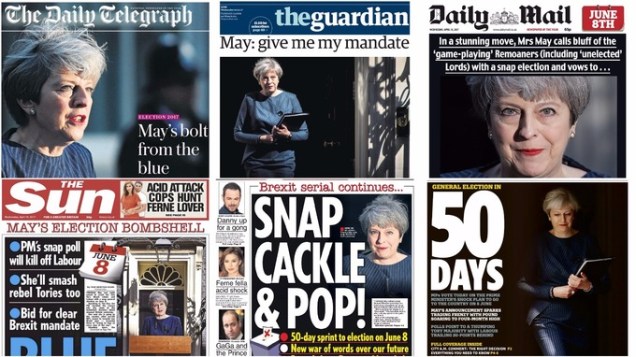
Theresa May - Snap General Election 8 June 2017

Does the prime minister’s decision to call a snap general election damage trust in politicians? No, but the actions of those MPs fighting a desperate rearguard attempt to overturn the referendum result and thwart Brexit certainly will

The received wisdom among the punditocracy seems to be that Theresa May has seriously damaged the public trust in her own leadership, and in the character of politicians in general, by reversing her earlier statements and calling a snap general election for 8 June.

The Spectator’s Isabel Hardman seems to be taking particular offence, singling out this decision as being emblematic of why voters distrust politicians and hold them in such low regard.

This might be true on the margins, but I would argue that most people do not devote a huge amount of time to storing up resentments over acts of political skulduggery and gamesmanship which impact the careers of individual MPs far more than the country as a whole.

The real reason for flatlining public trust in politicians is the fact that successive ministers, parties and MPs have continually promised radical change and sweeping improvement while offering nearly identical variants of the same centrist political consensus. People distrust politicians because for years they have claimed to hear public concern and anxiety about numerous issues – immigration levels, EU membership, state involvement in the economy, foreign policy – and then gone and done exactly what they wanted to do in the first place, without taking those concerns into account. People get angry about the real, material policy betrayals, not the cosmetic political ones.

Promising to cut net inward migration to the “tens of thousands” (wise or not) and then missing the mark by a factor of ten is liable to make people distrust politicians because it is a real and tangible failure. Offering a “cast iron guarantee” to hold a referendum on the Lisbon Treaty and then performing a complete U-turn is liable to make people distrust politicians because it actively takes away something that was promised to the electorate. By contrast, electoral shenanigans barely register on the same scale.

And yet the narrative that Theresa May has supposedly mortally wounded voter trust in politicians continues to grow, like a massive snowball picking up debris as it rolls down a hill:

Meanwhile, Isabel Hardman writes:

Today Theresa May broke her own promise about there being no early general election [..] She had been so adamant that even those who thought they knew her best after years of working together in Opposition and government had taken her at her world and were insisting until recently that May believed in keeping her promises and that there would be no snap general election.

[..] Oddly one of her complaints was that Westminster wasn’t ‘coming together’ after the referendum, as though it would be better if everyone agreed on everything she suggested, because consensus is such a good way of refining legislation so that it leaves Westminster in good shape.

This is great snark, but poor analysis. While unthinking, automatic consensus are never good, neither is blind, unreasonable opposition. The task before MPs is to help ensure that the UK achieves the best possible form of Brexit, given the clear instruction given by the British people to engineer Britain’s exit from the European Union. Yet there are many MPs – the entire SNP and LibDem caucuses, for instance – who have zero interest in abiding by the referendum result, and in fact have openly declared their intention to scupper the result and prevent Brexit by any means necessary and via any opportunity which can be grasped.

This is not reasonable. This is not respecting the will of the people as expressed through a majority of voters in a referendum whose legitimacy none of them complained about when they expected to win. In fact, this is deeply unreasonable.

To use a comparison from America, the behaviour of many Remainer MPs can be likened to Republican Senator Mitch McConnell declaring that the GOP’s main objective was to make Barack Obama a one-term president – not to help ensure American success despite their ideological differences, but to blindly and angrily oppose everything just for the sake of it in order to weaken the president. A temper tantrum rather than constructive opposition.

One can also compare the attitude of die-hard Remainers to the US Republican Party strategy when ObamaCare was being debated in Congress. Here was a president with a mandate and a congressional supermajority, but rather than engaging with the legislative process to inject conservative thinking and ideas into the eventual bill, the Republicans again chose blind opposition – including opposing policy ideas (such as the individual mandate) which were once approved by conservative think tanks and enacted by conservative governors. The result was a flawed attempt at American healthcare reform, which fell far short of achieving universal coverage or access and giving almost none of the parties what they really wanted (either single-payer or a deregulated insurance market).

Remainer MPs have a chance now to engage with the Brexit process, to apply pressure to help achieve the best kind of Brexit – in this blog’s view, an interim Norway-style option which preserves maximal single market access and avoids having to draw up alternative trade, regulation and customs arrangements against the clock. But this already unlikely goal cannot be achieved so long as so many Remainer MPs openly salivate at the idea of blocking Brexit altogether and brazenly boast about their intention to blindly oppose everything that this “Evil Tory” government tries to do.

Theresa May was right to state that Westminster needs to “come together” – not in blind obedience to a Tory manifesto but in acknowledgement of a legitimate referendum outcome which must now be enacted. Under this umbrella of basic respect for democracy there exists a vast spectrum for disagreement and opposition of particular policies and ideas, as is right for a liberal democracy. But unless we observe common rules and accept certain undeniable facts then we cannot work together productively.

Presently, too many pro-EU Remainer politicians are choosing the path of blind opposition as opposed to constructive engagement. They refuse to live in the real-world universe where they lost the EU referendum and the Brexiteers won. Living in denial is certainly their right – but in doing so they have given Theresa May exactly the cover that she needed to call this early general election.

Hardman concludes:

Actually, politicians are decent people, and all people can end up breaking promises. But the problem is that the voters have the same childlike sense of justice that doesn’t easily forget those broken promises (remember what happened to the Lib Dems in 2015 after their broken tuition fee pledge?)

Anyone who has worked with children who have been neglected in their early years knows that keeping promises is even more important, as each broken promise hurts terribly and reminds the child of the pain they felt when they were younger. Voters as a whole aren’t vulnerable in the same way, but they consistently show the same frustration with politicians when asked for their attitudes towards them in polls. And whatever they may say about their commitment to public service, but Theresa May and David Cameron have in recent years made it even harder for politicians as a group to gain the public’s trust.

This is a little condescending to voters, but there is some truth in it. I wouldn’t necessarily describe voter anger at broken material promises by politicians as being “childlike”. Rather, I think it represents that innate sense of fair play which is common to children and decent adults alike.

Promises should certainly be kept, but let us not pretend for another moment that all political promises are created equal. David Cameron standing down as an MP after first promising to stay on, and Theresa May holding a snap general election after promising not to do so – these acts simply do not offend the public trust as much as other, far more significant policy betrayals committed by all parties of government in recent decades.

Perhaps it is easy to lose perspective as an establishment journalist used to following every detail of the Westminster Game of Thrones, but out in the country actual tangible outcomes matter far more than the kind of palace intrigue which fascinates The Spectator.

But as even some Remainers (at least those outside of Parliament and the political elite) now realise, attempting to thwart the outcome of the EU referendum – either through procedural shenanigans or attempting to roll the dice with a second referendum, ignoring the fact that Article 50 has already been triggered – deeply offends that sense of fair play, and does so far more egregiously than Theresa May’s broken promise about not holding a general election until 2020.


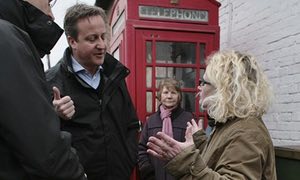
David Cameron confronted by angry voter

Support Semi-Partisan Politics with a one-time or recurring donation:

Agree with this article? Violently disagree? Scroll down to leave a comment.

Follow Semi-Partisan Politics on TwitterFacebook and Medium.