UKIP’s Subdued 2015 Election Broadcast: “Believe In Britain”


The first of UKIP’s party political broadcasts for the 2015 general election sets quite a different tone and mood than we are used to from the party. In fact, everything about the broadcast, now viewable on YouTube, seems designed to confound the expectations and prejudices of those who are reflexively opposed to UKIP and Nigel Farage.

Yes, the subject of immigration – UKIP’s key vote winner – is discussed in some detail. But this is the only context in which the European Union is mentioned, perhaps reflecting the party’s realisation that “banging on about Europe” is not attractive to voters in itself, and can only bear fruit when clearly linked to other subjects that voters consider important – like the state of Britain’s schools and hospitals.

The broadcast begins with Nigel Farage, seated against a black backdrop, channelling Monty Python by saying “And now for something completely different!” before breaking into a cheeky grin.

But what follows is neither laughably absurd nor tub-thumpingly, flag-wavingly nationalistic, which will no doubt come as a great disappointment to the party’s detractors.

Cue footage of Nigel Farage arriving at UKIP’s spring conference in Margate, greeting supporters and waiting in the wings while he is introduced before going on stage to deliver his speech. We then snap away to a voiceover, where Farage explains:

“UKIP was founded because people like me who were businessmen, not involved in politics at all, felt our political class were disconnected from ordinary people and were taking the country in the wrong direction. I think the point about UKIP, and the reason we call it the People’s Army, is it’s ordinary folks against the political class. That we’re a broad-based party and you’ve got people from all different walks of life, all classes, all races, all ages, and we want change”.

This is good counter-argument to those on the left who insist that Nigel Farage is every bit as much a part of the establishment as David Cameron or Ed Miliband, simply because he went to a private school and worked in the city – while overlooking the fact that Farage did not attend university, and makes the convincing case that he only entered politics because nobody else in Britain was advocating the policies that UKIP now champions.

When Farage goes on to claim that UKIP are “closer to the kind of conversations that go on in households up and down this country” not only is he likely right, he is also effectively rebuking the other party leaders – Ed Miliband is particularly guilty here – for their endless recounting of supposed interactions with “ordinary people” who just happen to think that they are doing a brilliant job, and who agree with their every policy pronouncement.

The broadcast then goes on to talk about concerns shared by nearly all British citizens, not just firm UKIP supporters – like worries about being able to afford a house, their children being able to find a good job, and whether the next generation will enjoy a better living standard than we enjoy today. When Farage bemoans the fact that “the rich are getting richer in this country, the poor are getting poorer and we want to do things, positive things, to help people” such as removing any income tax on the minimum wage, he sounds positively Labourite, not at all the Son of Thatcher.

It takes until the half-way mark until the first mention of “an end to uncontrolled, unskilled migrant labour coming into Britain and putting British people out of work” – as the camera cuts to the white cliffs of Dover. And then comes UKIP’s key message, placed very firmly in the context of needing independence from the EU to fully achieve everything else that the British people want: “I’m not against anybody, but I do think we have got to put the interests of ordinary British people first. We cannot have a net 300,000 people a year coming into Britain because of the impact on schools, on hospitals, on houses. But the problem is this: we cannot control our borders as members of the European Union.”

One man talking simply and honestly to the camera, contrasted with UKIP’s leader receiving a rapturous welcome at a local town hall meeting. With no tub-thumping and no scaremongering, no accusations or scapegoating of immigrants in sight. This calm and measured party political broadcast by UKIP is the work of a party no longer trying to expand its support base, but rather reassure their existing supporters that a vote for UKIP is “okay”, not something to second guess as polling day draws closer, or feel ashamed of as the other parties step up their attacks.

In an election campaign where Labour decided to wheel out the celebrity endorsements and the supposedly resurgent Green Party decided to squander any claim to seriousness with their boyband-themed election broadcast, UKIP decided to keep it simple – a sign of a party quietly confident of achieving gains, despite the barrage of attacks and a brace of new polls and articles suggesting that the party’s support is slipping back from its highs of late last year.

No dark warnings of invasion by foreigners. No union flag bunting. Not a single rendition of Land of Hope and Glory.

UKIP’s political operation is growing up. And the other political parties should be afraid.
 

UKIP Believe In Britain Party Political Broadcast General Election 2015

Rootless Tories Prefer LibDems Over UKIP As Future Coalition Partners

Nigel Farage Nick Clegg UKIP LibDem Coalition


An interesting (and concerning) poll in Conservative Home this week reveals that more Conservative supporters would prefer David Cameron to enter into a future coalition with the Liberal Democrats (again) rather than UKIP.

Paul Goodman breaks down the detail:

  • Liberal Democrats73 per cent. This finding may be a proof that familiarity doesn’t necessarily breed contempt.  To some degree it reflects the fact that Tories have simply got used to working with the LibDems.  It is also a tribute, in its own way, to the staying power of the Coalition: I put my hand up to not having expected it to last all the way to the end.
  • UKIP49 per cent.  Some members will see UKIP as a natural partner for the Party.  Others won’t, but will believe that differences can be fudged.  Others still, as with the Liberal Democrats, will feel that coalition is a price worth paying to keep a Conservative-led administration in office: in some cases, respondents will have selected both options.

What does it say about the modern Conservative Party and the mindset of its supporters, that they would prefer to enter into coalition with a party that is rabidly pro-EU and in favour of an ever-expanding public sector funded through ever-increasing tax bills on the successful, rather than UKIP, the party which (just about) believes in smaller government, lower and flatter taxes, personal responsibility, a stronger military and secession from the European Union?

The answer, of course, it that it says nothing good at all.

The fact is that some Conservatives have quite enjoyed having Nick Clegg and the Liberal Democrats as bedfellows for the past five years – the coalition has helped the wet Tories to cover their left flank, giving the party a plausible excuse for making little progress on shrinking the size of the state and zero progress on reclaiming power and sovereignty back from the EU.

But if the current course of the 2015 general election campaign tells us anything, it is that the bland centrism that characterises the modern Labour and Conservative parties is increasingly unattractive to voters. True, the smaller parties are seeing some shrinkage in their support as polling day nears, but we remain on course to see the largest ever number and percentage of national votes cast for parties outside the big three.

Whether left or right wing, people are finally getting tired of seeing their core convictions (be it trade union solidarity and income redistribution on the left, or personal liberty and small government on the right) bartered away in pursuit of ineffectual policies calculated to cause minimal offence to anyone.

Yes, the Tories still have work to do in order to detoxify their brand. But the answer is not for them to dress up in Labour Party clothing and bang on endlessly about the importance of public services and “our NHS”. Such an approach will never work – it has been tested to destruction by David Cameron and George Osborne, and has convinced no one.

To move to the left is to sidestep the issue and avoid the hard work detoxifying conservatism in Britain, when what is needed most is patient explanation and passionate promotion of the idea that small government and less state (and EU) interference in our lives would be something to celebrate, not to fear.

Here is an interesting – and different – way to frame the question to Tory activists and the Conservative Party leadership. Rather than simply asking whether they would prefer the devil they know or the devil they don’t when choosing a future coalition partner, let’s ask which of these UKIP policies and ideas have suddenly become so offensive to the modern Conservative Party that they would sooner jump back into bed with Nick Clegg than with Nigel Farage:

Sadly we already know many of their answers, and they give us very little hope for the immediate future of British conservatism.

Tim Montgomerie, The Good Right And The Battle For British Conservatism

David Cameron - Conservative Party - Tory Compassion - General Election 2015


With the opinion polls still neck-and-neck, David Cameron and the Conservative Party have good grounds to worry that they are not pulling ahead of Labour in the final month of the 2015 general election campaign.

The BBC’s poll of polls puts Labour and the Conservatives on 33% each, which, when constituency boundaries which favour the Labour Party are factored in, means that Ed Miliband’s party are potentially on course to win more seats than the Conservatives, throwing several highly unwelcome left-wing coalition scenarios into play.

Naturally, this is causing much hand-wringing both within the Conservative Party and the Tory-friendly press. But interestingly, much of the free advice being bandied about is encouraging the Conservatives to try to fight the election on Labour’s natural turf (such as emphasising the importance of public services), or to tack even further to the centre, in spite of UKIP’s challenge from the right.

The chief proponent of this strategy is Tim Montgomerie, who uses his most recent Times column (+) to argue that “a show of compassion” (whatever that means) from the Conservative Party could help to “swing the vote” in their favour. Montgomerie is absolutely correct in his diagnosis of the situation – an increasingly coddled, government-dependent British population representing unfertile electoral ground for the politics of individualism and self sufficiency – but hazy on his proposed remedy.

First, the good analysis:

The centre right has to worry that while Tony Blair was wooing Middle England it was really Gordon Brown who was running Britain. Blair was at the front of the shop but Brown was in the control room, overseeing the huge expansion in the number of people who received part or all of their income from the state. Even now, with austerity under way, 52 per cent of Britons receive more from the state than they pay in taxes. There are, to echo Mitt Romney’s infamous and ham-fisted description, more takers than makers. People who are dependent upon the state have every incentive to vote for bigger and bigger government and to get someone else to pay for it — especially, of course, “the rich”.

A redistributive, bash-the-rich message was exactly what helped Barack Obama defeat Governor Romney. If America, land of the free and home of the brave, was willing to choose big state interventionism over small state individualism then it’s hardly impossible that Britain might do the same in a few weeks’ time.

If ever there was a statistic to shock and shame British conservatives, it should be the fact that 52 percent of Britons are net financial beneficiaries from the state. In the conservative model society, there should be generous welfare support available for those suffering true hardship or disadvantage, but a level playing field and light-touch government regulations freeing everyone else to succeed to their potential.

Continue reading

Labour’s Arrogance Could Cost Ed Miliband The Election

Ed Miliband - Austerity - TUC March For The Alternative - Arrogance


With less than a month to go until the 2015 general election, the London Evening Standard (print edition) is currently running a Constituency Focus series, exploring the different dynamics and personalities at play in London’s diverse boroughs and constituencies.

Yesterday saw the focus on the constituency of Hampstead and Kilburn, this blogger’s home turf, with Labour candidate Tulip Siddiq featuring prominently. My own interview with Tulip Siddiq is here, and this blog’s overview of the electoral battle for Hampstead and Kilburn can be found here.

Today the focus moved to the west London constituency of Brentford and Isleworth, an area covering Chiswick, Isleworth, Brentford, Osterley and Hounslow, close to Heathrow Airport. Unsurprisingly, all of the main local candidates are proudly displaying their NIMBY credentials by opposing a third runway at Heathrow.

From the Standard:

In the Tory stronghold of Chiswick, the issue of school places dominates; while in the traditionally Labour-supporting parts to the west, NHS waiting times are the hot topic.

But the one issue that is a major talking point across the whole of the Brentford and Isleworth constituency is the proposed Heathrow expansion, which both the main candidates oppose.

Conservative candidate Mary Macleod won by just 1,958 votes in 2010, making this the 65th most marginal seat in the country. The constituency … is also one of the Tories’ 40/40 seats – 40 to win, 40 to keep.

But it is on the subject of austerity that a real difference is revealed between Labour and Conservative philosophies.

Ruth Cadbury, a long-serving Labour councillor and part of the Cadbury chocolate dynasty, is standing as the Labour Party candidate in the general election. And when she spoke about the level of Conservative support in the wealthier parts of her constituency, she had this to say:

Continue reading

UKIP Are Not The Ones Playing Politics With The Armed Forces

UKIP General Election 2015 Poster - Armed Forces - Dont Make Our Heroes Beg For More


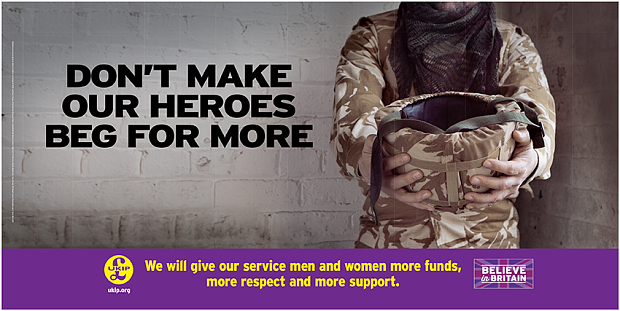
UKIP’s latest election campaign poster is quite striking, and not just because it has none of the bland, derivative unoriginality that marks out Labour’s feeble effort to capitalise on public fears about ‘our NHS’.

The body shot of a soldier in camouflage gear, holding out his helmet as though asking for a donation, with the words “Don’t Make Our Heroes Beg For More” should prick the consciousness of the nation – in Britain we do far too little to fund our national defence, honour those who currently serve in uniform and support those who have borne the burden of keeping us safe.

The BBC summarises the UKIP announcement on defence:

UKIP has set out its defence policy, including a new independent veterans’ minister and a national defence medal for all members of the armed forces.

It would also cut foreign aid in order to spend 2% of GDP on defence.

The party said there was “not a cigarette paper” between the defence policies of the Conservatives, Labour and the Lib Dems.

Sadly, not everyone sees UKIP’s announcement as a good thing. The Conservative Party, perhaps having finally rediscovered their sense of shame at the way they have squandered their traditional position as natural party of the armed forces, has gone firmly on the attack, accusing UKIP of “playing politics” with the topic of defence.

From the Daily Mail:

A Conservative Party spokesman said Mr Farage was ‘playing politics with the military in a calculated and completely irresponsible way’.

He added: ‘We’ve balanced the defence budget after inheriting a truly enormous black hole from Labour. We have the second largest defence budget in Nato after the United States and will spend over £160 billion in the next decade on new military equipment.

‘It comes down to this: you can only have strong armed forces if you have a strong economy first. That’s exactly what this Government is delivering. Ukip would put that at risk – making it up as they go along and letting Ed Miliband into Downing Street by the back door.’

In truth, UKIP are not so much “playing politics” with defence as they are being the only party bothering to talk about what should be a central issue in 2015. Can UKIP really be blamed for daring to bring up the British government’s shameful neglect of our armed forces and military capability when the other major political parties are determined to bury their heads in the sand? Can Nigel Farage really be accused of political opportunism for bringing up an important topic for public debate when David Cameron and Ed Miliband would rather pretend that the issue did not exist?

Continue reading