The Reaction To Labour’s Immigration Mug Is More Than A Storm In A Teacup

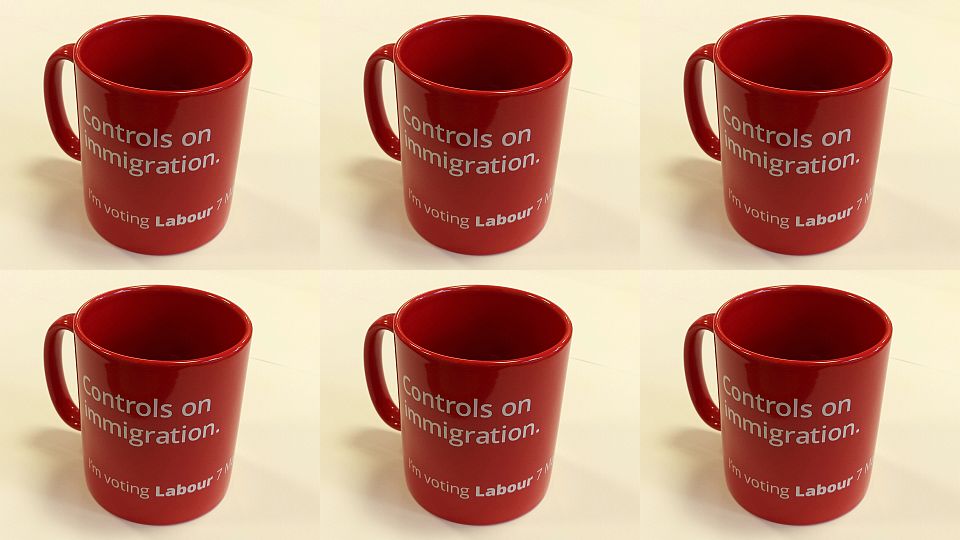
Labour 2015 General Election Mug Control Immigration - Immigration Policy


To mark the official start of the 2015 general election short campaign, the Labour Party celebrated by offering their supporters a commemorative coffee mug with Adolf Hitler’s face adorning one side, and quotes from Mein Kampf on the other. Or so one might be forgiven for thinking, judging by the pant-wettingly hysterical reaction of some left-wingers to Labour’s latest piece of campaign merchandise.

In reality, what happened was that the Labour Party released some campaign trinkets based on their “five pledges” outlining what they would do in government. The offensive mugs make reference to the fourth of these pledges:

CONTROLS ON IMMIGRATION: People who come here won’t be able to claim benefits for at least two years, and we will introduce fair rules making it illegal for employers to undercut wages by exploiting workers.

Cue hysteria and frantic disassociation from the “campaign essential” merchandise from the unthinking wing of the Labour Party, and its odd-couple ambassadors, Chuka Umunna and Dianne Abbott MP:

Diane Abbott, the MP for Hackney North and Stoke Newington and a former Labour leadership hopeful, tweeted a picture of the mug on Sunday afternoon with the words: “This shameful mug is an embarrassment. But the real problem is that immigration controls are one of our five pledges at all.”

Her tweet prompted a barrage of criticism against Labour on Twitter, with the Liberal Democrat MP Julian Huppert writing: “Wow. The stories are true. Labour have actually produced a campaign mug championing ‘Controls on immigration’.”

Owen Jones also felt the need to get in on the action, though one cannot disagree with his wider point that the Labour Party (and the others) would be better offering some hope, or a positive vision backed up by tangible policies:

Continue reading

Why Did The BBC Silence John Darvall?


John Darvall BBC bias General Election 2015 WordPress Blog 2


The personal WordPress blog of John Darvall, the BBC Radio Bristol presenter removed from his regularly scheduled programme because of his relationship with a Conservative MP, offers further clues as to why the DJ was silenced ahead of the 2015 general election.

In an article dated 9 November 2014, Darvall struck a decidedly cynical tone in response to the posturing of all the main political parties:

There is an election coming. You may have noticed. All the parties are squaring up to each other while trying to convince you that they ‘have a plan’. They all want to ‘help’ you and yours have a better life, they all say other parties offer you nothing and scare you about why you should be afraid of them if they get in.

We are, of course, being ravaged by ‘crisis’ in all our public services, there is failure on every front and it is all everyone elses fault, but not yours. You are the victim. This was the same in 1979, 1983, 1987, 1992, 1997 and so on. You didn’t ask to [borrow] the money, you didn’t use the services and you said yes when you should have said no. So now, as we hope for actual leaders to actually lead and real ideas to inspire us, it’s time to test and debate what they are offering. Exciting isn’t it? Well maybe it just might be in a world of four or even five party politics.

Does this sound like the ranting of an ethically compromised journalist eager to spin the news in favour of his fiancée’s political party?

On the contrary, it is the type of indiscriminate “plague on all your houses” lament that could be uttered by any but the most stridently partisan British voter. Rather than indicating a desire to talk up Conservative Party policies and accomplishments, this blog post suggests a weariness with all of the political parties, and impatience with the voters who keep falling for the same promises time after time.

Later in the piece, Darvall goes on to outline his semi-serious “manifesto” for Britain:

We all pay a flat income tax at 20% of our income, after that income exceeds £15,000 per annum. National Insurance is abolished, along with VAT. Once you earn over £100,000 you then pay 30% income tax and 40% over £200,000.*

You pay a further 2% of you income to you [sic] local council.*

Fuel Duty and Vehicle Tax is abolished and you pay 2p for every 1 mile you drive.

Both national and local councils must send you an annual receipt of what you paid and what they spent it on.

A visit to the Doctor will cost you £18.50, like a basic visit to the dentist, which is currently £18.50. The same exceptions will apply as in dental treatment and if you are undergoing treatment for a chronic illness you do not pay.

Flat taxes, a pay-per-use approach to Britain’s sacred public services and full transparency of how local and national government spend taxpayer money? Quelle horreur!

Not to mention Darvall’s heretical idea that the British people may themselves be partly to blame for the stale political consensus that currently entraps the main political parties.

It is starting to look as though the BBC torpedoed John Darvall’s career not because of any potential pro-Conservative bias he may have shown, but simply because he was no longer willing to pretend that this election (and the major parties competing in it) offers the British people anything like real democratic choice.

And shattering that particular illusion would be just terrible for ratings.

John Darvall And The BBC’s Warped Approach To Editorial Impartiality

John Darvall BBC bias General Election 2015


It can’t be easy for the BBC’s news division, required by law to produce strictly non-partisan coverage while being assailed by both left and right for failing to sing their respective praises loudly enough. And while much of this criticism may be deserved, the fact remains that most BBC journalists perform a difficult and valuable job to a good standard, much of the time.

But the BBC would make life much easier for itself by taking a more consistent approach to its handling of editorial, investigative and disciplinary matters. At present there is no consistency at all, leading to the strong (and correct) perception that there is one rule for some people (and political parties), and another rule for others less favoured.

Take the case of John Darvall, a local radio presenter for BBC Bristol who was removed from his regular presenting slot because he happens to be engaged to a Conservative MP:

John Darvall, of BBC Radio Bristol’s Mid-morning programme, is being moved before the general election but says that he has had no guarantee he will be able to return.

Darvall, 48, and Charlotte Leslie, the MP for Bristol North West, met four years ago on his programme. They began dating in October and the twice-married father of four proposed on Christmas Day.

He is being moved to an afternoon show with less emphasis on news due to “heightened sensitivities” and to avoid accusations of a conflict of interest. BBC bosses said that he will be back after May. During a phone-in on the sacking of Jeremy Clarkson, Darvall suggested that he might not be back even after the election. A caller suggested that he should apply for a job on Top Gear, to which the host replied: “Trust me, I have a lot of reasons myself to be angry with the BBC at the moment. I am coming off this programme tomorrow, so I might consider something of a career departure.”

Questioned by another caller, he added: “It’s to do with the election and protecting BBC impartiality. It’s not my decision. I’m honouring what the BBC have asked me to do and I sincerely hope to be back after the general election, and the BBC have sort of said that I might possibly be, barring any unforeseen circumstances.”

In short, John Darvall was removed from his position not for something he did, something he said or even something that he thought, but rather because of who his future spouse happens to be. This harsh and career-damaging reaction by the BBC –  as taking a journalist off the political beat at election time surely is – was meted out not even for thought-crime, but in Darvall’s case for existence-crime.

Continue reading

British Prime Ministers Should Have Term Limits, But Wider Constitutional Reform Is Needed

David Cameron 2015 election Term Limits Parliament Constitutional Reform


After the initial shock at David Cameron’s casual announcement that he intends to limit himself to two terms in office as Prime Minister should he win the 2015 general election, the nature of the media response is changing.

First came confusion and uncertainty as to what (if any) impact the announcement would have on the outcome of the election campaign currently upon us. Then came speculation about the impact on the Conservative Party, and whether the Tories would find themselves riven with infighting and jostling for position from the start of any new administration, effectively making David Cameron an instant lame duck. And then there were some rather tenuous claims from the left that Cameron’s decision was “arrogant” and presumptuous.

This blog believes that a far more interesting question is the mystery of who will replace Ed Miliband in the quite likely scenario that he fails to lead Labour out of opposition and back in to government, and is gently encouraged to fall on his sword on 8 May.

But now there is a school of thought among those riding to Cameron’s defence which holds that the Prime Minister’s actions were principled and honourable, and that his example should be formalised through the introduction of term limits for the role of Prime Minister.

Daniel Finkelstein, writing in The Times (+), is the latest high-profile convert to the cause:

Ten years is quite long enough for anyone to be prime minister. It’s not a good idea for anyone to enjoy power in perpetuity even if they have to get re-elected from time to time. Instead of this charade of asking the prime minister a question to which we all deserve an answer, and then calling him a fool or presumptuous if he answers, or a liar and evasive if he doesn’t, why don’t we just solve the problem for him or her?

We should have a term limit for prime ministers. Two terms and that’s your lot. And if you quit half way through your term, your successor should require an election within months. David Cameron’s answer should be compulsory.

Continue reading

British Politicians Ignore The Big Picture – But We Are To Blame

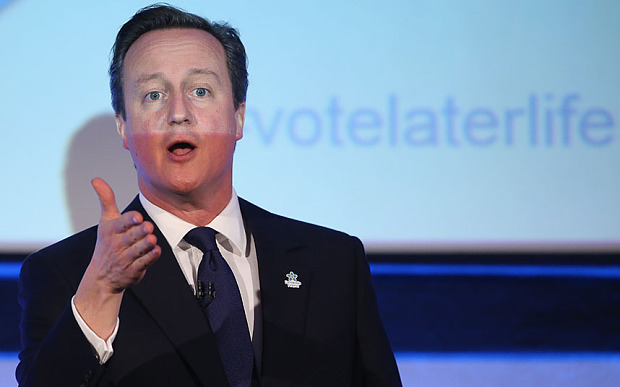
The Prime Ministers Visits Pensioners In Westeminster


In recent months, this blog has grown increasingly exasperated with the lack of anything resembling a coherent, overarching vision for Britain’s future offered by any of the main political parties, with the possible exception of UKIP (whose vision is very specific but not always appealing).

As Britain stumbled out of the financial crisis and Great Recession, we seem to have gone back to the days of fumbling along as a country, lurching from crisis to crisis, permeated throughout with a sense of “managed decline” rather than the positivity and optimism of more crusading governments – Margaret Thatcher’s first two administrations, or even New Labour under Tony Blair.

Yesterday, this sense that our national ambition appears to have evaporated, and that the people vying for the office of Prime Minister are little more than dull technocrats who want to minimise risk and wield power just for the sake of it, led me to ask:

What would it take for a British politician to tear up the current playbook (written by risk-averse party strategists so deeply buried in polling data that they have lost all sight of the bigger picture) and actually speak honestly and from the heart about the challenges facing Britain, and how we will overcome and surpass those challenges together?

What would it take for a British politician to take the moral high road and not seek to play one group of us off against another, instead reminding us that we are all united through our British citizenship, and that our fates – from the richest homeowner in Knightsbridge to the poorest council house tenant in Wolverhampton – are inextricably bound together, for better or worse?

What would it take for a British politician to suggest that as a country we might actually consider setting our national ambitions slightly higher than just having decent public services, that the country of Britten and Shakespeare and Berners-Lee and Hawking is still able to forge and reshape the world in a way that no other nation can?

Today, in the course of being heckled by a forum of elderly voters, David Cameron made unfortunate reference to his potential legacy. The Telegraph’s Matthew Holehouse reports in today’s election live blog:

Ill-advisedly, Cameron referred to his “political epitaph” in his speech.

“I don’t just want my political epitaph to read that I balanced the books, and cleared up the mess I inherited.

I am here today because I want a different kind of Britain,” he said.

Okay, so David Cameron wants to do more than balance the budget – probably just as well, considering the fact that even this basic accomplishment seems to be beyond the reach of either Labour or the Conservatives at present. But what is it that Cameron wants to achieve? What is this “different kind of Britain” that he wants to bring about?

Continue reading