Fighting Social Justice Warriors At Ohio University By Adopting Their Tactics

Ohio University College Republicans - Graffiti Wall - SJWs - Identity Politics

University Social Justice Warriors, with their victimhood culture and authoritarian tactics, are in danger of creating an equally illiberal conservative backlash

In a recent piece, Rod Dreher speculated as to what might happen if and when the usual targets of social justice warrior bullying come out of their defensive crouch and begin to fight back, playing the SJWs at their own game.

(The upshot: while an entirely understandable reaction, nothing good can from it; free speech will then be under assault from both ends of the political spectrum).

This comes in the context of Donald Trump-supporting students having their free speech right to advocate for Trump’s candidacy treated by snarling left-wing activists and cowed university administrations like some kind of grave assault on the safety of the campus community.

Dreher writes:

One likes to think that most students have enough residual dignity to restrain themselves from behaving like bully-babies.

What if that changes? What if students — whites, males, and other out-groups — decide that they’re going to fight fire with fire, and adopt Trumpian methods on campus, challenging the sacred victim status of the SJWs, and claim the mantle of victimhood for themselves, and intimidating university authorities until they get what they want? Trump has shown what you can do to acquire power if you just don’t give a rat’s rear end what people think of you. That is, if your own belief in yourself and your righteousness is so absolute that you are not susceptible to believing that it is undignified or dishonorable to present yourself in the public square as a victim. Trump’s genius is to present himself as both victim and victor, and that kind of thing is not going to work on campus. But sooner or later, the tactics of the SJWs are going to be taken up by their opponents, because that’s the only way they will save themselves from being entirely disempowered on campus, and in time, in the workplace. Trump has shown that establishments are weaker than people think, and can be pushed over. So have the SJWs. All that campuses need now are counterprotesters to the SJWs, making similar uncompromising demands from administrators, driven by nothing but their feelings of grievance. Then we can have a proper war of all against all.

Thanks, SJWs.

Unfortunately, this counterprotest is already coming to pass, with some American conservative students now adopting the same language of fragility and victimhood used by their leftist tormentors.

The College Fix reports:

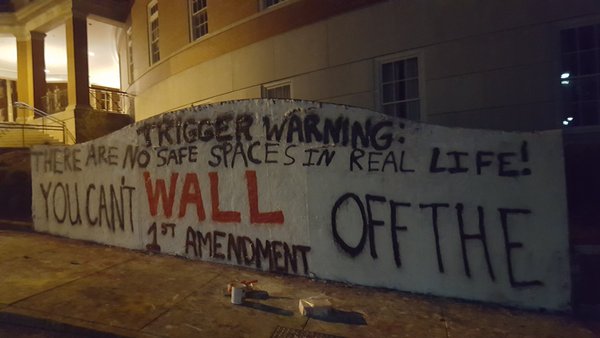
The College Republicans at Ohio University say they are under siege by peers for painting a message on the campus free speech wall defending the First Amendment.

In a barrage of cyber harassment over the last day, they have been called racists, described as Klansmen, and accused of literally threatening the campus — all over a painted message that read “Trigger warning: there are no safe spaces in real life! You can’t wall off the 1st Amendment.”

“It got so much hate, I just don’t know if I have ever received so much hate in my life,” David Parkhill, 19, president of the Ohio University College Republicans, said Thursday in an interview with The College Fix.

“Granted, I knew what I was getting into, but I didn’t think it would be that much hate,” he said. “We are basically a minority on this campus. Our opinion is so put down and so crushed, it’s almost like we don’t have a say.”

While the Ohio University College Republicans doubtless have a point – one can imagine campus life not being much fun for anyone with openly conservative convictions in the current climate – what is depressing here is the way in which David Parkhill, president of the OU Republicans, uses the same whining language of victimhood and oppression to elicit sympathy for his own embattled minority.

Nobody likes a pity party, but that is exactly what will get if conservative and liberal students face off against each other not as they should, through lively debate, but rather through constant, tear-stained appeals for the university authorities to intercede on behalf of their respective sides.

And in a sense, one cannot blame the Ohio University College Republicans for behaving in this way. They have watched for months and years while identity politics-wielding left-wing students get every little thing that they demand from spineless university administrations, and shame into submission anybody who stands in their way.

It is not therefore an illogical leap when other students conclude that this is the best and most effective way of advancing one’s own agenda. If the Social Justice Warriors can mobilise support and win concessions by emphasising (and frankly, grossly exaggerating) their supposed victimhood and oppression, why should conservatives not do the same?

But this can lead nowhere good. For a start, the SJWs have much more practice at wielding identity politics as a weapon. It is their bread and butter, they do it every day. Every linguistic trick and campaigning tactic to elicit the last drop of sympathy and support from sympathetic university authorities is already known to them, while as the Ohio University example demonstrates, conservative students are still taking their first baby steps at playing the victim.

Therefore, in the short term, conservatives will not only continue to be outgunned by the SJWs, they will squander whatever sympathy and respect they otherwise deserve by lowering themselves to the same tactic of  appealing to their weakness and minority status as a valid reason to clamp down on the freedom of others (SJWs) to organise and protest.

And in the longer term, if through repeated practice young students become adept at flaunting their fragility and exalting in their helplessness, both sides will fight to a bloody draw, with nobody able to say or do anything on campus without immediately triggering a protest and counter-protest. University will truly no longer be a place for the discussion of ideas, but a sheltered place of “comfort and home” for weak-minded adult babies, an intellectual demilitarised zone protected by a field of verbal landmines laid by every competing minority group over the academic and political discourse.

In other words, this is not the anti-SJW backlash that we have been waiting for. While it is unsurprising to see Ohio University College Republicans seeking to fight back in the way they believe will make the most difference in the short term, while they still have to live on campus, their adoption of the SJW’s own weapons and tactics will do nothing to halt the longer-term slide into authoritarianism, infantilisation and ever-more restrictive behavioural codes.

All of which makes it even more vital that the adults in the room – professors and university administrators – stop being so darn terrified of their own student populations, and actually start push back against any student or advocacy group which attempts to use their supposed fragility as a reason to shut down free speech for others.

As this blog has argued, students alone cannot halt the growth of safe spaces and censorship on their college campuses. Though liberty-minded students will have to be the foot soldiers in any such fightback, they can only succeed if they are given sufficient air cover by those in positions of authority and moral leadership – and on too many campuses, this has been pointedly lacking.

Some universities – like Mizzou – are starting to pay a high price for attempting to appease the mob rule of the SJWs.

How long will it be until more universities realise that they need to fight back and stand up to the identity politics takeover, or else face a similar fate?


Safe Space Notice - 2

Agree with this article? Violently disagree? Scroll down to leave a comment.

Follow Semi-Partisan Politics on TwitterFacebook and Medium.

Tales From The Safe Space, Part 25 – Student Action Alone Cannot Halt The Growth Of Safe Spaces And Censorship

St Olaf College Protest - Safe Space Policy

Students are leading the fightback against campus illiberalism and the Identity Politics takeover with almost no support from professors and university administrators. No wonder they are having limited success

As this blog noted last week in a worrying development, even some of those students who are now making the news for opposing the most authoritarian clampdowns on free speech on their campuses turn out to support the idea of safe spaces, trigger warnings and No Platforming in principle. In other words, their problem is not with censorship per se, but merely a quibble over its overenthusiastic application.

Latest case in point, this student from St. Olaf College in Northfield, Minnesota, who ruined a perfectly good protest about campus speech codes and draconian restrictions on free speech by conceding the broader point about the necessity of Safe Spaces.

From the Manitou Messenger:

On March 29, subscribers to St. Olaf Extra received an email from Anders Wahlberg ’17 in which he expressed his frustrations with St. Olaf ’s “incredibly broad and overreaching” policies regarding speech on campus and “the ridiculous concept of safe spaces.” Wahlberg closed the email with a call to other students who feel similarly to join his student organization, which “will offend people” and “will violate the sanctity of St. Olaf’s safe spaces.”

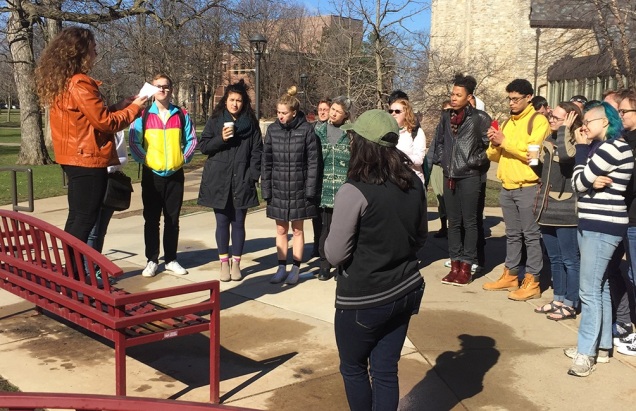
Within days of the email being sent out, Nikki Lewis ’18, Udeepta Chakravarty ’17 and Cynthia Zapata ’16 organized a rally in response. The rally was held in the quad on April 1 during chapel time and drew many students despite the cold temperatures. Both the organizers and representatives from safe spaces on campus spoke to the crowd.

“It’s always very hard when marginalized students on campus are trying so hard to make it clear that there’s issues at St. Olaf, and then emails like that go out,” Lewis said, “with so little regard to the fact that a lot of students on campus are subjected to hate speech and sometimes even hate crimes on this campus. So just sending out an email like that, what are you thinking?”

[..] Wahlberg’s email indicated that it wasn’t that safe spaces should be attacked, but that the mentality of safe spaces has not been contained in those safe spaces.

“By all means there should be safe spaces on campus. But making the entire campus a safe space is a threat to academic discussion and places people’s feelings above free speech. I don’t think there is a single issue that is ‘above debate.’ Classrooms, above all else, should not be safe spaces,” Wahlberg said.

In other words, limit free speech and infantilise students as much as you like on campus as a whole, just don’t do it within the classroom.

We should, perhaps, see the positive side in this. At least the student, Anders Wahlberg, appears to be motivated out of a strong and genuine concern for academic freedom. But tolerating any kind of exclusionary safe space where speech is restricted is inevitably the thin end of the wedge – conceding the principle of safe spaces means that the fight for free speech will ultimately be fought at the threshold of our own liberty.

Of course, one does not know the full extent to which potentially enormous social pressures force students to moderate or in some instances completely suppress their criticism of draconian speech codes, No Platform policies and other infantilising measures. It could be that Wahlberg would like to do away with Safe Spaces altogether, but knows that he would face total social ostracisation to the extent that speaking out fully is impossible.

And if so, who can really blame him? With very few honourable exceptions, most university administrations are running terrified of their student populations, falling over themselves to apologise and grant perks and concessions for the supposed injustices committed on their watch, almost before the Stepford Students themselves have had time to get into full outrage mode.

If I were a student today I like to think that I would take a vociferous, absolutist stance on free speech – but I would be under no illusion that the university hierarchy would have my back.

Cowardly concession after cowardly concession has shown that in a desperate final attempt at appeasement, many university administrations are happy to throw their allied supporters of academic freedom and free speech under the bus to buy a few more months of peace and quiet from their restive student populations.

It is always heartening to see students push back against attempts to infantilise them and limit their freedoms. But we are kidding ourselves if we believe that years of accumulated authoritarian and censorious policies can be overturned without the active participation of the academic establishment – dragged out kicking and screaming in support of academic freedom, if necessary.


Safe Space Notice - 2

Top Image: Manitou Messenger

Agree with this article? Violently disagree? Scroll down to leave a comment.

Follow Semi-Partisan Politics on TwitterFacebook and Medium.

Tales From The Safe Space, Part 24 – Finally, The Academy Strikes Back

Academic Freedom In An Age Of Conformity - Joanna Williams

When will professors and university administrators realise that they must work together with colleagues and rivals to stand a chance of withstanding and rolling back the current unprecedented threats to academic freedom?

Lest we begin to think it is all doom and gloom, it should be pointed out that some voices within the academy are pushing back on the demands of censorious students and the self-censoring impulse among university faculty to avoid giving offence or courting controversy.

Already in this series we have looked at the inspiring example of Dr. Everett Piper, president of Oklahoma Wesleyan University, whose resistance of “ideological fascism” puts many of his Ivy League peers to shame.

And now, winging its way to an Amazon locker near me is a copy of “Academic Freedom in an Age of Conformity” by Joanna Williams, a book which promises to get into detail as to the specific nature of the problem within our universities. Hopefully it will also provide some more detail – as well as proposed solutions to some of the questions raised – in Mick Hume’s worthwhile polemic “Trigger Warning: Is The Fear Of Being Offensive Killing Free Speech“.

Williams recently gave an interview to Inside Higher Ed to discuss the book, and this section from the Q&A is a breath of fresh air:

Q: Academic Freedom in an Age of Conformity has some choice words for the students who have in recent years sought to ban controversial speakers, discussions, art, etc., from their campuses. But you blame their censorship largely on their instructors, from whom you say they have learned. Is that fair? Some instructors, at least in the U.S., now say they’re afraid of their students, and are self-censoring because of them.

A: I think many academics are looking on in bemusement, or indeed horror, at this generation of censorious students. But I think academics need to engage in a far more honest debate about where such students have got their ideas — and their tactics — from. Of course higher education does not operate in a vacuum — and students do not arrive at university as blank slates. There are lots of different things going on here.

Too often nowadays students arrive at university having led quite sheltered lives and having been protected from discomfort. In many ways I think childhood itself has come to be equated with vulnerability. This carries over into universities. Young adults are treated as if being a student is in and of itself enough to make them vulnerable and in need of special protection. The campus comes to be seen as a safe space with infantilizing therapeutic interventions such as petting zoos. Students do not expect — and ultimately are not able — to deal with things that threaten their fragile sense of self.

These same students are often taught in the classroom that language is all powerful in constructing reality — that words can wound — in a way that goes beyond rhetoric that can upset us, move us and stir our emotions but actually to inflict psychic harm or real violence. When students who have come to see themselves as vulnerable are taught that language and images can threaten their identity, then the desire to ban is understandable.

Academics who are afraid of their students need to enlist the support of their colleagues in creating a university culture that is about learning through intellectual challenge rather than an entitlement to protection from discomfort.

Absolutely. The abysmal position in which even our top universities now find themselves is a confluence of several things going on all at once. There is the notion that some speech is beyond the pale and that bad words can equate to violence, which started with the “No Platform” concept several decades ago, and has grown to result in hate crime legislation which criminalises speech, writing or online activity which is perceived by any third party as likely to cause alarm or distress – a remarkably low bar for censorship.

Then there is our modern therapeutic culture, which as Joanne Williams (and this blog) rightly notes has raised a generation of young adults who believe that they are special, beyond reproach but also uniquely vulnerable and in need of constant protection by watchful authority figures. This sees students equating good mental health with a state of childlike regression, trying to face-paint and colour their way to equanimity.

And finally there is the rise of the Cult of Identity Politics or what Dr. Everett Piper calls “ideological narcissism”, whereby young minds are conditioned to believe that their arbitrary (and sometimes shifting) identity trumps not only the rights of other people to hold and express ideas which criticise those identities, but even trumps physical reality itself. Thus some students openly fret that allowing, say, a speaker who does not hold the mandatory stances on transgender issues to air their opinion will “invalidate the experience” or even the existence of trans students – as though Brendan O’Neill setting foot on their university campus would cause all trans people within a five mile radius to vanish in a puff of smoke.

What has been missing so far is any sign of co-ordination in terms of a fightback by the academy, which is where Joanna Williams’s book comes in. She herself has lamented that one of the problems is that professors and university administrators do not care about academic freedom in the abstract as much as they should, only becoming alarmed when their own campus or lecture theatre is engulfed in protest by self-entitled Identity Politics cultists.

Hopefully this book, “Academic Freedom in an Age of Conformity”, will begin to change that introverted aspect of academic life and prompt more professors and others to realise that the slide toward illiberalism and censorship taking place on one far-away college campus is a direct threat to their own.

Stay tuned for a full review of the book here in the coming weeks.


Safe Space Notice - 2

Agree with this article? Violently disagree? Scroll down to leave a comment.

Follow Semi-Partisan Politics on TwitterFacebook and Medium.

Tales From The Safe Space, Part 22 – Students For Slightly Less Coddling!

NUS Protest - No Platform Policy - Free Speech
What do we want? Slightly less censorship! When do we want it? At some point!

The student resistance to campus safe space policies and academic trigger warnings does not inspire much confidence

This student from the University of South Florida is mad as hell at being coddled and treated like a child with endless trigger warnings and safe spaces on campus, and she is not going to take it any more:

At USF’s Faculty Senate Executive Committee meeting on Wednesday, faculty members discussed trigger warnings and how to approach sensitive issues as they sought an answer to the growing demand for “tolerance” in classrooms.

No one is arguing most graphic material shouldn’t come with a warning, but creating campus-wide policies catered to coddling students will only inhibit our education.

So far so good. But it doesn’t take long before the wheels start to come off this student’s plea to be treated like an adult:

Obviously, no one wants a student to undergo stress or anxiety because of something they were blindsided with in class. However, it is ultimately up to both the professor and the student to ensure they can avoid that situation.

Professors need to begin offering detailed syllabi for their classes. Not a basic one-page overview of the course, but a week-by-week outline of what they intend to teach. While some professors already offer a detailed breakdown of their courses, many do not.

Yes, this will take more time to create, but let’s be honest — most professors don’t make major changes to their courses. Taking the time to create a detailed syllabus isn’t a big deal considering they can re-use it for years with just minor tweaks along the way.

Then it’s up to the students. Students, take five minutes out of your oh-so-busy schedule and actually read the syllabus handed out on the first day of class. If you see something is going to be covered that will trigger you, drop the class.

Do some research. Find out exactly what you’ll be reading before you commit to a course, and you won’t be caught off guard when the sensitive material comes.

Universities could even have a frank conversation with incoming students at orientation or during campus tours. Let them know this is a university, not an elementary school. In an effort to grow students’ minds and character, the university will approach subjects students may disagree with or find uncomfortable.

Oh dear. This isn’t so much an argument to sweep away the whole infantilising concept of trigger warnings and begin treating students like moderately resilient human beings once again, but rather a technical argument that trigger warnings should be brought forward to the beginning of the academic experience.

Breanne Williams is not upset with the idea of trigger warnings in general. She just wants one massive trigger warning placed at the beginning of each college class, or perhaps when students first arrive on campus. Quite how this is any less infantilising than individual content warnings before each lecture or book is never made clear.

Unfortunately, such is the calibre of much of the resistance to campus censorship these days. Even the voices arguing against the harshest and most illiberal measures often accept the general principle behind them – that words and text can be dangerous, and that students need to be protected from them.

Witness Edinburgh University students union officer Imogen Wilson, who stressed the importance of safe space policies to journalists even as she was being accused by others of violating the safe space of a student council meeting.

Or the protest outside the hugely censorious National Union of Students headquarters, where protesters held the risibly pathetic placards declaring “Reform, don’t scrap, no-platform policies”.

Depressingly, even some of the pushback against the censorious, infantilising treatment of students on campus now accepts the basic rationale behind trigger warnings and safe space policies. This is dangerous because conceding the fundamental principle – that free speech is dangerous, and that words can equate to “violence” – means that the debate becomes a simple matter of degrees, establishing an inevitable one-way ratchet to greater censorship.

The correct response to the slapping of trigger warnings on academic content is not “Please put them at the beginning of the class so that we can avoid studying entire subjects if we spot one thing in the syllabus which might cause us mental discomfort”.

The correct response is “To hell with your trigger warnings! Treat us like the adults that we are”.


Safe Space Notice - 2

Agree with this article? Violently disagree? Scroll down to leave a comment.

Follow Semi-Partisan Politics on TwitterFacebook and Medium.

Attention, Thought Criminals: Glasgow Police Have You In Their Sights

Greater Glasgow Police - THINK - Social Media - Police State - Free Speech

Glasgow Police’s conception of public safety is plain old fashioned tyranny

Imagine the kind of dystopian police state you would have to inhabit for it to be normal for the authorities to routinely warn citizens to be careful about what they think or say, on pain of criminal prosecution and potential incarceration.

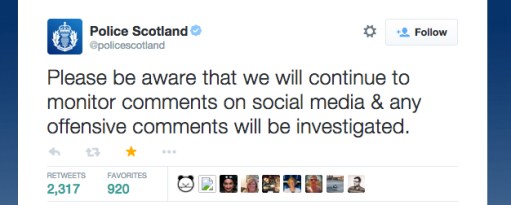
Well, you don’t have to imagine, because Police Scotland and the Greater Glasgow Police are busy constructing their own tribute to North Korea right here in the UK.

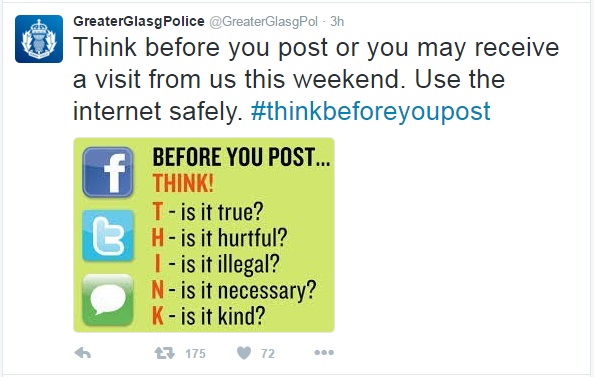
The tweet shown above was posted on twitter by the Greater Glasgow Police – unironically – this afternoon, along with the menacing hashtag #thinkbeforeyoupost.

Apparently before offering up our thoughts to the internet, whether they be on politics, cooking or sport, we are to ask ourselves whether what we are posting is True, Hurtful, Illegal, Necessary or Kind. The clear implication is that if our speech fails the THINK test, some snarling Scottish police officer will turn up on our doorstep to drag us away, much as the London Metropolitan Police did with Matthew Doyle last weekend.

This is something of a scope increase for the police, to put it mildly. Where once they largely confined themselves to preventing and solving crime, apparently having since eliminated all actual crime in our society (…) and finding themselves at a loose end, they are now eager to swoop in and punish speech which passes Britains’ already draconian hate speech laws but which happens to be arbitrarily perceived by others as hurtful, unnecessary or unkind.

Let’s call a spade a spade: this is tyranny. When an enforcement arm of the state can post jocular messages on social media warning citizens to be on their best, blandest and most inoffensive behaviour on pain of arrest, we do not live in a free society any more. And it is time that more of us acknowledged this, so that we can get on with the task of rolling it back and re-establishing our corroded right to freedom of expression.

Alex Massie thunders:

Whatever next? The monitoring of conversations in public houses? Why not? Twitter and Facebook, after all, are merely digital, virtual, gathering places. As the wags on social media have put it today, Thur’s been a Tweet and Detective Chief Inspector Taggart is on the case.

Beneath the necessary and hopefully hurtful mockery, however, lurks an important point. One that relates to something more than police stupidity and over-reach and instead asks an important question about the value placed on speech in contemporary Britain. The answer to that, as this and a score of other dismal examples demonstrate, cannot cheer any liberal-minded citizen. Such is the temper of the times, however, in which we live. Nothing good will come of any of this but you’d need to be a heroic optimist to think it will get any better any time soon.

What a country; what a time to be alive.

All very good points. If social media is fair game for the thought police, why not the local pub, too? What restraint should there be, besides time and resources, on blanket surveillance of everyone all the time in the pre-emptive battle against speech crime?

When will people finally start waking up to the sheer illiberality and the authoritarian nature of contemporary society?

When will people finally realise that weaponised offence-taking and the Cult of Identity Politics do not create a Utopian paradise of peace and harmony, that in behaving this way we are only driving bad ideas underground to fester and grow while punishing those who dare to think differently?

When will people get that having the state act as an overbearing, always-watching surrogate parent figure, monitoring our behaviour and punishing those who do no more than hurt our feelings, is creating a weak-minded and unresilient population who are unable to handle slights and setbacks without running to an external authority figure for redress?

In a healthy society, the author of that tweet by Greater Glasgow Police would have broken the law by using their position to threaten the right of the people to freedom of expression – a liberty which would be guaranteed in a written constitution enshrining our fundamental rights to life, liberty and the pursuit of happiness.

But we do not live in a healthy society, the police are free to do as they please without censure and there is no written constitution guaranteeing our liberties. Instead, we have a “make it up as you go along” constitution and form of government with a strong tendency to attempt to solve the immediate problem in front of it by taking power away from the people to act in their own interests and vesting those same powers in the state.

We are approaching the point where some kind of rebellion against this censorious, bullying, tyrannical behaviour by the police must be mounted – perhaps some kind of co-ordinated mass action whereby everyone tweets something “offensive”, gets a partner to report them to the police and vice-versa, the idea being to gum up the workings of the police and criminal justice system until the whole rotten edifice collapses in upon itself.

Semi-Partisan Politics is in very rebellious mood right now.


Police Scotland

Agree with this article? Violently disagree? Scroll down to leave a comment.

Follow Semi-Partisan Politics on TwitterFacebook and Medium.