Flexcit For Newbies – A Comprehensive Plan For Safely Leaving The EU

The Leave Alliance - Flexcit Workshop - EU Referendum - Brexit

There now follows a message from The Leave Alliance…

Richard North announces:

We’re all set up for the big day at the ROSL. The programme is all organised, with an opening address by Christopher Booker, the TED-style talk on Flexcit from me, and then Question Time.

The question-time is one of the key elements of the afternoon. Unlike the typical “talking head” presentation, you the audience are the stars. We’re looking for at least ten volunteers, each to ask a focused question, in a similar format. The questioner makes a short statement from the floor to introduce the subject, and then directs the question at the panel, comprising myself and Booker.

[..] Once we’ve chewed over the answer, the questioner gets a come-back, if they want it, and then we close on that issue and move to the next.  After editing, each becomes a YouTube clip, giving us a steady flow of material to post on the web.

Some of the topics to be addressed by the panel are as follows:

  • What will be the effect of Brexit on farming?
  • How will fishermen benefit from Brexit?
  • In view of the controversy over savings on contributions, how much do you think the UK will save?
  • Why isn’t Flexcit getting more (any) attention from the media?
  • Will expats be forced to return to the UK?
  • What guarantee can you give that the Efta/EEA option would not end up as the final step instead of the first?
  • What would happen if the UK failed to reach a trade agreement before leaving the EU?
  • Would the UK need to re-negotiate all its trade deals after Brexit?
  • Would the UK lose out by not being part of TTIP?
  • Will UK defence and security be damaged by Brexit?

Throughout the afternoon, we’ll have roving cameras, recording for vox pop contributions, with people responding to the simple question: “why do you want to leave the EU?” We’ll edit and collate the responses, which will make for another, and truly historic film clip.

I will be in attendance, representing Semi-Partisan Politics, for what promises to be a great event – and one which will answer many common questions about Flexcit.

The event will be held at the following time and place – do come along if you are able, I understand that tickets will be on sale on the door for £15 which is a small price well worth paying for an afternoon of education on the most important and existential question facing Britain today.


Princess Alexandra Hall

Royal Overseas League

Overseas House, Park Place, St James’s Street

London, SW1A 1LR

Saturday 23 April, 2pm – 6pm


The Leave Alliance - Flexcit

Agree with this article? Violently disagree? Scroll down to leave a comment.

Follow Semi-Partisan Politics on TwitterFacebook and Medium.

When Deciding How To Vote In The EU Referendum, Do Your Own Research – All The Information Is Out There

It is becoming fashionable among the undecideds in the EU referendum campaign to complain about the supposed lack of available facts in the debate. But they don’t want facts – they want to be spoon-fed opinions and simultaneously reassured that these answers are unbiased

There is a rather nauseating new trend among those people who have somehow not yet come to an informed opinion on whether or not Britain should vote to leave the EU, whereby they blame their inability to reach a decision on the supposed lack of available facts handed down to them from on high.

We even see this cropping up in Question Time, as the Independent reports:

With 113 days until the EU referendum – that’s more than 15 weeks away – levels of stamina among the public for the flow of information being directed at them seem to be waning.

And when the opening question of BBC’s Question Time was on how much the referedum’s outcome would depend on “which side could scare us more”, one audience member put the problem laid before the country in very clear terms.

A young man said the decision to continue or terminate the 40-year relationship all rested on wondering who could be trusted to give impartial, accurate information.

“With all this scaremongering that’s going on in the media about this, I don’t see how us as the general public can make an informed decision,” he said, prompting nods from those around him.

[..] In the light of such risks, the audience member seemed to be concerned that he was given little information with which to make a safe and long-term decision.

“It’s just all sides saying different things and you just don’t know who to believe,” he said.

Boo hoo. It’s so difficult for undecided voters today, bombarded with passionate (but often fact-free) arguments from both sides. How can they possibly be expected to vote when the government and the meejah don’t give them a clear and unambiguous signal?

The amusing thing is that the young Question Time audience member asking the question would probably have absolutely no difficulty using the internet to research a complex and technical query relating to his malfunctioning Playstation or home cinema system. He is likely adept at finding YouTube tutorials which show how to disassemble and repair household appliances, and if he has a favourite sports team, band or celebrity he can quite likely find all manner of information about them online with no difficulty at all.

But when it comes to the workings and operation of his own country and the European Union which influences so many aspects of his life, it apparently does not occur to the questioner that he can use exactly the same skills he honed researching his fantasy football team to turn up some relevant, unbiased facts about the EU. The thought simply does not compute. When it is something glitzy and fun, he is more than willing to spend five minutes consulting Google and a few hours reading through the results that his search throws up. But on “boring” matters like the governance of the EU, what the European Union might look like in the future or how Brexit might actually be accomplished, he loses focus before he can finish typing a query into the Google search bar.

Of course he is not getting unbiased information from the media. Playing the role of high-minded, neutral arbiter has not proven to be very successful for most media outlets, nearly all of which instead churn out content which plays to the gallery of their readerships. That’s life. But it does not mean that the primary information needed to reach an informed and independent opinion is unavailable. It just means forsaking Monday Night Football or the Great British Bakeoff for one night and using the internet or local library to make oneself a more informed and engaged citizen.

EU referendum blogger Pete North has by far the best response to these aggrieved undecided voters who flaunt their ignorance of the debate as though it is an injury inflicted upon them by evil external authority figures withholding “the facts”:

I watched Question Time last night. I heard that whining bovine complaint once more “I just want to be given the facts”, expecting that it’s the government’s job to spoonfeed them with information, under the assumption government can and will. Could they be any more bovine?

As it happens, the facts are available insofar as anything is ever truly a fact. On something as comprehensive as the EU there is all the information you could possibly want. And while you can say a lot of bad things about the EU, one thing we can say is that it is transparent. It publishes most of what it does, the schedules, the regulations, the meeting minutes, the agendas and the agreements. It’s all there if you can be bothered to look for it. I didn’t learn what I know by reading John f*cking Redwood.

And when it comes down to it people say they want the facts but they don’t. You can give them the facts but it’s always “tl;dr”. So they want a digest version of the facts. So you provide them with that and it tells them things they don’t want to hear – and so they stick with their ridiculous notions that either we can pull out overnight and comes the dawn of a new utopia – or on the other side the europhiles pretend the European Union IS that new utopia.

What people mostly want is to be told what to think. To have someone else make the decisions. To not let the complexity of life disturb their comforting ignorance. It’s the “I pay politicians to do the politics” attitude. THAT is how we get in these messes to begin with. Politics is too important to be delegated to these bozos and if this referendum has revealed anything it is that most of our elected representatives are intellectually subnormal and know f*ck all about nine tenths of anything.

In the end, to have a proper democracy participation requires more than just turning up to vote. It requires that you educate yourself, keep yourself informed, keep yourself up to date and find the facts for yourself – and especially that you do not rely on the media – after all our media are very much part of that political class with even less clue than the morons we elect. If you can’t be bothered to engage on that level you really do deserve everything you get from your “leaders”.

It is a lazy, naive idea that we can outsource the running of our country to elected politicians and only perk up and pay attention once every five years or so when there is a general election. As Pete North rightly says, that is how we got into this mess in the first place – people failing to hold their leaders to any kind of account, while the politicians did as they pleased.

If you want to be told what to think by the government or those in authority, don’t complain when David Cameron comes back with a one-sided, pro-EU propaganda leaflet costing the taxpayer over £9 million to produce and distribute. That’s what you get for outsourcing your decision-making processes to people with vested interests.

But at least if you do so, you are in plentiful (I won’t say good) company. Neither the official Remain or Leave campaigns are exactly brimming over with deep expertise on the workings of the European Union, in which direction the EU will travel or the logistics of achieving Brexit.

Fortunately, there are those who stopped watching television for long enough to educate themselves on this important subject. A number of them have become experts in the subject, certainly far more so than the Westminster media with its superficial grasp of the facts, all while holding down day jobs. They are the the bloggers of The Leave Alliance, and the plan they promote for leaving the European Union in a safe, orderly and non-disruptive way is called Flexcit, or the market solution.

Start with that. Or start with the European Union’s own websites – as Pete North says, much of this information is “hidden” in plain sight. Begin your search for facts in any number of places, just don’t repeat the whiny, false complaint that there is no factual information available.


Postscript: The irony is that facts and figures supporting either side are not the most important thing in this referendum, while economic projections are particularly unreliable to the point of being pure fiction. This blog contends that the EU referendum comes down to more qualitative factors like democracy, sovereignty, governance and constitutional reform, which simply cannot be calculated in an Excel spreadsheet.


European Union - United Kingdom - Britain - Flags

Agree with this article? Violently disagree? Scroll down to leave a comment.

Follow Semi-Partisan Politics on TwitterFacebook and Medium.

Taking Advantage Of The EEA To Ensure A Soft Landing After Brexit

All the benefits of Brexit without the risk of a “hard landing”

Could Britain avail itself of our existing EEA membership to continue trading with EU member states as part of the single market while leaving the EUs’ explicitly political organisation and structures? In a word, yes.

Ben Kelly sets out the process by which this would work – and the many advantages of this transitional step – in an ongoing series over at Conservatives for Liberty.

And in the video above, Dr. Richard North of eureferendum.com discusses the solution in detail, in an interview for Icelandic TV.

Up-to-the-minute information and commentary here.

Download Flexcit here.

European Parliament

Agree with this article? Violently disagree? Scroll down to leave a comment.

Follow Semi-Partisan Politics on TwitterFacebook and Medium.

An Open Letter To UKIP Voters

Open Letter to UKIP Supporters - Brexit - Immigration

Dear UKIP Supporter,

There’s no easy way to put this, so I’ll just come right out and say it. If you truly want Britain to vote for Brexit and independence from the European Union in the coming referendum – if that is your top priority right now, as it is mine – then we need to drop our demand to scrap the free movement of people between Britain and Europe and stop calling for stricter immigration controls on people wanting to live and work here.

Before you dismiss me as some pro-European mole from the Remain campaign sent to deceive you, hear me out. I voted for UKIP in the 2015 general election after much soul-searching, because I share your disillusionment and disgust with the political establishment and three main legacy parties – all of which are pro-EU to their core, and all of which have lied to us for decades about the European project and ever-closer political union. I also have admiration and respect for Nigel Farage, without whom we would not be having this referendum at all.

But this is our last chance to save Britain from being absorbed into a European state, and I am terrified of waking up on the morning after the referendum only to find that by insisting on every single one of our demands – particularly on immigration, which is a controversial topic with strong feelings on both sides – we scare the public, lose the vote and squander our only chance of escaping from ever-closer political union.

By asking people to vote to leave the EU, we are already asking them to place a lot of trust in our shared vision for a stronger, more prosperous independent Britain. Unfortunately, many people are swayed by the Remain campaign’s pro-EU propaganda, which relentlessly tells them that Britain is too small and weak a country to succeed on its own. You and I know that to be nonsense, but we already have an uphill battle on our hands to overcome the establishment’s formidable misinformation machine. And demanding an end to the free movement of people within the European Economic Area on top of everything else is just a step too far. People are naturally risk-averse, and keeping this issue on our list of demands is one thing too many.

I know that having secured the referendum from a reluctant David Cameron, it seems like total victory is within your grasp – that you are on the verge of getting everything that you have wanted for so long. And I know that despite the difficult general election result, there are enough indicators to convince you that the tide is turning in your direction, that the entirety of UKIP’s agenda can one day be achieved.

But I implore you to remember what happened to overconfident Labour supporters at the general election. They imprisoned themselves in an ideological bubble of their own making, used social media to talk to each other rather than convincing undecided voters, were hypnotised by their partisan Twitter feeds and drew the false conclusion that the country was about to make Ed Miliband the next prime minister. Their hearts were broken on May 8. Don’t make the same mistake.

I’ve seen some of the UKIP discussion groups on Facebook and the online newspaper comments sections, and I know you have, too. Yes, there are good points made here and there, and some very honest and decent people. But there is also an obsession with immigration that borders on the fanatical. To win the Brexit referendum, we need 51% of the country to vote with us, and like it or not, too many people simply don’t consider immigration a burning issue. They do, however, think that harping on the subject too much strays very close to xenophobia, and if our movement is portrayed as racist or xenophobic in any way, then it’s game over.

Besides, is immigration itself really the problem, or is it the negative side effects of immigration which need to be tackled – the impact on schools, housing, public services and community cohesion? Because there are ways that we can address these issues other than campaigning on a platform of ending free movement and enforcing strict limits on immigration, thus scuppering any chance we have of winning the referendum.

We can look at making our welfare system work on a much more contributory basis, and we can do more to ensure that local areas feeling the greatest strain of inward migration are given significantly more money and resources to help them cope. We can invest properly in adult education, reskilling our workforce for the jobs of the future so that hardworking British people are never left behind at the mercy of cheap overseas labour. And yes, we can also have that important conversation about British values, so that everyone who lives on these islands respects the unique culture and heritage which make Britain so special. Many of the levers to help mitigate the impact of immigration are not possible under EU law, but they would be if Britain were an independent country again.

But by insisting on ending the free movement of people within the European Economic Area as part of our demands for Brexit, we are letting perfection be the enemy of the good. At the risk of using too many clichés, ending free movement is the straw which will break the camel’s back and end our dream of leaving the European Union. Why? Because there are not enough votes in an anti-immigration stance to win, and because opposing free movement loses us nearly as many votes as it gains.

By insisting on ending the free movement of people as part of Brexit, 25% of the electorate will shun us because no matter how misguided they are, they hear “immigration controls” and think “racism”. And another 25% will be very wary of us because they are young, pro-European professionals or students who like the idea of easily being able to live and work in Rome or Paris if they want to, and understandably don’t want to jeopardise their own life chances. That leaves us with no margin for error – we would have to win every single other vote out there, which is just impossible.

But if we campaign for Brexit while promising to respect the free movement of people for the time being, we take away our opponent’s greatest weapon – the false and ludicrous accusation that we are Little Englanders who want to pull up the drawbridge because we are somehow scared of Johnny Foreigner.

Truth be told, you didn’t begin supporting UKIP just so that you could talk about immigration all the time, important though it is. Like me, you recognised that something fundamental is at stake when it comes to our relationship with the EU. Are we to continue sliding down the greasy slope toward European political union, where so many key decisions are taken in Brussels that the idea of Britain as a sovereign state with unique national interests becomes a laughable absurdity? Or are we finally ready to do what every major non-European country does, and face the world as a fully engaged, globally connected and influential world power? Will we continue to be governed by laws and policies set in Brussels where we have just 1/28th of a voice, or are we mature enough to govern ourselves?

At the end of the day, it comes down to one small word – democracy.

Like me, you supported UKIP because you saw Nigel Farage standing up for democracy when it seemed like nobody else cared. And the country owes you a debt of gratitude for what you did. I know many of you have received insults, abuse and worse for daring to vote differently than your friends and family, but your courage has brought us to a place where the dream of independence from the European Union and the return of democracy to Britain are within our reach.

Having got this far, it is all too tempting to assume that the same strategy which forced David Cameron to offer the referendum in the first place will also help us win it. But this is just not so. Nigel Farage did an amazing job turning UKIP’s 3% at the 2010 general election into 13% in 2015, but that still leaves us a massive 38 percent away from winning the referendum. And you just can’t make up that kind of gap by shouting the same message with a louder voice.

Bearing this in mind, I ask you to consider that no great endeavour is won without great sacrifice, and that something major has to change if we are to win the referendum and secure freedom and democracy for our country. And at this critical juncture, like it or not, the sticking point for the electorate is immigration and the free movement of people. Accept the status quo on the free movement of people for the time being and we have a fighting chance of extricating ourselves from the tentacles of Brussels. But stubbornly insist on getting everything we want, and we will be left with absolutely nothing.

This is a difficult and unwelcome message to hear, I know. But making this one sacrifice, and taking this one leap of faith – on the understanding that as an independent country we will seek to deal robustly with the negative consequences of immigration – will put victory within our grasp.

And just think of what we gain by being more flexible on immigration:

The young first-time voter who has only ever been taught good things about the EU and immigration will no longer be scared away by our campaign, and can then be engaged with our arguments about democracy and persuaded to vote for Brexit.

The young professional couple living in Manchester or London will be forced to pick between one side which wants remote and unaccountable government in Brussels and another side which wants laws made by the people they affect. And when they no longer have to worry that their freedom to live and work in Europe is in jeopardy, they will be much more likely to side with us.

Small and large business owners who are naturally eurosceptic but fear the potential uncertainty of labour supply or harm to the economy will be free to follow their hearts and vote for Brexit, knowing that there is no risk to their livelihoods.

Meanwhile, the sneering europhiles of the Remain camp will be dumbfounded, and their campaign left in utter chaos. Their whole argument is built on lying to voters and insisting that people like us only oppose the European Union because deep down we hate foreigners and want to see a complete halt to immigration. This is a golden opportunity to show them – and the country – that they are wrong, that while we have legitimate concerns about unrestricted immigration, we support Brexit because we are on the side of democracy first and foremost.

And ultimately, it is our faith in democracy – not our policies on immigration or anything else – which is our greatest strength, and the greatest weakness of our opponents. Unlike the europhiles, we can look voters in the eye and tell them that Brexit is about trusting them to make the right decisions for themselves and for our country. The Remain campaign has nothing to say about democracy, because they distrust the British people so much that they simply don’t believe we can run our own affairs.

So there it is.

We can win this referendum and secure Britain’s future for our children and grandchildren. But nobody said that it would be easy, or that this victory would be possible without sacrifice. Therefore we must be adaptable and willing to look at plans which have a chance of winning over undecided voters while simultaneously de-risking Brexit, even if it means that we don’t get everything that we might want.

And remember: democracy is key. If we win the referendum and keep Britain from being irreversibly absorbed into a political union, we preserve our freedom to revisit any and all other agreements with the EU in future, and to stand up for our national interest. But if we allow our greed to lose us the referendum, then Britain will soon be unable leave or change the terms of our membership, even if we want to. Dropping our demands on immigration is the safest thing to do, and it is also the right thing to do.

I hope that you will consider what I have to say, and bear it in mind as we respond to demands to show our plan for Brexit. Thank you for hearing me out.

With best wishes,

Sam Hooper

British citizen, former UKIP voter, Brexit campaigner
Open Letter

Agree with this article? Violently disagree? Scroll down to leave a comment.

Follow Semi-Partisan Politics on TwitterFacebook and Medium.

The Daily Smackdown: David Cameron’s Begging Letter To The EU

David Cameron - Donald Tusk - EU Renegotiation - Brexit - Referendum

The problem with the European Union cannot be solved through a renegotiation, because the renegotiation is just another symptom of the problem

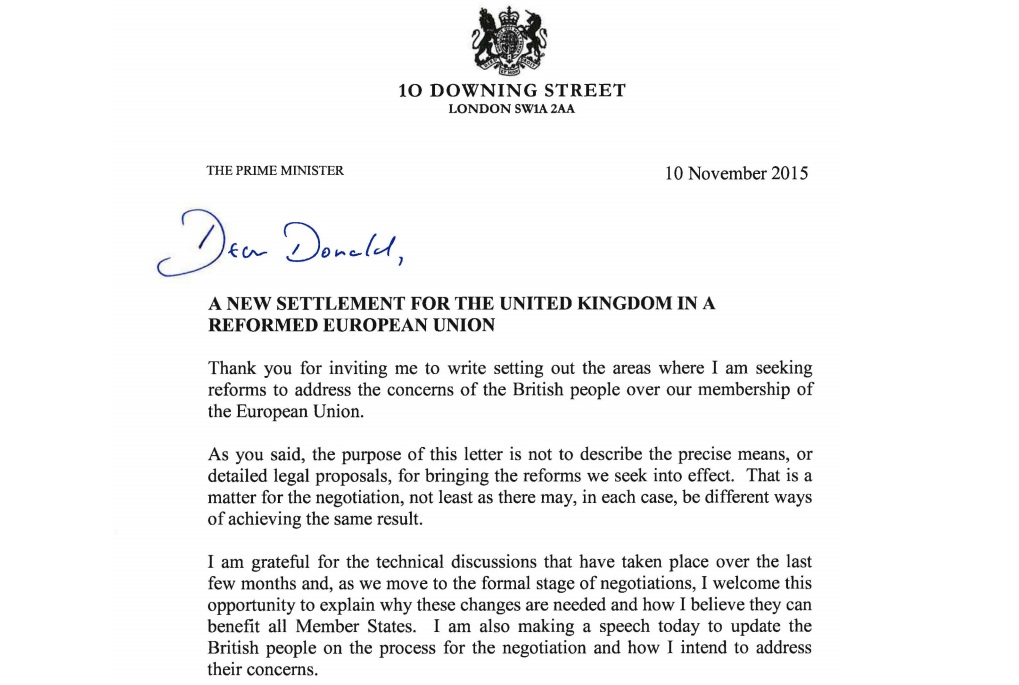
If you hadn’t already worked out that David Cameron’s EU renegotiation is a sham, a PR exercise from a PR prime minister designed to make it look as though Britain is leading real change in Europe when in fact we are merely haggling over a few cosmetic and inconsequential concessions, then your remaining doubts should now be answered.

Yesterday, the government released the wheedling, subservient letter that David Cameron has written to Donald Tusk, president of the European Council, begging his permission to reclaim a few minor and superficial aspects of British sovereignty. The fact that half of the prime minister’s demands – such as the call for the European Union to respect the principle of subsidiarity – are things which the EU has long been committed to doing on paper, but shown zero interest in following in practice – gives zero hope that whatever Cameron takes home from Brussels will be honoured.

But Britain’s fundamental problem with the European Union cannot be solved through a renegotiation, because the renegotiation itself is just another symptom of the problem. For as long as any British prime minister must flatter and beg countries like Portugal or Malta and seek their permission before acting in our own national interest, we have no true sovereignty and the European Union will remain an unwanted, antidemocratic millstone around our necks.

No possible outcome of David Cameron’s EU renegotiation will come close to touching this fundamental issue, because the EU is determined to remain a supranational political union, sitting above national governments and gradually acquiring more and more of their power. That’s just a fact, and those europhiles still in denial need to stop deluding themselves that an organisation with its own parliament, executive and judiciary is somehow just there to promote love and understanding between the peoples of Europe, with no designs on our democracy. Such a view is childishly naive.

Even if Cameron’s plea for Britain to be somehow exempted from the Treaty of Rome commitment to ever-closer union is heard, this will simply relegate us to a form of “associate membership” which would leave us – as Leave HQ put it so succinctly – “out on the edges and still on the leash”.

And so we are left with a cosmetic list of demands based not on any attempt to reflect the concerns of the British people, but based instead on what limited concessions David Cameron thinks he might be able to cajole from his European friends. He is essentially starting at his desired outcome (Britain voting to “remain” in the EU) and then working backward, rather than starting with Britain’s national interest at the forefront of his mind, and then letting the chips fall where they may when it comes to the renegotiation.

The whole exercise is a sham, and I refuse to be a part of it. I will not report the ups and downs of the coming “renegotiation” effort, with the inevitable carefully choreographed table-banging rows between Britain and France or the back-and-forth with Poland on migrant benefits access, because the whole thing is a PR exercise designed to make it look like our Conservative In Name Only government are looking out for our national interest when in reality they are only looking for a way out of an unwanted political problem.

Or as my Conservatives for Liberty colleague Ben Kelly puts it in his must-read piece:

There are no negotiations because the outcome of this act of political theatre has been decided for some time, the great deception is already in play. Osborne and Cameron will go through the ridiculous charade of demanding “associate membership” and their EU colleagues will play along and agree to their “demands”.

They will then return declaring a great victory for Britain and ask the public to endorse it in the referendum and give them a mandate to create our “new deal” in a “reformed EU”, which may very well include promises of minor concessions of reduced contributions and some leeway on the “four demands”.

On the surface, this two tier structure will seem enticing, in reality not only will we retain all the major disadvantages we currently suffer – from our trade policy being an ‘exclusive policy of the EU’, to the union’s redundancy in a globalised world, to its essentially anti-democratic nature – but once the eurozone integrates further we will be truly isolated within the union as a second class member.

What matters most now is not whatever choreographed stunt George Osborne or David Cameron cook up every day to make it look like they are going to battle for Britain. What matters most is honing our arguments in favour of Brexit to reach out to the undecided middle. And this means coalescing around a viable plan for a phased British exit from the EU, one which reassures wavering voters that stepping away from the EU is a prudent move, and not a leap into the unknown.

That plan is called Flexcit – I have seen no others that come close to Flexcit’s level of detail and rigour. All eurosceptics, Brexiteers and “Leave” campaigners now have a duty to read it, improve it where possible and then either champion it or propose a better plan of their own.

EU Renegotiation - Brexit - European Union

Further Reading:

The biggest gamble of all is to stay in the EU

The Cameron Deception: “associate membership” of the EU

Mr. Cameron still can’t beat the Flexcit offer

The EU makes us self-absorbed and insular

Agree with this article? Violently disagree? Scroll down to leave a comment.

Follow Semi-Partisan Politics on TwitterFacebook and Medium.