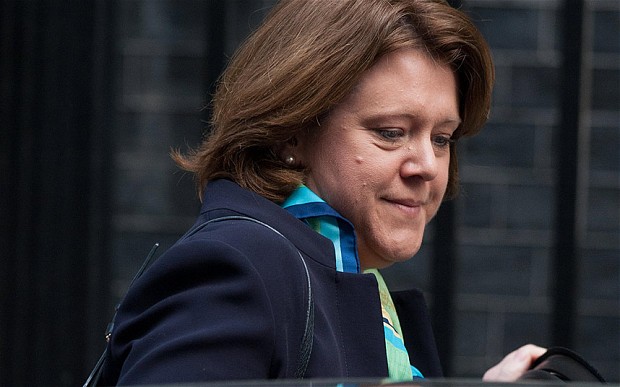
Maria Miller Resigns, But Justice Prevails Too Late

maria miller resignation

After resigning from the Cabinet, her hands finally pried away from her grip on office, Maria Miller actually did something quite rare and notable, which deserves recognition and adoption by other outgoing ministers under similar circumstances. The Telegraph reports:

Mrs Miller said on Wednesday night she was giving her £17,000 ministerial severance payment to a charity in her constituency.

Unlike a number of her colleagues, Maria Miller was not trying to make a fortune at the expense of taxpayers. Her breach of the rules was significant and certainly warranted this outcome (which could have been achieved at much less stress had Miller shown the humility to realise and atone for her errors earlier rather than clinging on for as long as she did), but donating her ministerial severance payment in this way was quite a noble act, one that she was by no means compelled to take.

Miller did not have to do this, especially when there was nothing left to salvage of her ministerial career. For Miller, it seems, it was not so much about the money as it was an ugly manifestation of that right-to-serve mentality and scorn for public disapprobation that still infects so much of the political class.

In truth, the particulars of Maria Miller’s excessive expense claims are quite mild compared to some of the more well publicised excesses of other departed politicians – employing relatives to do fake jobs, claiming rent paid to themselves, expensive furniture, third homes, premium home electronics and moat cleaning – but this is no defence.

Serving as a Member of Parliament and representing your constituents at Westminster is a privilege, not a right. And with that privilege comes the obligation to behave in a manner that is entirely above reproach in all areas related to the carrying out of those parliamentary duties. These obligations, and the commensurate scrutiny, should only increase if the MP is also a minister of state.

Serving in the people’s house is not just another career path where mistakes and transgressions should be overlooked in light of someone being a nice guy, or having had an impeccable record thus far, or having a family to feed. All other considerations are secondary to adherence to a strict code of behaviour and an unwavering following of the spirit – not just the letter – of the rules.

Maria Miller’s expenses intrigue was a remnant from the original expenses scandal, and as such theoretically could not have taken place under the news rules. This much is a far, if mealy-mouthed defence – one cannot retroactively try someone for committing an act that was not illegal at the time. But there, all sympathy for Miller must end. The former Culture Secretary was obstructive and threatening in tone and action, both to the parliamentary expenses commissioner and to the press who were seeking more information. Anything less than full co-operation with such an investigation is unpardonable. These actions alone warranted her resignation from the Cabinet.

Even now, however, it seems as though David Cameron is firmly stuck in denial that Maria Miller had to go and that is unequivocal support of her was wrong and hugely damaging to the public trust. The Telegraph reports:

At Prime Minister’s Questions, Mr Cameron defended his decision to support Mrs Miller. He said: “If people clear themselves of a serious offence, you let them get on with their job. That is actually the right thing to do.”

There was widespread public anger after the standards committee overruled Kathryn Hudson, the independent standards Commissioner, who called for Mrs Miller to repay more that £40,000.

Once again, David Cameron’s blind loyalty prevents him from correctly reading either his moral compass or the public mood, thus helping to reinforce everyone’s worst thoughts and convictions about the political class.

How long will it now take to undo this setback, to repair this damage that could have been almost entirely prevented with a swift and honourable resignation?

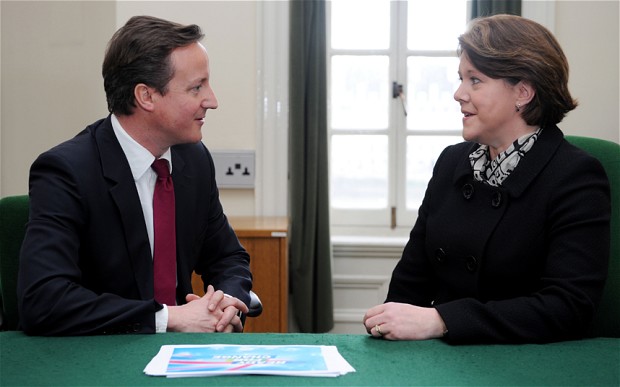
Maria Miller And The Government’s Contempt For The People

maria miller david cameron

According to the prime minister of the United Kingdom, it is both professionally and ethically acceptable for a Member of Parliament to use taxpayer money to house their parents and contribute toward the purchase of a property which is later sold having appreciated in value, the profits accruing to the lucky politician.

Furthermore, when questioned by the parliamentary expenses authority and by the media it is appropriate for an MP – in this case Maria Miller, the Culture Secretary – to obstuct, bully and harass those investigating the questionable expenses claims at every turn. There is nothing more to see here, the issue is closed and we should all stop fussing and just move on.

We know this because David Cameron tells us so.

The Telegraph summarises the tawdry scandal briefly enough to inform without entirely sapping the will to live:

[Culture Secretary Maria Miller] had to repay £5,800 in mortgage interest payments and also apologise for failing to cooperate with the parliamentary inquiry into her expenses. The Parliamentary Commissioner for Standards, Kathryn Hudson, had recommended that she pay back £44,000, an amount reduced by the MP-dominated Commons Committee on Standards.

But having housed her parents at the taxpayers’ expense, and made a capital gain in the process, Mrs Miller could be presented by the Tories’ opponents ahead of May’s European elections as the personification of alleged Westminster sleaze which so infuriates voters.

If any one image will come to symbolise this latest expenses scandal in British politics, it will be this – the picture of a haughty, self-entitled, unrepentant Maria Miller making her perfunctory, insincere and lightning-fast pseudo-apology to Parliament after having successfully reduced the amount which she was ordered to repay from the original £45,000 to an astonishingly low £4,500:

maria miller 1

Here, Maria Miller is flanked by a number of faces not commonly seen sitting on the back benches by virtue of their position – Health Secretary Jeremy Hunt and Chief Whip Sir George Young. This is no accident. They were ordered to sit with Miller to show the leadership’s determination to stand by the scandal-plagued politician no matter the public outcry.

The picture (from The Times) is essentially a freeze-frame image of Parliament once again conspiring to do right for themselves and act in the interests of the Old Boys (or, in this case, Girls) Club and against the interests of every single voter in the United Kingdom.

Iain Martin correctly surmises that the biggest beneficiary of this tawdry, self-inflicted crisis will be Nigel Farage and the UK Independence Party:

In such circumstances, the survival of the Culture Secretary is a dream for Ukip, as those Tory MPs observed. Having exploited the expenses system and made a sum most voters can only dream about, Miller then had her punishment watered down by a committee of MPs stuffed with the representatives of the mainstream parties. Farage can present Miller as a totem of all that he claims is wrong with the ruling elite.

Martin goes on to suggest that any benefit felt by UKIP would be the result of “scary populist politics”, which rather make one wonder whose side he is on – that of corrupt politicians or that of the people. But tactically speaking, he is quite right – the Maria Miller scandal can only redound to UKIP’s advantage because all of the other major British political parties are represented at Westminster and are consequently tainted by association.

Polly Toynbee, writing in The Guardian and no ideological soulmate of this blog, agrees that Cameron’s refusal to sack Miller – a case of misapplied loyalty at the worst possible time – will come back to haunt MPs from each and every political party and re-open the wounds from a parliamentary expenses scandal that had scarely been given time to heal since the original revelations:

The harm done to politics by the expenses scandal is felt by every MP in the blowback on the doorstep. Even the cleanest get the blame. Miller’s behaviour confirms the worst people think of politicians. How a £1.2m London property housing her husband, children and parents could be called a “second home” defeats most reasonable people. All those “second” bedrooms strike a wicked contrast with the bedroom tax. If her MP colleagues cutting a £45,000 payback to £5,800 was astounding, her 32-second stroppy teenager non-apology took the biscuit. Cameron should have sacked her that day, not for his government’s sake but to salvage a crumb of respect for the politician’s trade.

This really sums up the problem, a rather glaring one left conspicuously untackled since the expenses scandal blew up under the premiership of Gordon Brown – namely, the fact that the spirit of the rules governing expenses continue to be repeatedly violated and mocked, even if they are followed to the literal letter.

In the public mind, expenses exist to cover the necessary costs of performing a job, costs that can or should not be reasonably borne out of the employee’s own pocket. People tend to be reasonable and do not object to the idea of MPs being compensated for expenses incurred while conducting parliamentary or constituency business, just as they would never begrudge a business person legitimately claiming travel and accommodation costs when sent to visit a faraway client.

This blog advocates the introduction of a monitored charge card as the sole method of allowing MPs to pay for purchases to be expensed. Such a system – successfully deployed by many companies with vastly more employees than Westminster’s 650 serving MPs – would provide instant transparency and ease of auditing. In the twenty-first century, there is really no excuse for anything less.

Whenever talk of cracking down on expenses reaches a certain point, the counter-claim is often made that for our politics to work we must continue to attract the “brightest and best” talent to Westminster, and that frozen parliamentary salaries and stricter expenses policies will act as a grave disincentive. This is a self-serving and overblown threat, reliant on the assumption that the best statesmen and policymakers are motivated by cold hard cash. And while the 2015 general election will be the first to take place now that the new rules on expenses have bedded down, there seems little cause to worry that the next intake of MPs will be vastly different in composition to the bland automaton freshmen from 2010.

It is a popular conceit among MPs to believe that they are precious and irreplaceable altruists, but in reality there are many capable people willing and able to serve their country in parliament without also expecting the taxpayer to pick up the tab for their mortgage or second home as some kind of sick golden handshake deal-sweetener. Maria Miller belongs to a political generation that stubbornly refuses to acknowledge this new reality.

The longer that Miller’s petulant non-apology and the image of stony-faced Tory ministers supporting and flanking her on the backbenches remains forefront in the general consciousness, the more damage is done to what remains of public trust and engagement in the British political process.

It may be too late to claim any moral high ground for doing the right thing, but David Cameron needs to end the damage and guide the spirit of Maria Miller’s dying, unmourned political career towards the light.