Bitter Remainers Dream Of A Single Issue Anti-Brexit Political Party

EU Referendum - Brexit - Despair

Still firmly stuck in the “denial” stage of the grieving process, some bitter Remainers are now pinning their hopes on a new political party with the sole aim of thwarting Brexit

A number of overexcitable Remainers seem to be getting carried away with the idea that a brand new political party, dedicated solely to the purpose of thwarting Brexit, might be the answer to their prayers.

We first saw this idea floated in the Financial Times by Janan Ganesh, who did a masterful job of suppressing everything he knows about the British political system to convince himself that the idea might actually have merit:

A new political grouping has been in fitful gestation since Britain voted to leave the EU. Uncomfortable in their own parties, a few Conservative and Labour politicians have probed the idea in discreet settings. Donors are primed with start-up capital. Tony Blair has improvised a role as a curator of these forces, and at times as their frontman. An electorate that has withheld a decisive win from any party since his own days as prime minister is plainly open to some disruptive entrant to the market. If it shows promise, Liberal Democrat MPs might subsume themselves into it rather than stagger on as a futile dozen.

For all this, the breakthrough never comes — and not because Britain’s first-past-the-post voting system stymies the new. The project never gets that far. The trouble begins earlier. To avoid caricature as pro-European monomaniacs, and to let their restless energies roam, the people involved aspire to stand for something broad: political moderation in an age of extremes. This requires them to have policies, or at least first principles, across the full spectrum of government business. But each time a putative party settles its view on, say, fiscal policy or healthcare, it will alienate some of its original and potential supporters. It also loses definition. Before the project has a single achievement to its name, it is bogged down in matters of internal theology. It becomes a paradox: a fissiparous political party with no MPs.

Ganesh concludes with a well-rehearsed yet tone-deaf paean to the kind of bland, managerialist centrism which sparked this anti-establishment backlash in the first place:

A wider manifesto for moderate government might emerge, but only over time and as a consequence, not a cause, of the movement’s success. To design an entire worldview upfront is to wallow in detail before any political momentum has been established. And to lose friends in the process.

And yet the foolish idea is now gaining traction, with journalist (and ex-Chief of Staff to Brexit Secretary David Davis) James Chapman promoting the idea, as the Guardian excitedly reports:

A former chief of staff to David Davis has said Brexit is a catastrophe that must be stopped and called on centrist MPs to form a new party.

James Chapman, who worked for the Brexit secretary for a year as the Department for Exiting the European Union was set up, suggested the new party should be called the Democrats and claimed some “very interesting people” wanted to be involved.

[..] Chapman, who previously worked for George Osborne, said anti-Brexit MPs such as Anna Soubry, Grant Shapps and Mark Harper had more in common with party opponents such as Rachel Reeves and Vince Cable than “Owen Paterson et al”.

Let’s all take a moment to appreciate the delicious irony of a political party explicitly founded to overturn the results of a democratic referendum – and all in order to ensure that Britain remains a part of a supranational political union whose very purpose is to undermine nation state democracy – calling themselves the Democrats. This utterly shameless tactic is taken straight from the Karl Rove playbook, with Remainers projecting their own flaws onto their opponents while claiming the virtues of Brexiteers (commitment to democracy) as their own.

Nevertheless, Janan Ganesh and James Chapman both seemingly believe that the best way to overturn the result of the EU referendum and thwart Brexit is for pro-Europeans to band together and campaign only on that single issue, in the name of moderation and to avoid deadly infighting by introducing other ideological squabbles to the debate. But the problem with this thinking is that by definition, only those disaffected MPs who feel most strongly about stopping Brexit would join such a party, and they tend to be the swivel-eyed euro-federalists or dim but enthusiastic EU cheerleaders.

What the Remainers forget is that while the Leave campaign may only have won the referendum 52% to 48%, many of the 48% also have no real love for the EU. Even in my own North London constituency of Hampstead & Kilburn, one of the most defiantly Remain-voting constituencies in the entire country, I have spoken to numerous people who voted Remain either grudgingly or out of alarm at the apocalyptic stories spun by Britain Stronger in Europe.

Arch-Remainers have tended to assume – wrongly – that the full 48% who voted to Remain in the EU did so because they share the same fanatical devotion to the European Union as themselves, but this is not the case. Many people strongly bought into the Leave campaign’s argument about sovereignty and self-determination, but voted Remain because they prioritised short-term economic security over long-term democratic security. And one cannot entirely blame them for doing so – I fully admit that I am something of an outlier with my unfashionable, somewhat fanatical obsession with constitutional issues.

So how would a British public which was probably much more than 52% hostile to the EU at the time of the referendum react to the formation of a new political party created with the expressed intention of overturning the referendum result? Janan Ganesh clearly thinks that such a party would be greeted like liberators, come to rescue benighted Britain from the evil clutches of Nigel Farage and Boris Johnson. I’m not so sure.

While as a country we may be increasingly confused about what “British values” really mean, most of us would still point to the importance we attach to “fair play” being a defining national trait. And I think that the British people would take one look at a bunch of establishment arch-Remainers (led by Tony Blair, no less) attempting to undo the referendum result as a grave insult and a brazen power grab.

The New Party campaigners also totally overlook the dynamics of individual constituency races in favour of national polling. Even assuming that a new political party got off the ground (I’m not holding my breath) it would face exactly the same challenges as the SDP back in the 1980s, squeezed between a rock and a hard place as Labour and the Conservatives refused to stand aside.

Even Owen Jones sees through the scam:

And what then would be the point of such a party with (at best) only a handful of fanatical europhile MPs in Parliament? Even if Theresa May’s government falls before the next scheduled general election, the chances are that Brexit will either be concluded by this point or more likely that negotiations will be so far advanced (perhaps with a negotiation extended) that it is no longer possible to undo without accepting revised membership on harsh new terms (no budget rebate, mandatory joining of both Schengen and the Euro) that an overwhelming number of Britons would find unacceptable.

The whole idea is a complete non-starter, the futile fantasy of an establishment class which still believes that it can simply circumvent or nullify democratic outcomes rather than doing the hard work of convincing people and winning them over to their side. A year on from the referendum and the tantrum continues with no sign of abatement.

Having said that, by all means let them try. Lord knows that the Conservative Party would be an immeasurably better entity without the likes of Anna Soubry and Grant Shapps.
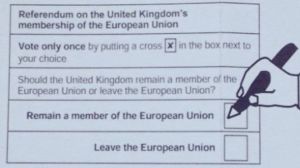
 

The Electoral Commission - EU Referendum Ballot Paper - Brexit - Biased Voting Guide

Support Semi-Partisan Politics with a one-time or recurring donation:

Agree with this article? Violently disagree? Scroll down to leave a comment.

Follow Semi-Partisan Politics on TwitterFacebook and Medium.

Remainers: You Can Stop Pretending To Be Patriotic Now

Jonn Elledge - Democratic World Superstate - Brexit

A rare moment of honesty from an arch-Remainer

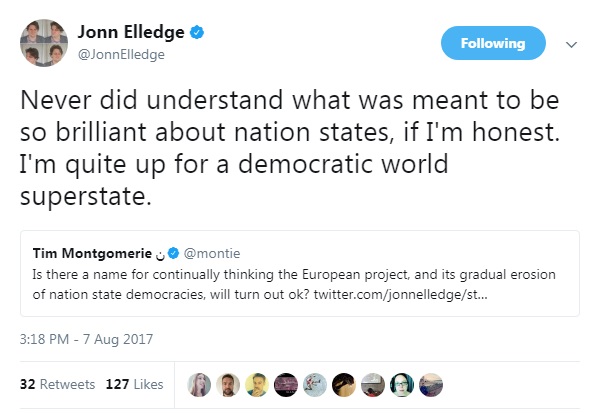
New Statesman staff writer Jonn Elledge – whom I recently described as “worse than a garden variety xenophobe” for his heinous statements about elderly Brexit voters, much to his indignant outrage – has been engaging in a minor Twitter spat with Tim Montgomerie this afternoon about the nature of Brexit.

This would be utterly unremarkable, but for one inadvertently revealing tweet in the exchange in which Jonn Elledge revealed in a moment of strange candour the real reason that establishment Remainers love the European Union and cannot conceive of a life outside of its cloying embrace.

Pressed by Montgomerie, who asked “Is there a name for continually thinking the European project, and its gradual erosion of nation state democracies, will turn out ok?”, Elledge replied, simply and honestly (for once) “Never did understand what was meant to be so brilliant about nation states, if I’m honest. I’m quite up for a democratic world superstate”.

This is an appallingly ignorant and historically illiterate statement, the kind of sentiment that could only be uttered by somebody who enjoys all the benefits of living in the age of the modern democratic nation state without pausing for a moment to consider the true source of all his comfort (hint: not the EU). Would Elledge at least concede that the nation state is a slight improvement on the city state? The multiethnic empire? The dynastic kingdom? Marauding tribes? He is at pains not to say, and yet is quite ready to roll the dice, jack in the nation state and try something new without really giving it a moment’s thought.

And there it is, ladies and gentlemen. Finally, a moment of honesty from the arch-Remainer side of the argument. Of course, those of us who followed the EU referendum debate closely and saw through the paucity and desperately narrow scope of the Remain side’s argument (focused almost entirely on negative scaremongering about trade with occasional rhetorical flourishes about “cutting ourselves off from the world”) knew that something deeper was motivating the EU’s loudest cheerleaders.

But of course Jonn Elledge and his co-conspirators could not admit their dirty desire in public during the referendum. They could not simply admit the truth – that they have no respect or appreciation for the nation state and its role in guaranteeing our core freedoms and liberties, and that they would sooner consign nations to the grave so long as they and their ilk could preserve their current perks and become true citizens of the world.

To admit their scorn for the nation state and eagerness of its demise would have been suicide during the EU referendum. Thus their only hope was to pretend to be patriotic and to have a love for this country and its many positive qualities (some of them are still continuing the pretence to this day to maintain their credibility in the hope of winning a potential second referendum) while secretly loving the EU precisely because it actively undermines nation states by design.

But of course the one world government (or “democratic world superstate”) longed for by Jonn Elledge (and no doubt many other Remainers in the secrecy of their own hearts) is totally impractical in any case, working against human nature rather than with it, as all Utopian left-wing pipe dreams tend to do.

Consider the case of the United States of America, fifty states combined into one great nation, bound together under the motto E Pluribus Unum (out of many, one). When it comes time for presidential elections, Americans do not stubbornly vote only for candidates from their own state, but instead choose from the candidate whose policies they prefer from any of the fifty states. A Californian might vote for a candidate from Illinois without so much as a second thought, knowing that the candidate will represent all of America if elected. Americans can do so in confidence because their sense of being American is stronger than their sense of being an Iowan, New Yorker, Nevadan or even Californian or Texan, the two states with the strongest sense of separate nationhood.

Now imagine an election for Leader of the World. Do you think that people from countries as diverse as Britain, Mexico, Malaysia, Russia, Greece, Kenya and Japan would vote high-mindedly for the candidate who offered the best suite of policies, regardless of his or her nationality? Would it even be likely that a candidate would offer a fair suite of policies rather than a manifesto geared toward benefiting his or her home nation? Of course not. Cultural differences are far more significant across national borders (despite the furious efforts of pro-EU “citizens of the world” to pretend otherwise), and out of protectionist instinct people would inevitably want to vote for a candidate from their own country, or at least a sympathetic country.

And who can say that they would be wrong to do so? Is Jonn Elledge seriously contending that he would be happy for the world to be led by a member of the Chinese Communist party? Or by a Putinesque Russian oligarch? Or a theocratic Saudi cleric? Of course he wouldn’t. Elledge, in his disdain for the nation state and desperate need to virtue-signal his abhorrence of patriotism, paints a fraudulent world of rainbows and unicorns where all cultures are equally praiseworthy and deep-seated cultural and religious differences are non-existent. Again, working doggedly against human nature rather than working practically with it.

There can be no world government because there is, as yet, no world demos. One day, probably quite far in the future, this may change. And that may be a good thing when it eventually happens. But we are not there yet, and to pretend that a “democratic world superstate” is either viable or desirable is foolishly naive as well as being oxymoronic – you can either have democracy or a world superstate, but not both.

I wrote about the ongoing importance of the nation state at some length back in 2015:

The liberties and freedoms we hold dear today can very easily slip away if we do not jealously guard them. By contrast, power is generally won back by the people from elites and powerful interests at a very heavy price – just consider Britain’s own history, or the American fight for independence from our Crown.

If we want to have a say in designing the new institutions that will govern our politics, trade, intra-bloc affairs (for we soon may not call it “foreign relations”) and other issues, we need to put the brakes on the demise of the nation state while we take stock and think about the future that we want, so that we do not end up in the future that our leaders and elites are building now in secret, without our consent.

Even if you find patriotism silly and the importance that conservatives attach to symbols and rituals to be absurd, it is still in your interests to slow down the juggernaut of European integration so that you too can help design the world our descendants will inhabit. You may laugh at the latest sensationalist Daily Mail headline, or think Nigel Farage a fool when he stands in his local pub, resplendent in tweed, drinking a pint of English ale. And that’s fine, you can laugh.

But think about what the world will be like in one hundred years, with its new technologies and services and ideas. Think about what innovations there will be in healthcare and banking and computing (and data collection) and travel. And then think about how much oversight and control we have over any of these things even today, in 2015. It it enough?

Imagine, then, the world of 2115. What institutions will then exist to safeguard our children’s  interests, and which bodies and authorities will they petition for redress of grievances? Who will control foreign relations between whatever nation states or multinational trading blocs remain, and who will decide whether to wage war using whatever unimaginable weapons we have conceived a century from now?

Do you entrust the EU with these powers? The World Trade Organisation? The United Nations?

The answer to this final question is apparently a resounding “yes!”, at least as far as Elledge is concerned. Any international or supranational institution is brimming over with legitimacy and ability to solve “a lot of stuff the nation state can’t do” in the mind of hardcore ideological Remainers, while the despised nation state offers nothing but insularity, bigotry and nationalism.

The naivety on display here is quite simply off the charts. Obviously it is one of the defining characteristics of those on the Left to leap towards radical change without stopping to think through the consequences, but to show a willingness to do so with something as fundamental as abandoning the nation state as the basic building block of human society is reckless indeed. Especially since neither Jonn Elledge or anybody else has proposed a viable alternative.

It is one thing to rage against the status quo and advocate for radical change. But to sneer at the nation state, close one’s mind to the stability and prosperity it has delivered and advocate for One World Government without even beginning to think through the consequences and practicalities should destroy once and for all whatever credibility Jonn Elledge and his ideological brethren have left.

And still we should be grateful. For too long, ideological establishment Remainers have walked a tightrope, angrily proclaiming that they are as patriotic as the next man (and taking great offence when the impossibility of this statement was pointed out to them) while doing everything in their power to ensure that the nation state is weakened, together with the fraying bonds which hold our society together. Now, finally, the mask is slipping. Whether through a moment of frustration or deliberate design, the real motivations are now being unmasked.

Now we see the hardcore ideological Remainers for what they are.


European Union - United Kingdom - Britain - Flags

Support Semi-Partisan Politics with a one-time or recurring donation:

Agree with this article? Violently disagree? Scroll down to leave a comment.

Follow Semi-Partisan Politics on TwitterFacebook and Medium.

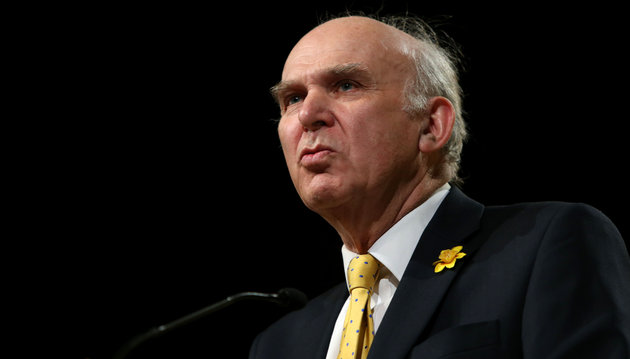
Vince Cable Joins The Anti-Brexit War On The Elderly

Vince Cable - Brexit

Remainers love to claim that the EU referendum “divided Britain”. But many prominent Remainers are perfectly happy to stoke divisions of their own in order to thwart Brexit

While any measured, rational human being ought to be immediately capable of seeing through YouGov’s recent flawed opinion poll – which was constructed to give the misleading impression of elderly Brexit voters being selfish extremists – new LibDem leader Vince Cable is happy to stoke intergenerational conflict in order to feed his desperate pro-EU confirmation bias.

Writing in the Mail on Sunday (surprising enough in itself, considering most bien-pensant elites view that paper as little more than a fascist propaganda newsletter), Cable moans and wails about how the older generations have supposedly “shafted the young”.

Cable writes:

The Remain argument about economic damage is now largely accepted. Mounting evidence of a slowing economy and rising inflation give substance to earlier warnings. The issue has become one of how to minimise or postpone the damage. And instead of countering the arguments, more and more Brexiteers are embracing economic pain as a price worth paying for ‘taking back control’: almost as a badge of honour.

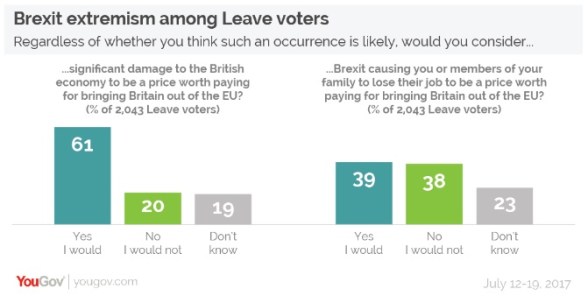
This attitude has reached worrying proportions. Press stories refer to ‘martyrs for Brexit’ based on a YouGov survey suggesting 61 per cent of the public would accept ‘significant damage to the economy’ from Brexit and 39 per cent ‘don’t mind losing their job’. These figures seem wildly implausible.

I don’t encounter people running around saying ‘please make me poorer’ or ‘please sack me’. These figures are also difficult to reconcile with polling which shows 66 per cent of voters wanting to remain inside the single market.

Of course, as I explained at length in my response to an equally idiotic piece in the New Statesman, there is in fact no contradiction here. It has nothing to do with being a “martyr”, or acting irrationally against one’s economic self interest. Rather, elderly voters simply understand that there are other motivations and considerations besides short term economic gain.

Having grown up in the post-war years and through the Cold War, older voters tend to appreciate the value of democracy and self-determination more than young voters who have never faced existential threat and for whom the EU has been an ever-present reality and an unquestioned positive force. And Vince Cable probably knows this full well, but it suits his purposes to portray those with differing political opinions as somehow unhinged or even malevolent.

Ironically, immediately after impugning the motives and morals of older Brexit voters, Vince Cable then goes on to make a plea for tolerance and mutual respect:

But the last thing the UK needs is further polarisation. There is already more than enough bad-mouthing of opponents and questioning of the patriotism of those who criticise the Government.

The gall of these establishment EU-defenders is absolutely off the charts. Where once a senior politician might have felt a degree of shame that would have prevented him from contradicting himself so completely in an Op-Ed, Cable does so proudly, fully expecting not to be picked up on it. This is how little establishment centrist politicians think of voters and their capacity to understand political or rhetorical arguments. But it is also a sign of the desperation in the Remain camp, as the dream of thwarting Brexit altogether recedes further and further into the distance.

And it gets worse:

To describe such masochism as ‘martyrdom’ is dangerous. We haven’t yet heard about ‘Brexit jihadis’ but there is an undercurrent of violence in the language which is troubling. We have already had the most fervent of Brexiteers, such as Nigel Farage, warning of civil unrest if the ‘will of the people’ is frustrated.

Brexiteers may well be frustrated since the practical difficulties of Brexit, as well as the costs, could result in Brexit never happening.

This is a clever little construction of Cable’s, writing that we haven’t yet heard about “Brexit jihadis” while simultaneously inserting what he clearly hopes will become the Left’s new insult of choice into the public discourse. Let’s be clear – the leader of the Liberal Democrats, that party which considers itself so rational and pragmatic, has just compared Brexiteers who dared to weigh considerations other than economic gain when voting in the EU referendum to jihadis. To murderous Islamist terrorists who maim and kill.

At what point do we stand up to the establishment’s collective hissy fit over Brexit? At what point do decent people refuse to be thus insulted by what Tim Montgomerie called the very “greybeards” who only recently urged further EU integration and the Euro on us even as these failing policies devastated the younger generation, particularly in southern Europe?

That’s not to say that Vince Cable is wrong in many of his warnings about Brexit. In many ways he is right to warn about the implausibility of hammering out a bespoke deal with the EU by 2019, and to urge a slower, managed transition which maintains current access to the EEA. But all of these sensible warnings are completely overshadowed by the overwrought, flowery language suggesting that Britain’s grey-haired voters are supposedly full of hatred and malice towards the children that they raised.

Are the older generations completely innocent? Of course not. Valid arguments can be made that they have been too sheltered from “austerity” and the consequences of the Great Recession thanks to universal benefits and the “triple lock” on pensions. And certainly, as a demographic with a high propensity to vote, the retiree lobby has been very successful in seeing their interests turned into government policy.

But Vince Cable’s over-the-top attack on older voters immediately turns them back into sympathetic characters, and only makes it harder to question the privileges that they have accrued through successive government policy. Comparing decent people who have worked their whole lives and done so much to build the country in which we live today to radical Islamist terrorists is so heinous, so wildly excessive, that sensible discussion becomes impossible.

This kind of behaviour might be just about acceptable from someone like me – a relatively unknown political blogger perhaps looking to make a splash by saying something outrageous or provocative (see Abi Wilkinson’s clickbait call for a 100% inheritance tax in the Guardian). But Vince Cable is not an obscure political commentator. He is leader of the Liberal Democrats, a political party which still purports to be taken seriously.

In reality, most people vote both for reasons of self interest and for the perceived good of society. The truth about the elderly Brexit vote probably lies between Brendan O’Neill’s lionisation of these voters and Vince Cable’s haughty dismissal.

O’Neill has been effusive in his praise:

I find it deeply inspiring, moving even, that my fellow Brexiteers are willing to have it rough in the name of democracy, in the name of bringing law-making back to where every progressive of the modern, Enlightened era believed it should be: in the nation, under a people’s oversight.

I straight up got a lump in my throat when I read the bit of the YouGov research that says many Leave voters would even be okay with losing their own jobs, or seeing a family member lose a job, in the name of Brexit. Thirty-nine per cent said such personal hardship would be a price worth paying, against 38 per cent who said it wouldn’t be. Now that’s devotion. That’s idealism. And if it seems alien to us, that only goes to show what a flat, grey political era we live in.

Indeed, the rather elitist alarm that has greeted the revelation that people are willing to suffer for their democratic ideals sums up what a baleful influence technocracy has had on our political imagination. In the technocratic era, when politics has been drained of big ideas and reduced to a box-ticking exercise that is all about managing society, its inhabitants and their aspirations, political passion can seem threatening. Strong feelings, democratic devotion, self-sacrifice – these have become foreign bodies in a time when politics is about making things chug along as uncontroversially as possible. To the technocrat, to the EU suit who drafts laws far from the madding demos, the utterance ‘I am willing to go through hardship for what I believe in’ seems perverse. It’s disruptive. It is because we inhabit such a beige world of spun, small politics that the willingness of us Brexiteers to suffer for our beliefs can look like ‘extremism’.

I get where O’Neill is coming from, even though I think he goes a little too far, reading something that both he and I desperately want to see (a return to conviction politics and commitment to ideology rather than fudged centrist compromise) into a vote whose motivations were more nuanced than either extreme.

In truth, elderly Brexit voters are neither selfless heroes nor foaming-at-the-mouth jihadists. But as far as the media is concerned, the narrative about older voters being selfish is too convenient to ignore. Unfortunately it reveals a gulf of misunderstanding, as Vince Cable makes clear:

The old have comprehensively shafted the young. And the old have had the last word about Brexit, imposing a world view coloured by nostalgia for an imperial past on a younger generation much more comfortable with modern Europe.

If I had a pound for every time some sanctimonious Remainer airily asserted that Brexit was motivated by “nostalgia for an imperial past” then I would never need to work again. In reality, the Lord Ashcroft poll taken in the immediate aftermath of the EU referendum clearly showed that the principle motivating factor for Leave voters was “the principle that decisions about the UK should be taken in the UK”. Perhaps this lacks nuance and an understanding of modern day interdependence in the regulatory environment, but it is also a clear and unambiguous call for the same kind of autonomy enjoyed by countries far smaller than ours in terms of GDP such as Australia, Canada or Korea. This is by no means unreasonable, and cannot be fairly caricatured as some kind of imperial nostalgia.

So why pretend that it is? Either Vince Cable is so full of self-hatred for his own country and its history that he believes that our dissolution as an independent nation state into an increasingly federal EU is somehow appropriate “payback” for our transgressions in the days of empire, or he knows full well that the Brexit vote was not motivated by imperial nostalgia but simply finds this to be a convenient trope with which to whip up his own supporters.

For now I will do Vince Cable the courtesy of assuming the latter rather than the former – that he is in fact not a self-hating Brit, but rather just a cynical old politician like so many others. But the longer this tantrum against anyone and everyone who voted for Brexit goes on, the harder it becomes to assume good faith on the part of the furious Remainers.

At some point the Vince Cables of this world have to either engage with the real substance of Brexiteer arguments, attitudes and motivations, or else just admit that they don’t care – that they simply feel blind, unthinking hatred towards those who disagree with them and have no interest in rational discussion.

It might actually prove quite cathartic; rather than having to make increasingly ludicrous arguments that people voted for Brexit somehow want to bring back the Empire, Vince Cable and his ilk could simply have their Two Minutes Hate every day and be satisfied.


Vince Cable - Brexit - EU

Support Semi-Partisan Politics with a one-time or recurring donation:

Agree with this article? Violently disagree? Scroll down to leave a comment.

Follow Semi-Partisan Politics on TwitterFacebook and Medium.

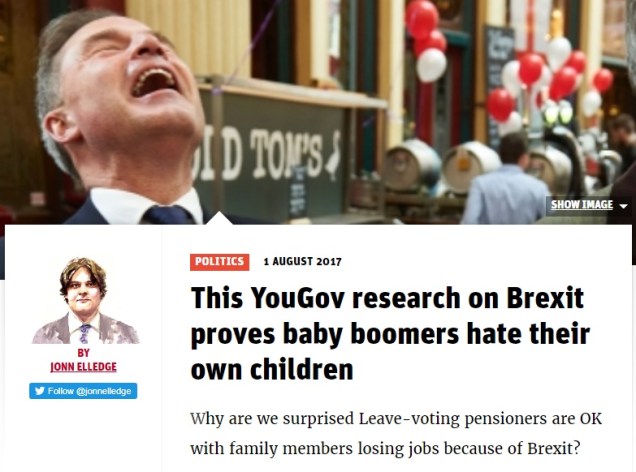
Does Brexit Mean That Baby Boomers Hate Their Own Children?

New Statesman hysteria - Brexit means baby boomers hate their own children

The idea that parents and grandparents would vote Leave out of hatred for their own children is as absurd as it is vile. But some Remainers will make any accusation in their rage against Brexit

The baby boomers of Britain are in the grip of a virulent, infanticidal mania. The EU referendum apparently caused highly contagious spores to be released into the air,  primarily affecting those aged 65 and over, causing them to forget any maternal, paternal or other protective familial instincts and instead seek to cause maximum financial and emotional suffering to their own children and grandchildren, for the pure pleasure of it.

Or at least so says Jonn Elledge, staff writer for the New Statesman, who brings every ounce of confirmation bias in his body to bear on a new YouGov poll in order to pronounce that by voting for Brexit, baby boomers and older people must actively “hate their own children”.

First of all, let’s be clear about what the YouGov poll actually says:

YouGov poll - Brexit extremism

That is, a significant majority of Brexit voters would be willing to tolerate significant damage to the British economy in order to see Brexit fulfilled, a tendency which the poll goes on to reveal becomes stronger among older age groups.

Is this necessarily evidence of “Brexit extremism”? Perhaps, but one can only say for sure if one takes it for granted that economic growth (or avoiding economic harm) is the sole valid consideration of a rational person, a premise which neither the poll nor Jonn Elledge even attempts to make.

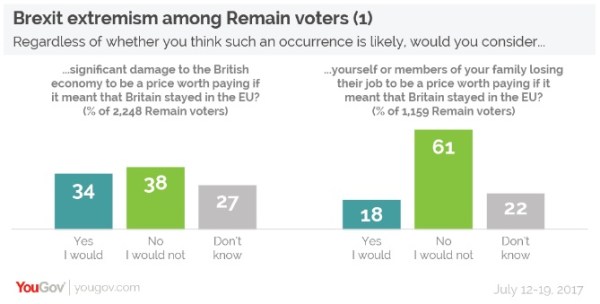
And of course, the corollary to these figures is the fact that the same “extremism” is alive and well among Remain voters, many of whom would dearly love to see Britain heavily punished economically so long as it meant that Brexit was subverted and they could stay in their beloved European Union:

YouGov poll - Brexit extremism 2

Jonn Elledge takes no notice of this latter fact, though, and immediately launches into a hysterical tirade against the evil older generations who clearly could have had no other motive for voting Leave other than to watch as their children and grandchildren suffered and led diminished lives. No, seriously.

Elledge writes:

The older Leave voters are, the more likely they are to think crashing the economy because they don’t like Belgians is a pretty fine kind of idea.

That trend reaches its peak among the Leavers aged over 65, fully half of whom are happy to tell pollsters that they don’t give a shit if Brexit causes a relative to lose their job, they want it and they want it hard.

Ah yes, let’s begin with a glib assertion that Brexit is all about not liking Belgians or other funny foreigners. One might think that one year on after having his worldview so thoroughly and humiliatingly repudiated by the British people in the EU referendum, Jonn Elledge might have had the humility to go back to the drawing board and question some of his glib and not-very-witty assumptions about what motivates people to make political choices. But apparently not.

More:

The thing about the over 65s is that relatively few of them work: to be blunt about it, those most enthusiastic about people losing jobs are those who don’t have jobs to lose. The vast majority of this oldest cohort will be on pensions, whose value is far less likely to come under threat from a recession than almost any other form of income. Most will own their own houses, too. They’re the section of the population most likely to be left entirely unscathed by the Brexit-based recession. They are quite literally alright, Jack – and, it turns out, fully half of them don’t care if their kids aren’t.

Baby boomers, as a cohort, benefited from free education, generous welfare and cheap housing, then voted for parties which denied those things to their kids. Their contribution to intergenerational inequality led my colleague Stephen Bush, in one of his frequent bouts of being infuriatingly good at his job, to note that, “The baby boomer is one of the few mammals that eats its own young.” All this we already knew.

Nonetheless, it’s rare to see this selfishness communicated so baldly, so shamelessly. When asked directly whether they’d swap the wealth and security of their own children for a blue passport and the ability to deport Polish plumbers, they said yes in huge numbers.

“Would you like your children to have a better life than yourselves?” You Gov asked them. And the reply came back: “Fuck ’em.”

This YouGov poll could have touched off a genuinely interesting conversation about the balance between present wealth and future liberty, about other historical examples of populations allowing themselves to be bought off with bread and circuses in exchange for turning a blind eye to the way that their societies were (mis)governed. But that would have required a British political media class who did not think as a herd that the European Union is an unquestionably Good Thing, and that anybody who dissents from this groupthink is an irrational, evil hater.

Does Jonn Elledge seriously believe, in his heart of hearts, that those older people who voted for Brexit did so with the expressed intention of harming their children and grandchildren – or at least not caring that such harm might come to pass? Does he not realise that the counterfactual, unrecorded by YouGov (who did not bother to probe more deeply) is that perhaps these older people – rightly or wrongly – thought that by voting for Brexit they were preserving some other vital social good for their descendants, something potentially even more valuable than a couple of points of GDP growth?

I would posit that the supposedly hateful Daily Mail-reading generation of grey haired fascists scorned by Jonn Elledge actually do not have any particular desire to inflict economic harm on their children and grandchildren, but simply realise – through having lived full lives through periods of considerably less material abundance than those of us born since the 1980s – that other things matter too. Things like freedom and self-determination, precious gifts which were under threat during the Second World War and the Cold War, and which the older generations who remember these difficult times therefore do not casually take for granted.

They correctly perceive that sometimes there is a trade-off between short term economic security and long term freedom and prosperity. Can anyone who knows their history – or at least has watched the recent Dunkirk movie – doubt that the British population would have been immeasurably safer and better off in the short term had we made peace with Nazi Germany rather than fighting on alone after the fall of Europe? And looked at through a purely economic lens, how many years of subjugation beneath the jackboot of a fascist regime would have tipped the scale and suddenly made it worth fighting for freedom after all?

This time, the choice before us is nowhere near as difficult, and the trade-offs nowhere near as severe. Even if this incompetent government mishandles Brexit as badly as sometimes appears likely, bombs will not fall from the sky to level our cities and destroy our cathedrals. This is not to understate the effect that a mishandled Brexit negotiation could have – any uptick in unemployment or decrease in economic activity is highly suboptimal, with real human consequences.

But there are negative consequences associated with failing to safeguard our democratic institutions and fundamental liberties too, though they often seem remote or even irrelevant until suddenly they are both present and irreversible. Those who have been on this good Earth for a few more decades than Jonn Elledge perhaps appreciate this fact more readily.

Our politics has become increasingly consumerist in recent years – the politics of me me me. And unfortunately we now have a young and poorly educated millennial generation – my generation – who see politics only through the lens of what they can get for themselves in terms of perks and opportunities. This makes them particularly vulnerable to any old charlatan who comes along spewing EU propaganda suggesting that the European Union is the only reason that they are able to “live, love and work in other countries” (to use their nauseating phrase du jour).

Ultimately this is yet another total failure of the pro-EU Left to remotely empathise with those on the other side of the Brexit argument. It represents a colossal failure of imagination to sincerely believe – let alone publish in a major national political magazine! – that a generation of parents and grandparents who scrimped, saved and sacrificed to raise their families now want to cause them harm merely to warm themselves in the glow of imperial nostalgia as they enter their twilight years.

And yet this is what Elledge, the New Statesman and countless commentators on the Left would have us believe. Frankly, this haughty and arrogant attitude is more dehumanising of its victims than that of the xenophobe who may believe that foreigners are good people, but simply doesn’t want them in his country – at least there is still the outside possibility that they vaguely respect the other.

I’ll say that again, lest there be any doubt or confusion – by holding this vile opinion, Jonn Elledge, the New Statesman and anyone who concurs is worse than a garden variety xenophobe.

A society which does not respect its elders cannot long endure, and these puffed-up millennial moralisers seem determined to drive us into the ditch as fast as they possibly can.


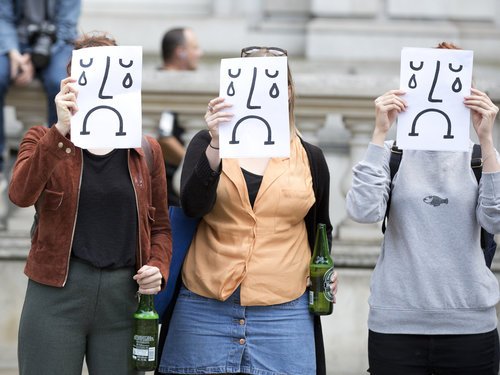
Thousands Of People Take Part In The March For Europe

Support Semi-Partisan Politics with a one-time or recurring donation:

Agree with this article? Violently disagree? Scroll down to leave a comment.

Follow Semi-Partisan Politics on TwitterFacebook and Medium.

Brexit Catastrophisation Watch, Part 11 – Neither Imperial Delusions Nor Fearful Retreat From The World

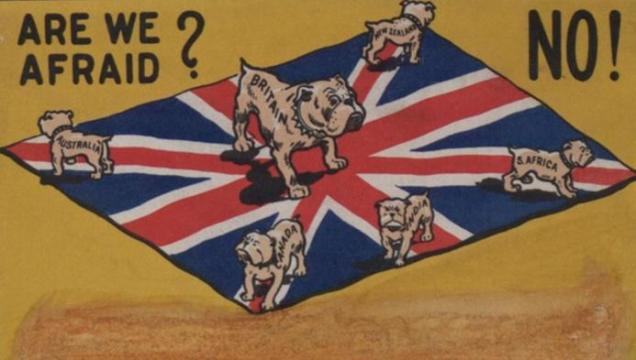
British Empire cartoon

Replacing one slanderous Brexit narrative with another

Janan Ganesh almost gets it right (for once) in his FT column, accurately warning people away from the myth – especially popular with many foreigners – that the vote for Brexit was some kind of reflexive grasp to regain a long-gone empire and adopt a more swashbuckling, colonial-style role in world affairs.

Ganesh writes:

There is a certain kind of Briton, often educated to the hilt, who believes that sick Americans are left to writhe around on hospital floors until they show the doctors a credit card. Even sophisticated people think in simple terms about foreign countries. They just need a plausible line-to-take that sees them through a dinner party as it turns to political chat.

Americans give as good as they get. To the extent that their smartest people talk about Britain, they focus on our imperial delusions: here is a country that never adjusted to its loss of empire and does odd things to compensate. In Europe and Asia, too, exit from the EU is read as a desperate lunge for a global role, an act nearer to therapy than to statecraft. Colonial nostalgia has become the one thing the world “knows” about modern Britain.

It just happens to lack the ring of truth if you live here. Vestiges of empire survive in public life and some Conservative ministers picture a new Commonwealth trade zone that diplomats call, in what must pass for office banter, Empire 2.0. But Britain is not Liam Fox. It voted to leave the EU for reasons that differ from those that animate the trade secretary.

Quite. In Britain, the only ones who really see Brexit as a ham-fisted attempt to reclaim the losses of decolonialisation are the pants-wetting, pseudo-liberal preeners at the Guardian and satirical news site the Daily Mash, who love to portray Brexiteers as angry, curtain-twitching retired colonels outraged by the sudden appearance of brown-skinned neighbours.

Talk to the average Brexiteer on the street, however, and this is not the justification that you will hear. Neither is the glib “hankering for empire” explanation borne out through the opinion polls, which – contrary to the race and immigration angle played up by the media – proved that freedom and national self-determination ranked most highly among the priorities of Brexit voters.

Unfortunately, in the course of refuting this particular misguided Brexit narrative, Ganesh goes off the rails and embraces a fatalistic “retreat from the world” narrative every bit as presumptuous and fatalistic as the original:

The regions that shaped and were shaped by empire voted to remain, including London, the old metropole; Scotland, the source of many settlers and administrators; Manchester, not just the empire’s industrial centre but its liberal intellectual heart; and the port cities of Liverpool and Bristol. Inland Birmingham voted to leave, as did the countryside and market towns of Deep England. What those communities seem to want is Nation 1.0 — the sovereign statehood that predated the globalised era —

So far, so good. Brexiteers do indeed want the United Kingdom to return to a norm which might be called Nation 1.0. In fact, this is not a dim and distant past but a present reality still enjoyed by every advanced country outside of Europe – enjoying the benefits of globalisation, but not plugged in to a supranational political entity with federalist ambitions to become the government of a united Europe.

Nobody ever argues that Australia, New Zealand, Malaysia, Indonesia, the Philippines and Papua New Guinea need to be part of an homogeneous overarching political union with a shared parliament, judiciary and executive in order to thrive. Neither does anybody criticise these countries for “retreating from the world” or otherwise failing to play their full part in global commerce and cultural exchange. Only in Europe has the pernicious myth taken hold – helped along by media cheerleaders, both ignorant and cynically knowing – that to reject an explicitly political project is also to wish to sever all links with the modern world.

Sadly, this is the trap that Ganesh immediately falls into. To pick up the end of his previous sentence:

— when the population was more homogenous and the economy less exposed to foreign competition. Whatever these impulses are, they are not colonial.

[..] Since 1945, intelligent outsiders have overestimated Britain’s frustrated ambition and underrated its sense of resignation, its desire for a quiet life after a draining few centuries as a player. When the American diplomat Dean Acheson said the British had not yet found a role after empire, he rather assumed that we were looking for one. Insiders make the same mistake. The least effective argument for the EU in the referendum campaign centred on its usefulness as a power-multiplier for medium-sized nations. It is not that voters disbelieved this. They just did not care enough.

History keeps forcing countries into this choice between significance abroad and retrenchment at home. Imagine that it were possible to go back in time and make sure the empire had never happened, in return for much-reduced postwar immigration from the former colonies. I suspect that some of the voters now fingered as neo-imperialists would trade their nation’s record of world grandeur for what might delicately be called a more familiar population. A less extreme thought experiment is already in the news. If a UK-India trade deal were to hinge on freer migration between the two countries, would Mr Fox sign it? He must know his keenness would not be matched by his own voters.

[..] It is easy for foreigners to read imperial nostalgia into something much more parochial. The terminal point of empire is introspection, not a restless desire to do it all over again. Introspection is bad enough but the British cannot be guilty of that and the opposite at the same time. Outsiders are free to fault us, if they pick the right fault.

We now appear to be caught in an imperial / introspective false dichotomy where Brexit can be explained (especially to anxious faux-liberals like New York Times readers) only as a racist country’s dying grasp to regain imperial greatness or a shrunken, scared and insular country seeking to retreat from the dangers of the world.

(We’ll ignore the fact that it was America, not Britain, who just elected as president an authoritarian strongman who promised not to enhance citizens’ liberties but rather to keep them safe from any danger – particularly from China, Mexicans and Islamist terror – and free from all anxiety. But by all means, tell us again how Britain is supposedly the country in decline and fearful of the world).

In reality, neither of these two absurd characterisations get to the truth of Brexit. At its heart – and this is borne out by opinion polls which clearly showed “self determination” to be the key issue for Brexit voters – Brexit is about wanting to normalise Britain and cease participating in a federalist experiment which almost nobody wanted and for which even its loudest champions failed to properly advocate.

British voters simply did not understand – with good reason – why Britain’s participation in a modern economy and a globalised world requires us to dissolve our sovereignty into an explicitly political union, when other advanced countries around the world are not under any similar obligation. And the Remain campaign could give them no good answer, for they have none. The EU is a political project whose economic activities are but a means to the ultimate end. Knowledgeable Remainers could say nothing to the contrary without perjuring themselves.

But rather than admit the truth about the European Union, how much easier it is to sit at a keyboard and invent ever more daft reasons explaining away the vote for Brexit. How much easier for Remainers to use weak satire or hysterical doom-mongering to distract themselves from the vacuity of their own case and the failure of their campaign.

Janan Ganesh is right – Britain did not vote to secede from the European Union through some misguided attempt to timewarp back to the days of empire. But it is not good enough to refute this silly idea only to promulgate another equally lazy explanation, as Ganesh unfortunately also does.

Remainers have long tried to paint Brexit as some kind of aberration, an inexplicable and harmful departure from international norms. But in fact it is the European Union which is an aberration and which flies in the face of human instinct and history. It is the European Union which attempts to force on member states a model of supranational government for which no meaningful democratic consent was ever sought, which reliably becomes less popular the more it is understood and which no other countries or regions of the world have ever sought to emulate.

Brexit was a vote to return to Nation State 1.0, not because we never want to reach Nation State 2.0 but because the EU’s status quo (Nation State 1.5) is buggy, full of defects and leading us in the wrong direction. The European Union is the Microsoft Windows Millennium Edition of political governance systems, and deciding to uninstall it and wait for something better neither means that we are hankering for the past nor giving up as a country. It’s just the smart thing to do.

It may be difficult for self-regarding members of the political media establishment to accept,  but Brexiteers were right to vote as they did. Remainers were wrong. And columnists would do better to analyse the failings, inconsistencies and non sequiturs in the Remainer case – the timidity, the tedious declinism, the remarkable ability to ignore the example of any country in the world outside the European Union – than continue to invent imaginary flaws in the case for Brexit.


brexit-pixabay

Support Semi-Partisan Politics with a one-time or recurring donation:

Agree with this article? Violently disagree? Scroll down to leave a comment.

Follow Semi-Partisan Politics on TwitterFacebook and Medium.