Does Privacy Exist? Yes, But Only For Our Leaders At Bilderberg 2014

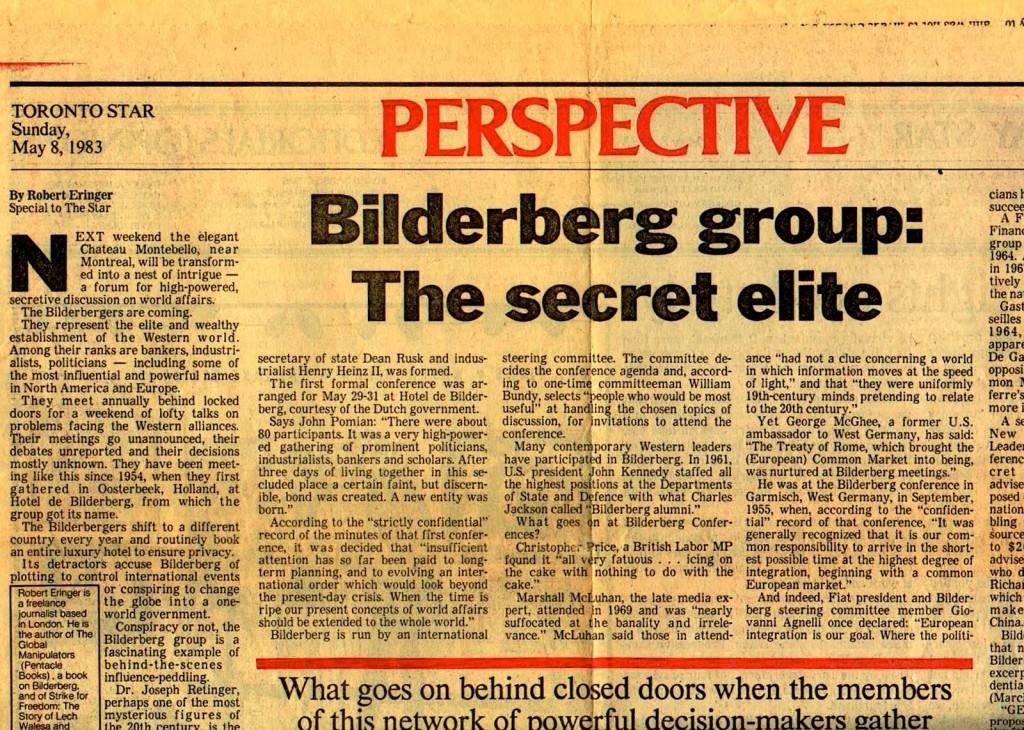
Bilderberg 2014 Copenhagen 3


If 100 of the world’s top celebrities – from Angelina Jolie to Will Smith – suddenly dropped what they were doing and hunkered down together in a luxury hotel to debate the future of the entertainment industry in complete seclusion from the world, and then emerged three days later as though nothing happened, people would be rightly curious to know what they were up to.

Actually, curious is an understatement. There would be wall-to-wall media coverage, the TMZ drone would hover above the scene capturing aerial footage, pundits would offer endless speculation and real-time ‘analysis’ of what they thought might be taking place inside – in short, the world’s press would make a presidential election look like local newspaper reports about a lost kitten.

Isn’t it odd then, that when 100 of the most wealthy and influential people from outside of Hollywood – powerful establishment politicians, new rising stars, corporate CEOs, high-tech moguls and royalty – meet in secret every year to do the very same thing, nobody gives it a second thought?

The Bilderberg 2014 conference is now under way in Copenhagen, where a star-studded cast of characters from civilian, business and military-intelligence backgrounds are gathering to debate this year’s agenda of topics including sustainable economic recovery, the future of democracy, the Middle East, the Ukraine crisis and whether or not the basic concept of privacy still exists.

And no, you didn’t miss the hype. There has been scarcely any coverage of this year’s confab in the British or American press. Outfits such as the New York Times and the Daily Telegraph do not see fit to mention the meeting to their readers (in contrast to their coverage of the annual World Economic Forum meeting at Davos, Switzerland), and the BBC’s only acknowledgement of Bilderberg this year has been a Daily Politics segment which discussed conspiracy theories in general, and laughingly recalled the occasion last year when the show mocked and denigrated American radio host Alex Jones, one of the few activists to cover the 2013 Bilderberg meeting in Watford, England.

If Bilderberg was just another place for the wealthy and well-connected to hang out, there would be no issue – the world is awash with exclusive places and events for the elite to hobnob with each other. The same cast of characters also meet up at Davos for the World Economic Forum (the red carpet event of the year for people of lesser beauty and charisma), but if twelve months is simply too long to wait between encounters then nobody should begrudge them another opportunity to awkwardly flirt with one another while putting the world to rights.

The problem is not that successful and powerful people are meeting in secret in Copenhagen. The problem is the particularly volatile, toxic blend of people that assemble. Why are serving heads of government and state on the invite list to what is in part a giant, closed-door lobbying event? And how do attendees from the military and intelligence communities such as the secretary general of NATO, the head of MI6 and the former head of the NSA have common cause with corporate leaders including the Chairmen or CEOs of Shell, Barclays, BP, HSBC, Nokia, LinkedIn and Google?

And one more question – when the press are neither invited to the meeting nor briefed on its outcomes, why do the editors of media outlets including The Economist, The Financial Times, Le Monde and Italy’s RAI-TV sanction Bilderberg with their attendance?

In short, the answer is this: Bilderberg is the closest that western democratic societies come these days to openly, flat-out declaring that well-connected, wealthy people have an inherent right to rule and influence national and international policy, and to have their opinions taken more seriously than regular folk. From supposedly meritocratic “if I can make it there, I’ll make it anywhere” New York through the Scandinavian poster-children of equality and back to post-Citizens United Washington DC it holds true; but most of the time we try to convince ourselves that it is otherwise, that our voices still count and that we are all equal before the law. For those who pay attention, the yearly Bilderberg conference serves to disenthrall us, briefly lifting the curtain on the truth.

That truth is the fact that money talks, and exorbitant wealth carries the loudest megaphone of all. It’s hardly a revelation, but the only time when the rest of us have it shoved in our faces quite so explicitly is at the yearly Bilderberg meeting – ironically the one time when almost none of us, led by the press, pay any attention.

Venue for the 2014 Bilderberg conference
Marriott Copenhagen – venue for the 2014 Bilderberg conference


On the agenda for Bilderberg 2014 is the subject of privacy – very topical given the ongoing fallout and scandal resulting from the Edward Snowden surveillance revelations and consequent exposure of the real extent of government surveillance in and by the United States, United Kingdom and other Five Eyes group countries.

Meeting with John Sawers, General Petraeus and others who are intimately involved in the conducting of government surveillance activities will be many high-profile people of vast wealth and influence. Many of these people are likely to hold quite forceful opinions on the issue of privacy, but they are more likely to be interested in protecting their own privacy from the journalists who would make their activities and indiscretions known to the public than altruistically pressuring governments to cease collecting everyone’s private data in their indiscriminate dragnet.

Given the rare opportunity to hold face-to-face meetings with the people who run the surveillance programmes and formulate the policies which underpin them, which aspects of the privacy question – and whose personal  interests, those of the elite or those of society as a whole – are the privileged attendees most likely to discuss?

Charlie Skelton at the Guardian, one of few mainstream journalists to cover Bilderberg every year, also picks up on the irony of an organisation as secretive as Bilderberg holding a discussion about the existence of privacy:

That’s an exquisite irony: the world’s most secretive conference discussing whether privacy exists. Certainly for some it does. It’s not just birthday bunting that’s gone up in Copenhagen: there’s also a double ring of three-metre (10ft) high security fencing … There’s something distinctly chilling about the existence of privacy being debated, in extreme privacy, by people such as the executive chairman of Google, Eric Schmidt, and the board member of Facebook Peter Thiel: exactly the people who know how radically transparent the general public has become.

Precisely. The average person might care about privacy issues because they don’t like being treated as automatic suspects in the intelligence services’ surveillance dragnet, or because they don’t want risk-averse insurance companies from searching out deeply private facts from our lives in order to increase their premiums. The privacy concerns of an oil company CEO or the queen of Spain (attendees all) are likely to be of a different order altogether, more focused on keeping potentially explosive or embarrassing information out of the public domain, and creating a legal framework that punishes those who reveal the truth while empowering those who seek to operate in the dark.

And you can bet that the Bilderberg attendees do want to affect change – they do not assemble for purely social reasons, but to leverage one another’s influence for their own ends – sometimes quite noble ends, but equally possibly very selfish ones. This leads to another sharp observation from Skelton:

The Bilderberg Group says the conference has no desired outcome. But for private equity giants, and the heads of banks, arms manufacturers and oil companies, there’s always a desired outcome. Try telling the shareholders of Shell that there’s “no desired outcome” of their chairman and chief executive spending three days in conference with politicians and policy makers.

If people want to shoot the breeze or have long, meandering yet inconclusive conversations about the state of the world, they go to Starbucks or sneak off to the pub with their friends. Influential and high net worth individuals – whose time is supposedly so valuable – don’t check out for three days and traverse continents unless there’s something significant in it for them, or the causes that they promote.

As Bilderberg 2013 drew to a close in the Hertfordshire countryside, Semi-Partisan Sam had this to say (among other things) about the motivations and biases of the people who get together once a year to decide what’s best for the rest of us:

The reason so many of the actions taken by [Bilderberg members] over the years have been so harmful to ‘normal people’ is because the membership is comprised entirely of the successful. None of the protesters were allowed to remonstrate with the Great Ones within. No refugees from the middle east Arab Spring. No malnourished people from Africa. No failed small business owners from the town of Watford itself, which has struggled in the recession.

If every year you and your chums reassemble at the next Bilderberg meeting and find yourselves even more spectacularly successful and wealthy than the last time you met, “more of the same” could start to seem like a pretty good prescription.

A year later, and this ‘confirmation bias’ explanation is starting to look rather too charitable toward the Bilderbergers. Since the Watford meeting we have learned of more government overreach in the realm of surveillance, more incursions on privacy, more intimidation of the media and the further undermining of national democracy from overturned limits on corporate political spending in the United States to the growing concentration of powers at super-national level in the European Union.

It really would be helpful if the organisers would consent to publishing minutes from their meetings, because at the moment it looks suspiciously as though the 2013 attendees listened to public opinion, then got together and resolved to do the polar opposite.

Perhaps the ultimate irony of Bilderberg 2014 is this: not one week ago, the voters of Europe delivered a stinging rebuke to the political establishment for their growing disconnect with the people and their tendency to talk amongst themselves and prescribe universal solutions from on high without a democratic mandate for their actions. And now today, at a Copenhagen hotel in the heart of Europe, they’re at it once again as though the European elections never happened.

Unfortunately for us, our political elites are seemingly the only ones still able to assert a right to privacy, conducting their business with Bilderberg behind closed doors. But it’s just as much our fault – by not paying any attention, we let them get away with it.

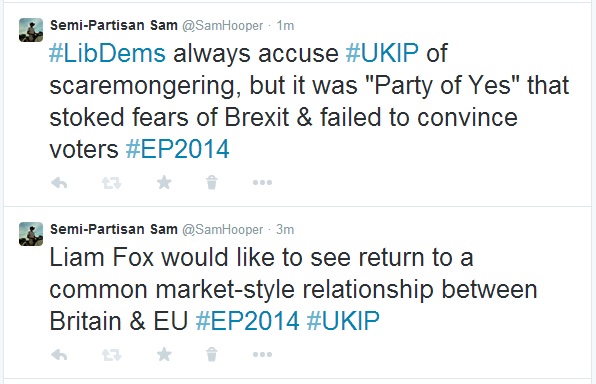
Live-Tweeting The European Election Results

Live blog European Election 2014 SPS

Real time, Semi-Partisan tweets and analysis of the incoming European election results are accessible here.

There are a lot of moving parts at the moment. As expected, UKIP are performing very well and are still on track to win the vote in the United Kingdom. But interestingly, the Conservative vote is proving quite resilient in many areas – it’s the Liberal Democrats who are haemorrhaging support and staring the possibility of losing all their MEPs in the face.

Nigel Farage appears confident – even jubilant – on television, saying “Who’s to say what UKIP can and cannot achieve in the 2015 general election … Anything’s possible after tonight’s result”.

So far, London is dark – the returning officer is not releasing information from the various London regions individually as they become available, opting to release all of London’s results simultaneously. A much clearer (and more final) view of the new electoral map will be available once we know London’s verdict.

How Do You Solve A Problem Like Nigel Farage?

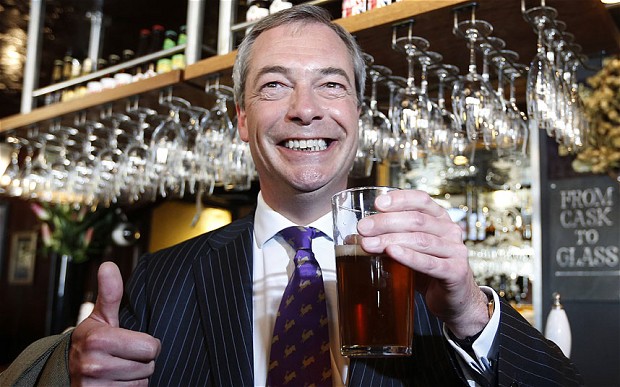
Nigel Farage Pint Elections 2014


Let’s play pretend.

Suppose that you are a British voter who happened to express admiration for Nigel Farage back in 2010. Your friends were aghast and asked how you could possibly support such an eccentric right-wing oddball, so you kept quiet for awhile, putting your feelings down to maybe not knowing as much about politics as you should, and feeling a bit chastened by the reaction you received.

Imagine that you then found yourself agreeing with Farage and the UKIP position even more on things like immigration and leaving the European Union when the local elections rolled around in May 2013 and the party made headlines for doing so well. Surely now you could admit to your friends and family that you were becoming a fan of this new kid on the block, especially since one in four voters supported UKIP this time around and they were receiving so much press coverage? But once again, as soon as you mentioned your political sentiments people looked at you as though you must have fallen over and hit your head.

Fast-forward to spring 2014. The things that you think are important issues are still not being addressed by the main political parties,and now the European and local elections are coming up. Only UKIP are offering the policy proposals that seem like common sense to you, and they are the only party whose candidates seem able to express themselves freely and persuasively without sounding like they are reading aloud from (at best) a teleprompter or (more usually) the telephone directory. Surely now people must see the appeal of UKIP? Surely now it must be safe to come out?

At the pub one evening, you admit that you are planning to vote UKIP in the European election, and maybe for the local council too. Outrage! That won’t do at all, it’s quite simply the end of the world. Your horrified friends dive for their smartphones, and before you can blink five brightly-lit screens are shoved in your face, each one blaring “top ten” lists of reasons not to vote UKIP, or trumpeting the misdeeds of a dodgy-looking UKIP councillor on the other side of the country.

Didn’t you know? Nigel Farage wants to rescind women’s suffrage! Godfrey Bloom once chartered a Boeing 767 at his own expense and set up a stall at the Notting Hill carnival, offering dark-skinned people £100 each to hop onboard and fly home to Bongo Bongo Land! How can you think of lending your support to people like that? Are you crazy?

You go home in a sour mood and turn on the computer. You’re sure you had more Facebook friends than that this morning. And why have you received nine invitations to “like” the Liberal Democrats and see the amazing work their MEPs are doing in Brussels, protecting the environment and “standing up to the bankers”? Disgusted – and determined never to vote for Nick Clegg’s party again, no matter how much your overbearing aunt cajoles – you switch on the television. The newsreader is reporting that Nigel Farage was hit by an egg while out campaigning earlier that day. “Wow”, you think. “I know just how he feels”.

Election day rolls around. For the past two weeks, every newspaper article and news segment has seemed to be about UKIP one way or another – and none of them positive. But the UKIP you know from looking at the website and talking to the volunteer on the doorstep doesn’t look anything like the monstrous effigy being held up by the media. You decide to quietly vote UKIP, and just not tell anybody about it. To hell with them anyway, you never said a word when they all decided to jump on the bandwagon and grow pretentious hipster beards.

As the election results start coming in, pandemonium breaks out. David Dimbleby has a meltdown in the BBC studio, the swing-o-meter self-destructs in a shower of sparks, the Labour shadow cabinet form an orderly queue to tell Adam Boulton exactly how Ed Miliband led them to disaster and the Tories are cursing you and your kind for costing them their precious flagship councils in Essex.

What’s more, in the space of two breathless minutes, the all-knowing BBC panel packed with manicured, London-dwelling upper-middle class “experts” has solemnly suggested at least five ludicrous reasons why you voted for UKIP:

You were left behind by the modern information economy. Actually no, you have a decent skilled job; you’re not Alan Sugar but it has good prospects and pays the bills.

Your local community looks nothing like it did in 1960 and it’s scary for you to see the change. Well you were born in the 80s, and you managed to take the internet, iPhones and the falafel restaurant round the corner in your stride without wetting yourself in terror, so that probably isn’t the reason.

You feel persecuted for holding on to your traditional values. Hardly. Two of your friends are gay (the first ones to grow the stupid hipster beards, come to think of it) and although you know that some UKIP councillors have said pretty nasty things about gay people, you’re not homophobic at all, that’s not what attracted you to the party.

You feel like no one listens to you, your vote was just a blind stab at the hated political elite. Well it used to feel like no one listened, but Nigel Farage and his party came and listened. A protest vote would be a spoiled ballot paper or a write-in for the Monster Raving Loony Party. What you did was positive and purposeful, a vote for certain policies you agreed with.

You’re angry, you’re furious, you’re consumed with blind rage. Well yes, but only since the start of this election broadcast!

So many reasons offered by the Westminster commentariat, and none of them the simple truth:

You looked at the Conservative platform and you don’t trust them to deliver on the things that they say they would do – the government is failing to meet its immigration targets again, and the Tories already broke one “cast-iron” promise to hold a referendum on Europe.

You looked at Labour and saw a party that hasn’t even accepted that they did anything wrong when they were in government leading up to the recession, who never mention Europe or immigration at all unless you beat it out of them with a stone, and whose leader can’t even eat a bacon sandwich without getting on the front page of the papers for doing it wrong.

You didn’t bother to look at the Liberal Democrats too closely, because you’re not weird and it isn’t 2010 any more.

But you looked at UKIP and found that their policy prescriptions fit your list of concerns rather handily, and gave them your vote because isn’t that precisely how democracy is supposed to work?

Yes! The truth is that you voted UKIP for the same reason that other people voted for their parties – because you thought through the issues and liked UKIP’s policies. Now why is that so hard for the politicians and people in the media to understand?

Now before you stop reading – yes, there was a point to that tortuous exercise in imagination. Consider:

In the aftermath of the election, all that anyone has been able to talk about is the question of how so many people were conned, duped or tricked into voting UKIP. Earnest, well-intentioned (and less well-intentioned) commentators and newspaper articles have been encouraging us to imagine what it must be like to be a UKIP voter, as though the very thought is so alien that ‘normal’ people actually need a tourist guide into the mind of a Ukipper in order to make sense of the election results. Did you know that they are omnivores and base their waking hours on the rising and setting of the sun, just like us? Fascinating!

But does the media (and they are almost all guilty) ever stop to think what it must be like – purely by virtue of subscribing to some fairly commonly held political views – to be talked about as though you are a symptom of a terrible and shameful national venereal disease, or a wayward prodigal child that needs to be rehabilitated back into the family?

Do the newspaper columnists and TV talking heads ever stop to think just how maddeningly patronising they sound to UKIP voters when they write their anguished, hand-wringing columns on what to do about Britain’s awful UKIP problem?

Most of the time, a conservative can read the Guardian or a liberal the Telegraph and not necessarily feel loved and perfectly understood, but at least see their opinions treated with a very basic level of respect. There were no psychological inquests in the Guardian as to why the voters ignored Gordon Brown’s self-evident brilliance in such large numbers and rudely cast him from Downing Street in 2010, the answer was clearly political.

But with UKIP it is different. It is as though believing in UKIP’s worldview and policies doesn’t deserve acknowledgement, understanding and then persuasion by those who vote differently – it requires correction by those who know better. You’re not thinking properly, UKIP voter. If you were, you would have selected from one of our pre-existing bland political flavours.

Only one article (in the Guardian of all places) shows any degree of contrition at all for the way that UKIP supporters were hounded, bullied and vilified in the press over the past few weeks. Apologies are in very short supply, but there is an abundance of smug condescension packaged as expert political analysis.

A host of British politicians have already been wheeled through the television studios to offer their own variants on the standard post-election-upset mea culpa: we hear their concerns, we need to start speaking their language, we need to show that we are relevant to their lives, we need to stop them from being exploited by the far-right.

You can be sure that all the main parties are plotting their next moves already. The only idea missing from all of their plans? Actually talking to UKIP supporters, and treating them as though they are fellow human beings.

To be a UKIP voter watching or reading the news today must feel as though you are a dangerous but valuable specimen kept in a lab, with a curious Guardian reader in a hazmat suit poking you through the safety glass to see how you respond to political stimuli while someone from CCHQ takes notes and a BuzzFeed staffer snaps pictures and adds mocking captions. I CAN HAZ PINT WITH NIGEL NOW?

This can’t be a very pleasant experience – the resultant emotion is likely to be one of immense irritation at being so misunderstood and publicly belittled. In fact, the only thing likely to make the whole damn experience any better is watching Nigel Farage’s smiling face as he sinks another pint and poses for photographs with his victorious local candidates.

It’s the political and media establishment’s turn to play pretend now:

You are that UKIP voter. After being subjected to this barrage of disbelief turned to mockery turned to outrage turned to hate turned to amazement turned to curiosity turned to pity from the big three political parties and most of the press, where do your political sympathies lie, looking ahead to the 2015 general election?

Get Out And Vote

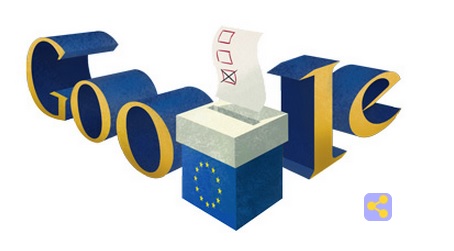
Google European Elections 2014


To my British and European readers:

Whatever your political convictions may be, PLEASE make the effort to get out and vote today. People have given their lives in defence of our democratic right to choose our representation; the least we can do is take time to read up on the candidates/issues and make the trip down to the polling station.

Remember: those who can’t be bothered to get out and vote forfeit their right to complain about all things political until the next election.

For those who want to read a final Semi-Partisan analysis of the European election landscape before voting, click here.

European Elections: Zero Hour

EU European Elections 2014


In less than twenty-four hours, the polls will close and British voters will render their verdict in the European elections – as best they can, given the negligible differences between the main political parties, the lack of debate about EU policy and the vast shortcomings of the media’s coverage throughout.

This blog would have relished the opportunity to provide coverage and commentary on the three main political parties, had they made any substantive policy proposals or generated interesting news of their own – but in terms of the European election in Britain, almost from the start, it has been UKIP driving the agenda and making the headlines.

Today has been another day of incessant attacks on UKIP and euroscepticism by the main political parties, the media and spontaneous social media efforts. The #WhyImVotingUKIP hashtag, announced by the party’s leadership in a naive bid to gain positive grassroots momentum, was immediately and predictably hijacked by anti-UKIP activists and self-proclaimed wits across the country, resulting in some occasionally amusing (but mostly tiresome and false) jibes at their expense.

UKIP’s support having remained solid despite the missteps of the past week and the concerted efforts of nearly every major media outlets to portray isolated, reprehensible racist and homophobic actions as being representative of the party as a whole, the final tranche of negative UKIP stories betrayed signs of desperation. Today’s burning new reasons not to vote UKIP ranged from cycling policy to the similarity between UKIP supporters and football hooligans.

More seriously, a UKIP candidate standing in the local council election in Lancashire was allegedly stabbed in the face by a neighbour as a result of his political views. A man has been arrested and bailed pending a police enquiry, but if it is determined that the attack was indeed politically motivated it should give serious pause to those who have so gleefully participated in the free-for-all effort to paint UKIP as the British Union of Fascists reborn and their supporters uniformly as hate-filled individuals deserving of public scorn and shaming.

Throughout the election campaign, this blog has been torn when considering the electoral options on the table. There is no easy, natural option for those with small-government or libertarian-leaning views, who are eurosceptic and in favour of nation state democracy but pro-immigration (in this blog’s view, an entirely consistent and strongly defensible worldview).

Those who still believe in the European project and want lots more – though such people are few and far between – have it easy. The Liberal Democrats will happily take their votes and translate them into continued and unquestioning rubber-stamping of European Union policies, borne out of the ingratiating desire to ‘harmonise’ with the rest of Europe and driven by their pessimistic assessment of Britain’s strength and place in the world. They will also happily patronise the more wavering pro-European with assurances that they too believe in EU ‘reform’, though the specifics of this reform remain forever unarticulated and unattempted.

Those who buy into Ed Miliband’s fuzzy socialist view of Britain and who couldn’t care less about European policy – the party certainly hasn’t offered any concrete ideas, just platitudes about “getting the best deal” and “bringing jobs and growth” to Britain – will always have a welcome home in the Labour Party.

The eurosceptics and the libertarians are left to choose between the Conservative Party (whose track record is long and verifiable, but decidedly mixed) and UKIP (who represent uncharted territory and unwelcome controversy but seem to hold closer to their convictions).

In truth, the Conservative Party has played the role of Lucy to the public’s Charlie Brown in their wavering policy toward the European Union, holding out the ball of an in/out or treaty ratification referendum to win eurosceptic votes only to yank it away and wrongfoot the gullible voters once safely returned to office:

Just kidding about that referendum.


Nonetheless, it must be acknowledged that many existing Conservative MEPs have worked effectively in the European Parliament to scupper some of the more damaging pieces of legislation, creating something of a much-needed opposition in an institution otherwise characterised by consensus and groupthink. Since Britain’s immediate withdrawal from the European Union is not on the cards, it is important (for those of a democratic mindset) that an effective rearguard action can be fought to defend British interests while a more comprehensive renegotiation with or withdrawal from the EU is completed.

The Conservative MEP and staunch eurosceptic Daniel Hannan reinforces the important point that the European election is not just a glorified opinion poll, and that the electorate’s verdict will have real-world consequences. But while this is true – and the new European Parliament will be making decisions long after the 2015 general election in Britain – the campaign has been fought along such determinedly domestic political lines that protest voting has been inadvertently encouraged from the start. And there is more than enough to protest.

The Telegraph’s Tim Stanley sums up some of the grievances:

London liberals believe that a) their liberalism is self-evidently smart and b) anyone who rejects it is a bigoted moron. For years, those who do not subscribe to London’s fashionable politics have had to put up with being told not only that they are wrong but also mentally deficient and prejudiced. Hence, the attacks on Farage as a racist fool inspire, if not sympathy, a recognition that this slight is daily inflicted upon almost everyone who lives outside the M25. By treating so many of their fellow Britons with contempt, the London establishment has built up a tide of bitterness against it. And, on Thursday, that tide will probably break against the shore.

Stanley goes on to add:

I’m probably a London liberal – but I’d be the first to say that we’ve got it coming and that it’s richly deserved.

This kicking is indeed coming – UKIP are still polling in first place, despite their recent missteps and the attacks from the establishment, as well as the uncovering of a decidedly nasty element of indeterminate size within the party.

But whether UKIP’s success is based on growing support for their policies or through being the main beneficiary of the protest vote (the truth lies somewhere in between), a good result for them will be a stunning rebuke to the main political parties – a rebuke too important to be dismissed as a simple act of blind protest.

National protest movements might capture 10 or 15 percent of the vote on a good day. An election result of 30 percent or more (as UKIP are predicted to achieve) isn’t evidence of a mere protest vote, or the electorate “letting off steam”. It’s a clear sign that a significant body of British public opinion is being ignored and not given a home within the three main political parties.

The rise of UKIP reflects the realisation among British voters that our democracy is becoming increasingly illusory. Regular elections may still take place and the campaigns may be boisterous as ever, but they are increasingly fought within a vanishingly small segment of the political spectrum, with an enormous degree of consensus among the ruling elite that has simply not been achieved among the population in general.

This spurning of popular opinion – on a range of issues from immigration to capital punishment – is epitomised by our politicians’ attitudes toward the European Union, with Britain being swept down the stream to ever-closer union without any public consultation since the referendum of 1975.

The point is not that the elites are always wrong – capital punishment is abhorrent and its reinstatement would be hugely regressive, while the idea that one additional immigrant automatically means one less job for a British worker is laughably misguided, for example – but at some point they must make the effort to change the hearts and minds of the people, rather than high-handedly overriding or ignoring them. Yet high-handed presumption seems to be all that the main parties now know and practice.

Suppose that an alien, familiar with and supportive of the concept of democracy but ignorant of modern British and European history, were to land on Earth in the midst of this election campaign. They would ascertain that Britain joined what was then known as the European Economic Community in 1973, following a campaign based largely on joining a free trade group. But they would then be aghast to see that organisation – with no new referendum through which the people gave their consent – grow into a political union negotiating its own trade deals, decreeing its own understanding of human rights, making its own foreign policy pronouncements and acting independently on the world stage on behalf of all, but with the consent of none.

The remarkable fact is that more people are not outraged at this betrayal by the political class – but the betrayal has taken place very slowly, with degrees of sovereignty handed over to the EU in imperceptible stages, until – like the frog placed in cold water and slowly boiled alive without ever realising the danger – Britain finds herself so enmeshed within the developed European institutions that any renegotiation or withdrawal becomes an inevitably traumatic prospect.

A British exit from the European Union – or a wholesale renegotiation of the terms of Britain’ membership – could have a net positive effect or a negative overall effect on Britain, depending on the terms under which they took place. This European election campaign – since it was never going to be about EU policy – was a golden opportunity to have this debate and consider the various proposals for renegotiation or exit and submit them to scrutiny. But instead it was spent making headlines out of gaffes and missteps, and throwing the kitchen sink at the one party whose views lie outside the pro-European consensus.

And yet the reviled anti-establishment party remains on course to win.

When Britain voted to remain within the EU in 1975, the late Tony Benn – then Secretary of State for Industry and leading figure from the No campaign – had these magnanimous words to say in the hour of defeat:

When the British people speak everyone, including members of Parliament, should tremble before their decision and that’s certainly the spirit with which I accept the result of the referendum.

Today, the British people will speak and deliver their verdict on 39 years of ever-closer union without consultation, but no one will tremble before our decision. The party PR machines will whir into action, the spin doctors will get to work and a herculean exercise in groupthink will take place until the establishment convince themselves – and many of us – that the result is an aberration, a blip, a flash in the pan which can be explained away with talking points until normal business can quietly resume.

No, they will not tremble or humble themselves. We do that now.


If you enjoyed this article, please Like and Share it on social media using the links below.