Federalism Is Not A Dirty Word Simply Because It Is Associated With The EU

Towards a Federal Europe

If political and social cohesion is fraying even in the United States, where citizens share a strong common American bond, what chance is there for successful European government?

In her latest Telegraph column, Janet Daley makes an interesting comparison between the prospects of European federal union and those of the United States (currently experiencing its own political turmoil with Donald Trump’s successful insurgency on the Right and a nearly-successful  insurgency on the Left in the form of Bernie Sanders).

Daley writes:

That ideal of the European continent as a unified entity, presenting an alternative presence in the world to the overweening superpower across the Atlantic was once the whole point – wasn’t it?

[..] But, as I say, nobody who favours remaining in the EU is talking up that idea these days. In fact, it’s the other guys – the ones who want to leave – who are most inclined to remind us of it, to the clear embarrassment of the Remainers. Could this be because the political model itself – the American success story of a federation of states joined together under a central government – seems to be going badly wrong? The nation that appeared to have found the ultimate solution to conjoining separate states, each with its own semi-autonomous authority, under one set of national governing institutions is now apparently facing an electoral choice between the demagogic and the disreputable.

I get what Daley is trying to do here, but she makes a leap too far in suggesting that the nature of federal government itself is responsible for American political woes. The federal model has served the United States well for nearly 250 years; today’s problems are indeed mirrored in Europe and America, but they are not the result of federalism, tempting as it might be to discredit federalism in order to prevent its unwelcome imposition on the countries of Europe.

On the contrary, the current political disillusionment and the rise of the insurgent outsider candidates is largely the inevitable consequence of corporatism, an unhealthy perversion of capitalism in which unaccountable and undistinguishable elites from all major parties leech off the state to unfairly consolidate their hold on power, which is common among many Western governments. And tellingly, Daley provides no evidence to back up her assertion that federalism is to blame for this.

Daley then goes on to discredit her argument further with this highly inaccurate portrayal of conservatism in America:

Most disturbingly, the US seems to be prey to the same excesses which are so worrying n the European scene. American federal elections both at the presidential and the congressional level, used to be predictably, boringly moderate. For generations, both the major parties (and there were no others worth considering) could have fit within what was, in European terms, a narrow spectrum of political possibility: roughly the middle ground of the British Conservative party. Capitalism under reasonable controls and a strong defence of individual liberty were the basic tenets of a consensus which underpinned every plausible candidacy, allowing only for differences of emphasis and intonation.

This is wrong on several counts. Firstly, it is a wholly wrong to suggest that the entire spectrum of American political thought would miraculously fit within the British Tory party. To make this claim is to overlook the numerous areas of social policy (gay rights, abortion and religion in public life are just the first which spring to mind) where the British Conservative Party has more or less completely moved on and abandoned its past conservative stances, while the Republican Party continues to exploit the culture wars as a vote-winning wedge issue.

It is also to overlook the fact that in terms of economic policy, the Tories are often comfortably to the left of even the US Democratic Party in terms of their tolerance for state involvement in political life, the scope and depth of the welfare state and – how can one forget – the British worship of nationalised healthcare. True, there are isolated Democrats who openly support a “public option”, but almost nobody in American political life thinks that the NHS is a great model to emulate, or would be caught dead suggesting its adoption by the United States.

In almost every way, the British political spectrum sits (at least) a few points to the left of America’s, with our dreary post-war collectivism standing in marked contrast to the individualism of the United States. To suggest that both Republicans and Democrats would find a comfortable home within the Conservative Party is simply false – even the most Thatcherite of Tory MPs would be laughed out of the GOP as a ludicrous socialist.

Secondly, while recoiling in horror from Trump (admittedly a demagogue) and Bernie Sanders (who this blog admires for bringing genuinely left wing conviction to the debate, if only so that it can be exposed as flawed) Daley seems almost approving when she writes of “predictably, boringly moderate” government which allowed only for slight “differences of emphasis and intonation”. But this is exactly the problem – it is when the major political parties begin to look and sound indistinguishable from one another that a void opens which is often filled by glib and unsavoury types like Trump. In many ways, Britain has been fortunate in this regard – going into the 2015 general election, Labour and the Conservatives could hardly have been more depressingly alike, and yet the worst we have to show for it is a diminished UKIP and Jeremy Corbyn.

Daley appears to be defending consensus politics and railing against demagoguery at the same time, while failing to understand that an excess of the former all but guarantees the latter. Her column also forms part of an unwelcome trend of unnecessarily problematising issues around the EU referendum. Both sides are guilty – mostly desperate Remainers, who in their desperation to win are prone to suggesting that the smallest of bureaucratic or diplomatic hurdles to Brexit is an immovable showstopper, but also many on the Leave side who are apt to grasp at any problem with the EU or any world event and seek to fashion it into a weapon to be fired at Brussels.

In this case, holding Donald Trump and Bernie Sanders up as evidence suggesting that the American federal model itself is broken may help to land a solitary punch on the European Union this once, because the EU’s inexorable direction of travel is toward federal union. But by slandering an entire mode of governance in this way, we limit ourselves when it comes time to think about how we may wish to be governed if and when we leave the European Union. Some – including this blog – actually believe that moving towards a federal United Kingdom following a constitutional convention to be held after Brexit would be a great outcome.

So a plea to everyone on both sides (but in reality, only to those on the Brexit side – for we know that the Remain camp will tell any lie and stoke any fear in their desperation to win): there are sufficient real problems with the European Union as it is now and is soon likely to become without attacking every single word or concept associated with Brussels. So let’s debate where we can win – not getting into a mud slinging contest with trumped up economic figures, and not disparaging every single thing associated with the European Union, but by focusing on democracy and sovereignty, and building a positive vision of how Brexit can be the first step in Britain’s re-emergence as a global player.

The Brexit side is already accused of being alarmist. Let’s not live up to the hype by slandering federalism – a mode of government which has worked exceedingly well for many countries, including the most powerful and prosperous on Earth – in our desperation to slander everything which is also connected with the European project.

 

European Union - United Kingdom - Britain - Flags

Agree with this article? Violently disagree? Scroll down to leave a comment.

Follow Semi-Partisan Politics on TwitterFacebook and Medium.

The Financial Times Makes A Worryingly Stupid Cheerleader For The EU

A company logo hangs on the headquarters of the Financial Times newspaper in London

The slavishly pro-EU Financial Times often displays a childlike level of understanding of how the European Union – and global regulation – actually works

Apparently the arguments for Brexit “do not add up”.

We have this from the most scrupulous and unbiased of sources, the Financial Times, so of course it must be true. Millions of Brexiteers, The Leave Alliance and little old me can pack up our things and go home, because Martin Wolf of the Financial Times has spoken.

Except that when Martin Wolf speaks on the topic of the European Union, he sounds like an idiot. This is his opening gambit:

If the UK voted to leave the EU, it would almost certainly be outside the arrangement organising the life of our neighbours and principal economic partners forever. Given this, the question is whether the option to leave should be exercised now. My answer is: absolutely not. To see why, let us examine popular arguments in favour of departure.

Oh dear. In his first sentence, Wolf inadvertently describes the overwhelming case for Brexit, before he can even launch in to his promised list of ten rebuttals. For he says that the EU is an organisation which seeks to “organis[e] the life of our neighbours and principal economic partners” – and indeed ourselves, since we are part of the union, too.

This is refreshingly honest, albeit unwittingly so. The EU does indeed seek to organise not only the lives of our neighbours and trading partners at the nation state level, but crucially (and most offensively) at the level of the private citizen too. Why? Because the EU does not see itself as some kind of a trading club. It sees itself as a government of Europe, sitting above national governments but gradually rendering them obsolete and irrelevant. The EU makes no secret of this fact – it is enshrined in the treaties, quotes from senior EU officials and even emblazoned on the wall of the European Parliament Visitors’ Centre, for those who care to look. It is only here in Britain where politicians and assorted EU apologists bury their heads in the sand and lie to themselves (and to us) about the real purpose of the European Union.

So Martin Wolf is quite correct – if Britain leaves the EU, we will absolutely be outside the arrangement which seeks to organise the lives of 500 million European citizens from every single member state. Power will be brought one step closer back to the individual citizen. And the fact that Martin Wolf and the Financial Times see this as a bad thing – that they visibly recoil from the idea that Britain should shed a superfluous layer of supranational government and seek to return power to the people – really tells you everything you need to know about whose side they are on. Hint: it is not the side of we the people.

The article then lurches from bad to worse, with a series of “rebuttals” of the Brexit case each one less supportable than the next. We are assured, for example, that a politically integrated eurozone is unlikely, despite the European Union doing everything but spell out in fireworks their intention to do exactly that.

Some of Wolf’s later points – particularly around immigration and trade agreements – are slightly more accurate. But this is only because he is creating straw man arguments to demolish, aided in his efforts by the hapless official Vote Leave campaign. The various spokespeople and figureheads of Vote Leave say enough stupid things between them to enable Martin Wolf to publish a ten point anti-Brexit rebuttal every day from now until polling day, but that is very different from Wolf managing to disprove or discredit the core arguments in favour of Brexit, most of which he pointedly skirts around.

Specifically, Martin Wolf never appears more out of his depth than when he attempts to show that there is no natural positive alternative to EU membership, and when he attempts to discredit the Norway (EFTA/EEA) option as an interim step. Thus we get utter bilge like this:

Seventh, it would be easy to agree on alternatives to EU membership. Yet those recommending leaving have no agreed position. There are three plausible alternatives: full departure with trade regulated by the World Trade Organisation, which would cost the UK its preferential market access to the EU; Swiss-style membership of a trade arrangement in goods, with bilateral deals in other areas, which is complex and would require the UK to retain free movement of people; and Norwegian-style membership of the European Economic Area, giving full access (except for having to abide by rules of origin in trade in goods) but would deprive the UK of a say on regulations. In all, the more sovereignty the UK wishes to regain, the less preferential access it retains. This trade-off cannot be fudged.

Enter Pete North, with a forensic and merciless dissection of Wolf’s position that genuinely make one wonder how it can be that North is the amateur blogger and Wolf the supposedly prestigious journalist.

North responds:

Wolf says that “There are three plausible alternatives”. This is where we are in straw man territory. He cites the WTO option which does not in any way address the multiple cooperation agreements or issues surrounding non-tariff barriers and in fact would likely cause asymmetric tariffs in the EU’s favour. If Wolf was a halfway credible analyst he would know that much. It’s a non-starter and would in fact case the very chaos that remainers have been talking up. So we are back to the age old question. Ignorance, dishonesty or both?

This means of exit is commonly associated with unilateral withdrawal, which no government intends to do nor would even consider it when faced with the practical ramifications. And so we can say with absolute certainty that we are looking at a negotiated exit.

With regard to the Swiss Option, comprising of membership of a trade arrangement in goods, with bilateral deals in other areas, Wolf is right to say it is “complex” and given that we have only two years under Article 50 to negotiate a settlement, we can safely assume that a bespoke deal is not on the cards. Talks may be extended but the tolerance for uncertainty will be short. Any UK government entering negotiations would rapidly be disabused of any fanciful notions of recreating the relationship from the ground up.

So actually, an off the shelf agreement based on the EEA is looking the most probable exit means and since it is the least disruptive for both parties and the most achievable, that is most likely what will be asked for and the only thing on offer. Having done a scoping exercise in advance of submitting our Article 50 notification, we can say with some confidence that a transitional deal could be arranged inside the mandated two years. To ensure it does not drag on, we will in all likelihood adopt most of the existing cooperation agreements as they are without opening them up fro scrutiny. We will swallow the lot. Wolf has it that the UK would have to retain free movement of people membership of the European Economic Area, which is true, but actually irrelevant.

At the end of negotiations what we end up with is more or less the same access to the single market and no real changes in the business environment. Cooperation agreements continue as before and nothing looks that much different on day one. This renders much of the speculation about Brexit entirely redundant. Wolf as much admits this.

Having taken Wolf to school on the fundamental about the most likely future model for UK-EU relations, North goes on to destroy Wolf’s fatuous but oft-repeated claim that an interim EEA/EFTA solution somehow means having no “say in regulations”:

In any area of regulation you care to look, the EU is a recipient of rules as much as anybody else. Its rules are subordinate to global standards and such standards from the basis of nearly all new EU technical regulation. Brexit not only gives us a right of opt out at the WTO/UNECE level, we would also enjoy EU consultation before any rules went as far as the EU parliament for what they laughingly call scrutiny. What that means is we will never again see the EU abusing its power to foist rules on us that we do not want.

Wolf is right however when he says that there are trade-offs. Asserting sovereignty in regulatory areas does have trade-offs. Because Norway has heavy protections on its own aquaculture and agriculture it is subject to tariffs. It remains that way because that is what Norway chooses to do. Their parliament examined the balance of issues and decided on a case by case basis whether the trade off was worth it. In more areas than one, Norway has concluded that sovereignty matters more. This would be that democracy thing. And the whole point of Brexit as it happens.

And while the regulatory regime doesn’t change that much, it does mean that we are free to change it where we deem change is appropriate. It categorically does not mean a huge administrative undertaking to establish a separate regulatory system. All it means is we can change it as and when we want to – and when we want regulatory reform, we have a direct line to the global bodies that make the rules rather than having the EU speak on our behalf. The clout we have in that regard in on the basis of what we bring to the table in terms of soft power and expertise which is considerable when you consider the UK’s many assets.

[..] The dinosaur hacks of the FT are fixated on “free trade deals”, many of which are not actually that useful to UK industry and we would benefit more from independent participation on global forums to remove technical barriers to trade. In that respect the traditional bilateral trade deal (or FTA as they insist on calling them) is obsolete. The future is the development of common regulatory frameworks that extend far beyond the confines of little Europe. Being independent of the EU ensures that we put the brake on the EU’s gold plating tendency while having first dibs in the global arena.

In so many ways, Brexit gives us the best of both worlds. The continuity of single market access along with trading agility, free association with global alliances and a functioning veto. All we get from the europhiles is that we can’t have our cake and eat it. It turns out we can eat the cake and ask for seconds if we so choose.

I cannot repeat this often enough: if you want sound analysis of the EU referendum question and an informed understanding what Brexit might look like, it is absolutely no good turning to the legacy media. They simply do not know what they are talking about because they have not invested the time to think through the issues clearly or to update their 1990s-era understanding of global trade and regulation. Worse still, they lack the humility to learn from those who have invested time and do know.

Martin Wolf airily tries to dismiss Brexit as a leap into the unknown, claiming that leaving the EU would entail moving toward one of three unpalatable future relationships, when it actually turns out that there is only one likely future model Brexit state given the political and economic constraints faced by both parties, and that one model preserves the single market access about which the FT and others rightly fret while extricating us from the unwanted political union.

Worse still, Wolf compounds his error by lazily asserting that this “cake and second helpings option” (as North puts it) would mean Britain having no say when it comes to shaping regulations, when in fact it is only by leaving the European Union that we are able to restore our voice at the real “top tables” where the rules are made.

We are now presented with a rather difficult set of possibilities. Either:

1. Martin Wolf and the Financial Times are so thoroughly incompetent and lacking in knowledge about one of the very subjects for which readers pay them for their expertise, or

2. Martin Wolf and the Financial Times do understand how global trade works and the true nature of the European Union, but deliberately keep this information from their own readers for some other sinister purpose (most likely because their corporate readership balks at the increased economic risk which inevitably accompanies any great enterprise worth undertaking – like Brexit)

Incompetence or malevolence. Pick your poison, but the Financial Times is undoubtedly guilty of at least one of these offences, if not both.


European Union - United Kingdom - Britain - Flags

Top Image: Reuters

Agree with this article? Violently disagree? Scroll down to leave a comment.

Follow Semi-Partisan Politics on TwitterFacebook and Medium.

An Anti-Immigration Brexit Campaign Is Doomed To Failure

Michael Gove - EU Referendum - Vote Leave - Immigration

Ben Kelly of Conservatives for Liberty and The Sceptic Isle has an excellent new piece explaining why a Leave campaign focused on immigration is both depressingly regressive and doomed to failure.

Kelly’s warning is in response to Michael Gove’s latest contribution to the Vote Leave campaign, as reported today by ITV:

Michael Gove has warned the UK faces a migration “free for all” unless it leaves the EU, as the Leave camp moved to exploit an admission from the Government that EU free movement of labour rules make it harder to curb immigration.

The Justice Secretary insisted potential new members of the EU posed a “direct and serious threat” to public services such as the NHS, and social harmony.

He said five countries “due to join the European Union” – Albania, Macedonia, Montenegro, Serbia and Turkey – which he warned would mean Britain’s public services would not be left in a “strong position”.

Writing from the perspective of The Leave Alliance (an independent grassroots movement for Brexit supported by this blog) which advocates exiting the EU’s political union and using EFTA/EEA membership to maintain access to the single market, Kelly writes:

A recent ComRes poll that asked the question “what is the most important issue in your decision on the EU Referendum?” was illuminating. 47% said the economy was the most important factor, with immigration trailing on 24%. So the belief that it doesn’t matter that the Leave campaign loses the economic argument because they can win on immigration is bunkum.

First and foremost, people will vote according the economic risk. That is why we propose an EEA based solution; it de-risks Brexit, secures the economy and gives us a soft landing. That is stage one of the secession process, a safe platform to build on. This is the key to winning the referendum and thereby restoring democracy and self-governance in the United Kingdom. In any case, it will likely be the only offer on the table for Article 50 negotiations and is the likely government course of action.

Although the EFTA/EEA solution puts on hold changes to freedom of movement it crucially protects our Single Market participation and thereby neutralises the economic uncertainty surrounding Brexit. In the long term we can make the case for reforms to freedom of movement, but pending such reform there is plenty of scope for improving the management of our borders with a coordinated set of policies designed to address push/pull factors. We would also gain the option of activating the “emergency brake” provision in the EEA Agreement as a temporary safeguard measure against exceedingly high net migration numbers.

Many who unrealistically seek a clean break Brexit and want everything at once will see this position as sub-optimal, but the alternative – pulling out of the EU’s freedom of movement provisions – would lose us access to the Single Market.  Without continued access to the Single Market, we cannot win the referendum because we lose the economic argument.

Those who insist on ending freedom of movement and imposing strict new immigration controls on Day 1 are letting their own “perfect scenario” be the enemy of the good. The type of Brexit necessary to deliver what Vote Leave are promising inevitably means losing access to the single market, membership of which is contingent on adopting free movement of people. This creates a degree of economic uncertainty which is gleefully seized upon by the Remain campaign and makes it virtually impossible for Leave to win the referendum.

By contrast, exiting to an EFTA/EEA holding pattern allows Britain to extricate herself from political union with the EU while maintaining the stability in the economic sphere which is necessary to reassure the 47% of voters for whom this will be the deciding factor. Further changes to immigration policy can then follow according to the democratic will of the British people, subject to various economic and political constraints.

It should be pointed out, too, that the accession of the next group of EU candidate countries – Albania, Macedonia, Montenegro, Serbia and Turkey – could be more than a decade away from joining, and in Turkey’s case this may well not happen at all. This gives plenty of time for Britain to secure freedom from political union, and then flex our independent policy levers to address push and pull factors as Kelly advocates.

Kelly concludes:

Stepping back into the EEA means leaving political and judicial union safely.  From that position of security and strength a world of opportunity opens up. Over time we can take advantage of regaining control over a vast swathes of policy making and review the statute books. Gradually we can move towards a more bespoke “British model” of relations with the EU and form a coalition to push for necessary reforms.

Disastrously, this is seemingly unacceptable to a number of inflexible and uncompromising Eurosceptics who reject freedom of movement and the Single Market and are therefore actively adding to the perceived uncertainty of Brexit. Regressive Euroscepticism, which is unwilling to compromise and refuses to acknowledge that freedom of movement actually has many great positives, is a disease that will lead only to abject failure.

We need an optimistic message and a positive, liberal vision. The ability to move freely across Europe is hugely beneficial in so many ways and a great many Britons enjoy those benefits and will fear losing their rights.  EEA immigration has been good for this country in many clear and measurable ways, economically and socially, and this absolutely has to be said.

An independent Britain must be a positive, diverse and liberal country with an open economy; this is the key to our cultural and social dynamism and how we can make a great success of Brexit. Leave cannot possibly win with a regressive vision that contradicts this. An anti-immigration campaign arguing for the abolition of freedom of movement and the loss of Single Market access is guaranteed to lose, and the failure will be richly deserved.

The New Statesman’s political editor George Eaton is also devastatingly accurate with his take on Vote Leave’s pivot back to immigration:

Britain’s high immigration rate is undeniably of concern to many voters. The boast that EU withdrawal would exempt the UK from free movement (though Norway and Switzerland show it may not) is perhaps the best card the Brexiters have to play. But it may not deliver victory. The Remain campaign speaks of a “plateau” beyond which Leave cannot advance. There are millions of people whose priority is reducing immigration – just not enough for the outers to win. The issue is to them what the NHS was to Ed Miliband’s Labour – a strategic comfort blanket.

[..] The more the Brexiters play the migration card, the greater the risk that they animate their core voters while alienating others. It was for this reason that Vote Leave resolved to run an optimistic campaign, non-centred on immigration. Gove’s rhetorical escalation shows that they are struggling to abide by this vow.

In raising the salience of immigration, Leave is playing to its strengths. Until it is able to neutralise its weaknesses, that will remain a displacement activity.

Continuing to place this uncompromising immigration message front and centre in the Leave campaign is the quickest and surest way to a 45-55 defeat on June 23. The only ones not to realise this seem to be the official Leave campaign, who are more interested in covering their blushes and resetting the agenda after having their flimsy economic case taken apart last week by a gleeful Remain campaign.

Any campaign aimed at motivating core supporters at the expense of alienating swing voters (by preventing the adoption of a plan which would ease their economic concerns) is not helpful at this stage. Persisting with exactly the same unfocused, populist message which helped to secure the referendum will not also help to win it, and telling the UKIP contingent exactly what they want to hear rather than challenging them to think more strategically and longer-term could well be looked back on as the single biggest failure of the campaign.


European Union - United Kingdom - Britain - Flags

Top Image: Independent

Agree with this article? Violently disagree? Scroll down to leave a comment.

Follow Semi-Partisan Politics on TwitterFacebook and Medium.

With Allies Like These…

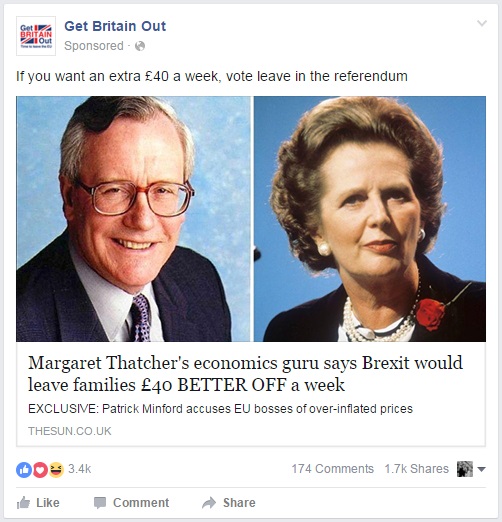
Get Britain Out - EU Referendum - Save 40 per week

With allies like Patrick Minford and Get Britain Out, who needs the Remain campaign?

The Sun reports:

Maggie Thatcher’s economics guru stormed into the referendum battle last night, claiming Brexit would cut living costs by £40 a week.

Professor Patrick Minford accused EU chiefs of imposing over-inflated prices on everything from food to cars.

And he calculated tearing down trade barriers after we leave will boost growth and bring consumer prices down by 8p in the Pound.

Prof Minford said: “Prices are 20 per cent higher inside the EU compared with world prices.

“The system is designed to keep prices up and consumers are paying for this.

“But if we pulled out, your average Sun on Sunday reader would be 40 quid a week better off.

Well, that’s sorted then. Punch a few numbers into the Minford Model and it turns out that £40 will magically materialise in our wallets the moment we achieve Brexit. Great! That will just about cover the cost of a bottle of Veuve Cliquot to toast the restoration of our democracy.

How long until Vote Leave use this “analysis” to knock up their own version of Britain Stronger in Europe’s risible calculator, which shows how terribly destitute we will all be if we are so rash as to spurn the European Union?

How long until either of the main campaigns treats the British electorate like intelligent adults?*


*rhetorical question


European Union - United Kingdom - Britain - Flags

Agree with this article? Violently disagree? Scroll down to leave a comment.

Follow Semi-Partisan Politics on TwitterFacebook and Medium.

If The Remain Campaign Succeed In Cheating Their Way To Victory, Their Joy Will Be Short Lived

EU Referendum - Divisive - Bitterness

There will be no kissing and making up on 24 June

Much like this blog, Pete North is angry at the conduct of this referendum campaign by the arrayed forces of Remain, and sees little point in hiding the fact:

We’ve had decades of their rule, decades of their orthodoxy and no means to challenge their political dominance. We’ve been watching and waiting for years. Watching as successive governments have ceded ever more power, ever more control and have insulated themselves from the wishes of the public. Well, now we’ve got our referendum. And now we see just how deeply the game is rigged.

So we’re angry to say the least. Angry at what has been done to us, done in our name, and angry that once again democracy is being trampled on to preserve the orthodoxy. And we do not take kindly to being lied to.

There’s an old saying that politics is between you, me and the swamp. Minorities on either side, playing games for the votes in the middle. But unlike classic politics, this is not a left vs right dispute. There are only those above the line and those below the line. Those who have the power and those who do not. In this estimation, the establishment holds all of the cards. It has always known a challenge to its legitimacy would one day come which is why it set out to bribe institutions in advance.

We Brexiteers on the other hand have what we have. An angry rabble with keyboards. And let’s face it, none of us are ever going on the front cover of Vogue. We’re a bunch of griping, moaning angry people who seem to hate just about everyone in politics and everything they do. We’re not helped by a pretty shoddy Leave campaign either, with some fairly odious spokesmen.

We are irredeemably spit. We all hate each other. I despise the Toryboys and I loathe Ukip. I hate all political tribalism. I’m not a joiner of clans. But there’s one thing that unites us all. All of us can articulate a better definition of democracy than any of those would would have us remain in the EU – and though we can’t seem to agree on coherent Brexit plan, we all know what democracy is, why we should have it and crucially why the EU is the absolute opposite of it.

And that’s why this referendum really settles nothing. The Remainers will play their little games, steal the referendum and carry on as before; feathering their own nests and consolidating their power. But we’re not going anywhere. We’re not giving up. And we are taking names. Us Brexiteers hold deep grudges. We are in it for the duration.

We will remember Cameron the fraud. We will remember Hague and Corbyn as turncoats. We will remember the frauds like Boris Johnson who used the cause for their own advancement. We will remember the parasites who had their fingers in the till. We will remember all those hacks and policy wonks who twisted the truth. We will not forget what was done here. And unlike 1975 – we have a full record of who said what. The internet never forgets.

And North’s blood-chilling conclusion:

In fact, we are going to be pure poison. If you thought the SNP were sore losers, you ain’t seen nothing. A remain vote will ensure domestic politics remains permanently toxic. While these part timers waft into to the Brexit debate with their tedious rhetoric about Brexiteers being little englanders and xenophobes, and venting their empty rhetoric of cooperation and internationalism, we have been here from the beginning. Will be here at the end.

You can stifle an idea, but you can’t kill one. Especially not that seemingly antiquated notion that the people should be able to refuse their government. The EU may be powerful but it is not stronger than the desire for democracy. And if it takes another generation to get what we want then that is what we will do. There is only one way this fight ends – Britain leaving the European Union. We will either do it amicably and by the book – or we will do it some other way. The general public may well go back into their political slumber, but we Brexiteers will be back – and in between, we are going to cause merry hell.

I should say that I agree with nearly everything in Pete’s piece – as always, his diagnosis of the flaws of the EU is spot-on, and his objections rooted not in shameless partisan positioning (like nearly every Remain supporter on the Left) but in a deep love and respect for democracy.

I can’t say that I look forward to the idea of being “pure poison”, or causing merry hell. But increasingly, I cannot see an alternative if, as is still likely, the Remain camp prevails on the back of a campaign based on sowing fear, uncertainty and doubt.

There are some political issues where I don’t get my way – in fact, as a libertarian / conservatarian living in Britain, it is pretty near all of them – where I am still happy to play the game according to the rules. I think personal taxes are too high, for example, as a result of decades of fiscal drag and Gordon Brown’s only partially-repealed spiteful hike. But I’m not going to take my toys and go home in protest, refusing to engage and participate in the democratic process because we don’t have a flatter tax system.

Likewise with the size of the state. This blog believes that government does far too much for far too many people – including many who are already self-sufficient and do not need government largesse, as well as many who could know self sufficiency if only they had the right short-term help and weren’t indefinitely coddled by the welfare state. But it is not the relatively unambitious and half-finished work of implementing Universal Credit which has enraged me against this supposedly conservative government.

On all manner of issues I’m happy to play for incremental progress, accept the victories as well as the losses for my side, and then move on to the next battle. But this is different. The European Union question is different.

The EU referendum is not about whether we want politics to be a little bit more left wing or a bit more right wing. It is not about tweaking tax policy, industrial policy, reforming benefits, or social issues. It is so much more fundamental than that, because whether or not Britain votes to remain in the EU says in a single gesture what kind of country we are, and what kind of country we want to be.

And the same thing applies at the personal level. I have never had a problem socialising and being friends with people from all across the political spectrum. Most of my social circle probably leans significantly to the Left, if anything, and while it leads to the occasional lively conversation there is always a full measure of respect. But – and I don’t take any great joy in writing this – I do not think I will be able to help thinking less of people who vote for Britain to remain in the EU.

Now, that doesn’t go for every Remain supporter. If I knew that someone is voting Remain because they truly believe in the European project, that they admit that political union is being brought about by stealth but that the ends justify the means, that they “feel” more European than British and want to forge a new combined European state, then I would profoundly disagree with them but I could respect that position. It is a positive (although distasteful to me) vision of Europe, and it is an honest one. I know several people who do take that position, and I am at my happiest when I am debating with them because I don’t feel like part of my soul is dying while I do it.

My problem is with those who either see supporting the European Union as some kind of necessary virtue-signalling act to be accepted in their social circle (oh, aren’t UKIP simply awful, darling?), and those who abrogate any notion of acting as an engaged and enlightened citizens with a responsibility to this country and to democracy, and so vote based solely on their wallets or other narrow personal interests. I will struggle to look upon such people in quite the same way after this referendum.

Maybe that is easy for me to say – I do not have a lot materially at stake in this referendum, financially or otherwise. My job is not dependent on EU funding, and the immediate interests of my family are not threatened by Brexit. All of these are mitigating factors – if my own salary and job security were directly or even indirectly contingent on staying in the EU, I concede that it would take a superhuman effort to overcome the instinct toward confirmation bias which would encourage me to seek out other facts and opinions supporting the Remain case.

But human beings are emotional creatures and the fact cannot be denied: I have a lot invested in this campaign, in terms of this blog and my other campaigning activities on the side. With such an early referendum and with the government doing everything short of stuffing ballot boxes with fake votes to assure a Remain vote, I remain pessimistic about our chances, though I fight to win. But if we lose, the behaviour and motivations of many of those agitating for Remain is such that I will be very angry for a very long time. And I will not be the only one.

(None of this should be taken as a Rebecca Roache-style, “unfriend all my Tory acquaintances on Facebook in a fit of moral grandstanding, virtue-signalling post-election leftist pique” piece of melodrama. But there will be a degree of real disappointment, if for no other reason than it will confirm that those who vote Remain and I clearly see the world in a profoundly, irreconcilably different way).

Britain should be ready for the wave of anger that is likely to break over our heads on 24 June. In the event of a Leave vote, expect a lot of short term hysterics from the virtue-signallers and special interests, most of which will die down once it becomes evident that Britain will be exiting to an EEA/EFTA holding position and maintaining single market access. But in the event of a Remain vote, given the underhanded way that the government has been fighting the referendum campaign, expect the SNP on steroids – a long, guerilla campaign of attrition directed against anyone and everyone who betrayed the Brexit cause.

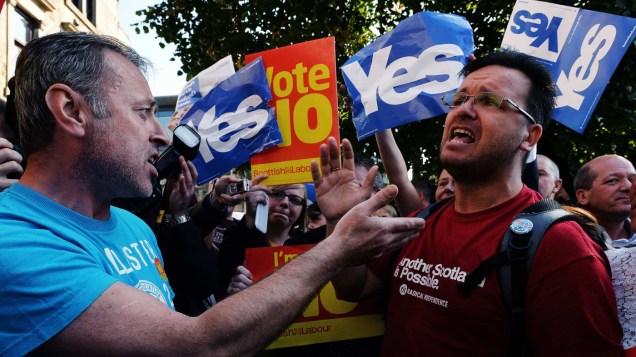
Chris Deerin painted a vivid and I believe accurate prediction of the future in a piece for CapX last year, comparing the likely fallout from the EU referendum to the aftermath of the 2014 Scottish independence referendum:

I have been bemused and fascinated by the number of English people telling me in recent weeks that “it won’t be like Scotland” – that this will be a more sedate affair, will inspire less passion, do less long-term damage. Well, perhaps. But, as we Scots say, ah hae ma doots.

What was most extraordinary about last year’s independence vote was the turnout: 84.5 per cent, the largest since the introduction of universal suffrage in the UK in 1918. Many of those voting were people who had never before even considered entering a polling station. What happened? There was certainly a long, noisy, impassioned campaign. There was global interest beyond anything we’d experienced before, but beyond this were two key factors that I believe drove this historic level of engagement.

The first was timing – the referendum came along after a decade in which every significant British institution had suffered either a scandal, a crisis of confidence or a loss of purpose, from Westminster to the media to the City to the military. The ties that bind had never been looser, respect for the status quo never lower.

Second, people were asked an existential question: who are you? This is not nothing. You will want to answer. You will want to answer on behalf of yourself and your family and your nation. Especially when you realise that the answer really matters – no safe seats to consider, no popular or unpopular incumbent MPs, no First Past The Post system ensuring only a few marginals get all the attention. Every individual counts. This is the big one, for keeps. So: in or out?

Deerin concludes:

Ultimately, we are about to ask the people of Britain an existential question: who are you? They will know that their voice counts this time, and that the consequences of the decision will be enormous and era-defining. They will think about themselves, their family and their country. They will get angry with the other side. Some very harsh words will be exchanged. Tempers will be lost and relationships fractured. And afterwards, whatever the outcome, the losers will be very sore, for a long time.

Not like Scotland? Don’t say you weren’t warned.

Like I say, I have no great desire to spend the next year walking around angry, holding nearly the entire political class in derision and many of my fellow citizens in open contempt. It does not warm my heart, in the same way that many left wing activists clearly revel in their anger and the righteousness of their cause, bleating about socialism and hating the Evil Tories.

But to my mind, there is a right way to vote in this referendum and a clearly, unambiguously wrong way to vote, and it is not hard to tell the difference between the two. The right way strikes a blow for democracy, self-determination and the normalcy of independence enjoyed by every single major country in the world outside Europe, while the wrong way would be to reward people who do not dare to advance their own positive argument for European political union, and so instead spend the bulk of their time pecking over the foibles, inconsistencies and other low-hanging fruit offered up by the hapless official Leave campaign.

In the event of defeat, then, the only question open to disappointed Brexiteers will be whether or not they use that anger and channel it toward some positive action to further the eurosceptic cause. This blog will do just that. Semi-Partisan Politics is in this for the long haul. Because as Pete North rightly says, you can stifle an idea like Brexit, but you cannot kill it.

I continue to fight this referendum campaign to win. But if we are fated to lose, I will not be going anywhere. If my generation is not to be the generation which restores democracy and self-governance to the United Kingdom then we can at least ensure that the flame of liberty is kept alive until it is time to try again – assuming that the doomed project does not implode under the weight of its own internal contradictions and the relentless pressure of global events, making the Brexit debate redundant.

And in the meantime, I and many others will make life as painfully difficult and unfulfilling as we can for all those in public life – particularly those in the Conservative Party – who come down on the wrong side of this referendum. That much I can promise.


European Union - United Kingdom - Britain - Flags

Top Image: CapX

Agree with this article? Violently disagree? Scroll down to leave a comment.

Follow Semi-Partisan Politics on TwitterFacebook and Medium.